63
Studies on Bilimbi
S. Chaitanya kumari
St. Pious X Degree & PG College, Secunderabad 500 094, Telangana, India
ABSTRACT
Bilimbi (Averrhoa bilimbi) is a multipurpose, drought resistant evergreen tree with various therapeutic potentials. It belongs to family Oxalidaceae. The plant has an enormous medicinal value since most of the parts like leaves, bark, flowers, fruits, seeds, roots or the whole part are used as alternative medicine to treat a variety of diseases. It is a good source of oxalic acid. The extract of various parts of Averrhoa bilimbi is medicinally used as a folk remedy for many symptoms so it necessary to know the disease causing pathogens of the plant as well as antimicrobial activity of leaf and fruit extracts against human pathogens. It has been examined and reviewed for making it popular in common household in Telangana state and elsewhere. Therefore in this paper it has been studied from microbiological view point and general significances have been highlighted. The material has been collected from Telangana and Maharastra states. However, the fruit, leaves microflora has been examined. It is a pest free tree. The fruit and leaf extract has good antimicrobial activity against Staphylococcus aureus. It’s culinary and pharmaceutical uses are reviewed to popularize this plant.
Keywords: antimicrobial activity, bilimbi, microbiology, oxalidaceae,.
1. INTRODUCTION
Medicinal plants have been used as traditional treatments for numerous human diseases for thousands of years and in many parts of the world. Hence, researchers have recently paid attention to safer phytomedicines and biologically active compounds isolated from plant species used in herbal medicines with acceptable therapeutic index for the development of novel drug.
The bilimbi (Averrhoa bilimbi L.) belongs to Oxalidaceae. It is closely allied to Averrhoa carombola which is commonly known as Starfruit. They differ from each other in appearance, manner of fruiting, size, flavour and uses. It is found in India, Malaysia, Jamaica, Cuba, Sri Lanka, Venuzela, Australia, Argentina, Mauritius, USA and other parts of the world. [1]
Bilimbi is an attractive, long lived perennial evergreen tree widely cultivated in the gardens and fields. It has a short trunk soon divides into a number of branches. The trunk is stout, Corky brown. The branches bear compound imparipinnate leaves mainly clustered at the apex alternate 10 to 25 inches (30 to 60 cms) long with 10 to 35 alternate or downy sub opposite leaf lets, ovate or oblong with rounded base and pointed tip, medium green on upper surface and pale on the lower surface 0.75 to 4 inches (2 to 10 cms) long and 0.5 to 1.2 inches (1.25 to 2.25 cms) wide[2,3].
Flowers are small, fragrant, 5 petalled, yellowish green or with dark purple borne in small, hairy panicles emerging directly from the trunk on oldest, thickest branches and some twigs as do the clusters of fruits. The fruits are ellipsoidal or nearly cylindrical, faintly 5 sided, 1.5 to 4 inches (4-10 cm) long , persistant five lobed calyx, five petals pinkish deciduous corolla. The fruit is crisp when unripe, turns bright green to yellowish- green, ivory or white when ripe and falls to the ground.[4,5] The outer skin is glossy, very thin soft tender, jelly like juicy and extremely acidic. Seeds 6-7 flattened disc like about 0.25 inches (4-6 mm) wide, smooth and brown.
Varieties
64 Climate
The Averrhoa bilimbi is a tropical plant. It is sensitive to cold climate. It can tolerate evenly distributed rainfall but there should be 2-3 months dry season. The tree grows slowly in shady or semi-shady situations. It needs full sun shine [6]. Bilimbi grows well in rich, moist, but well drained soil. It grows well on sand or lime stone soils.
Propagation
Bilimbi can be propagated by seeds. However this plant has not received any special horticultural attention, as it is allied to carambola which has received much cultural care and treatment which give good results .In future aspects its propagation by bonsai methods will be beneficial to rural and Urban areas in limited space. It also grown in home gardens due to attractive small purplish-red flowers. It is attractive to bees, butterflies or birds. In Telangana and Maharastra the trees begin to flower in the months of february and march and continue up to December. The fruits are hand picked.
Biochemical Characteristics
Bhaskar & shankaram (2013) and bhaurav etal (2014) have demonstrated Averrhoa bilimbi L. fruits are acidic mainly containing oxalic acid. PH was low containing crude proteins, lipids, fiber, ash, carbohydrates and energy value[7]. Further studies have revealed that bilimbi fruits contain N ,Na, K Ca, P, Mg, Fe, Cu, Zn, Mn and Se. The fruits are rich source of vitamin C,D, antioxidants and are low in fat. The food value of bilimbi per 100g of edible portion contain moisture, proteins, fiber, ash, carotene thiamine, riboflavin ,niacin and ascorbic acid . [8]
Medicinal Importance
Averrhoa bilimbi fruit conserve is administered as a treatment for coughs, beri-beri and biliousness. Syrup prepared from the fruit is taken as a cure for fever and inflammation and to stop rectal bleeding and alleviate internal hemorrhoids [9]
Leaves are applied as a paste on itches, swellings of mumps and rheumatism, and on skin eruption. They are applied on bites of poisonous creatures. Malaysians take the leaves fresh or fermented as a treatment for venereal disease[10] A leaf infusion is a remedy for coughs and is taken after childbirth as a tonic. A leaf decoction is taken to relieve rectal inflammation.
A flower infusion is said to be effective against coughs and thrush. In Java, the fruits combined with pepper are eaten to cause sweating when people are feeling "under the weather". Other uses include as stain remover and flowers are used in preparation of dye [11,12]
2. MATERIALS AND METHODS
Collection of Plant Materials
Fresh leaves and fruits of A. bilimbi were collected from Hyderabad and Maharastra in zip lock covers.
Preparation of Plant Extracts
Fresh leaves and fruits were thoroughly washed with tap water first and then with distilled water to remove debris and other contaminants. These thoroughly washed leaves and fruits were air dried. For extract preparation 15 gm of cut leaves and fruit pulp were boiled in 100 ml ultra pure water for 20 min and filtered through Whatman ’s filter paper No.1 after cooling. The filtered extracts were stored at 40C and used for further studies .
Assessment of Antimicrobial Activity
65 and allowed to diffuse at room temperature for 2 h. The plates were incubated at 370 C [13,14]. After the incubation period, the mean diameters of
the zones of inhibition around the wells were recorded. The experiments were conducted in triplicates along with control and the average values were recorded for antimicrobial activity [15].
3. RESULTS AND DISCUSSION
So far my studies on Bilimbi reveal that it is a pest-free plant except drosophila (fruit fly) which appear when the fruits are mature enough or almost ripe when they exude slimy juice, flies are attracted and the fruit start decaying. FIG- 1,2,3,4.
Fig: - 1,2,3,4- Leaves and fruits of A. bilimbi in Telangana and Maharastra states
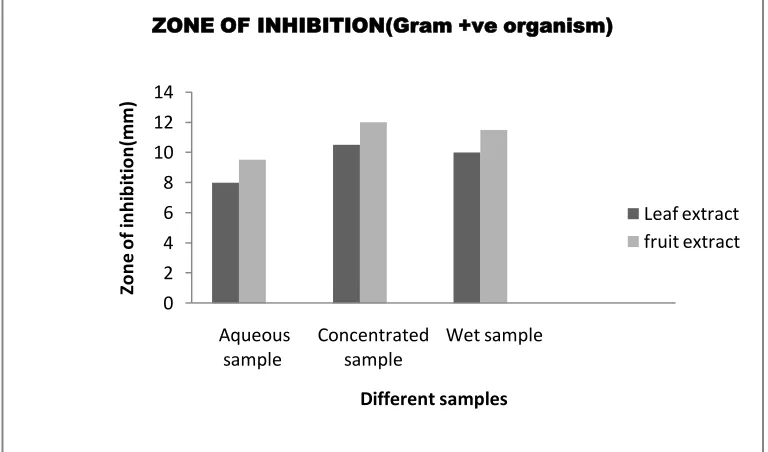
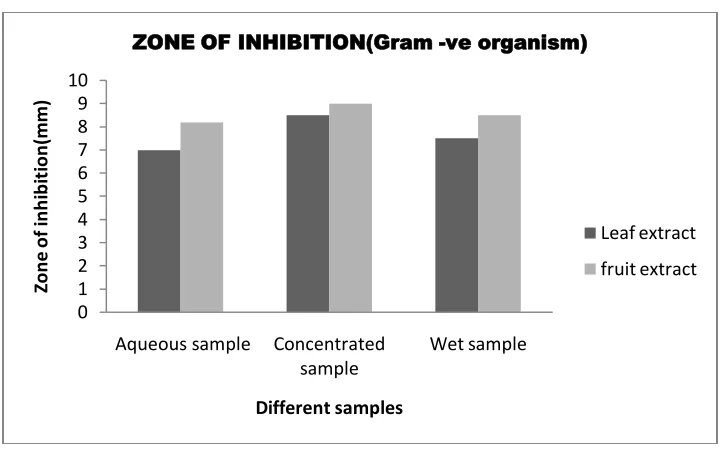
The effects of antimicrobial screening of different extracts of A. bilimbi have been shown in FIG 5 and 6 .The aqueous and wet extracts of both leaf and fruit showed moderate antibacterial activity. Among the extracts, concentrated extracts showed satisfactory inhibition against Gram-positive and Gram-negative bacteria selected i.e 10mm,12mm of zone of inhibition for leaf and fruit extract respectively against Gram-positive organism(S. aureus) and 8.5mm,9 mm of zone of inhibition for leaf and fruit extract respectively against Gram-negative organism(E. coli). The standard, cefadroxil exhibited significant zone of inhibition against the test organisms.
Fig 5: Graph Showing Zone Of Inhibition Of Leaf And Fruit Extract Against staphylococcus aureus
0 2 4 6 8 10 12 14
Aqueous sample
Concentrated sample
Wet sample
Zo
n
e
o
f
in
h
ib
it
io
n
(m
m)
Different samples
ZONE OF INHIBITION(Gram +ve organism)
66 Fig 6: Graph Showing Zone of Inhibition of Leaf and Fruit Extract against E. Coli
When the flowers are in full blossom cladosporium appear as small, greenish dusty particles. The pathological relation between the fungus and the host is not established. Probably the moist conditions encourage the incidence. The leaf spots light and dried have been observed due to infections by cercospora sp. Alternaria sp. colletotrichum sp. phyllosticate sp. not causing serious damage to the host plant. These pathogens have also been reported from China, Malaya, Srilanka and other places. Black powdery mass has been observed on rotting wood, injured, decaying plant matter containing Torula sp. and Trimmatostroma sp. which are non pathogenic therefore precautionary measures are not suggested. The fruit surface appears to be a sooty mold fungus. Pencillium sp. and Fusarium sp. were isolated from fruit and bark of Averrhoa bilimbi respectively.
CONCLUSION
In conclusion, the various extracts of A. bilimbi have potent actions as antibacterial agent. These finding provides an insight into the usage of the plant in traditional treatment associated with bacterial infection which could be of considerable interest to the development of new drugs through the isolation of active antibacterial components from the leaves and fruits of A. bilimbi. And also the presence of bioactive compounds among bilimbi makes it a potent herb for future research to combat drug resistance since it has commendable antimicrobial properties. However, more detailed investigations including clinical trials are essential.
ACKNOWLEDGMENT
Sincere thanks to the management of St. Pious X degree & pg college for encouraging to do research. Myself records the help rendered by “SUNRISE FOUNDATION “(to be registered) and its primary members Prof. Vasanth Rao (Rtd) and Dr. S. S. Kulkarni (Rtd) Hyderabad, Devrakhaha Philanthropist Mauritius and Dr. A. Srinivas Rao (Rtd) DEO Hyderabad for kind help and encouragement.
REFERENCES
[1]. Morton. J.1987. Bilimbi-p.128-129 In:fruits of warm climates. Julia F. Mortan . Miami, FL.
[2]. Orwa C, Mutua A, Kindt R, Jamnadass R, Anthony S. Agroforestree Database:a tree reference and selection guide version 4.0. 2009. [Last accessed on 2015 Jul 05]. Available from: http://www.worldagroforestry.org /treedb/AFTPDFS/Averrhoa_bilimbi.PDF .
[3]. De Lima VL, Mélo ED, Lima LD. Physicochemical characteristics of bilimbi (Averrhoa bilimbi L.) Rev Bras Frutic. 2001;23:421–3.
[4]. Lim TK. Edible Medicinal and Non-Medicinal Plants. Vol. 2. Springer Netherlands; 2012. pp. 867–78. [5]. Ganders FR. The biology of heterostyly. N Z J Bot. 1979;17:607–35.
0 1 2 3 4 5 6 7 8 9 10
Aqueous sample Concentrated sample
Wet sample
Zo
n
e
o
f
in
h
ib
it
io
n
(m
m
)
Different samples
ZONE OF INHIBITION(Gram -ve organism)
67
[6]. Ambili, Savithri, Appian, Subramaniam, Nagarajan, Natesan Shanmugam (2009). Studies on the antihyper lipidemic properties of Averrhoa for bilimbi fruit in Rats. Planta Med .Doi:10.1055/s-0028 1088361.
[7]. Bhaurav, T.Dangat, Amja A. Shinde,Depali, N.Jagtap,Varsharani R.Desai Pranchi B.Shinde & Rajaram V.Gurav 2014 Mineral analysis of Averrhoa Bilimbi L.- a potential fruit. Asian J. of Pharmaceutical & clinical Research 7(3):150-151. [8]. Bhaskar.B & ShankaramM .2013 Morphological and biochemical characters of Averrhoa fruits in 1JC BS
2013,3(3):924-928.
[9]. Goh S, Chuah C, Mok J, Soepadmo E. Malaysian Medicinal Plants for the Treatment of Cardiovascular Diseases. Malaysia: Pelanduk Publications; 1995. pp. 62–3.
[10]. Samuel AJ, Kalusalingam A, Chellappan DK, Gopinath R, Radhamani S, Husain HA, et al. Ethnomedical survey of plants used by the Orang Asli in Kampung Bawong, Perak, West Malaysia. J Ethnobiol Ethnomed. 2010;6:5. [PMC free article] [PubMed]
[11]. Ong HC, Nordiana M. Malay ethno-medico botany in Machang, Kelantan, Malaysia. Fitoterapia. 1999;70:502.
[12]. Alsarhan AN, Sultana N, Kadir MR, Aburjai T. Ethnopharmacological survey of medicinal plants in Malaysia, the Kangkar Pulai region. Int J Pharmacol. 2012;8:679–86.
[13]. Mackeen MM, Ali AM, El-Sharkawy SH, Manap MY, Salleh KM, Lajis NH, et al. Antimicrobial and cytotoxic properties of some Malaysian traditional vegetables (Ulam) Pharm Biol. 1997;35:174–8.
[14]. Zakaria ZA, Zaiton H, Henie EF, Jais AM, Zainuddin EN. In vitro antibacterial activity of Averrhoa bilimbi L. leaves and fruits extracts. Int J Trop Med. 2007;2:96–100.