MEMBRAIN NEURAL NETWORK FOR VISUAL PATTERN RECOGNITION
Artur Popko1, Marek Jakubowski2, Rafał Wawer3
1 Fundamentals of Technology Faculty, Lublin University of Technology, ul. Nadbystrzycka 38, 20-618 Lublin, Poland, e-mail: [email protected]
2 Management Faculty, Lublin University of Technology, ul. Nadbystrzycka 38, 20-618 Lublin, Poland, e-mail: [email protected]
3 University of Maria Curie Sklodowska, Multimedia Communications Lab. 20-011 Lublin ul. Narutowicza 12, Poland, e-mail: [email protected]
INTRODUCTION
Artificial Neural Networks (ANN) have been successfully employed in many applications of visual pattern recognition. Application areas in-clude system identification and control (vehicle control, process control, natural resources man-agement), quantum chemistry [1], game-playing and decision making (backgammon, chess, pok-er), pattern recognition (radar systems, face iden-tification, object recognition and more), sequence recognition (gesture, speech, handwritten text recognition), medical diagnosis, financial appli -cations (automated trading systems), data mining (or Knowledge Discovery in Databases – KDD), visualization and e-mail spam filtering.
ANN deals with recognition and classification of characters from an image, especially in Opti-cal Character Recognition. For the recognition to be accurate, certain topological and geometrical properties are calculated, based on which a char-acter is classified and recognized [2].
A given pattern, its recognition/classification may consist of one of the following two tasks:
1) supervised classification (e.g., discriminant analysis) in which the input pattern is identi-fied as a member of a predefined class, 2) unsupervised classification (e.g., clustering)
in which the pattern is assigned to a hitherto unknown class [3, 4].
MemBrain is a neural network editor and simulator supporting neural networks of arbitrary size and architecture [5].
MEMBRAIN ARTIFICIAL NEURON
NETWORK
The neuron and link model of MemBrain is very flexible: everything from simple time invari -ant Feed-Forward Networks to Nets with spiking neurons, arbitrary loopback connections and sig-nal runtime delays on the links can be simulated. It is even possible to connect directly the output of a neuron to its own input. In principle, every net in MemBrain is a valid net. Through the consequent object-oriented approach every neuron and also every link in MemBrain can have different prop-Research Journal
Volume 7, Issue 18, June 2013, pp. 54–59
DOI: 10.5604/20804075.1051257 Original Article
ABSTRACT
Recognition of visual patterns is one of significant applications of Artificial Neural Networks, which partially emulate human thinking in the domain of artificial intel
-ligence. In the paper, a simplified neural approach to recognition of visual patterns is
portrayed and discussed. This paper is dedicated for investigators in visual patterns
recognition, Artificial Neural Networking and related disciplines. The document de -scribes also MemBrain application environment as a powerful and easy to use neural networks’ editor and simulator supporting ANN.
Keywords: Neural Network, pattern recognition, neuron model. Received: 2013.04.24
Advances in Science and Technology – Research Journal vol. 7 (18) 2013
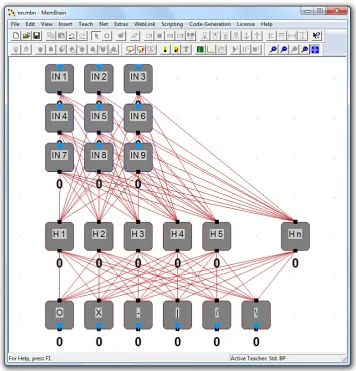
Fig. 1. Architecture of Artificial Neural Network erties. Links can have user-defined logical lengths,
so that real runtime behaviour can be simulated and visualized. The following learning algorithms are implemented in MemBrain. Supervised learn-ing: Standard Backpropagation (only forward links are trained), Standard Backpropagation with momentum (only forward links are trained), Backpropagation with support for loopback links, Backpropagation with support for loopback links and with momentum, RPROP (Resilient Back-propagation) with support for loopback links, Cascade Correlation with support for loopback links (using Backpropagation with momentum), Cascade Correlation with support for loopback links (using RPROP), Trial and Error with support for loopback links. Unsupervised learning: Win-ner Takes it All for SOMs (Self Organizing Maps) The aim of this paper was to determine and optimize the structure of neural network built to recognize six visual patterns (O, X, -, |, /, \). A required structure of Artificial Neural Network (Figure 1) was created in MemBrain application
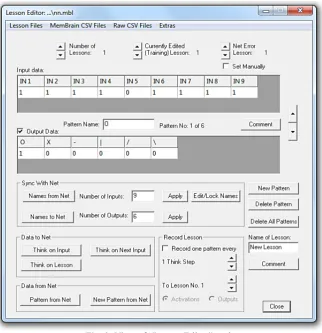
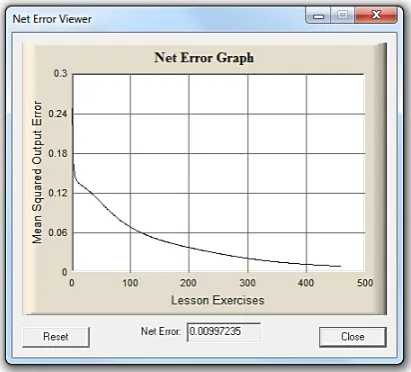
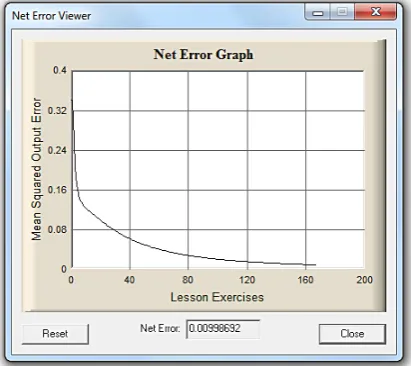
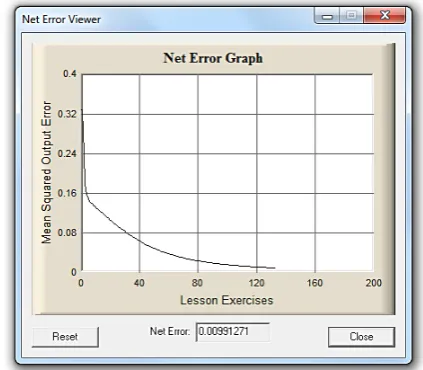
environment. Vectors of input and output data were generated with help of “lesson editor” tool (Figure 2). Asample of one pattern visualization was presented in Figure 3. Training algorithm - Standard Back Propagation was enabled and Tar-get Net Error was established for value equal 0.01 (Figure 4). In order to achieve proper results dur -ing teach-ing the net has to be randomized before undergoing the first teaching process. Randomiz -ing a net means that all the link weights and the neuron activation thresholds are initialized with small random values (unless the corresponding link or neuron properties are locked). The next stage of the research was to test the networks with the amount of 3–14 neurons in the hidden layer. The results are shown in Figures 5–16. Bet -ter result are obtained when the neural network requires less training.
Fig. 2. View of “Lesson Editor” tool
Advances in Science and Technology – Research Journal vol. 7 (18) 2013
Fig. 5. 3-hidden neurons ANN test results
Fig. 4. View of “Edit Teacher” tool
Fig. 6. 4-hidden neurons ANN test results
Fig. 7. 5-hidden neurons ANN test results
Fig. 8. 6-hidden neurons ANN test results
Fig. 9. 7-hidden neurons ANN test results
Fig. 10. 8-hidden neurons ANN test results
Fig. 11. 9-hidden neurons ANN test results
Fig. 12. 10-hidden neurons ANN test results
Fig. 13. 11-hidden neurons ANN test results
Advances in Science and Technology – Research Journal vol. 7 (18) 2013
The final resulting dependence of number of lesson exercises and number of neurons in hidden layer is shown in Figure 17.
CONCLUSIONS
Most effective architecture of tested ANN consist of 12 neurons in a hidden layer. The num-ber of lesson exercises in this case was smallest and was equal 119. The constructed and tested neural network recognizes visual patterns without errors. MemBrain is a powerful and easy to use neural network editor and simulator supporting neural networks of arbitrary size and architecture, it can be also very helpful in teaching in Artificial Neural Networks.
Fig. 15. 13-hidden neurons ANN test results Fig. 16. 14-hidden neurons ANN test results
Fig. 17. Dependence of the number of lesson exercises and neurons in hidden layer
REFERENCES
1. Balabin R.M., Lomakina E.I.: Neural network ap-proach to quantum-chemistry data: Accurate pre-diction of density functional theory energies. J. Chem. Phys., 131(7), 2009: 74-104.
2. Shrivastava V., Sharma N.: Artificial Neural Net -work Based Optical Character Recognition. Sig-nal & Image Processing. An InternatioSig-nal JourSig-nal (SIPIJ), 3(5), 2012.
3. Basu J. K., Bhattacharyya D., Kim T.: Use of
Ar-tificial Neural Network in Pattern Recognition. In -ternational Journal of Software Engineering and Its Applications, 4(2), 2010.
4. Dung L., Mizukawa M.: Designing a Pattern Rec-ognition Neural Network with a Reject Output and Many Sets of Weights and Biases. Pattern Recogni-tion Techniques, Technology and ApplicaRecogni-tions, 2008. 5. http://www.membrain-nn.de/english/details_