University of Kentucky University of Kentucky
UKnowledge
UKnowledge
Theses and Dissertations--Business
Administration Business Administration
2015
WHY SUPPLIER DEVELOPMENT WORKS? A
WHY SUPPLIER DEVELOPMENT WORKS? A
KNOWLEDGE-MANAGEMENT PERSPECTIVE
MANAGEMENT PERSPECTIVE
Liang Chen
University of Kentucky, [email protected]
Right click to open a feedback form in a new tab to let us know how this document benefits you. Right click to open a feedback form in a new tab to let us know how this document benefits you.
Recommended Citation Recommended Citation
Chen, Liang, "WHY SUPPLIER DEVELOPMENT WORKS? A KNOWLEDGE-MANAGEMENT PERSPECTIVE" (2015). Theses and Dissertations--Business Administration. 5.
https://uknowledge.uky.edu/busadmin_etds/5
This Doctoral Dissertation is brought to you for free and open access by the Business Administration at UKnowledge. It has been accepted for inclusion in Theses and Dissertations--Business Administration by an authorized
STUDENT AGREEMENT: STUDENT AGREEMENT:
I represent that my thesis or dissertation and abstract are my original work. Proper attribution has been given to all outside sources. I understand that I am solely responsible for obtaining any needed copyright permissions. I have obtained needed written permission statement(s) from the owner(s) of each third-party copyrighted matter to be included in my work, allowing electronic distribution (if such use is not permitted by the fair use doctrine) which will be submitted to UKnowledge as Additional File.
I hereby grant to The University of Kentucky and its agents the irrevocable, non-exclusive, and royalty-free license to archive and make accessible my work in whole or in part in all forms of media, now or hereafter known. I agree that the document mentioned above may be made available immediately for worldwide access unless an embargo applies.
I retain all other ownership rights to the copyright of my work. I also retain the right to use in future works (such as articles or books) all or part of my work. I understand that I am free to register the copyright to my work.
REVIEW, APPROVAL AND ACCEPTANCE REVIEW, APPROVAL AND ACCEPTANCE
The document mentioned above has been reviewed and accepted by the student’s advisor, on behalf of the advisory committee, and by the Director of Graduate Studies (DGS), on behalf of the program; we verify that this is the final, approved version of the student’s thesis including all changes required by the advisory committee. The undersigned agree to abide by the statements above.
WHY SUPPLIER DEVELOPMENT WORKS? A KNOWLEDGE-MANAGEMENT PERSPECTIVE
______________________________________
DISSERTATION
______________________________________
A dissertation submitted in partial fulfillment of the requirements for the degree of Doctor of Philosophy in the
College of Business and Economics at the University of Kentucky
By
Liang Chen
Lexington, Kentucky
Co-Directors: Dr. Clyde W. Holsapple, Professor of Decision Science & Information Systems and Dr. Scott Ellis, Assistant Professor of Supply Chain Management
Lexington KY
2015
ABSTRACT OF DISSERTATION
WHY SUPPLIER DEVELOPMENT WORKS? A KNOWLEDGE-MANAGEMENT PERSPECTIVE
Supplier development (SD) has been intensively and increasingly used in practice and studied in academia. Many studies find that SD can generate operational, capability-based, attitudinal, and financial performance measures for both the supplying firm (supplier) and the buying firm (buyer), but very few studies systematically explain why SD yields supplier’s performance improvements and, in turn, buyer’s performance improvements. Using a meta-analysis approach, this dissertation finds that SD does lead to positive outcomes, but SD is found to have very weak or even negative relationship with performance improvements in some cases. Such findings further support the importance of examining the main research question: why SD works.
In order to answer the main research question, this dissertation adopts a multiphase triangulation approach: theoretical construction, conceptual examination, and empirical examination. Doing so, this dissertation constructs and validates a knowledge management (KM) view of SD.
The purpose of theoretical construction (Chapter 3) is to develop a KM view of supplier development via a systematic view of previous studies. Presented in Chapter 4, conceptual examination reveals that all SD activities can be subsumed into KM activities, and further conceptually supports the feasibility of the KM view in SD. Empirical examination, including a survey of 39 SD scholars and a survey of 295 SD practitioners (156 complete responses), is presented in Chapters 5 and 6. Most hypotheses are strongly supported, demonstrating the importance of the knowledge-management view of SD.
Third, it contributes by offering a catalog of SD activities and guidance for designing, implementation, and evaluation of SD initiatives. Fourth, it contributes by advancing a mental model to understand SD literature. Conclusions, limitations, and future research directions are also discussed.
KEYWORDS: Knowledge Chain, Knowledge Management, Knowledge Sharing, Supplier Development, Supply Chain Management
Liang Chen Student’s Signature
WHY SUPPLIER DEVELOPMENT WORKS? A KNOWLEDGE-MANAGEMENT PERSPECTIVE
By
Liang Chen
Dr. Clyde W. Holsapple Co-Director of Dissertation
Dr. Scott Ellis Co-Director of Dissertation
Dr. Kenneth R. Troske Director of Graduate Studies
iii
ACKNOWLEDGMENTS
I firmly believe that God has guided and supported me to complete this
dissertation. With His sufficient provision, I have not only obtained courage and wisdom
when I am afraid and struggling, but also gained dedicated support, love, prayer, and help
from many people, including my academic and spiritual mentors, family members,
friends, brothers and sisters in my church, and many others. I give them my sincere
thanks from the bottom of my heart.
First of all, my sincere thanks go to my advisors Dr. Clyde W. Holsapple and Dr.
Scott Ellis. Since I joined in the PhD program at the University of Kentucky in 2010, I
have been greatly influenced by their excellent research and teaching and wonderful
mentorship and love to doctoral students. I am very grateful to have both of them as my
advisors. Each time I am deeply touched by reading their constructive comments to my
writing: they are reputable and busy, but they still spend their precious time on students. I
would like to thank my committee members, Dr. Chen Chung, Dr. Anita Lee-Post, and
Dr. Peggy Keller, and outside examiner Dr Yoonbai Kim for their continuous
commitment and insightful and constructive comments.
Second, I am very thankful for my spiritual mentor, brothers and sisters in LCCC,
and coworkers in CSSF. With their dedicated prayer, practical support, and real love in
Christ, I have conquered many difficulties during my data collection and writing. Third, I
want to thank my parents, parents-in-law, sisters, and many other family members for
iv
Furthermore, I really appreciate the support from many supplier development
scholars and practitioners during my data collection. It is a tough job to collect sufficient
and valid responses using survey, but their support makes this job much more enjoyable
and hopeful. My appreciation goes to Dr. George A. Zsidisin, Dr. Chidambaranathan
Subramanian, Mr. Claudia Rebolledo, Dr. Elsebeth Holmen, Dr. Canan
Kocabasoglu-Hillmer, Dr. Ying Liao, Dr. Manoj Kumar Mohanty, Dr. Paul Ghijsen, Dr. Fred Raafat,
Dr. Stephan M. Wagner, Dr. Pilar Ester Arroyo López, and many other anonymous
scholars for their kind participation in this study and valuable comments and suggestions.
My sincere thanks also go to Mr. Russ Smith, Mr. John Singleton, Mr. William E.
Sullins, Mr. Rick Luellen, Mr. Thomas Alexander Dunlap, Mr. Rick Marcil, Mr. Don
Johnson, and other anonymous consultants. In addition, I also owes thanks to hundreds of
supplier development practitioners in the United States and Canada who contributed to
my research participating in my survey and even talking with me.
Finally, I am greatly blessed to have a beloved wife, Ling Jiang, and two
wonderful children Joy and Andrew Chen. I want to express my deepest gratitude to you
because you three make my life more colorful, interesting, blessed, and enjoyable. I love
v
TABLE OF CONTENTS
ACKNOWLEDGMENTS ... iii
LIST OF TABLES ... viii
LIST OF FIGURES ... x
CHAPTER 1 INTRODUCTION ... 1
1.1 General Definitions and Research Scope ... 1
1.2 The Importance of Supplier Development ... 3
1.3 Research Questions and Methods ... 4
1.4 Contributions ... 7
1.5 Structure of This Dissertation ... 9
CHAPTER 2 A COMPARATIVE EXAMINATION OF SUPPLIER DEVELOPMENT RESEARCH ... 11
2.1 The History of Supplier Development ... 11
2.2 Definitions of Supplier Development ... 13
2.3 Implementation Approaches of Supplier Development ... 16
2.4 Taxonomies of Supplier Development Activities ... 18
2.5 Measurements of Supplier Development ... 22
2.6 Supplier Development Episode ... 24
2.7 Does Supplier Development Work: A Meta-Analysis ... 26
2.7.1 Research Approach... 27
2.7.2 Brief Findings ... 29
CHAPTER 3 HYPOTHESES DEVELOPMENT ... 31
3.1 “Black Box” ... 31
3.1.1 The Direct-Impact paradigm ... 31
3.1.2 The Knowledge-Sharing Paradigm... 33
3.2 Knowledge Management in Supplier Development ... 35
3.2.1 Knowledge and Knowledge Management ... 35
3.2.2 Knowledge Chain Theory ... 36
3.2.3 Knowledge Management and Supplier Development ... 41
3.3 Key Variables from Existing Theories ... 43
vi
3.3.2 Supplier Dependence ... 44
3.3.3 Relational Capital ... 45
3.3.4 SD Motivation ... 46
3.3.5 Goal Congruence ... 47
3.4 Research Hypotheses... 48
CHAPTER 4 CONCEPTUAL EXAMINATION ... 50
4.1 Five-step Research Method ... 50
4.2 Research Results ... 54
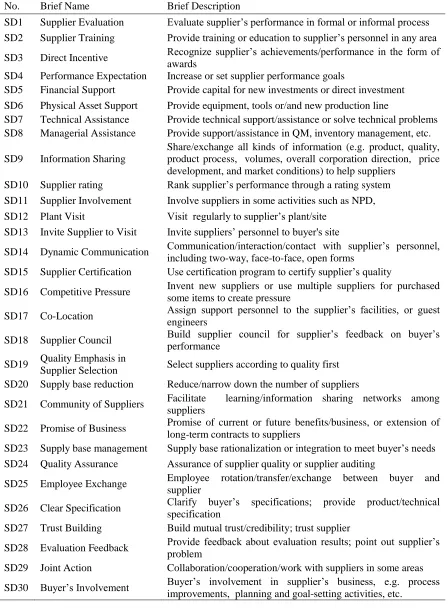
4.2.1 An Overview of Supplier Development Activities ... 54
4.2.2 First-Order KM Activities in Supplier Development ... 56
4.2.3 Second-order KM Activities in Supplier Development ... 62
4.2.4 Co-occurrence Analysis ... 65
4.3 Implications ... 68
4.3.1 Contributions ... 68
4.3.2 Future Research ... 74
CHAPTER 5 DATA COLLECTION ... 76
5.1 Data Collection from SD Scholars ... 76
5.1.1 Data Collection Purpose... 76
5.1.2 Data Collection Process ... 76
5.1.3 Brief Findings ... 78
5.2 Data Collection from SD Practitioners... 81
5.2.1 Survey Design ... 81
5.2.2 Survey Instrument ... 82
5.2.3 Sample Identification ... 84
5.2.4 Survey Distribution Process ... 85
5.2.5 Respondents and Organization Background ... 88
CHAPTER 6 MAIN FINDINGS ... 93
6.1 Survey Bias Checking ... 93
6.1.1 Non-response Bias ... 93
6.1.2 Common Method Variance ... 94
vii
6.2 Reliability & Validity of Scales ... 96
6.3 Measurement Models of Knowledge Management ... 100
6.4 Justification of Linear Regression Assumptions ... 103
6.5 Hypotheses Testing ... 105
6.5.1 Dependent Variable: Supplier Performance ... 106
6.5.2 Dependent Variable: Buyer Performance Improvements ... 108
CHAPTER 7 CONCLUSIONS & DISCUSSIONS ... 110
7.1 Conclusions ... 110
7.2 Limitations ... 111
7.3 Future Research ... 113
7.3.1 Future Research Driven by Study Limitations ... 113
7.3.2 Future Research Driven by Study Results ... 115
7.4 Contributions ... 117
7.4.1 Theoretical Contributions ... 117
7.4.2 Practical Contributions ... 119
APPENDICES ... 123
Appendix I: Large-Scale Survey-Based Supplier Development Studies ... 123
Appendix II: Examples of 30 Types of Supplier Development in Extant Studies ... 131
Appendix III: Cover Letter & Survey to SD Scholars ... 134
Appendix IV Definition and Measurement of Multi-Item Variables ... 137
Appendix V: Cover Letter & Survey to SD Practitioners ... 139
Appendix VI Descriptive Statistics of Items ... 144
REFERENCES ... 146
viii
LIST OF TABLES
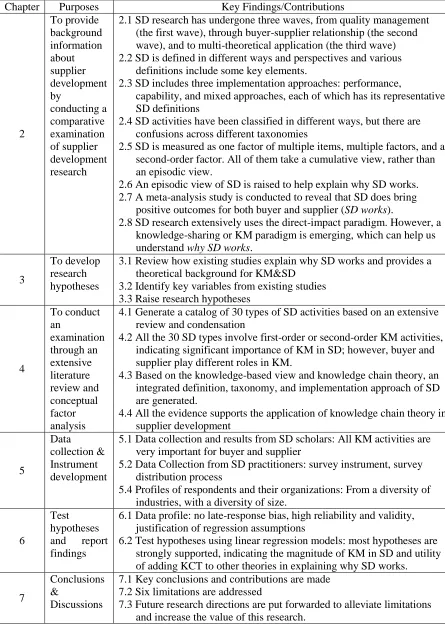
Table 1-1: Key Findings/Contributions for Each Remaining Chapter ... 10
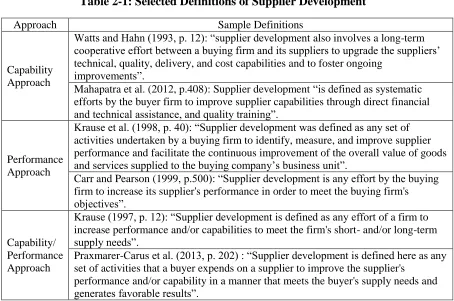
Table 2-1: Selected Definitions of Supplier Development ... 17
Table 2-2: A Review of Supplier Development Taxonomies ... 19
Table 2-3: A Review of Supplier Development Measurement ... 23
Table 2-4: Supplier Development Coding in Meta-Analysis ... 26
Table 2-5: Literature Search Procedure Meta-Analysis ... 28
Table 2-6: Weighted Effect Size between Supplier Development and Operational Performance ... 30
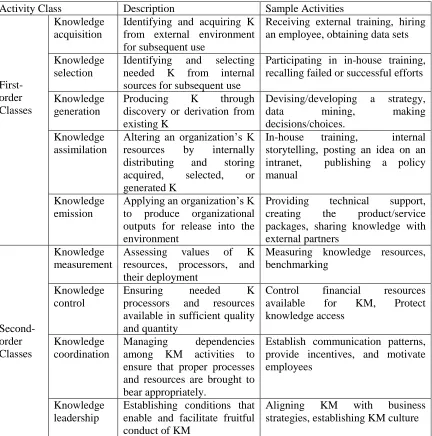
Table 3-1: A Brief Description of First- and Second-order KM Activities ... 38
Table 4-1: Catalog of Supplier Development Activity Types ... 55
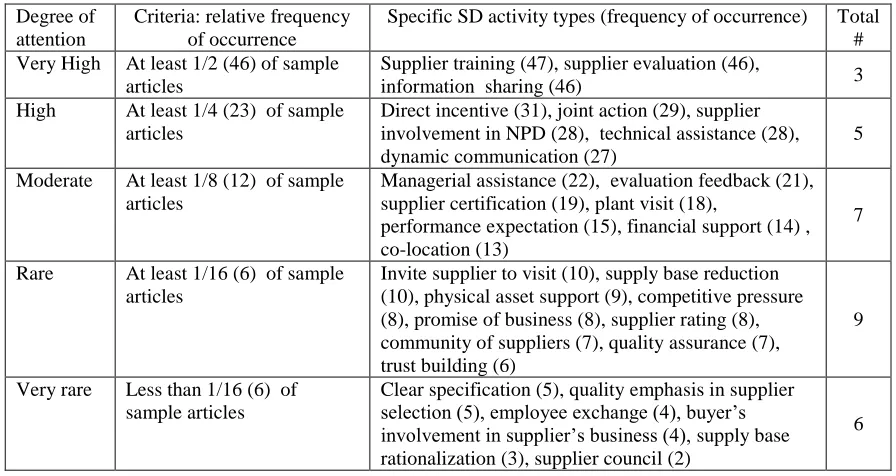
Table 4-2: Attention Given to the Thirty SD Activity Types ... 56
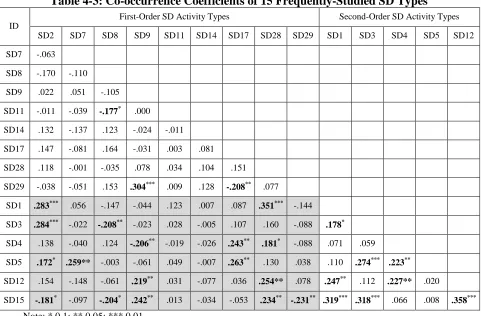
Table 4-3: Co-occurrence Coefficients of 15 Frequently-Studied SD Types ... 66
Table 4-4: Comparisons of Three SD Approaches ... 72
Table 5-1: To What Degree to KM Activities Should Be Conducted in SD ... 79
Table 5-2: Exploratory Factor Analysis of Responses from SD Scholars ... 80
Table 5-3: Constructs/Variables: Theory and Their Source ... 84
Table 5-4: Data Collection and Response Rate ... 87
Table 5-5: Survey Completion Progress ... 87
Table 5-6: Titles of Respondents ... 89
Table 5-7: Knowledge & Working Years of Respondents ... 89
Table 5-8: Industries of Respondents’ Organizations ... 90
Table 5-9: Size of Respondents’ Organizations ... 91
Table 6-1: EFA for Variables in Section II of the Survey ... 97
Table 6-2: EFA for Variables in Section III of the Survey ... 98
Table 6-3: Correlations and Descriptive Statistics for the Model of Supplier Performance Improvement ... 99
Table 6-4: Correlations and Descriptive Statistics for the Model of Buyer Performance Improvement ... 99
ix
Table 6-6: Standardized Factor Loadings and Goodness-of-Fit Indices of Second-order
Factor Models ... 102
Table 6-7: Models with Single Theories (Supplier Performance) ... 106
Table 6-8: Models with Combined Theories (Supplier Performance) ... 107
Table 6-9: Regression Analysis for Buyer Performance ... 109
Table 6-10: A Summary of Hypotheses Testing... 109
x
LIST OF FIGURES
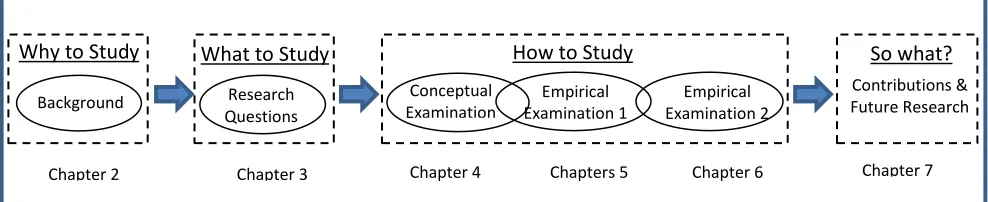
Figure 1-1: Structure of Remaining Chapters ... 9
Figure 2-1: The "What" Dimension of SD Definition ... 15
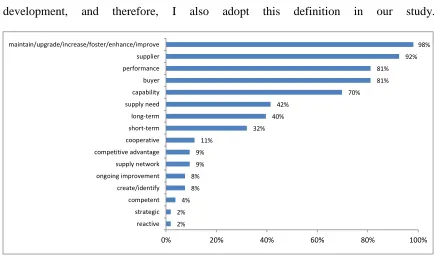
Figure 2-2: The Most Frequently-used Key Words in SD Definitions ... 16
Figure 2-3: An episodic View of Supplier Development ... 25
Figure 3-1: The Direct-impact Paradigm ... 32
Figure 3-2: The Knowledge-sharing Paradigm ... 33
1
CHAPTER 1INTRODUCTION
1.1General Definitions and Research Scope
An industrial market includes at least two critical roles: buyer and supplier. Broadly
speaking, buyer (i.e., buying organization) refers to an entity purchasing resources for
value-added purpose from the market; whereas, supplier (i.e., supplying organization)
refers to an entity selling its product in the market for value-realization purpose.
Buyer-supplier dyads represent fundamental unit of a typical supply chain, which refers to “all
those activities associated with the transformation and flow of goods and services,
including their attendant information flows, from the sources of raw materials to end
users” (Ballou et al., 2000, p. 9). Within a supply chain, buyer-supplier dyads involve
buyer-supplier relationships supporting information flow and business transactions.
Therefore, in nature, “supply chain management is about relationship management”
(Lambert, 2008, p. 6).
Although supply chains could be examined from both buyer’s perspective and
supplier’s perspective, for the sake of research convenience, the buyer is typically chosen
as the focal company in the discipline of supply chain management. Accordingly, its
upstream parties include tier 1 suppliers, tier 2 suppliers, and tier 3 to initial suppliers and
its downstream parties include tier 1 customers, tier 2 customers, and tier 3 to end users.
For the buyer (focal company), it is overwhelming to manage all suppliers. This study
focuses on the tier 1 suppliers of a buyer because of their important and close relationship
with the buyer. Additionally, a buyer purchases both direct martials (i.e., core materials
used to manufacture finished products) and indirect materials (i.e., materials used to
2
may be provided by different suppliers. This dissertation focuses on suppliers of direct
materials. In summary, supplier in this study is defined as the organization which directly
(i.e., tier 1) provides the focal organization (i.e., buyer) with direct materials.
In order to make its supply chain work, a buyer has to create and maintain a network
of competent suppliers (Watts & Hahn, 1993)1. A “competent” supplier must demonstrate
both performance and capability to meet the buyer’s supply needs. Supplier performance
refers to a supplier’s demonstrated ability to meet the buyer’s supply requirements, and
supplier capability denotes a supplier’s potential that can be leveraged to the buyer’s
advantage in the long run (Sarkar and Mohapatra, 2006; Prajogo et al., 2012). If a
supplier cannot meet the buyer’s supply needs, a buyer might either switch to another
supplier or develop this incompetent supplier. This study focuses on the second approach,
that is, supplier development. Broadly speaking, supplier development in this study refers
to any organizational efforts initiated by the buyer to improve an existing supplier’s
performance and/or capability to meet the buyer’s supply needs.
This dissertation aims at providing a convincing framework to answer why supplier
development (SD) leads to buyer/supplier performance improvements through modeling
SD as a knowledge management system. Knowledge has been identified as the most
strategically-significant resource of an organization (Grant, 1996a, b). One important
purpose of an organization is to managing its knowledge resources to create or add value
to the organization and its environment. Knowledge management represents
organizational efforts to expand, cultivate, and apply available knowledge resources by
knowledge processors via knowledge processes (Holsapple and Joshi, 2004).
1
3
1.2The Importance of Supplier Development
In the supply chain management (SCM) area, SD has been identified as an important
topic. After summarizing more than 774 articles published in Journal of Supply Chain
Management during its first 35 years (from 1965 to 2000), Carter and Ellram (2003) find
that SD is one of the fifteen important topics in SCM research. More recently, Giunipero
et al. (2008) review 405 articles published in nine leading academic journals from 1997
to 2006 and demonstrate that SD is one of the thirteen key SCM research topics.
Extant research has identified many activities that fall under the umbrella of SD
ranging from low-risk initiatives such as supplier evaluation, to high-risk initiatives like
supplier-specific investments (Krause and Scannell 2002). SD has broad implications,
involving many functional areas in addition to purchasing and significantly affecting
overall organizational performance (Hahn et al., 1990).
Scannell et al. (2000) refer to SD as one of the three important improvement
programs associated with supply chain management and argue that SD can “improve a
firm’s competitive positions through lowering costs, increasing quality, and flexibility,
improving technology, and reducing cycle times” (p. 26). Accordingly, SD has been
intensively initiated in many notable companies, including Toyota (Dyer & Hatch, 2006;
Dyer & Nobeoka, 2000; Sako, 1999; Langfield-Smith & Greenwood, 1998; Marksberry,
2012), Italtel (Colombo & Mariotti, 1998), Honda (MacDuffie & Helper, 1997), and
Kodak (Ellram & Edis, 1996).
In addition, empirical studies have supported that SD activities improve the
performance of both buyer and supplier, including the following dimensions: productivity
4
2007), innovation (e.g. McGovern & Hicks, 2006; Wagner, 2006a), reputation (e.g. Chen
& Paulraj, 2004; Dyer and Hatch, 2006), satisfaction (e.g. De Clercq & Rangarajan,
2008; Ghijsen et al.; 2010), and financial improvement (e.g. Kim, 2006;
Sanchez-Rodriguez & Hemsworth, 2005). These results underscore the value of supplier
development activities, which occur at every stage in the supply chain.
However, little research systematically explains why SD leads to supplier’s
performance improvement and, in turn, buyer’s performance improvement. Therefore,
the value-creation process of SD is still a black box. Without a good understanding of this
process, I cannot provide a convincing explanation of why SD activities generate various
performance measures, and thus offer a feasible guidance on matching SD activities with
performance measures.
1.3Research Questions and Methods
The main research question in this dissertation is:
Why does supplier development lead to positive outcomes in terms of buyer and
supplier performance improvements?
This research question can be called why SD works for short. Positive outcomes of
SD can be influenced by two groups of factors: environmental factors which measure the
external environment in which SD is implemented, such as company resources, firm size,
asset specificity, and industry, and component factors which describe elements or
activities involved in a SD program, such as knowledge sharing and supplier evaluation.
However, the first group of factors varies greatly across firms, and cannot be controlled
5
make SD lead to positive outcomes. Before answering the main question, one prerequisite
question should be answered:
Does supplier development lead to positive outcomes in terms of buyer and supplier
performance improvements?
In order to answer the prerequisite research question, this dissertation first
comprehensively reviews existing studies and then synthetizes those studies using a
meta-analysis approach. The main reason is that many existing studies have examined the
relationship between SD and buyer/supplier performance improvements. The
meta-analysis results demonstrate that SD has a medium weighted effect size on buyer/supplier
performance improvements, even though correlations between SD and buyer/supplier
performance improvements range from -0.365 to 0.900. These results further highlight
the importance of answering the main research question.
Existing studies have identified a list of variables to explain why SD works, but they
do not uncover the inside (i.e., elements) of SD. This dissertation leverages a
knowledge-management perspective and introduces knowledge knowledge-management (KM) factors, which
adopted from Knowledge Chain Theory (Holsapple & Singh, 2001). As a value-creation
process theory, KCT can capture what occur in a SD program (the inside of SD), and thus
can be combined with other theories to explain why SD works. Consideration of these
KM factors can increase the chance to explain why SD works if they are considered as
useful indigents of an SD program. The main research question can be divided into the
following two sub-questions
Can SD be modeled as a knowledge management system?
6
In order to answer the two sub-questions above, this dissertation adopts a multiphase
triangulation approach, which includes three steps: theoretical construction, conceptual
examination, and empirical examination. Each of the three steps is described as below:
1) Theoretical Construction
The purpose of theoretical construction is to develop a knowledge-management
view of supplier development. Chapter 3 reviews how previous studies explain
this question and summarizes two research paradigms. Such a review not only
facilitates opening the black box of why SD works, but also sheds light on the use
of knowledge management (in particular, knowledge chain theory) in supplier
development. In order to develop a KM perspective of supplier development, this
dissertation then reviews knowledge, knowledge management, knowledge chain
theory, and the relationship between knowledge management and supplier
development. These reviews provide a theoretical foundation for developing
testable hypotheses of this study.
2) Conceptual Examination
Presented in Chapter 4, the purpose of conceptual examination is to investigate
whether SD can be modeled as a knowledge management system. First, various
SD activities are identified and collected from previous empirical studies focusing
on supplier development and then further condensed into 30 distinct SD types,
generating an extensive catalog of SD activities. Second, each SD type is
examined to see whether it is matched with any KM activity identified from the
7
knowledge management activities. Such a finding conceptually supports the
feasibility of knowledge-management view in supplier development.
3) Empirical Examination
The purpose of empirical examination is to examine whether SD performance is
better explained when SD is modeled as a knowledge management system.
Empirical examination includes a survey of SD scholars, structured interviews
with SD practitioners, and a survey of SD practitioners, all of which are presented
in Chapters 5 and 6. First, a pre-survey structure interview is conducted to
examine whether the KM perspective can applied to the actual SD
implementation, which further check the feasibility of knowledge-management
view in supplier development. Then, a survey about the role of knowledge
management and knowledge sharing in supplier development is sent to SD
scholars. Their responses further support feasibility of knowledge-management
view in supplier development and validate the instrument of the knowledge
management constructs. Finally, a survey of SD practitioners is used to test
hypotheses which are raised during the theoretical construction process. Those
results can demonstrate the utility of knowledge-management view of supplier
development.
Doing so, this dissertation constructs and validates a knowledge-management view of
SD and provides a useful framework to answer the question of why SD works
1.4Contributions
The answer to the research question is very valuable for researchers, practitioners, and
value-8
creation process of SD. Even though many environmental factors such as company
resources, firm size, asset specificity, and industry may contribute to predicting positive
outcomes of supplier development, they are out of the “box”. Some other elements such
as knowledge sharing may be considered as one value-creation process, but this study
argues and finds that knowledge management is at least one of the key elements which
can explain why SD works.
By opening the black box, this study serves as a trigger for future research avenues
and subsequent research programs. First, armed with a better understanding of
value-creation process of SD, researchers can solve contradictory observations from existing
studies. For instance, extant studies fail to explain why the combination of different types
of SDAs generates lower performance than implementing each individually. Using a
survey-approach, Wagner (2010) finds that the combined effect of indirect and direct
SDAs results in lower levels of supply chain performance such as supplier’s product and
delivery performance and capabilities. However, some case studies find that some
well-known firms such as Toyota can achieve superior performance through combing both
types of supplier development (Dyer & Hatch, 2006; Dyer & Nobeoka, 2000; Sako,
1999; Langfield-Smith & Greenwood, 1998).
Moreover, this study contributes to managerial practice by showing why SD works
and providing practitioners with a realistic framework for conducting SD activities
effectively. Managers cannot mistakenly assume that SD outcomes are guaranteed as
long as they initiate it. Currently, many firms do not realize the expected benefits from
SD initiatives (Mohanty et al., 2014). One of the main reasons is that they lack a
9
review of SD and framework, it is of value to them concerned with organizing coverage
of SD in course plans.
1.5Structure of This Dissertation
In order to provide an extensive background of SD, the next chapter first reviews the
history, definition, classification and measurement of SD and then examines the
prerequisite question using a meta-analysis approach and reviews the paradigms which
are used to build the link between SD and its outcomes. Following, Chapter 3 states
research question, describes research roadmap, and develop hypotheses. The next three
chapters report results. Chapter 4 develops an extensive catalog of SD activities based on
a systematic review and classification of SD activities identified from previous studies
and establishes a conceptual link between SD and knowledge management activities.
Chapter 5 reports findings derived from a survey of scholars and presents survey
instruments for SD practitioners and sample profiles. Chapter 6 reports results from a
survey of SD practitioners. Chapter 7 triangulates all these findings and makes final
conclusions, and then discusses limitations, future research directions, and contributions.
Figure 1-1: Structure of Remaining Chapters
Why to Study What to Study How to Study So what?
Conceptual Examination
Empirical Examination 1
Empirical Examination 2 Research
Questions
Background Future Research Contributions &
10
Table 1-1: Key Findings/Contributions for Each Remaining Chapter
Chapter Purposes Key Findings/Contributions
2
To provide background information about supplier development by
conducting a comparative examination of supplier development research
2.1 SD research has undergone three waves, from quality management (the first wave), through buyer-supplier relationship (the second wave), and to multi-theoretical application (the third wave) 2.2 SD is defined in different ways and perspectives and various
definitions include some key elements.
2.3 SD includes three implementation approaches: performance,
capability, and mixed approaches, each of which has its representative SD definitions
2.4 SD activities have been classified in different ways, but there are confusions across different taxonomies
2.5 SD is measured as one factor of multiple items, multiple factors, and a second-order factor. All of them take a cumulative view, rather than an episodic view.
2.6 An episodic view of SD is raised to help explain why SD works. 2.7 A meta-analysis study is conducted to reveal that SD does bring
positive outcomes for both buyer and supplier (SD works).
2.8 SD research extensively uses the direct-impact paradigm. However, a knowledge-sharing or KM paradigm is emerging, which can help us understand why SD works.
3
To develop research hypotheses
3.1 Review how existing studies explain why SD works and provides a theoretical background for KM&SD
3.2 Identify key variables from existing studies 3.3 Raise research hypotheses
4
To conduct an
examination through an extensive literature review and conceptual factor analysis
4.1 Generate a catalog of 30 types of SD activities based on an extensive review and condensation
4.2 All the 30 SD types involve first-order or second-order KM activities, indicating significant importance of KM in SD; however, buyer and supplier play different roles in KM.
4.3 Based on the knowledge-based view and knowledge chain theory, an integrated definition, taxonomy, and implementation approach of SD are generated.
4.4 All the evidence supports the application of knowledge chain theory in supplier development
5
Data
collection & Instrument development
5.1 Data collection and results from SD scholars: All KM activities are very important for buyer and supplier
5.2 Data Collection from SD practitioners: survey instrument, survey distribution process
5.4 Profiles of respondents and their organizations: From a diversity of industries, with a diversity of size.
6
Test hypotheses and report findings
6.1 Data profile: no late-response bias, high reliability and validity, justification of regression assumptions
6.2 Test hypotheses using linear regression models: most hypotheses are strongly supported, indicating the magnitude of KM in SD and utility of adding KCT to other theories in explaining why SD works.
7
Conclusions &
Discussions
7.1 Key conclusions and contributions are made 7.2 Six limitations are addressed
11
CHAPTER 2 A COMPARATIVE EXAMINATION OF SUPPLIER
DEVELOPMENT RESEARCH
2.1The History of Supplier Development
Japanese automobile companies such as Toyota and Honda are pioneered the use of
SD practice (Krause, 1999; Krause et al., 2007; Wagner & Johnson, 2004). However, the
term ‘‘supplier development’’ was first used by Leenders (1965, 19662
) to describe
efforts by manufacturers to increase the number of viable suppliers and improve
suppliers’ performance. Leenders (1966) contends that the basic idea of supplier
development could date back to the expeditions of the explorers of Spain, England, and
Holland from 1400 to 1700 A.D. Leenders (1989) defines supplier development as “the
creation of a new source of supply by the purchaser” (p. 52). Using a case study,
Leenders illustrates the needs and decisions of SD. He argues that SD is necessary for
assuring long-term future source of supply. His study mainly concentrates on creating
new suppliers.
However, this term was not further examined until “business environments forced
firms to pay more attention to quality management issues” in 1980s (Wagner, 2006b). At
the end of 1980s, SD emerged as a prominent quality improvement approach. Wagner
(2006b) treats this period (1987-1993) as the “first wave” of SD research, which was
initiated by researchers in the quality management field. A few notable articles in this
period include Bache et al. (1987), Lascelles & Dale (1988, 1989, 1990), Saraph et al.
(1989), Hahn et al. (1990) and Galt & Dale (1991). All these studies contribute by
12
developing conceptual frameworks of SD implementation and examining SD drivers and
barriers. For instance, Lascelles & Dale (1990) summarize a few key steps involved in a
supplier development program and point out that supplier development is an ongoing
process aimed at building-up an effective business relationship. Hahn et al. (1990) create
a framework for supplier development process and suggest that SD could be defined in
both narrow and broad perspectives.
At the end of this period, two studies reported the SD adoption level: Galt & Dale
(1991) reveal how SD has been used in ten British organizations and summarize eight
important issues observed in the supplier development process and Watts & Hahn (1993)
report the use of SD programs in the United States. Both studies indicate that, in practice,
SD programs are more prevalent and less novel than as expected. In sum, the “first wave”
SD studies are still practice-oriented: They have summarized relevant issues such as
implementation process, observed problems from practice, and then create a framework
to guide the SD implantation. Accordingly, most of these early studies focus on SD
implementation process, barriers, and benefits.
The “second wave”, which was mainly characterized by buyer-supplier relationship
management, started at 1995 and continued until 2005 (Wagner, 2006b). At this period,
many empirical studies (survey and case studies) were published. Krause (1995) finished
his dissertation Interorganizational cooperation in supplier development Influencing
factors in 1995 and then he and his colleagues published six empirical papers in the late
1990s. Krause & Ellram (1997a) test critical elements of supplier development, Krause &
Ellram (1997b) present that high-performance firms involve more supplier development
13
heterogeneous activities. Later, Krause et al. (1998) summarize an evolutionary path to
SD and improved supply base performance and identify two approaches to supplier
development: strategic and reactive. Krause (1999) first empirically examines the
antecedents of SD and Krause et al. (1999) first investigate SD from the minority
suppliers’ perspective.
The “third wave” started at 2006, and a large number of theories were employed to
show the link between SD activities and their outcomes: the transaction cost theory (e.g.
Ghijsen et al., 2010), the resource dependence theory (e.g. Cai &Yang, 2008), the
resource-based view (e.g. Koufteros et al., 2012), the knowledge-based view (e.g. Modi
& Mabert, 2007), the social exchange theory (e.g. De Clercq & Rangarajan, 2008), and
the social capital theory (e.g. Krause et al., 2007).
2.2Definitions of Supplier Development
Scholars have different views and various definitions for SD. Hahn et al. (1990) indicate
that SD could be defined from general, narrow, and broad perspectives. In a general
perspective, SD is defined as “any systematic organizational effort to create and maintain
a network of competent suppliers” (p.3). Whereas the narrow perspective of SD involves
“identifying new sources of supply where no adequate ones exist”, the broad perspective
of SD involves “a long-term cooperative effort between a buying firm and its suppliers to
upgrade the suppliers' technical, quality, delivery, and cost capabilities and to foster
ongoing improvements” (Watts and Hahn, 1993, p.12). The general perspective points
out the ultimate goal of SD to buyers, while the other two describe two ways to achieve
14
SD was first defined, from a narrow perspective, as “the creation of a new source of
supply by the purchaser” (Leenders, 1989, p.52). However, this perspective of SD was
later called “reverse marketing” by Leenders & Blenkhorn (1988). In the past decades,
intensifying global competition, increased outsourcing, more demanding just-in-time
supply requirements, and enhanced focus on supply disruption management have served
to favor the broad perspective. Accordingly, a majority of SD studies have been
stimulated by the broad perspective.
Even in the broad perspective, SD is still defined in several ways. In order to better
understand how SD is defined and what key elements should be included to define it, I
review SD definitions identified from the previous research. Our review includes around
200 articles. However, I find that less than 20 percent of articles explicitly define this
term. That finding is consistent with Wacker (2008), who finds that a majority of
business articles do not formally define their concepts. In addition, I find that SD
definitions vary greatly in the level of details (i.e., the number of words use in the
definition). The shortest definition is given by Park et al., (2010) and includes only seven
words: SD refers to “a process that improves the supplier’s performance” (p.506). In
contrast, the longest definition includes 49 words: SD refers to “a long-term cooperative
strategy initiated by a buying organization to enhance a supplier's performance and/or
capabilities so that a supplier is able to meet the buying organization's supply needs in
more effective and reliable way which will give additional competitive advantage to
buyer to become more competitive in market” (Chavhan et al., 2012, p. 38).
Fundamentally, what is supplier development? Is it an abstract theory, strategy,
15
Figure 2-1), I find that SD could be defined either at the operational level (how to
implement, e.g. process, practice, program, procedure, operation), or at the strategic level
(how to plan, e.g. strategy, approach), or at the mixed level (e.g. activity, effort,
initiative). At most cases, SD refers to particular efforts or activities, that is, a set of
practical actions.
Figure 2-1: The "What" Dimension of SD Definition
In terms of how to describe SD, I find that a few key words are frequently used (see
Figure 2-2): positive verbs (e.g. maintain, increase), supplier, buyer, performance, and
capability. This indicates that both buyer and supplier are involved in supplier
development, and the direct goal is to improve supplier performance and capability. For
instance, the most highly-cited SD definition is given by Krause & Ellram (1997a) , who
define SD as “any effort of a buying firm with its supplier (s) to increase the performance
and/or capabilities of the supplier and meet the buying firm's short- and/or long-term
supply needs” (p. 21). This definition indicates that SD includes a set of practical actions
sponsored by the buyer and aims to meet the buyer’s supply needs through improving a
supplier’s performance and/or capabilities. In addition, both suppliers and buyers benefit
48% 21%
4% 6% 6% 4% 2% 2% 2% 2% 2% 2%
0% 10% 20% 30% 40% 50% 60%
effort activty initiative process practice identifying programme procedure operations vehicle strategy approach
Mixed Level Operationa
l Level Strategic
16
from SD activities, indicating that SD is a win-win strategy rather than a zero-sum
approach. This widely-used definition includes the key components of supplier
development, and therefore, I also adopt this definition in our study.
Figure 2-2: The Most Frequently-used Key Words in SD Definitions
2.3Implementation Approaches of Supplier Development
As mentioned above, SD is concerned with establishing and sustaining a firm’s
competitive advantage through its supply side. In order to achieve this ultimate goal, SD
involves systematic and bilateral efforts for improving the supplier’s performance and/or
capability (Hahn et al., 1990; Sako, 2004). Therefore, performance improvement and
capability development are perceived as two intermediate goals. Programs geared toward
the two goals represent distinct approaches to defining and performing SD. Table 2-1
shows sample definitions for each approach, as well as combinations. 2%
2% 4%
8% 8% 9% 9%
11%
32% 40%
42%
70% 81% 81%
92% 98%
0% 20% 40% 60% 80% 100%
17
Table 2-1: Selected Definitions of Supplier Development
Approach Sample Definitions
Capability Approach
Watts and Hahn (1993, p. 12): “supplier development also involves a long-term cooperative effort between a buying firm and its suppliers to upgrade the suppliers’ technical, quality, delivery, and cost capabilities and to foster ongoing
improvements”.
Mahapatra et al. (2012, p.408): Supplier development “is defined as systematic efforts by the buyer firm to improve supplier capabilities through direct financial and technical assistance, and quality training”.
Performance Approach
Krause et al. (1998, p. 40): “Supplier development was defined as any set of activities undertaken by a buying firm to identify, measure, and improve supplier performance and facilitate the continuous improvement of the overall value of goods and services supplied to the buying company’s business unit”.
Carr and Pearson (1999, p.500): “Supplier development is any effort by the buying firm to increase its supplier's performance in order to meet the buying firm's objectives”.
Capability/ Performance Approach
Krause (1997, p. 12): “Supplier development is defined as any effort of a firm to increase performance and/or capabilities to meet the firm's short- and/or long-term supply needs”.
Praxmarer-Carus et al. (2013, p. 202) : “Supplier development is defined here as any set of activities that a buyer expends on a supplier to improve the supplier's
performance and/or capability in a manner that meets the buyer's supply needs and generates favorable results”.
The performance approach focuses on solving specific production problems for
suppliers and making immediate improvements in the supplier’s operations (Hartley and
Jones, 1997). When a supplier cannot meet the buyer’s performance requirement, the
buyer describes this problem to the supplier’s top management and then works with the
supplier’s employees by collecting and analyzing production data. With hand-on
assistance from the buyer’s development team, supplier’s problems are quickly identified
and solved. Once the supplier’s performance reaches the threshold of the buyer’s
performance requirement, the supplier development program ceases. Under such an
approach, suppliers cannot continue an upward trend of continuous improvements on
their own, because they lack adequate time and experience to learn the problem-solving
18
In contrast, the capability approach emphasizes making continuous improvement
through cultivating the supplier’s technical, quality, delivery, and/or cost capabilities. In
addition to identifying and solving the supplier’s problems, the buyer’s development
team can further help the supplier locate what capabilities it needs to upgrade for
continuous improvement. For instance, a high defect rate of incoming material could be
traced to poor quality control capability. Then, the buyer’s development teams can
provide total quality management (TQM) training and share incoming material control
techniques with the supplier. At the same time, the supplier is required to unlearn its old
practices, learn new practices, and encode the new knowledge into its organization
routines (Hartley and Jones, 1997). Sako (2004) interprets this approach as a buyer’s
attempt to transfer (or replicate) some aspects of its in-house organizational capability
across firm boundaries.
The two foregoing approaches differ greatly in many aspects, such as the degree of
buyer’s investment and involvement. However, both of them reveal that SD involves
knowledge sharing from the buyer to supplier. Even though both approaches help the
buyer achieve its ultimate goal, they are not able to explain how the improvement of
performance and/capability is achieved.
2.4Taxonomies of Supplier Development Activities
As shown in Table 2-2, Previous studies have classified SD by various perspectives such
as SD Objectives (e.g., Hartley & Jones, 1997), the degree of buyer’s involvement (e.g.,
19
Table 2-2: A Review of Supplier Development Taxonomies
Studies Classified by Types and Description
Hahn et al. (1990)
Supplier performance problems
Supplier development activities matrix is classified by two dimensions: required supplier capabilities (technical, quality, delivery, and cost) and problem source (product-, process-, and systems-related).
Hartley & Jones (1997)
SD Objective Result-oriented SD: activities which focus on solving specific production problems for suppliers.
Process-oriented SD: activities which increase the supplier’s capability for improvement.
Krause (1997)
Buyer’s involvement
Enforced Competition: No firm commitment
Incentives: Buying Firm Commitment Only If Supplier Improves. Direct involvement: Buying Firm Commits to Active Involvement in Supplier Development.
Krause et al. (1998)
SD Objective Strategic SD: efforts to increase the capabilities of the supply base to enhance the buying firm’s long-term competitive advantage. Reactive SD: efforts to increase the performance of laggard suppliers.
Krause et al. (2000)
Buyer’s involvement
Internalized SD: activities which represent a direct investment of the buying firm’s resources in the supplier.
Externalized SD: activities which represent the use of the external market to instigate supplier performance improvements.
Humphreys et al. (2004)
Transaction cost
Transaction-specific SD: activities which represent buyer’s direct involvement in developing suppliers (the core practice of SD) Infrastructure factors: the environment that supports effective use of transaction-specific activities
Sako (2004) Organization al capability
Supplier development activities are classified along two dimensions: type of capability (three levels: maintenance, evolutionary, dynamic) and scope of activity (ranging from a specific component to the whole firm).
Sanchez-Rodriguez et al. (2005)
Implementati on
Basic SD: activities that require the most limited firm involvement and minimum investment of the company’s resources.
Moderate SD: activities characterized by moderate levels of buyer involvement and implementation complexity, therefore requiring comparatively more company resources than basic SD.
Advanced SD: activities characterized by high levels of implementation complexity and buyer involvement with suppliers, therefore, requiring more company resources than the other two. Wagner
(2006a, 2006b, 2010)
Buyer’s involvement
Direct SD: activities which represent buyer’s active role and human and/or capital resources dedicated to a specific supplier.
Indirect SD: activities which represent no or only limited resources committed by the buyer to a specific supplier and no active involvement of the buyer in supplier’s operation.
Blonska et al. (2013)
Development goal
20
Hartley & Jones (1997) demonstrate that process-oriented SD activities help suppliers
sustain and continue the change process, and therefore are more effective in building a
supplier’s capability for improvement. Compared to the reactive approach, the strategic
approach requires significantly greater levels of resource commitment, but it can bring
more benefits such as more responsive suppliers and higher levels of supplier input, all of
which are more likely to yield a competitive advantage for the buyer (Krause et al.,
1998). Sanchez-Rodriguez et al. (2005) think basic SD activities are first implemented
because they require the minimum involvement and resources dedicated by the buyer.
Krause et al. (2000) categorize SD strategies as externalized or internalized activities.
Externalized SD initiatives such as supplier incentives, supplier assessment, and
competitive pressure represent the way that firms make use of the external market to
instigate supplier performance improvements. Internalized activities, such as training and
site visits, represent a direct investment of the buying firm’s resources in the supplier.
Correspondingly, Wagner (2006a, 2006b, 2010) puts forth the notions of indirect and
direct SD activities, asserting that they are the same as externalized and internalized SD
activities, respectively. In addition, Humphreys et al. (2004) point out that SD activities
are classified into transaction-specific SD and infrastructure factors of SD. While
transaction-specific SD represents direct involvement of the buying company in
developing suppliers, infrastructure factors comprise the environment that supports
effective use of transaction-specific SD activities.
All of these taxonomies contribute to our understanding of SD strategies, but there are
confusions across different taxonomies, even for those based on the same theory. Using
21
represents a transaction-specific investment by a buying firm in a supplier” and uses the
construct transaction-specific supplier development activities to cover all SD activities
such as supplier evaluation, certification programs, training, and site visits. Later,
however, Krause et al. (2000) indicate that only direct involvement activities, such as
training and education of a supplier’s personnel, represent transaction-specific
investments (i.e., internalized SD); other SD strategies, such as supplier incentives,
supplier assessment, and competitive pressure, are treated as externalized SD. In contrast,
Humphreys et al. (2004, p. 132) contend that transaction-specific SD not only
encompasses buyer’s direct investments in a supplier, but also includes buyer’s
expectation for supplier performance improvement and joint action between both parties.
More recently, Ghijsen et al. (2010) introduce the notion of relationship-specific SD
activities. From their description and examples, I can see that relationship-specific SD
activities are comparable to transaction-specific SD activities, even though their names
are different.
In addition, same SD activities are categorized into different types within taxonomies.
For example, Krause (1999) considers supplier evaluation as a transaction-specific SD
activity, but Humphreys et al. (2004, 2011) view it as one of the infrastructure factors of
transaction-specific SD activities. Furthermore, the relationships among multiple types of
SD activities are unclear. Krause et al. (2000) find that externalized SD activities are key
enablers of internalized SD activities, indicating that one type of SD precedes the other
type. However, Humphreys et al. (2004) argue that the infrastructure factors of supplier
22
activities, indicating the moderation effect of one type of SD on the influence of the other
type.
2.5Measurements of Supplier Development
SD consists of many activities. Therefore, in practice, how to measure this construct is a
question. Through an extensive review of existing studies, I find this construct is
measured by various approaches (see Table 2-3). Wen-li et al. (2003) identify seven key
factors of supplier development and recognize them as supplier development elements.
They further indicate that these elements are reliable and valid instruments for measuring
supplier development practice. However, this measurement is problematic because it
mixes up determinants (e.g., long-term strategic goals, top management support) with
elements (e.g., supplier evaluation, direct supplier development).
Based on the data collected from respondents, who are asked to indicate the extent to
which their firms engaged in various SD activities, Krause (1997) uses explanatory factor
analysis to yield three factors: enforced competition (no commitment), incentives
(commitment if supplier improves), and direct firm involvement (commitment to active
involvement).
The review of SD measures yields several important conclusions. First, many studies
consider all of a firm’s supplier relationships in aggregate (e.g. Sanchez-Rodriguez et al.,
2005). However, such a measurement approach ignores the diversity of supplier
relationships within a buying firm’s supply base. It is very important to consider
individual supplier relationships when studying SD for avoiding compound effects of
multiple relationships. For instance, Krause (1997) asks respondents (i.e., buying firms)
23
to increase its performance or capabilities. Second, existing studies hold cumulative
views of SD in which the SD construct is operationalized as a composite of disparate SD
activities. However, such views cannot show why specific SD activities work. Therefore,
I adopt the episodic view in this dissertation.
Table 2-3: A Review of Supplier Development Measurement Measurement
Methods
Example Studies (including measurement)
A factor with multiple items
Scannell et al. (2000): supplier development
Carr & Kaynak (2007): supplier development support A list of multiple
factors with multiple items
De Toni & Nassimbeni (2000): formalized vendor rating/ranking procedure, organizational integration devices, supplier assistance training, contractual incentives
Krause & Scannell (2002): supplier assessment, supplier incentives, direct involvement, competitive pressure
Wen-li et al. (2003): seven factors, including long-term strategic goals, effective communications, partnership strategy, top management support, supplier evaluation, direct supplier development and perception of supplier’s strategic objective.
Sanchez-Rodriguez et al. (2005): three factors, including basic, moderate, and advanced supplier development
Wagner (2006a): two factors, indirect and direct supplier development Kim (2006): effective communication and buyer’s involvement
Li et al. (2007): five factors, including asset specificity, joint action, performance expectation, and trust
Modi & Mabert (2007): four factors, including competitive pressure, evaluation, incentives, and direct involvement (operational knowledge transfer activities)
Krause (1997): enforced competition (no commitment), incentives (commitment if supplier improves), and direct firm involvement (commitment to active involvement)
A hierarchy of factors with multiple items
Krause et al. (2000): three externalized supplier development factors (competitive pressure, supplier assessment, and supplier incentives) and one internalized supplier development factor (direct involvement). Wagner (2006b): four indirect supplier development factors (occasional
supplier evaluation, regular, planned and proactive supplier evaluation, supplier evaluation system and process, and communication) and two direct supplier development factors (human resource and know-how commitment, transfer of capital resources to the supplier)
24
2.6Supplier Development Episode
In the communication literature, an episode has been defined as “rule-conforming
sequence of symbolic acts generated by two or more actors who are collectively oriented
toward emergent goals” (Frentz & Farrell, 1976, p. 336). When an actor is unable or
unwilling to accomplish a goal without assistance of other actors, an episode may occur
(Holsapple et al., 1996). Within an episode there can be multiple interactions or acts.
Accordingly, Liljander and Strandvik (1995, p.78) define an episode as “an event of
interaction which has clear starting point and an ending point”. This concept has been
examined in multiple research areas such as business marketing (e.g., Anderson, 1995),
service marketing (e.g., Liljander and Strandvik, 1995), and knowledge management
(e.g., Holsapple et al., 1996).
Here, I note that researchers have made an important distinction between
relationships and interaction episodes. Relationships capture characteristics that are more
generalized and longer-term than interaction episodes. An episode involves specific
transactions or interactions, while relationships are (conceptually) higher-level
manifestations of connected episodes. A relationship consists of a number of interaction
episodes, and interaction episodes are comprised of actions associated with exchange and
adaption between firms (Liljander and Strandvik, 1995; Schurr, 2007). Therefore,
relationships and interaction episodes represent two different levels of analysis. This
study will focus on the episode level, rather than relationship level. Supplier development
episodes are one of many interaction episodes which can facilitate buyer supplier
25 Recognition of
development need or opportunity
Achievement of Supplier Development
Goals Supplier Development Episode
Trigger Cultivate in
An episode involving configuration of one or multiple development activities
The definition of supplier development and previous literature indicate that supplier
development can be studied in an episodic view. Arroyo-López et al. (2012) present that
a supplier’s participation in a supplier development program can be treated as one set of
episodes among many other episodes in the relationship with the buyer. Therefore, I
conceptualize the term of supplier development episode (SDE). Such an episodic view
can help researchers understand specific details occurring in a SD program.
Figure 2-3: An episodic View of Supplier Development
Each SD episode is a short-term event, with a clear starting point and an ending point.
In addition, each SD episode has specific goals, which are set up by both buyer and
supplier before the episode commences. Each SD episode involves intensive interactions
between buyer and supplier’s employees and systems. For instance, when a buyer
provides its supplier with a quality management training program, this program involves
both buyer and supplier and aims to improve supplier’s quality management skills. A SD
episode may involve a single or multiple subsidiary activities. For instance, supplier
evaluation covers developing measures, applying measures, and providing the evaluation
feedback. This dissertation will collect all SD episodes from existing literature and
examine whether/how knowledge management is involved in each SD episode. As shown
26
the start of a SD episode, which will involve many subsidiary activities and end with
achievement of SD goals.
2.7Does Supplier Development Work: A Meta-Analysis
Despite many articles on this topic, there is no agreement on the relationship between SD
activities and their outcomes. For instance, Modi and Mabert (2007) find that evaluation
and certification do not significantly affect supplier performance improvements, while
Humphreys et al. (2011) find a significant influence. Wagner (2010) find direct supplier
development doesn’t lead to product and delivery performance while Wagner and Krause
(2009) find that, knowledge transfer, a type of direct supplier development, greatly
enhances product and delivery performance improvement. Therefore, a synthesis of
current studies is necessary to proffer an integrated view of the relationship between
supplier development activities and their outcomes.
Based on how prior studies measure supplier development, this study codes the
measurement of supplier development as knowledge sharing (KS) activity or KS enabler.
Studies which use both KS activities and KS enablers to measure supplier development
are coded as Mix. Some examples are presented in Table 2-4.
Table 2-4: Supplier Development Coding in Meta-Analysis
Type Example
KS activity Knowledge Transfer (Wagner & Krause, 2009) Employee Exchange(Wagner & Krause, 2009)
Human-Specific Supplier Development (Ghijsen et al., 2010) KS Enabler Supplier Evaluation & Feedback (Wagner & Krause, 2009)
Promises (Ghijsen et al., 2010)
Mix Quality Management Practices in Purchasing (Sanchez-Rodriguez & Hemsworth, 2005)
Asset specificity (Li et al., 2007)
Terpend et al. (2008) review 151 articles published in four prominent U.S.-based
27
measures: operational, integration-based, capability, and financial outcomes. In addition,
many studies such as Hong & Hartley (2011), Humphreys et al. (2004), and Kim (2006)
measure supplier development outcomes from both supplier and buyer perspective.
Therefore, it is reasonable to consider this perspective in measuring supplier development
performance.
2.7.1 Research Approach
Given the extensive treatment that SD has received within prior literature, meta-analysis
is an appropriate methodology to investigate whether SD works. Meta-analysis refers to
“the statistical analysis of a large collection of analysis results for the purpose of
integrating the findings” (Glass, 1976, p.3). The basic purpose of meta-analysis is to
provide the same methodological rigor to a literature review that I require from
experimental research and survey research. Some good examples of meta-analysis
published in Management Science include Capon et al. (1990), Sabherwal et al. (2006),
and Vanderwerf & Mahon (1997).
DeCoster (2004) provides a clear procedure about how to conduct meta-analysis, so
this study follows their procedure. The key step in meta-analysis is to collect, calculate,
and test effect sizes. Effect size refers to a statistical measure that describes the strength
degree of relationship between factors is present in a sample or a population (Field, 2001;
Cohen, 2013). Effect size could be gained from mean difference or correlation
coefficients. This study collects correlation coefficients between supplier development
constructs and supply chain performance constructs provided in current studies.
This study collects journal articles, published between 2002 and 2011, using Google