P R O T O C O L
Open Access
Effects of transcutaneous electrical nerve
stimulation (TENS) on proinflammatory
cytokines: protocol for systematic review
Tábata Cristina do Carmo Almeida
1*, Francisco Winter dos Santos Figueiredo
1, Valter Cordeiro Barbosa Filho
2,
Luiz Carlos de Abreu
3, Fernando Luiz Affonso Fonseca
4and Fernando Adami
1Abstract
Background:Pain reduction can be achieved by lowering proinflammatory cytokine levels in the blood. Transcutaneous electrical nerve stimulation (TENS) is a non-invasive physiotherapeutic resource for pain management, but evidence on the effectiveness of this device at reducing proinflammatory cytokines in the blood is unclear. This study systematically reviews the literature on the effect of TENS on proinflammatory cytokines.
Methods:A systematic review protocol was developed based on searches of articles in six electronic databases and references of retrieved articles, contact with authors, and repositories of clinical trials. Eligibility criteria: publication in peer-reviewed journals, randomized clinical trials, use of TENS in the experimental group, and pre- and post-measurements of proinflammatory cytokines in the blood. Selection of the studies and extraction of the data will be carried out by two reviewers independently. Characteristics of the study, participants, interventions and outcomes were extracted and described. Assessments were performed on the risk of bias, level of evidence and the size of the intervention effect in the studies, according to GRADE guidelines and the Cochrane Handbook for Systematic Reviews. Clinical and statistical assessments compared the effects of the interventions (meta-analysis), taking into consideration any influencing characteristics of the studies (e.g., methods and application sites).
Discussion:We anticipate that this review will strengthen evidence-based knowledge of the effect of TENS on
proinflammatory cytokines and, as a result, direct new studies to benefit patients with specific pathologies.
Systematic review registration: PROSPERO, CRD42017060379.
Keywords: Transcutaneous electric nerve stimulation, TENS, Cytokines, Inflammation, Systematic review
Background
The first line of treatment for pain, according to inter-national guidelines, is analgesic and anti-inflammatory medications. However, because of intolerable side effects in some individuals (e.g., gastritis, nausea and vomiting) [1] or ineffectiveness of these interventions, analgesic and non-pharmacological treatments with minimal side effects are needed [2]. Transcutaneous electrical nerve stimulation (TENS) has been increasingly studied as an alternative therapy.
To date, there has yet to be a definitive conclusion on the effectiveness of TENS in clinical practice. Some stu-dies [1–5] show a reduction in pain intensity compared with control groups in a variety of disorders, indicating effective analgesia. However, there is great heterogeneity in clinical protocols (different combinations of TENS ap-plication parameters to treat different pathologies), small sample sizes, different methods of evaluation of the same outcomes or low methodological quality (e.g., lack of ran-domisation and blinding) [2, 4], which prevents the standardization of a clinical protocol.
TENS is a strategy that allows for interaction with the peripheral vascular system [6, 7] or with the autonomic nervous system [8, 9]. Studying its systemic effects may help determine the likely effectiveness of treatment when * Correspondence:[email protected]
1Faculdade de Medicina do ABC (FMABC), Laboratório de Epidemiologia e
Análise de dados (ABC Medical School), Av. Lauro Gomes, 2000, Vila Sacadura Cabral, CEP: 09060-870 Santo André, SP, Brazil
Full list of author information is available at the end of the article
local access is limited or may shed light on other non-analgesic strategies, such as circulatory [6, 10], wound healing [7, 11], or inflammatory approaches [9, 12, 13].
Controlling inflammation in patients can reduce pain and improve their quality of life. In several clinical situations, such as in osteoarthritis [14], post-operative [15, 16], and even breast cancer [17, 18], proinflamma-tory cytokines are described as one of the main media-tors of pain [18, 19].
When confronted with a stimulus, the body initiates a cascade of proinflammatory cytokines and induces the production and secretion of later or distal cytokines that perpetuate the inflammatory response. They cause sensi-tisation of nociceptors, which interact with the central ner-vous system to increase the perception of pain [19–21].
In the presence of pain, there are two possible mecha-nisms of action that may be involved in analgesia: (I) nociception blockade reduces the production of proin-flammatory cytokines or (II) reduction of proinflamma-tory cytokines decreases pain intensity [15, 19, 22].
TENS acts on the afferent nerve fibers to block nerve transmission, an effect known as gating theory, or sti-mulates the release of opioids by the central nervous system [8]. These are both mechanisms that are known to decrease pain. In the context of this known inter-action of pain and inflammation, this study sought to answer the following questions: (I) Can the blockage of nociception caused by TENS reduce proinflammatory cytokine levels? (II) If so, what are the application pa-rameters of TENS required to change the proinflamma-tory cytokines?
To date, no literature review has been published focusing on the effect of TENS on the reduction of proinflamma-tory cytokines. This information would allow physiothera-pists to apply TENS to persistent inflammatory processes that occur in various pathologies. To fill this gap in know-ledge, we have developed a systematic review of studies of the effect of TENS on proinflammatory cytokine levels in adults. This protocol will consider the theoretical and methodological aspects of the published literature.
The aim of this systematic review protocol was to address the role of transcutaneous electrical nerve stimulation (TENS) on the reduction of blood levels of proinflammatory cytokines and also to determine how TENS parameters can affect cytokine levels.
Methods
Study design
This is a systematic review protocol for clinical trials prepared in accordance with the guidelines of the Pre-ferred Reporting Items for Systematic Reviews and Meta-Analyses protocol (PRISMA-P) [23], as presented in Additional file 1.
Study registration
This protocol was registered with the International Pro-spective Register of Systematic Reviews (PROSPERO) on 28 March 2017 (registration number: CRD 42017060379; http://www.crd.york.ac.uk/PROSPERO/).
Identification of eligible studies
Included in this review will be studies published in peer-reviewed journals that meet the following eligibility criteria, organized by population, intervention, control, outcome, and study design (PICO framework) [24, 25].
Participants
Studies that address the application of TENS in adult humans (over 18 years of age) will be considered for the review. Animal studies will not be considered.
As TENS is used when symptoms occur (pain and/or inflammation), subjects with a variety of clinical con-ditions (e.g., chronic pain, acute post-operative pain, osteoarthritis, spine pain, and cancer pain) [5] will be included.
Intervention
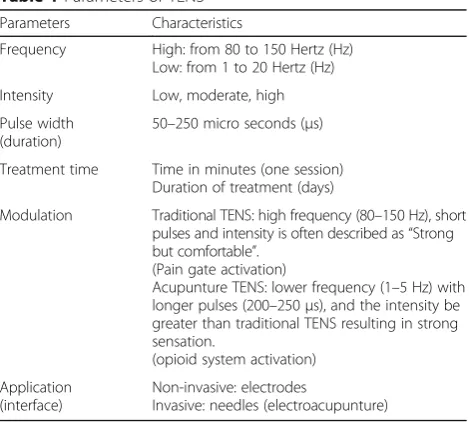
TENS is a non-pharmacological analgesic therapy used in almost all medical specialties. The appliance generates an electrical current through cutaneous application in-terfaces, usually positioned around the area of pain. The application parameters are adjustable and determine the therapeutic effects of the current [5]. There are several modulations of TENS used in previous studies. We aim to discuss these modulations and their potential effects. The main application parameters of TENS [5, 8, 26–29] are described in Table 1.
Due to heterogeneity in TENS application, we chose not to make initial restrictions on the application parameters
Table 1Parameters of TENS
Parameters Characteristics
Frequency High: from 80 to 150 Hertz (Hz) Low: from 1 to 20 Hertz (Hz)
Intensity Low, moderate, high
Pulse width (duration)
50–250 micro seconds (μs)
Treatment time Time in minutes (one session) Duration of treatment (days)
Modulation Traditional TENS: high frequency (80–150 Hz), short pulses and intensity is often described as“Strong but comfortable”.
(Pain gate activation)
Acupunture TENS: lower frequency (1–5 Hz) with longer pulses (200–250μs), and the intensity be greater than traditional TENS resulting in strong sensation.
(opioid system activation)
Application (interface)
Non-invasive: electrodes
and only make adjustments in the analysis, according to the number of studies included with each possible inter-vention parameter. Furthermore, since TENS is generally used in symptomatic phase pathologies in which the medi-cations cannot be stopped, it is better to consider the stud-ies that use both medication and TENS concomitantly.
The TENS application parameters can trigger different mechanisms of action [5, 8]; and therefore, we defined specific control groups for each intervention group to somewhat homogenize the effects of the studies included.
The following interventions for the experimental group will be included:
1. TENS with application by electrodes;
2. TENS associated with pharmacological therapy (for pain and inflammation);
3. TENS with acupuncture needles (electro-acupuncture).
The application of TENS associated with other phy-siotherapeutic resources will not be included due to the difficulty of assigning causal relationships in interven-tions with multiple resources.
Types of study (control)
Randomized clinical trials should have an experimental group according to the interventions described above. Each intervention group should be paired with a specific control group. Only studies that fit these criteria (interven-tion X control) as described in Table 2 will be included.
Outcomes and prioritization
Only randomized clinical trials that have at least one measurement of at least one proinflammatory cytokine at the pre- and post-intervention stages of TENS will be considered for this review.
Primary outcomes
We will consider as the primary endpoint the level of any of the major proinflammatory cytokines [14, 18, 20, 30] described below:
1. Interleukin 1β(IL-1β);
2. Interleukin 1α(IL-1α); 3. Interleukin 2 (IL-2);
4. Tumor necrosis factor (TNFα); 5. Interleukin 6 (IL-6);
6. Interleukin 8 (IL-8).
Secondary outcomes
We will consider as a secondary outcome only pain assessed by the visual analogue scale (VAS) because of its relationship with inflammation [9, 12, 13].
Search strategy
An electronic search of six databases will be carried out to identify publications that meet the selection criteria. The search will be carried out without limits to the date and language of the publication.
To identify the biochemical terms for the search, stu-dies that addressed the subject of inflammatory cyto-kines will be consulted [20, 22, 31–34]. Keywords are selected according to Medical Subject Headings (MeSH) in the National Library of Medicine.
The organization of the terms for the search will be carried out according to the PICO strategy. To sensitize the search for articles, each database has described its strategy:
1. Medline (Pubmed) (Additional file2): was used with MeSH terms and all theirentry terms;
2. Scopus (Additional file3);
3. Web of Science (Additional file4);
4. Physiotherapy Evidence Database–PEDro (Additional file5);
5. Cochrane Clinical Trials (Additional file6); 6. EMBASE (Additional file7).
In addition to the database searches, the following search strategies will be employed:
1. Consultation of the reference lists of all original articles included: After final selection, we will review references to identify clinical trials that may not have been found in the initial search.
Table 2Relationship between intervention group and control group—required as inclusion criteria
Intervention group Expected control group Effect analyzed in the trial
TENS
(Electrode application)
TENS placeboa (Electrode application)
Effect of the TENS current on the reduction of proinflammatory cytokines
TENS (electrode) + pharmacological therapyb TENS (electrode) placeboa+ pharmacological therapyb
TENS (electrode) + pharmacological therapyb Pharmacological Therapyb
TENS by needles (Electro-acupuncture)
Acupuncturec
a
Placebo: the electrodes will be on the skin; there may be luminous indications that signal to the patient that the appliance is switched on, but the power is off
b
Standard pharmacological therapy: prescription of the same drugs for both groups; usually analgesic or anti-inflammatory
c
2. Contact with the authors: (i) if complete articles are not available; (ii) after article selection, the authors will be consulted about other publications on the subject that may not have been found in the initial search; and (iii) if certain data are not available in the original article, such as data presented only in graphs.
3. Searches in clinical trial repositories: We will also consult the Clinical Trials (http://clinicaltrials.gov/) and the Brazilian Clinical Trials Registry (http:// www.ensaiosclinicos.gov.br). For Clinical Trials, we will use the term“transcutaneous electrical nerve stimulation”for the search, and in the Brazilian registry, the term“estimulação elétrica nervosa transcutânea”is to be used. Eligibility criteria will be applied to original studies and those in the repositories for inclusion in this review. If we find eligible studies that are unpublished, we will contact the authors to obtain the results.
Study records
Data management
The management of references and removal of dupli-cates will be performed with EndnoteX8, and articles will be managed using Excel spreadsheets and Review Manager 5 (RevMan) software (http://community.co-chrane.org/tools/review-production-tools/revman-5).
Selection process
After searches in the proposed databases have been completed, a single library will be created in EndnoteX8. The duplicates will be removed with the help of the
“find duplicate” tool. To ensure that all duplicates have been removed, we will check manually.
After removing duplicates, two identical libraries will be created in EndnoteX8 so that two reviewers can inde-pendently select articles. Also, two Excel spreadsheets will be created with references of all articles, using End-note’s “copy formatted” tool in which the reasons for excluding articles will be justified.
There will be two levels to the selection process. At the first level, reviewers will screen articles by reading ti-tles and abstracts in EndnoteX8 according to the follo-wing inclusion criteria: adult population, use of TENS as an intervention, dose of some proinflammatory cytokine, and randomized clinical trial. The reviewers must justify exclusion of any items in the spreadsheet.
Once the first level of selection is completed, the reviewers will hold a consensus meeting to evaluate the selection of articles to be evaluated at the second level. At this stage, if there is any divergence between the inclusion and exclusion criteria, a third reviewer will be consulted. At the end of this meeting, full article downloads will be performed, and as described earlier,
we will create two libraries in EndnoteX8 and two Excel spreadsheets with identical contents for full post-read selection.
At the second level of selection, the reviewers will read the full texts. At this stage, the reviewers should evaluate the following inclusion criteria: the article must have at least one TENS intervention group and one control group according to Table 2 and present measurements of at least one proinflammatory cytokine before and after TENS. Exclusions must be justified in the spreadsheet.
After this selection, another consensus meeting will be held to review which articles will be considered eligible for review. If necessary, a third reviewer will also be used to resolve disagreements. At the end of this second level of the selection, a library will be created in EndnoteX8 with selected full articles.
Reference lists of included studies will be indepen-dently searched by one reviewer to identify additional studies.
Data items
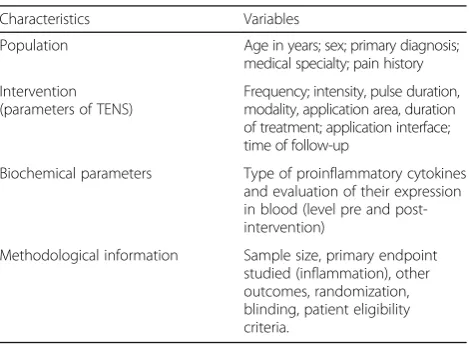
For data extraction and management in spreadsheets in Excel, two reviewers will extract the data from the in-cluded articles; a third reviewer will resolve disagreements. Reviewers will receive the spreadsheet (elaborated by TCCA) with all the variables to be filled. The main cha-racteristics and variables that were used to build the spreadsheet are pre-established and described in Table 3.
Risk of bias and methodological quality
To reduce systematic biases and inferential error in the results of interest, we will evaluate the methodological quality based on evaluations of the strength of evidence and risk of bias, according to the Grades of Recom-mendation, Assessment, Development and Evaluation (GRADE) [35–41], and the guidelines of the Cochrane Handbook for Systematic Reviews [42].
Table 3Characteristics and variables to be extracted from included articles
Characteristics Variables
Population Age in years; sex; primary diagnosis; medical specialty; pain history
Intervention (parameters of TENS)
Frequency; intensity, pulse duration, modality, application area, duration of treatment; application interface; time of follow-up
Biochemical parameters Type of proinflammatory cytokines and evaluation of their expression in blood (level pre and post-intervention)
The process for assessing methodological bias on indi-vidual studies will be performed in the RevMan program and the results will be presented risk of bias summary (review authors’judgments about each risk of bias item for each included study).
The quality of final evidence, according to GRADE, will be classified as high, moderate, low, or very low. The study design is the starting point in assessing the quality of evidence. Randomized controlled trials are designated with the highest level of evidence because they are considered to be less prone to methodological limitations [35, 41]. There are five possible factors that subsequently diminish this quality: risk of bias [36], in-consistency [39], imprecision [38], indirect evidence [40], and publication bias [37].
The risk of bias (or methodological limitations) is assessed by the following factors: absence of allocation concealment (randomisation), absence of blinding, in-complete follow-up, selective reporting of outcomes, or other limitations (e.g., early termination of benefit study or use of outcome measures without validation) [36].
The quality of evidence is also reduced by indirect evi-dence, whereby participants, interventions, or outcomes evaluated in the study are substantially different from those considered in the research question (PICO) of the clinical trial [40].
Publication bias includes conflicts of interest or initial studies with positive results, especially with a small sam-ple size, and the non-publication of negative results [37]. A funnel plot will be created to analyze the risk of pu-blication bias in accepted studies, using the software Review Manager 5 (RevMan).
In the publication of the original article, if there are changes to the protocol, they will be detailed and justi-fied in a specific section of the review.
Data synthesis
We will present descriptive results relating to the study population, diagnoses, main treatment areas, objectives, and proinflammatory cytokine concentrations. Regarding the TENS application parameters, we intend to identify the most used values of frequency, intensity, pulse du-ration, treatment time, and modulation.
The size of the intervention effect will be calculated for each study using the mean difference with a 95% confidence interval (95% CI), according to equations used in the software Review Manager 5 (RevMan). The following parameters are required for this calculation: mean, standard deviation, and sample size of both the control and experimental group. When there is insuf-ficient information to perform effect-size (ES) calcula-tion, mean values and/or standard deviations will be requested from the authors of the original studies. In studies that have more than one experimental group
besides TENS, the ES calculation will be performed in-dependently for each group.
The results obtained in non-TENS experimental groups, or from studies that fail to meet the size criterium due to limited data, will be maintained in the systematic review, but not included in the meta-analysis if performed. The ES was classified according to the Cohen test [43] as very small (<0.20), small (0.20 to 0.49), intermediate (0.50 to 0.79) or large (≥0.80).
The decision of whether to include a study in a meta-analysis (for the mean difference in inflamma-tory markers using TENS application parameters) will be based on author consensus to avoid loss of clinical and statistical questions [42]. The following points will be considered:
i. Low level of clinical heterogeneity (ability to combine participants, intervention characteristics, and levels of proinflammatory cytokines);
ii. Low level of methodological heterogeneity (different methods used in the clinical trials are unlikely to influence the results).
Variability in the effects of the interventions will be tested for statistical heterogeneity using the chi-square test (χ2
) with the correspondingpvalue (Cochrane test) and through the I2statistic. The heterogeneity is consi-dered low if I2≤50% [44]. The level of significance will be 5%, and the analyses were performed in RevMan. For low heterogeneity, a fixed-effect meta-analysis will be used to estimate the treatment effect; for high hetero-geneity, we will use the random effects model.
If the final consensus of the authors is not to perform the meta-analysis, we will present the results in a narra-tive synthesis.
Sensitivity and subgroup analyses (for the meta-analyses)
To evaluate the overall effect of an intervention, all ex-perimental groups will be evaluated as a single category. Subgroup analyses may be performed, considering the clinical and statistical aspects, to identify factors acting as moderators of the intervention. This analysis will be performed to determine whether factors such as ad-equate sample size were attempted [42].
By identifying these factors, sensitivity analysis of the synthetic measurements will be performed. Although it is not possible to predict all of these adjustments in ad-vance, we believe that factors related to different pain models (i.e., traumatic pain, neuropathic pain, etc.) can be used in the sensitivity analysis depending on the number of articles included.
To understand the relationship between TENS and proinflammatory cytokines, we will analyze variations in the levels of proinflammatory cytokines by considering characteristics of the intervention, such as frequency (high versus low), modulation (conventional versus acu-puncture), and application interface (electrode versus needle), and the types of pathologies or medical areas.
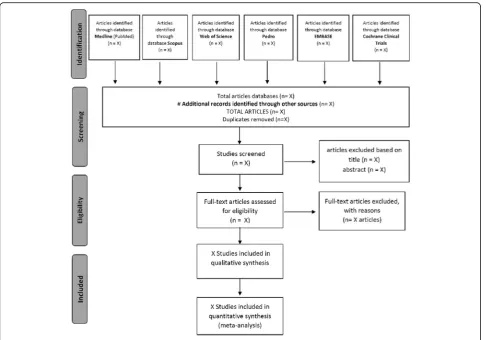
Preliminary report
Figure 1 shows a flowchart of the research development process, according to PRISMA guidelines [45].
Discussion
Although TENS is a widely-used method for pain ma-nagement, some studies focus on the reduction of in-flammation as an outcome. However, the mechanisms of action of TENS on the inflammatory process are not well understood. Despite scant evidence, the results of this review will direct further research into the effects of TENS treatment (in the case of poor evidence), or re-commend interventions in case-specific studies (high quality of evidence).
A limitation of this review is that the studies may be influenced by short intervention times and/or small sample sizes. However, as TENS is performed in the symptomatic phase, participant inclusion is limited to specific pathologies and treatments performed in specific periods.
The TENS current can be adjusted by many applica-tion parameters (such as frequency, intensity, pulse size, and application interface) and used in various medical conditions. This adaptability makes it difficult to com-pare results when different methods are analyzed sepa-rately. However, regardless of the application parameter used, the grouping of interventions may represent the actual effect of the current on the outcome (judged here by inflammatory markers). TENS may reduce the inflam-matory process and can be used as a physiotherapeutic treatment of pathologies marked by inflammation and pain.
Additional files
Additional file 1:PRISMA-P (Preferred Reporting Items for Systematic review and Meta-Analysis Protocols) 2015 checklist: recommended items to address in a systematic review protocol. Completed PRISMA-P checklist outlining how each point has been addressed in the manuscript. (PDF 287 kb)
Additional file 2:Search strategy from Medline database. Description of the search terms according to the Medline (Pubmed) database. (PDF 186 kb)
Additional file 3:Search strategy from Scopus database. Description of the search terms according to the Scopus database. (PDF 167 kb)
Additional file 4:Search strategy from Web of Science database. Description of the search terms according to the Web of Science database. (PDF 291 kb)
Additional file 5:Search strategy from Physiotherapy Evidence Database
-PEDrodatabase. Description of the search terms according to thePEDro database. (PDF 176 kb)
Additional file 6:Search strategy from Cochrane Clinical Trials database. Description of the search terms according to the Cochrane Clinical Trials database. (PDF 290 kb)
Additional file 7:Search strategy from EMBASE database. Description of the search terms according to the EMBASE database. (PDF 183 kb)
Abbreviations
CI:Confidence interval; ES: Effect-size; GRADE: Grades of Recommendation, Assessment, Development and Evaluation; IL-1α: Interleukin 1α; IL-1β: Interleukin 1β; IL-2: Interleukin 2; IL-6: Interleukin 6; IL-8: Interleukin 8; MeSH: Medical Subject Headings; PEDro: Physiotherapy Evidence Database; PICO strategy: Population, intervention, control, outcomes; PRISMA: Preferred reporting items for systematic reviews and meta-analyses; PRISMA-P: Preferred reporting items for systematic review and meta-analysis protocols;
PROSPERO: International Prospective Register of Systematic Reviews; RevMan: Review Manager software; TENS: Transcutaneous electrical nerve stimulation; TNFα: Tumor necrosis factor alpha; VAS: Visual analogue scale;
χ2: Chi-square test
Acknowledgements
TCCA thanks the National Council for Scientific and Technological Development and the Coordination for the Improvement of Higher Education Personnel (CNPq/CAPES), process n° 133157/2016-4.
Funding
Not applicable.
Availability of data and materials
No additional data is available.
Authors’contributions
TCCA and FWSF designed the research question and wrote the review protocol. VCBF contributed to the protocol by reviewing the methods. VCBF and FA revised the draft paper for intellectual content. LCA and FLAF contributed to the revision of the intellectual content of the draft paper. TCCA and FWSF conceived and initiated the review protocol. All authors have read and approved the final version of the manuscript.
Ethics approval and consent to participate
The proposed systematic review will collect and analyze secondary data that are not associated with individuals. No primary data will be collected hence ethics is not a requirement.
Consent for publication
Not applicable.
Competing interests
The authors declare that they have no competing interests.
Publisher’s Note
Springer Nature remains neutral with regard to jurisdictional claims in published maps and institutional affiliations.
Author details
1Faculdade de Medicina do ABC (FMABC), Laboratório de Epidemiologia e
Análise de dados (ABC Medical School), Av. Lauro Gomes, 2000, Vila Sacadura Cabral, CEP: 09060-870 Santo André, SP, Brazil.2Centre in Physical Activity
and Health. Department of Physical Education, Federal University of Santa Catarina, Florianópolis, Brazil.3Faculdade de Medicina do ABC (FMABC), Laboratório de Delineamento de Estudos e Escrita Científica (ABC Medical School), Av. Lauro Gomes, 2000, Vila Sacadura Cabral, CEP: 09060-870 Santo André, SP, Brazil.4Faculdade de Medicina do ABC (FMABC), Laboratório de Análises Clínicas (ABC Medical School), Av. Lauro Gomes, 2000, Vila Sacadura Cabral, CEP: 09060-870 Santo André, SP, Brazil.
Received: 2 May 2017 Accepted: 22 June 2017
References
1. Sharma N, Rekha K, Srinivasan JK. Efficacy of transcutaneous electrical nerve stimulation in the treatment of chronic pelvic pain. J Mid-Life Health. 2017;8(1):36–9.
2. Igwea SE, Tabansi-Ochuogu CS, Abaraogu UO. TENS and heat therapy for pain relief and quality of life improvement in individuals with primary dysmenorrhea: a systematic review. Complement Ther Clin Pract. 2016;24:86–91.
3. Jauregui JJ, Cherian JJ, Gwam CU, Chughtai M, Mistry JB, Elmallah RK, Harwin SF, Bhave A, Mont MA. A meta-analysis of transcutaneous electrical nerve stimulation for chronic low back pain. Surg Technol Int. 2016;28:296–302.
4. Johnson MI, Paley CA, Howe TE, Sluka KA. Transcutaneous electrical nerve stimulation for acute pain. Cochrane Database Syst Rev. 2015;(6):1-95. doi:10. 1002/14651858.CD006142.pub3.
5. Vance CG, Dailey Dl, Rakel BA, Sluka KA. Using TENS for pain control: the state of the evidence. Pain Manag. 2014;4(3):197–209.
6. Kamali F, Mirkhani H, Nematollahi A, Heidari S, Moosavi E, Mohamadi M. The effect of transcutaneous electrical nerve stimulation of sympathetic ganglions and acupuncture points on distal blood flow. J Acupunct Meridian Stud. 2017;10(2):120–4.
7. Liebano RE, Abla LE, Ferreira LM. Effect of low-frequency transcutaneous electrical nerve stimulation (TENS) on the viability of ischemic skin flaps in the rat: an amplitude study. Wound Repair Regen. 2008;16(1):65–9. 8. Cramp AF, Gilsenan C, Lowe AS, Walsh DM. The effect of high- and
low-frequency transcutaneous electrical nerve stimulation upon cutaneous blood flow and skin temperature in healthy subjects. Clin Physiol. 2000;20(2):150–7. 9. Fiorelli A, Morgillo F, Milione R, Pace M, Passavanti M, Laperuta P, Aurilio C, Santini
M. Control of post-thoracotomy pain by transcutaneous electrical nerve stimulation: effect on serum cytokine levels, visual analogue scale, pulmonary function and medication. Eur J Cardiothorac Surg. 2012;41:861–8. discussion 868. 10. Campos FV, Neves LM, Da Silva VZ, Cipriano GF, Chiappa GR, Cahalin L,
Arena R, Cipriano G. Hemodynamic effects induced by transcutaneous electrical nerve stimulation in apparently healthy individuals: a systematic review with meta-analysis. Arch Phys Med Rehabil. 2016;97(5):826–35. 11. Machado AFP, Santana EF, Tacani PM, Liebano RE: The effects of
transcutaneous electrical nerve stimulation on tissue repair: A literature review. Can J Plast Surg. 2012;20(4):237-240.
12. Stavrakis S, Scherlag B, Humphrey M, Lazzara R, Po S. Low-level tragus stimulation suppresses atrial fibrillation and decreases inflammation in humans. Heart Rhythm. 2014;11:S278.
13. Song C, Halbreich U, Han C , Leonard Be, Luo H. Imbalance between pro- and anti-inflammatory cytokines, and between Th1 and Th2 cytokines in depressed patients: the effect of electroacupuncture or fluoxetine treatment. (1439–0795 (Electronic)).
14. Wojdasiewicz P, Poniatowski LA, Szukiewicz D. The role of inflammatory and anti-inflammatory cytokines in the pathogenesis of osteoarthritis. Mediat Inflamm. 2014;2014:19.
15. Shavit Y, Fridel K, Beilin B. Postoperative pain management and proinflammatory cytokines: animal and human studies. J Neuroimmune Pharmacol. 2006;1(4):443–51.
16. Fiorelli A, Izzo AC, Frongillo EM, Prete AD, Liguori G, Di Costanzo E, Vicidomini G, Santini M. Efficacy of wound analgesia for controlling post-thoracotomy pain: a randomized double-blind study. Eur J Cardiothorac Surg. 2016;49(1):339–47.
17. Panis C, Pavanelli WR. Cytokines as mediators of pain-related process in breast cancer. Mediat Inflamm. 2015;2015:6.
19. Kraychete DC, Calasans MTA, Valente CML. Citocinas pró-inflamatórias e dor. Rev Bras Reumatol. 2006;46:199–206.
20. Zhang J-M, An J. Cytokines, inflammation and pain. Int Anesthesiol Clin. 2007;45(2):27–37.
21. Sommer C, Kress M. Recent findings on how proinflammatory cytokines cause pain: peripheral mechanisms in inflammatory and neuropathic hyperalgesia. Neurosci Lett. 2004;361(1–3):184–7.
22. Oliveira CMB, Sakata RK, Issy AM, Gerola LR, Salomão R. Citocinas e dor. Rev Bras Anestesiol. 2011;61:260–5.
23. Shamseer L, Moher D, Clarke M, Ghersi D, Liberati A, Petticrew M, Shekelle P, Stewart LA. Preferred reporting items for systematic review and meta-analysis protocols (PRISMA-P) 2015: elaboration and explanation. BMJ. 2015;349:g7647. 24. Ho GJ, Liew SM, Ng CJ, Hisham Shunmugam R, Glasziou P. Development of a search strategy for an evidence based retrieval service. (1932–6203 (Electronic)).
25. Huang X, Lin J, Demner-Fushman D. Evaluation of PICO as a knowledge representation for clinical questions. AMIA Ann Symp Proc. 2006;2006:359–63. 26. Franco OS, Paulitsch FS, Pereira APC, Teixeira AO, Martins CN, Silva AMV,
Plentz RDM, Irigoyen MC, Signori LU. Effects of different frequencies of transcutaneous electrical nerve stimulation on venous vascular reactivity. Braz J Med Biol Res. 2014;47:411–8.
27. Sluka KA, Walsh D. Transcutaneous electrical nerve stimulation: basic science mechanisms and clinical effectiveness. J Pain. 2003;4(3):109–21.
28. Gopalkrishnan P, Sluka KA. Effect of varying frequency, intensity, and pulse duration of transcutaneous electrical nerve stimulation on primary hyperalgesia in inflamed rats. Arch Phys Med Rehabil. 2000;81(7):984–90. 29. Chesterton LS, Foster NE, Wright CC, Baxter GD, Barlas P. Effects of TENS frequency, intensity and stimulation site parameter manipulation on pressure pain thresholds in healthy human subjects. Pain. 2003;106(1–2):73–80. 30. Kavoussi B, Ross BE. The neuroimmune basis of anti-inflammatory
acupuncture. Integr Cancer Ther. 2007;6(3):251–7.
31. Gurgen SG, Sayin O, Cetin F, Tuc Yucel A. Transcutaneous electrical nerve stimulation (TENS) accelerates cutaneous wound healing and inhibits pro-inflammatory cytokines. Inflammation. 2014;37(3):775–84.
32. Grellner W, Georg T, Wilske J. Quantitative analysis of proinflammatory cytokines (IL-1beta, IL-6, TNF-alpha) in human skin wounds. Forensic Sci Int. 2000;113(1–3):251–64.
33. Sebastian A, Syed F, Perry D, Balamurugan V, Colthurst J, Chaudhry IH, Bayat A. Acceleration of cutaneous healing by electrical stimulation: degenerate electrical waveform down-regulates inflammation, up-regulates angiogenesis and advances remodeling in temporal punch biopsies in a human volunteer study. Wound Repair Regen. 2011;19(6):693–708. 34. Wang Y, Gehringer R, Mousa SA, Hackel D, Brack A, Rittner HL. CXCL10
controls inflammatory pain via opioid peptide-containing macrophages in electroacupuncture. PLoS One. 2014;9(4):e94696.
35. Balshem H, Helfand M, Schunemann HJ, Oxman AD, Kunz R, Brozek J, Vist GE, Falck-Ytter Y, Meerpohl J, Norris S, et al. GRADE guidelines: 3. Rating the quality of evidence. J Clin Epidemiol. 2011;64(4):401–6.
36. Guyatt GH, Oxman AD, Vist G, Kunz R, Brozek J, Alonso-Coello P, Montori V, Akl EA, Djulbegovic B, Falck-Ytter Y, et al. GRADE guidelines: 4. Rating the quality of evidence—study limitations (risk of bias). J Clin Epidemiol. 2011;64(4):407–15.
37. Guyatt GH, Oxman AD, Montori V, Vist G, Kunz R, Brozek J, Alonso-Coello P, Djulbegovic B, Atkins D, Falck-Ytter Y, et al. GRADE guidelines: 5. Rating the quality of evidence—publication bias. J Clin Epidemiol. 2011;64(12):1277–82. 38. Guyatt GH, Oxman AD, Kunz R, Brozek J, Alonso-Coello P, Rind D, Devereaux PJ, Montori VM, Freyschuss B, Vist G, et al. GRADE guidelines 6. Rating the quality of evidence—imprecision. J Clin Epidemiol. 2011;64(12):1283–93. 39. Guyatt GH, Oxman AD, Kunz R, Woodcock J, Brozek J, Helfand M,
Alonso-Coello P, Glasziou P, Jaeschke R, Akl EA, et al. GRADE guidelines: 7. Rating the quality of evidence—inconsistency. J Clin Epidemiol. 2011;64(12):1294–302.
40. Guyatt GH, Oxman AD, Kunz R, Woodcock J, Brozek J, Helfand M, Alonso-Coello P, Falck-Ytter Y, Jaeschke R, Vist G, et al. GRADE guidelines: 8. Rating the quality of evidence—indirectness. J Clin Epidemiol. 2011;64(12):1303–10. 41. Guyatt GH, Oxman AD, Sultan S, Glasziou P, Akl EA, Alonso-Coello P, Atkins
D, Kunz R, Brozek J, Montori V, et al. GRADE guidelines: 9. Rating up the quality of evidence. J Clin Epidemiol. 2011;64(12):1311–6.
42. Higgins JPT GSe. Cochrane Handbook for Systematic Reviews of Interventions Version 5.1.0 [updated March 2011]. The Cochrane Collaboration, 2011. 2011. Available from http://www.handbook.cochrane.org. Accessed 6 July 2017.
43. Lakens D. Calculating and reporting effect sizes to facilitate cumulative science: a practical primer for t-tests and ANOVAs. Front Psychol. 2013;4:863.
44. Higgins JPT, Thompson SG. Quantifying heterogeneity in a meta-analysis. Stat Med. 2002;21(11):1539–58.
45. Moher D, Liberati A, Tetzlaff J, Altman DG. Preferred reporting items for systematic reviews and meta-analyses: the PRISMA statement. PLoS Med. 2009;6(7):e1000097.
• We accept pre-submission inquiries
• Our selector tool helps you to find the most relevant journal
• We provide round the clock customer support
• Convenient online submission
• Thorough peer review
• Inclusion in PubMed and all major indexing services
• Maximum visibility for your research
Submit your manuscript at www.biomedcentral.com/submit