The Thirty-Third AAAI Conference on Artificial Intelligence (AAAI-19)
Feature Sampling Based Unsupervised Semantic Clustering for Real Web
Multi-View Content
Xiaolong Gong, Linpeng Huang, Fuwei Wang
Department of Computer Science and Engineering, Shanghai Jiao Tong University, Shanghai, China {gxl121438, lphuang, wfwzy2012}@sjtu.edu.cn
Abstract
Real web datasets are often associated with multiple views such as long and short commentaries, users preference and so on. However, with the rapid growth of user generated texts, each view of the dataset has a large feature space and leads to the computational challenge during matrix decomposition process. In this paper, we propose a novel multi-view clus-tering algorithm based on the non-negative matrix factoriza-tion that attempts to use feature sampling strategy in order to reduce the complexity during the iteration process. In par-ticular, our method exploits unsupervised semantic informa-tion in the learning process to capture the intrinsic similar-ity through a graph regularization. Moreover, we useHilbert Schmidt Independence Criterion(HSIC) to explore the un-supervised semantic diversity information among multi-view contents of one web item. The overall objective is to min-imize the loss function of multi-view non-negative matrix factorization that combines with an intra-semantic similarity graph regularizer and an inter-semantic diversity term. Com-pared with some state-of-the-art methods, we demonstrate the effectiveness of our proposed method on a large real-world datasetDoucomand the other three smaller datasets.
1
Introduction
Real world application has to deal with data presenting var-ious perspectives and is usually characterized by varvar-ious heterogeneous sources of information. Web pages, multi-media documents, user profiles are examples of data that can be organized into multi-graphs. It is common that rel-evant multi-view data from different sources may have se-mantic correlations. For example, a movie item in IMDB often consists of many user reviews and one plot summary; An artist in Last.fm is always associated with its descrip-tion and lots of short comments. As different semantic in-formation may emphasize different aspects of the data, it gives rise to an emerging demand to explore the interactions between multi-view data for the application like multi-view clustering (Bickel and Scheffe 2004; Chaudhuri et al. 2009; Liu et al. 2013), co-regularized spectral clustering (Kumar, Rai, and Daum´e 2011; Kumar and Daum´e 2011) and cross-view retrieval (Zhai et al. 2013). Different from the tradi-tional data with a single view, large-scale multi-view web
Copyright c⃝2019, Association for the Advancement of Artificial Intelligence (www.aaai.org). All rights reserved.
contents commonly have the following properties: 1) Every single view of one web item1has its own feature sets. 2) Dif-ferent views of one item share some consistency in semantic information. Just like a new story may be reported by dif-ferent news resources, but the underlying content will not be changed. 3) The diversity information among the represen-tations of one web item exists in multi-view data, and each representation corresponds to a single view content. Taking ourDoucomdataset as an example, a movie item in the web community consisting of multiple views including summary, short comment, long review, and user group. And each view of a movie item mainly contains specific information in the relevant content.
According to the above properties, multi-view clustering has attracted more and more attention because it can ex-plore the intrinsic structure of the multi-view dataset and handle large numbers of unlabeled data. Generally, the main challenge lies in how to make use of the complementary characteristics embedded in the multiple sources of infor-mation and exploit the interactions and correlations be-tween a various number of views accurately and automati-cally. Plenty of multi-view clustering algorithms have been developed to solve this problem. Some methods perform multi-view clustering through merging the clustering results from different individual views (Long, Yu, and Zhang 2008; Greene and Cunningham 2009). Some works (Cai, Nie, and Huang 2013; Cheng et al. 2013; J. Sun and Kran-zler 2014) seek groupings that are consistent across dif-ferent views. Recently, some researches (Liu et al. 2013; He et al. 2014) focus on nonnegative matrix factoriza-tion(NMF) framework, which attempts to interpret the dis-tinction between different views via pairwise representation. All the above studies have shown effective in multi-view clustering, but they suffer from some inevitable problems: 1) Most of the studies ignore the curse of dimensionality in feature space with the growth of data size. This problem leads to a significant computational challenge when opti-mization algorithms load complete view matrix with large dimensions. Most recently proposed multi-view clustering methods (Hoyer 2004; Mohammadiha and Leijon 2009; Sun et al. 2015; Gong, Wang, and Huang 2017) utilized complete feature space to deal with the above problem,
1
whose optimization ignores the computational complexity. For instance, alternate minimization algorithm should be it-erated hundreds of times for each original view matrix ob-servation. 2) Some previous methods do not consider the unsupervised semantic similarity and diversity information among data instances in latent representation. They used su-pervised label information as similarity measurement to cap-ture semantic information. Especially, the manual labels are insufficient in real large web data. The multiple clustering solutions can be accurately achieved if we explore the diver-sity information. For example, some movies directed by the same director could be grouped into one cluster according to the summary view and some movies that have different genres could possibly be grouped into one cluster due to the detailed description and profound implication from the view of the long review.
In this paper, we propose a novel multi-view unsuper-vised semantic clustering method, dubbed the name Feature Sampled Unsupervised Semantic Clustering (F SU SC) for real web multi-view content. We use graph regularization to capture the intrinsic intra-semantic similarity information. We also use the Hilbert Schmidt Independence Criterion
(HSIC)(Arthur et al. 2005) as a co-regularizer term to en-force the inter-semantic diversity of the jointly learned rep-resentations. Although a few existing methods (Wang et al. 2015; Zhu et al. 2013; Zheng et al. 2011; Yang et al. 2014) apply graph regularization to various applications, they only observe the original data information, which motivates us to explore the semantic structure information and identify a common low-dimensional space of the data instance across multiple views in our work, thus reducing the memory con-sumption if data refers to a large view numbers. We formu-late our multi-view clustering as a joint optimization prob-lem that minimizes the reconstruction errors over the mul-tiple views. The contributions of this paper can be summa-rized as the following:
• We construct a large-scale organized dataset from web community, namely Doucom, where feature space is much larger than other previous real-world datasets. The proposed method explicitly reduces the computational complexity by performing feature sampling at each iter-ation in four real web datasets.
• F SU SCleverages unsupervised semantic information to refine the graph regularizer during the step of graph con-struction and uses HISC to measure diversity among data representations.
• To solve the objective function ofF SU SC, we derive a new iterative updating optimization scheme and our pro-posed method can achieve state-of-the-art results in terms of accuracy and normalized mutual information.
2
Feature Sampled Unsupervised Semantic
Clustering (
F SU SC
)
Problem Statement
Before we describe the formulation of the problem, we sum-marize some notations used in this paper in Table 1. Let
l = 1,· · ·, nv, an arbitrary original data matrix in viewl
Table 1: Summary of the Notations
Notations Description
m Total number of items
nv Total number of views
d(l) Feature numbers in thel-th view
X(l) Data matrix for thel-th view
U(l) Class indicator matrix
V(l) The basis matrix for thel-th view
S(l) Semantic similarity matrix
L(l) Laplacian matrix
M(l) Sampling matrix for thel-th view
η Reduction factor
α, β Parameters in objective function
isX(l)= [x(1l), x2(l),· · ·, xm(l)]T ∈Rm×d
(l)
+ , where each row
x(il)T(1 ≤i≤m)represents a data instance and each col-umn represents one feature. Non-negative matrix factoriza-tion (Lee and Seung 2001) aims to find two factors with
non-negative elementsU(l)∈
Rm+×KandV(l)∈R
K×d(l)
+ ,K≪
d(l), which factorization is formulated asX(l) ≈ U(l)V(l).
U(l)represents the class indicators, indicating the final clus-tering result. V(l) is termed the basis matrix. K denotes the desired reduced dimension. The fundamental multi-view based on NMF function tries to minimize the joint problem overU(l), V(l):
nv
∑
l
∥X(l)−U(l)V(l)∥2
F+ Ω, s.t. U
(l), V(l)≥0
(1)
whereΩrepresents different kinds of penalty terms.∥ · ∥F is the Frobenius norm of the matrix.
Loss Function
In real-world application, feature space is much larger than item numbers(i.e.d ≫ m). However, the cost of a single iteration depends linearly on dimension number dand in-creases the computation time and memory requirements also degenerate performance of algorithms. We propose two fea-ture sampling schemes which improve the efficiency of the update process forV(l). Our algorithm can be written as,
min
U,V nv
∑
l
∥(X(l)−U(l)V(l))M(l)∥2F
s.t. U(l)TU(l)=I, U(l), V(l)≥0
(2)
We enforce the orthogonal constraint onU(l)to guarantee the uniqueness of the solution.M(l)∈ Rd
(l)×d(l)
is a diag-onal matrix with the i-th diagonal elementMi,i(l) ∈ {0,1}, which selects a subset of features inX(l)andV(l). Now we
propose two strategies in our sampling process:
which is indicated by∥X·(,jl)∥2,j= 1,· · ·, d(l). Then
se-lect top-p columns as our sampled features. We should note that different view matrices have different feature numbers. Thus p(l) = d(l)
η =
∑d(l)
i=1Mi,i, whereη is a
reduction factor.
• Random Sampling According to the top sampling method, sampled features are always the same at per iter-ation, which incurs the loss of important informiter-ation, for instance, special features in special items. Therefore, we adopt random scheme in feature sampling process.
Sam-pling number isp(l) = d(l) η =
∑d(l)
i=1Mi,i < d(l). This strategy is more flexible than top sampling method.
Unsupervised Semantic Regularization
Intra-semantic Graph Regularizer Our class indicator matricesU(l) = [u(l)
1 , u (l) 2 ,· · ·, u
(l)
m]T, u
(l)
i ∈ R1×K, i =
1,2,· · · , m. Then, our intra-semantic similarity graph regu-larizer can be formulated as,
1 2
m
∑
i=1
m
∑
j=1
Si,j(l)∥ui(l)−u(jl)∥2 2
=1 2(2
m
∑
i=1
d(il)ui(l)u(il)T −2
m
∑
i=1
m
∑
j=1
Si,j(l)ui(l)u(jl)T)
= tr(U(l)TD(l)U(l))−tr(U(l)TS(l)U(l))
= tr(U(l)TL(l)U(l))
(3)
whereLis a symmetric graph Laplacian matrix constructed from similarity matrixS,Dis a diagonal matrix with its el-ements defined asdi=Di,i=∑
m
j=1Si,j. Here,tr(AB) =
tr(BA)is used in above equation. The key task in our work is how to define unsupervised semantic similarity matrix
S∈Rm×m, which is defined by two strategies,
• Semantic Cosine based (SC)The true underlying seman-tic information would assign corresponding items across different views into the same latent topic distribution, which can be indicated byT(x(1)i ) =T(x(2)i ) =· · · =
T(x(nv)
i ), i= 1,2,· · ·, m. FunctionT(·)returns the se-mantic topics vector, i.e.,T(x(il)) = [f1, f2,· · · , ft] ∈ R1×t,tis a topic number. We calculate pairwise similar-ity via the cosine kernel:
Si,j(l)=
⎧
⎨
⎩
<T(x(il)),T(x(jl))>
∥T(x(il)∥∥T(x(jl))∥ i̸=j
1 i=j
• Gaussian kernel based (GK) We construct
matrix S through Gaussian kernel: Si,j(l) =
exp(−
1
nv ∑nv
l=1∥x (l)
i −x
(l)
j ∥
2 2
σ2 ) where σ is the
control-ling parameter selected by cross-validation.
Inter-semantic Diversity Term In real web content appli-cations, different views may be generated heterogeneously and may vary drastically in quality. To implement the inter-semantic diversity information of multi-view clustering, an
intuitive method is to regularize the class indicator matrices
U(l)of the different views, which are enforced to be inde-pendent to each other. We letX = {X1,X2,· · · ,Xnv} be our space of different views, and each i-th view is drawn from Xi ∈ X space. Our purpose is to maximize the di-versity and minimize the dependence between latent repre-sentations in different spaces. i.e.Xi× Xj. Therefore, we utilize theHilbert Schmidt Independence Criterion(HSIC) to deal with the dependence, which computes the sum of the squared singular values of the cross-covariance operator overXi× Xj ={(u1(i), u(1j)),(u2(i), u(2j)),· · · ,(u(mi), u(mj))} in Hilbert space and demonstrates fast exponential conver-gence. Formally, the HSIC (Arthur et al. 2005) is defined as
HSIC(U(l), U(s)) = (m−1)−2tr(K(l)Y K(s)Y) (4) where K(l), K(s) ∈
Rm+×m are Gram matrices of kernel
functions. We employ the inner product kernel here, which meansK(l) = U(l)U(l)T.Y = I− 1
mee
T, whereI is an identity matrix andeis an all-one column vector. We use the HSIC as a penalty term in our objective function to ensure that representations in different views provide inter-semantic diversity information.
Objective Function
According to the above introduction, the overall objection function is rewritten as follows:
min
U,V nv
∑
l
∥(X(l)−U(l)V(l))M(l)∥F+
α∑
l̸=s
HSIC(U(l), U(s)) +β
nv
∑
l
tr(U(l)TL(l)U(l)))
(5)
whereα, βare the tradeoff parameters to control the weight between unsupervised semantic information and the pro-posed error loss function. For simplicity, we ignore the con-stant factor in the HSIC function, and Eq. 5 can be rewritten as
J1= min
U,V nv
∑
l
∥(X(l)−U(l)V(l))M(l)∥F+
α∑
l̸=s
tr(K(l)Y K(s)Y) +β
nv
∑
l
tr(U(l)TL(l)U(l)))
s.t. U(l)TU(l)=I, U(l), V(l)≥0
(6)
By encouraging diversity of views, the algorithm fi-nally learns a very different cluster class indicator ma-trix U(l) for each view l. The final aggregated
represen-tation U can be obtained by combining all U(l): U =
[U(1), U(2),· · · , U(nv)]∈
Rm×(nvK).
3
Optimization Algorithm
Algorithms & Optimization
The objective function in Eq.6 is separately convex w.r.t each of U(l) and V(l). We handle this problem via
Algorithm 1:F SU SCalgorithm
Input: Data matricesX(l); ParametersK, α, β, γ, η;
Semantic similarity matricesS(l)
Output:U(l),V(l);
1 InitializeU(l)andV(l)using the k-means;
2 Topic modeling forX(l)and calculateSunder different
strategies(SC, GK);
3 repeat
4 forltonvdo
5 Draw a feature sampling matrix:M(l)(Topor
Random);
6 UpdateV(l)by Eq. 8; 7 UpdateU(l)by Eq. 15;
8 end
9 returnU(l)andV(l) 10 untilConvergence;
other variables until convergence. Therefore, we propose an alternating optimization algorithm that guarantees each sub-problem converges to the local minima under non-negative condition. TheF SU SC algorithm is summarized in Algo-rithm 1.
FixingU(l), then minimizeV(l).Letϕandψ(l)be the
Lagrange matrices for constraintU(l)≥0andV(l)≥0,
re-spectively. For notional convenience, we letX˜(l),V˜(l)
rep-resentX(l)M(l), V(l)M(l). Then, the derivative ofJ1with
respect toV(l)is:
∂J1
∂V(l) = (−2U (l)T
˜
X(l)+ 2U(l)TU(l)V˜(l)) +ψ(l) (7)
Using the Karush-Kuhn-Tucker(KKT) conditions that
ψ(i,jl)Vi,j(l)= 0, we have:
Vi,j(l)←Vi,j(l) (U
(l)TX(l)M(l))
i,j
(U(l)TU(l)V(l)M(l))
i,j
(8)
FixingV(l), then minimizeU(l).Now, we analyze the
stationary pointU(l)in the second subproblem. Letγbe the
balance parameter for orthogonal constraint. So our mini-mization subproblemJ2(U(l))can be written as:
nv
∑
l
{tr((X˜(l))TX˜(l))−2 tr((X˜(l))TU(l)V˜(l))+
tr((V˜(l))TU(l)
T
U(l)V˜(l)) +βtr(U(l)
T
L(l)U(l)))
+ tr(ϕU(l)) +γtr(U(l)TU(l)−I)}
+α
nv
∑
l̸=s
tr(U(l)U(l)TY K(s)Y)
(9)
Then the derivative ofJ2with respect toU(l)is:
−2X˜(l)(V˜(l))T+ 2U(l)V˜(l)(V˜(l))T + 2βLU
+ 2γU+ϕ+ 2α
nv
∑
l̸=s
Y K(s)Y U(l) (10)
However,Y in above equation contains negative values, we letY =Y+−Y−, which is separated to two nonnegative
parts. AndY+
pq =
∥Ypq∥+Ypq
2 , Y
−
pq =
∥Ypq∥−Ypq
2 . Following
the KKT rule, we have the following equation if we set the Eq. 10 to be0and we can easily get the update rule forU(l),
(X˜(l)(V˜(l))T−U(l)V˜(l)(V˜(l))T−βLU−γU
−α(
nv
∑
l̸=s
Y+K(s)Y+U(l)+
nv
∑
l̸=s
Y−K(s)Y−U(l))
+α(
nv
∑
l̸=s
Y+K(s)Y−U(l)+
nv
∑
l̸=s
Y−K(s)Y+U(l))
)ipU
(l)
ip = 0
(11)
Now we prove that Eq.9 keeps non-increasing when up-dating the stationary pointU(l)from Eq. 11 .
Definition 1 (Lee and Seung 2001) F(U, U′)is an
auxil-iary function of J2 if the conditionsF(U, U
′
) ≥ J2 and
F(U, U) =J2. IfF is an auxiliary function forJ1thenJ1
is non-increasing under the update
U(t+1)= arg min
U F(U, U
t) (12)
Lemma 1 (Ding, Li, and Jordan 2010) For any matrices
A ∈ Rn+×n, B ∈ R
r×r
+ , Q ∈ R
n×r
+ , Q
′
∈ Rn+×r, with A
andBsymmetric, the following inequality holds:
T r(QTAQB)≤ n
∑
i=1
r
∑
p=1
(AQ′ipB)Q2ip
Q′ip (13)
First, we should denote some brief notations
Y1 = ∑
nv l̸=sY
+K(s)Y−, Y
2 = ∑
nv l̸=sY
−K(s)Y+, Y
3 =
∑nv
l̸=sY−K
(s)Y−, Y
4 = ∑
nv l̸=sY
+K(s)Y+ and we use
U to represent U(l) in the following equation. Second,
we ignore the irrelevant terms in Eq.9 and an appropriate auxiliary functionF(U, U′)ofJ2is as the following:
−∑
ip
2(X(l)M(l)(V(l))T)ipU
′
ip(1 + log
Uip
Uip′ )
+∑
ip
[U′(V(l)M(l))(V(l)M(l))T)]ip
Uip2 Uip′
−β∑
ijpq
SipU
′
ipU
′
jq(1 + log
UipUjq
Uip′ Ujq′ )
+β∑
ip
(DU′)ip
U2
ip
Uip′ +γ
∑
ip
(U′)ip
U2
ip
Uip′
−α∑
ijpq
((Y1+Y2)ipU
′
ipU
′
jq(1 + log
UipUjq
Uip′ Ujq′ )
+α∑
ip
((Y3+Y4)U ′
)ip
U2
ip
Uip′
(14)
Table 2: Description of datasets
Dataset #items size #view #clusters
Doucom 31297 4 39
Last.fm 9694 3 21
Yelp 2624 3 7
3-Sources 169 3 6
the minimum ofF(U, U′), we set∂F(U,U
′ )
∂Uip to zero, we can get the stationary point ofUipand the updating rule is:
Uip
√
(λlX˜(l)(V(l))T +βSU+αU(Y1+Y2))ip
(λlUV˜(l)(V˜(l))T+βDU+γU+αU(Y3+Y4))ip (15) Then, we take the second derivative with respect toU, we get a positive semidefinite Hessian matrix:
∂2F(U, U′)
∂Uip∂Ujq
={2λl(X˜
(l)
(V(l))T)ipU ′
ip+ 2βSip(U
′
ip)2
U2
ip
+2α(U
′
(Y1+Y2))ipU ′ ip
U2
ip
+2[λlU
′
(V˜(l))(V˜(l))T]ipUip2 (Uip′ )3
+2[β(DU
′
)ip+γ(U ′
)ip+α(U ′
(Y3+Y4))ip]Uip2
(Uip′ )3 }ζijζjq
(16)
ThusF(U, U′)is a convex function ofU, and under the up-dating rule Eq. 15 the objective function values ofJ2(U(l))
in Eq. 9 will be non-increasing.
Complexity Analysis
There are two subproblems in F SU SC algorithm: opti-mizing V(l) and optimizing U(l). It can be shown that cost for Multi-view NMF’s update rules in each iteration is
O(nvKmd(l)). But the computation cost for updatingV(l) is O(nvKmp(l)) after applying the feature sampling. For class indicator matrixU(l), the largest cost is the first term of
the denominator, whose time complexity isO(nvK2mp(l)).
nv denotes the number of views. The total time complex-ity isO(nvKmp(l)) +O(nvK2mp(l))≈O(nvK2mp(l)), which is a linear to the size of dataset. In a real application, the number of items and clusters are much smaller than the size of features(e.g.K, m≪d(l)). Our method can be
suit-able for large-scale data if we utilize feature sampling in the iteration process.
4
Experiments
In this section, we conduct experiments to evaluate the ef-fectiveness ofF SU SC.
Datasets and Settings
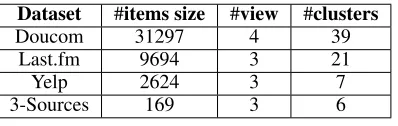
Table 2 summarizes the characteristics of those real web multi-view datasets and all descriptions of the datasets are as follows.
1)Doucom. This large-scale dataset is crawled from a famous web community, called Douban2, we collect
2
https://developers.douban.com/wiki/?title=api v2
four views for this dataset, including 31297 summaries, 2,995,406 comments, 608,158 reviews and 461,358 users. After data preprocessing, we have 50,992; 46,706; 32,935; 232,531 token features for view “Summary”, “Long re-view”, “Short commentary”, “Users” respectively.Doucom
lists 39 movie types such as “Action”, “Love”, “Bloopers”, etc. In fact, for some items tagged with multiple types, we retain one type to annotate single item.
2)Last.fm.This dataset consists of 9,694 items(artists), which contains three views such as description of each item, user comments and users. Each item is annotated with one of the 21 music genres. All the relevant textual information can be achieved by API of Last.fm3.
3)Yelp. This dataset is a subset of the Yelp Challenge Dataset (YDC)4, which includes 11,537 items (businesses) in total. We randomly sample the equivalent amount of items from the every category. So final Yelp dataset has three views (eg. businesses’ names view, comment words view and user view) and consists of 2,624 items from 7 categories. 4)3-Sources.5This text dataset was collected from three well-known online news sources: BBC, Reuters and The Guardian. In total it consists of 416 distinct news manually categorized into 6 topical labels. Among them, there are 169 stories reported in all three sources which are used as three views in our experiments.
To evaluate the performance of the proposed method, we compare our method with the following algorithms.CoRe.
(Kumar, Rai, and Daum´e 2011) proposed the objective func-tions to co-regularize the eigenvectors of all views’ Lapla-cian matrices.MulitNMF(Liu et al. 2013) developed a so-lution on consensus-based regularization for NMF to group the multi-view data.PcoNMF (He et al. 2014) is a recent pair-wise co-regularization method for clustering the whole mapped data, which focus on the difference between the la-tent indicator matrix.CMVNMF(Zhang et al. 2015) pro-posed a novel small number of constraints on must-link sets and cannot-link sets based on the NMF framework. And we letF SU SC-intrabe our baseline method that only includes intra-semantic similarity constraint and let F SU SC-inter
be our another baseline method that only includes inter-semantic diversity constraint.
In this work, we have six major parameters: { σ,α,β,
γ,η,K}. We empirically setσ = 0.01in kernel function.
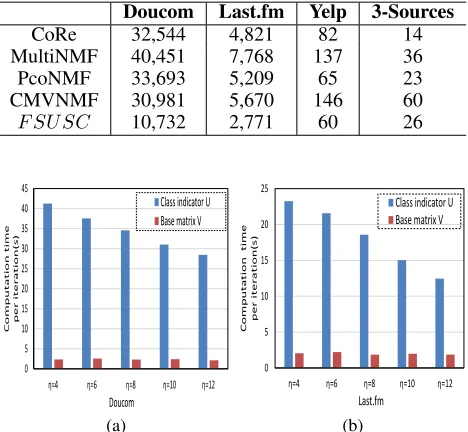
α, β, γ are the weight coefficients, which are set to1,2,1, respectively.η is a reduction factor which controls the dif-ferent size of feature subset, we setη= 8in final results and compare the computation time with different value at per iteration(See Fig.1. and Fig.3.). Also we compare the time consumption of the proposed algorithm with necessary base-line models in Table 3.K is a reduced dimension number that equals to cluster numbers which are described in each dataset. We extract topic vector as our unsupervised seman-tic information to build the similarity matrix. Each item is represented as a 20-dimensional topical feature using Latent Dirichlet Allocation (Blei, Ng, and Jordan 2003). For all the
3http://www.last.fm/api
4
http://www.yelp.com/dataset challenge 5
Table 3: Average computation time for convergence of dif-ferent methods(in seconds)
Doucom Last.fm Yelp 3-Sources
CoRe 32,544 4,821 82 14
MultiNMF 40,451 7,768 137 36 PcoNMF 33,693 5,209 65 23 CMVNMF 30,981 5,670 146 60
F SU SC 10,732 2,771 60 26
0 5 10 15 20 25 30 35 40 45
η=4 η=6 η=8 η=10 η=12
Com
p
u
t
a
tio
n
tim
e
p
er
it
er
a
tion
(
s)
Doucom
Class indicator U Base matrix V
(a)
0 5 10 15 20 25
η=4 η=6 η=8 η=10 η=12
C
omp
u
t
a
tion
tim
e
p
er
it
er
a
tion(
s)
Last.fm
Class indicator U Base matrix V
(b)
Figure 1: Iteration time with different reduction factor
used text datasets, we apply the TF-IDF transformation on all item-word frequency matrices.To evaluate the clustering performance, we use clustering accuracy(ACC) and normal-ized mutual information(NMI) (Du, Li, and Shen 2012) as our metrics. The larger ACC and NMI are, the better perfor-mance is. We put all view matrices together to form a huge one, then we run K-means 100 times and select the best clus-tering result to initialize our factorU(l)andV(l).
Clustering Results
Comparison results of our two sampling strategies are shown in Fig.2.. It is obvious that the efficiency of random sam-pling strategy is much better than top samsam-pling strategy. It should be noted that the feature subset is fixed per itera-tion in top sampling method, and this situaitera-tion deeply influ-ences the clustering performance, especially in some small datasets like Yelp and 3-Sources. Stationary feature sub-set results in the information loss which is the only reason-able cause for performance sharply decreasing inYelpand
3-Sources. Our random sampling strategy is more flexible than top sampling in above aspect. Therefore, the random sampling strategy is used as our final method in all experi-ments. We compared two unsupervised similarity informa-tion extractors and supervised label similarity extractors in Table 5 and 6, we can also observe that combining the unsu-pervised semantic prior information with our loss function outperforms supervised label similarity measurements, es-pecially inDoucom&Last.fm. Because supervised manual label information represents a matrix for all views of con-tent. Further, label information is a limited source in large scale web datasets and degenerates clustering performance in our framework. Further, we should know that Doucom
0 0.1 0.2 0.3 0.4 0.5 0.6 0.7 0.8
Doucom Last.fm Yelp 3-Sources
Acc
u
ar
c
y
p
erf
or
m
an
c
e
random top
0 0.1 0.2 0.3 0.4 0.5 0.6 0.7 0.8
Doucom Last.fm Yelp 3-Sources
NMI
p
erf
or
m
an
c
e
random top
Figure 2: Sampling strategy with respect to clustering per-formance on each dataset
0.25 0.3 0.35 0.4 0.45 0.5 0.55 0.6
0 20 40 60 80 100 120
Acc
u
r
ac
y
Iteration number Doucom
η=6
η=8 η=10
0.4 0.45 0.5 0.55 0.6 0.65 0.7
0 20 40 60 80 100 120
Acc
u
r
ac
y
Iteration number Last.fm
η=6 η=8 η=10
Figure 3: The best performance with various parameterη
andLast.fmare sparser than other datasets because of their dimensional problem, and this further indicates that our un-supervised semantic regularization on a latent factor matrix is a better solution to sparseness problem. In fact, GK uses the whole feature space to calculate similarity, and an en-tire feature space suffers from sparseness problem. This is a strong reason that declines the performance of ourF SU SC
framework.
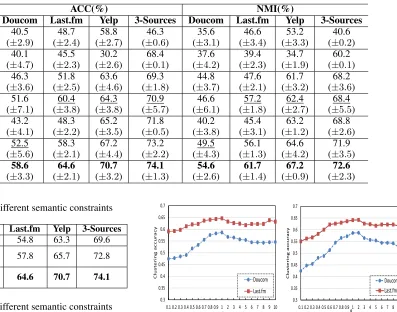
In Table 4, we present results of all methods measured by ACC and NMI for each dataset. We observe that: 1)The
F SU SCframework usually achieves a better improvement in all web datasets. This may indicate thatF SU SC frame-work has the evident effect in each web dataset, especially more suitable for real large corpus in the web application. 2)Among the NMF based clustering methods with different similarity constraint, a framework with the intra-semantic similar constraint and inter-semantic diversity information (e.g.F SU SC) performs much better than the simple pair-wise constraint, which validates that the algorithm based on our proposed unsupervised semantic framework might be a better way of capturing the difference in intrinsic connec-tion between every two data points. 3)F SU SC-inter shows a promising result, especially in Doucom. That means our inter-semantic constraint could capture diversity informa-tion among different views in large datasets, which contains many noises and useless features.
Parameter study
Table 4: Performance on four real-world datasets(Both mean value and standard deviation are reported,best results are formated in bold, while second best result are underlined)
ACC(%) NMI(%)
Metric Doucom Last.fm Yelp 3-Sources Doucom Last.fm Yelp 3-Sources
CoRe (±40.52.9) (±48.72.4) (±58.82.7) (±46.30.6) (±35.63.1) (±46.63.4) (±53.23.3) (±40.60.2)
MultiNMF 40.1 (±4.7)
45.5 (±2.3)
30.2 (±2.6)
68.4 (±0.1)
37.6 (±4.2)
39.4 (±2.3)
34.7 (±1.9)
60.2 (±0.1)
PcoNMF 46.3 (±3.6)
51.8 (±2.5)
63.6 (±4.6)
69.3 (±1.8)
44.8 (±3.7)
47.6 (±2.1)
61.7 (±3.2)
68.2 (±3.6)
CMVNMF 51.6 (±7.1)
60.4 (±3.8)
64.3 (±3.8)
70.9 (±5.7)
46.6 (±6.1)
57.2 (±1.8)
62.4 (±2.7)
68.4 (±5.5)
F SU SC-intra 43.2 (±4.1)
48.3 (±2.2)
65.2 (±3.5)
71.8 (±0.5)
40.2 (±3.8)
45.4 (±3.1)
63.2 (±1.2)
68.8 (±2.6)
F SU SC-inter 52.5 (±5.6)
58.3 (±2.1)
67.2 (±4.4)
73.2 (±2.2)
49.5 (±4.3)
56.1 (±1.3)
64.6 (±4.2)
71.9 (±3.5)
F SU SC 58.6
(±3.3)
64.6
(±2.1)
70.7
(±3.2)
74.1
(±1.3)
54.6
(±2.6)
61.7
(±1.4)
67.2
(±0.9)
72.6
(±2.3)
Table 5: ACC with different semantic constraints
Data Doucom Last.fm Yelp 3-Sources
Supervised 45.6 54.8 63.3 69.6
F SU SC
+GK 50.4 57.8 65.7 72.8
F SU SC
+SC 58.6 64.6 70.7 74.1
Table 6: NMI with different semantic constraints
Data Doucom Last.fm Yelp 3-Sources
Supervised 43.7 52.1 62.4 67.9
F SU SC
+GK 49.6 56.4 63.9 71.3
F SU SC
+SC 54.6 61.7 67.2 72.6
andβdetermine the weights of the intra-semantic similarity graph regularizer and inter-semantic diversity term, respec-tively. Figure 3 shows the performance of different reduc-tion factor on two large real-world datasets and Fig.4. eval-uates our constraint parameter while holdingγ = 1, η = 8
for all views on the two largest datasets. We also studied whether we could improve the clustering by tuning the pa-rameterγ. However, the performance is not improved much. In Fig.3., our iteration number is set to be 120, our algo-rithm will converge during 100 iterations. And we can ob-serve the performance curve inDoucomshows more steep-ness becauseDoucomis much larger thanLast.fm. In Fig.4,
F SU SC performs the sensitive change, which illustrates thatF SU SC is more suitable for the large and sparse cor-pus. In addition,F SU SC performs best whenα, βlocates in 1 or 2 when varyingγfor all views. We also studied the parameter on other small datasets likeYelpand3-Sources, and all results indicate that performance is the best when
α, βlocates around 1 or 2. This suggests that the parameter 0.3 0.35 0.4 0.45 0.5 0.55 0.6 0.65 0.7
0.1 0.2 0.3 0.4 0.5 0.6 0.7 0.8 0.9 1 2 3 4 5 6 7 8 9 10
Clu
s
t
erin
g
ac
c
u
r
ac
y
α
Doucom
Last.fm
25 30 35
0.1 0.2 0.3
0.3 0.35 0.4 0.45 0.5 0.55 0.6 0.65 0.7
0.1 0.2 0.3 0.4 0.5 0.6 0.7 0.8 0.9 1 2 3 4 5 6 7 8 9 10
C
lu
s
t
erin
g
ac
c
u
r
ac
y
β
Doucom Last.fm
Figure 4: Evaluating parameters α and β with respect to clustering accuracy on two large datasets
α, βcan be set to 1 and 2, respectively.
5
Conclusion
We have proposedF SU SCframework, a featured sampling based nonnegative matrix factorization algorithm which is combined with unsupervised semantic constraint, which can handle the real-world multiple view datasets with a large number of features. Also, we have developed an iterative op-timization algorithm to make iteration faster and accelerate convergence. Extensive experiments have demonstrated that the proposed method is effective. In the future, we will study how to model any other features together generated by com-ment users such as the list of user preference and investigate how to improve the algorithm efficiency when dealing with the huge items and features both.
Acknowledgments
References
Arthur, G.; Olivier, B.; Alex, S.; and Bernhard, S. 2005. Measuring statistical dependence with hilbert-schmidt norms. In International conference on algorithmic learning
theory, Springer63–77.
Bickel, S., and Scheffe, T. 2004. Multi-view clustering.
IEEE International Conference on Data Mining,.
Blei, D. M.; Ng, A. Y.; and Jordan, M. I. 2003. Latent dirichlet allocation. JMLR,3:993–1022.
Cai, X.; Nie, F.; and Huang, H. 2013. Multi-view k-means clustering on big data.International joint conference on
Ar-tificial Intelligence.2598–2604.
Chaudhuri, K.; Kakade, S. M.; Livescu, K.; and Sridharan, K. 2009. Multi-view clustering via canonical correlation analysis.In ICML,New York, NY, USA.
Cheng, W.; Zhang, X.; Guo, Z.; and Wu, Y. 2013. Flexible and robust co-regularized multi-domain graph clustering.
Proceedings of the 19th ACM SIGKDD international con-ference on Knowledge discovery and data mining-KDD’13.
1:320–328.
Ding, C. H.; Li, T.; and Jordan, M. I. 2010. Convex and semi-nonnegative matrix factorizations. Pattern Analysis
and Machine Intelligence, IEEE Transactions on,32(1):45–
55.
Du, L.; Li, X.; and Shen, Y. 2012. Robust nonnegative ma-trix factorization via half-quadratic minimization. In Pro-ceedings of the 12th International Conference on Data Min-ing,201–210.
Gong, X.; Wang, F.; and Huang, L. 2017. Weighted nmf-based multiple sparse views clustering for web items. In
PAKDD’17.416–428.
Greene, D., and Cunningham, P. 2009. A matrix factoriza-tion approach for integrating multiple data views.European Conference on Machine Learning and Knowledge Discovery
in Databases.423–438.
He, X.; Kan, M.; Xie, P.; and Chen, X. 2014. Comment-based multi-view clustering of web 2.0 items. In
Interna-tional Conference on World Wide Web,771–782.
Hoyer, P. O. 2004. Nonnegative matrix factorization with sparseness constraints.J. Machine Learning Research,
5:1457–1469.
J. Sun, J. B., and Kranzler, H. R. 2014. Multi-view singu-lar value decomposition for disease subtyping and genetic associations.BMC Genet.15(73).
Kumar, A., and Daum´e, H. 2011. A co-training approach for multi-view spectral clustering.In ICML’11,393–400. Kumar, A.; Rai, P.; and Daum´e, H. 2011. Co-regularized multi-view spectral clustering. In Proc. of NIPS’11,1413– 1421.
Lee, D. D., and Seung, H. S. 2001. Algorithms for non-negative matrix factorization. In Advances in neural
infor-mation processing systems,13:252–260.
Liu, J.; Wang, C.; Gao, J.; and Han, J. 2013. Multi-view clustering via joint nonegative matrix factorization.In Proc.
of SDM’13,252–260.
Long, B.; Yu, P. S.; and Zhang, Z. 2008. A general model for multiple view unsupervised learning . SIAM International
Conference on Data Mining.822–833.
Mohammadiha, N., and Leijon, A. 2009. Nonnegative ma-trix factorization using projected gradient algorithms with sparseness constraints. Proc. IEEE Int’l Symp. Signal
Pro-cessing and Information Technology,418–423.
Sun, J.; Lu, J.; Xu, T.; and Bi, J. 2015. Multi-view sparse co-clustering via proximal alternating.In Proceedings of the 32th International Conference on Machine Learning, Lille,
France,37.
Wang, Z.; Yang, Y.; Chang, S.; Li, J.; Fong, S.; and Huang, T. S. 2015. A joint optimization framework of sparse coding and discriminative clustering. In Proceedings of the 24th International Joint Conference on Artificial
Intel-ligence.3932–3938.
Yang, Y.; Wang, Z.; Yang, J.; Wang, J.; Chang, S.; and Huang, T. S. 2014. Data clustering by laplacian regular-ized l1-graph. In Proceedings of the 28th AAAI Conference on Artificial Intelligence.
Zhai, D.; Chang, H.; Zhen, Y.; Liu, X.; Chen, X.; and Gao, W. 2013. Parametric local multimodal hashing for cross-view similarity search. In Proceedings of the 23rd
Inter-national Joint Conference on Artificial Intelligence. 2754–
2760.
Zhang, X.; Zong, L.; Liu, X.; and Yu, H. 2015. Con-strained nmf-based multi-view clustering on unmapped data.
In AAAI’15,3174–3180.
Zheng, M.; Bu, J.; Chen, C.; Wang, C.; Zhang, L.; Qiu, G.; and Cai, D. 2011. Graph regularized sparse coding for image representation. Image Processing, IEEE Transactions on,
20(5):1327–1336.