Volume 2010, Article ID 303640,7pages doi:10.1155/2010/303640
Research Article
Fixed Simplex Property for Retractable Complexes
Adam Idzik
1, 2and Anna Zapart
31Institute of Mathematics, Jan Kochanowski University, 15 ´Swie¸tokrzyska street, 25-406 Kielce, Poland 2Institute of Computer Science, Polish Academy of Sciences, 21 Ordona street, 01-237 Warsaw, Poland 3Faculty of Mathematics and Information Science, Warsaw University of Technology, Pl. Politechniki 1,
00-661 Warsaw, Poland
Correspondence should be addressed to Adam Idzik,[email protected]
Received 16 December 2009; Revised 10 August 2010; Accepted 9 September 2010
Academic Editor: L. G ´orniewicz
Copyrightq2010 A. Idzik and A. Zapart. This is an open access article distributed under the Creative Commons Attribution License, which permits unrestricted use, distribution, and reproduction in any medium, provided the original work is properly cited.
Retractable complexes are defined in this paper. It is proved that they have the fixed simplex property for simplicial maps. This implies the theorem of Wallace and the theorem of Rival and Nowakowski for finite trees: every simplicial map transforming vertices of a tree into itself has a fixed vertex or a fixed edge. This also implies the Hell and Neˇsetˇril theorem: any endomorphism of a dismantlable graph fixes some clique. Properties of recursively contractible complexes are examined.
1. Preliminaries
We apply some combinatorial methods in the fixed point theory1. These methods allow us to extend some known theorems for graphs2and to suggest algorithmic procedures finding fixed simplices for simplicial maps defined on some classes of complexes.
ByNwe denote the set of natural numbers. LetV be a finite set andIn {0, . . . , n}, n∈N. ByPVwe denote the family of all nonempty subsets ofV, andPnV PnVis the family of all subsets ofV of the cardinalityn1at mostn1,n∈N. A subsetHn⊂PnV is called ahypergraphand its elements are callededgesa subsetH1 ⊂P1Vis called agraph 3. An element ofPnVis called ann-simplexdefined on the setV, and a nonempty family
Kn⊂PnVofn-simplices defined onV is called ann-complexdefined on the setV.
Acomplex generated by ann-simplexSis the complexKnS {V :V ⊂S}.
Generally, a complex Kn or an n-complexK defined on the set V is a family consisting of some complexes generated byi-simplices,i ∈ In, that is,Kn ⊂ PnV, and for any simplexS∈Kn,KnS⊂Kn.
Vertices of a complex areadjacentif they are vertices of some of its simplex.
Astar at a vertexpin ann-complexKis then-complex stKp {S:p∈S∈K}; the
vertexpis also called acenter of the star.
Let S ∈ Kn be an i-simplex of a complexKn. Then the i-simplex S is a singlei
-simplexif there exists exactly onei1-simplexT ∈Knsuch thatS⊂T, i∈In−1; compare
4, Definition 2.60of a free face.
Observe that ann-complex Kis precisely defined by its vertices VK : S∈KS and its maximal simplices maxK : {S : S ∈ K; there is no T such that S ⊂ T ∈ K andS /T}.
For complexesKnandLma mapf:VKn → VLmis calledsimplicialif every simplex ofKnis mapped onto some simplex ofLm.
For a simplex S {p0, . . . , pn} ∈ Kn by ∂S : {{p0, . . . ,pi, . . . , pn} : i ∈ In} ⊂
Kn we denote the boundary of a simplexS and denotation pi means that the vertex pi is omitted.
Notice that for ann1-simplexS,∂Sis ann-complex consisting of alln-subsimplices ofS.
Letu, vbe adjacent vertices of a complexKn, and letV be the set of its vertices. A mapr :V → V\ {u}defined byru vandrx xforx∈V\ {u}is called aretractionif:
iuandvdo not belong to the boundary∂S⊂Knof some simplexS /∈Kn,
iithe complexKndefined on verticesV\{u}with simplicesS∈Kn, such thatu /∈S orSS\ {u} ∪ {v}for someS∈KnandSu, is the subcomplex ofKn.
A complex Kn is retractable if it can be reduced to one vertex by a sequence of retractions.
A union of complexesKi, i ∈ In, is the complex L i∈InKi with vertices VL
i∈InVKi.
Analogously, theintersection of complexesKi,i∈ In, is the complexL i∈InKiwith verticesVL i∈InVKi.
2. Fixed Simplex Property
We say that an n-complex K has the fixed simplex property if for every simplicial map f : VK → VK, there exists a simplex S ∈ K which is mapped onto itself, that is, fS S.
Observe that the following lemma is true.
Lemma 2.1. For ann-simplexS, the complexKnShas the fixed simplex property.
Proof. Let the complexKnS be generated by an n-simplex S, and let f : S → S be a
simplicial map. Notice thatfk1S⊂fkS, wherek∈Nandf0S:S.
BecauseSis a finite set, we haveffiS fiSfor some iterationi ∈ In, that is, fiSis a fixed simplex.
Lemma 2.1can be extended to the following.
Theorem 2.2. A star has the fixed simplex property.
Proof. Assume that stKpis a star at a vertexp in an n-complexK. It consists of a finite
that for any simplicial mapf :VstKp → VstKpthere is a simplex in stKpwhich is
mapped onto itself. Denotep0:p.
1Iffp0 p0, then{p0}is a fixed simplex.
2Iffp0/p0, then denote p1 : fp0. The vertices p0 andp1 are adjacent because
the center of the starp0is adjacent to all vertices.
Observe that all succesive iterations of the vertexp0includingp0are in one simplex.
ByLemma 2.1there exists a fixed simplex of the mapf. More precisely, consider any vertex pi fip0such thatfpi pk, wherek ∈Ii, i∈In. Observe that the simplex{pk, . . . , pi}is the fixed simplex of the mapf.
The method used in the second step of the proof ofTheorem 2.2can be applied to show the following.
Theorem 2.3. If ann-complex is retractable, then it has the fixed simplex property.
Proof. We proceed by induction on the numbermof vertices of a retractable complex. The
theorem is true for the 0-complex. LetKnbe retractable complex withm1 vertices and let fbe a simplicial map defined onVKn. By the definition of a retractable complexKnthere exists a retractionrof a vertexuto a vertexv. The complexKnwithmvertices obtained by the retractionrhas the fixed simplex property. Of courseris the simplicial map fromVKn toVKn, indeed all simplices ofKnare mapped onto themselves, simplices containing{u} are mapped onto respective simplices containingv, simplices containinguandvare mapped onto simplices of a smaller dimension. Define a simplicial mapf : r◦f onVKn. Let S ∈ K
nbe a fixed simplex of the mapf|VK
n. IffS ∈K
n, thenSis the fixed simplex off. If not, then there is some vertexx∈Ssuch thatfx u,u /∈S, andfx v,v∈ S. For all the other verticesy∈S\ {x}we havefy fy∈S\ {v}. We consider successive iterations offxand show that allfix,i ∈ N,f0x : x, are in some simplex ofK
n. Becausefis the simplicial map, the simplex{u} ∪S\ {v}∈Kn. Byifor anyT ⊂S\ {v} the simplex{u, v} ∪T belongs toKnbecauseu, vare on some boundary∂T⊂Knfor some T ⊂ {u, v} ∪S. In particular the simplexfx∪Sis inK
n. Analogously, by induction on k we prove that i∈Ik{fix} ∪S ∈ Kn,k ∈ Im. Observe that any vertex adjacent to the vertexuis also adjacent to the vertexv, because of conditioniiof the retractionr. So all simplices{fix, v}belong toKn,i∈N\ {0,1}. Thus, byLemma 2.1applied to the simplex
i∈N{fix} ∪S, the complexKnhas the fixed simplex property.
3. Recursively Contractible Complexes
A complex isrecursively contractible 5if it is generated by an n-simplex or, recursively, it is a union of two recursively contractible complexes whose intersection is also a recursively contractible complex.
A complex iss-recursively contractibleor atree-likeif it is generated byn-simplex or, recursively, it is a union of two s-recursively contractible complexes whose intersection is a complex generated by some simplex.
Theorem 3.1. From ans-recursively retractable complexKn, by a sequence of retractions, one can
Proof. We proceed by induction on the number of recursive steps in the definition ofKn. Our theorem is obviously true for complexes consisting of two complexes generated by some simplices with a common complex generated by some simplex. Assume that our theorem is true for s-recursively complexesKnandLn. Let the complexKn∪Lnbe their union and a complexMnS generated by some simplexSbe their intersection. LetT ∈ Kn. Then we construct a sequence of retractions fromLn to the complexMnSand successively in the complexKnto obtain the complex generated byT.
Corollary 3.2. Every s-recursively contractible complexKnis retractable.
Now fromCorollary 3.2andTheorem 2.3we have the following.
Corollary 3.3. If an n-complex K is s-recursively contractible, then it has the fixed simplex property.
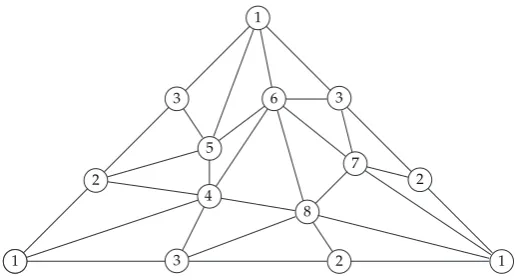
Notice that the recursive contractibility of complexes is not equivalent to the topological contractibilityseeFigure 1.
Theorem 3.4. Any triangulation of the dunce cap is not recursively contractible.
Proof. Let an2-complexKbe a triangulation of the dunce cap. Assume thatKis recursively
contractible. Then it can be represented as a union of two recursively contractible 2-complexesAandBsuch that their intersectionCis also a recursively contractible complex. Each of complexesAandBmust contain at least one 2-simplex which does not belong toC. Let us remove all 2-simplices, 1-simplices and 0-simplices ofAandBwhich do not belong toC, respectively. The remaining simplices compose a complexC. We successively remove all single 1-simplices and respective 2-complexes ofC. Observe that the remaining part ofC contains a 1-dimensional cycle and it cannot be recursively contractible.
4. Graph Complexes
Now we present some applications to the graph theory.
A graph is represented by an1-complex. A vertex of a graph is considered also as a 0-simplex and an edge is considered as a 1-simplex7.
AgraphGis a nonempty finite set VG, whose elements are called vertices, and a
finite setEG⊂ P1VGof unordered pairs of the setVGcalled edges. In caseEG
P1VGit is called acliqueor acomplete graph.
An edge of the form{v} ∈P0VGis called aloopinEG.
Assumption 4.1. In this paragraph we assume thatP0VG⊂EGfor every graphG.
A vertexuis aneighbourof a vertexvif there is an edgee{u, v} ∈EG.
Asubgraphof a graphG V,Eis a graphH V1,E1, whereV1⊂VandE1⊂E. In
this case we denoteHG.
A pathP W,Fin a graphG V,Eis a subgraphP Gwith pairwise different verticesW {v0, v1, . . . , vk1}, such that{vi, vi1} ∈Ffori∈Ikand somek ∈N. The path P is denoted byv0· · ·vk1.
Furthermore, a pathv0· · ·vk1 W,Fis acycleif{v0, vk1} ∈F, k∈N.
1
3 3
2
4 5
6
7
8
2
2
3 1
1
Figure 1:Dunce cap is topologically contractible6.
A connected graph without cycles is called atree.
Let Gi be a graph,VGibe a set of its vertices and EGi be a set of its edges. A
union of the graphsGi,i∈In, is a graphHi∈InGi, whereVH i∈InVGiandEH
i∈InEGi.
Analogously, theintersection of the graphsGi,i ∈ In, is a graphH i∈InGi, where VH i∈InVGiandEH i∈InEGi.
Let the vertices of a graphGbe covered by its maximal cliquesthe covering is unique. These cliques generate maximal simplices. The graphGis identified with a graph complex
KG consisting of these simplices and its subsimplices. There is one to one correspondence between the graphGand the graph complexKGdefined in that way.
We know that a tree has the fixed edge property8or the fixed point property9. To formulate this theorem for graph complexes we consider a tree as a union of 1-simplices, where the intersection of some two 1-simplices is a vertex or an empty set.
Fact 1see8, Theorem 3. A tree with loops has the fixed clique property.
Similarly, we conclude that a union of graphs, having the fixed clique property, with a clique as their intersection also has the fixed clique property. We just consider complexes generated by these graphs with simplices generated by respective cliques.
The fixed clique property is analogous to the fixed simplex property. Simplicial maps on complexes correspond to edge-preserving maps on graphs.
Theorem 4.2. If each of a finite number of graphsG1 V1,E1,G2 V2,E2, . . . , Gk Vk,Ek
has the fixed clique property and the intersection of these graphs is a clique, then their union
G1
G2
· · ·Gk V1∪V2∪ · · · ∪Vk,E1∪E2∪ · · · ∪Ekhas also the fixed clique property.
A graph G which generate the retractable graph complex KG is called a retractable
graph.
A graphGis triangulated10if every cycle of the length greater than 3 possesses a chord, that is, an edge joining two nonconsecutive vertices of the cycle.
1
3 2
4
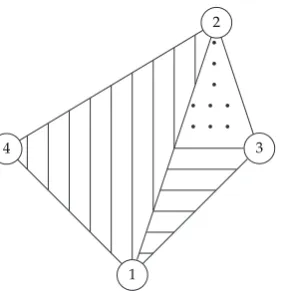
Figure 2:The retractable complexM2cannot be obtained from the dismantlable graphK4by covering
by maximal cliques.
Figure 3:The dismantlable graph which is not triangulated.
Observe that a fold in a dismantlable graph G corresponds to a retraction in the respective graph complexKG.
Theorem 4.3see 2, Theorem 2.65. Every endomorphism of a dismantlable graph fixes some clique.
Fact 2. A dismantlable graph is a retractable graph.
A dismantlable graph always generate a retractable complex. However, there are some retractable complexes which cannot be obtained from the dismantlable graph. Consider a cliqueK4with four vertices. Covering its vertices by simplices we obtain a complexL3K4.
This complex contains all edges of the clique K4 but these edges are also contained in the
complexM2obtained fromL3K4by removing simplices 1234 and 123seeFigure 2.
Observe that triangulated graphs are dismantlable. One can find some dismantlable graphs which are not triangulatedseeFigure 3.
Acknowledgment
References
1 A. Granas and J. Dugundji,Fixed Point Theory, Springer Monographs in Mathematics, Springer, New York, NY, USA, 2003.
2 P. Hell and J. Neˇsetˇril,Graphs and Homomorphisms, vol. 28 ofOxford Lecture Series in Mathematics and Its Applications, Oxford University Press, Oxford, UK, 2004.
3 C. Berge,Graphs and Hypergraphs, North-Holland, Amsterdam, The Netherlands, 1973.
4 T. Kaczynski, K. Mischaikow, and M. Mrozek, Computational Homology, vol. 157 of Applied Mathematical Sciences, Springer, New York, NY, USA, 2004.
5 A. Wieczorek, “The Kakutani property and the fixed point property of topological spaces with abstract convexity,”Journal of Mathematical Analysis and Applications, vol. 168, no. 2, pp. 483–499, 1992. 6 J. R. Munkres,Elements of Algebraic Topology, Addison-Wesley, Menlo Park, Calif, USA, 1984.
7 A. K. Dewdney,Extensions and generalizations of graph theorems to complexes and hypergraphs, Ph.D. thesis, Department of Combinatorics and Optimalization, University of Waterloo, August 1974. 8 R. Nowakowski and I. Rival, “Fixed-edge theorem for graphs with loops,”Journal of Graph Theory,
vol. 3, no. 4, pp. 339–350, 1979.
9 A. D. Wallace, “A fixed-point theorem for trees,”Bulletin of the American Mathematical Society, vol. 47, pp. 757–760, 1941.