111 Brock Education Journal, 26(2), 2017
Exploring Native and Non-Native EFL Teachers’ Oral Corrective
Feedback Practices: An Observational Study
Yusuf Demir
Necmettin Erbakan University
Kemal Sinan Özmen
Gazi University
Abstract
Commonly defined as L2 teachers’ responses to learners’ erroneous utterances, oral corrective feedback (OCF) is an interactional classroom phenomenon which frequently occurs in foreign language classes and has gained growing momentum in SLA research in recent years. However, how OCF preferences of English teachers vary in terms of their native-nonnative speaker status remains as an uncharted territory of inquiry specifically in an expanding-circle context. This study aims to reveal the differences between in-class OCF practices of native and non-native English-speaking teachers (NESTs & NNESTs) in Turkish EFL context and to explore the cross-cultural influences that might affect these practices. To these ends, structured classroom observations and interviews were conducted with seven NESTs and seven NNESTs. The findings of the observations showed that the NESTs’ and NNESTs’ in-class OCF practices differed considerably in terms of their tolerance of errors, preferred OCF types, the amount of OCF and different types of OCF to different types of errors. Moreover, the follow-up interview findings demonstrated some similar and different dispositions between the teacher groups concerning several dimensions (whether, how, when, and which errors should be corrected, and by whom) including the effect of teaching experience and teacher education on their OCF-giving patterns.
Keywords: Oral corrective feedback, error correction, native/non-native English-speaking teachers, cross-cultural influences
Yusuf Demir, Ph.D., is currently employed as an Assistant Professor at Necmettin Erbakan University, School of Foreign Languages, Konya, Turkey. His main research interests include second language teacher education, error and feedback in L2 classroom interaction, the use of newly-introduced technological tools in teaching foreign languages, native and non-native teacher issues.
Email: [email protected]
Kemal Sinan Özmen, Ph.D., works as an Associate Professor at Gazi University, English language teaching program in Turkey. He holds a Ph.D. degree on teaching English as a Foreign Language with a specific focus on artistic dimensions of teaching profession, teacher identity and beliefs as well as pre-service teacher education.
112 Brock Education Journal, 26(2), 2017
As the form of responses to learner utterances that contain an error (Ellis, Loewen, & Erlam, 2006), oral corrective feedback (OCF) is a frequently resorted feature of classroom interaction by L2 teachers. Teachers’ decisions regarding OCF provision are shaped by their implicit and explicit theories of L2 learning and teaching, in addition to some essential determinants including their native-nonnative position. Yet, the role of this teacher variable in classroom OCF provision has been underresearched in the related field thus far, in a way marginalizing its value for pedagogical scrutiny. While a plethora of studies have addressed OCF in terms of internal and external factors such as instructional contexts (e.g., Lyster & H. Mori, 2006; Sheen, 2004), the focus, target and types of OCF provided and the following uptake (e.g., Russell & Spada, 2006; Long, 2007), student and teacher cognition, stated preferences and perceptions toward OCF (e.g., Mori, 2011; Rahimi & Zhang, 2015), individual learner factors including age (e.g., Havranek, 2002), proficiency level (e.g., Ammar & Spada, 2006), anxiety (e.g., Sheen, 2006), limited attention has been directed to the provider of OCF (i.e. teacher).
Only few studies investigated the link between individual factors regarding L2 teachers such as their native-nonnative status, pre-service education, teaching experience and their provision of OCF in the foreign language classroom (Gurzynski-Weiss, 2010) in spite of the teacher being the main source of L2 input (Philp & Tognini, 2009). What is more, studies on OCF “appear mainly to involve L2 English or L2 French in either Canada or the USA” (Dilans, 2015, p. 1). While some of the OCF research has been carried out in laboratory settings (e.g., McDonough, 2007), a good number of studies picked immersion classes as research settings (e.g., Lyster & Ranta, 1997; Lee, 2007; Vicente-Rasoamalala, 2009) despite the worldwide abundance and numeric dominance of English as a foreign language (EFL) contexts. These gaps point to the obvious need to conduct more OCF research outside the countries of the inner circle and in EFL classroom settings, serving as a springboard for the present study. Bearing these gaps in OCF research in mind, this study sets out to unravel native and non-native English-speaking teachers’ (NESTs and NNESTs) in-class OCF preferences in tertiary education English language schools with regards to previous educational background of those group of teachers, the cultural dispositions behind their instructional practices and how all those are enacted in actual classroom settings.
Theoretical Framework
113 Brock Education Journal, 26(2), 2017
While these theories lend support to the facilitative effect of OCF on L2 learning, there are also those who raised criticisms toward its provision. Truscott (1999), for example, contended that correction disturbs the ongoing communication and diverts the students’ and teacher’s attention from the essential communicative tasks. He also questions why a busy teacher should devote so much time and effort to mastering error correction which in his view is most likely to be unsuccessful. Yet, in today’s post-method era when the necessity of error correction is acceptably underscored, such criticisms might be a chimera if one considers the large number of studies (e.g. Han, 2002; Sheen & Ellis, 2011; Lyster, Saito, & Sato, 2013) which found error correction to be useful in formal instruction. In the post-method era, the methodologists recognize the cognitive contribution OCF can make, while at the same time raising concerns about the potential affective damage it can do (Ellis, 2009).
NESTs’ and NNESTs’ General Dispositions Toward Error Correction
Although the related research literature provides some insight into the instructional behaviour of L2 teachers with reference to NEST/NNEST variable, studies with such a focus have mostly been carried out at the level of perception. While NESTs were generally characterized by more authentic use of language (Barratt & Kontra, 2000), fluent speech (Lasagabaster & Sierra, 2005), less commitment to coursebooks (Benke & Medgyes, 2005) and so on, their non-native counterparts were perceived to be more willing to teach (Mahboob, 2004), more empathetic (Tatar & Yıldız, 2010) and better predictors of learning difficulties (Braine, 2004). The common by-product finding of those perception studies was that NESTs were thought to be more tolerant of errors than NNESTs.
In spite of not saying much about NESTs’ and NNESTs’ in-class OCF practices, these perception studies shed light on where both populations stand in the eyes of students regarding their tolerance of errors. More purposive findings come from two recent classroom-based theses. In the first, contrary to the findings of perception-exploring studies, Gurzynski-Weiss (2010) found that the native teachers of Spanish (NTSs) were, in practice, not more tolerant of errors than the non-native teachers of Spanish (NNTSs) as a foreign language, and the NTSs provided explicit feedback significantly more than the NNTSs. In the other thesis in question, Dilmaghani (2014) compared NESTs’ and NNESTs’ OCF giving patterns in the Turkish EFL context through classroom observations. In contrast with Gurzynski-Weiss (2010), he revealed that the NNESTs provided higher amounts of OCF than the NESTs, in addition to the NESTs’ more frequent resort to explicit correction than the NNESTs.
The present study is a contribution to the diversion of OCF research trend to L2 teachers as the main source of OCF, and specifically investigates the effects of their native/non-native (N/NN) status on their in-class OCF giving patterns. To this end, this study sought answers to the following research questions:
1. What are the types of OCF preferred by the NESTs and NNESTs in Turkey? 2. How tolerant are NESTs and NNESTs of errors?
3. Which errors are corrected more frequently by NESTs and NNESTs?
4. What types of learner errors lead to what types of OCF by NESTs and NNESTs ?
5. Are there any cross-cultural influences that affect OCF preferences of NESTs and NNESTs?
114 Brock Education Journal, 26(2), 2017
Methodology
Classroom Observations
This classroom-based SLA study has primarily chosen natural classroom settings from which the primary data are obtained through a large quantity of classroom observations. Classroom-based studies have a high level contextual convenience, and therefore, they are “most likely to lead to a better understanding about the kind of interaction that occurs in classrooms where the teacher is the only proficient speaker and interacts with a large number of learners” (Spada & Lightbown, 2009, p. 159). For this reason, structured classroom observations are ideally suited for identifying the targeted interactional behaviours within the scope of this study.
The classes of 7 NESTs and 7 NNESTs were observed over a period of 6 weeks, totaling 55 course hours which amounts to upwards of 36 hours of audio recordings (20.16 hour long observation of NEST classes, and 16.08 hours of NNEST classes). The observed teachers were teaching 20 tertiary-level EFL classrooms at one private and two state universities in Turkey. The recorded classes were homogeneous in terms of students’ proficiency level, which was A2. Class sizes varied from 16 to 25 students. Before the observations, official permissions were received from the institutions, and the observed teachers were distributed informed consent forms. The teachers were not informed about the foci of the research. The researcher was not present in the class during the audio recordings to avoid any observer effect (Gurzynski-Weiss, 2010) and to ensure data naturality.
While the observed NESTs were teaching listening and speaking, their non-native counterparts taught integrated courses. The courses taught by both teacher groups were oriented toward improving learners’ Basic Interpersonal Communicative Skills (BICS), defined by Brown (2007) as the communicative capacity which learners acquire so as to function in daily interpersonal changes, being context-embedded in face-to-face communication. The observed NESTs came from the United States, with English being their L1. Except for one, all the NESTs had CELTA (Certificate in English Language Teaching to Adults). Their average age was 28, and they had 2.3 years of teaching experience on average. On the other hand, 5 out of 7 observed NNESTs graduated from SLTE programs and the other two received pedagogical formation training. The observed NNESTs’ average age was 33 and they had on average 10.2 years of teaching experience.
Analysis of the Classroom Interaction Data
115 Brock Education Journal, 26(2), 2017
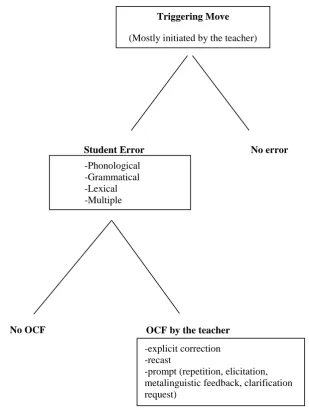
Figure 1: The model of error treatment sequence (partially adapted from Lyster & Ranta, 1997) In this interactional model, firstly, the teacher initiates the topic, discussion, dialogue etc. or asks students some questions about the target content. However, it is not necessarily the teacher who triggers a conversation. This may also be done by students. Then, as a response, one of the students produces speech either unerringly or including at least one type of error. In the latter case, the teacher either ignores the error, or provides OCF in the form of explicit correction, recast or prompt that pushes learners to self-correct. This model comes to an end at this point and does not proceed with if/how learners respond to the teacher’s OCF (i.e. uptake) because it falls outside of the boundaries of the current research.
In the coding of the interaction database, some considerations were specified. First, it was a prerequisite for coding the data to decide on what makes a word or utterance an erroneous one, and if so, which error category it needs to fall into, and which corrective move belongs to which type of OCF. At this juncture, Lyster’s (1998) specifications of error groupings were put to use. As for the types of OCF, they were labelled as recast, explicit correction, elicitation, clarification request, repetition and metalinguistic feedback as in Lyster and Ranta (1997). Afterwards, these six OCF types were reduced into three subcategories for the contextual convenience of the present study: recast, explicit correction, and prompts (elicitation,
Student Error No error
-Phonological -Grammatical -Lexical -Multiple
No OCF OCF by the teacher
-explicit correction -recast
-prompt (repetition, elicitation, metalinguistic feedback, clarification request)
Triggering Move
116 Brock Education Journal, 26(2), 2017
clarification request, repetition and metalinguistic feedback) considering that such a taxonomy would allow for a more concrete and cumulative understanding of the research findings.
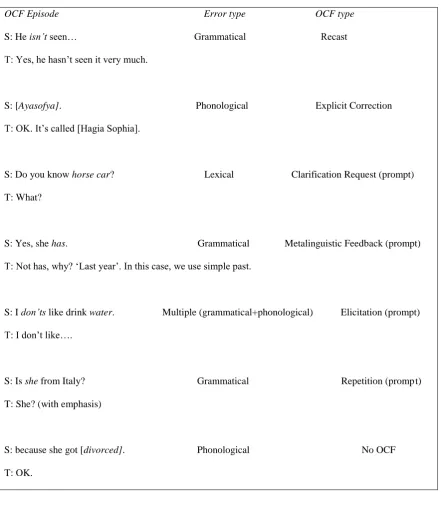
Table 1 provides examples for each error and OCF type extracted from the database of interaction obtained from the classroom audio recordings for the present study.
Table 1
Coded Examples of Errors and OCF Moves
OCF Episode Error type OCF type
S: He isn’t seen… Grammatical Recast
T: Yes, he hasn’t seen it very much.
S: [Ayasofya]. Phonological Explicit Correction
T: OK. It’s called [Hagia Sophia].
S: Do you know horse car? Lexical Clarification Request (prompt)
T: What?
S: Yes, she has. Grammatical Metalinguistic Feedback (prompt)
T: Not has, why? ‘Last year’. In this case, we use simple past.
S: I don’ts like drink water. Multiple (grammatical+phonological) Elicitation (prompt)
T: I don’t like….
S: Is she from Italy? Grammatical Repetition (promp t)
T: She? (with emphasis)
S: because she got [divorced]. Phonological No OCF
T: OK.
117 Brock Education Journal, 26(2), 2017
to code randomly selected 60 OCF-containing episodes out of 558 (a subset of 11% of all the OCF episodes) by using the coding system. It was seen that a 92% rate of intercoder agreement was reached between the selected coder’s and the researcher’s codings. Then, an ELT professor was consulted to perform a thorough scrutiny of the coding throughout the whole database. Following some constructive discussions on the coding system and question-and-answer session for verification, he substantiated the accuracy of the codings. Analysis of the interaction database generated numerical data. Descriptive statistics were used to show the numbers, frequencies and percentage distributions, in addition to Chi-Square tests of independence and logistic regression analysis to explore some relationships.
Follow-up Interviews and Analysis
As a commonly-used tool for qualitative inquiry, interviews are well-suited for getting the story behind the experiences of participants. Interviews can make this possible by giving access to the context of people’s behaviour (Seidman, 2006), providing in-depth information about the topic and serving as a follow-up to respondents’ practices and experiences. To this end, as an extention of the results obtained from the classroom observations, semi-structured interviews were held with the NESTs and NNESTs following the classroom observations in order to make sense of their dispositions toward error correction and OCF provision in the Turkish EFL context. The interviews included a total of 13 questions (see the Appendix), developed exclusively by Lennane (2007) in order to examine the cross-cultural influences on OCF preferences of the NESTs and Taiwanese NNESTs as well as those raised by Hendrickson (1978) to form a basis for the field of error correction. Hendrickson’s (1978) questions did not suffer any relevance issues because SLA researchers have been addressing them for almost forty years. Lennane’s (2007) interview questions were also adopted with peace of mind, having served the same purposes as the present study in a formerly written PhD dissertation. The draft version of the interview questions were examined by an ELT professional in terms of suitability for the purposes of the current research, which led to minor modifications in some of the interview questions.
The interviews were content analyzed qualitatively with a view to interpreting the textual data to find the salient discourse patterns in the NESTs’ and NNESTs’ conceptions regarding error correction, cross-cultural factors on their OCF practices, and their dispositions toward OCF. After the transcribing process, a three-stage coding approach was adopted to organise the data: open, axial and selective coding. The first stage was performed sentence-by-sentence through cyclical readings, leading to emergence of the initial codes. It was noticed after a while that theoretical saturation was provided (Glaser & Strauss, 1967), which shows that adequate information has been collected to thoroughly reflect the perspectives of the study’s participants. In the second stage, the relationship of categories were explored and connections were made among them.
118 Brock Education Journal, 26(2), 2017
Results
Findings of the Classroom Observations
RQ 1: What are the types of OCF preferred by the NESTs and NNESTs in
Turkey? Table 2 shows the NESTs’ and NNESTs’ preferences for different OCF types as well
as the total number of each OCF move. In this observational data set, the NESTs provided 332 (59%) OCF moves to learner errors, while the NNESTs directed OCF 226 (41%) times, totaling 558 (100%) OCF moves. Of these OCF moves, as is evident in Table 2, recast is by far the most preferred type of OCF by both the NESTs (89% of all NEST OCF, n=296) and NNESTs (73% of all NNEST OCF, n=164). This preference amounts to 82% (n=460) of the total OCF moves by the two teacher groups. This suggests that recasting is seemingly both the NESTs’ and NNESTs’ established way of OCF provision. Besides, the NESTs and NNESTs displayed the same order of frequency in their uses of other OCF types. While prompt was their second most preferred OCF type (the NESTs, 9%, n=29; the NNESTs, 23%, n=53), it was explicit correction that both the NESTs and NNESTs resorted to the least (2%, n=7, and 4%, n=9, respectively). It may well be said that explicit correction hardly exists in the NESTs’ and NNESTs’ OCF repertoire. Explicit corrections and prompts provided by the two groups together make up less than one fifth of the total amount of their OCF (18%, n=98).
Table 2
Distribution of OCF Types Provided by the NESTs and NNESTs (In a Total of 20.16 Hours of NEST and 16.08 Hours of NNEST Classroom Recordings)
____________________________________________________________________________
NESTs (N=332) NNESTs (N=226) Total (N=558)
f % f % f %
Recast 296 89 164 73 460 82
Prompt 29 9 53 23 82 15
Explicit Correction 7 2 9 4 16 3
In order to find out if there is a significant relationship between N/NN status and the amount of different OCF types used, Square tests of independence were performed. Chi-Square results revealed that there are statistically significant relationships between N/NN status and (1) the amount of recast use (x2=25.56, p<.01), and (2) the amount of prompt use (x2=23.23, p<.01), separately. The NESTs employed more recasts than the NNESTs (n=296, 89% of all the OCF by the NESTs; and n=164, 73% of all the OCF by the NNESTs was recast), whereas the NNESTs used prompts more than the NESTs (n=29, 9% of all the OCF by the NESTs; and n=53, 23% of all the OCF by the NNESTs was prompt). Being quite limited in number, significance was not tested between N/NN status and the amount of explicit correction used.
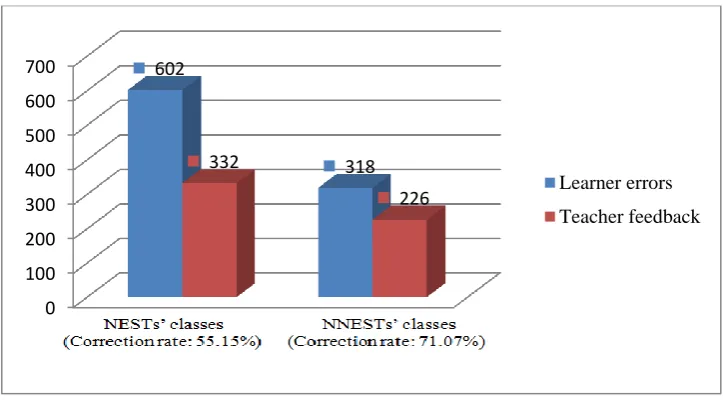
RQ 2: How tolerant are NESTs and NNESTs of errors? Figure 2 shows the total
119 Brock Education Journal, 26(2), 2017
NESTs, while the NNESTs provided 226 OCF moves to a total of 318 errors in their classes. The NNESTs corrected their learners’ errors at a higher percentage than the NESTs (71.07% correction rate by the NNESTs, and 55.15% correction rate by the NESTs). This specific result indicates that the NESTs seem to be more tolerant of errors than the NNESTs in the present context.
Figure 2. Rate of error correction by the NESTs and NNESTs (in a total of 20.16 hours of NEST and 16.08 hours of NNEST classroom recordings)
In addition, a binary logistic regression analysis was performed to explore the potential relationship between N/NN status and the amount of OCF. The analysis indicated that N/NN status is significantly related to the percentage of errors addressed with OCF (p< .01).
RQ 3: Which errors are corrected more frequently by NESTs and NNESTs? Table
3 shows the number of phonological, grammatical, lexical and multiple errors made by the learners and the number of OCF moves provided by the NESTs and NNESTs for each error type (the number of OCF to the specified error type / the number of learner errors made in the specified error type) as well as the NESTs’ and NNESTs’ correction rates for each error type. Table 3 points to the similarities as well as some striking differences between the NESTs’ and NNESTs’ correction rates for different types of error. For example, the NESTs and NNESTs clearly drew apart from each other in handling grammatical errors (32% correction rate by the NESTs, and 70% by the NNESTs). Another distinct dissimilarity was observed with respect to the correction of lexical errors (67% correction rate by the NESTs, and 96% by the NNESTs). In addition, the NESTs corrected almost one half of the multiple errors (49%) and the NNESTs two thirds of them (67%). However, their correction rates for phonological errors were similar although it was a bit higher in favor of the NESTs (75% correction rate by the NESTs, and 67% by the NNESTs). As a parallel commentary, the NESTs corrected phonological (75%) and lexical errors (67%) considerably more than grammatical errors (32%). On the other hand, the NNESTs corrected nearly all the lexical errors (96%), followed in a descending order by the correction of 70% of all the grammatical and 67% of all the phonological errors.
0 100 200 300 400 500 600
700 602
318 332
226 Learner errors
120 Brock Education Journal, 26(2), 2017
Table 3
The Number and Percentage of OCF Moves by the NESTs and NNESTs per Error Type (In a Total of 20.16 Hours of NEST and 16.08 Hours of NNEST Classroom Recordings)
____________________________________________________________________________
Phonological Grammatical Lexical Multiple
NESTs / NNESTs NESTs / NNESTs NESTs / NNESTs NESTs / NNESTs
f 184/247 74/111 77/238 114/162 52/78 26/27 19/39 12/18
% 75 67 32 70 67 96 49 67
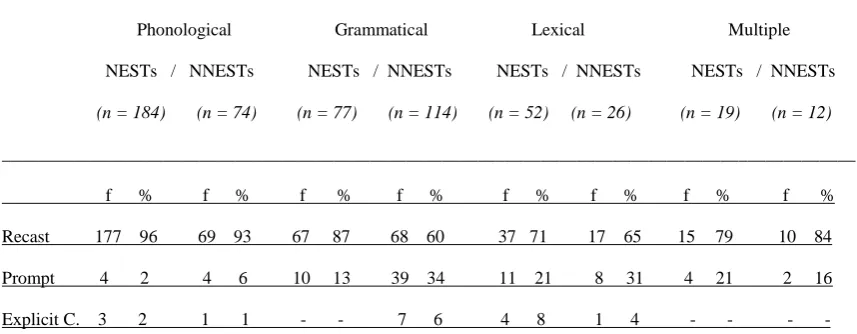
RQ 4: What types of learner errors lead to what types of OCF by NESTs and
NNESTs ? Table 4 shows the distribution of three types of OCF across different types of error
in the NESTs’ and NNESTs’ classes. In both the NESTs’ and NNESTs’ classes, nearly all the phonological errors were corrected with recasts (96% by the NESTs, and 93% by the NNESTs). As for grammatical errors, the NESTs opted for giving recasts to a great majority of them (87%), followed by prompts (13%). The NESTs used no explicit correction to correct grammatical errors. If not as much as the NESTs did, the NNESTs provided recasts to grammatical errors at a high rate (60%). This was followed by prompts (34%) and explicit correction (6%). Recast was also the NESTs’ and NNESTs’ most preferred strategy to correct lexical errors (71% and 65%, respectively). They also resorted to prompts (21% by the NESTs, and 31% by the NNESTs) and explicit correction (8% by the NESTs, and 4% by the NNESTs) to treat lexical errors. Even in the small sample of the correction of multiple errors, they primarily used recasts (79% by the NESTs, and 84% by the NNESTs), followed by prompts (21% by the NESTs, and 16% by the NNESTs). In conclusion, recast was evidently the most prominent OCF strategy of both the NESTs and NNESTs for all types of error, especially in the case of handling phonological errors. In addition, it was revealed that in their efforts to treat grammatical, lexical and phonological errors, the NESTs employed proportionally more recasts than the NNESTs whereas the NNESTs used proportionally more prompts than the NESTs.
Table 4
Distribution of Errors Receiving OCF from the NESTs (N= 332) and NNESTs (N=226) across OCF Types and Error Types (In a Total of 20.16 Hours of NEST and 16.08 Hours of NNEST Classroom Recordings)
_______________________________________________________________ Phonological Grammatical Lexical Multiple
NESTs / NNESTs NESTs / NNESTs NESTs / NNESTs NESTs / NNESTs
(n = 184) (n = 74) (n = 77) (n = 114) (n = 52) (n = 26) (n = 19) (n = 12)
_______________________________________________________________________________________________
f % f % f % f % f % f % f % f %
Recast 177 96 69 93 67 87 68 60 37 71 17 65 15 79 10 84
Prompt 4 2 4 6 10 13 39 34 11 21 8 31 4 21 2 16
121 Brock Education Journal, 26(2), 2017
Findings of the Follow-up Interviews
RQ 5: Are there any cross-cultural influences that affect OCF preferences of
NESTs and NNESTs? The interview findings are presented below pursuant to the emergent
categories. Pseudonyms were used throughout the reportings to ensure the teachers’ anonymity.
Category 1: Teacher training and teaching experience: Their effects on teachers’ attitudes toward error correction and OCF practices. There was a consensus among the NESTs on that attitudes about error correction are widely shaped through experience. Teaching experience was highlighted by the NESTs as a vital factor in shaping their correction patterns. They further emphasized the necessity of being familiar to students and getting to know about their characters, dispositions etc. in time. The NESTs raised mixed reactions with regard to the effect of teacher training on their OCF practices. Some of the NESTs admitted that their teacher training did not practically contribute to their OCF giving patterns, though they appreciated the role of teacher training in giving some theory and generating ideas on error correction in general. As for the NNESTs, in a similar vein, there was not a unity in their reflections on the effect of teacher training on their error correction practices. Some of the NNESTs held the belief that their teacher training played an important role in shaping their attitudes toward error correction and teaching in general while some others attributed their attitudes about error correction to their teaching experience rather than teacher training. As one of the NNESTs, Ercan, stated: “Certain aspects of teaching come with experience. Teaching is not 100% teachable. Some things are intuitive in teaching. My training didn’t influence the way I correct errors. I still do it intuitively.”
As a result, both the NESTs and NNESTs laid strong emphasis on teaching experience. They were of the belief that error correction is an instructional tool which develops automatically in due course of time as one gains enough experience. However, both in the NEST and NNEST groups, the teachers fell into dispute about the contribution of teacher training to their attitudes about error correction.
Category 2: The necessity and effectiveness of error correction. The NESTs did not seem to reach a consensus on the necessity of correcting learners’ oral errors, nor on its effectiveness. They held different beliefs with regard to the necessity and effectiveness of error correction. When they stated errors had to be handled, these statements were accompanied by different conditions and factors such as focus of the lesson, the individual student, affective concerns, flow of the communication. When they were for the effectiveness of error correction, they uttered its benefits such as informing learners about their errors and preventing them from making potential errors. Yet, other NESTs questioned the effectiveness of error correction and emphasized student-bound drawbacks such as their failure to take criticism and ultimately become discouraged, thus resulting in silence as well as their inability to learn from the received OCF and make the same error over and over again. On the other hand, the NNESTs widely agreed that oral error correction is a necessary and effective pedagogical tool. As different from the NESTs who uttered conditions for correction, the NNESTs gave reasons why correction should be made. The NNESTs argued that correction prevents further misunderstandings and errors from being fossilized, gives learners an opportunity to learn from errors, enables them to gain self-awareness and hear the correct form.
122 Brock Education Journal, 26(2), 2017
on the supposition that they do not have the potential to disrupt the conversation. As for the NNESTs, they mainly linked their use of different OCF types to a number of factors such as the task/activity, the type of error, the individual student. The NNESTs mentioned having used prompts because they believed that it is important to give learners some hints to lead them to self-correct. Recast was also voiced as a popular way of correction among the NNESTs, though not as much as prompts. Also noteworthy is that the NNESTs mentioned more varied OCF types than the NESTs as their OCF preferences including recast, different ways of prompting, delayed and implicit OCF.
Category 4: Prioritized types of error for correction. It was agreed by the NESTs and NNESTs that errors which impede intelligibility require the most attention. However, the two groups differed in terms of their viewpoints on prioritizing different types of error. For the most part, the NESTs remarked that they give priority to the correction of phonological errors, thinking that they are mainly responsible for unintelligibility. On the other hand, the NNESTs did not highlight a particular type of error to receive top priority. They rather labelled errors in need of special care as critical, strategic or fundamental. One NEST, Betsy, raised the following remark at this point: “Quite important for listening and speaking lessons, of course pronunciation. And I will correct grammar and vocabulary if it affects communication.”
Category 5: Determinants in the timing of error correction. Some of the NESTs expressed their preference for immediate OCF, stating that it is the best time right after a student says the word. On the other hand, some of the NESTs underscored the negative effects of immediate OCF on learners’ oral production. They argued that correction can be delayed until the end of learner speech, especially because immediate OCF has the potential to discourage them from speaking. The following is an exemplary remark from one of the NESTs (Judith): “… it kind of discouraged them from speaking so I stopped correcting immediately because it is detrimental to their self-confidence.” On the other side, the NNESTs attributed their timing of OCF to factors such as orientation of the course, task type, frequency of errors, affective concerns and retention.
Category 6: Division of responsibilities for error correction. The NESTs and NNESTs held similar beliefs with regard to who should be involved in correcting oral errors. For instance, both teacher groups valued the role of the OCF by the teacher and self-correction. The main reason for their favoring teacher’s OCF was the trueness and trustworthiness it is supposed to offer. The NESTs and NNESTs also highlighted the role of self-correction due to the fact that it serves to incite learners, and constant OCF by the teacher can discourage learners from speaking. They further argued that the teacher can step in when learners fail to modify their own output. However, the NESTs and NNESTs differed in their viewpoints on peer correction. While the NNESTs paid regard to the place of peer correction, the NESTs marginalised its role in the English classroom, thinking that students might consider it as an instrument for teasing their peers, and some students may not welcome the correction from their classmates.
123 Brock Education Journal, 26(2), 2017
viewpoints on this issue: “They prefer explicit correction because they do not have many experiences in self-correction. They are accustomed to spoonfeeding. Most of the time they expect to get the correct answer without thinking about the error. This is because they prefer methods they are familiar to.”
In addition, regarding whether Turkish EFL learners feel comfortable with being corrected, neither the NESTs nor the NNESTs reached a consensus among themselves. In both of the groups, there were those who were and were not for the idea that learners might feel disturbed by corrections.
Discussion
The first major finding of the present study is that recast was the predominant OCF type used by the NESTs and NNESTs. In the OCF research literature, recast is considered to be “the most common feedback method in the classroom” (Loewen, 2013, p. 23) as shown in numerous studies across different settings that collected data from either NESTs and NNESTs separately or both of them together (e.g., Sheen, 2004; Kılınç, 2007; Gholami & Mousavi, 2014; Roothooft, 2014). However, recasting may not always be the most effective move since it prevents learners from testing their hypotheses regarding the TL. As Nicholas, Lightbown, and Spada (2001) mentioned, “there is a point beyond which recasts are ineffective in changing stabilized interlanguages” (p. 752). Therefore, especially in cases where recasts could be perceived as the approval for learners’ non-target forms and where learners have reached a developmental plateau in their use of the non-target forms, learners are more likely to benefit from prompts than recasts (Lyster et al., 2013). Over and above this, Lyster’s (1998) study showed that teachers’ prompts were more effective at eliciting immediate repair than recasts in the case of lexical and grammatical errors, but not in the case of phonological errors. Phonological errors benefited from recasts quite a lot. In Dilans (2010), also, prompts proved to be slightly more advantageous than recasts in the longer term lexical development and the prompt group was the only one that showed significant gains over time on different dimensions of vocabulary development. Therefore, as a result, it can be held that the observed NESTs and NNESTs in the present study are in the right direction in their decisions to provide consistent recast to phonological errors. On the other hand, their frequent resort to recasts and sparing use of prompts in correcting grammatical and lexical errors seem to be in contrast with the findings of the focused studies that are few in number. But still, it is noteworthy that by prompting especially grammatical errors more than the NESTs, the NNESTs seem to have acted within pedagogical boundaries and more in line with those research findings than the NESTs. For going deep into the reasons, the NNESTs’ clearly more use of prompts than the NESTs might to an extent be attributed to the four-year SLTE program they attended considering that decisions regarding focus on form are addressed more directly than the more general ones by language teacher trainers (Yates & Muchiski, 2003) in SLTE programs. This is also supported by the fact that the majority of the prompts by the NNESTs were used by the teachers who mentioned having benefited from teacher training in the interviews.
124 Brock Education Journal, 26(2), 2017
provided to different error types. Apparently, this is because they “vary in the criteria they use” (Ellis, 1994, p. 66). Regarding the judging criteria for errors, intelligibility and grammaticality are assumed to be at the so-called opposite ends of the continuum. In Hughes and Lascaratou (1982), for example, the NNESTs showed regard to the ‘basic-ness’ of the grammatical rules violated, whereas non-teacher NSs relied heavily on the criterion of intelligibility and the NESTs on both, with more preference for intelligibility. Intelligibility is more likely to be affected by mispronunciation and wrong lexical choices than morphosyntactic errors (Mackey, Gass, & McDonough, 2000). In addition, as Isaacs and Trofimovich (2012) revealed, it was phonological and lexical errors which made L2 learners’ impromptu speech unintelligible for NSs, whereas inaccurate grammar did not have a negative influence on the intelligibility of learners at low and intermediate level. This might be a good reason why the NESTs in the present study corrected phonological (by three fourths) and lexical errors (by two thirds) at a considerably higher rate than grammatical errors (by less than a third). The NNESTs, on the other hand, provided OCF to all the lexical errors with one exception and corrected two thirds of all the phonological errors, without having dispelled the stereotype that NNS judges seem to be especially hard on morphological errors (by more than two thirds) in comparison to NS judges (Ellis, 1994).
Two individual differences that might affect L2 teachers’ use of incidental focus-on-form are teacher education and their level of experience (Mackey, Polio, & McDonough, 2004). First, some of the NESTs and NNESTs in the present study held that their teacher training helped to shape their attitudes toward error correction, not least because it provided them with some theory and strategy of language teaching and OCF provision. These stated beliefs are in keeping with Postareff, Lindblom-Ylänne, and Nevgi (2007) who found that pedagogical training made teachers more cognisant of their approach to teaching and teaching methods. However, others did not seem to lend credence to the potential contribution teacher training could make to their OCF practices. Furthermore, Zeichner and Tabachnick (1981) called attention to an interactive relation between pre-service teacher education and teaching experience and concluded that the impact of college (i.e. pre-service teacher education) is ‘washed out’ by the experience at school. This washout could also be one reason why the NESTs and NNESTs in the present study put teaching experience in a position that is superior to teacher education in terms of its potential to contribute to their error correction and OCF practices. Second, the NNESTs in the current study were more experienced than the NESTs in addition to being less tolerant of errors than them, which was practically observed and also corroborated by the interview data. This position is congruent with Mackey et al.’s (2004) prediction that experienced teachers use more incidental focus-on-form techniques than inexperienced ones. This is partly because more experienced teachers may be more willing to deviate from their preplanned classroom activities and their practices are fostered not only by the relatively more information about form-focused instruction they received in pre-service programs but also by the ample opportunities to gain additional knowledge through professional development activities and their own classroom experience (Mackey et al., 2004). More experienced teachers’ provision of significantly more OCF than inexperienced ones was also manifested statistically (Gurzynski-Weiss, 2010). Rahimi and Zhang’s (2015) interview data furthered this tendency: as teachers become more experienced, these acquired experiences raise their awareness of the role of mediating factors such as error frequency and types, instructional focus, and task types in their cognitions about the necessity, timing and types of OCF.
125 Brock Education Journal, 26(2), 2017
extent with their in-class practices. For example, Their stated use of OCF types can be said to have a perfect match with their actual OCF preferences. Both in their statements and classroom practices, they favored recasts as their most preferred type of OCF. However, there were mismatches as well as matches between the NNESTs’ stated OCF preferences and in-class practices. Although recast was their most preferred OCF type followed by prompts as in the NESTs, their stated order of the use of OCF types was the other way around.
Implications
Findings of the present study generate some implications for classroom practice. Classroom observational data showed recast to be the most frequently resorted pedagogical intervention by NESTs and NNESTs for every type of error. Yet, learners may not necessarily notice the modification provided with recasts. They may perceive recasts as identical replications of their utterances (Lyster and Ranta, 1997). Given its implicit nature (Chaudron, 1977), by recasting, teachers tend to hide the corrective force of their OCF moves due to affective concerns. However, OCF becomes more effective when it is explicit and noticeable as substantiated by several studies (Ellis et al., 2006; Sheen, 2007). Learners need to know they are being corrected so that they can learn more from the OCF directed. Therefore, explicit types of OCF should also find a place in teachers’ repertoires of corrective practice. It was also noticed during the observations that the teachers did not tend to give learners responsibility to correct their own errors. Teachers should present opportunities for self-correction and create space following the corrective moves in order that learners uptake the correction. Teachers’ expertise in OCF pedagogy can pave the way for the promotion of self- and peer correction among L2 learners to serve both self-confident and self-conscious students. Finally, the effectiveness of self- and peer correction can be increased through strategy training. This sort of training may include the ways of noticing their own, their teachers’ and peers’ utterances with errors and OCF moves.
For further research, cross-cultural differences of L2 teachers and their effects on teachers’ OCF preferences can be examined in different contexts, with learners of different proficieny levels, and with a greater number of observed teachers to help make more well-grounded interpretations and generalizations. In addition, it would be a promising point of inquiry to investigate whose OCF moves (NESTs’ or NNESTs’) result in more student uptake and L2 acquisitional gains in terms of different linguistic targets. Finally, potential benefits of strategy training for enhancing the use and effectiveness of self- and peer correction might be worth exploring to claim its implications further.
Note
This paper is an abridged version of the research phase of the first author’s PhD dissertation completed at Gazi University, Ankara, Turkey, under the supervision of the second author.
Acknowledgments
126 Brock Education Journal, 26(2), 2017
References
Aljaafreh, A., & Lantolf, J. (1994). Negative feedback as regulation and second language learning in the zone of proximal development. The Modern Language Journal, 78, 465-483.
Ammar, A., & Spada, N. (2006). One size fits all? Recasts, prompts and L2 learning. SSLA, 28(4), 543-574.
Barratt, L., & Kontra, E. H. (2000). Native-English-speaking teachers in cultures other than their own. TESOL Journal, 9, 19-23.
Benke, E., & Medgyes, P. (2005). Differences in teaching behavior between native and nonnative speaker teachers: As seen by the learners. In E. Llurda (Ed.), Nonnative language teachers: Perceptions, challenges, and contributions to the profession (pp. 195-216). New York, NY: Springer.
Braine, G. (2004). The nonnative English speaking professionals’ movement and its research foundation. In L. Kamhi-Stein (Ed.), Learning and teaching from experience: Perspectives on nonnative English-speaking professionals (pp. 9-25). Ann Arbor: University of Michigan Press.
Brown, H. D. (2007). Principles of language learning and teaching. New York: Pearson Education, Inc.
Chaudron, C. (1977). A descriptive model of discourse in the corrective treatment of learners‘ errors. Language Learning, 27, 29-46.
DeKeyser, R. M. (Ed.). (2007). Practice in second language learning: Perspectives from applied linguistics and cognitive psychology. Cambridge: Cambridge University Press. Dilans, G. (2010). Corrective feedback and L2 vocabulary development: Prompts and recasts in
the adult ESL classroom. The Canadian Modern Language Review, 66, 787-815.
Dilans, G. (2016). Corrective feedback in L2 Latvian classrooms: Teacher perceptions versus the observed actualities of practice. Language Teaching Research, (20)4, 479-497. Dilmaghani, A. (2014). A comparative study of native speaker and non-native speaker teachers
concerning their feedback giving patterns. Unpublished master’s thesis, Gazi University Institute of Educational Sciences, Ankara.
Ellis, R. (1994). The study of second language acquisition. Oxford: Oxford University Press. Ellis, R., Loewen, S., & Erlam, R. (2006). Implicit and explicit corrective feedback and the
acquisition of L2 grammar. SSLA, 28, 339-368.
Ellis, R. (2009). Corrective feedback and teacher development. L2 Journal, 1(1), 3-18.
Ellis, R. (2010). A framework for investigating oral and written corrective feedback. SSLA, 32, 335-349.
Gholami, J., & Mousavi, K. (2014). Corrective feedback and the story of EFL teacher’s experience, Elt Voices – India, 4(2), 183-199.
Glaser, B. G., & Strauss, A. L. (1967). The discovery of grounded theory: Strategies for qualitative research. Hawthorne, NY: Aldine.
Gurzynski-Weiss, L. (2010). Factors influencing oral corrective feedback provision in the Spanish foreign language classroom: Investigating instructor native/nonnative speaker status, SLA education and teaching experience. Unpublished doctoral dissertation, Georgetown University, Washington, DC.
Han, Z. (2002). Rethinking the role of corrective feedback in communicative language teaching. RELC, 33, 1-34.
127 Brock Education Journal, 26(2), 2017
Hendrickson, J. (1978). Error correction in foreign language teaching: Recent theory, research and practice. Modern Language Journal, 62, 387-398.
Hughes, A., & Lascaratou, C. (1982). Competing criteria for error gravity. ELT Journal, 36(3), 175-182.
Isaacs, T., & Trofimovich, P. (2012). Deconstructing comprehensibility: Identifying the linguistic influences on listeners’ L2 comprehensibility ratings. SSLA, 34(3), 475-505. Kavaliauskienė, G., & Anusienė, L. (2012). Case study: Learner attitudes towards the
correction of mistakes. Social Technologies, 2(1), 88-101.
Kılınç, E. (2007). Use of corrective feedback in EFL classes. Unpublished master’s thesis, Anadolu University, Eskişehir.
Lantolf, J., & Thorne, S. L. (2007). Sociocultural theory and second language learning. In B. van Patten & J. Williams (eds.), Theories in second language acquisition (pp. 201-224). Mahwah, NJ: Lawrence Erlbaum.
Lasagabaster, D., & Manuel Sierra, J. (2005). What do students think about the pros and cons of having a native speaker teacher? In E. Llurda (Ed.), Nonnative language teachers: Perceptions, challenges, and contributions to the profession (pp. 217-242). New York, NY: Springer.
Lee, J. (2007). Corrective feedback and learner uptake in English immersion classrooms at the primary level in Korea. English Teaching, 62(4), 311-334.
Lennane, B. M. (2007). Cross-cultural influences on corrective feedback preferences in English language instruction. Unpublished master’s thesis, McGill University, Montreal.
Loewen, S. (2013). The role of feedback. In S. M. Gass, & A. Mackey (Eds.), The Routledge handbook of second language acquisition (pp. 24-40). New York: Routledge.
Long, M. (2007). Problems in SLA. Mahwah, NJ: Lawrence Erlbaum.
Lyster, R., & Ranta, L. (1997). Corrective feedback and learner uptake: Negotiation of form in communicative classrooms. SSLA, 19, 37-66.
Lyster, R. (1998). Negotiation of form, recasts, and explicit correction in relation to error types and learner repair in immersion classrooms. Language Learning, 48, 183-218.
Lyster, R., & Mori, H. (2006). Interactional feedback and instructional counterbalance. Studies in Second Language Acquisition, 28(2), 269-300.
Lyster, R. & Saito, K. (2010). Oral feedback in classroom SLA: A meta-analysis. SSLA, 32(2), 265-302.
Lyster, R., Saito, K., & Sato, M. (2013). Oral corrective feedback in second language classrooms. Language Teaching, 46(1), 1-40.
Mackey, A., Gass, S., & McDonough, K. (2000). How do learners perceive interactional feedback? SSLA,, 22(4), 471-497.
Mackey, A., Polio, C., & McDonough, K. (2004). The relationship between experience, education, and teachers’ use of incidental focus-on-form techniques. Language Teaching Research, 8, 301-327.
Mackey, A., & Goo, J. (2007). Interaction research in SLA: A meta-analysis and research synthesis. In A. Mackey (Ed.), Conversational interaction in second language acquisition (pp. 407-452). Oxford: OUP.
Mahboob, A. (2004). Native or nonnative: What do the students think? In L. Kamhi-Stein (Ed.), Learning and teaching from experience: Perspectives on nonnative English-speaking professionals (pp. 121-147). Ann Arbor: University of Michigan Press.
128 Brock Education Journal, 26(2), 2017
McKay, S. L. (2006). Researching second language classrooms. Mahwah, NJ: Erlbaum. Mori, R. (2011). Teacher cognition in corrective feedback in Japan. System, 39, 451-467.
Nicholas, H., Lightbown, P., & Spada, N. (2001). Recasts as feedback to language learners. Language Learning, 51(4), 719-758.
Peacock, M. (1998). Exploring the gap between teachers’ and learners’ beliefs about ‘useful’ activities for EFL. International Journal Of Applied Linguistics, 8(2), 233-250.
Philp, J., & Tognini, R. (2009). Language acquisition in foreign language contexts and the differential benefits of interaction. IRAL, 47, 245-266.
Postareff, L., Lindblom-Ylänne, S., & Nevgi, A. (2007). The effect of pedagogical training on teaching in higher education. Teaching and Teacher Education, 23(5), 557-571.
Rahimi, M., & Zhang, L. J. (2015). Exploring non-native English-speaking teachers’ cognitions about corrective feedback in teaching English oral communication, System, 55, 111-122. Roothooft, H. (2014). The relationship between adult EFL teachers’ oral feedback practices and
their beliefs. System, 46, 65-79.
Russell, J., & Spada, N. (2006). The effectiveness of corrective feedback for the acquisition of L2 grammar. In J. Norris & L. Ortega (eds.), Synthesizing research on language learning and teaching (pp. 133-162). Amsterdam: John Benjamins.
Schmidt, R. (1994). Deconstructing consciousness in search of useful definitions for applied linguistics. AILA Review, 11, 11-26.
Seidman, I. (2006). Interviewing as Qualitative Research (3rd Ed.). New York: Teachers College Press.
Sheen, Y. (2004). Corrective feedback and learner uptake in communicative classrooms across instructional settings. Language Teaching Research, 8, 263-300.
Sheen, Y. (2006). Exploring the relationship between characteristics of recasts and learner uptake. Language Teaching Research, 10, 361-392.
Sheen, Y. (2007). The effect of corrective feedback, language aptitude and learner attitudes on the acquisition of English articles. In A. Mackey (Ed.), Conversational interaction in second language acquisition (pp. 301-322). Oxford: Oxford University Press.
Sheen, Y., & Ellis, R. (2011). Corrective feedback in language teaching. In E. Hinkel (Ed.), Handbook of research in second language teaching and learning (Vol. 2, pp. 593-610). London: Routledge.
Spada, N., & Lightbown, P. M. (2009). Interaction in second/foreign language classrooms. In A. Mackey & C. Polio (Eds.), Multiple perspectives on interaction: Second language research in honor of Susan M. Gass (pp. 157-174 ). London: Routledge.
Tatar, S., & Yıldız, S. (2010). Empowering nonnative-English speaking teachers in the classroom. In A. Mahboob (Ed.), The NNEST lens: Nonnative English speakers in TESOL (pp. 114-128). Newcastle upon Tyne, England: Cambridge Scholars Publishing. Truscott, J. (1999). What’s wrong with oral grammar correction.Canadian Modern Language
Review, 55,437-456.
Vicente-Rasoamalala, L. (2009). Teachers’ reactions to foreign language learner output. Doctoral Dissertation, Universitat de Barcelona.
Yates, R., & Muchisky, D. (2003). On reconceptualizing teacher education. TESOL Quarterly, 37, 135-147.
129 Brock Education Journal, 26(2), 2017
Appendix A
Follow-Up Interview Questions
1. Did you have any special training regarding how to give feedback to English learners during your teacher training process before you began your professional teaching career? If yes, please explain the dimensions of it.
2. Should learners’ errors be corrected?
3. When should learners’ errors be corrected?
4. Which errors should be corrected?
5. How should errors be corrected?
6. Who should do the correcting?
7. How effective do you think correcting students' errors is, in terms of improving their English ability?
8. Do you think your teacher training has influenced the way you correct errors? Explain.
9. What method do you use most when correcting student errors in class and think is the most effective? Why?
10.Do you change the way you correct student errors depending on their level? If so, how. If not, why not?
11.Do you think it's better to just give students the correct answer or make them try and think about their errors and provide the corrected response themselves? Why?
12.Considering the traditional education system that the typical student goes through in Turkey, do you think students are comfortable with error correction and, if so, what method do you think they would be most accustomed to?