Available Online at www.ijpret.com 234
INTERNATIONAL JOURNAL OF PURE AND
APPLIED RESEARCH IN ENGINEERING AND
TECHNOLOGY
A PATH FOR HORIZING YOUR INNOVATIVE WORK
COMPARING DIFFERENT APPROACHES TOWARDS OBJECT DETECTION AND
TRACKING
AMIT S. KAKAD, DR. C. M. JADHAO, SANTOSH S. MHASKE 1. Dept of Electronics & Telecommunication MGI-COET, Shegaon, India
2. Principal & Professor Dept. of Electronics and Telecommunication Engg. MGI-COET, Shegaon India 3. Dept of Electronics & Telecommunication MGI-COET, Shegaon, India
Accepted Date: 15/03/2016; Published Date: 01/05/2016
\
Abstract: Object detection in a sequence is the first step in making a efficient surveillance system. Here we have taken into consideration various approaches different authors have taken into consideration for detecting the objects and further tracking them in a video sequence. Paper proceeds with basics of object detection and various techniques to do the same and as well as different algorithms for object tracking. Particularly we are comparing Particle filter and Kalman filter for object detection and tracking. Results of various authors are mentioned in the paper.
Key Words: Object Tracking; kalman filter; Particle Filter
Corresponding Author: MR. AMIT S. KAKAD Access Online On:
www.ijpret.com
How to Cite This Article:
Amit S. Kakad, IJPRET, 2016; Volume 4 (9): 234-242
Available Online at www.ijpret.com 235 INTRODUCTION
Object detection [1] plays a vital role in any kind of image and video processing applications. Most importantly detection of interested objects is of prime importance. After detection next important concept is to track those detected objects using an estimator. For that feature selection plays an important role. Feature is the best thing for object representation. Various tracking algorithm use combination of color, edges, optical flow and texture detection for these processes. Feature selection is divided into filter and wrapper methods[2]. The filter methods selects the features based on a general criteria, for example, the features should be uncorrelated. The wrapper methods select the features based on the usefulness of the features in a specific problem domain, for example, the classification performance using a subset of features. In tracking two problems are associated: prediction and correction. Predict problem deals with predicting the location of an object being tracked in the next frame, that is identify a region in which probability of finding the object is high whereas correction problem deals with identifying the object in the next frame within designated region. A well known solution for prediction is Kalman filter[3][18], a recursive estimator of state of a dynamic system. To predict search region more effectively, mean shift is combined with kalman filter. In many of the tracking algorithm, the tracking performance depends up on the target image representation.
2. Detection Methodologies
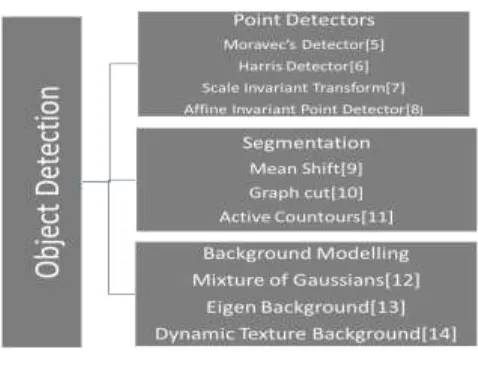
Following diagram shows various approaches towards Object Detection.
Fig 1
Available Online at www.ijpret.com 236 motion, stereo, and tracking problems. Interest point detectors include Moravec interest operator, Harris interest point detector and SIFT detector. Object detection can be achieved by building a representation of the scene called the background model[7][8][9] or the reference frame and after that comparing each coming frame with this reference frame and find any deviations from the reference frame. Any changes in an image region from the reference frame depicts a moving object. The pixels constituting the regions undergoing change are marked for further processing. This process is referred to as the background subtraction. Segmentation [10][11][12] partitions the image into perceptually similar regions. Segmentation describes, the criteria for a good partition and the method for achieving efficient partitioning. In mean shift clustering clusters are found in the spatial and colorspace. Here the process starts with an image with a large number of hypothesized cluster centers randomly chosen from the data. Then, each cluster center is moved to the mean of the data lying inside the multidimensional ellipsoid centered on the cluster center. The vector defined by the old and the new cluster centers is called the mean-shift vector. The mean-shift vector is computed iteratively until the cluster centers do not change their positions. Segmentation using graph cut can be described as graph partitioning problem, where the vertices (pixels) of a graph (image) are partitioned into N disjoint subgraphs (regions) by pruning the weighted edges of the graph. The total weight of the pruned edges between two subgraphs is called a cut. The weight is typically computed by color, brightness, or texture similarity between the nodes.
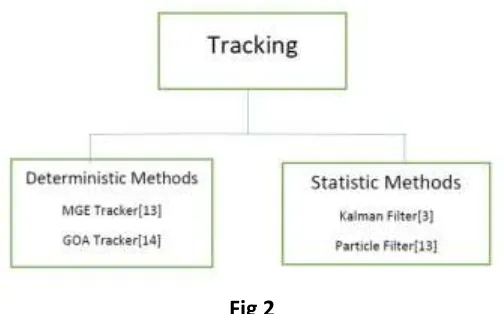
3. Methodologies for Tracking
Fig 2
Available Online at www.ijpret.com 237 detection algorithm, and then the tracker corresponds objects across frames.Deterministic method define a cost of associating each object in frame t − 1 to a single object in frame t using a set of motion constraints. Minimization of the correspondence cost is formulated as a combinatorial optimization problem. The correspondence cost is usually defined by using a combination of the following constraints.
--It is assumed location of object would not change. --Small change in speed does not change drastically.
[13] handle these problems by first establishing correspondence for the detected points and then extending the tracking of the missing objects by adding a number of hypothetical points. [14] extend the above work by introducing the common motion constraint for correspondence. The common motion constraint provides a strong constraint for coherent tracking of points that lie on the same object; however, it is not suitable for points lying on isolated objects moving in different directions Measurements obtained from video sequence is associated with lot of noise. Also the object moving direction can have random motion, for example a vehicle moving in zigzag manner. Statistical methods solve these tracking problems by taking the measurement and the model uncertainties into consideration. Here we are going to see and compare two statistical method of detection and tracking
--Kalman Filter --Particle Filter
3.1Kalman Filter
A Kalman filter is an optimal estimator. It infers parameters of interest from indirect, inaccurate and uncertain observations. It is recursive in nature so that new measurements can be processed as they arrive. Main features of Kalman filter in terms of tracking are
•Tracking can be achieved even if the objects goes out of the searched region.
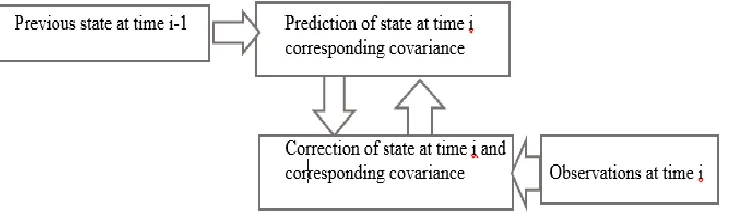
Available Online at www.ijpret.com 238 Fig 3: Flow for Kalman Filter
If all noise is Gaussian, the Kalman filter minimises the mean square error of the estimated parameters. The Kalman filter estimates a process by using a form of feedback control which means the filter estimates the process state at some time and then obtains feedback in the form of (noisy) measurements. The equations fall into two groups: time update equations and measurement update equations.
The time update equations point towards the current state estimate and error covariance prediction is used to obtain the main estimates for the next time step. Then measurement update step is responsible for the feedback by calculating the kalman gain. The time update equations is associated with prediction, while the measurement update equations is associated with correction equations.
In the case of kalman filters each iteration begins with predicting the process’ s state using a linear dynamics model.
State Space Prediction:
For each time step T, a Kalman filter first makes a prediction Xt and it is given by
is process state at time t-1, A is process transition matrix
and B is control vector. Ut which converts control vector into state space
Error Covariance Prediction: The Kalman filter concludes the time update steps by estimating the error covariance forward by one time step
Available Online at www.ijpret.com 239 3.1.2 Measurement Update
By using the time update step kalman filter will predict the state xt -1 and find the error covariance at time k. then after during the measurement update steps kalman filter uses measurements to correct its prediction
A). Kalman Gain
Kalman filter computes a Kalman gain , which is used for correcting the state estimate xt
Where H is a matrix used for converting into measurement space from state space and R is measurement noise covariance.
B). State Update: Using Kalman gain and measurements from time step t, where we can update the state estimate:
C). Error Covariance Update: The final step of the Kalman filter’ s iteration is to update the error covariance Pt.
If the measurements are accurate then the updated error covariance will be decreased. 4. Paticle Filter
Here to start of with particle filter. Its state space and dynamics need to defined[]. Firstly the window centre of the object is initialized that is . Let the motion which is going to be estimated is Vt.
Where µ is state prediction error.
Observation LikelihoodIt goes ahead with assumption that intensity , motion and detector measurement are independent. Therefore it results in following likelihood.
[2]
Available Online at www.ijpret.com 240 5. Experimental Results from authors
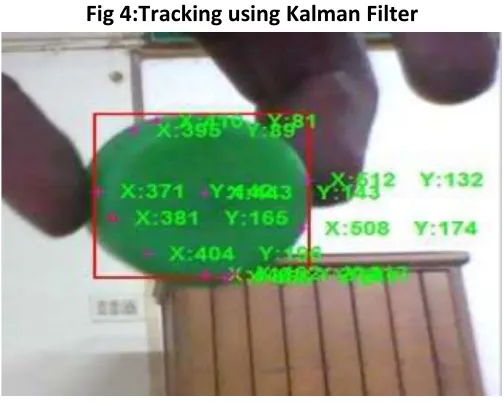
After performing a series of experiments tracking of object in video was demonstrated.
Fig 4:Tracking using Kalman Filter
Fig 5: Tracking varied shape object
Available Online at www.ijpret.com 241 Fig6: Object detection using particle filter
6.CONCLUSION
The goal of this paper was to give a brief of various approaches and theory that is followed while anything about object detection in image as well as video processing is concerned. Different techniques for detection were studied and was found that background modelling gives better detection of the object. Also for tracking kalman filter and particle filter were studied. From observation of authors it can be concluded that Kalman filter is beneficial for surveillance in low populated areas and particle filter would be for more complex situation..
REFERENCES
1. A.Yilmaz, O.Javed, and M.Shah, “Object tracking: A survey,” ACM Computing Surveys, vol. 38, no. 4, 2006.
2. R. Collins, Y. Liu, “On-Line Selection of Discriminative Tracking Features”, IEEE ICCV’ 03, 2003
3. Sherin Cherian, C.Senthil Singh, “Real Time Implementation of Object Tracking through webcam”
4. MORAVEC, H. 1979. Visual mapping by a robot rover. In Proceedings of the International Joint Conferenceon Artificial Intelligence (IJCAI). 598–600.
5. HARRIS, C. AND STEPHENS, M. 1988. A combined corner and edge detector. In 4th Alvey Vision Conference.147–151.
6. LOWE, D. 2004. Distinctive image features from scale-invariant keypoints. Int. J. Comput. Vision 60, 2,91–110.
7. STAUFFER, C. AND GRIMSON, W. 2000. Learning patterns of activity using real time tracking. IEEE Trans.Patt. Analy. Mach. Intell. 22, 8, 747–767.
Available Online at www.ijpret.com 242 9. MONNET, A., MITTAL, A., PARAGIOS, N., AND RAMESH, V. 2003. Background modeling and subtraction of dynamicscenes. In IEEE International Conference on Computer Vision (ICCV). 1305–1312.interactions. IEEE Trans. Patt. Analy. Mach. Intell. 22, 8, 831–843.
10. COMANICIU, D. AND MEER, P. 1999. Mean shift analysis and applications. In IEEE International Conferenceon Computer Vision (ICCV). Vol. 2. 1197–1203.
11. SHI, J. AND MALIK, J. 2000. Normalized cuts and image segmentation. IEEE Trans. Patt. Analy. Mach.Intell. 22, 8, 888–905.
12. CASELLES, V., KIMMEL, R., AND SAPIRO, G. 1995. Geodesic active contours. In IEEE International Conferenceon Computer Vision (ICCV). 694–699.
13. SALARI, V. AND SETHI, I. K. 1990. Feature point correspondence in the presence of occlusion. IEEE Trans.Patt. Analy. Mach. Intell. 12, 1, 87–91.
14. VEENMAN, C., REINDERS, M., AND BACKER, E. 2001. Resolving motion correspondence for densely moving points. IEEE Trans. Patt. Analy. Mach. Intell. 23, 1, 54–72.
15. Yu Huang, Joan Llach, Chao ZhangA Method of Small Object Detection and Tracking Based on Particle Filters
16. Y. Huang, J. Llach, S. Bhagavathy, “Players and Ball Detection in Soccer Videos Based on Color Segmentation and Shape Analysis”, Int. Workshop on Multimedia Content Analysis and Mining, June, 2007.
17. BLUM, A. L. AND LANGLEY, P. 1997. Selection of relevant features and examples in machine learning. Artific.Intell. 97, 1-2, 245–271
18. Amir Salarpour, Arezoo Salarpour, Mahmoud Fathi, and MirHossien Dezfoulian, “Vehicle Tracking using Kalman Filter and Features” Signal & Image Processing: (SIPIJ) Vol.2, No.2,June 2011.
19. Yu Huang, Joan Llach, Chao Zhang, “A method of small object detecion and tracking based on Particle filters” Thomson Corporate Research Princeton, NJ08540, US.
20. D. Comaniciu , v Ramesh, (2000) “ Mean shift and optimal prediction for efficient object tracking”, IEEE Int. Conf. Image Processing, vol. 3, pp. 70-73, Vancouver, Canada.
21. M.Farrokhi, B.Tokaman, “ A Kalman Filter Based Methodfor real Time Visual Tracking of a Moving Object Using Pan and Tilt Platform,” International Journal of Scientific & Engineering Research Volune 3, Issue 8, August 2012
22. S. Fazli, H. Pour, and H. Bouzari, “Particle filter based object tracking with sift and color feature,” in Machine Vision, 2009. ICMV ’ 09. Second International Conference on, dec. 2009, pp. 89 –93.