Available Online At www.ijpret.com
INTERNATIONAL JOURNAL OF PURE AND
APPLIED RESEARCH IN ENGINEERING AND
TECHNOLOGY
A PATH FOR HORIZING YOUR INNOVATIVE WORK
INTERFERENCE AND TRAFFIC AWARE CHANNEL ASSIGNMENT IN WMN USING A
GAME THEORETIC APPROACH
NUTAN M. DHANDE, VINAY S. KAPSE
Department of Computer Science & Engineering, Tulsiramji Gaikwad-Patil College of Engineering & Technology, Nagpur (MH)
Accepted Date:
27/02/2013
Publish Date:
01/04/2013
Keywords
Wireless Mesh Networks
(WMNs),
Channel assignment
problem,
Partially overlapped
channels,
Game theory,
Potential games
Corresponding Author
Mr. Nutan M. Dhande
Abstract
Available Online At www.ijpret.com I. INTRODUCTION
Wireless Mesh Networks (WMNs) have
attracted tremendous interest from
researchers involved in both academia and
industry [1]. While a WMN consists of a
multi-hop environment, its concept and
target differ from those of the
conventional Mobile Ad hoc Networks
(MANETs). In a typical WMN, there are two
types of nodes, namely Mesh Routers
(MRs) and Mesh Clients (MCs). MRs is
responsible for network routing and
bridging while MCs are light-weight nodes
performing simple client functions. One
key feature of the WMN is the backbone
network composed by MRs in which they
are usually static and have no constraints
on energy consumption. Due to these
attractive features, WMNs are expected to
appear as a promising technology in the
Next Generation Networks (NGNs) in order
to deploy ubiquitous Internet access. To
promote this phenomenal prospect, a
number of standards have already been
developed for WMNs for different access
ranges, namely IEEE 802.15.4, IEEE 802.11s
and IEEE 802.16j [1]. Since IEEE 802.11 is
one of the most popular access
technologies for commercial end-users, we
are interested in WMNs based on this
technology. One of the most promising
techniques in Multi-Radio Multi-Channel
(MRMC) field is Partially Overlapped
Channel Assignment by using IEEE 802.11
b/g technology, which can increase the
network throughput by exploiting more
simultaneous transmissions. According to
this standard, there are eleven channels
available for communication on the 2.4
GHz band. By exploiting all eleven channels
in a systematic approach to avoid the
interference among adjacent channels, we
can achieve a higher number of
simultaneous transmissions than
restricting ourselves with the use of only
three orthogonal channels. Note that this
approach is not as straightforward as it
seems at the first glance. Unless it is
carefully planned, adjacent channel
interference may become significant in
severely degrading network performance
instead of improving it. In this paper, we
use game theory to design a systematic
approach to utilize partially overlapped
channels in WMNs while minimizing the
Available Online At www.ijpret.com
interference. Game theory is a
mathematical tool, particularly useful, in
the network engineering field to model
highly complex scenarios that may include
complex traffic models, mobility,
unpredictable link quality, and so forth, in
which pure mathematical analysis has met
limited success. This mathematical tool
provides researchers with the ability to
model individual or independent decision
makers called “players”. Every player
interacts with other players and has an
impact on their decisions. The dynamics of
WMNs and MANETs closely resemble to
this observation.
A channel assignment A assigns a
set A(u) of channels (jA(u)j 6 k(u)) to each
node u 2 V . Thus, A induces a new graph
model G = (V;E) where two nodes u and
v are connected if u ! v 2 EI and they share
at least one common channel. In case u
and v share multiple channels, the set E
may include as many links between the
two nodes as the number of common
channels. channel assignment that satisfies
such condition exists (decision problem) is
an NP complete problem. Given that it is
not possible (in polynomial time) to
determine whether a channel assignment
exists that makes a given set of
pre-computed flow rates schedulable,
proposed heuristics, in the attempt to
keep the total utilization of every collision
domain below 1, seek a solution that
minimizes the maximum total utilization of
all the collision domains. Such a problem
turns out to be the optimization version of
the decision problem stated above and
hence it is NP-complete, too.
Consequently, channel assignment
algorithms are mainly heuristics that
attempt to minimize max e2E Utot(e).The
channel re-assignment problem: The
problem we intend to tackle is to re-assign
at most a given number of channels in
order to cope with variations in the set of
pre-computed flow rates. Our proposed
solution thus assumes the availability of a
solution to the channel assignment
problem given an original set of
pre-computed flow rates.
Wireless ad hoc network is
characterized by a distributed, dynamic,
self-organizing architecture. Each node in
the network is capable of independently
Available Online At www.ijpret.com
current environment according to
predetermined algorithms and protocols.
Analytical models to evaluate the
performance of ad hoc networks have
been scarce due to the distributed and
dynamic nature of such networks. Game
theory offers a suite of tools that may be
used effectively in modeling the
interaction among independent nodes in
an ad hoc network. In this article we
describe how such games can be set up
and discuss recent advances in this area.
II. LITERATURE REVIEW
In 2010, the work conducted by Zhou et al.
developed fully distributed scheduling
schemes, which solve the following three
problems for video streaming over
multi-channel multiradio networks: (i) CA, (ii)
rate allocation, and (iii) routing and
fairness. Instead of focusing on optimal
system throughput or scheduling efficiency
as with conventional scheduling schemes,
this work aimed at achieving minimal video
distortion and a level of fairness through
integrated media aware distribution and
network resource allocation. This work,
however, did not consider the issue of
overlapping or non overlapping channels in
formulating the CA problem.
Skalli et al. [2] reviews a number of CA
schemes using non-overlapping channels.
According to this survey, “this (i.e., the use
of non overlapping channels) leads to
efficient spectrum utilization and increases
the actual bandwidth available to the
network”.
Bukkapatanam et al. [3] using numerical
analysis demonstrates that the usage of
overlapping channels achieves better
performance than three no overlapping
channels for the backbone network,
expanding the previous work of Mishra [4],
[5]. However, none of the these works
clearly delineates a novel CA algorithm
exploiting POC. Following the promising
trend of using POC, a new heuristic CA
algorithm was proposed in [6] and in one
of our earlier works [7]. In this paper, we
further develop our previous work in [7] by
addressing the WMN channel assignment
problem from the game theoretical
perspective in contrast with a heuristic
approach adopted earlier. Game theory
Available Online At www.ijpret.com of research, particularly in formulating and
solving Economics problems. Using the
game theoretical perspective to address
complex engineering issues has immensely
attracted the attention of prominent
researchers in the last decade and its
applicability has been abound ever since.
More specifically in the context of network
communications, there has been a
plethora of game theory based work,
ranging from power control in cellular
radio systems [8] to optimal routing
control [9] [10], network congestion [11]
Readers unfamiliar with Game Theory
concepts and its applications are
encouraged to study the work in [12],
which contains fundamental results in this
area and are specially focused on
communication applications.
Meshkati et al. [13], who proposed a non
cooperative game theoretic framework,
which aims at performing trade-offs
among energy efficiency, delay,
throughput, and constellation size. This
work shows that a user, in order to
maximize its utility in terms of energy
efficiency, needs to select the lowest
modulation level, which can accommodate
the user’s Quality of Service (QoS) delay
constraint. However, this approach missed
one important aspect, i.e., it did not take
the CA problem into account. The work in
[14] developed a game-theoretic model for
radio resource management in a network
architecture, which combines IEEE 802.11
Wireless Local Area Networks (WLANs)
with IEEE 802.16-based multi-hop wireless
mesh infrastructure for relaying the WLAN
traffic to the Internet. The formulated
game offers the players fair bandwidth
allocation and optimal admission control of
different types of connections such as
WLAN connections and relay connections
in an IEEE 802.16 mesh router. In [15], an
incompletely cooperative game theory was
proposed to improve the system
performance of WMNs. In this approach,
all the players contend for the channel to
transmit real packets always with the
optimal strategy. [16] offers game theory
models to address the CA problem in
wireless networks. The afore-mentioned
game theoretic approaches, however, do
not consider exploiting partially
overlapped channels in wireless networks,
Available Online At www.ijpret.com problem by varying the channel width in
order to achieve a fair/optimal resource
allocation. In this paper, we employ game
theory concepts to model MRs as decision
makers of a cooperative game. The
interaction among all MRs can be classified
as an identical interest game as in [17].
Furthermore, we introduce a negotiation
based CA algorithm that converges to a
steady state, in other words a Nash
Equilibrium (NE), and as a property of
identical interest games, this condition
implies achieving an optimum CA.
III. SYSTEM MODEL
The CA issue defined as an optimization
problem in terms of mapping available
communication channels to network
interfaces in order to maximize the
communication capacity while minimizing
signal interference. Note that Interference
range is defined as the distance within
which interference occurs. In a
multi-channel environment, four different types
of interference and their influence on the
network capacity should be addressed. To
describe easily, let us consider two pairs of
nodes where each pair has a sender and a
receiver. Let the sender and receiver of the
first pair be S1 and R1, respectively. The
sender and receiver of the second pair are
denoted by S2 and R2, respectively. To
illustrate our considered system model,
first we describe the following terms.
• Co-channel Interference: Co-channel interference occurs in case that all four
nodes involved in the afore-mentioned
pairs are operating in the same channel.
Because of Carrier Sense Multiple Access
with Collision Avoidance (CSMA/CA), this
type of interference is less harmful for the
network capacity than Adjacent Channel
Interference. Consider the following
scenario: node S1 is starting to transmit a
packet to R1. S1 checks if the medium is
busy or idle. If it detects that the medium
is busy, the node will withdraw its attempt
to transmit by postponing it. However, if
the medium is idle, it will proceed with the
transmission. While S1 is sending data to
R1, consider a scenario in which S2 also
attempts to send a packet to R2. S2 will
detect the busy medium. Hence, S2 will
withdraw the transmission attempt and
wait over a back off period. Later on, it will
Available Online At www.ijpret.com between S1-R1 is already finished, S2 will
finally succeed with the signal transmission
to R2. In this scenario, we have a
contention based access.
• Orthogonal Channels: Consider another
scenario whereby S1-R1 and S2-R2 are
using two orthogonal channels. Again, S1
detects an idle medium and starts the
packet transmission. Meanwhile, S2 will
also detect an idle medium since it is
operating on a distinct channel. Both pairs
are able to successfully transmit their
packets simultaneously, because there is
no overlapping frequency band between
those channels. Limitation of this approach
is that only three pairs of nodes can
communicate in this manner since only
three out of the eleven available channels,
namely channels 1, 6, and 11, are
orthogonal.
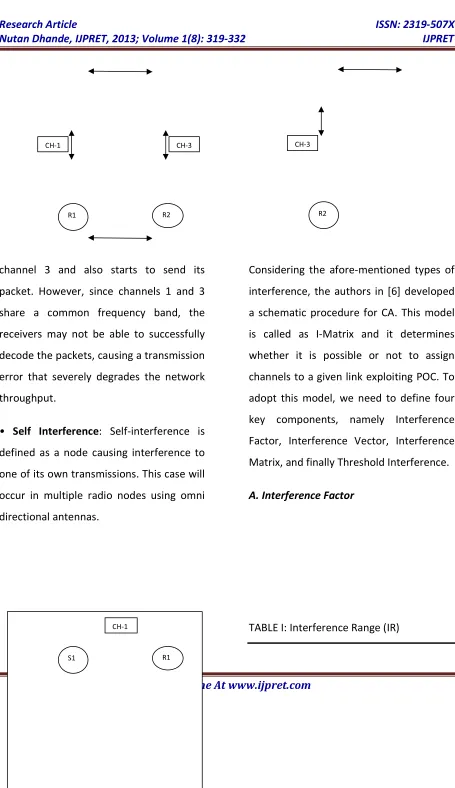
• Adjacent Channel Interference: This kind
of interference seriously degrades the
network capacity. Here, we consider S1-R1
and S2-R2 assigned to channels 1 and 3,
respectively. S1 begins transmitting first,
S2 will detect an idle medium in
S1 S2
R1 R2
CH-1 CH-1
S1 S2
R1 R2
CH-1 CH-6
Available Online At www.ijpret.com channel 3 and also starts to send its
packet. However, since channels 1 and 3
share a common frequency band, the
receivers may not be able to successfully
decode the packets, causing a transmission
error that severely degrades the network
throughput.
• Self Interference: Self-interference is defined as a node causing interference to
one of its own transmissions. This case will
occur in multiple radio nodes using omni
directional antennas.
Considering the afore-mentioned types of
interference, the authors in [6] developed
a schematic procedure for CA. This model
is called as I-Matrix and it determines
whether it is possible or not to assign
channels to a given link exploiting POC. To
adopt this model, we need to define four
key components, namely Interference
Factor, Interference Vector, Interference
Matrix, and finally Threshold Interference.
A. Interference Factor
TABLE I: Interference Range (IR)
R2 R1
CH-3 CH-1
R2
S1 R1
CH-3
Available Online At www.ijpret.com δ 0 1 2 3 4
5
IR (δ) 13.26 9.08 7.59 4.69
3.21 0
___________________________________
The interference factor fi,j takes as input
parameters geographical distance and
channel separation, and provides the
effective spectral overlapping level
between channels i and j. In order to
calculate fi,j , the experimental
measurements showed in [21] [22] are
used. To achieve an environment as similar
as possible to the previous CA scheme, we
use the same Interference Range (IR) table
where δ is the channel separation δ = |i −
j| and IR(δ) is the maximum distance in
which there will be interference between
channels i and j. Given the IR table, let d be
the Euclidean distance between
transceivers using channels i and j. Also, if
transceivers are in the same node, we
define d being zero. To calculate fi,j we
should consider the following three cases:
(1) fi,j = 0: when δ > 5 or d > IR(δ)
In this case, there will be no interference
between the radios since either they are
assigned orthogonal channels,
Or they are distant enough not to cause
interference given IR for channels i and j.
(2) 1 < fi,j < ∞: when 0 ≤ δ ≤ 5 and d ≤
IR(δ)
Here, we have two radios assigned to
overlapping channels i and j, also the
distance between them is within the
interference range. Thus, interference
factor should be calculated as the
following equation in which fi,j is inversely
proportional to the distance between
radios.
fi,j = IR(δ)/d : (1)
(3) fi,j = ∞: when 0 ≤ δ ≤ 5 and d = 0
Here, we strictly exclude the
self-interference to occur. Overlapping
channels will not be assigned at a given
node.
Available Online At www.ijpret.com For a given channel i, we should calculate
the Interference Factor between this
channel and all other 11 channels. Note
that here, the distance di stands for the
closest radio at channel i. In order to
permit the co-channel assignment, we add
Co channel (CoC) column in the I-Matrix.
This value will be set to one, if the channel
assigned to that radio is an interfering
co-channel, or to zero, otherwise.
C. Interference Matrix
After combining the interference vectors
for all 11 channels. Each node has its own
I-Matrix. Initially, all entries are set to zero
and after a channel is assigned for any
given link, every node updates its I-Matrix.
D. Threshold Interference
Setting this parameter on a value (Th < 1),
only non interfering channels will be
assigned. The tolerance for interfering links
can be increased specifying (Th > 1).
Increasing this parameter’s value would
lead to a more connected network.
However those links would suffer with ACI.
In our algorithm, we increase the network
connectivity exploiting the links that cause
co-channel interference.
IV. PROPOSED SOLUTION BASED ON GAME THEORY
In this section, we model our MRs as
“players”. The main objective of such
modeling is to derive an optimal CA using
the mathematical analyses provided by the
Game Theory framework, and then
compare this result against existing
heuristic algorithms.
Each MR is considered as a decision maker
of the game, and we model the
interactions among them as a Cooperative
Channel Assignment Game (CoCAG). The
game is composed of a finite set of players,
denoted by A = {a1, a2. . . aN} and all the
players have a common strategy space S =
Si, i. In this context, we map the
channel(s) assigned to a given MR’s radios
to its chosen strategy. Formally, the
strategy of the ith player is si= {ki,1, . . . ,
ki,c, . . . , ki,|C|}, where |C| is the number
of channels for the channel set C and ki,c is
a binary value. ki,c is set to one, if channel
c is assigned to one of the player’s radio.
Available Online At www.ijpret.com profile is defined as the Cartesian product
of the players’ strategy vector, Ψ = ×iЄAsi =
s1 × s2 ×・ ・ ・×sN. Note that a game
profile includes one strategy for each
player. Also, s−i is specially defined as the
strategy set chosen by all other players
except player i.
V. ALGORITHM
SIMULATION SETTINGS
Simulator Numerical
simulation using JAVA
Number of Nodes 4,9,16,20,25
Node distance 120 m
Number of radios 2
MAC Protocol IEEE 802.11g
Data Rate 6 Mbps
Channels (2.4 GHz) 1 – 11
VII.RESULT
VI. CONCLUSION
This paper, to solve the channel
assignment problem, we envisioned a
novel distributed channel assignment
algorithm for Wireless Mesh Networks by
exploiting partially overlapped channels
from a game theoretical approach, which
reaches an optimal performance. Such
improvements can be measured as
network throughput, channel spatial
re-use, and non interfering links.
REFERENCES
1. I. Akyildiz and X. Wang, “A survey on
wireless mesh networks,” IEEE Commun.
Mag., vol. 43, no. 9, pp. S23–S30, Sep.
2005. Cooperative Channel Assignment
Game (CoCAG)
1: si = {0}∀ai ∈ A
2: while T = 0 do
3: Randomly select ai with prob. 1/N
4: sirand ← random strategy {ki, 1, . . . ,
ki,c, . . . , ki,|C|}
5: while sirand ≠ valid strategy do
6: sirand← random strategy
7: end while
8: if p(sirand , sit) ≥ random number [0, 1]
then 9: sit+1← sirand
10: else 11: sit+1← sit
12: end if
13: Broadcast ai ID + sit+1
Available Online At www.ijpret.com 2. H. Skalli, S. Ghosh, S. Das, L. Lenzini,
and M. Conti, “Channel assignment
strategies for multiradio wireless mesh
networks: Issues and solutions,” IEEE
Commun. Mag., vol. 45, no. 11, pp. 86–95,
Nov. 2007.
3. V. Bukkapatanam, A. Franklin, and C.
Murthy, “Using partially overlapped
channels for end-to-end flow allocation
and channel assignment in wireless mesh
networks,” in ICC ’09: IEEE Int. Conf. on
Commun., Dresden, Germany, Jun. 2009,
pp. 1–6.
4. A. Mishra, E. Rozner, S. Banerjee, and
W. Arbaugh, “Exploiting partially
overlapping channels in wireless networks:
turning a peril into an advantage,” in IMC
’05: Proc. 5th ACM SIGCOMM Conf. on
Internet Measurement, Philadelphia, PA,
2005, pp. 29–29.
5. A. Mishra, V. Shrivastava, S. Banerjee,
and W. Arbaugh, “Partially overlapped
channels not considered harmful,” in
SIGMETRICS ’06: Proc. Joint Int. Conf. on
Measurement and Modeling of Comput.
Syst., Saint-Malo, France, Jun. 2006, pp.
63–74.
6. M. Hoque, X. Hong, and F. Afroz,
“Multiple radio channel assignement
utilizing partially overlapped channels,” in
GLOBECOM ’09: Proc. IEEE Global
Telecommun. Conf., Honolulu, HI, Nov.
2009, pp. 1 –7.
7. P. B. F. Duarte, Z. M. Fadlullah, K.
Hashimoto, and N. Kato, “Partially
overlapped channel assignment on
wireless mesh network backbone,” in
Globecom ’10: Proc. IEEE Global Commun.
Conf., Miami, FL, Dec. 2010.
8. L. Gao, X. Wanga, Y. Xu, X. Gan, H. Yu,
and A. V. Vasilakos, “A game approach for
cell selection and resource allocation in
heterogeneous wireless networks,” in
IEEE/ACM Trans. Netw., to be published.
9. R. La and V. Anantharam, “Optimal
routing control: repeated game approach,”
IEEE Trans. Autom. Control, vol. 47, no. 3,
pp. 437–450, Mar. 2002.
10.C. Busch, R. Kannan, A. Vasilakos,
”Approximating Congestion + Dilation in
Networks via ’Quality of Routing’ Games”,
IEEE Trans. Comput. to appear, doi:
Available Online At www.ijpret.com
11.R. Kannan, C. Busch, and A. V.
Vasilakos, “Optimal price of anarchy of
polynomial and super-polynomial
bottleneck congestion games,” in
GameNets 2011 : Int. Conf. on Game
Theory for Networks, Shanghai, China, Apr.
2011.
12.F. Meshkati, A. Goldsmith, H. Poor, and
S. Schwartz, “A game-theoretic approach
to energy-efficient modulation in cdma
networks with delay qos constraints,” IEEE
Sel. Areas Commun., vol. 25, no. 6, pp.
1069– 1078, Aug. 2007.
13.D. Niyato and E. Hossain, “Integration
of ieee 802.11 wlans with ieee
802.16-based multihop infrastructure mesh/relay
networks: A game theoretic approach to
radio resource management,” IEEE
Network, vol. 21, no. 3, pp. 6–14, May-Jun.
2007.
14.L. Zhao, J. Zhang, and H. Zhang, “Using
incompletely cooperative game theory in
wireless mesh networks,” IEEE Network,
vol. 22, no. 1, pp. 39–44, Jan.-Feb. 2008.
15.L. Gao and X. Wang, “A game approach
for multi-channel allocation in multi-hop
wireless networks,” in MobiHoc ’08: Proc.
9th ACM Int. Symp. on Mobile ad hoc
networking and computing, Hong Kong
SAR, China, 2008, pp. 303–312.
16.Y. Song, C. Zhang, and Y. Fang, “Joint
channel and power allocation in wireless
mesh networks: A game theoretical
perspective,” IEEE J. Sel. Areas Commun.,
vol. 26, no. 7, pp. 1149–1159, Sep. 2008.
17.E. Koutsoupias and C. H. Papadimitriou.
Worst-case equilibria. In Proceedings of
the 16th Annu Symposium on Theoretical
Aspects of Computer Science, pages
404-413, 1999.
18.T. Roughgarden and E. Tardos. How
bad is sel_sh routing? Journal of the ACM,
49(2):236- 259, 2002.
19.T. Rough garden and E. Tardos.
Bounding the ine_ciency of equilibrium in
nonatomic congestion games. Games and
Economic Behavior, 47(2):389-403, 2004.
20.Z. Feng and Y. Yang, “Characterizing the
impact of partially overlapped channel on
the performance of wireless networks,” in
Proc. IEEEGLOBECOM 2008., New Orleans,
Available Online At www.ijpret.com
21.Vivek Srivastava, James Neel, Allen B.
Mackenzie, Rekha Menon, Luiz A. Dasilva,
James E. Hicks, Jeffrey H. Reed, and Robert
P. Gilles,” Using game theory to analyze
wireless ad hoc networks”in IEEE
Communication, FOURTH QUARTER 2005,