Organized by C.O.E.T, Akola. Available Online at www.ijpret.com496
INTERNATIONAL JOURNAL OF PURE AND
APPLIED RESEARCH IN ENGINEERING AND
TECHNOLOGY
A PATH FOR HORIZING YOUR INNOVATIVE WORKSOFT STOREY EFFECT ON STRUCTURAL RESPONSE OF HIGH RISE BUILDING
VIPIN V HALDE, ADITI H. DESHMUKH
Associate Professor, B.Arch.; M. Tech (urban planning); M I R P M. School of Architecture, C O E & T, Akola
Accepted Date: 12/03/2016; Published Date: 02/04/2016
Abstract: In high rise building or multi storey building, soft storey construction is a typical and unavoidable feature because of urbanization and the space occupancy considerations. These provisions reduce the stiffness of the lateral load resisting system and a progressive collapse becomes unavoidable in a severe earthquake for such buildings due to soft storey. This storey level is unable to provide adequate resistance, hence damage and collapse. In the current study the focus is to investigate the effect of a soft storey for multistoried high rise building with different models having identical building plan. Equivalent diagonal struts are provided as suggested in FEMA-273 in the place of masonry to generate infill effect. Soft storey level is altered at different floors in different models & equivalent static analysis is carried out using SAP 2000 analysis package.
Keywords: Soft Storey, SAP 2000, Equivalent Strut, High Rise Building.
. Corresponding Author: MR. VIPIN V HALDE
Co Author: MS. ADITI H. DESHMUKH
Access Online On:
www.ijpret.com
How to Cite This Article:
Vipin V. Halde, IJPRET, 2016; Volume 4 (8): 496-514 PAPER-QR CODE
SPECIAL ISSUE FOR
NATIONAL LEVEL CONFERENCE
"RENEWABLE ENERGY
Organized by C.O.E.T, Akola. Available Online at www.ijpret.com497
INTRODUCTION
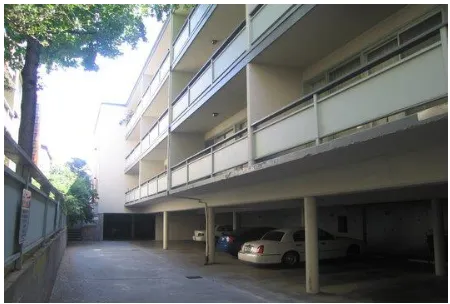
Multi storey reinforced-concrete framed structure in recent time have a special feature, The ground storey is left open for the purpose of social and functional needs this space is used for vehicle parking, shops, reception lobbies, a large space for meeting room or a banking hall etc. Such buildings are called open ground storey buildings or soft story buildings or stilt floors. The name soft storey because number of infill walls are less compared to adjoining floors, which reduces the stiffness of the floor in question.
Again when a sudden change in stiffness takes place along the building height, the story at which this drastic change of stiffness occurs is called a soft story. The Indian code (clause no. 4.20) classifies a soft storey as, It is one in which the lateral stiffness is less than 70 percent of that in the storey above or less than 80 percent of the average lateral stiffness of the three storeys above(IS 1893:2002). Soft storey can form at any level of a high rise building to fulfill required functional necessity and serve various purposes. Due to various functional need a soft storey is also unavoidable and thus it becomes important to study the performance of a soft storey building and study its effects.
Figure 1. Soft storey buildings
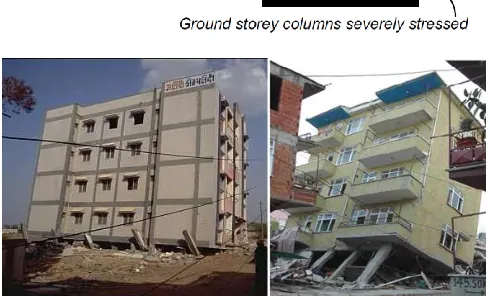
Organized by C.O.E.T, Akola. Available Online at www.ijpret.com498 Lateral displacement of a story is a function of stiffness, mass and lateral force distributed on that story. It is also known that the lateral force distribution along the height of a building is directly related to mass and stiffness of each story. If the P-delta effect is considered to be the main reason for the dynamic collapse of building structures during earthquakes, accurately determined lateral displacements calculated in the elastic design process may provide very important information about the structural behavior of the system. Therefore dynamic analysis procedure is required in many of the actual codes for accurate distribution of the earthquake forces along the building height, determining modal effects and local ductility demands efficiently. The upper stories moves as single block as there is presence of infill masonary which makes it stiffer. Hence displacment is more in soft storey.
Figure 3. Failure due to large lateral displacement in soft storey
Organized by C.O.E.T, Akola. Available Online at www.ijpret.com499
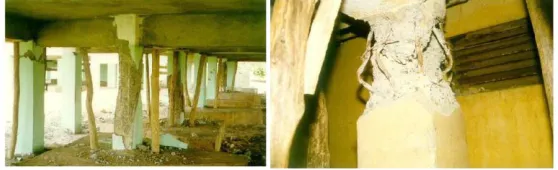
Figure 4. Damages in columns during earthquake
High Rise Buildings
The National Building Code (NBC 2005) of India (clause no.2.25) defines a high-rise Building as “all buildings 15 m or above in height shall be considered as high rise buildings”. The logic to the 15 meters number is explained was that NBC's decided by authorities of Bureau of Indian Standards, on the basis of the height of a manually-operated extension ladder of 35 feet (roughly 11 meters) working height. Fire departments around the country use this ladder for buildings of 15 meters height. For tackling fires in buildings beyond 15 meters in height, specialized vehicles need to be used by the fire force. Throughout India high-rises are defined by the 15 meters norm except in Mumbai (24 meters) and Ahmedabad (18 meters). This norm for high-rises in Mumbai and Ahmedabad is because of the vertical growth in the cities.
Methodology
The study is carried out on reinforced concrete moment resisting frame building is being modeled using computer software SAP2000. Further, the columns are square to focus only on the soft storey effect, without being distracted by the issues like orientation of columns. The supports of the columns are assumed to be fixed. The floor slabs are assumed to act as diaphragms, which insure integral action of all the vertical load resisting elements and are modeled as four noded shell elements with six degree of freedom at each node.
Organized by C.O.E.T, Akola. Available Online at www.ijpret.com500
Modelling Of Equivalent Strut
For an infill wall located in a lateral load-resisting frame, the stiffness and strength contribution of the infill has to be considered. Non-integral infill walls subjected to lateral load behave like diagonal struts. Thus an infill wall can be modelled as an equivalent compression only strut in the building model. Rigid joints connect the beams and columns, but pin joints connect the equivalent struts to the beam-to-column junctions. This section explains the procedure to calculate the modelling parameters (effective width, elastic modulus and strength) of an equivalent strut. The geometric characteristics of infilled frame follows are as shown in figure 3.1.
Figure 5. Geometric Characteristics of Infilled Frame
Equivalent area of strut,
e e
A W t
Width of strut,
0.4
0.175( )
e
W h d
4
sin(2 )
4 '
i f c
E t E I h
Where,
Ei - The modules of elasticity of the infill material, N/mm2
T - Thickness of the brick infill,
Organized by C.O.E.T, Akola. Available Online at www.ijpret.com501 Ef - The modules of elasticity of the frame material, N/mm2
Ic - The moment of inertia of column, mm4
h' - Height of brick infill,
ℓ’ - Length of brick infill,
h & ℓ - The height & length of the frame, measured between the centerlines of the
beams & columns respectively,
d - Diagonal length of the brick infill,
We - Width of diagonal strut and
λ - a coefficient depending on properties of infill
2.2 Description Of Structural Model
In this work G+12 three dimensional models are selected for which the soft storey behavior is modelled. For this a typical rectangular building is taken having 5 bays in X-direction each is of 6 m span, and the 3 bays in Y-direction each of 4.5 m span each. Height of each story is taken as 3.0 m. Models are generated to get displacement, storey drift, base shear and story shear are discussed here in this work.
2.3 Details Of Structural Elements And Material Used
Plan dimensions 30m×13.5m
Total height of building 39 m
Height of each storey 3.0m
Size of beams 300mm×450mm
Size of columns 450mm×450mm
Thickness of slab 120mm
Thickness of Shear Wall 150mm
Organized by C.O.E.T, Akola. Available Online at www.ijpret.com502 Seismic zone III
Soil condition Medium soil (Type II)
Zone factor 0.16
Response reduction factor 5
Importance factor 1
Live load at all floors 3.0 kN/m
Grade of Concrete M25
Grade of Steel Fe415
Concrete:
Density of Concrete 25 kN/m3
Modulus of Elasticity 5000 = 25000 N/mm2
Poisson’s ratio for concrete 0.3
Compressive strength 25 N/mm2
Masonry infill:
Density of brick masonry 19 kN/m3
Poisson’s ratio for brick 0.2
Clay burnt brick, Class A, confined unreinforced
masonry
Compressive strength of brick (fm) 10 N/mm2
Modulus of Elasticity 550 fm = 5500 N/mm2
Depth is thickness of wall 230mm
Organized by C.O.E.T, Akola. Available Online at www.ijpret.com503 570 mm in Y-direction
Modelling
ANALYTICAL MODELS CONSIDERED
3) Model 1. RC frames buildings with soft storey at ground storey and infill at all above storey.
8) Model 2 RC frames buildings with soft storey at ground storey providing Shear Walls
4) Model 3 RC frames buildings with soft storey at Sixth storey and infill at all other Storey.
6) Model 4 RC frames buildings with soft storey at Sixth storey without Central intermediate column and infill at all other storey.
5) Model 5 RC frames buildings with soft storey at Twelth storey and infill at all other storey
7) Model 6 RC frames buildings with soft storey at Twelth storey without Central intermediate column and infill at all other storey.
Organized by C.O.E.T, Akola. Available Online at www.ijpret.com504
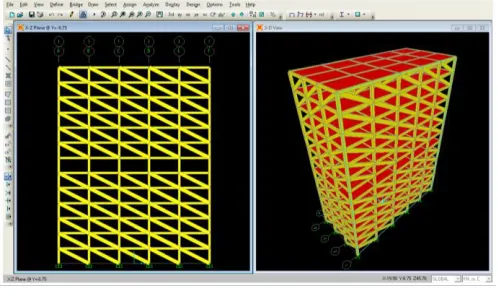
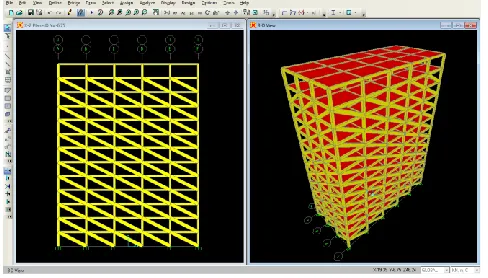
Figure 7. Model 2 showing Elevation at second frame and 3D view
Figure 8. Model 3 showing Elevation and 3D view
Organized by C.O.E.T, Akola. Available Online at www.ijpret.com505
Figure 10. Model 5 showing Elevation and 3D viewv
Figure 11. Model 6 showing Elevation at second frame and 3D view
Assigning Loads
After having modeled the structural components, load cases are assigned as follows:
Gravity loads
Gravity loads on the structure include the self weight of beams, columns, slabs, walls and other permanent members. The self weight of beams and columns (frame members) and slabs (area sections) is automatically considered by the program itself.
The wall loads have been calculated and assigned as uniformly distributed loads on the beams.
Wall load
Wall load = unit weight of brickwork×thickness of wall×height of wall.
Organized by C.O.E.T, Akola. Available Online at www.ijpret.com506 Thickness of wall = 0.23m
Wall load on floor levels =19×0.23×3= 13.11kN/m
(wall height = 3m)
Live loads
Live loads have been assigned as uniform area loads on the slab elements as per IS 1893
(Part 1) 2002
Live load on floors = 3.0 kN/m2
Percentage of Imposed load to be considered in Seismic weight calculation, as per IS 1893 (Part 1) 2002, since the live load class is up to 3 kN/m2 , 25% of the imposed load has been considered.
The seismic weight
The seismic weight of each floor is its full dead load plus appropriate amount of imposed load.
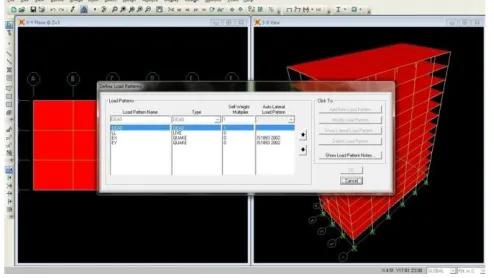
The defined load patterns are as shown below in figure 4.9 having Dead load, live load and horizontal earthquake load in both i.e X direction and Y direction as per IS 1893(Part 1):2002.
Figure 12. Showing Defined load pattern
RESULTS AND DISCUSSIONS
Organized by C.O.E.T, Akola. Available Online at www.ijpret.com507 The data of displacement is collected for in X direction for seismic loading from that all the eight models and shown below.
Table 1.Displacements of Various Models in X direction & Y direction
Comparison of Displacements
For easy comparison of displacements of selected building, plots of the floor level versus displacements in both transverse and longitudinal direction are made for different models and all imposed on same graph.
0.00 2.00 4.00 6.00 8.00
0 1 2 3 4 5 6 7 8 9 10 11 12 13
D isp la ce m en t (m m ) Floor Level
Comparison of Displacements in X- Direction (mm)
Model 1 Model 2 Model 3 Model 4 Model 5 Model 6
Graph 1: Displacements in all Models at All Storey Levels in X Direction
0.00 1.00 2.00 3.00 4.00 5.00 6.00
0 1 2 3 4 5 6 7 8 9 10 11 12 13
D isp la ce m en t (m m ) Floor Level
Comparison of Displacements in X- Direction (mm)
Model 1 Model 2
Organized by C.O.E.T, Akola. Available Online at www.ijpret.com508 0.00 2.00 4.00 6.00 8.00
0 1 2 3 4 5 6 7 8 9 10 11 12 13
D isp la ce m en t (m m ) Floor Level
Comparison of Displacements in X- Direction (mm)
Model 3 Model 4
Graph 3: Comparison of Displacement of Model 3 & Model 4 in X-direction
0.00 1.00 2.00 3.00 4.00 5.00
0 1 2 3 4 5 6 7 8 9 10 11 12 13
D isp la ce m en t (m m ) Floor Level
Comparison of Displacements in X- Direction (mm)
Model 5
Model 6
Graph 4: Comparison of Displacement of Model 5 & Model 6 in X-direction
Storey Drift
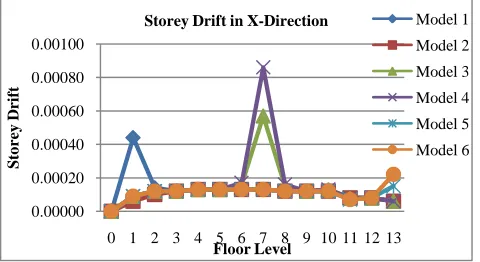
Lateral drift and inter-storey drift are commonly used damage parameter in structural analysis. In this study, lateral drift of the 3D building frame was analyzed for earthquake load coming from long direction. Inter storey drift was also evaluated and tabulated which is given by
where, Ui – Ui-1 = relative displacement between successive storey, hi = storey height.
Organized by C.O.E.T, Akola. Available Online at www.ijpret.com509
Table 2. Storey Drift of Various Models in X direction & Y direction
.
Comparison of Storey Drift
A graph is plotted taking floor level versus storey drift for different models in both transverse and longitudinal direction
0.00000 0.00020 0.00040 0.00060 0.00080 0.00100
0 1 2 3 4 5 6 7 8 9 10 11 12 13
S
to
re
y
D
ri
ft
Floor Level
Storey Drift in X-Direction Model 1 Model 2 Model 3 Model 4 Model 5 Model 6
Graph 5: Storey Drift in all Models at All Storey Levels in X Direction
Shear Forces (kN)
Organized by C.O.E.T, Akola. Available Online at www.ijpret.com510
Table: 3 Showing Shear force values of all Models
Comparison of Shear Force
The maximum shear forces in the columns in longitudinal direction for all models are shown below in graphs
-20.000 -10.000 0.000 10.000 20.000 30.000 40.000 50.000
0 1 2 3 4 5 6 7 8 9 10 11 12
S
h
ea
r
Fo
rc
e
(k
N
)
Storey Level Shear Force (kN)
Model 1 Model 2 Model 3 Model 4 Model 5
Model 6
Graph 5.17: Shear Forces in all Models at All Storey Levels
Bending Moment (kN-m)
Organized by C.O.E.T, Akola. Available Online at www.ijpret.com511
Table 4: Bending Moments in the columns in longitudinal direction
Comparison of Bending Moment
The maximum bending moments in the columns in longitudinal direction for all models are shown below in graphs.
-40.000 -20.000 0.000 20.000 40.000 60.000 80.000
0 1 2 3 4 5 6 7 8 9 10 11 12
B e n d in g M o m e n t (k N -m) Storey Level Bending Moment (kN-m)
Model 1 Model 2 Model 3 Model 4 Model 5 Model 6
Graph 5.21: Bending Moments in all Models at All Storey Levels
In Model 1 & Model 2 soft storey is kept at same i.e at ground storey level but as Model 2 have shear wall at ground soft floor, the all parameters like Displacement, Storey Drift, shear force and bending Moments demands are more in Model 1 at ground storey as compared to Model 2 as it contain shear wall.
Organized by C.O.E.T, Akola. Available Online at www.ijpret.com512 In Model 5 & Model 6 soft storey is kept at same i.e at top twelth storey level but as Model 6 have curtailed central intermediate columns for the purpose of auditorium or hall, the all parameters demands are more in Model 6 as compared to Model 5 at twelth storey.
CONCLUSIONS
RC frame buildings with open first storeys are known to perform poorly during in strong earthquake shaking. In this paper, the seismic vulnerability of buildings with soft first storey is shown through an example building. The drift and the strength demands in the first storey columns are large for buildings with soft ground storeys and hence necessary measures should taken to improve capacities of the columns in the soft first storey.
Model 1 has soft storey at ground storey, when shear wall is introduced as in Model 2 the parameters like deflection, storey drift, shear forces and bending moments are reduced. Thus shear wall in soft storey building can improve the performance considerably. This will also reduce the financial input finally.
If soft storey introduced at higher level by curtailing few columns at that particular level for the purpose of auditorium or hall as in Model 4 and Model 6, the results are critical as compared to soft storey at same level without curtailing columns as in Model 3 and Model 5. Thus we can say that discontinuous load path makes a building week and proper measures should be taken during design and execution.
When we compare the results obtained of Model 5 with Model 3 (without curtail column) and Model 6 with model 4 (with few column curtailed) we can see that Model 5 and Model 6 gives better results than Model 3 and Model 4. Thus intermediate soft storey should be avoided and if at all needed should be provided at top storey.
When the position of soft storey moved to higher level then parameters tends to reduced.
Results shows that Moments & Shear forces are always maximum at soft storey level in all Models.
These results will help design engineers in fast & reliable assessment of effects of soft storey.
Organized by C.O.E.T, Akola. Available Online at www.ijpret.com513
REFERENCES
1. Bureau of Indian Standards: IS-875, part 1 (1987), dead loads on buildings and Structures, New Delhi, India.
2. Bureau of Indian Standards: IS-875, part 2 (1987), live loads on buildings and Structures, New Delhi, India.
3. Bureau of Indian Standards: IS-1893, part 1 (2002), “Criteria for earthquake resistant design of structures: Part 1 General provisions and buildings”, New Delhi, India.
4. Bureau of indian standards , National building code of india 2005
5. FEMA-356/November:2000, Federal Emergency Management Agency, Prestandard and Commentary For The Seismic Rehabilitation Of Buildings,.
6. M.R. Amin, P. Hasan. B.K. and M.A. Islam, Effect of soft storey on multistoried reinforced concrete building frame, 4th Annual Paper Meet and 1st Civil Engineering Congress, December 22-24, 2011, Dhaka, Bangladesh Noor, Amin, Bhuiyan, howdhury and Kakoli (eds)
7. A.S.Kasnale and Dr. S.S.Jamkar, Study of Seismic performance for soft basement of RC framed Buildings.
8. Jaswant N. Arlekar, Sudhir K. Jain and C.V.R. Murty, Seismic Response of RC Frame Buildings with Soft First Storeys.
9. P.B.Lamb, Dr R.S. Londhe, Department of Civil Engineering, I.I.T.Kanpur, Kanpur 208016, Seismic Behavior of Soft First Storey IOSR Journal of Mechanical and Civil Engineering (IOSR-JMCE) ISSN: 2278-1684 Volume 4, Issue 5 (Nov. - Dec. 2012), PP 28-33
10. Prof. Patil S.S. and Mr. Sagare S.D., Dynamic Analysis of Soft Storey-High Rise Building with Shear Wall, International Journal of Civil Engineering Research & Applications (IJCERA), Vol. 1 Issue 4, August - 2013
11. Dr. Saraswati Setia and Vineet Sharma, Seismic Response of R.C.C Building with Soft Storey International Journal of Applied Engineering Research, ISSN 0973-4562 Vol.7 No.11 (2012) © Research India Publications.
Organized by C.O.E.T, Akola. Available Online at www.ijpret.com514 13. Nikhil Agrawal, Prof. P.B kulkarni, Pooja Raut, Analysis of Masonry Infilled R.C.Frame with & without Opening Including Soft Storey by using “Equivalent Diagonal Strut Method, International Journal of Scientific and Research Publications, Volume 3, Issue 9, September 2013 1 ISSN 2250-3153