4413 STABILITY INDICATING RP-HPLC METHOD DEVELOPMENT AND
VALIDATION OF MARAVROC IN BULK AND TABLET DOSAGE FORM Niranjan Panda1, Kanhu Charan Panda2, Byasabhusan Das3*,
1Department of Pharmaceutics, Anwarul Uloom College of Pharmacy, Hyderabad
2 Research Scholar, Department of Pharmaceutical Sciences, JNTUA, Anantapur
3Department of Pharmaceutical Analysis & QA, Anwarul Uloom College of Pharmacy,
Hyderabad, India
*Corresponding Author E-mail: [email protected]
ARTICLE INFO ABSTRACT
Key Words Maraviroc, RP-HPLC, ICH Guidelines.
A Novel Reverse phase high-performance liquid chromatographic (RP-HPLC) method has been developed and validated for the estimation of the Maraviroc in the bulk and tablet dosage form. Chromatographic separation was carried out on a C18 Develosil ODS HG-5 RP 150mm x 4.6mm, 5µm particle size column, using the mixture of ACN: phosphate buffer in the ratio of 30:70 as mobile phase by gradient elution with a flow rate of 1.0 ml/min, and UV detection was performed at 210 nm. The method was validated according to the ICH guidelines. Linearity (r > 0.998) was observed over the concentration ranges of 0–100 µl/ml. The percentage RSD value of the recovery found to be 100.2733%, 99.18%, 99.46%. The method was found simple and rapid with good specificity and robustness, which can be used for the further analysis of Maraviroc.
INTRODUCTION:
It (Brand name - Selzentry or Celsentri outside the U.S.) is a antagonist of chemokine receptor and the drug developed by the Pfizer company that is designed to act against the HIV by interfering with the interaction between HIV and CCR5. Maraviroc was originally labelled as UK-427857 during the development but was assigned the Maraviroc name as it entered trials. It was approved by the FDA in August, 2007. Maraviroc IUPAC name is 4, 4-difluoro-N-[(1S)-3-[(1R, 3S, 5S)-3-[3-methyl-5-(propan-2-yl)-4H-1,2,4-triazol-4-yl]
8azabicyclo [3.2.1] octan-8-yl] -1-
phenylpropyl]
cyclohexane-1-carboximidic acid.[1]
Maraviroc (Selzentry sel-zen-tree, or Celsentri outside the U.S.) is an antiretroviral drug used in the CCR5 receptor antagonist class and also used in the treatment of HIV infection. It is also classed as an entry inhibitor. It also appeared to reduce the graft-versus-host disease in patients treated with the allergenic bone marrow transplantation for leukaemia, in a phase 1/2 study. Maraviroc is an entry inhibitor. Maraviroc specifically, is a negative allosteric modulator of the CCR5 receptor, which is present on the surface of certain human cells. The chemokine receptor CCR5 is an important co-receptor for most HIV strains and necessary for the entry process of the virus into the host cell. The Maraviroc An Elsevier Indexed Journal ISSN-2230-7346
4414 drug binds to the CCR5 receptors, thereby
blocking the HIV protein gp120 from associating with the receptor. Then HIV virus is unable to enter into the human macrophages and T cells. Because HIV can also use other co-receptors, such as CXCR4, an HIV tropism test such as a profile assay must be performed to determine if the drug will be more effective.[1,2]
Fig-1: Maraviroc Chemical structure The stability indicating method is defined as validated quantitative analytical method that can be detect the change with time in the chemical, physical or microbiological properties of the drug substance and the drug product, that are specific so that the content of active ingredient degradation can be accurately measured without any disturbance. Stability testing provides information about the degradation mechanisms, potential degradation products, possible degradation pathways of the drug as well as interaction between the drug and the excipients in drug product.[3] Survey of Literature revealed that only few analytical methods are reported for the drug. Very few analytical methods have been reported for the estimation of Maravirac like, UV, HPLC, HPTLC and LC-MS methods. Some RP-HPLC methods were not economical in terms of mobile phase composition, column dimensions and run times. Hence there is need for the development of newer method for the estimation of Maraviroc present in tablet to overcome above discussed hurdles. So it is felt worthwhile to develop a rapid, simple, accurate, precise and more economical stability indicating rp-hplc
high performance liquid chromatographic method for the estimation of Maraviroc in bulk and tablet dosage form.[4,5,6]
MATERIALS AND METHODS Chemicals and reagents [7,]
The pharmaceutical high grade pure samples of Maraviroc were received as gift samples from Spectrum Pharmaceutical solutions, Hyderabad. Maraviroc were purchased from local market. HPLC grade water, HPLC grade Acetonitrile, HPLC grade methanol and analytical grade potassium dihydrogen phosphate, was obtained from Syncorp clincare Technologies Pvt.Ltd.
Instrumentation and chromatographic condition
The chromatographic estimation was performed on a HITACHI L2130 with D Elite 2000 Software with Isocratic with UV-Visible Detector (L-2400). The analytical separation was carried out in Develosil ODS HG-5 RP C18, 5µm, 15cmx4.6mm column was used at a flow rate of 1.0 ml/min and the detector wavelength was set at 210 nm. The injection volume was 20 μl.
Preparation of 0.01M Potassium dihydrogen phosphate buffer: [8, 9, 10] Accurately weighed 1.3609 gm of potassium dihydrogen phosphate was placed in a 1000 ml volumetric flask. About 900 ml of HPLC grade water was added and degassed by using sonication. Finally make up the volume with water.
Preparation of mobile phase [11]
4415 Preparation of diluents
Acetonitrile and phosphate buffer were mixed in the ratio of 30: 70 (% v/v).
Preparation of standard & sample solutions of Maraviroc
Preparation of standard solution
Accurately weighed and transferred 10 mg of Maraviroc working standards into a 10 ml clean dry volumetric flask. Added 3/4th volume of diluents and sonicated for 15 min. Finally the volume was made using diluents. Working standards solution of Maraviroc was prepared by diluting the 0.5 ml of above stock solutions to 10 ml using diluents in 10 ml volumetric flask.[12,13]
Preparation of standard solution
Weighed 20 tablets, determined the average weight and crushed to fine powder. Weighed accurately tablet powder equivalent to 50 mg of Maraviroc were transferred into 10 ml volumetric flask, 3 ml of diluents added and sonicated for 30 minutes. Finally the volume was made using diluents and filtered. From the filtered solution 0.5 ml was pipette out into a 10 ml volumetric flask and made up to 10 ml with diluents to get final concentration of 50 μg/ml.[12]
Procedure
10 μl of the filtered portion of sample and standard preparations were injected into the chromatograph. The responses for the major peaks were recorded and the content of Maraviroc in each tablet was calculated.
Validation parameters [13,14,15]
All analytical validation parameters were determined according to ICH guidelines for this proposed method. Obtained validation parameters are presented in Table 2.
1. System suitability: Standard solution was injected six times into system and chromatograms were recorded, % RSD
(relative standard deviation) [16] of retention time & peak area, theoretical plates and tailing factor were calculated.
2. Accuracy
Accuracy was determined in terms of % recovery. Sample solutions were prepared at three different concentration levels 80 %, 100 % and 120 %. Predetermined amount of standard was added to these solutions by spiking standard drug solution to the sample. % Recovery was calculated by assaying these solutions. [17,18]
3. System precision, method precision and intermediate precision
The system, method and intermediate precision of the proposed method are ascertained by injecting 6 replicates of test and standard sample, % RSD were calculated. [19]
4. Specificity
Standard solution, sample solution, blank solution and placebo solution were injected simultaneously into the system and chromatograms were recorded.
5. Linearity
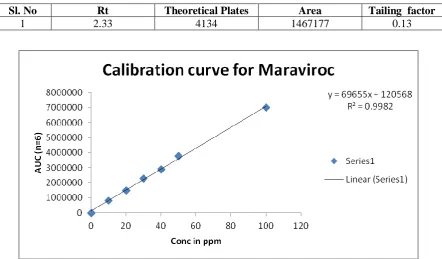
A linear relationship was evaluated across the range of the analytical procedure. A series of standard dilutions were prepared from the working standard solution in the concentration range of 0-100μg/ml of Maravirac.[20] 10 μl of each solution was injected into HPLC system. Linearity is evaluated by plotting the peak area as a function of analyte concentrations.
6. Robustness
4416 7. LOD and LOQ
The limit of detection (LOD) and limit of quantification (LOQ) were determined for the drug Maraviroc by using following procedures.
Procedure for forced degradation studies:
In order to demonstrate the stability of both standard and sample solutions during the analysis, both solutions were analyzed over a period of 24 hrs at room temperature. Further forced degradation studies were conducted for indicating the stability of the developed method. The results of the forced degradation studies are showed in Table 3. [21]
a. Acid degradation studies
To 1 ml of stock solution, 1 ml of 1 N Hydrochloric acid was added and refluxed for 30 min at 60 °C. The resultant solution was suitably diluted to obtain 20 μg/ml of Maraviroc. 10μl solutions were injected into the HPLC system and the chromatograms were recorded to assess the stability of sample.
b. Base degradation studies
To 1 ml of stock solution, 1 ml of 1 N sodium hydroxide was added and refluxed for 30 min at 60 °C. The resultant solution was suitably diluted to obtain 20 μg/ml of Maraviroc. 10μl solutions were injected into the HPLC system and the chromatograms were recorded to assess the stability of sample.
c. Peroxide degradation studies
To 1 ml of stock solution, 1 ml of 20 % Hydrogen peroxide (H
2O2) was added and
the solutions were kept aside for 30 min at 60 °C. For HPLC study, the resultant solution was suitably diluted to obtain 20 μg/ml of Maraviroc. 10μl solutions were injected into the HPLC system and the chromatograms were recorded to assess the stability of sample.
d. Thermal degradation studies
The standard drug solution was placed in oven at 105 °C for 6 hrs to study dry heat degradation. For HPLC study, the resultant solution was diluted to 20 μg/ml of Maraviroc.10μl solutions were injected into the HPLC system and the chromatograms were recorded to assess the stability of the sample.
e. Photo stability studies
The photochemical stability of the drug was also studied by exposing the sample solution to UV Light by keeping the beaker in UV chamber for 7 days or 200
Watt hours/m2 in photo stability chamber. For HPLC study, the resultant solution was suitably diluted to obtain 20 μg/ml of Maraviroc. 10 μl solutions were injected into the system and the chromatograms were recorded to assess the stability of sample.
RESULTS AND DISCUSSION
4417
2.01
2.33
5.57
0 1 2 3 4 5 6 7
Retention Time (min) 0
50 100 150 200 250 300
Intensit
y (mV)
Fig. 3: Typical sample chromatogram Table-1: System suitability parameters
Sl. No Rt Theoretical Plates Area Tailing factor
1 2.33 4134 1467177 0.13
4418
1.89
2.33
4.45 5.53
0 1 2 3 4 5 6 7
RetentionTime(min)
0 2 4 6 8
10
Intensity (
mV)
Fig. 6a: Chromatogram of acid degradation studies
1.89
3.37
3.95
0 1 2 3 4 5 6 7
RetentionTime(min) 0.0
0.5 1.0 1.5
Intensity (
mV)
Fig. 6b: Chromatogram of base degradation studies
1.19
1.55
1.99
2.31
0 1 2 3 4 5 6 7
RetentionTime(min) 0
50 100 150 200
Intensity (m
V)
4419
1.98
2.32
0 1 2 3 4 5 6 7
RetentionTime(min) 0
50 100 150 200 250 300
Intensity (m
V)
Fig. 6d: Chromatogram of thermal degradation studies
1.99
2.31
0 1 2 3 4 5 6 7
RetentionTime(min) 0
50 100 150 200
Intensity (m
V)
Fig. 6e: Chromatogram of photo stability studies Table 2: Validation parameters
Parameters Results
Maraviroc
Wavelength (nm) 210nm
Specificity % interference <0.5 %
Linearity & Range Linear in the range of 0-100 µg/ml Regression Equation Y= 69655x + 12056, R2=0.198
Accuracy (% Recovery) 80, 100, 120 100.2733%, 99.18%, 99.46% Precision (% RSD) Repeatability (% RSD) 1.829684
Intraday(32,40,48 μg/ml) 1.03,0.51,0.19 Inter day(32,40,48 μg/ml) 0.46,0.28,0.15
LOD (µg/ml) 0.01
LOQ (µg/ml) 0.03
4420 Stress condition Time Assay of
active substance
Assay of degraded products
Mass Balance (%)
Acid Hydrolysis (0.1 M HCl)
24Hrs. 2.19 97.34 99.53
Basic Hydrolysis (0.I M NaOH)
24Hrs. 1.59 95.02 96.61
3 % Hydrogen peroxide 24Hrs. 69.41 30.14 99.55 Thermal Degradation (50
0C)
24Hrs. 99.13 --- 99.13
UV (254nm) 24Hrs. 66.94 43.76 100.7
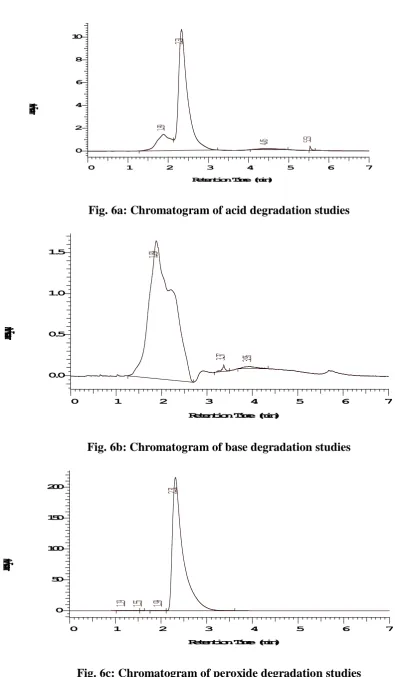
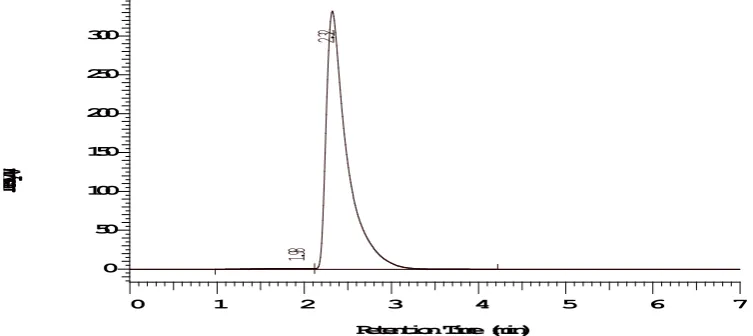
The linearity for HPLC method was determined at six concentration levels ranging from 0-100 μg/ml. The calibration curve was constructed by plotting response factor against respective concentration of Maraviroc. The plots of peak area Vs respective concentrations of Maraviroc were found to be linear in the range of 0-100 μg/ml with coefficient of correlation (r2) 0.998. The linearity of this developed method was evaluated by linear regression analysis. The slope and intercept calculated for Maraviroc were given in above Figure 4. Robustness of this developed method was determined by the small deliberate changes in flow rate, wavelength and temperature. The content of the drug was not adversely affected by these changes as evident from the low value of relative standard deviation indicating that the method was robust. The LOD and LOQ values were found to be 0.01 μg/ml and 0.03 μg/ml. The obtained data in validation studies are summarized in Table 2. From the validation study it was cleared that all the observed values were within the acceptable range. Therefore, the method attempted to evaluate the stability of the drug under various stress conditions with different rates of decomposition. The chromatograms observed from samples, subjected to various stress conditions, are shown in Figures 6a to 6e. The amount of drug decomposed at various stress conditions are shown in Table 3.
CONCLUSION
From this study, it is concluded that the proposed stability indicating RP-HPLC method was found to be simple, sensitive, rapid, economical and useful for routine analysis of Maraviroc in bulk & its pharmaceutical dosage form. The statistical parameters and recovery studies were carried out and reported. The obtained results were satisfactory as per ICH guidelines.
REFERENCES
1. Kalyan
Chakravarthy* and D.Gowri sankar stability indicating hplc method for determination of maraviroc and its degradants/impurities in bulk and pharmaceutical formulation rasayan journal of chemistry vol. 5, no.1, 90-105, January-march, 2012.
2. Notari S, Simultaneous estiamtion of maraviroc and raltegravir in human plasma by HPLC-UV. IUBMB Life. 2009 Apr;61(4):470-5.
3. D'Avolio A, Simiele M, Baietto, Validated high-performance liquid chromatography-ultraviolet method for quantification of the CCR5 inhibitor maraviroc in plasma of HIV-infected patients. The Drug Monit. 2010 Feb;32(1):86-92. 4. Sellappan Velmurugan, Mohamed
4421 Pharmaceutical Formulation,
International Journal of Pharmacy and Pharmaceutical Sciences, Vol 5, Issue 3, 2013
5. Mohanareddy Chilukuri1,2, Katreddi Hussainreddy2, Papadasu Narayanareddy1 and Madireddi Venkataramana1 A Validated Stability-Indicating UPLC Method for the Determination of Impurities in Maraviroc J Chromatogr Sci
(2013) doi:
10.1093/chromsci/bmt085 First published online: July 3, 201 6. Masaaki Takahashi, Development
and application of a simple LC-MS method for the determination of plasma maraviroc concentrations 7. Satyanarayana L., The Estimation
of Maraviroc in Tablet dosage forms by RP-HPLC. Research Journal of Pharmaceutical Dosage Forms and Technology Year : 2011, Volume : 3, Issue : 5 First page : ( 230) Last page : ( 232) Print ISSN : 0975-234X. Online ISSN: 0975-4377.
8. Stefania Notari, a new HPLC–UV method to quantify simultaneously maraviroc and raltegravir levels inhuman plasma.
9. R. Patil: J of Chromatographia, 67, 575,(2008).
10.Rasayan Journal of chemistry Vol. 5, No.1, 90-105, January-March | 2012ISSN: 0974-1496 | CODEN: RJCABP.
11.H.H.Williard, L.L.Merit, F.A.Dean and F.A.Settle, Instrumental methods of analysis, 7th edition,
C.B.S.Publishers, New Delhi,( 2002).
12.GN Menon, LB White, Department of Analytical Research, Abbott Laboratories, (PubMed-index for MEDLINE).
13.Validation of analytical procedures, Methodology, ICH harmonized tripartite guideline, 108, 1996.
14.The complete Drug reference; Martindale, Pharmaceutical press 32 edition;12th pg.
15.International Conference on Harmonization (ICH), "Q2A:
Validation of Analytical Procedures," Federal Register
60(40), 11260–11262 (1995). 16.International Conference on
Harmonization, "Q2B: Text on Validation of Analytical Procedures: Methodology; Availability," Federal Register 62(96), 27463–27467 (1997). 17.Food Drugs Administration (FDA),
"Analytical Procedures and Method Validations: Chemistry, Manufacturing and Controls Documentation; Availability," Federal Register (Notices) 65(169), 52776–52777 (2000).
18.G.A. Shabir, "Validation of HPLC Chromatography Methods for Pharmaceutical Analysis. Understanding the Differences and Similarities between Validation Requirements of FDA, and the US Pharmacopeia and the ICH," J. Chromatogr. A. 987 (1-2), 57-66 (2003)
19.Green, A practical guide to analytical method validation, Anal. Chem. News & Features, 1 May 1996, pages. 305A–309A.
20.Winslow and R. F. Meyer, Defining a master plan for the validation of analytical methods and procedures, J. Validation Technology, pages. 361–367 (1997).
21.Vessman, Validation of analytical methods from the perspective of an analytical chemist in the pharmaceutical industry, J. Pharm & Biomed Analysis 14:867–869 (1996).