Volume 11, Number 4, pp. 393–399. http://www.scpe.org c 2010 SCPE
A GRAPH-BASED APPROACH TO CONTEXT MATCHING∗
ANDREI OLARU†AND ADINA MAGDA FLOREA†
Abstract. This paper presents the work in progress towards a simple, flexible and decentralized representation of context and for the detection of appropriate context-aware action. Continuing our previous work on decentralized multi-agent systems for the context-aware exchange of information, we propose a representation for context inspired from concept maps and conceptual graphs, and also a formalism for context patterns, that allows the detection and solution of problems related to the user’s context.
Key words: knowledge representation, multi-agent systems, pattern recognition
1. Introduction. Domains like Ubiquitous Computing [27] and Ambient Intelligence [8] have brought context-awareness as a central issue for research. As the electronic environment that surrounds people must assist them in more and more of their daily activities, ambient applications must consider more aspects of the user’s context in order to improve their performance and their adequateness to the principles of UbiComp and AmI.
A true AmI system must be non-intrusive, but also proactive. This is a balance that may be difficult to reach. Appropriate proactive action must fit the context of the user or the user will not have an optimal experience with the system [23]. Additionally, in order to be useful, many times proactive action must result from the anticipation, based on the current context, of future situations. Context-aware action and anticipation will also make an AmI system seem “intelligent” [4, 22].
There is a large body of research dealing with the subject of context-awareness. Context has been defined as [6]: “Any information that can be used to characterize the situation of entities (i. e. whether a person, place or object) that are considered relevant to the interaction between a user and an application, including the user and the application themselves”. Most works deal with context as location, location and time or other physical conditions, like temperature [1, 21, 10]. Another aspect of context that is considered in some works is activity [12, 14].
However, most times the situation of the user is defined only by means of aspects that have been predefined. Situations may be described by means of certain types of associations [12] or by means of ontologies and / or rules [21]. However, these methods are not very flexible and the range of contexts that can be treated becomes limited with respect to what Ambient Intelligence should ideally be.
In our approach towards an implementation of Ambient Intelligence, we are trying to build mechanisms and representations that facilitate a more flexible approach to AmI and context-awareness, while in the same time are easy to implement and can work on resource-constrained devices. In previous work a decentralized multi-agent system for the distribution of information was built, that shared relevant information between multi-agents, based on some simple measures of context-awareness [19]. However, context-awareness requires a more complex and powerful representation of context, while less capable devices require that this representation be flexible in size and also easy to process.
This paper deals with describing a simple formalism that allows agents in a multi-agent system, that have only local knowledge, to share and process context-related information and to solve problems by usingcontext matching. We consider that there is one agent assigned to each user of the system (we call the system AmIciTy and the agents AmIciTy agents). Each agent has a representation of the context of its user, including models on other users. The focus of this paper is more on defining a manner of representation, and less on the algorithms used for context matching, the agent’s behaviour or the protocol used in the communication between agents.
Context matching is based on representing information about the context of a user as a conceptual graph [24] and on the existence of context patterns, or, in short, patterns. Patterns can describe (in more or less detail) situations that the user has been in, they can describe common sense knowledge, or just associations between different pieces of information that are observed to appear frequently in the user’s history. They resemble the
∗This work has been supported by CNCSIS–UEFISCSU, project number PNII–IDEI 1315/2008 and by the Sectoral Operational
Programme Human Resources Development 2007-2013 of the Romanian Ministry of Labour, Family and Social Protection through the Financial Agreement POSDRU/6/1.5/S/16.
†Computer Science Department, University Politehnica of Bucharest, 313 Splaiul Independentei, 060042 Bucharest, Romania. {cs, adina}@andreiolaru.ro.
The next section presents related work in the field of context-awareness. The proposed context representa-tion, as well as a scenario and examples of context-aware behaviour form the content of Section 3. The last two sections give an insight on future work and draw the conclusions.
2. Related Work. In previous work in the field of context-awareness there are usually two points of focus: one is the architecture for capturing context information; the other is the modeling of context information and how to reason about it.
Ever since the first works on context-awareness for pervasive computing [7], certain infrastructures for the processing of context information have been proposed [13, 11, 15, 12, 1, 9]. There are several layers that are usually proposed, going from sensors to the application: sensors capture information from the environment, there is a layer for the preprocessing of that information, the layer for its storage and management, and the layer of the application that uses the context information [1]. This type of infrastructures is useful when the context information comes from the environment and refers to environmental conditions like location, temperature, light or weather. However, physical context is only one aspect of context [5]. Moreover, these infrastructures are usually centralized, using context servers that are queried to obtain relevant or useful context information [7, 15]. In our approach [18], we attempt to build an agent-based infrastructure that is decentralized, in which each agent has knowledge about the context of its user, and the main aspect of context-awareness is based on associations between different pieces of context information.
Modeling of context information uses representations that range from tuples to logical, case-based and ontological representations [21, 25]. These are used to determine the situation that the user is in. Henricksen et al use several types of associations as well as rule-based reasoning to take context-aware decisions [12, 3]. However, these approaches are not flexible throughout the evolution of the system – the ontologies and rules are hard to modify on the go and in a dynamical manner. While ontologies make an excellent tool of representing concepts, context is many times just a set of associations that changes incessantly, so it is very hard to dynamically maintain an ontology that describes the user’s context by means of a concept. In this paper we propose a more simple, but flexible and easy-to-adapt dynamical representation of context information, based on concept maps and conceptual graphs. While our representations lacks the expressive power of ontologies in terms of restrictions, a graph-based representations is very flexible and extensible, so support for restriction may be added as future work.
Our approach to context representation is rooted in existing knowledge representation methods like semantic networks, concept maps [17] and conceptual graphs [24]. These structures can be used to describe situations (and context) in a more flexible manner and using less memory than ontological representations. While graph matching has been previously used, for instance for image processing [2], we attempt to use it for the matching of context graphs, also improving the graphs by means of special notation elements that allow the definition of patterns.
There has been a significant body of work in the domain of ontology alignment, which is vital for a viable implementation of Ambient Intelligence systems [26]. However, this is not the subject of this paper. We assume that all agents in the system work with terms from the same ontology (where it is the case), or that ontologies have already been aligned.
Software agents and multi-agent systems have been used many times in the implementation of AmI en-vironments in the past [15, 4, 16], however context-awareness in these systems is limited to location-related associations and simple forms of representation.
3. Context Matching. The main idea of this paper is to propose a graph representation for contexts, designed in order to facilitate the detection of compatible contexts.
(a)
(b)
Fig. 3.1.The knowledge of Alice’s and Bob’s agents, respectively: (a) Alice will go to a concert where a rock band is playing and which is located at the stadium, and then to go out with friends; (b) Bob will be going at the same concert, and has also booked a taxi to get there. Part of the relations and concepts that appear in the graphs may come from ontologies.
Fig. 3.2. A pattern that says that if the user attends an activity that has a location, then the location of the activity should be reached in some way.
approach [18]: insufficient communication between people leads to a lack of otherwise relevant information that could be easily obtained by means of an AmI system.
Alice and Bob are both users of the AmIciTy Ambient Intelligence system. What we want is that the system (1) detects the need for a means of transportation for Alice, (2) based on information on Bob’s agenda, suggest that a taxi may be an appropriate solution for Alice as well, and (3) based on the existing shared context, propose to Alice that she uses the same taxi that Bob has already booked.
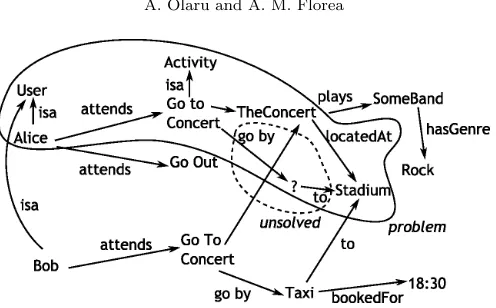
Each user of AmIciTy has an associated agent. Figure 3.1 shows the concept graph for the knowledge of the two agents (agentAfor Alice and agentB or Bob) that is relevant to the scenario. Formally, the knowledge of each agent can be represented as a graph:
G= (V, E)
V ={vi}, E={ek}, ek = (vi, vj, value)
wherevi, vj ∈V, i, j= 1, n, k= 1, m
The values of vertices and edges can be either strings or, better, URI identifiers that designate concepts, relations, people, etc. The value of an edge may be null.
The graph that an agent has contains the knowledge that the agent has about the user and about the user’s context. The graph represents the context of the user, in the measure in which the agent has perceived it (or been informed of by the user or by another agent).
First, we want the system to detect the fact that it is necessary to know how Alice will be getting at the concert. This can be done by means of the following pattern: if the user intends to attend something that is an activity, and that has a location (it’s not, for instance, making a phone call), then there should also be a means for the user to reach that location. The pattern is represented in Figure 3.2.
A pattern is also a graph, but there are several additional features that makes it match a wider range of situations. The graph for a patternsis defined as:
GP
s = (VsP, EsP) VP
Fig. 3.3.The knowledge base of agentA, completed with the information on Bob’s agenda. Also the problem and its unsolved part are circled with a continuous and a dashed line respectively. Although the unsolved part is displayed together with the rest of the context graph, it is not a concrete or known fact so it would not be used in pattern-matching.
EP
s ={ek}, ek= (vi, vj, E RegExp), vi, vj∈VsP, k= 1, m
whereE RegExp is a regular expression formed of strings or URIs.
Apattern represents a set of associations that has been observed to occur many times and that is likely to occur again. Patterns may come from past perceptions of the agent on the user’s context or be extracted by means of data mining techniques from the user’s history of contexts. Commonsense patterns may come from public databases, and patterns may also be exchanged between agents. However, the creation or extraction of patterns is not the subject of this paper.
The agent has a set of patterns that it matches against the current context (graph G). We will mark with theP superscript the graphs or vertex / edge sets that contain special pattern features (like ? nodes, for
instance).
A patternGP
s matches a subgraphG′ ofG, withG′= (V′, E′) andGPs = (VsP, EsP), iff an injective function f :VP
s →V′ exists, so that
(1)∀vP
i ∈VsP, viP =? orvPi =f(vPi ) (same value)
and
(2)∀eP ∈EP
s, eP = (vPi , vjP, value) we have:
ifvalueis a string or an URI, then the edge (f(vP
i ), f(vPj), value)∈E′
if value is a regular expression, then it matches the values value0, value1, . . . , valuep of a series of edges e0, e1, . . . , ep∈E′, where
e0= (f(viP), va0, value0),
ek = (vak−1, vak, value1), k= 1, p−1
ep= (vap−1, f(v
P
j ), valuep), val∈V′.
In other words, every non-? vertex from the pattern must match a different vertex from G′; every
non-RegExp edge from the pattern must match an edge fromG′; and every regular expression edge from the pattern
must match a series (that can be void, if the expression allows it) of edges from G′. SubgraphG′ should be
minimal. A graph (or subgraph)G′ is minimal with respect to a matching pattern GP
s iff there is no edge in G′ that is not the match (or part of the match) of an edge inGP
s.
A pattern GP
s k-matches a subgraph G′ of G, if condition (2) above is fulfilled for m−k edges in EsP, k∈[1, m−1], m=||EP
s||and G′ remains connected and minimal. The relationship ofk-matching should be
interpreted as matching except for k edges. Non-matching vertexes imply non-matching edges. We consider the number of edges as relevant (as opposed to number of vertices, for instance), because context is a set of associations, so it is the edges that matter.
For the example in Figure 3.1 (a), the pattern in Figure 3.2 2-matches the knowledge about Alice that her agent has,G′containing the information that the user (Alice) will attend a concert (which is an activity) which
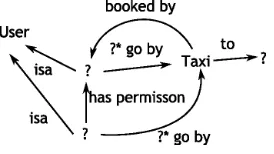
Fig. 3.4.A second pattern, specifying that two people can use the same taxi to get to the same location if the person who has not booked the taxi has permission from the other to ride the same taxi.
patternGP
s k−matches G→
if k>0
put problem in the list
if there is a problem and this can be a solution is the solution is certain / complete
let user know
user confirms solution
increase confidence in pattern otherwise
decrease confidence in pattern otherwise
link possible solution to problem
Fig. 4.1.Pseudocode of the agent’s behaviour related to context matching.
4. Problem Solving. AProblemis a graphGP that contains features that are specific for patterns (like ?
nodes for instance) and that is a partial instantiation of a patternGP
s, according to the current context. A
problemGP is the union between the subgraphG′(of the context graphG) that k-matches patternGP
s and the
part ofGP
s that is not matched byG′. The latter is theunsolved part of the problem. A problem also remains
associated with the pattern that generated it. Therefore, formally, if a pattern GP
s = (VsP, EsP) k-matches
the subgraphG′ = (V′, E′) ofG, we can define a problempas a tuple (GP
s, GPp), whereGPp is the problem’s
graph:
GP
p =G′∪GPx GP
x = (VxP, ExP) VP
x ={v∈VsP, v /∈dom(f)} EP
x ={e∈EsPf or which condition(2)is not f ulf illed}
Note thatGP
x (the unsolved part of the problem) is a subgraph ofG P
s. Also note that the unsolved part
may contain edges whose vertices are not both in the unsolved part. Theproblem from our example is circled in Figure 3.3 with a continuous line, and its unsolved part is circled with a dashed line.
The agents in AmIciTy are not single agents. They are part of a multi-agent system. Agents A and B
communicate frequently due to the fact that Alice and Bob live in the same place and exchange a lot of data. At some point in this communication, they exchange data about Alice’s and Bob’s agendas, which is normal for two people that share an apartment. AgentB will send the subgraphagenda→ConcertandA will send
agenda→ Concert/ →Go Out (agent A will only send the GoOutactivity if Alice has not designated it as private).
Agent A receives the subgraphagenda →Concert and matches it against Alice’s context, detecting the compatibility (a full match). So it responds by building upon this common context: it sends a larger subgraph, containing the band playing at the concert, as well as the location of the concert. Agent B does the same operations asA (they share the same context regarding the concert, so each one’s context matches the other one’s), just that it also sends toAthe associationsConcert−go by→T axi−to→Stadium.
Adetects that the pattern mentioned above fully matches the model for Bob. AgentAalso has aproblem that is linked to this pattern. Since Bob’s context fully matches the pattern, it means it may be asolutionto Alice’s problem: Alice may also use a taxi to reach the concert. But that would mean booking a different taxi (use a different instance of the concept).
Another pattern may be used in this context: agentAmay know that two people may share the same taxi to get to the same destination, if one has permission from the person that booked the taxi (we have somewhat simplified the problem and we do not mention that the two people must leave from the same location and need to reach the destination at the same time). This pattern is shown in Figure 3.4. Matching this pattern against the knowledge of agentAabout Alice’s context in Figure 3.3 (remember that unsolved parts are not matched), a 2-match is obtained (missing relations arehas permissionand Alice’sgo by). Not only that, but adding those relation would solve the problem that Alice has. Therefore, the agent can suggest to Alice to ask permission from Bob to use the same taxi.
In this particular case, with the given knowledge and patterns, there is only one solution to the problem that arose. But in a more realistic case, where context is more complex and there are more patterns, more solutions to the same problem may be found. In case they fit equally well in the current context, then the agent must prompt the user with all of them and the user must be given the choice.
It can be argued that context-matching is a very difficult problem in the case of large graphs and complex situations. However, resource-constrained devices will work only with smaller pieces of context information (i. e. smaller graphs), that are relevant to their function. Second, algorithms inspired from data-mining allow for incremental matching, starting from common nodes and growing the matching sub-graph (similar to the algorithm for matching Rule Schemas [20]).
Another problem that may appear in realistic situations (as opposed to our simple example) is the abundance of simultaneous matching context patterns, possibly describing contradictory situations. This is where more refined measures must be found that will allow calculating the relevance of each match. This too will be part of our future work.
5. Future Work. The work presented in this paper is in progress. We are in the process of identifying an efficient matching algorithm, as well as deploying the described formalism into a previously implemented multi-agent system.
Besides detecting compatible contexts, there is a very interesting potential in detecting incompatible con-texts, or contexts that the user should not be in. Also, uncertainty has yet to be included in our work. Both these problems have been researched in the domain of conceptual graphs and graph matching.
One last question that must be further researched is if a subgraph k-matching a pattern should really be connected. Moreover, should a pattern be necessarily connected, and how could unconnected patterns and matches be interpreted.
6. Conclusion. So far, work in context-awareness for pervasive environments has been based predom-inantly on location-awareness and physical conditions. The use of ontologies or rules does not bring much dynamical flexibility and they are not easy to modify automatically, at runtime.
This paper presents the work in progress towards the development of a more simple – suitable for resource-constrained devices – and more flexible manner of representing context and context patterns, that allows the agents to take decisions without the need for a centralized structure, by means of their knowledge, their history and local communication alone.
REFERENCES
[1] M. Baldauf, S. Dustdar, and F. Rosenberg,A survey on context-aware systems, International Journal of Ad Hoc and Ubiquitous Computing, 2 (2007), pp. 263–277.
[3] C. Bettini, O. Brdiczka, K. Henricksen, J. Indulska, D. Nicklas, A. Ranganathan, and D. Riboni,A survey of context modelling and reasoning techniques, Pervasive and Mobile Computing, 6 (2010), pp. 161–180.
[4] G. Cabri, L. Ferrari, L. Leonardi, and F. Zambonelli,The LAICA project: Supporting ambient intelligence via agents and ad-hoc middleware, Proceedings of WETICE 2005, 14th IEEE International Workshops on Enabling Technologies, 13-15 June 2005, Link¨oping, Sweden, (2005), pp. 39–46.
[5] G. Chen and D. Kotz,A survey of context-aware mobile computing research, Technical Report TR2000-381, Dartmouth College, November 2000.
[6] A. Dey,Understanding and using context, Personal and ubiquitous computing, 5 (2001), pp. 4–7.
[7] A. Dey, G. Abowd, and D. Salber,A context-based infrastructure for smart environments, Proceedings of the 1st Interna-tional Workshop on Managing Interactions in Smart Environments (MANSE’99), (1999), pp. 114–128.
[8] K. Ducatel, M. Bogdanowicz, F. Scapolo, J. Leijten, and J. Burgelman,Scenarios for ambient intelligence in 2010, tech. report, Office for Official Publications of the European Communities, February 2001.
[9] L. Feng, P. M. G. Apers, and W. Jonker,Towards context-aware data management for ambient intelligence, in Proceedings of DEXA 2004, 15th International Conference on Database and Expert Systems Applications, Zaragoza, Spain, August 30 - September 3, F. Galindo, M. Takizawa, and R. Traunm¨uller, eds., vol. 3180 of Lecture Notes in Computer Science, Springer, 2004, pp. 422–431.
[10] H. Hagras, V. Callaghan, M. Colley, G. Clarke, A. Pounds-Cornish, and H. Duman,Creating an ambient-intelligence environment using embedded agents, IEEE Intelligent Systems, (2004), pp. 12–20.
[11] A. Harter, A. Hopper, P. Steggles, A. Ward, and P. Webster,The anatomy of a context-aware application, Wireless Networks, 8 (2002), pp. 187–197.
[12] K. Henricksen and J. Indulska,Developing context-aware pervasive computing applications: Models and approach, Perva-sive and Mobile Computing, 2 (2006), pp. 37–64.
[13] J. Hong and J. Landay,An infrastructure approach to context-aware computing, Human-Computer Interaction, 16 (2001), pp. 287–303.
[14] M. Kaenampornpan and E. O’Neill, An integrated context model: Bringing activity to context, in Proceedings of the Workshop on Advanced Context Modelling, Reasoning and Management, 2004, pp. 7–10.
[15] T. C. Lech and L. W. M. Wienhofen,AmbieAgents: a scalable infrastructure for mobile and context-aware information services, Proceedings of the 4th International Joint Conference on Autonomous Agents and Multiagent Systems (AAMAS 2005), July 25-29, 2005, Utrecht, The Netherlands, (2005), pp. 625–631.
[16] C. Muldoon, G. M. P. O’Hare, R. W. Collier, and M. J. O’Grady,Agent factory micro edition: A framework for ambient applications, in Proceedings of ICCS 2006, 6th International Conference on Computational Science, Reading, UK, May 28-31, V. N. Alexandrov, G. D. van Albada, P. M. A. Sloot, and J. Dongarra, eds., vol. 3993 of Lecture Notes in Computer Science, Springer, 2006, pp. 727–734.
[17] J. D. Novak and A. J. Ca˜nas,The origins of the concept mapping tool and the continuing evolution of the tool, Information Visualization, 5 (2006), pp. 175–184.
[18] A. Olaru, A. El Fallah Seghrouchni, and A. M. Florea, Ambient intelligence: From scenario analysis towards a bottom-up design, in Proceedings of IDC’2010, the 4th International Symposium on Intelligent Distributed Computing, M. Essaaidi, M. Malgeri, and C. Badica, eds., vol. 315 of Studies in Computational Intelligence, Springer, 2010, pp. 165– 170.
[19] A. Olaru, C. Gratie, and A. M. Florea,Context-aware emergent behaviour in a MAS for information exchange, Scalable Computing: Practice and Experience - Scientific International Journal for Parallel and Distributed Computing, 11 (2010), pp. 33–42. ISSN 1895-1767.
[20] A. Olaru, C. Marinica, and F. Guillet,Local mining of association rules with rule schemas, in Proceedings of CIDM 2009, the IEEE Symposium on Computational Intelligence and Data Mining, March 30 - April 2, Nashville, TN, USA, IEEE Symposium Series on Computational Intelligence, 2009, pp. 118–124.
[21] M. Perttunen, J. Riekki, and O. Lassila,Context representation and reasoning in pervasive computing: a review, Inter-national Journal of Multimedia and Ubiquitous Engineering, 4 (2009), pp. 1–28.
[22] C. Ramos, J. Augusto, and D. Shapiro,Ambient intelligence - the next step for artificial intelligence, IEEE Intelligent Systems, 23 (2008), pp. 15–18.
[23] G. Riva, F. Vatalaro, F. Davide, and M. Alca˜niz, eds.,Ambient Intelligence, IOS Press Amsterdam, 2005. [24] J. Sowa,Knowledge representation: logical, philosophical, and computational foundations, MIT Press, 2000.
[25] T. Strang and C. Linnhoff-Popien,A context modeling survey, Workshop on Advanced Context Modelling, Reasoning and Management as part of UbiComp, (2004), pp. 1–8.
[26] J. Viterbo, L. Mazuel, Y. Charif, M. Endler, N. Sabouret, K. Breitman, A. El Fallah Seghrouchni, and J. Briot,
Ambient intelligence: Management of distributed and heterogeneous context knowledge, CRC Studies in Informatics Series. Chapman & Hall, (2008), pp. 1–44.
[27] M. Weiser,The computer for the 21st century, Scientific American, 272 (1995), pp. 78–89.
Edited by: Costin B˘adic˘a and Viorel Negru Received: December 20th, 2010