International Journal of Applied And Pure Science and
Synthesis, crystal structure
N
2O
Dhrubajyoti Majumda
1
Department of Chemistry, Tamralipta mahavidyalaya, Tamluk, Purba
2
Department of Chemistry, Indian Institute of Technology Delhi, Hauz Khas, New Delhi 110016, India
One new Complex of formula [
ligand H2L, condensation product of 5
ethylenediamine and it has been spectra, Mass spectroscopy study. revealing that environment of coordinated by two imine nitrogen
spectra and structure of complex (1) have been compared with the DFT calculated results. Keywords: Schiff base, Cu(II) complex, UV, DFT
Thanks to Prof. Hugo Schiff who fi discovery many inquisitive chemists
and its metal complexes occupy
coordinate different kinds of metals such as rare transition metals and to stabilize them in
synthesized using these ligands is increasing squarely day by day due to their easily tunable steric and electronic property, good yield, high purity and w applications. Such ligand complexes have also versatile
as antibactericide agents, as antivirus agent, as fungicide agents properties. Different kind of applications have b
chemical analysis, absorption and transport of
heterogenenous and homogeneous catalysis for oxidation and polymerizat compounds.
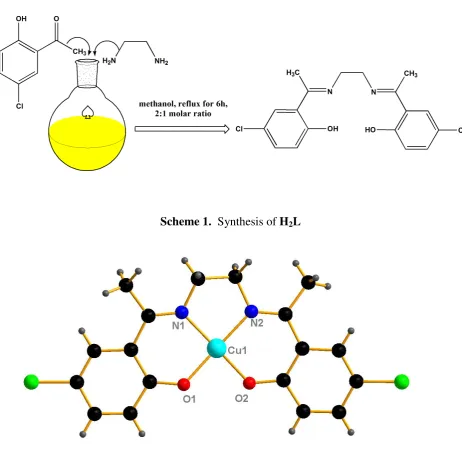
In the present research work, we have used a t donor (Scheme 1) to prepare copper (II) complex without any bridging ligands. W
tetradentate Schiff base ligands
successful synthesis of novel Schiff base ligand, characterization, calculations and experimental data, X
Schiff base ligand derived from the conde diamine (1,2-ethylenediamine).
state have been calculated by DFT.
International Journal of Applied And Pure Science and
Agriculture
www.ijapsa.com
Synthesis, crystal structure and DFT study of a new copper (II) complex of
O
2donor Schiff base
ligand
Dhrubajyoti Majumdar1, Atanu Jana2
Department of Chemistry, Tamralipta mahavidyalaya, Tamluk, Purba medinipur, W.B
hemistry, Indian Institute of Technology Delhi, Hauz Khas, New Delhi 110016, India
Abstract
One new Complex of formula [Cu(L)2] (1) has been prepared using tetradentate chelating
condensation product of 5-chloro-2-hydroxy acetophenone and 1,2 ethylenediamine and it has been characterized by means of elemental analysis,
Mass spectroscopy study. Single crystal X-ray diffraction studies that environment of Cu (II) is four coordinated square-planar
nitrogen atoms and two phenoxide ions. The experimental electronic spectra and structure of complex (1) have been compared with the DFT calculated results.
Cu(II) complex, UV, DFT
I. INTRODUCTION
Thanks to Prof. Hugo Schiff who first discovered the Schiff base in discovery many inquisitive chemists got interested to this field. Consequently,
occupy a vast area of coordination chemistry. Schiff bases are able to coordinate different kinds of metals such as rare-earths or post transition metals as well as transition metals and to stabilize them in different oxidation states. The number
synthesized using these ligands is increasing squarely day by day due to their easily tunable steric and electronic property, good yield, high purity and w
. Such ligand complexes have also versatile applications in the treatment of cancer s antibactericide agents, as antivirus agent, as fungicide agents and promising biological
. Different kind of applications have been reflected for Schiff base complexe ion and transport of oxygen in biological system, in pesticides heterogenenous and homogeneous catalysis for oxidation and polymerizat
In the present research work, we have used a tetradentate Salen type Schiff base
prepare copper (II) complex (1) using copper nitrate as the metal precursor We obtained mono-nuclear complex (1) where steric crowding of tradentate Schiff base ligands probably restricts the polymerization. We herein report the
synthesis of novel Schiff base ligand, characterization, a comparison between the calculations and experimental data, X-ray crystal structure of one new copper (II
derived from the condensation of 5-chloro-2-hydroxy acetophenone with Finally complex (1) optimized structure in the singlet ground state have been calculated by DFT.
International Journal of Applied And Pure Science and
) complex of
medinipur, W.B 721636., India. hemistry, Indian Institute of Technology Delhi, Hauz Khas, New Delhi 110016, India.
g tetradentate chelating hydroxy acetophenone and 1,2-characterized by means of elemental analysis, FT-IR,UV-VIS
ray diffraction studies in solid-state where Cu (II) The experimental electronic spectra and structure of complex (1) have been compared with the DFT calculated results.
1864. After his Consequently, the Schiff bases Schiff bases are able to earths or post transition metals as well as The number of complexes synthesized using these ligands is increasing squarely day by day due to their facile synthesis, easily tunable steric and electronic property, good yield, high purity and wide range of treatment of cancer, and promising biological for Schiff base complexes like in oxygen in biological system, in pesticides and heterogenenous and homogeneous catalysis for oxidation and polymerization of organic
Schiff base ( N,O ) using copper nitrate as the metal precursor where steric crowding of We herein report the a comparison between the l structure of one new copper (II) complex of
II. EXPERIMENTAL 2.1 Materials
All chemicals were of reagent grade and used without further purification. 5-chloro2-hydroxy acetophenone and 1,2-ethylenediamine were purchased from (Aldrich Chemical Co.USA). All other solvents and reagents were obtained from commercial sources and were used without further purification.
2.2 Preparation
2.2.1 Preparation of the ligand H2L
A methanolic solution (100 mL) of 5-chloro-2-hydroxyacetophenone (1.705 g, 10 mmol ) was added dropwise to the methanolic solution (30 mL) of l,2-ethylenediammine (0.30 g, 5 mmol ) with constant vigorous stirring for 10 minutes. The colour of the solution then turned to deep yellow and it was then refluxed for 6 hrs at water bath temperature. A yellow product was separated out. It was collected by filtration, washed several times with chilled methanol. Finally yellow solid was dried in vacuum over fused CaCl2 dessicator. (Yield: 1.5 gm, 75 % ), MS (m/z)
364 (M+, 100%). Anal. Calc. for C18H18N2O2Cl2: C, 59.19; H, 4.97; N, 7.67. Found: C, 59.17; H,
4.98; N, 7.65; IR (KBr, νmax/cm-1): ν(O-H) = 3473; ν(C=N) = 1613, UV-vis λmax(nm) in
methanol: 376, 401 nm.
2.2.2. Preparation of copper complex [Cu(L)2 ] (1)
To a methanolic (25mL) solution of Schiff base ligand H2L (0.182 g, 0.5 mmol) Cu(NO3)2.3H2O (0.12 g, 0.5 mmol) taken in the same solvent was added dropwise with constant
vigorous stirring for 3 hrs. At this moment a green precipitate was separated out and it was collected by filtration. The green filtrate was allowed to undergo slow evaporation when after few days green single crystal was observed under bottom of the vessel, suitable for X-ray diffraction. (Yield: 70% ), Anal. Calc. for C36H32Cl2Cu2N4O5: C, 54.14; H, 4.04; N, 7.02; Found:
C, 54.15; H, 4.01; N, 7.01; IR ( KBr, νmax/cm-1 ): ν(C=N) 1632. UV-vis λmax(nm) in methanol:
329, 354, 365, 385 nm.
2.2.3. Physical measurements
Elemental analyses (carbon, hydrogen and nitrogen) of the ligand H2L and the metal complex (1) were performed on a Perkin-Elmer-240C elemental analyzer. IR spectra in KBr (4000-400cm-1) were recorded using a Perkin-Elmer model 883 infrared spectrophotometer. Electronic spectra UV in methanol were recorded using UV-Spectrometer. Mass spectra were done with a JEOLJMS-AX 500 spectrophotometer.
2.2.4. X-ray crystallography
For complex (1), the data collections were made using a CCD area detector equipped with a graphite monochromated MO-Kα (K = 0.71073Å ) source in the w scan mode at 293 K. The
molecular structure of complex (1) was solved by direct methods and refinement by full-matrix least squares on F2 using the SHELXS-97 package. Non-hydrogens atoms were refined with
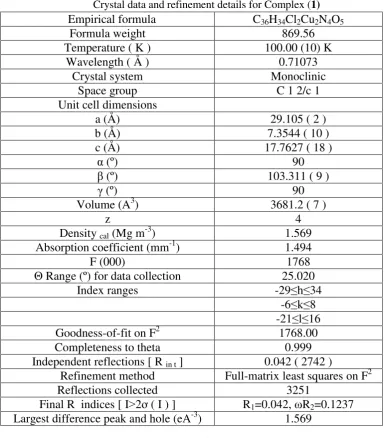
crystallographic data for complex (1) are given in Table 1. Selected bond lengths and angles are summarized in Table 2.
2.2.5 Theoretical calculations
For complex (1) singlet ground state geometry optimizations were carried out using density functional theory (DFT) at the B3LYP level using the GAUSSIAN09 program package by using the Becks three-parameter hybrid exchange functional and the Lee-Yang-Parr non-level correlation functional (B3LYP).In the calculation the Los Alamos effective core potentials plus the Double Zeta (LanL.2DZ) basis set were employed. For this purpose single crystal X-ray geometry were used as an initial guess structure. The geometry of complex (1) is fully optimized in gas phase without any symmetry constraints. All subsequent mathematical calculation were carried out based on the optimized structure of complex (1).vertical electronic excitations based on B3LYP optimized geometries were computed for complex (1) using (TD-DFT) formalism in MeOH using the conductor-like polarizable continuum model (CPCM).To determine fractional contribution of various groups to each molecular orbital GAUSS SUMwas used.
III. RESULTS AND DISCUSSION 3.1. Synthesis
The Schiff base ligand (H2L) was prepared by 1:2 condensation of 1,2-ethylenediamine and 5-chloro-2-hydroxy acetophenone in dry methanol. The complexation behavior of Schiff base ligand H2L towards copper nitrate as metal precursor was investigated. A methanolic solution of copper (II) nitrate was then added to the methanol solution of compartmental Schiff base ligand (H2L) at 1:1 molar ratio with constant stirring to prepare complex (1). X-ray quality crystal of complex (1) was obtained upon slow evaporation of the reaction mixture at room temperature. Schiff base ligand was characterized by different physicochemical techniques like IR, mass spectroscopic studies.
3.2. IR Characterization of the ligand and complex (1)
The infrared spectra of complex (1) are consistent with the structural data given in this paper. An intense strong band due to imine bond at ca. 1613 cm-1 for complex (1) are shifted considerably towards lower frequencies compared to that of the free Schiff base ligand for which it is 1632 cm-1 indicating coordination of the imine nitrogen atom. Complex (1) does not have any significant peak in the IR region of 3200-3500 cm-1 which clearly indicates that there will be no free –OH group and deprotonation takes place during complexation.
3.2.1 Crystal structure description of complex (1)
Complex (1) perspective view with atom numbering ORTEP representation is clearly shown in Fig. 1. Complex (1) different crystal metrical parameters are given in Table 1. and
Table 2. Complex (1) crystallizes in the space group C12/c1. The structure of [Cu(L)2] (1) is a
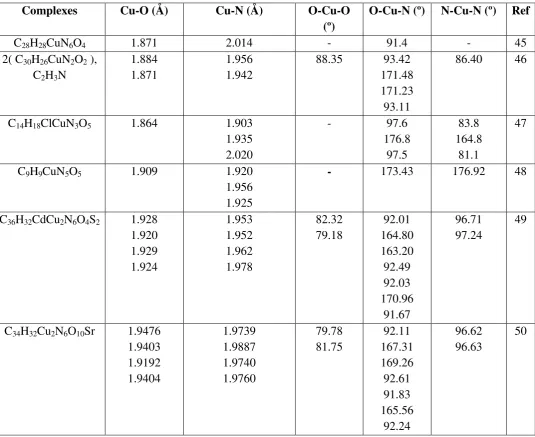
87.6º(1). Other important angles are O1-Cu1-N1 92.8º (1), O1-Cu1-N2 174.6º (1).The experimental bond distances and bond angles are similar to the literature values (Table 3).45-50
3.2.2. DFT calculations and electronic structure
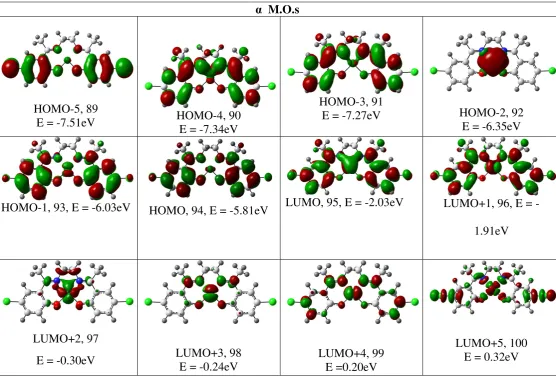
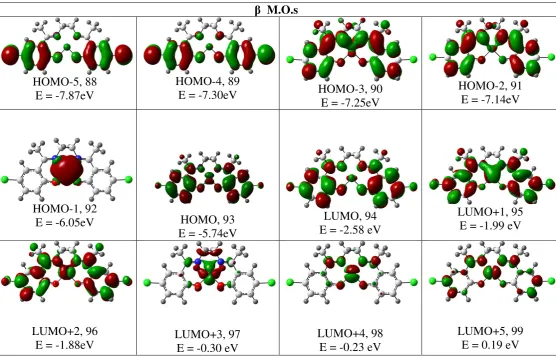
The energy and composition of the selected MOs (Fig. 2 a and b) of 1 are summarized in Table 5a and 5b. The HOMO of α and β spin as well as LUMO of α-spin are concentrated on
coordinated ligand for 1. The α-spin HOMO has 98% ligand character with reduced contribution
(2%) of dπ(Mn) orbitals. The HOMO to HOMO+2 (α-spin) have 84-100% ligand character,
while HOMO-13 to HOMO-15 have mixed ligand and dπ(Mn) character. For α-spin, LUMO+1
to LUMO+7 and LUMO+12 to LUMO+15 possess exclusively ligand character whereas LUMO+8 to LUMO+1 possess mainly metal character. For β-spin MOs HOMO-1 to HOMO-13, LUMO+1 to LUMO+8 and LUMO-13 to LUMO+15 have ligand character.
TDDFT calculations have been performed to get deep insight into the electronic transitions of the complex. The calculated vertical electronic transitions are summarized in Table 6. For complex 1 the transitions at 329 nm and 370 nm correspond to aromatic ring to aromatic ring charge transfer (AACT). Transitions at 354 nm is due to both aromatic ring to aromatic ring charge transfer (AACT) and aromatic ring to imine charge transfer transition (AICT) and 385 nm represents aromatic ring to imine charge transfer transition (AICT).
IV. CONCLUSION
Salen-type Schiff base ligand H2L has been used to synthesize a mononuclear Cu (II) complex (1), with Cu (II) nitrate as the metal precursor without any bridging ligands. The Schiff base ligand H2L form square planar complex with Cu(II) metal ion via two imine N atoms and two phenoxide ions. X-ray crystal structure determination confirmed the structure of complex (1). Moreover, FT-IR,UV-Vis spectral comparisons have been carried out to distinguish the Schiff base ligand H2L alterations and its metal complexes before and after metal ion complexation. The geometry of complex (1) optimized with the DFT-B3LYP method and LanL.2DZ basis sets for Cu (II). The experimental determined electronic transitions are compared with those obtained theoretically from TD-DFT calculations.
ACKNOWLEDGEMENTS
DJM thanks Tamralipta Mahavidyalaya, Purba Medinipur, Tamluk, W.B., India, for giving the laboratory facilities.
Appendix A. SUPPLIMENTARY DATA
CCDC 1044685 contain the supplementary crystallographic data for 1. These data can be obtained free of charge via http://www.ccdc.cam.ac.uk/ conts/retrieving.html, or from the Cambridge Crystallographic Data Centre, 12 Union Road, Cambridge CB2 1EZ, UK; fax: (+44) 1223-336-033; or e-mail: [email protected].
BIBLIOGRAPHY
[1] Schiff, H. 1864. Ann. Suppl. 3:343. [2] Alexander, V. 1995. Chem. Rev. 95:273.
[3] Vigato, P A. Tamburini, S. and Bertolo, L. 2007. Coord. Chem. Rev.251:1311.
[4] Saimenko ,A P. 2012. Organometallic Complexes of Pyridyl Schiff Bases, in: A. R.Katritzky ( Ed. ) Advances in Heterocyclic Chemistry, Academic Press, 107:133-218.
[6] Garnovskii, A D. Vasilchenko,I S. Garnovskii, D A. Burlov, A S. and Uraev, A I. Russ. J. Gen. Chem, 2009.79: 2776.
[7] Garnovskii,A D. Vasilchenko, I S. Garnovskii, D A. and Kharisov,B I. J. Coord. Chem, 2009.62:151. [8] Miyasaka, H. Saitoh ,A. and Abe, S. Coord. Chem. Rev,2007.251:2622.
[9] Radecka-Paryzek ,W. Patroniak ,V. and Lisowski, J. Coord. Chem. Rev, 2005.24:2156.
[10] Nayak,S. Gamez, P. Kozlevcar, B. Pevec ,A. Roubeau, O. Dehnen, S. and Reedijk ,J. Polyhedron,2010.29:2291.
[11] Mohamed ,G G. Zayed ,MA. and Abdallah, SM. J. Mol. Struct,2010.979:62. [12] Chattopadhyay, S. Drew, M C B. and Ghosh, A. Polyhedron,2007.26:3513.
[13] Wang,M. Wang, L F. Li, Y Z. Li, Q X. Xu, Z D. and Qu, D Q. Transition Met. Chem,2001. 26: 307. [14] Dhumwad ,S D. Gudasi, K B. and Goudar, T R. Indian J. Chem. A, 1994.33:320.
[15] Gulerman ,N N. Rollas, S. Erdeniz, H. and Kiraj, M. J. Pharm. Sci, 2006.26:1. [16] Reddy, K H. Reddy, P S. and Babu, P R. Transition Met. Chem, 2000.25:154.
[17] Tarasconi ,P. Capacchi, S. Pelosi, G. Corina, M. Albertini, M. Bonati, A. Dall’Aglio ,P P. Lunghi, P. and
Pinelli ,S. Bioorg, Med. Chem, 2000. 8:154.
[18] Singh,H. Yadav, L D S. and Mishra, B S. J. Inorg. Nucl. Chem, 1981.42:1701.
[19] Charo, J. Lindencrona ,J A. Carlson, L M. Hinkula, J. Kiessling, R. and Virol, J, 2004.78:11321.
[20] West ,D X. Dietrich, S L. Thientananvanich, I. Brown ,C A. and Liberto ,A E. Transition Met. Chem, 1994.19:320.
[21] Singh ,N K. and Singh, S B. Indian J. Chem. A, 2001.40:1070.
[22] Mishra, V. Pandeya ,S N. and Anathan ,S. Acta Pharm. Turc, 2000.42:139. [23] Jamal ,D. and Quaraishi, M A. J. Eletrochem. Soc. India, 2000.49:56. [24] Baran ,E J. J. Inorg. Biochem, 2000.80:1.
[25] Velde ,F. Arends, I W C E. and Sheldon ,R A. J. Inorg. Biochem, 2000.80:81.
[26] ] Zhu ,X D. Wang ,C G. Dang ,Y L. Zhou, H B. Wu, Z S. Liu, Z J. Ye, D L. and Zhou, Q C. Synth. React. Inorg. Met.-Org. Chem, 2000.30:625.
[27] Kanthimathi, M. Dhathathreyan, A. and Nair, B U. Chem. Phys. Lett, 2000.324:43. [28] Zhang ,H. Zhang, Y. and Li, C. J. Catal, 2000.238:369.
[29] Bahramian ,B. Mirkhani, V. Moghadam, M. and Tangestaninejad, S. Appl. Catal.A, 2001. 301:169. [30] Wen, J. Zhao ,J. Wang, X. Dong ,J. and You, T. J. Mol. Catal. A, 2006.245:242.
[31] Sheldrick, G M. Acta Crystallogr. Sect. A, 2008.64:112.
[32] SAINT, Version 6.02, SADABS, Version 2.03; Bruker AXS Inc., Madison, WI, 2002. [33] CRYSALIS, Oxford Diffraction Ltd., Abingdon, UK, 2006.
[34] Becke, A D. J. Chem. Phys, 1998.98:5648.
[35] Stevens, P J. Devlin, J F. Chabalowski, C F. and Frisch, M J. J. Phys. Chem, 1998.98:11623. [36] Lee ,C T. Yang ,W T. and Parr, R G. Phys. Rev. B, 1998.37:785-789.
[37] Hay, P J. and Wadt, W R. J. Chem. Phys., 1985.82:270.
[38] Bauernschmitt, R. and Ahlrichs, R. Chem. Phys. Lett, 1996.256:454.
[39] Stratmann, R E. Scuseria, G E. and Frisch, M J. J. Chem. Phys, 1998. 109:8218.
[40] Casida, M E. Jamorski, C. Casida ,K C. and Salahub, D R. J. Chem. Phys, 1998. 108:4439. [41] Barone ,V. and Cossi ,M. J. Phys. Chem. A, 1998.102:1995.
[42] Cossi, M. and Barone, V. J. Chem. Phys, 2001. 115:4708.
[43] Cossi, M. Rega, N. Scalmani ,G. and Barone ,V. J. Comput. Chem, 2003.24:669. [44] O’Boyle, M M. Tenderholt ,A L. and Langer, K M. J. Comput. Chem, 2008.29:839.
[45] Qian, Hui-Fen. Dai ,Yuan. Geng, Jiao. Wang, Li. Wang, Cheng. and Huang,Wei. Polyhedron, 2014.67 :314-320.
[46] Abbasi ,Z. Behzad,M. Ghaffari, A. Rudbari, H A. and Bruno, G. Inorg. Chim. Acta, 2014.414:78-84.
[47] Chattopadhyay ,S. Ray, M S. Chaudhuri ,S. Mukhopadhyay, G. Bocelli, G. Cantoni ,A. and Ghosh ,A. Inorg. Chim. Acta, 2006.359:1367-1375.
[48] Ješić ,L S V. Radanović ,M M. Rodić, M V. Jovanović ,L S. Česljević ,V I. and Joksović, M D. Polyhedron, 2014.80:90-96.
[49] Das ,Lakshmi Kanta. Biswas , Apurba. Frontera ,Antonio., and Ghosh ,Ashutosh., Polyhedron, 2013.52:1416-1424.
Figure and Table section
Reaction scheme and figures:
Scheme 1. Synthesis of H2L
α M.O.s
HOMO-5, 89
E = -7.51eV HOMO-4, 90 E = -7.34eV
HOMO-3, 91
E = -7.27eV HOMO-2, 92
E = -6.35eV
HOMO-1, 93, E = -6.03eV HOMO, 94, E = -5.81eV LUMO, 95, E = -2.03eV LUMO+1, 96, E =
-1.91eV
LUMO+2, 97
E = -0.30eV LUMO+3, 98 E = -0.24eV LUMO+4, 99 E =0.20eV
LUMO+5, 100 E = 0.32eV
β M.O.s
HOMO-5, 88 E = -7.87eV
HOMO-4, 89
E = -7.30eV HOMO-3, 90
E = -7.25eV
HOMO-2, 91 E = -7.14eV
HOMO-1, 92
E = -6.05eV HOMO, 93
E = -5.74eV
LUMO, 94 E = -2.58 eV
LUMO+1, 95 E = -1.99 eV
LUMO+2, 96
E = -1.88eV LUMO+3, 97 E = -0.30 eV LUMO+4, 98 E = -0.23 eV
LUMO+5, 99 E = 0.19 eV
Fig. 2b.Contour plots of some selected MOs (β-spin) of 1.
Table 1
Crystal data and refinement details for Complex (1)
Empirical formula C36H34Cl2Cu2N4O5
Formula weight 869.56
Temperature ( K ) 100.00 (10) K
Wavelength ( Å ) 0.71073
Crystal system Monoclinic
Space group C 1 2/c 1
Unit cell dimensions
a (Å) 29.105 ( 2 )
b (Å) 7.3544 ( 10 )
c (Å) 17.7627 ( 18 )
α (º) 90
β (º) 103.311 ( 9 )
γ (º) 90
Volume (A3) 3681.2 ( 7 )
z 4
Density cal (Mg m-3) 1.569
Absorption coefficient (mm-1) 1.494
F (000) 1768
Θ Range (º) for data collection 25.020
Index ranges -29≤h≤34
-6≤k≤8 -21≤l≤16
Goodness-of-fit on F2 1768.00
Completeness to theta 0.999
Independent reflections [ R in t ] 0.042 ( 2742 )
Refinement method Full-matrix least squares on F2
Reflections collected 3251
Final R indices [ I˃2ơ ( I ) ] R1=0.042, ωR2=0.1237
Largest difference peak and hole (eA-3) 1.569
Table 2
Selected some bond distances (Å) and angles (°) for complex (1)
Selected bonds Bond distances value ( Å ) Selected angles Bond angles value (°)
Cu1-O1 1.941 ( 3 ) O1-Cu1-O2 86.9 ( 1 )
Cu1-O2 1.952 ( 2 ) O1-Cu1-N1 92.8 ( 1 )
Cu1-N1 1.997 ( 3 ) O1-Cu1-N2 174.6 ( 1 )
Cu1-N2 1.994 ( 3 ) O2-Cu1-N1 173.1( 1 )
N1-C7 1.3355 ( 4 ) O2-Cu1-N2 93.3 ( 1 )
N1-C9 1.508 ( 5 ) N1-Cu1-N2 87.6 ( 1 )
Table 3
Selected some Copper square planar complexes Bond distances (Å) and Bond Angles (º) values.
Complexes Cu-O (Å) Cu-N (Å) O-Cu-O
(º)
O-Cu-N (º) N-Cu-N (º) Ref
C28H28CuN6O4 1.871 2.014 - 91.4 - 45
2( C30H26CuN2O2 ),
C2H3N
1.884 1.871
1.956 1.942
88.35 93.42 171.48 171.23 93.11
86.40 46
C14H18ClCuN3O5 1.864 1.903
1.935 2.020
- 97.6
176.8 97.5 83.8 164.8 81.1 47
C9H9CuN5O5 1.909 1.920
1.956 1.925
- 173.43 176.92 48
C36H32CdCu2N6O4S2 1.928
1.920 1.929 1.924 1.953 1.952 1.962 1.978 82.32 79.18 92.01 164.80 163.20 92.49 92.03 170.96 91.67 96.71 97.24 49
C34H32Cu2N6O10Sr 1.9476
Table 4
Experimental and calculated bond distances (Å) and angles (°) of omplex.
Bond Distances Experimental calculated
Cu1-O1 1.941(2) 1.924
Cu1-O2 1.952(2) 1.924
Cu1-N1 1.997(3) 1.987
Cu1-N2 1.994(3) 1.986
Bond angles
O1-Cu1-O2 86.94(10) 89.69
O1-Cu1-N1 92.77(11) 91.68
O1-Cu1-N2 174.57(10) 174.31
O2-Cu1-N1 173.11(10) 174.31
O2-Cu1-N2 93.33(10) 91.67
N1-Cu1-N2 87.61(11) 87.48
Table 5
Electronic transitions of 1 calculated by TDDFT method
Excitation Wavelength
λ(nm)
Oscillatory strength (f)
Major Contribution Assignment ‡
1 684.08 0.0032 SOMO(β)→LUMO(β) (80%) AMCT
2 526.58 0.0004 SOMO -1(β) →LUMO(β) (76%) AMCT
3 506.26 0.0315 SOMO -8(β) →LUMO(β) (23%),
SOMO -2(β) →LUMO(β) (38%)
MMCT
HMCT
4 487.58 0.0001 SOMO -1(β) → LUMO +2(β) (13%),
SOMO (β) → LUMO +1(β) (37%)
AACT
AICT
6 451.14 0.0147 SOMO -15(β) →LUMO(β) (37%),
SOMO -12(β) →LUMO(β) (13%),
SOMO -8(β) →LUMO(β) (32%)
MMCT
IMCT
MMCT
SOMO -11(β) →LUMO(β) (28%), IMCT
8 387.62 0.0124 SOMO -14(β) →LUMO(β) (27%) MMCT
9 386.60 0.0119 SOMO -2(α) →LUMO(α) (53%),
SOMO -1(α) →LUMO(α) (32%)
HICT
AICT
10 384.19 0.0125 SOMO (α) →LUMO(α) (29%),
SOMO (β) → LUMO +1(β) (36%)
AICT
AICT
11 380.27 0.0001 SOMO -4(α) →LUMO(α) (14%),
SOMO -3(α) → LUMO +1(α) (15%),
AICT
AACT
12 377.99 0.0008 SOMO -4(β) →LUMO +2(β) (12%),
SOMO -3(β) →LUMO +1(β) (14%)
AACT
AICT
14 370.57 0.0936 SOMO (α) → LUMO +1(α) (45%), SOMO (β) → LUMO +2(β) (44%)
AACT AACT
15 352.46 0.0082 SOMO (α) → LUMO +1(α) (16%),
SOMO -1(β) → LUMO +1(β) (47%)
AACT
AICT
16 350.05 0.0002 SOMO -2(α) → LUMO +1(α) (12%)
SOMO (α) →LUMO(α) (12%), SOMO -1(β) → LUMO +2(β) (47%)
HACT
AICT AACT
17 346.67 0.0463 SOMO -1(α) →LUMO(α) (36%),
SOMO -1(β) → LUMO +1(β) (25%)
AICT
AICT
18 330.08 0.0118 SOMO -1(α) → LUMO +1(α) (33%),
SOMO -1(β) → LUMO +2(β) (34%)
AACT
AACT
19 322.48 0.147 SOMO (α) → LUMO +2(α) (10%),
SOMO -2(β) →LUMO(β) (29%)
AACT
HMCT
20 318.40 0.0001 SOMO -1(β) →LUMO +3(β) (13%),
SOMO (β) → LUMO +4(β) (18%)
AACT
AACT
‡AMCT = Aromatic ring to metal charge transfer, AACT = Aromatic ring to aromatic ring
charge transfer, MMCT = Metal to metal charge transfer, AICT = Aromatic ring to imine charge transfer transition, HMCT = Hydroxyl to metal charge transfer, HACT= Hydroxyl to aromatic
Table 6
Selected MOs along with their energies and compositions of complex
MOs Energy
(eV) Hydroxy % of Composition
l Cu Chlorine atom Aromatic ring Imine
α-MOs
LUMO+15 3.34 0 0 1 61 38
LUMO+14 3.12 0 19 0 60 21
LUMO+13 2.94 0 1 0 29 70
LUMO+12 2.87 0 41 0 27 33
LUMO+11 0.87 0 96 0 5 0
LUMO+10 0.77 0 100 0 0 0
LUMO+9 0.70 0 87 2 9 1
LUMO+8 0.61 2 75 0 17 6
LUMO+7 0.50 1 21 1 56 21
LUMO+6 0.35 0 4 34 60 2
LUMO+5 0.32 0 5 34 59 2
LUMO+4 0.20 0 24 2 56 18
LUMO+3 -0.24 7 0 1 88 5
LUMO+2 -0.30 5 5 1 86 3
LUMO+1 -1.91 3 1 0 49 47
LUMO -2.03 4 1 0 45 50
HOMO -5.81 28 2 7 57 6
HOMO -1 -6.03 25 5 7 54 9
HOMO -2 -6.35 36 15 1 20 27
HOMO -3 -7.27 0 1 0 79 20
HOMO -4 -7.34 0 1 0 82 16
HOMO -5 -7.51 65 5 0 20 10
HOMO -6 -8.29 14 5 45 31 5
HOMO -8 -8.56 32 5 21 19 23
HOMO -9 -8.72 0 1 86 10 3
HOMO -10 -8.74 4 1 81 11 3
HOMO -11 -8.81 10 9 5 25 51
HOMO -12 -8.94 6 16 1 29 48
HOMO -13 -9.21 3 44 2 11 41
HOMO -14 -9.72 9 38 26 27 1
HOMO -15 -9.89 8 60 3 17 12
β-MOs
LUMO+15 3.13 0 18 0 60 22
LUMO+14 2.97 0 1 0 31 68
LUMO+13 2.87 0 42 0 26 31
LUMO+12 0.93 0 99 0 3 -1
LUMO+11 0.77 0 100 0 0 0
LUMO+10 0.72 1 82 2 11 4
LUMO+9 0.62 2 74 0 18 6
LUMO+8 0.5 1 21 1 56 21
LUMO+7 0.36 0 4 34 60 2
LUMO+6 0.33 0 5 34 59 1
LUMO+5 0.19 0 25 2 55 18
LUMO+4 -0.23 7 0 1 87 5
LUMO+3 -0.30 5 5 1 85 3
LUMO+2 -1.88 3 1 0 49 47
LUMO+1 -1.99 4 3 0 44 49
LUMO -2.58 17 57 0 6 20
HOMO -5.74 29 3 6 55 7
HOMO -1 -6.05 24 3 8 60 6
HOMO -3 -7.25 3 1 0 77 19
HOMO -4 -7.30 0 2 0 80 17
HOMO -5 -7.87 66 11 1 20 2
HOMO -6 -8.23 13 9 42 32 5
HOMO -7 -8.41 19 6 46 28 1
HOMO -8 -8.57 3 50 3 12 32
HOMO -9 -8.71 0 1 84 11 3
HOMO -10 -8.73 0 2 87 9 2
HOMO -11 -8.78 2 26 5 28 39
HOMO -12 -8.93 8 22 3 22 44
HOMO -13 -9.05 4 16 6 19 56
HOMO -14 -9.43 2 60 18 16 4