Impact Factor: 5.515
Image Compression and Decompression
using Coding Redundancy Method
Dr. Deepa Raj
Assistant Professor, BBAU University Lucknow
Abstract: Image compression is a technology in the field of digital image processing. It is a process of reducing the size of image at the time of storing on the disk and transmitting the image from one place to other place. Now days whole world adopt the online system for carry out any official or academic work for sending or receiving textual or image data. Therefore for fast speed transmitting, image should have smaller size. Different techniques are available for reducing the size of image. In this paper I discussed on coding redundancy method for lossless type of images, in which it choose a less number of bits for frequently occurring data at the time of compression. This paper explained a compression technique and its model with algorithm for an image which will easy for the programmer for coding or writing program for compression.
Keywords- Lossless, coding redundancy method, compression.
1. Introduction
Image compression plays a key role in much application such as image data base, image communication, digital movie, televideo conferencing, remote sensing ,document and medical imaging, fax and in camera. It speed the processing due to reduce the size of image. Web page image and high resolution digital camera photos also are compressed routinely to save storage space and reduce transmission time. The residential internet connections deliver data at speed ranging from 56 Kbps via conventional phone line and more than 12 Mbps for broadband. The time required to transmit a small 128X128X8 bit full color image over this range of speed is from 7.0 to 0.03 seconds. Compression can reduce the transmitting time by the factor of 2 to 10 or more. Number of works has been done on this area. In [4] Syed Ali Hassan and Mehdi Hussain described Lossless Image Data Compression Method in spatial domain. In [5] author has described a lossless image compression algorithm using duplication run length coding.
Saravanan et. al.[6] explained lossless grey-scale image compression using source symbol reduction and Huffman Coding. Effective context lossless image coding approach based on adaptive prediction is explained in [9]..Xiwen Zhao has explained a local structure learning and prediction for efficient lossless image compression. Lossless image compression using super-spatial structure prediction is explained in 11.
Impact Factor: 5.515 2. Background
Data compression is the process of reducing the amount of data required to represent a given quantity of information. Data are the means by which information is conveyed. Amount of data can be used to represent the same amount of information, representation that contain irrelevant or repeated information are said to contain redundant data. Suppose b and b’ contain the number of bits in two representation of the same information then compression ratio is nothing but ratio of b and b’ and relative data redundancy (R)
R = 1-1/C
Which shows how much percent data is redundant. Where C is called compression ratio defined as
C = b/b’
2.1 Different types of redundancy
There are different types of redundancies that can be identified in two dimensional representation of image
a) Coding redundancy- A code is a system of symbols used to represent a body of information or a set of events. Each piece of information or event is assigned a sequence of code symbol called a code word. The number of symbol in each code word is its length. In coding redundancy the symbol which are used many times in a image, set a less number of symbols. In this way reducing the size of image.
b) Spatial redundancy-this types of redundancy called a inter pixel redundancy. The neighborhood pixels are correlated. So the redundant data may be deleted to compress image.
c) Irrelevant information- Most 2D intensity arrays contains information that is ignored by the human visual system. That information is redundant data.
Data compression is achieved when one or more of these redundancies are eliminated. Hoffman coding method uses a coding redundancy to compress the image.
3. Types of compression
There are two types of compression. Lossless compression and lossy compression.In lossless compression compress image is identical to the original image while lossy compression loss some information of the image and little bit change in the decompressed image. Due to telemedicine facility now a days, medical image may be transmitted fast due to compressed and may be diagnosed anywhere in the country in short period of time. Lossless image compression is highly suitable for medical image. Compression techniques for the lossless compression are
Impact Factor: 5.515 d) Entropy coding
e) Area coding
Lossy image loss some information so it is suitable only for the photographic image. Compression techniques for the Lossy compression
a) Predictive coding
b) Transform coding(FT/DCT/Wavelet)
4. Coding redundancy technique
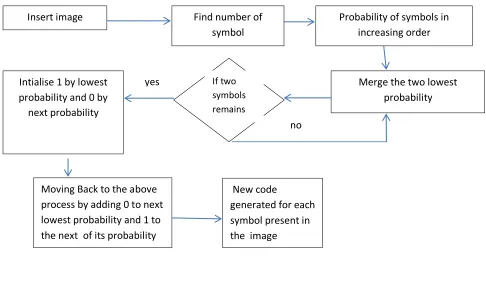
Huffman coding method of compression uses a coding redundancy technique. In this technique image is first digitized and sampled.. In the 8-bit representation each pixel use 8 bit to represent intensity in the image. Probability is used to calculate largest occurrence of intensity present in the image. This method reduces the number of bits for largely occurrence symbol. In this way storage capacity of image may reduce. Figure 1 shows the model of compression of an image
Figure 1. Models of Huffman Coding as Encoder New code
generated for each symbol present in the image
Insert image Probability of symbols in
increasing order Find number of
symbol
Merge the two lowest probability Intialise 1 by lowest
probability and 0 by next probability
Moving Back to the above process by adding 0 to next lowest probability and 1 to the next of its probability
If two symbols remains yes
Impact Factor: 5.515 Let us take one example to understand the Huffman coding technique-
Probability of each symbol can be calculated by nak/n where nak is number of times ak occurs in
the image and n is the total number of pixel in image. If N is number of row and M is numbers of column then n= MN.
Entropy can be the average number of bits used to represent each pixel. Let each symbol or each pixel uses 8 bits then entropy can be calculated as
Entropy or L avg = ∑ l(ak) pr(ak) for k= 0 to n-1
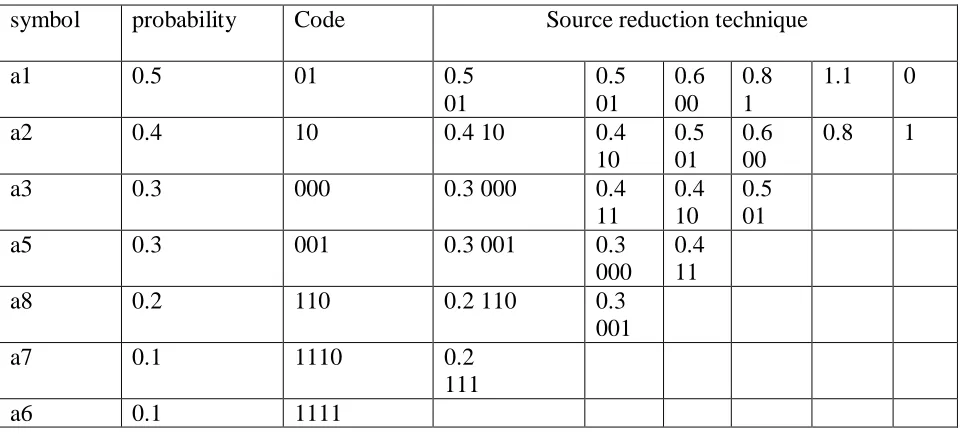
Where l(ak) is number of bits used to represent the symbol ak. Table 1 shows the variable length code of each symbol present in the image with probability is mentioned. Table 1 shows the process of finding the codes of each symbols presents in the image by source reduction technique.
Table 1. Huffman Source Reduction
symbol probability Code Source reduction technique
a1 0.5 01 0.5
01
0.5 01
0.6 00
0.8 1
1.1 0
a2 0.4 10 0.4 10 0.4
10
0.5 01
0.6 00
0.8 1
a3 0.3 000 0.3 000 0.4
11
0.4 10
0.5 01
a5 0.3 001 0.3 001 0.3
000
0.4 11
a8 0.2 110 0.2 110 0.3
001
a7 0.1 1110 0.2
111
a6 0.1 1111
Impact Factor: 5.515 each symbols starting with the smallest source and working back to the original source. In the 5th column of source reduction smallest number is 0.8 so code for this is taken as 1. And 1.1 is the combination of 0.6 and 0.5 so 0.6 is taken as 00 and 0.5 is taken as 01.next 0.8 is the combination of last two lowest probabilities 0.4 and 0.4 so coding is proved accordingly as 10 and 11. Repeat the same process until reached to the first source reduction. Here a1 has more probability but less number of bits. At the time of scanning image row by row, binary bits are replaced by particular symbolic binary digits mentioned in the table 1 and send or store in the internet or disk which reduce the transmission as well storage capacity. After complete compression of the image data are stored in the terms of bits in the file. .
5. Model for Compression and Decompression of an image
Input image f(x,y) is fed into encoder i.e. Huffman encoding procedure, which create a compressed representation of the input. This representation is stored for later use or transmitted at a remote location. Now compressed representation is presented on the decoder, At the time of decompression particular symbolic binary code is replaced by original code bits which is done by a decoder and original image is obtained at receiving end.
Figure-2: Decompression of an Image using Coding Redundancy
6. Conclusion and Future Cope
We presented a lossless image compression using code redundancy technique. We achieved 60% reduction in gray scale images so finding fast transmission time and less storage capacity. Mean square error has the value zero and Peak signal to noise ratio has the value infinite because it is the inversely proportional to mean square error. In future we will apply this method to colored image compression and video compression and medical image of CT scan type MRI and X-Ray image. Huffman technique is also used nowadays for compression of image dynamically, coming online data compress in parts one by one.
Compressed data Replace Code by Symbol from from Huffman Table
Scan the data
Decompressed data image Scan the data
Impact Factor: 5.515
References
1. Ralf Steinmetz and Klara Nahrstedt, “Multimedia: Computing, Communications and Applications”, 1st Edition, Pearson Education Inc. ISBN: 81-7808-319-1, 2005.
2. Rafael C. Gonzalez and Richard E. Woods, “Digital Image Processing 2nd Edition”, Pearson Prentice Hall. ISBN: 81-7758-168- 6, 2005.
3. Komal Ramteke and Sunita Rawat, “Lossless Image Compression LOCO-R Algorithm for 16 bit Image”, 2nd National Conference on Information and Communication Technology (NCICT), pp. 11-14, 2011.
4. Syed Ali Hassan and Mehdi Hussain, “Spatial Domain Lossless Image Data Compression Method”, International Conference of Information and Communication Technologies, 2011.
5. Al-Wahaib and M. S. KokSheikh Wong, “A Lossless Image Compression Algorithm Using Duplication Run Length Coding”, IEEE Conference on Network Application Protocols and Services, pp. 245-250, 2010.
6. C. Saravanan and R. Ponalagusamy, “Lossless Grey-Scale Image Compression Using Source Symbol Reduction and Huffman Coding”, International Journal of Image Processing, IJIP, Vol-3. Issue-, pp. 246-251, 2009.
7. Still Image and Video Compression with Matlab, by K.S. Thyagarajan, a John Wiley & Sons, Inc, Publication.
8. Rafael Gonzalez & Richard Woods,“Digital Image Processing using MATLAB”, Tata McGraw Hill, 2010.
9. Grzegorz Ulacha and Ryszard Stasiński, “Effective Context Lossless Image Coding Approach Based on Adaptive Prediction”, World Academy of Science, Engineering and Technology, 2009.
10. Xiwen Zhao and Zhihai He, “Local Structure Learning and Prediction for Efficient Lossless Image Compression”, 2010 IEEE, pp. 1286-1289.
11. Xiwen OwenZhao, and Zhihai HenryHe, ”Lossless Image Compression Using Super-Spatial Structure Prediction”, IEEE signal processing letters, VOL. 17, NO. 4, APRIL 2010, pp. 383-386.