Bharath V
et al
, International Journal of Computer Science and Mobile Applications,
Vol.2 Issue. 4, April- 2014, pg. 59-64
ISSN: 2321-8363
©2014, IJCSMA All Rights Reserved, www.ijcsma.com 59
ENERGY EFFICIENT DATA
TRAFFIC MANAGEMENT IN
MOBILE CLOUD COMPUTING
Bharath V
1, Priyadarsini K
21Department of CSE, SRM University, [email protected] 2 Department of CSE, SRM University, [email protected]
Abstract
The cloud heralds a new era of computing where application services are provided through the Internet. Cloud computing can enhance the computing capability of mobile systems, but is it the ultimate solution for extending such system’s battery lifetimes. Cloud computing1 is a new paradigm in which computing resources such as processing, memory, and storage are not physically present at the user’s location. Instead, a service provider owns and manages these resources, and users access them via the Internet. For example, Amazon Web Services lets users store personal data via its Simple Storage Service (S3) and perform computations on stored data using the Elastic Compute Cloud (EC2). This type of computing provides many advantages for businesses—including low initial capital investment, shorter start-up time for new services, lower maintenance and operation costs, higher utilization through virtualization, and easier disaster recovery—that make cloud computing an attractive option. Reports suggest that there are several benefits in shifting computing from the desktop to the cloud.1, 2. The primary constraints for mobile computing are limited energy and wireless bandwidth. Cloud computing can provide energy savings as a service to mobile users, though it also poses some unique challenges.
Keywords: Feed Cloud (FC), Feed Base (FB), Organizer, Collector, Temporary Feed Base
1. INTRODUCTION
Energy efficiency is a fundamental consideration for mobile devices. Cloud computing has the potential to save mobile client energy but the savings from offloading the computation need to exceed the energy cost of the additional communication. Existing studies thus focus on determining whether to offload computation by predicting the relationships among these three factors. The computation offloading depends on the wireless bandwidth B, the amount of computation to be performed C, and the amount of data to be transmitted D. In proposed system we identified a service provider owns and manages resources (such as processing, memory, storage), and users access them via the Internet. For example, Amazon Web Services Simple Storage Service (S3): let users store personal data, Elastic Compute Cloud (EC2): perform computations on stored data. There are several benefits in shifting computing from the desktop to the cloud. The primary constraints for mobile computing are limited energy and wireless bandwidth.
2. SYSTEM DESIGN
Bharath V
et al
, International Journal of Computer Science and Mobile Applications,
Vol.2 Issue. 4, April- 2014, pg. 59-64
ISSN: 2321-8363
©2014, IJCSMA All Rights Reserved, www.ijcsma.com 60
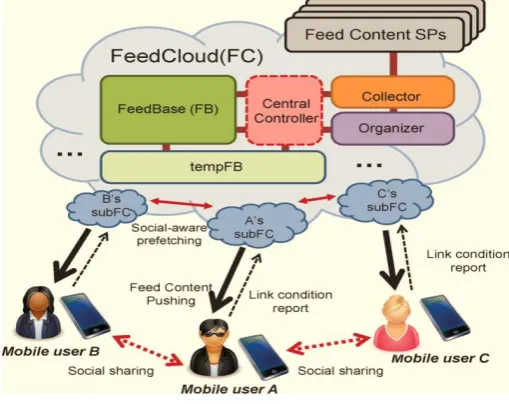
text, image, and multimedia contents of the original website. There is also a tempFB, which temporarily stores new feeds, and once it is accessed by a required number of users, it will be moved to FB.There is the organizer to make a summary of all RSSs of all users by filtering out duplicated ones, and then the collector will fetch the RSS updates and the original content from the feed content SPs. In particular, for each active subscribing user, the cloud virtualizes a smart agent called subFC to monitor the user RSS requirement, as well as the wireless link quality, and then to decide how to request the RSS content and how to push content to the mobile user. Due to the elastic computation of dynamic resource allocation of cloud computing, FCs with subFCs is working with optimal performance adaptively to the user demands.
Figure 1: PreFeed
In PreFeed, users first share their subscribed RSS lists to the cloud agent subFC, which will report to FC’s organizer to shrink the duplicated RSSs (due to the disparity of the RSS popularity) with the requests from other users. Due to the disparity of RSS popularity, it is expected that many duplicated subscriptions will be filtered out and the redundant bandwidth and storage consumption will be maximally reduced. Each subFC will evaluate the update frequency of each RSS feed of each user and then carry out prefetching feed content periodically. The RSS feed is only an XML-based file containing the URL address of the RSS site, and if we take HTML request to that address, a list of up-to-date news in format of abstract will be returned. The collector will not only fetch the abstracts of the RSS updates but also parse the HTML source code of the original website of the specified document in order to obtain the texts, images, and even embedded videos. Once all the files of the document are obtained, they will be stored in tempFC by extending new names with suffixes while the controller will update the file database FB. The naming system can be referred to the Named Data Networking architecture. Anytime any new request arrives from subFC, the FC will check the tempFB and FB to check if the needed file is already cached by maximal prefix matching. If so, it will be directly reused.
Bharath V
et al
, International Journal of Computer Science and Mobile Applications,
Vol.2 Issue. 4, April- 2014, pg. 59-64
ISSN: 2321-8363
©2014, IJCSMA All Rights Reserved, www.ijcsma.com 61
2.1 SAVING ENERGY FOR MOBILE SYSTEM
Various studies have identified longer battery lifetime as the most desired feature of such systems. Many applications are too computation intensive to perform on a mobile system. If a mobile user wants to use such applications, the computation must be performed in the cloud. Other applications can run on a mobile system. However, they consume significant amounts of energy, such as Image retrieval, voice recognition, gaming, and navigation. Eliminate computation all together. The mobile system does not perform the computation. Instead computation is performed somewhere else.
2.2 OFFLOADING COMPUTATION TO SAVE ENERGY
Client – Server computing: Service providers managing programs running on servers Cloud computing:
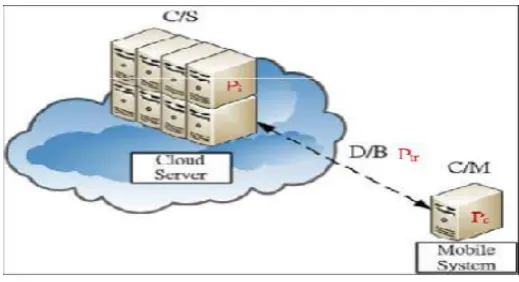
Figure 2: Energy analysis for computation offloading
Allows cloud vendors to run arbitrary applications from different customers on virtual machines. Cloud vendors thus provide computing cycles, and users can use these cycles to reduce the amounts of computation on mobile systems and save energy. Cloud computing can save energy for mobile users through computation offloading. Virtualization: Lets applications from different customers run on different virtual machines, thereby providing separation and protection.
2.3 MAKING COMPUTATION OFFLOADING MORE ATTRACTIVE:
Energy saved by computation offloading through wireless bandwidth, amount of computation to be performed, and amount of data to be transmitted.
Client-Server Model: Because the server does not already contain the data, all the data must be sent to the service provider.
Cloud Computing: The cloud stores data and performs computation on it. Google’s Picasa, Amazon S3, Amazon EC2.
2.4 CHALLENGES AND POSSIBLE SOLUTIONS
Because the data is stored and managed in the cloud, security and privacy settings depend on the IT (information technology) management of the cloud provides. Some types of data cannot be stored in the cloud without considering these privacy and security implications. One possible solution is to encrypt data before storage Reliability. A mobile user performing computation in the cloud depends on the wireless network and cloud service.
3. TRAFFIC LOAD CONTROL
Bharath V
et al
, International Journal of Computer Science and Mobile Applications,
Vol.2 Issue. 4, April- 2014, pg. 59-64
ISSN: 2321-8363
©2014, IJCSMA All Rights Reserved, www.ijcsma.com 62
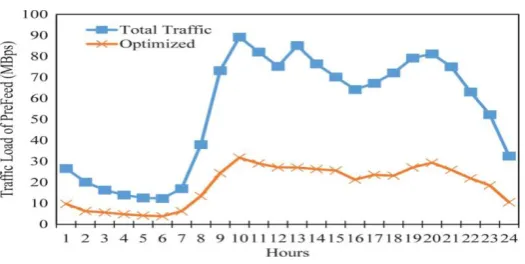
Figure 3: Traffic load without and with PreFeed.They access RSS feeds during their daily life, and we evaluate the real traffic via the PreFeed service per day. As shown in Fig. 3, the total traffic is the estimated full traffic by assuming if there is no caching, which shows traditional RSS services for multiple users, and the optimized traffic is the realistic traffic going through PreFeed. Obviously, due to the reutilization of RSS content files cached in subFB/FB, a large portion of the traffic, around 43%–74%, is reduced.
4 CONCLUSION
In this paper, we have utilized the cloud computing technology to propose a new framework to improve the system’s battery life time for mobile users. PreFeed consists of two parts, i.e., cloud-assisted prefetching, which will proactively fetch the multimedia content of the RSS feeds for all subscribed mobile users, and cognitive pushing, which will push the content to mobile users at an appropriate time by evaluating the link quality and user QoS requirements. Furthermore, the social impact among users is considered. We implement a prototype of the PreFeed framework to evaluate its performance. It is shown that cloud computing can effectively facilitate feed prefetching and cognitive pushing for mobile users; a large portion of traffic load (around 43%–74%) due to redundant downloads can be reduced.
REFERENCES
[1] X. Wang, A. V. Vasilakos, M. Chen, Y. Liu, and T. T. Kwon, “A survey of green mobile networks: Opportunities and challenges,” ACM/Springer MONET, vol. 17, no. 1, pp. 4–20, Feb. 2012.
[2] M. Chen, “MM-QoS for BAN: Multi-Level MAC-Layer QoS Design in Body Area Networks,” in Proc. IEEE Globecom, Atlanta, GA, USA, Dec. 9–13, 2013.
[3] RSS 2.0 Specification, Advisory R. S. S. Board, Jun. 2007.
[4] Power Law. http://en.wikipedia.org/wiki Power_law
[5] X. Li, J. Yan, Z. Deng, L. Ji, W. Fan, B. Zhang, and Z. Chen, “A Novel Clustering-based RSS Aggregator,” in Proc. 16th Int. Conf. World Wide Web, 2007, pp. 1309–1310.
[6] M. Chen, Y.Wen, H. Jin, and V. Leung, “Enabling technologies for future data center networking: A primer,” IEEE Netw., vol. 27, no. 4, pp. 8–15, Jul. 2013.
Bharath V
et al
, International Journal of Computer Science and Mobile Applications,
Vol.2 Issue. 4, April- 2014, pg. 59-64
ISSN: 2321-8363
©2014, IJCSMA All Rights Reserved, www.ijcsma.com 63
[8] D. Niu, H. Xu, B. Li, and S. Zhao, “Quality-assured cloud bandwidth autoscaling for video-on-demand applications,” in Proc. IEEE INFOCOM, 2012, pp. 460–468.
[9] X.Wang, M. Chen, T. T. Kwon, L. T. Yang, and V. C. M. Leung, “AMESCloud:A framework of adaptive mobile video streaming and efficient social video sharing in the clouds,” IEEE Trans. Multimedia, vol. 15, no. 4, pp. 811–820, Feb. 2013.
[10] L. Zhou and H. Wang, “Toward blind scheduling in mobile media cloud: Fairness, simplicity, and asymptotic optimality,” IEEE Trans. Multimedia, vol. 15, no. 4, pp. 735–746, Jun. 2013.
[11] N. Davies, “The case for VM-based cloudlets in mobile computing,” in IEEE Pervasive Comput., Oct.–Dec. 2009, vol. 8, no. 4, pp. 14–23.
[12] B. Aggarwal, N. Spring, and A. Schulman, “Stratus: Energy-efficient mobile communication using cloud support,” in Proc. ACM SIGCOMM, 2010, pp. 477–478.
[13] C. Ji and J. Zhou, “A study on recommendation features for an RSS reader,” in Proc. Int. Conf. CyberC, Oct. 2010, pp. 193–198.
[14] J. J. Samper, P. A. Castillo, L. Araujo, J. J. Merelo, Cordón Ó., and F. Tricas, “NectaRSS, an intelligent RSS feed reader,” J. Netw. Comput. Appl., vol. 31, no. 4, pp. 793–806, Nov. 2008.
[15] A. Das, M. Datar, and A. Garg, “Google news personalization: Scalable online collaborative filtering,” in Proc. 16th Int. Conf. World Wide Web, 2007, pp. 271–280.
[16] Y. Kim, J. W. Lee, S. R. Park, and B. C. Choi, “Mobile advertisement system using data push scheduling based on user preference,” in Wireless Telecommun. Symp., 2009, pp. 1–5.
[17] G. Cugola and H.-A. Jacobsen, “Using publish/subscribe middleware for mobile systems,” ACM SIGMOBILE Mobile Comput. Commun. Rev., vol. 6, no. 4, pp. 25–33, Oct. 2002.
[18] S. Zhao, P. P. C. Lee, J. C. S. Lui, X. Guan, X. Ma, and J. Tao, “Cloud based push-styled mobile botnets: A case study of exploiting the cloud to device messaging service,” in Proc. ACSAC, Dec. 2012, pp. 119–128.
[19] G. Yunwen, W. Shaochun, Y. Bowen, and L. Jiazheng, “The methods of data prefetching based on user model in cloud computing,” in Proc. Int. Conf. iThings/CPSCom, Oct. 2011.
[20] B. Cheluvaraju, A. S. R. Kousik, and S. Rao, “Anticipatory retrieval and caching of data for mobile devices in variable-bandwidth environments,” in Proc. IEEE Int. SysCon, Apr. 2011, pp. 531–537.
[21] B. Li and X. Jia, “Caching and prefetching for web content distribution,” in Proc. Comput. Sci. Eng., Jul./Aug. 2004, vol. 6, no. 4, pp. 54–59.
[22] B. D. Higgins, J. Flinn, T. J. Giuli, B. Noble, C. Peplin, and D. Watson, “Informed mobile prefetching,” in Proc. ACM MobiSys, 2012, pp. 1–14.
[23] Y. Yang and H. Zhang, “HTML page analysis based on visual cues,” in Proc. 6th Int. Conf. Document Anal. Recog., 2001, p. 859.
[24] B. Han, X. Wang, N. Choi, T. T. Kwon, and Y. Choi, “AMVS-NDN: Adaptive mobile video streaming and sharing in wireless named data networking,” in Proc. INFOCOM NOMEN Workshop, 2013, pp. 1–6.
[25] X. Wang, T. T. Kwon, Y. Choi, H. Wang, and J. Liu, “Cloud-assisted adaptive video streaming and social-aware video prefetching for mobile users,” IEEE Wireless Commun. Mag., vol. 20, no. 3, pp. 72–79,
Bharath V
et al
, International Journal of Computer Science and Mobile Applications,
Vol.2 Issue. 4, April- 2014, pg. 59-64
ISSN: 2321-8363
©2014, IJCSMA All Rights Reserved, www.ijcsma.com 64
A Brief Author Biography
1
Bharath V – Bharath is pursuing MTECH CSE in SRM University who is interested in Cloud Computing research. He holds BE CSE and working in a software concern.