
Production of tannase enzyme by using aspergillus niger (ATCC1644) strain on solid substrate fermentation
6
0
0
Full text
(2) Supriya CH. et al., Int. J. Pharm & Ind. Res., Vol.–04 (03) 2014 [76 - 81]. of dicotyledons and 44 families of monocotyledons (Cronquist).8 There may be a loss in the bioavailability of tannins in plants due to birds, pests, and other pathogens.9 Softwoods, while in general much lower in tannins than hardwoods. are usually not recommended for use in an aquarium. Coffee has been found to contain a low to vanishing amount of tannins.10 Cloves, tarragon, cumin, thyme, vanilla and cinnamon all contain tannins.11 Chocolate Liquor contains about 6% tannins.12 Recent studies have demonstrated that products containing chestnut tannins included at low dosages (0.15–0.2%) in the diet of chickens may be beneficial.13 Improved fermentability of soya meal nitrogen in the rumen has also been reported by F. Mathieu and J.P.Jouany (1993).14 Tannin is a component in a type of industrial particle board adhesive developed jointly by the Tanzania Industrial Research and Development Organization and Forintek Labs Canada.15 The use of resins made of tannins has been investigated to remove mercury and methyl-mercury from solution.16 Immobilized tannins have been tested to recover uranium from seawater .17. Materials and Methods Chemicals All the chemicals used in the present study were of pure quality grade citrate buffer (pH-5) and ammonium sulphate 80%) and all the components were of pure quality and analytical grade. Enzyme activity was measured by using UV-Visible spectrometer [Thermo scientific] in the Pharmaceutical analysis laboratory. Microorganism In the present study we used Aspergillums niger [ATCC 16404] fungal strains, which were collected from NCIM [National collection of industrial micro organisms] Pune. Composition of potato dextrose agar medium [PDA] The isolates were maintained on potato dextrose agar slants. Generally 46 hrs old cultures were used for the preparation of inoculums. We used pineapple [tannin rich source] as a solid substrate for the maximum tannase production on solid state fermentation. Agar - 4.5 gm, dextrose - 1.5 gm, yeast extract - 0.015 gm, potato starch - 150 ml, Magnesium sulphate - 3.7 gm, sodium chloride -. 77. 0.5 gm, ammonium sulphate - 2.5 gm, distilled water -1000 ml. The strain was propagated in a PDA agar slants at 35˚c for 3-5 days incubation period until sporulation takes place. Five days old cultures were used in the present study for the production of tannase enzyme. Preparation for 80% ammonium sulphate solution The 8 gm of Ammonium sulphate was dissolved in 800 ml of water Preparation of citrate buffer at pH - 5 It is prepared by using Citric acid [48.5 ml] and Disodium hydrogen phosphate [51.5 ml] and made at 2.7 pH. Production of tannase enzyme experimental procedure PDA [potato dextrose agar] medium was prepared in the first step. After that pineapple pieces are taken and different concentrations [10, 20, 30,40,50,60,70,80,90,100 gms] are prepared. Into the prepared sterilized PDA medium different concentrations of pineapple substrate was added and sterilized for 20 minis. After sterilization slants are prepared in aseptic cabin. After solidification, the organism i.e. Aspergillus Niger was inoculated by using inoculating loop. After inoculation, slants are incubated for 2 days and growth was observed. That growth was taken into conical flask using citro-phosphate buffer at PH-5. Then conical flasks are transferred to orbital shaker for 20mins for separation of cultures from media. After orbital shaking that solution is transferred to centrifuge test tubes and centrifuged for 20 min at 8000rpm. Seperate the supernatant layer and to that obtained liquid and add ammonium sulphate to half of the volume f the liquid. The solution was incubated over night at 4˚C. After incubation that the enzyme concentration is measured by taking their absorbance(OD) values at 540nm. After that effect of temperature, effect of pH, and effect of incubation period were studied to fix the optimum parameters for the maximum enzyme production Effect of Concentration To determine the effect of the concentration the pineapple substrate is prepared at different concentrations such as 200, 400, 600, 800 & 1000. www.ijpir.com.
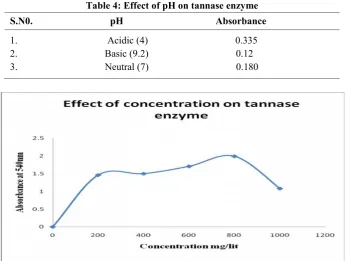
(3) 78. Supriya CH. et al., Int. J. Pharm & Ind. Res., Vol.–04 (03) 2014 [76 - 81]. mg/lit and inoculated with the given culture and allowed to incubate at 28˚C for 72 hrs. Effect of Temperature To study the effect of temperature the inoculated medium is allowed to incubate at different temperature conditions such as at 4˚C, 20˚C, 28˚C, 30˚C, 32˚C , 40˚C & 50˚C respectively for 72 hrs. After 72 hrs of incubation period the test tubes were collected and subjected to purification methods. Effect of Incubation period To study the effect of incubation period on the production of tannase enzyme, the inoculated samples were incubate at different incubation periods such as 2, 4, 6 and 8 days at 28˚C and with 800 mg/lit of substrate. After the respective incubation periods the test tubes were collected and subjected to purification methods. Effect of pH While optimizing the initial pH of the medium of the tannase enzyme was varied at the different pH such as Acidic [4], Basic [9.2] & neutral [7] by dissolving the substrate either in acidic or in basic buffers at 28˚C with 800 mg/lit of substrate for an incubation period of 72 hrs. Then the samples were withdrawn and subjected to purification methods.. Results and discussion In the present study the optimum parameters were fixed for the maximum enzyme production. We studied the following parameters; Effect of concentration Effect of temperature Effect of incubation period Effect of pH. Effect of various concentrations on tannase enzyme was studied and results were tabulated in Table 1. The results shows that maximum tannase activity was observed at 800 mg/lit. The optimum concentration was fixed due to maximum utilization of substrate and beyond this it starts to decrease due to saturation of active sites of enzymes. Effect of temperature on tannase enzyme was carried at various temperatures and results were tabulated in Table 2. The data shows that there was maximum tannase enzyme takes place at temperature of 32˚c and on further increases in temperature causes reduction of tannase enzyme capacity of organism because at that temperature the catalytic activity of tannase is very high at that temperature for the maximum utilization of substrate. The effect of different incubation periods on tannase enzyme was studied and results were tabulated in Table 3. The results shows that maximum tannase activity was occurred at 72 hrs that is the incubation period increases the tannase enzyme is also increases because as the incubation period increases organism utilizes maximum carbon source from the substrate. Beyond that Incubation period that is unable to utilise the substrate due to saturation of active sites of enzymes. The pH was found that pH plays an important role in tannase enzyme. The effect of pH on tannase enzyme was carried out and results were tabulated in Table 4. The results shows that there was maximum tannase activity occurs at acidic pH after that it starts to decrease. The reduction in tannase enzyme is due to the fact that, H+ ions of the organism is suitable for maximum utilization of substrate.. www.ijpir.com.
(4) Supriya CH. et al., Int. J. Pharm & Ind. Res., Vol.–04 (03) 2014 [76 - 81]. Table No. 01: Effect of substrate concentration on tannase enzyme S.No.. Concentrations [mg/lit]. 1. 2. 3. 4. 5.. 200 400 600 800 1000. Absorbance 1.463 1.502 1.709 1.996 1.082. Table No. 02: Effect of temperature on tannase enzyme S.No.. Temperature. Absorbance. 4˚C 20˚C 28˚C 32˚c 50˚c. 1. 2. 3. 4. 5.. 0.032 0.057 0.043 0.117 0.012. Table 3: Effect of incubation period on tannase enzyme S.No. 1. 2. 3. 4. 5. 6. 7.. Incubation Period 24 hrs 48 hrs 72 hrs 120 hrs 168 hrs 216 hrs 264 hrs. Absorbance 0.354 0.212 0.803 0.394 0.327 0.242 0.124. Table 4: Effect of pH on tannase enzyme S.N0. 1. 2. 3.. pH. Absorbance. Acidic (4) Basic (9.2) Neutral (7). 0.335 0.12 0.180. Fig. No. 01: Tannase enzyme by A. niger and pineapple at different substrate concentrations. www.ijpir.com. 79.
(5) 80. Supriya CH. et al., Int. J. Pharm & Ind. Res., Vol.–04 (03) 2014 [76 - 81]. Fig. No. 02: Tannase enzyme by A.niger and pineapple at different temperatures.. Fig. No. 03: Tannase enzyme by A.niger and pineapple at various incubation periods.. Fig. No. 04: Tannase enzyme by A.niger and pineapple at different pH conditions.. www.ijpir.com.
(6) Supriya CH. et al., Int. J. Pharm & Ind. Res., Vol.–04 (03) 2014 [76 - 81]. Acknowledgements. 9.. The author would like to thank the management and to the principal Dr. Abdul Rahaman of Nirmala college of Pharmacy, for supporting the research related to this publication.. 10.. References 1.. 2.. 3.. 4.. 5.. 6.. 7.. 8.. Katie E. Ferrell; Thorington, Richard W. (2006). Squirrels the animal answer guide. Baltimore: Johns Hopkins University Press. p. 91. ISBN 0-8018-8402-0. Drabble, E.; Nierenstein, M. (1907). "On the Rôle of Phenols, Tannic Acids, and Oxybenzoic Acidsin Cork Formation". Biochemical Journal 2 (3): 96–102.1. Perkin, A. G.; Nierenstein, M. (1905). "Some oxidation products of the hydroxybenzoic acids and the constitution of ellagic acid. Part I". Journal of the Chemical Society, Transactions 87: 1412. Nierenstein, M. (1915). "The Formation of Ellagic Acid from Galloyl-Glycine by Penicillium". The Biochemical Journal 9(2) : 240–244. Nierenstein, M. (1932). "A biological synthesis of m-digallic acid". The Biochemical journal 26 (4): 1093–1094. Adam, W. B.; Hardy, F.; Nierenstein, M. (1931). "The Catechin of the Cacao Bean". Journal of the American Chemical Society 53 (2): 727. Nierenstein, M.; Potter, J. (1945). "The distribution of myrobalanitannin". The Biochemical journal 39 (5): 390–392. Simon Mole (1993). "The Systematic Distribution of Tannins in the Leaves of Angiosperms: A Tool for Ecological Studies".Biochemical Systematics and Ecology 21 (8): 833–846.. 11.. 12.. 13.. 14.. 15.. 16.. 17.. www.ijpir.com. 81. Kadam, S. S.; Salunkhe, D. K.; Chavan, J. K. (1990). Dietary tannins: consequences and remedies. Boca Raton: CRC Press. p. 177. ISBN 0-8493-6811-1. lifford M. N., Ramirez-Martinez J. R. "Tannins in wet-processed coffee beans and coffee pulp"; Food Chemistry, 1991, 40 (2), 191– 200. Reed J. D. (1 May 1995). "Nutritional toxicology of tannins and related polyphenols in forage legumes". J. Anim. Sci. 73(5): 1516– 28. Marion Kite; Roy Thomson (2006). Conservation of leather and related materials. Butterworth-Heinemann. p. 23. ISBN 978-0-7506-4881-3. Schiavone A., Guo K., Tassone S., et al. (March 2008). "Effects of a natural extract of chestnut wood on digestibility, performance traits, and nitrogen balance of broiler chicks". Poult. Sci. 87 (3): 521–7. Mathieu F., Jouany J. P. (1993). "Effect of chestnut tannin on the fermentability of soyabean meal nitrogen in the rumen".Ann Zootech 42 (2): 127. 18.Li, Jingge; Maplesden, Frances (1998). "Commercial production of tannins from radiata pine bark for wood adhesives"(PDF). Takashi Sakaguchia, Akira Nakajimaa (June 1987). "Recovery of Uranium from Seawater by Immobilized Tannin".Separation Science and Technology 22 (6): 1609–23. Bajaj, Y. P. S. (1988). Medicinal and aromatic plants. Biotechnology in agriculture and forestry. 24. Berlin: Springer-Verlag. ISBN 0387-56008-4..
(7)
Figure

Related documents
Conclusion: Prevalence of diabetic retinopathy in pregnant women with diabetes mellitus and gestational diabetes mellitus is low as most patient does not have a
It is recommended to work on the effect of the article writing on word acquisition, the effect of the composition on vocabulary learning, but with both gender and
In the present study, the abdominal cavity ESTBS allowed various types of training and implementation of progressive complexity tasks, since the medical students, surgery residents
Background: The aims of this study were to assess the prevalence of hepatitis C virus (HCV) infection in Japanese patients with oral lichen planus and identify the impact of amino
Results: LPG and post-LPG CTA detected 17 unilateral and one bilateral chyle leaks in the 18 patients, with clear images of the communication of lymphatic vessels and the
The use of dexmedetomidine for sedation in adults was approved in 1999 by Food and Drug Administration (FDA) for intubated patients in intensive care unit (ICU) and in 2008
We therefore conclude that the differences in weed seed production between GMHT and conventional maize and spring oilseed rape (and, less certainly, beet) crops are likely
