Convex vs Non-Convex Estimators for Regression and
Sparse Estimation: the Mean Squared Error Properties of
ARD and GLasso
Aleksandr Aravkin [email protected]
IBM T.J. Watson Research Center 1101 Kitchawan Rd, 10598
Yorktown Heights, NY, USA
James V. Burke [email protected]
Department of Mathematics, Box 354350 University of Washington
Seattle, WA, 98195-4350 USA
Alessandro Chiuso [email protected]
Gianluigi Pillonetto [email protected]
Department of Information Engineering Via Gradenigo 6/A
University of Padova Padova, Italy
Editor:Francis Bach
Abstract
We study a simple linear regression problem for grouped variables; we are interested in methods which jointly perform estimation andvariable selection, that is, that automatically set to zero groups of variables in the regression vector. The Group Lasso (GLasso), a well known approach used to tackle this problem which is also a special case of Multiple Kernel Learning (MKL), boils down to solving convex optimization problems. On the other hand, a Bayesian approach commonly known as Sparse Bayesian Learning (SBL), a version of which is the well known Automatic Relevance Determination (ARD), lead to non-convex problems. In this paper we discuss the relation between ARD (and a penalized version which we call PARD) and Glasso, and study their asymptotic properties in terms of the Mean Squared Error in estimating the unknown parameter. The theoretical arguments developed here are independent of the correctness of the prior models and clarify the advantages of PARD over GLasso.
Keywords: Lasso, Group Lasso, Multiple Kernel Learning, Bayesian regularization, marginal likelihood
1. Introduction
We consider sparse estimation in a linear regression model where the explanatory factors θ∈Rm are naturally grouped so that θ is partitioned as θ= [θ(1)> θ(2)> . . . θ(p)>]>.
addition, we assume that the number of unknowns m is large, possibly larger than the size of the available data n. Interest in general sparsity estimation and optimization has attracted the interest of many researchers in statistics, machine learning, and signal pro-cessing with numerous applications in feature selection, compressed sensing, and selective shrinkage (Hastie and Tibshirani, 1990; Tibshirani, 1996; Donoho, 2006; Candes and Tao, 2007). The motivation for our study of the group sparsity problem comes from the “dynamic Bayesian network” scenario identification problem (Chiuso and Pillonetto, 2012, 2010b,a). In a dynamic network scenario, theexplanatory variables are the past histories of different input signals, with the groups θ(i) representing the impulse responses1 describing the re-lationship between the i-th input and the output y. This application informs our view of the group sparsity problem as well as our measures of success for a particular estimation procedure.
Several approaches have been put forward in the literature for joint estimation and variable selection problems. We cite the well known Lasso (Tibshirani, 1996), Least Angle Regression (LAR) (Efron et al., 2004), their group versions Group Lasso (GLasso) and Group Least Angle Regression (GLAR) (Yuan and Lin, 2006), Multiple Kernel Learning (MKL) (Bach et al., 2004; Evgeniou et al., 2005; Pillonetto et al.). Methods based on hierarchical Bayesian models have also been considered, including Automatic Relevance Determination (ARD) (Mackay, 1994), the Relevance Vector Machine (RVM) (Tipping, 2001), and the exponential hyperprior (Chiuso and Pillonetto, 2010b, 2012). The Bayesian approach considered by Chiuso and Pillonetto (2010b, 2012) is intimately related to that of Mackay (1994) and Tipping (2001); in fact the exponential hyperprior algorithm proposed by Chiuso and Pillonetto (2010b, 2012) is a penalized version of ARD (PARD) in which the prior on the groups θ(i) is adapted to the structural properties of dynamical systems.
A variational approach based on the golden standard spike and slab prior, also called two-groups prior (Efron, 2008), has been also recently proposed by Titsias and Lzaro-Gredilla (2011).
An interesting series of papers (Wipf and Rao, 2007; Wipf and Nagarajan, 2007; Wipf et al., 2011) provide a nice link between penalized regression problems like Lasso, also called type-I methods, and Bayesian methods (like RVM, Tipping, 2001 and ARD, Mackay, 1994) with hierarchical hyperpriors where thehyperparameters are estimated via maximizing the marginal likelihood and then inserted in the Bayesian model following the Empirical Bayes paradigm (Maritz and Lwin, 1989); these latter methods are also known as type-II methods (Berger, 1985). Note that this Empirical Bayes paradigm has also been recently used in the context of System Identification (Pillonetto and De Nicolao, 2010; Pillonetto et al., 2011; Chen et al., 2011).
Wipf and Nagarajan (2007) and Wipf et al. (2011) argue that type-II methods have advantages over type-I methods; some of these advantages are related to the fact that, under suitable assumptions, the former can be written in the form of type-I with the addition of a non-separable penalty term (a functiong(x1, .., xn) is non-separable if it cannot be written
asg(x1, .., xn) =Pni=1h(xi)). The analysis of Wipf et al. (2011) also suggests that in the low
noise regime the type-II approach results in a “tighter” approximation to the`0norm. This
is supported by experimental evidence showing that these Bayesian approaches perform
well in practice. Our experience is that the approach based on the marginal likelihood is particularly robust w.r.t. noise regardless of the “correctness” of the Bayesian prior.
Motivated by the strong performance of the exponential hyperprior approach introduced in the dynamic network identification scenario (Chiuso and Pillonetto, 2010b, 2012), we provide some new insights clarifying the above issues. The main contributions are as follows:
(i) We first provide some motivating examples which illustrate the superiority of PARD (and also of ARD) over GLasso both in terms of selection (i.e., detecting block of zeros inθ) as well as in estimation (i.e., reconstructing the non zero blocks).
(ii) Theoretical findings explaining the reasons underlying the superiority of PARD over GLasso are then provided. In particular, all the methods are compared in terms of optimality (KKT) conditions, and tradeoffs between sparsity and shrinkage are studied.
(iii) We then consider a non-Bayesian point of view, in which the estimation error is measured in terms of the Mean Squared Error, in the vein of Stein-estimators (James and Stein, 1961; Efron and Morris, 1973; Stein, 1981). The properties of Empirical Bayes estimators, which form the basis of the computational schemes, are studied in terms of their Mean Square Error properties; this is first established in the simplest case of orthogonal regressors and then extended to more general cases allowing for the regressors to be realizations from (possibly correlated) stochastic processes. This, of course, is of paramount importance for the system identification scenario studied by Chiuso and Pillonetto (2010b, 2012).
Our analysis avoids assumptions on the correctness of the priors which define the stochastic model and clarifies why PARD is likely to provide sparser and more accurate estimates in comparison with GLasso (MKL). As a consequence of this analysis, our study clarifies the asymptotic properties of ARD.
Before we proceed with these results, we need to establish a common framework for these estimators (GLasso/MKL and PARD); this mostly uses results from the literature, which are recalled without proof in order to make the paper as self contained as possible.
The paper is organized as follows. In Section 2 we provide the problem statement while in Section 3 PARD and GLasso (MKL) are introduced in a Bayesian framework. Section 4 illustrates the advantages of PARD over GLasso using a simple example and two Monte Carlo studies. In Section 5 the Mean Squared Error properties of the Empirical Bayes estimators are studied, including their asymptotic behavior. Some conclusions end the paper while the Appendix gathers the proofs of the main results.
2. Problem Statement
We consider a linear modely=Gθ+vwhere the explanatory factorsGused to predictyare grouped (and non-overlapping). As such we partitionθ intopsub-vectorsθ(i),i= 1, . . . , p, so that
… …
!
y
!
"
1!
"
2!
"
m …!
y
!
"
1!
"
m …!
"
k1…
…
…
!
"
1!
"
1!
"
m!
"
2!
"
!
"
!
"
!
m+1"kp
…
!
"
pa) b)
!
v
!
v
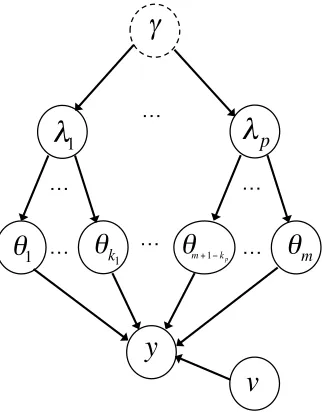
Figure 1: Bayesian networks describing the stochastic model for group sparse estimation
For i = 1, . . . , p, assume that the sub-vector θ(i) has dimension ki so that m = Ppi=1ki.
Next, conformally partition the matrix G = [G(1), . . . , G(p)] to obtain the measurement model
y=Gθ+v=
p
X
i=1
G(i)θ(i)+v. (1)
In what follows, we assume that θis block sparse in the sense that many of the blocks θ(i) are zero, that is, with all of their components equal to zero, or have a negligible effect ony.
Our problem is to estimate θfrom y while also detecting the null blocks ofθ(i).
3. Estimators Considered
The purpose of this Section is to place the estimators we consider (GLasso/MKL and PARD) in a common framework that unifies the analysis. The content of the section is a collection of results taken from the literature which are stated without proof; the readers are referred to previous works for details which are not relevant to our paper’s goal.
3.1 Bayesian Model for Sparse Estimation
Figure 1 provides a hierarchical representation of a probability density function useful for establishing a connection between the various estimators considered in this paper. In par-ticular, in the Bayesian network of Figure 1, nodes and arrows are either dotted or solid depending on whether the quantities/relationships are deterministic or stochastic, respec-tively. Here,λdenotes a vector whose components{λi}pi=1 are independent and identically
distributed exponential random variables with probability density
whereγ is a positive scalar and
χ(t) =
1, t≥0
0, elsewhere.
In addition, letN(µ,Σ) be the Gaussian density of meanµand covariance Σ while, given a generick, we useIk to denote thek×kidentity matrix. Then, conditional onλ, the blocks
θ(i) of the vectorθare all mutually independent and each block is zero-mean Gaussian with covarianceλiIki,i= 1, .., p, that is,
θ(i)|λi ∼ N(0, λiIki). The measurement noise is also Gaussian, that is,
v∼ N(0, σ2In). 3.2 Penalized ARD (PARD)
We introduce a sparse estimator, denoted by PARD in the sequel, cast in the framework of the Type II Bayesian estimators and consisting of a penalized version of ARD (Mackay, 1994; Tipping, 2001; Wipf and Nagarajan, 2007). It is derived from the Bayesian network depicted in Figure 1 as follows. First, the marginal density of λ is optimized, that is, we compute
ˆ
λ= arg max
λ∈Rp+ Z
Rm
p(θ, λ|y)dθ.
Then, using an empirical Bayes approach, we obtain E[θ|y, λ = ˆλ], that is, the minimum variance estimate of θ with λ taken as known and set to its estimate. The structure of the estimator is detailed in the following proposition (whose proof is straightforward and therefore omitted).
Proposition 1 (PARD) Define
Σy(λ) := GΛG>+σ2I, (2)
Λ := blockdiag({λiIki}). (3)
Then, the estimator θˆP A of θ obtained from PARD is given by
ˆ
λ = arg min
λ∈Rp+
1
2log det(Σy(λ)) + 1 2y
>Σ−1
y (λ)y+γ p
X
i=1
λi, (4)
ˆ
θP A = ΛˆG>(Σy(ˆλ))−1y. (5)
where Λˆ is defined as in (3) with each λi replaced by thei-th component of λˆ in (4).
One can see from (4) and (5) that the proposed estimator reduces to ARD if γ = 0.2 In this case, the special notation ˆθAis used to denote the resulting estimator, that is,
ˆ
λ = arg min
λ∈Rp+
1
2log det(Σy(λ)) + 1 2y
>
Σ−y1(λ)y, (6)
ˆ
θA = ΛˆG>(Σy(ˆλ))−1y (7)
where Σy is defined in (2), and ˆΛ is defined as in (3) with each λi replaced by the i-th
component of the ˆλin (6).
Observe that the objective in (4) is not convex in λ. Letting the vectorµ denote the dual vector for the constraint λ≥0, the Lagrangian is given by
L(λ, µ) := 12log det(Σy(λ)) +12y>Σy(λ)−1y+γ1>λ−µ>λ.
Using the fact that
∂λiL(λ, µ) = 1 2tr
G(i)>Σy(λ)−1G(i)
− 1
2y
>Σ
y(λ)−1G(i)G(i)>Σy(λ)−1y+γ −µi,
we obtain the following KKT conditions for (4).
Proposition 2 (KKT for PARD) The necessary conditions for λto be a solution of (4) are
Σy =σ2I+Ppi=1λiG(i)G(i)>,
WΣy =I,
tr G(i)>W G(i)
− kG(i)>W yk2
2+ 2γ−2µi = 0, i= 1, . . . , p,
µiλi = 0, i= 1, . . . , p,
0≤µ, λ.
(8)
3.3 Group Lasso (GLasso) and Multiple Kernel Learning (MKL)
A leading approach for the block sparsity problem is the Group Lasso (GLasso) (Yuan and Lin, 2006) which determines the estimate of θ as the solution of the following convex problem
ˆ
θGL= arg min θ∈Rm
(y−Gθ)>(y−Gθ)
2σ2 +γGL
p
X
i=1
kθ(i)k, (9) where k · k denotes the classical Euclidean norm. Now, letφ be the Gaussian vector with independent components of unit variance such that
θi =
p
λi φi. (10)
We partitionφ conformally withθ, that is,
φ=
h
φ(1)> φ(2)> . . . φ(p)>
i>
. (11)
Then, interestingly, GLasso can be derived from the same Bayesian model in Figure 1 underlying PARD consideringφandλas unknown variables and computing their maximum a posteriori (MAP) estimates. This is illustrated in the following proposition which is just a particular instance of the known relationship between regularization on kernel weights and block-norm based regularization. In particular, it establishes the known equivalence between GLasso and Multiple Kernel Learning (MKL) when linear models of the form (1) are considered, see the more general Theorem 1 of Tomioka and Suzuki (2011) for other details.
Proposition 3 (GLasso and its equivalence with MKL) Consider the joint density ofφandλconditional onyinduced by the Bayesian network in Figure 1. Letˆλandφˆdenote, respectively, the maximum a posteriori estimates of λ and φ (obtained by optimizing their joint density). Then, for every γGL in (9) there exists γ such that the following equalities hold
ˆ
λ = arg min
λ∈Rp+
y>(Σy(λ))−1y
2 +γ
p
X
i=1
λi, (12)
ˆ φ(i) =
q
ˆ
λiG(i)>(Σy(ˆλ))−1y,
ˆ θGL(i) =
q
ˆ
λiφˆ(i). (13)
We warn the reader that MKL is more general than GLasso since it also embodies estimation in infinite dimensional models; yet in this paper we use interchangeably the nomenclature GLasso and MKL since they are equivalent for the considered model class.
Comparing Propositions 1 and 3, one can see that the sole difference between PARD and GLasso relies on the estimator forλ. In particular, notice that the objectives (12) and (4) differ only in the term 12log det(Σy) appearing in the PARD objective (4). This is the
component that makes problem (4) non-convex but also the term that forces PARD to favor sparser solutions than GLasso (MKL), making the marginal density ofλmore concentrated around zero. On the other hand, (12) is a convex optimization problem whose associated KKT conditions are reported in the following proposition.
Proposition 4 (KKT for GLasso and MKL) The necessary and sufficient conditions for λ to be a solution of (12) are
K(λ) =Pp
i=1λiG(i)G(i)
>,
Σy =K(λ) +σ2I,
WΣy =I,
−kG(i)>W yk2
2+ 2γ−2µi = 0, i= 1, . . . , p,
µiλi= 0, i= 1, . . . , p,
0≤µ, λ.
(14)
Remark 5 (The LASSO case) When all the blocks are one-dimensional, the estimator (9) reduces to Lasso and we denote the regularization parameter and the estimate byγLand
ˆ
θL, respectively. In this case, it is possible to obtain a derivation through marginalization. In fact, given the Bayesian network in Figure 1 with all theki = 1 and letting
ˆ
θ= arg max
θ∈Rm
Z
Rm+
p(θ, λ|y)dλ,
it follows from Section 2 in Park and Casella (2008) that θˆ= ˆθL provided that γL= √
2γ.
4. Comparing PARD And GLasso (MKL): Motivating Examples
In this section, we present a sparsity vs. shrinkage example, and a Monte Carlo simulation to demonstrate advantages of the PARD estimator over GLasso.
4.1 Sparsity vs. Shrinkage: A Simple Experiment
It is well known that the `1 penalty in Lasso tends to induce an excessive shrinkage of
“large” coefficients in order to obtain sparsity. Several variations have been proposed in the literature in order to overcome this problem, including the so called Smoothly-Clipped-Absolute-Deviation(SCAD) estimator (Fan and Li, 2001) and re-weighted versions of`1like
theadaptive Lasso (Zou, 2006). We now study the tradeoffs between sparsity and shrinking for PARD. By way of introduction to the more general analysis in the next section, we first compare the sparsity conditions for PARD and GLasso (or, equivalently, MKL) in a simple, yet instructive, two group example. In this example, it is straightforward to show that PARD guarantees a more favorable tradeoff between sparsity and shrinkage, in the sense that it induces greater sparsity with the same shrinkage (or, equivalently, for a given level of sparsity it guarantees less shrinkage).
Consider two groups of dimension 1, that is,
y=G(1)θ(1)+G(2)θ(2)+v y∈R2, θ(1), θ(2) ∈ R,
where G(1) = [1 δ]>, G(2) = [0 1]>, v ∼ N(0, σ2). Assume that the true parameter ¯θ satisfies: ¯θ(1) = 0, ¯θ(2) = 1. Our goal is to understand how the hyperparameterγ influences sparsity and the estimates of θ(1) and θ(2) using PARD and GLasso. In particular, we would like to determine which values of γ guarantee that ˆθ(1) = 0 and how the estimator ˆ
θ(2) varies with γ. These questions can be answered by using the KKT conditions obtained in Propositions 2 and 4.
Let y:= [y1 y2]>. By (8), the necessary conditions for ˆλP A1 = 0 and ˆλP A2 ≥0 to be the
hyperparameter estimators for the PARD estimator (for fixedγ =γP A) are
2γP A ≥
h
y1
σ2 +
δy2
σ2+ˆλP A
2 i2
−h1
σ2 + δ
σ2+ˆλP A
2 i
and
ˆ
λP A2 = max
−1+√1+8γP Ay22
4γP A −σ
2, 0
.
Similarly, by (14), the same conditions for ˆλGL1 = 0 and ˆλGL2 ≥ 0 to be the estimators obtained using GLasso read as (for fixedγ =γGL):
2γGL≥
h
y1
σ2 +
δy2
σ2+ˆλGL
2 i2
and
ˆ
λGL2 = maxn√|y2|
2γGL −σ
2,0o.
(16)
Note that it is always the case that the lower bound for γGL is strictly greater than the
lower bound for γP A and that ˆλP A2 ≤λˆGL2 when γP A =γGL, where the inequality is strict
whenever ˆλGL2 >0. The corresponding estimators for ˆθ(1) and ˆθ(2) are ˆ
θP A(1) = ˆθ(1)GL= 0, ˆ
θ(2)P A= ˆλP A2 y2
σ2+ˆλP A
2
and θˆGL(2) = ˆλGL2 y2
σ2+ˆλGL
2
.
Hence, |θˆ(2)P A| < |θˆGL(2)| whenever y2 6= 0 and ˆλGL2 > 0. However, it is clear that the lower
bounds onγ in (15) and (16) indicate thatγGL needs to be larger thanγP A in order to set
ˆ
λGL1 = 0 (and hence ˆθ(1)GL= 0). Of course, having a larger γ tends to yield smaller ˆλ2 and
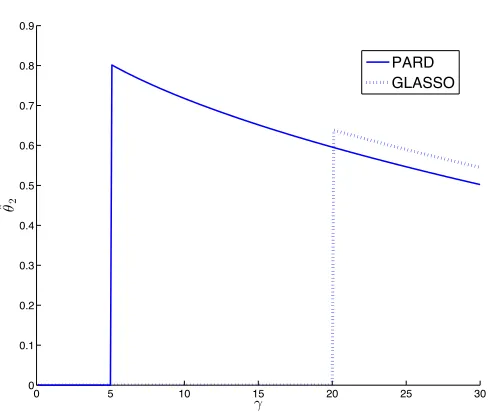
hence more shrinking on ˆθ(2). This is illustrated in Figure 2 where we report the estimators ˆ
θ(2)P A (solid) and ˆθ(2)GL (dotted) for σ2= 0.005,δ = 0.5. The estimators are arbitrarily set to zero for the values ofγ which do not yield ˆθ(1) = 0. In particular from (15) and (16) we find that PARD sets ˆθ(1)P A= 0 forγP A >5 while GLasso sets ˆθ(1)GL= 0 forγGL>20. In addition,
it is clear that MKL tends to yield greater shrinkage on ˆθGL(2) (recall that ¯θ(2)= 1).
4.2 Monte Carlo Studies
We consider two Monte Carlo studies of 1000 runs. For each run a data set of sizen= 100 is generated using the linear model (1) with p = 10 groups, each composed of ki = 4
parameters. For each run, 5 of the groupsθ(i) are set to zero, one is always taken different
from zero while each of the remaining 4 groupsθ(i)are set to zero with probability 0.5. The components of every blockθ(i) not set to zero are independent realizations from a uniform distribution on [−ai, ai] where ai is an independent realization (one for each block) from
a uniform distribution on [0,100]. The value of σ2 is the variance of the noiseless output divided by 25. The noise variance is estimated at each run as the sum of the residuals from the least squares estimate divided by n−m. The two experiments differ in the way the columns ofG are generated at each run.
1. In the first experiment, the entries of G are independent realizations of zero mean unit variance Gaussian noise.
2. In the second experiment the columns ofGare correlated, being defined at every run by
Gi,j =Gi,j−1+ 0.2vi,j−1, i= 1, .., n, j= 2, .., m,
0 5 10 15 20 25 30 0
0.1 0.2 0.3 0.4 0.5 0.6 0.7 0.8 0.9
γ
ˆθ2
PARD GLASSO
Figure 2: Estimators ˆθ(2) as a function ofγ. The curves are plotted only for the values of γ which yield also ˆθ(1)= 0 (different for PARD (γP A >5) and MKL (γGL>20)).
ARD PARD GLasso
0 0.05 0.1 0.15 0.2 0.25 0.3 0.35 0.4
Relative errors − experiment #1
ARD PARD GLasso
0 0.1 0.2 0.3 0.4 0.5 0.6 0.7 0.8
Relative errors − experiment #2
where vi,j are i.i.d. (asi and j vary) zero mean unit variance Gaussian and Gi,1 are
i.i.d. zero mean unit variance Gaussian random variables. Note that correlated inputs renders the estimation problem more challenging.
Define ˆκ ∈ R as the optimizer of the ARD objective (6) under the constraint κ = λ1 =
. . .=λp. Then, we define the following 3 estimators.
• ARD. The estimateθAis obtained by (6,7) usingλ1 =. . .=λp= ˆκas starting point
to solve (7) .
• PARD. The estimateθP Ais obtained by (4,5) using cross validation to determine the
regularization parameterγ. In particular, data are split into a training and validation set of equal size and the grid used by the cross validation procedure to selectγcontains 30 elements logarithmically distributed between 10−2×κˆ−1 and 104×κˆ−1. For each value ofγ, (6) is solved using λ1=λ2=. . .=λp = ˆκ as starting point. Finally, θP A
is obtained using the full data set fixing the regularization parameter to its estimate.
• GLasso (MKL). The estimate θGL is obtained by (12-13) using the same cross
validation strategy adopted by PARD to determineγ.
The three estimators described above are compared using the two performance indexes listed below:
1. Relative error: this is computed at each run as
kθˆ−θk kθk
where ˆθ is the estimator ofθ.
2. Percentage of the blocks equal to zero correctly set to zero by the estimator after the 1000 runs.
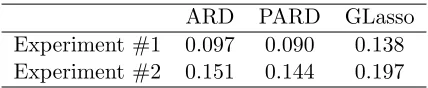
The left and right panel of Figure 3 displays the boxplots of the 1000 relative errors obtained by the three estimators in the first and second experiment, respectively. The average relative error is also reported in Table 1. It is apparent that the performance of PARD and ARD is similar and that both of these non convex estimators outperform GLasso. Interestingy, in both of the experiments ARD and PARD return a reconstruction error smaller that that achieved by GLasso in more than 900 out of the 1000 runs.
In Table 2 we report the sparsity index. One can see that PARD exhibits the best performance, setting almost 75% of the blocks correctly to zero in the first and second experiment, respectively, while the performance of ARD is close to 67%. In contrast, GLasso (MKL) correctly set to zero no more than 40% of the blocks in each experiment.
ARD PARD GLasso Experiment #1 0.097 0.090 0.138 Experiment #2 0.151 0.144 0.197
Table 1: Comparison with MKL/GLasso (section 4.2). Average relative errors obtained by the three estimators.
ARD PARD GLasso
Experiment #1 66.7% 74.5% 35.5% Experiment #2 66.6% 74.6% 39.7%
Table 2: Comparison with MKL/GLasso (section 4.2). Percentage of theθ(i) equal to zero correctly set to zero by the four estimators.
We notice that (4) is a differentiable function of λ. The computation of its derivative requires a one time evaluation of the matricesG(i)G(i)>, i= 1, . . . , p. However, for each new value ofλ, the inverse of the matrix Σy(λ)also needs to be computed. Hence, the evaluation of the objective and its derivative may be costly since it requires computing the inverse of a possibly large matrix as well as large matrix products. On the other hand, the dimension of the parameter vector λ can be small, and projection onto the feasible set is trivial. We experimented with several methods available in the Matlab packageminConf to optimize (4). In these experiments, the fastest method was the limited memory projected quasi-Newton algorithm detailed in Schmidt et al. (2009). It uses L-BFGS updates to build a diagonal plus low-rank quadratic approximation to the function, and then uses the Projected Quasi-Newton Method to minimize a quadratic approximation subject to the original constraints to obtain a search direction. A backtracking line search is applied to this direction terminating at a step-size satisfying a Armijo-like sufficient decrease condition. The efficiency of the method derives in part from the simplicity of the projections onto the feasible region. We have also implemented the re-weighted method described by Wipf and Nagarajan (2007). In all the numerical experiments described above, we have assessed that it returns results virtually identical to those achieved by our method, with a similar computational effort. It is worth recalling that both the projected quasi-Newton method and the re-weighted approach guarantee convergence only to a stationary point of the objective.
4.3 Concluding Remarks
reconstruction of the non zero blocks. The rest of the paper will be devoted to derivation of theoretical arguments supporting the intuition gained from these examples.
5. Mean Squared Error Properties of PARD and GLasso (MKL)
In this Section we evaluate the performance of an estimator ˆθ using its MSE, that is, the expected quadratic loss
tr
E
ˆ
θ−θ θˆ−θ
>
λ, θ= ¯θ
,
where ¯θ is the true but unknown value of θ. When we speak about “Bayes estimators” we think of estimators of the form ˆθ(λ) := E[θ|y, λ] computed using the probabilistic model Figure 1 with γ fixed.
5.1 Properties Using “Orthogonal” Regressors
We first derive the MSE formulas under the simplifying assumption oforthogonalregressors (G>G=nI) and show that the Empirical Bayes estimator converges to an optimal estimator in terms of its MSE. This fact has close connections to the so calledStein estimators(James and Stein, 1961; Stein, 1981; Efron and Morris, 1973). The same optimality properties are attained, asymptotically, when the columns of Gare realizations of uncorrelated processes having the same variance. This is of interest in the system identification scenario considered by Chiuso and Pillonetto (2010a,b, 2012) since it arises when one performs identification with i.i.d. white noises as inputs. We then consider the more general case of correlated regressors (see Section 5.2) and show that essentially the same result holds for a weighted version of the MSE.
In this section, it is convenient to introduce the following notation:
Ev[·] :=E[· |λ, θ= ¯θ] and Varv[·] :=E[· |λ, θ= ¯θ].
We now report an expression for the MSE of the Bayes estimators ˆθ(λ) := E[θ|y, λ] (the proof follows from standard calculations and is therefore omitted).
Proposition 7 Consider the model (1) under the probabilistic model described in Fig-ure 1(b). The Mean Squared Error of the Bayes estimator θˆ(λ) := E[θ|y, λ] given λ and
θ= ¯θ is
M SE(λ) =trhEv
h
(ˆθ(λ)−θ)(ˆθ(λ)−θ)>ii
=tr
σ2
G>G+σ2Λ−1
−1
G>G+σ2Λ−1θ¯θ¯>Λ−1 G>G+σ2Λ−1
−1
(17)
=tr
σ2ΛG>G+σ2
−1
ΛG>GΛ +σ2θ¯θ¯> G>GΛ +σ2
−1
.
Corollary 8 Assume thatG>G=nI in Proposition 7. Then MSE(λ) is globally minimized by choosing
λi =λopti :=
kθ¯(i)k2
ki
, i= 1, . . . , p.
Next consider the Maximum a Posteriori estimator of λ again under the simplifying assumptionG>G=nI. Note that, under the noninformative prior (γ = 0), this Maximum a Posteriori estimator reduces to the standard Maximum (marginal) Likelihood approach to estimating the prior distribution of θ. Consequently, we continue to call the resulting procedure Empirical Bayes (a.k.a. Type-II Maximum Likelihood (Berger, 1985)).
Proposition 9 Consider model (1) under the probabilistic model described in Figure 1(b), and assume thatG>G=nI. Then the estimator of λi obtained by maximizing the marginal posterior p(λ|y),
{λˆ1(γ), ...,λˆp(γ)}:= arg max λ∈Rp+p(λ
|y) = arg max
λ∈Rp+ Z
p(y, θ|λ)pγ(λ)dθ,
is given by
ˆ
λi(γ) = max
0, 1 4γ
q
k2
i + 8γkθˆ (i) LSk2−
ki+
4σ2γ n
, (18)
where
ˆ θLS(i) = 1
n
G(i)
>
y
is the Least Squares estimator of the i−th block θ(i). As γ → 0 (γ = 0 corresponds to an improper flat prior) the expression (18) yields:
lim
γ→0
ˆ
λi(γ) = max 0,
kθˆ(LSi)k2
ki
−σ 2
n
!
.
In addition, the probabilityP[ˆλi(γ) = 0|θ= ¯θ]of setting λˆi= 0 is given by
P[ˆλi(γ) = 0|θ= ¯θ] =P
χ2
ki,kθ¯(i)k2
n σ2
≤
ki+ 2γ
σ2 n
, (19)
where χ2(d, µ) denotes a noncentral χ2 random variable with d degrees of freedom and noncentrality parameterµ.
Note that the expression of ˆλi(γ) in Proposition 9 has the form of a “saturation”. In
particular, forγ = 0, we have
ˆ
λi(0) = max(0,λˆ∗i), where λˆ∗i :=
kθˆ(LSi)k2
ki
−σ 2
n . (20)
The following proposition shows that the “unsaturated” estimator ˆλ∗i is an unbiased and consistent estimator of λopti which minimizes the Mean Squared Error while ˆλi(0) is only
Corollary 10 Under the assumptionG>G=nI, the estimator ofˆλ∗ :={λ∗1, .., λ∗p}in (20)
is an unbiased and mean square consistent estimator of λopt which minimizes the Mean Squared Error, while λˆ(0) := {λ1(0), .., λp(0)} is asymptotically unbiased and consistent, that is:
E[ˆλ∗i |θ= ¯θ] =λ opt
i nlim→∞E[ˆλi(0)|θ= ¯θ] =λopti
and
lim
n→∞
ˆ
λ∗i m.s.= λopti lim
n→∞
ˆ λi(0)
m.s.
= λopti (21)
where m.s.= denotes convergence in mean square.
Remark 11 Note that if θ¯(i) = 0, the optimal value λopti is zero. Hence (21) shows that asymptotically λˆi(0) converges to zero. However, in this case, it is easy to see from (19) that
lim
n→∞P[ˆλi(0) = 0|θ= ¯θ]<1.
There is in fact no contradiction between these two statements because one can easily show that for all >0,
P[ˆλi(0)∈[0, )|θ= ¯θ] n→∞
−→ 1.
In order to guarantee that limn→∞P[ˆλi(γ) = 0|θ = ¯θ] = 1 one must chose γ =γn so that
2σn2γn→ ∞, withγn growing faster thann. This is in line with the well known requirements for Lasso to be model selection consistent. In fact, recalling remark 5, the link betweenγ and the regularization parameterγLfor Lasso is given byγL=
√
2γ. The conditionn−1γn→ ∞ translates into n−1/2γLn → ∞, a well known condition for Lasso to be model selection consistent (Zhao and Yu, 2006; Bach, 2008).
The results obtained so far suggest that the Empirical Bayes resulting from PARD has desirable properties with respect to the MSE of the estimators. One wonders whether the same favorable properties are inherited by MKL or, equivalently, by GLasso. The next proposition shows that this is not the case. In fact, for ¯θ(i) 6= 0, MKL does not yield consistent estimators forλopti ; in addition, forθ(i)= 0, the probability of setting ˆλ
i(γ) to zero
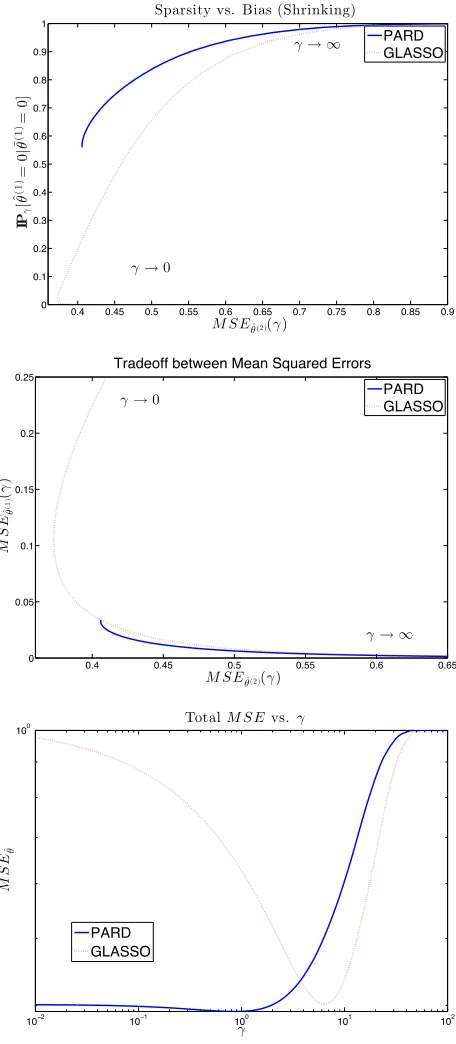
(see Equation (24)) is much smaller than that obtained using PARD (see Equation (19)); this is illustrated in Figure 4 (top). Also note that, as illustrated in Figure 4 (bottom), when the true ¯θ is equal to zero, MKL tends to give much larger values of ˆλ than those given by PARD. This results in larger values ofkθˆk(see Figure 4).
Proposition 12 Consider model (1)under the probabilistic model described in Figure 1(b), and assumeG>G=nI. Then the estimator ofλi obtained by maximizing the joint posterior p(λ, φ|y) (see Equations (10) and (11)),
{λˆ(γ), ...,λˆp(γ)}:= arg max λ∈Rp+,φ∈Rm
+
p(λ, φ|y),
is given by
ˆ
λi(γ) = max 0, kθˆ(LSi)k
√
2γ − σ2
n
!
where
ˆ θLS(i) = 1
n
G(i)>y
is the Least Squares estimator of the i−th block θ(i) for i = 1, . . . , p. For n → ∞ the estimator λˆi(γ) satisfies
lim
n→∞
ˆ λi(γ)
m.s.
= k ¯ θ(i)k √
2γ . (23)
In addition, the probabilityP[ˆλi(γ) = 0|θ= ¯θ]of setting λˆi(γ) = 0 is given by
Pθ[ˆλi(γ) = 0|θ= ¯θ] =P
χ2
ki,kθ¯(i)k2
n σ2
≤2γσ
2
n
. (24)
Note that the limit of the MKL estimators ˆλi(γ) as n→ ∞ depends on γ. Therefore,
using MKL (GLasso), one cannot hope to get consistent estimators of λopti . Indeed, for
kθ¯(i)k2 6= 0, consistency of ˆλ
i(γ) requiresγ → k
2
i
2kθ¯(i)k2, which is a circular requirement.
5.2 Asymptotic Properties Using General Regressors
In this subsection, we replace the deterministic matrix G withGn(ω), where Gn(ω)
repre-sents ann×mmatrix defined on the complete probability space (Ω,B,P) with ω a generic element of Ω and B the sigma field of Borel regular measures. In particular, the rows of Gn are independent3 realizations from a zero-mean random vector with positive definite
covariance Ψ.
As in the previous part of this section, λ and θ are seen as parameters, and the true value ofθis ¯θ. Hence, all the randomness present in the next formulas comes only fromGn
and the measurement noise.
We make the following (mild) assumptions on Gn. Recalling model (1), assume that
G>G/nis bounded and bounded away from zero in probability, so that there exist constants
∞> cmax ≥cmin >0 with
lim
n→∞P[cminI ≤G
>G/n≤c
maxI] = 1, (25)
so, as nincreases, the probability that a particular realization Gsatisfies
cminI ≤G>G/n≤cmaxI (26)
increases to 1.
In the following lemma, whose proof is in the Appendix, we introduce a change of variables that is key for our understanding of the asymptotic properties of PARD under these more general regressors.
Lemma 13 Fix i∈ {1, . . . , p} and consider the decomposition
y = G(i)θ(i)+Pp
j=1,j6=iG(j)θ(j)+v
= G(i)θ(i)+ ¯v (27)
0.4 0.45 0.5 0.55 0.6 0.65 0.7 0.75 0.8 0.85 0.9 0
0.1 0.2 0.3 0.4 0.5 0.6 0.7 0.8 0.9 1
Sparsity vs. Bias (Shrinking)
M S Eθˆ(2)(γ)
IP
γ
[ˆ
θ
(1
)=0
|
¯θ
(1
)=0
]
PARD GLASSO
γ→ ∞
γ→0
0.4 0.45 0.5 0.55 0.6 0.65
0 0.05 0.1 0.15 0.2 0.25
Tradeoff between Mean Squared Errors
M S Eθˆ(2)(γ)
MS
Eˆθ
(1
)(
γ
)
PARD GLASSO
γ→ ∞
γ→0
10−2 10−1 100 101 102
100
TotalM S Evs. γ
γ
MS
Eˆθ
PARD GLASSO
Figure 4: In this example we have two blocks (p = 2) of dimension k1 = k2 = 10 with
¯
θ(1) = 0 and all the components of the true ¯θ(2) ∈ R10 set to one. The matrix
G is the identity, so that the output dimension (y ∈ Rn) is n = 20; the noise variance equals 0.5. Top: probability of setting ˆθ(1) to zero vs Mean Squared Error in ˆθ(2). Center: Mean Squared Error in ˆθ(1) vs. Mean Squared Error in ˆ
of the linear measurement model (1) and assume (26) holds. Define
Σ(¯vi):=
p
X
j=1,j6=i
G(j)G(j)
>
λj +σ2I.
Consider now the singular value decomposition
Σ(v¯i)−1/2G(i)
√
n =U
(i) n D(ni)
Vn(i)>, (28)
where each Dn(i)=diag(dk,n(i)) is ki×ki diagonal matrix. Then (27) can be transformed into the equivalent linear model
zn(i) = Dn(i)βn(i)+(ni), (29)
where
z(ni):=
Un(i)
>
Σ(v¯i)
−1/2
y
√
n = (z (i)
k,n), β (i) n :=
Vn(i)
>
θ(i)= (βk,n(i)), (ni):=
Un(i)
>
Σ(¯vi)
−1/2
¯ v
√
n = ( (i) k,n),
(30)
and Dn(i) is uniformly (in n) bounded and bounded away from zero.
Below, the dependence of Σy(λ) on Gn, and hence on n, is omitted to simplify the
notation. Furthermore,−→p denotes convergence in probability.
Theorem 14 For knownγ and conditional on θ= ¯θ, define
ˆ
λn= arg min
λ∈CT
Rp+
1
2log det(Σy(λ)) + 1 2y
>Σ−1
y (λ)y+γ p
X
i=1
λi, (31)
where C is anyp-dimensional ball with radius strictly larger than maxi
kθ¯(i)k2
ki . Suppose that
the hypotheses of Lemma 13 hold. Consider the estimator (31) along its i−th component
λi that, in view of (29), is given by:
ˆ
λni = arg min
λ∈R+
1 2 ki X k=1 " η2
k,n+vk,n
λ+wk,n
+ log(λ+wk,n)
#
+γλ , (32)
where ηk,n :=βk,n(i), wk,n := 1/(n(d(k,ni))2) andvk,n = 2 (k,ni) d(k,ni) β
(i) k,n+
(k,ni) d(k,ni)
2
. Let
¯ λγi :=
−ki+
q
k2
i + 8γkθ¯(i)k2
4γ , ¯λi =
kθ¯(i)k2
ki
.
We have the following results:
2. If kθ¯(i)k>0 and γ >0, we haveλˆni −→p λ¯γi . 3. If kθ¯(i)k>0 and γ = 0, we haveλˆni −→p λ¯i . 4. if θ¯(i)= 0, we have ˆλγi −→p 0 for any value γ≥0.
We now show that, when γ = 0, the above result relates to the problem of minimizing the MSE of the i-th block with respect to λi, with all the other components of λ coming
from ˆλn. For any indexi, we define
I1(i):=nj : j =6 iand ¯θ(j)6= 0o, I0(i) :=nj : j=6 iand ¯θ(j) = 0o. (33) If ˆθn(i)(λ) denotes thei-th component of the PARD estimate ofθ defined in (5), our aim
is to optimize the objective
M SEn(λi) := tr
h
Ev
h
(ˆθ(ni)(λ)−θ¯(i))(ˆθn(i)(λ)−θ¯(i))>
ii
with λj = ¯λnj for j6=i
where is ¯λnj is any sequence satisfying condition
lim
n→∞fn= +∞ where fn:= minj∈I(i) 1
nλnj, (34)
(condition (34) appears again in the Appendix as (47)). Note that, in particular, ¯λnj = ˆλnj in (31) satisfy (34) in probability.
Lemma 13 shows that we can consider the transformed linear model associated with the i-th block, that is,
zk,n(i) = d(k,ni)βk,n(i) +(k,ni), k= 1, . . . , ki, (35)
where all the three variables on the RHS depend on ¯λnj forj 6=i. In particular, the vector
βn(i) consists of an orthonormal transformation ofθ(i) while thed(k,ni) are all bounded below
in probability. In addition, by letting
Ev
h
(k,ni)i=mk,n, Ev
h
((k,ni) −mk,n)2
i
=σ2k,n,
we also know from Lemma 20 (see Equations (48) and (49)) that, provided ¯λnj (j 6= i) satisfy condition (34), both mk,n and σ2k,n tend to zero (in probability) as n goes to ∞.
Then, after simple computations, one finds that the MSE relative to β(ni) is the following
random variable whose statistics depend on n:
M SEn(λi) = ki
X
k=1
βk,n2 +nλ2id2k,n(m2k,n+σ2k,n)−2λidk,nmk,nβk,n
(1 +nλid2k,n)2
withλj = ¯λnj forj 6=i.
Above, except forλi, the dependence on the block number iwas omitted to improve
read-ability.
Now, let ˘λn
i denote the minimizer of the following weighted version of the M SEn(λi):
˘
λni = arg min
λ∈R+
ki
X
k=1
d4k,nβ
2
k,n+nλ2id2k,n(m2k,n+σ2k,n)−2λidk,nmk,nβk,n
(1 +nλid2k,n)2
.
Proposition 15 Forγ = 0 and conditional on θ= ¯θ, the following convergences in proba-bility hold
lim
n→∞
˘
λni = kθ¯
(i)k2
ki
= lim
n→∞
ˆ
λni , i= 1,2, . . . , p. (36)
The proof follows arguments similar to those used in last part of the proof of Theorem 14, see also proof of Theorem 6 in Aravkin et al. (2012), and is therefore omitted.
We can summarize the two main findings reported in this subsection as follows. As the number of measurements go to infinity:
1. regardless of the value ofγ (provided γ does not depend on n; in such a case suitable conditions on the rate are necessary, see also Remark 11), the proposed estimator will correctly set to zero only those λi associated with null blocks;
2. whenγ = 0, results 2 and 3 of Theorem 14 provide the asymptotic properties of ARD, showing that the estimate ofλi will converge to the energy of thei-th block (divided
by its dimension).
This same value also represents the asymptotic minimizer of a weighted version of the MSE relative to thei-th block. In particular, the weights change with n, as they are defined by the singular values d(k,ni) (raised at fourth power) that depend on the trajectories of the other components of λ (see (28)). This roughly corresponds to giving more emphasis to components ofθ which excite directions in the output space where the signal to noise ratio is high; this indicates some connection with reduced rank regression where one only seeks to approximate the most important (relative to noise level) directions in output space.
Remark 16 (Consistency of θˆP A) It is a simple check to show that, under the assump-tions of Theorem 14, the empirical Bayes estimatorθˆP A(ˆλn)in (5)is a consistent estimator of θ¯. Indeed, Theorem 14 shows much more than this, implying that for γ = 0, θˆP A(ˆλn) possesses some desirable asymptotic properties in terms on Mean Squared Error, see also Remark 17.
5.3 Marginal Likelihood and Weighted MSE: Perturbation Analysis
We now provide some additional insights on point 2 above, investigating why the weights d4k,n may lead to an effective strategy for hyperparameter estimation.
For our purposes, just to simplify the notation, let us consider the case of a single m -dimensional block. In this way, λbecomes a scalar and the noise k,n in (35) is zero-mean
of variance 1/n.
Under the stated assumptions, the MSE weighted by dαk,n, withα an integer, becomes
m
X
k=1
dαk,nn
−1β2
k,n+λ2d2k,n
(n−1+λd2 k,n)2
,
whose partial derivative with respect toλ, apart from the scale factor 2/n, is
Fα(λ) = m
X
k=1
dαk,n+2 λ−β
2 k,n
(n−1+λd2 k,n)3
Letβk= limn→∞βk,n and dk = limn→∞dk,n.4 When ntends to infinity, arguments similar
to those introduced in the last part of the proof of Theorem 14 show that, in probability, the zero ofFα becomes
˘ λ(α) =
Pm
k=1dα
−4 k βk2
Pm
k=1d α−4 k
.
Notice that the formula above is a generalization of the first equality in (36) that was obtained by setting α= 4. However, for practical purposes, the above expressions are not useful since the true values ofβk,nandβkdepend on the unknown ¯θ. One can then consider
a noisy version ofFα obtained by replacingβk,n with its least squares estimate, that is,
˜ Fα(λ) =
m
X
k=1
dαk,n+2
λ−βk,n+√vndk,n
k,n
2
(n−1+λd2 k,n)3
,
where the random variable vk,n is of unit variance. For large n, considering small additive
perturbations around the model zk=dkβk, it is easy to show that the minimizer tends to
the following perturbed version of ˘λ:
˘
λ(α) + 2
Pm
k=1d α−5 k βkvk,n √
nPm
k=1d α−4 k
. (37)
We must now choose the value of α that should enter the above formula. This is far from trivial since the optimal value (minimizing MSE) depends on the unknownβk. On one
hand, it would seem advantageous to have α close to zero. In fact, α = 0 relates ˘λ to the minimization of the MSE on θ while α = 2 minimizes the MSE on the output prediction, see the discussion in Section 4 of Aravkin et al. (2012). On the other hand, a larger value forα could help in controlling the additive perturbation term in (37) possibly reducing its sensitivity to small values ofdk. For instance, the choiceα= 0 introduces in the numerator
of (37) the term βk/d5k. This can destabilize the convergence towards ˘λ, leading to poor
estimates of the regularization parameters, as, for example, described via simulation studies in Section 5 of Aravkin et al. (2012). In this regard, the choiceα= 4 appears interesting: it sets ˘λto the energy of the block divided bym, removing the dependence of the denominator in (37) ondk. In particular, it reduces (37) to
kβk2
m +
2 m
m
X
k=1
β√kvk,n
ndk
=
m
X
k=1
βk2 m
1 + 2 vk,n βk
√
ndk
. (38)
It is thus apparent thatα= 4 makes the perturbation on βk2
m dependent on vk,n
βk
√
ndk, that is, on the relative reconstruction error on βk. This appears a reasonable choice to account
for the ill-conditioning possibly affecting least-squares.
Interestingly, for large n, this same philosophy is followed by the marginal likelihood procedure for hyperparameter estimation up to first-order approximations. In fact, under
the stated assumptions, apart from constants, the expression for twice the negative log of the marginal likelihood is
m
X
k=1
log(n−1+λd2k,n) + z
2 k,n
n−1+λd2 k,n
,
whose partial derivative w.r.t. λis
m
X
k=1
λd4k,n+n−1d2k,n−zk,n2 d2k,n (n−1+λd2
k,n)2
.
As before, we consider small perturbations around zk =dkβk to find that a critical point
occurs at
m
X
k=1
β2k m
1 + 2 vk,n βk
√
ndk
,
which is exactly the same minimizer reported in (38).
5.4 Concluding Remarks and Connections to Subsection 4.2
We can now give an interpretation of the results depicted in Figure 3 in view of the theo-retical analyses developed in this section.
When the regressors are orthogonal, which corresponds, asymptotically, to the case of white noise defining the entries ofG, the results in subsection 5.1 (e.g., Corollary 10) show that ARD has a clear advantage over GLasso (MKL) in terms of MSE. This explains the outcomes from the first numerical experiment of Section 4.2 which are depicted in the left panel of Figure 3.
For the case of general regressors, subsection 5.2 provides insights regarding the proper-ties of ARD, including its consistency. Ideally, a regularized estimator should adopt those hyperparameters contained in λ that minimize the MSE objective, but this objective de-pends on ¯θ, which is what we aim to estimate. One could then consider a noisy version of the MSE function, for example, obtained replacing ¯θ with its least squares estimate. The problem is that this new objective can be very sensitive to the noise, leading to poor regularizers as, for example, described by simulation studies in Section 5 of Aravkin et al. (2012). On an asymptotic basis, ARD circumvents this problem using particular weights which introduce a bias in the MSE objective but make it more stable, that is, less sensi-tive to noise. This results in a form of regularization introduced through hyperparameter estimation. We believe that this peculiarity is key to understanding not only the results in Figure 3 but also the success of ARD in several applications documented in the literature.
maintaining similar performance in the reconstruction of the non null blocks. This is illus-trated by the Monte Carlo results in Section 4.2. To better understand the role ofγ, consider the orthogonal case discussed in Section 5.1, for sake of clarity. Recall the observation in Remark 11 that model selection consistency requires γ =γn. It is easy to show that the or-acle property (Zou, 2006) holds provided γn
n → ∞ and γn
n2 → 0. However, large γ’s tend to
introduce excessive shrinkage, for example, see Figure 4 (center). It is well known (Leeb and P¨otscher, 2005) that shrinkage estimators that possess the oracle property have unbounded normalized risk (normalized Mean Squared Error for quadratic loss), meaning that they are certainly not optimal in terms of Mean Squared Error. To summarize, the asymptotic prop-erties suggest that to obtain the oracle propprop-erties γn should go to infinity at a suitable rate withnwhile γ should be set equal to zero to optimize the mean squared error. However, for finite data length n, the optimal mean squared error properties as a function of γ are found for a finite but nonzeroγ. This fact, also illustrated in Figure 4 (bottom), is not in contrast w.r.t. Corollary 10: γ may induce a useful bias in the marginal likelihood estimator of the
λi which can reduce the variance. This also explains the experimental results showing that PARD performs slightly better than ARD.
6. Conclusions
We have presented a comparative study of some methods for sparse estimation: GLasso (equivalently, MKL), ARD and its penalized version PARD, which is cast in the framework of the Type II Bayesian estimators. They derive from the same Bayesian model, yet in a different way. The peculiarities of PARD can be summarized as follows:
• in comparison with GLasso, PARD derives from a marginalized joint density with the resulting estimator involving optimization of a non-convex objective;
• the non-convex nature allows PARD to achieve higher levels of sparsity than GLasso without introducing too much regularization in the estimation process, thus providing a better tradeoff between sparsity and shrinking.
• the MSE analysis reported in this paper reveals the superior performance of PARD in the reconstruction of the parameter groups different from zero. Remarkably, our analysis elucidates this issue showing the robustness of the empirical Bayes procedure, based on marginal likelihood optimization, independently of the correctness of the priors which define the stochastic model underlying PARD. As a consequence of our analysis, the asymptotic properties of ARD have also been illuminated.
Many variations of PARD are possible, adopting different prior models forλ. In this paper, the exponential prior is used to compare different estimators that can be derived from the same Bayesian model underlying GLasso. In this way, it is shown that the same stochastic framework can give rise to an estimator derived from a posterior marginalization that has significant advantages over another estimator derived from posterior optimization.
Acknowledgements
Network of excellence, by the MIUR FIRB project RBFR12M3AC - Learning meets time: a new computational approach to learning in dynamic systems.
Appendix A. Proofs
In this Appendix, we present proofs of the main results in the paper.
A.1 Proof of Proposition 9
Under the simplifying assumptionG>G=nI, one can use
Σy(λ)−1 =σ−2
h
I−G(σ2Λ−1+GTG)−1G>
i
which derives from the matrix inversion lemma to obtain
G(i)>Σy(λ)−1 =
1 nλi+σ2
G(i)>,
and so
trG(i)>Σy−1G(i)= nki nλi+σ2
and kG(i)>Σ−y1yk2 2 =
n nλi+σ2
2
kθˆ(LSi)k2 .
Inserting these expressions into (8) with µi = 0 yields a quadratic equation in λi which
always has two real solutions. One is always negative while the other, given by
1 4γ
q
ki2+ 8γkθˆLS(i)k2−
ki+
4σ2γ n
is non-negative provided
kθˆ(LSi)k2
ki
≥ σ 2
n
1 +2γσ
2
nki
. (39)
This concludes the proof of (18). The limiting behavior for γ → 0 can be easily verified, yielding
ˆ
λi(0) = max 0,
kθˆ(LSi)k2
ki
−σ 2
n
!
i= 1, .., p.
Also note that ˆθ(LSi) = n1 G(i)>y and G(i)>G(i) = nIki while G
(i)>G(j) = 0, ∀j 6= i.
This implies that ˆθLS(i) ∼ N(¯θ(i),σn2Iki). Therefore
kθˆ(LSi)k2 n
σ2 ∼χ
2(d, µ) d=k
i, µ=kθ¯(i)k2
n σ2.
A.2 Proof of Proposition 10
In the proof of Proposition 9 it was shown thatkθˆLS(i)k2 n
σ2 follows a noncentralχ2distribution
with ki degrees of freedom and noncentrality parameter kθ¯(i)k2σn2. Hence, it is a simple
calculation to show that
E[ˆλ∗i |θ= ¯θ] =
kθ¯(i)k2
ki
Var[ˆλ∗i |θ= ¯θ] = 2σ
4
kin2
+4kθ¯
(i)k2σ2
k2in . By Corollary 8, the first of these equations shows thatE[ˆλ∗i |θ= ¯θ] =λ
opt
i . In addition, since
Var{ˆλ∗i} goes to zero asn→ ∞, ˆλ∗i converges in mean square (and hence in probability) to λopti .
As for the analysis of ˆλi(0), observe that
E[ˆλi(0)|θ= ¯θ] =E[ˆλ∗i |θ= ¯θ]−
Z kiσ
2
n
0
kθˆLS(i)k2
ki
−σ 2
n
!
dP(kθˆ(LSi)k2|θ= ¯θ)
where dP(kθˆLS(i)k2|θ = ¯θ) is the measure induced by kθˆ(i)
LSk2. The second term in this
expression can be bounded by
−
Z kiσ
2
n
0
kθˆ(LSi)k2
ki
−σ 2
n
!
dP(kθˆLS(i)k2|θ= ¯θ)≤ σ 2
n
Z kiσ
2
n
0
dP(kθˆLS(i)k2|θ= ¯θ),
where the last term on the right hand side goes to zero asn→ ∞. This proves that ˆλi(0)
is asymptotically unbiased. As for consistency, it is sufficient to observe that Var[ˆλi(0)|θ=
¯
θ]≤ Var[ˆλ∗i|θ = ¯θ] since “saturation” reduces variance. Consequently, ˆλi(0) converges in
mean square to its mean, which asymptotically isλopti as shown above. This concludes the proof.
A.3 Proof of Proposition 12
Following the same arguments as in the proof of Proposition 9, under the assumption G>G=nI we have that
kG(i)>Σ−y1yk2 2 =
n nλi+σ2
2
kθˆ(LSi)k2.
Inserting this expression into (14) withµi= 0, one obtains a quadratic equation inλi which
has always two real solutions. One is always negative while the other, given by
kθˆLS(i)k √
2γ − σ2
n.
is non-negative provided
kθˆLS(i)k2 ≥ 2γσ 4
n2 . (40)
The limiting behavior for n → ∞ in Equation (23) is easily verified with arguments similar to those in the proof of Proposition 10. As in the proof of Proposition 9, kθˆLS(i)k2 n
σ2
follows a noncentralχ2(d, µ) distribution withd=ki and µ=kθ¯(i)k2σn2, so that from (40)
the probability of setting ˆλi(γ) to zero is as given in (24).
A.4 Proof of Lemma 13:
Let us consider the Singular Value Decomposition (SVD)
Pp
j=1,j6=iG(j) G(j)
>
λj
n =P SP
>
, (41)
where, by the assumption (26), using
Pp
j=1,j6=iG
(j)(G(j))>λ
j
n ≥
Pp
j=1,j6=i,λj6=0G
(j)(G(j))>
n min{λj, j:
λj 6= 0} and Lemma 19 the minimum singular valueσmin(S) of S in (41) satisfies
σmin(S)≥cminmin{λj, j :λj 6= 0}. (42)
Then the SVD of Σ(¯vi)=Pp
j=1,j6=iG(j) G(j)
>
λj+σ2I satisfies
Σ(¯vi)−1= P P⊥
(nS+σ2)−1 0
0 σ−2I
P> P⊥>
so that
Σ(v¯i)−1
=σ−2. Note now that
D(ni) =Un(i)
> Σ(i)
¯ v
−1/2
G(i)
√
n V
(i) n
and therefore, using Lemma 19,
kD(ni)k ≤
Σ(¯vi)−1/2
√
cmax=σ−1 √
cmax
proving thatD(ni)is bounded. In addition, again using Lemma 19, condition (26) implies that ∀a, b (of suitable dimensions) s.t. kak =kbk = 1, a>P
> ⊥√G(i)
n b ≥k, k=
p
1−cos2(θ min) ≥ cmin
cmax >0. This, using (28), guarantees that
D(ni) =
Un(i)
>
Σ(¯vi)
−1/2
G(i) √
n V (i) n =
Un(i)
>
P(nS+σ2)−1/2P>+P⊥σ−1P⊥> G√(i)
n
≥ Un(i)
>
P⊥σ−1P⊥> G√(i)
n ≥ kσ−1I
and thereforeD(ni) is bounded away from zero. It is then a matter of simple calculations to
show that with the definitions (30) then (27) can be rewritten in the equivalent form (29).
A.5 Preliminary Lemmas
This part of the Appendix contains some preliminary lemmas which will be used in the proof of Theorem 14. This first focuses on the estimator (31). We show that when the hypotheses of Lemma 13 hold, the estimate (31) satisfies the key assumptions of the forthcoming Lemma 20. We begin with a detailed study of the objective (4).
Let
I1:=
n
j : ¯θ(j)6= 0
o
, I0:=
n
j : ¯θ(j)= 0
o
.
Note that these are analogous to I1(i) and I0(i) defined in (33), but do not depend on any specific indexi. We now state the following lemma.
Lemma 18 Writing the objective in (4) in expanded form gives
gn(λ) = logσ2+
1
2nlog det(σ
−2Σ y(λ))
| {z }
S1
+ 1 2n
X
j∈I1
kθˆ(j)(λ)k2
kjλj
| {z }
S2
+ 1 2n
X
j∈I0
kθˆ(j)(λ)k2
kjλj
| {z }
S3
+ 1 nγkλk1
| {z }
S4
+ 1
2nσ2ky−
X
j
Gjθˆ(j)(λ)k2
| {z }
S5
,
where θˆ(λ) = ΛGTΣy−1y (see (5)), kj is the size of the jth block, and dependence on n has been suppressed. For any minimizing sequenceλn, we have the following results:
1. θˆn→p θ¯.
2. S1, S2, S3, S4 →p 0. 3. S5 →p 12.
4. nλnj →p∞ for allj∈I1.
Proof First, note that 0≤Si fori∈ {1,2,3,4}. Next,
S5=
1 2nσ2ky−
X
j
Gjθ¯(j)(λ) +X
j
Gjθ¯(j)(λ)−θˆ(j)(λ)k2
= 1
2nσ2kν+
X
j
Gjθ¯(j)(λ)−θˆ(j)(λ)k2
= 1
2nσ2kνk 2+ 1
2nσ2ν TX
j
Gjθ¯(j)(λ)−θˆ(j)(λ)+ 1 2nσ2k
X
j
Gjθ¯(j)(λ)−θˆ(j)(λ)k2.
(43) The first term converges in probability to 12. Since ν is independent of all Gj, the middle term converges in probability to 0. The third term is the bias incurred unless ˆθ= ¯θ. These facts imply that, ∀ >0,
lim
n→∞P
S5(λ(n))>
1 2 −
Next, consider the particular sequence ¯λnj = kθ¯jk2
kj . For this sequence, it is immediately clear that Si→p 0 fori∈ {2,3,4}. To show S1 →p 0, note thatPλiGiGTi ≤max{λi}PGiGTi,
and that the nonzero eigenvalues ofGGT are the same as those ofGTG. Therefore, we have
S1 ≤
1 2n
m
X
i=1
log(1 +nσ−2max{λ}cmax) =OP
log(n) n
→p0.
Finally S5→p 12 by (43), so in fact,∀ >0,
lim
n→∞P
gn(¯λ(n))−
1
2 −log(σ
2)
<
= 1. (45)
Since (45) holds for the deterministic sequence ¯λn, any minimizing sequence ˆλnmust satisfy, ∀ >0,
lim
n→∞P
gn(ˆλ(n))<
1
2 + log(σ
2) +
= 1
which, together with (44), implies (45)
Claims 1,2,3 follow immediately. To prove claim 4, suppose that for a particular mini-mizing sequence ˇλ(n), we have nˇλjn 6→p ∞ forj∈I1. We can therefore find a subsequence
where nλˇnj ≤ K, and since S2(ˇλ(n)) →p 0, we must have kθˆ(j)(ˇλ)k →p 0. But then there
is a nonzero bias term in (43), since in particular ¯θ(j)(λ)−θˆ(j)(λ) = ¯θ(j)(λ) 6= 0, which contradicts the fact that ˇλ(n) was a minimizing sequence.
We now state and prove a technical Lemma which will be needed in the proof of Lemma 20.
Lemma 19 Assume (26) holds; then the following conditions hold
(i) Consider I = [I(1), . . . , I(pI)] of size pI to be any subset of the indices [1, . . . , p], so
p≥pI and define
G(I) =
G(I(1)). . . G(I(pI)) ,
obtained by taking the subset of blocks of columns ofG indexed by I. Then
cminI ≤
(G(I))TG(I)
n ≤cmaxI . (46)
(ii) Let Ic be the complementary set of I in [1, . . . , p], so that Ic∩I = ∅ and I ∪Ic = [1, . . . , p]. Then the minimal angleθmin between the spaces
GI :=col span{G(i)/√n, i∈I} and GIc :=col span{G(j)/√n:j∈Ic} satisfies:
θmin ≥acos
r
1− cmin
cmax
Proof Result (46) is a direct consequence of Horn and Johnson (1994), see Corollary 3.1.3. As far as condition (ii) is concerned we can proceed as follows: let UI and UIc be orthonormal matrices whose columns spanGI andGIc
, so that there exist matricesTI and
TIc so that
G(I)/√n=UITI,
G(Ic)/√n=UIcTIc
whereG(Ic) is defined analogously toG(I). The minimal angle betweenGI and GIc
satisfies
cos(θmin) =
U
>
I UIc
.
Now observe that, up to a permutation of the columns which is irrelevant, G/√n = [UITI UIcTIc], so that
UI>G/√n= [TI UI>UIc TIc] = [I UI>UIc]
TI 0
0 TIc
.
Denoting withσmin(A) andσmax(A) the minimum and maximum singular values of a matrix
A, it is a straightforward calculation to verify that the following chain of inequalities holds:
cmin=σmin(G>G/n)≤σ2min UI>G/
√
n
= σ2
min
[I UI>UIc]
TI 0
0 TIc
≤ σ2
min [I UI>UIc]σ2max
TI 0
0 TIc
= σ2
min [I UI>UIc]
max σ2
max(TI), σ2max(TIc)
≤ σ2
min [I UI>UIc]cmax.
Observe now thatσ2
min [I UI>UIc]= 1−cos2(θmin) so that cmin ≤(1−cos2(θmin))cmax
and, therefore,
cos2(θmin)≤1−
cmin
cmax
from which the thesis follows.
Lemma 20 Assume that the spectrum ofGsatisfies (25). For any indexi, letI1(i) and I0(i)
be as in (33). Finally, assume aλnj, which may depend on n, are bounded and satisfy:
lim
n→∞fn= +∞ where fn:= minj∈I(i) 1
nλnj. (47)
Then, conditioned on θ, (ni) in (30) and (29) can be decomposed as
(ni)=mn(θ) +vn.
The following conditions hold:
Ev
h
(ni)
i
=mn(θ) =OP
1
√
fn
vn =OP
1
√
n
so that(ni)|θconverges to zero in probability (as n→ ∞). In addition
V arv{(ni)}=Ev
h
vnv
>
n
i
=OP
1 n
. (49)
If in addition5
n1/2 G
(i)>G(j)
n =OP(1) ; j∈I
(i)
1 (50)
then
mn(θ) =OP
1 √ nfn . (51)
Proof Consider the Singular Value Decomposition
¯
P1S¯1P¯1> :=
1 n
X
j∈I1
G(j)
G(j)
>
λnj. (52)
Using (47), there exist ¯n so that, ∀ n > n¯ we have 0 < λnj ≤ M < ∞, j ∈ I1(i). Oth-erwise, we could find a subsequence nk so that λnjk = 0 and hence nkλnjk = 0,
con-tradicting (47). Therefore, the matrix ¯P1 in (52) is an orthonormal basis for the space G1 :=col span{G(j)/√n:j ∈I1(i)}. Let alsoT(j) be such that G(j)/√n= ¯P1T(j),j ∈I1(i).
Note that by assumption (25) and lemma 19
kT(j)k=OP(1) ∀j ∈I1(i). (53)
Consider now the Singular Value Decomposition
P1 P0
S1 0
0 S0
P1> P0>
:= 1 n
X
j∈I1
G(j)
G(j)
>
λnj
| {z }
+ 1
n
X
j∈I0
G(j)
G(j)
>
λnj
| {z }
= P¯1S¯1P¯1> + ∆.
(54) For future reference note that ∃TP¯1 : ¯P1=
P1 P0
TP¯1. Now, from (28) we have that
Σ(¯vi)−1G(i)
√
n V
(i) n
Dn(i)
−1
= Σ(v¯i)−1/2Un(i). (55)
Using (55) and defining
P :=
P1 P0
S :=
S1 0
0 S0
,