Cryptanalysis and Improvement of the Robust User Authentication
Scheme for Wireless Sensor Networks
Yung-Cheng Lee
1,*, Hsin-Yu Lai
2and Pei-Ju Lee
31Department of Security Technology and Management, WuFeng University, Chiayi, Taiwan
2Graduate School of OptoMechatronics and Materials, WuFeng University, Chiayi, Taiwan
3
School of Information Science, University of Pittsburgh, 135 N Bellefield, Pittsburgh, PA 15260
Received 25 July 2012; received in revised form 10 September 2012; accepted 08 October 2012
Abstract
Wireless sensor networks are widely used in industrial process control, human health care, environmental
control, vehicular tracking and battlefield surveillance, etc. A wireless sensor network consists of lots of sensor nodes
and a gateway node. The sensor node usually communicates with the gateway node and users over an ad hoc wireless
network. However, due to the open environments, the wireless sensor networks are vulnerable to variety of security
threats. Thus, it is a critical issue to adopt a suitable authentication mechanism for wireless sensor networks to
enhance security. In 2009, Vaidya et al. proposed a robust user authentication schemes for wireless sensor networks.
In this article, we will show that their scheme is vulnerable to the guessing attack and the impersonation attack. Since
it needs a secure channel for communications in password changing phase, their scheme is also inconvenient and
expensive for users to update passwords. We also propose an improved scheme to remedy the flaws. The improved
scheme withstands the replay attack and off-line guessing attack, and the users can freely update their passwords via
public channels.
Keywords: wireless sensor networks, authentication, guessing attack, impersonation attack
1. Introduction
Wireless sensor networks (WSNs) [1-4, 6] are used in many industrial and consumer applications such as industrial
process, human health care, environmental control, vehicular tracking, habitat monitoring and battlefield surveillance, etc. A
WSN system consists of lots of sensor nodes and a gateway node [7]. The sensor nodes, with low processing power and limited
storage space, usually communicate over an ad hoc wireless network [10]. The sensor nodes transmit data through network to
the gateway cooperatively or independently. Generally, the communications of the WSNs are bidirectional so that the sensor
nodes send data to the gateway and the gateway is capable to control the sensor's activity.
Due to the open environments, the security problem is one of the most important issues for the wireless sensor networks.
Especially in some applications, e.g., battlefield surveillance, the collected data is critical. It is required to adopt security
mechanisms to protect the collected secrets. It is essential to provide authentication between the gateway node (GWN) and
sensor nodes (SDs), between the GWN and users and between the sensor nodes and users while transmitting data [3]. User
authentication protocol provides a method for every entity to validate each other; it is an important mechanism for network
Copyright © TAETI
security. Authentication mechanism can prevent adversaries attack WSNs by retrieving, modifying or replacing the information
collected by sensor nodes. Until now, a lot of methods proposed to enhance the security of the application systems. But due to
the highly constrained nature on computation capability and memory space of sensor nodes, it is difficult to implement complex
security algorithms in WSNs [8].
In 1981, Lamport [5] proposed the first user authentication scheme for communication in insecure channel. Hereafter,
many user authentication schemes have been proposed to prevent unauthorized users gaining access to the system. Wong et al.
[12] proposed a dynamic user authentication scheme for wireless sensor networks. But their scheme has security weaknesses
such as it cannot withstand the replay and forgery attacks, passwords could be revealed by any of the sensor nodes, and
password cannot be updated freely. Das [4] proposed a two-factor user authentication scheme in WSNs to overcome the
security flaws. Tseng [9] also propose a modified scheme to remedy the weakness. However, Tseng et al.’s scheme is vulnerable
to guessing attack and impersonation attack
In 2009, Vaidya et al. [10] proposed an improved robust user authentication schemes for WSNs, which is a variation of
strong-password based solution proposed by Wong et al. [12] and modified version of the scheme [11]. Though Vaidya et al.'s
scheme provides mutual authentication and capable to protect against the replay attack, the forgery attack and the
man-in-the-middle attack. However, in this article, we will show that their scheme is vulnerable to the guessing attack and the
impersonation attack. Moreover, since it needs a secure channel for communications in password changing phase, Vaidya et
al.'s scheme is inconvenient and expensive for users to update their passwords. We propose an improved scheme to remedy the
flaws. The improved scheme can withstand the replay attack and the off-line guessing attack, and the users can freely update
their passwords through insecure open channels.
The rest of this paper is organized as follows: All notations used throughout this article are listed in Section 2. In Section
3, we briefly describe Vaidya et al.'s scheme. Next, the weaknesses of Vaidya et al.'s scheme are shown in Section 4. The
improved scheme and its security analysis are presented in Section 5 and 6, respectively. Finally, we make conclusions in
Section 7.
2. Preliminaries and notations
Normally, a wireless sensor network is composed of four phases: registration phase, login phase, authentication phase,
and password changing phase. All notations used throughout this article are listed as follows.
(1) U: A legitimate user.
(2) ID: A user’s identity.
(3) GWN: A gateway node.
(4) SD: A sensor node.
(5) PW: A user’s password.
(6) x: The secret information of the gateway node. (7) h( ): A one-way hash function.
(9) A⇒B:{M}: The entity A sends message M to the receiver B via a secure channel.
(10) A→B:{M}: The entity A sends message M to the receiver B through a public channel.
3.
Vaidya et al.'s robust user authentication scheme
Vaidya et al.'s scheme is described briefly as follows.
3.1. Registration phase
When a user wants to join the system, he/she sends identity ID and hashed password vpw to the gateway node. The steps
of the registration phase are as follows.
Step R-1:U⇒GWN:{ID,vpw}
The user U first chooses a password PW and computes vpw=h(PW). Then, the user submits {ID,vpw} to the GWN via a secure channel.
Step R-2:GWN⇒SD:{ID,X,TS}
After receiving {ID,vpw}, the GWN computes X=h(ID,x) with the secret key x, and stores {ID,vpw,X,TS} in the database, where TS is the current timestamp. Then, the GWN distributes {ID,X,TS} to all sensor nodes. Next, the GWN responses to the user with successful registration information {Succ_Reg(X)}.
Step R-3: The user stores X
Upon receiving {Succ_Reg(X)}, the user stores X for future use.
3.2. Login phase
If a user wants to retrieve or transmit data from/to the sensor nodes, firstly, he/she should login the system. The login steps
are as follows.
Step L-1: U→SD:{ID,A,t}
The user first computes A=h(vpw,t), where t is the current timestamp. Then he/she sends {ID,A,t} to a sensor node SD
through a public channel.
Step L-2: SD→GWN:{ID,C,T0,t}
After receiving the login request {ID,A,t}, the sensor node checks whether ID is in its lookup table and checks whether
t is in a valid time interval. The login request will be rejected if it is not. Otherwise, the sensor node computes )
⊕ ⊕ (
=h X A T0
Copyright © TAETI 3.3. Authentication phase
The steps of the authentication phase are as follows.
Step A-1: GWN→SD:{Acc_Login,V,T1}
On receiving {ID,C,T0,t} from the sensor node, the GWN checks whether {ID,T0,t} are valid. The login request will be
stopped if it is not. If {ID,T0,t} are valid, the GWN computes A'=h(vpw,t) and C'=h(X⊕A'⊕T0). Then a reject message is
sent to the sensor node if C'≠C . Otherwise, the GWN computes {ID,X,TS} and sends the accept message }
, , _
{Acc LoginV T1 ) to the sensor node, where T1 is the current timestamp.
Step A-2: SD→U:{Acc_Login,Y,T1,T2}
After receiving {Acc_Login,V,T1}, the sensor node checks whether T1 is in a valid time interval. If T1 is valid, the SD
checks whether V'=V after computing V'=h(X,A,T1) . If V'=V , SD computes Y=h(V,T2) and sends
} , , , _
{Acc LoginY T1T2 to the user, where T2 is the current timestamp.
Step A-3: The user authenticates the sensor node.
Upon receiving the message {Acc_Login,Y,T1,T2}, the user checks the freshness of timestamps T1 and T2. If T1 and
2
T
are both in the allowed time interval, the user computes V'=h(X,A,T1) and Y'=h(V',T2). The user will start obtaining ortransmitting data if Y'=Y holds.
3.4. Password-changing phase
The Vaidya et al.'s scheme provides users to freely update their passwords. The steps of the password changing phase are
as follows. Note that the password changing phase should be performed via secure channels.
Step C-1: U⇒GWN:{ID,vpw,vpwnew}
If the user wants to update the password, firstly, he/she chooses a new password PWnew and computes
) ( = new new h PW
vpw . Then, the user sends the triple {ID,vpw,vpwnew} to the GWN via a secure channel.
Step C-2: GWN⇒SD:{ID,TS1}
Upon receiving {ID,vpw,vpwnew}, the GWN checks ID and vpw. If both of them are true, the GWN updates its database
and sends password changing successful information {Succ_Change} to the user. At the same time, the GWN distributes the updated information to all the sensor nodes.
Step C-3: All sensor nodes update their databases.
Copyright © TAETI
4. Weakness of the Vaidya et al.'s scheme
Though Vaidya et al.'s scheme, besides providing mutual authentication, has several advantages such as protection
against the replay attack, the forgery attack and the man-in-the-middle attack. However, in this section, we will show that their
scheme is vulnerable to the guessing attack and the impersonation attack. Moreover, since it needs a secure channel for
communications, Vaidya et al.'s scheme is inconvenient and expensive on updating password.
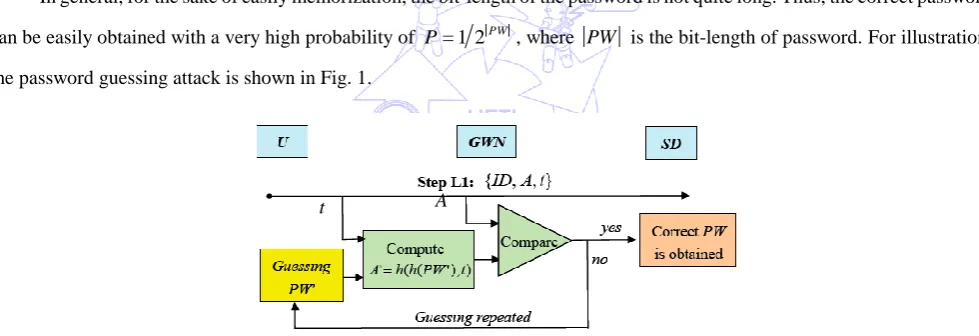
(1) It is vulnerable to the password guessing attack.
In Step L-1 of the login phase, the user sends {ID,A,t} to a sensor node through public channel, where A=h(vpw,t) and
) ( =h PW
vpw . An adversary can be easily guesses the password by the following steps:
Step G-1: Adversary intercepts {ID,A,t} in Step L-1.
Step G-2: By using the guessed password PW' and the intercepted timestamp t, the adversary computes A' with )
), ' ( ( =
' hh PW t
A .
Step G-3: The step G-2 is repeated if A'≠A. The correct password will be obtained if A'=A.
In general, for the sake of easily memorization, the bit-length of the password is not quite long. Thus, the correct password
can be easily obtained with a very high probability of P=12PW , where PW is the bit-length of password. For illustration,
the password guessing attack is shown in Fig. 1.
Fig. 1 The password guessing attack on Vaidya et al.'s scheme
(2) It is vulnerable to the impersonation attack.
Vaidya et al.'s scheme is also vulnerable to the impersonation attack. We describe the impersonation attack by the
following three cases:
Case 1. An adversary impersonates as the legitimate user.
As described in (1) of this section, Vaidya et al.'s scheme cannot withstand guessing attack. If the password is correctly
guessed, the adversary can impersonate as a legitimate user to retrieve information from any sensor node. The attack is
successful due to the gateway and sensor nodes authenticate the users only by passwords. A
Copyright © TAETI
Case 2. An adversary impersonates as the sensor node to fool the user.
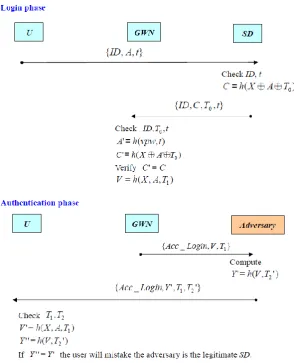
The GWN sends {Acc_Login,V,T1} to the SD in Step A-1for authentication, an adversary can compute Y' by using the
intercepted information V and the new timestamp T2' with Y'=h(V,T2'). Then, the adversary sends {Acc_Login,Y',T1,T2'}
to the user. Upon receiving {Acc_Login,Y',T1,T2'}, the user will authenticate the adversary if T2' is in the allowed time
interval. Thus, an adversary can impersonate as the sensor node to release fake sensor data. For illustration, the impersonation
attack is shown in Fig. 2.
Case 3. A malicious sensor node impersonates as the gateway node.
Suppose that a malicious sensor node wants to impersonate as the gateway node to attack the system. Due to the malicious
SD (MSD for short) knows X and can obtain A from Step L-1, he/she can compute V with V=h(X,A,T1) for legitimate SD to authenticate GWN in Step A-1. That is the MSD can compute and forward fake message for other sensor nodes to pass the verification, and the legitimate SDs suppose that they communicate with the real GWN.
(3) It needs secure channel in password-changing phase.
Since the user sends {ID,vpw,vpwnew} to the gateway node for password updating, where vpw=h(PW) and
) ( = new new h PW
vpw , an adversary will obtain the old password PW and the new password PWnew easily if the message is transmitted through public channels. Thus, in Vaidya et al.'s scheme, a secure channel should be required in password changing
phase. However, the secure channel is more expensive than the public channel. In order to prevent secret message from leakage,
the user should forwards the message in person or use a cryptographic mechanism to ensure the security. This makes it is
inconvenient and expensive on updating password.
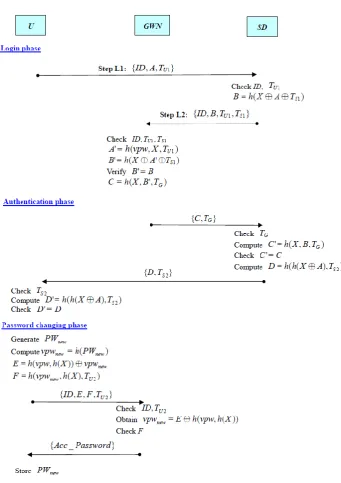
5. The improved user authentication scheme for wireless sensor networks
In this section, we will describe the improved scheme. The improved scheme is also composed of four phases. The
registration phase of the improved scheme is the same as Vaidya et al.'s scheme. The login phase, authentication phase, and
password changing phase are described as follows.
5.1. Login phase
If a user wants to obtain or transmit data from sensor nodes, the login steps are as follows.
Step IL-1: U→SD:{ID,A,TU1}
The user U computes A=h(vpw,X,TU1) and sends {ID,A,TU1} to a sensor node SD through a public channel, where
1
U
T is the current timestamp.
Step IL-2: SD→GWN:{ID,B,TU1,TS1}
Upon receiving the login request {ID,A,TU1}, the sensor node checks whether ID and TU1 are valid. The login request
will be rejected if it is not. Otherwise, the sensor node retrieves the corresponding A and computes B=h(X⊕A⊕TS1) and sends
{
ID
,
B
,
T
U1,
T
S1}
to the GWN, where is TS1the current timestamp.5.2. Authentication phase
The steps of the authentication phase are as follows.
Step IA-1: GWN→SD:{C,TG}
On receiving
{
ID
,
B
,
T
U1,
T
S1}
from the SD, the GWN checks whether {ID,TU1,TS1} are valid. The login request will berejected if it is not. If {ID,TU1,TS1} are valid, the GWN computes A'h(vpw,X,TU1) and B'=h(X⊕A'⊕TS1). Then GWN
checks whether B'=B holds. The GWN computes C=h(X,B',TG) and sends message {C,TG} to the sensor node if B'=B,
where TG is the current timestamp.
Copyright © TAETI
After receiving {C,TG}, the sensor node checks whether TG is in a valid interval. If TG is valid, SD computes )
, , ( =
' h X BTG
C . The GWN is authenticated if C'=C. Next, SD computes D=h(h(X⊕A),TS2) and sends {D,TS2} to the
user.
Step IA-3: The user authenticates the sensor node.
After receiving {D,TS2}, the user checks the freshness of timestamps TS2. If TS2 is in a valid time interval, the user
computes D'h(h(X⊕A),TS2). The user will start to obtain or transmit data if D'=D holds.
5.3. Password changing phase
The steps of the password changing phase are as follows. The communications of the password changing phase can be via
insecure open channels.
Step IC-1: U→GWN: {ID,E,F,TU2}
The user first chooses a new password PWnew and computes vpwnew=h(PWnew) . Next, the user computes
new
vpw X
h vpw h
E= ( , ( ))⊕ and F=h(vpwnew,h(X),TU2), where TU2 is the current timestamp. Finally, the user sends
} , , ,
{ID E F TU2 to the GWN.
Step IC-2: GWN→U:{Acc_Password}
Upon receiving {ID,E,F,TU2}, the GWN checks ID and
T
U2. If both of them are valid, the GWN obtains vpwnew by)) ( , ( ⊕
=E hvpw h X
vpwnew . Then GWN computes F'=h(vpwnew,h(X),TU2) and checks whether F' is equal to the received
message F. The GWN sends a successful password changing information {Acc_Password} to the user if
F
'
=
F
holds. Finally, the user replaces PWwith PWnew. The improved scheme is shown in Fig. 3 above.6. Discussions and security analysis of the improved scheme
In the improved scheme, only hash function and bitwise exclusive-OR operations are adopted in computation, thus the
computation overhead is quite low. The scheme also has the merits as follows.
(1) The proposed scheme withstands the replay attack.
Due to the transmission information is maliciously or fraudulently repeated, many authentication schemes suffer the
replay attack. In the improved scheme, all the transmission information contains timestamp, the receiver can detect the resent
information by checking the freshness of the timestamp. Thus the improved scheme can withstand the replay attack.
(2) The proposed scheme resists the off-line guessing attack.
If an adversary wants to guess the password, though he/she intercepts {ID,A,TU1} from Step IL-1, it is infeasible to
correctly guess the password since A=h(vpw,X,TU1) and X is unknown by the adversary. Similarly, if an adversary wants to
obtain the password from the transmission information in Step IL2, the trials also will fail due to B=h(X⊕A⊕TS1). Moreover, sinceDh(h(X⊕A),TS2), an adversary also cannot guess the password by using the information D. Thus the improved scheme resists the off-line guessing attack.
(3) The proposed scheme provides mutual authentication.
In the Step IL-2, the GWN will authenticate the user and SD by checking whether B'B holds. The SD authenticates
the user and the GWN by verifying C in Step IA-1. At last, in the Step IA-2, the user will authenticate the SD and GWN if D'=D
Copyright © TAETI
7. Conclusions
Vaidya et al. proposed a robust user authentication schemes for wireless sensor networks. Though Vaidya et al.'s scheme
provides mutual authentication and capable to protect against the replay attack, the forgery attack and the man-in- the-middle
attack. However, since it needs a secure channel in password changing phase, Vaidya et al.'s scheme is inconvenient and
expensive for users to update their passwords. Moreover, their scheme is vulnerable to the guessing attack and the
impersonation attack. We propose an improved scheme to remedy the flaws. The improved scheme can withstand the replay
attack and off-line guessing attack, and the users can freely update their passwords via public channels.
Acknowledgment
This work was partially supported by the National Science Council of the Republic of China under the contract number
NSC 101-2632-E-274-001-MY3.
References
[1] I.F. Akyildiz, W. Su, Y. Sankarasubramaniam and E. Cayirci, “Wireless sensor networks: A survey,” Computer Networks, vol.38, pp.393-422, 2002.
[2] Z. Benenson, N. Gedicke and O. Raivio, “Realizing robust user authentication in sensor networks,” Workshop on Real-World Wireless Sensor Networks (REALWSN 2005), 2005.
[3] C.Y Chong, S. Kumar, “Sensor networks: evolution, opportunities, and challenges,” Proceedings of the IEEE, vol.91,
pp.1247-1256, 2003.
[4] M.L. Das, “Two-factor user authentication in wireless sensor network,” IEEE Transaction on Wireless Communications, vol.8, pp.1086-1090, 2009.
[5] L. Lamport, “Password authentication with insecure communication,” Communications of the ACM, vol.24, pp.770-772,
1981.
[6] I. E. Liao, C. C. Lee and M. S. Hwang, “Security enhancement for a dynamic ID-based remote user authentication scheme,” Proceedings of the IEEE International Conference on Next Generation Web Services Practices (NWeSP 2005), 2005, pp.22-26.
[7] K. Martinez, J.K. Hart, R. Ong, “Environmental sensor networks,” IEEE Computer, vol.37, pp.50-56, 2004.
[8] Z. Tan, “Cryptanalysis of a two-factor user authentication scheme in wireless sensor networks,” Advances in Information Sciences and Service Sciences, vol.3, pp.117-126, 2011.
[9] H.-R. Tseng, R.-H. Jan and W. Yang, “An improved dynamic user authentication scheme for wireless sensor networks,”
Proceedings of the IEEE Global Telecommunications Conference, GLOBECOM '07, 2007, pp.986-990.
[10] B. Vaidya, M. Chen and J.J.P.C. Rodrigues, "Improved robust user authentication scheme for wireless sensor networks," 2009 Fifth IEEE Conference on Wireless Communication and Sensor Networks (WCSN), 2009, pp.1-6.
[11] B Vaidya, J.S. Silva, J.J. Rodrigues, “Robust dynamic user authentication scheme for wireless sensor networks,”
Proceedings of the 5th ACM Symposium on QoS and Security for wireless and mobile networks (Q2SWinet 2009), Tenerife, Spain, 2009, pp.88-91.