RESEARCH NOTE
BIT ERROR PERFORMANCE FOR ASYNCHRONOUS
DS/CDMA SYSTEMS OVER MULTIPATH RAYLEIGH
FADING CHANNELS
H. R. Bakhshi, M. H. Ghassemian and M. Kahrizi
Department of Electrical Engineering, Tarbiat Modarres University Tehran, 14155 – 4838, Iran, [email protected]
(Received: November 13, 1999 – Accepted in Revised From: January 5, 2002)
Abstract In recent years, there has been considerable interest in the use of CDMA in mobile communications. Bit error rate is one of the most important parameters in the evaluation of CDMA systems. In this paper, we develop a technique to find an accurate approximation to the probability of bit error for asynchronous direct–sequence code division multiple–access (DS/CDMA) systems by modeling the multiple access interference (MAI) as an improved Gaussian process. The channel is modeled as a multipath flat Rayleigh fading channel. Numerical results are obtained by using the improved Gaussian approximation (IGA) and compared to the standard Gaussian approximation (SGA).
Key Words DS/CDMA, Bit Error Rate, Multipath Fading, Rayleigh Distribution
ƵŶǀƨģ
ƵŵźŤƀĭƞǀƏ ƽŚƸưŤƀǀſ źǀųř ƶƷŵ Źŵ
DS/CDMA
ƶūƺţ ŵŹƺƯ ƾƫƺƬſ šřźŝŚŴƯŹŵ ƵŵŚƠŤſř ƽřźŝ
ŶƳřƶŤƟźĭŹřźƣƱřƹřźƟ
. ƮŤƀǀſƾŝŚƿŻŹřŹŵŚƷźŤƯřŹŚěƲƿźŤưƸƯŻřƾƨƿ
DS/CDMA
ƤƯ ŢſŚƐųƩŚưŤůřŹřŶ
.
ƲƿřŹŵ
ƶŞſŚŰƯƽřźŝŶƿŶū ƾƃƹŹƶŤƟŚƿ ŵƺŞƸŝƾſƺĭŶƴƿōźƟ ƱřƺƴƗƶŝ ƶƳŚĭŶƴģƾſźŤſŵ ƪųřŶţƱŵƺưƳ ƩŶƯŚŝ ƶƫŚƤƯ ƵŵźŤƀĭƞǀƏƽŚƸưŤƀǀſŹŵŢǀŝƽŚƐųƩŚưŤůř
DS/CDMA
ƾƯŵŚƸƴƄǀě ŵŵźĭ
. ŶƴģšŹƺƇƶŝƩŚƳŚƧƲǀƴĤưƷ
ƺŰƯŚŝ ƽźǀƀƯ
Ŷƃ ƶŤƟźĭźƔƳŹŵ ƾƬƿřŹƕƺƳ ŻřƾĭŶƃ Ţſř Ƶ
.
ƾƯƱŚƄƳ ƶƬƇŚůŪƿŚŤƳ
ŚŝŚƐų ƩŚưŤůřƶƧŶƷŵ
ŢſřŵŹřŶƳŚŤſřƾſƺĭŜƿźƤţŚŝŚƐųƩŚưŤůřƶŝŢŞƀƳƽźŤƄǀŝŢƣŵƽřŹřŵƶŤƟŚƿŵƺŞƸŝƾſƺĭŜƿźƤţ
.
1. INTRODUCTION
In recent years, there has been considerable interest in the use of CDMA as an alternative to traditional frequency–division multiple−access (FDMA) and time–division multiple–access (TDMA) techniques in mobile communications [1]. In CDMA, multiple users transmit, often asynchronously, over a common communication channel, typically using the direct–sequence (DS) spread spectrum technique. Multiple access interference (MAI) is the main factor that limits the throughput in a CDMA system by reducing the number of active users operating at a specified system bit error rate (BER).
In practice, the MAI terms in a DS/CDMA system are independent only when conditioned on
a set of specific operating circumstances for every user [2]. Thus, the SGA is not always accurate enough. This observation has led to the proposal of an alternative procedure based on the improved Gaussian approximation (IGA). The point of departure in an improved Gaussian approximation is the application of the central limit theorem and the law of total probability to a conditional probability of error.
in [6].
In this paper, we extend the works in [3] and [6] to analyze the performance of asynchronous DS/CDMA systems using Gold sequences [7] over the multipath flat Rayleigh fading channel, by modeling the MAI as an improved Gaussian process.
2. SYSTEM MODEL
Consider K users transmitting asynchronously over a multipath-fading environment to a single receiver station. Assume that each transmitter uses a binary phase shift keying (BPSK) DS/CDMA modulation. The kth transmitter generates data bits at a rate of 1/Tb bits per second. Its data signal, bk(t), and the spreading signal, ak(t), are defined as [8]
∑
=∞−∞
= −
= n
n T b
) k ( n
k(t) b P (t nT )
b b (1)
) nT t ( P a )
t (
a (k) T c
n n
n
k =
∑
c −∞ =
−∞ =
(2)
here PT(t) is unit rectangular pulse. The data symbols, bn(k), are considered to be independent and identically distributed (iid) sequences with Pr[bn(k) = −1] = Pr[bn(k) = +1] = 0.5. Tc is the chip period and we assume Tb = N Tc, with N being the period of spreading sequence.
First, data are multiplied by the spreading signal to produce a base band signal. Then, the carrier modulation is used to get
) k t c cos( ) t ( k a ) t ( k b P 2 ) t ( k
s = ω +θ (3)
In (3), θk, ωc, and P represent the phase of the kth carrier, the common center frequency and the signal power respectively.
The low pass equivalent impulse response of the passband-fading channel for the link between the kth user transmitter and the receiver is
∑
β
δ
−
τ
φ
=
L
)
k
l
j
exp(
)
k
l
t
(
k
l
)
t
(
k
h
(4)where βl,k, φl,k, and τl,k are, respectively, the lth path
gain, phase and time delay of the kth user, and δ (.) is the Dirac delta function.
For any input signal sk(t), modeled as (3), the output signal, yk(t), produced by the composite multipath fading channel, consists of a sum of delayed, phase shifted, attenuated replicas of the input signal,
) t ( b P 2 )
t (
y l,k k l,k
L 1 l
k =
∑
β − τ=
) t cos( ) t (
ak −τl,k ωc +ϕl,k
(5) where ϕl,k = φl,k + θk – ωc τl,k. In (5), τl,k has a
uniform distribution over the interval [0 , Tb), ϕl,k is
uniform in [0, 2π), and βl,k is a Rayleigh random
variable.
The received signal is the sum of signal components arriving over all paths from the users along with an additive thermal noise. In fact
), t ( n
) t cos( ) t ( a ) t ( b P 2 )
t (
r l,k k l,k k,l ,lk c l,k L
1 l K
1 k
+
ϕ + ω τ
− τ
− β =
∑
∑
= =
(6) where n(t) is a white zero–mean Gaussian process
with a two−sided noise power spectral density
N0/2.
It is assumed that the signal of user 1 is to be detected. Furthermore, without loss of generality [8], we assume that the receiver is locked to the component of user 1 on τ1,1 = 0 and ϕ1,1 = 0. The
output of a coherent receiver is . dt ) t cos( ) t ( a ) t ( r
Z 1 c
T
0 b
ω =
∫
(7) By substituting (6) into (7), we obtain
1 , 1 k ,l
) cos( W 2
/ P T b 2 / P
Z l,k ,lk l,k
L
1 l K
1 k b
) 1 ( 0 1 , 1
≠
η + ϕ β
+ β
=
∑
∑
= =
(8) where we have
)]
(
R
b
)
(
R
b
[
W
(k) 1k l,k0 k
, l k 1 ) k (
1 k
,
l
=
−τ
+
∧τ
(9) b-1(k) and b0(k) represent a pair of consecutive data
bits of the kth signal. R1k(τl,k) and R^1k(τl,k) are the ∑
= β δ −τ φ
= L
1
l l,k (t l,k)exp( j l,k) )
continuous time partial cross−correlation of the kth and 1st spectral spreading waveforms as defined in [7].
Since data bits are assumed to be equiprobable, the bit error probability is
Pb = Pr( Z < 0 b0(1) = +1 (10)
3. PROBABILITY OF BIT ERROR WITH IGA
An improved Gaussian approximation was presented in [3,4], and it was shown that this approximation provides an accurate result for the probability of bit error in asynchronous DS/CDMA, using a random sequence in an AWGN channel. In this section, we extend the work in [3] and evaluate the probability of bit error for asynchronous DS/CDMA in multipath Rayleigh fading channel, using the improved Gaussian approximation. Following the approach in [3], let Tc = 1 (Tb = N), b10 = 1, and P = 2. Then we have
1 , 1 k , l
) cos( W N
Z l,k l,k l,k
L
1 l K
1 k 1 , 1
≠
η + ϕ β
+ β
=
∑
∑
= =
(11)
As in [3], let Ψ denote the variance of the MAI conditioned on the path gains, delays and phases of all interfering signals and of the desired sequence structure, through a quantity B = (N−1−C)/2 where
C is the discrete aperiodic autocorrelation of the signature sequence of receiver 1,
) 1 (
1 j a ) 1 (
j a
2 N
0
j
C ∑− +
=
= (12)
and
2 1 N ] B [
E = − (13)
4 ) 1 N ( N ] B [
E 2 = − (14)
Therefore, the conditioned variance, Ψ, is given by
Ψ = Var[MAIτl,k, ϕl,k, βl,k, B]
1 , 1 k ,l
, X 1 , 1 k ,l
] B , , , | ) cos W [( E
k , l L
1 l K
1 k
k , l k , l k , l 2 k , l k , l k , l L
1 l K
1 k
≠ =
≠
β ϕ τ ϕ β
=
∑
∑
∑
∑
= =
= =
(15) Xl,k = E[(βl,k cosϕl,k)2βl,k, ϕl,k] E[(Wl,k)2τl,k, B] =(βl,kcosϕl,k)2 E[(Wl,k)2τl,k, B]. (16) The second term of Xl,k is equal to [3]
E[(Wl,k)2τl,k,B]= 2(2B + 1)(Sl,k2− Sl,k) + N (17) where Sl,k is τl,k normalized on Tb. Thus, Xl,k
becomes
Xl,k=(βl,kcosϕl,k)2[2(2B + 1)(Sl,k2− Sl,k) + N]. (18) In what follows, we first assume that MAI is the major source of error. Then, the effect of the thermal noise is also taken into account. The accurate probability of bit error conditioned on β1,1 can be found by evaluating
Ψ Ψ Ψ β ψ β ∫ ∞ = β
β Pb| 1,1, ( 1,1, )p( )d 0
) 1 , 1 ( 1 , 1 | b
P (19)
where p(Ψ) is the pdf of Ψ and Pbβ ,ψ(β,Ψ) is the
probability of bit error conditioned on Ψ for a fixed β and is given by
). noise P N (
Q ) , ( , | b P
+ Ψ
β =
Ψ β ψ
β (20)
To obtain the probability of bit error, we must evaluate the integral
1 , 1 d ) 1 , 1 ( p ) 1 , 1 ( 1 1 | b P b
P β β β
β ∫ ∞
= ( 1,1)p( 1,1)d 1,1 (21)
1 , 1 | b P
0
b
The computation of (19) requires evaluating the pdf of Ψ, which is very cumbersome, especially when multipath fading is considered. Holtzman [5] has used a simple approximation for the computation of probability of bit error for asynchronous DS/CDMA in an AWGN channel that does not require the pdf of Ψ directly. By using a similar approach, we have computed the probability of bit error over the multipath-fading channel. The objective here is to compute (19) without carrying out the integration. This can be done by expanding Pbβ ,ψ(β, Ψ) using the Taylor
series.
To simplify the notation, we denote Pbβ,ψ(β,Ψ)
as P(Ψ). Using the Taylor series, P(Ψ) can be written as + µ µ − Ψ + + µ µ − Ψ + µ = Ψ ψ ψ ψ ψ ψ ) ( P ! n ) ( ... ) ( P ) ( ) ( P ) ( P ) n ( n ) 1 ( (22)
where µψis the mean of Ψ and P(n)(µ
ψ) is the nth
derivative of P(Ψ) evaluated at Ψ = µψ. Taking the expectation of (22) with respect to Ψ, one obtains ... ) ( P ! n ... ) ( P ! 2 ) ( P )] ( P [
E (2) ,n (n) 2 + µ µ + + µ σ + µ =
Ψ ψ ψ ψ ψ ψ (23) where σψ2 is the variance of Ψ and µ
ψ,n is the nth moment given by E[(Ψ − µψ)n]. The second derivative of P(Ψ) − in which Ψ is a random variable − can be approximated by the Stirling’s formula: 2 ) 2 ( h ) h ( P ) ( P 2 ) h ( P ) (
P Ψ = Ψ + − Ψ + Ψ −
(24) where h is the step−size. A appropriate value for h
is h =√3 σψ [5]. We assume that only the first two
terms in (23) are important. Substituting (24) into (23), gives ) 3 ( P 6 1 ) 3 ( P 6 1 ) ( P 3 2 )] ( P [ E ψ ψ ψ ψ ψ σ − µ + σ + µ + µ = Ψ (25)
Now, we find the mean and the variance of Ψ,
∑∑
∑
∑
= = = = ψ + − + ϕ β = ≠ + − + ϕ β = µ K 1 k L 1 l k , l 2 k ,l k ,l 2 2 k , l L 1 l k , l 2 k ,l 2 k ,l k , l K 1 k ] N ) S S )( 1 B 2 ( 2 [ E ] [cos E ] [ E 1 , 1 k ,l ]} N ) S S )( 1 B 2 ( 2 [ ) cos ( { E (26) Since βl,k is a Rayleigh random variable, using(13), we have
) 2 ( 3
1
KL− σ2
=
µ ψ (27)
The variance of Ψcan be written as
2 K 1 k L 1 l 2 k , l 2 k , l 4 k , l k , l 2 2 2 ) ( 1 , 1 k ,l } ] N ) S S )( 1 B 2 ( 2 [ ) cos ( { E ) ( E ) ( E ψ = = ψ µ − ≠ + − + ϕ β = Ψ − Ψ = σ
∑∑
(28) Using (14), one obtains) 4 ( 36 1 N ) 2 K KL 2 L K ( ) 4 ( 9 N ) 1 KL ( ) 24 ( 40 1 N 2 N 7 ) 1 KL ( 2 2 2 2 2 2 2 2 σ − + − − + σ − − σ − + − = σψ (29) If we substitute (19), (27) and (29) into (25), and
incorporate the effect of thermal noise, the probability of bit error conditioned on β1,1 becomes ) ( P 6 1 ) ( P 6 1 ) ( P 3 2 ) (
Pb|β1,1 β1,1 = 1β1,1 + 2 β1,1 + 3 β1,1 (30)
where Pi(β1,1) is given by
) D ( Q ) ( P i 1 , 1 1 , 1 i β =
β (31)
5 . 0 2 b
0
1 N (2 )]
1 KL E
N [
D = + − σ (32)
5 . 0 ] N
3 ) 2 2 ( N
1 KL b E0 N [ 2
D = + − σ + σψ (33)
5 . 0 ] N
3 ) 2 2 ( N
1 KL b E0 N [ 3
D = + − σ − σψ (34)
Now, substituting (30) into (21), we can calculate the probability of bit error
∫ ∞
β β β +
∫ ∞
∫ ∞
β β β +
β β β =
0
. 1 , 1 d ) 1 , 1 ( p ) 1 , 1 ( 3 P 6
10 0
1 , 1 d ) 1 , 1 ( p ) 1 , 1 ( 2 P 6 1 1 , 1 d ) 1 , 1 ( p ) 1 , 1 ( 1 P 3 2 b P
(35)
4. NUMERICAL RESULTS AND CONCLUSIONS
Figure 1 depicts the probability of bit error for an asynchronous DS/CDMA system over a flat Rayleigh fading channel for Eb/N0 = ∞, N = 63, and parameter L. Note that as L increases, the discrepancy between the SGA and the IGA decreases. This result complies with the central limit theorem.
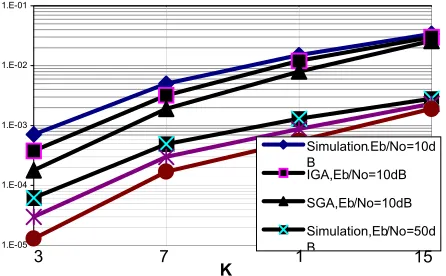
Figure 2 shows the probability of bit error for an asynchronous DS/CDMA system over a flat Rayleigh fading channel for Eb/N0 = ∞, L = 2, and parameter N. We observe that the accuracy of the SGA does not depend on N. The difference between the bit error rate curve for the SGA and the IGA remains almost the same when N changes. Figure 3 illustrates the probability of bit error for an asynchronous DS/CDMA system over a flat Rayleigh fading channel for L = 2, N = 63, and parameter Eb/N0. From this figure, we note that when Eb/N0 increases, the probability of bit error decrease. Also, the difference between the SGA and IGA remains the same when Eb/N0changes.
1.E-04 1.E-03 1.E-02
1.E-013 5 7 9
Simulation,L=6 IGA,L=6 SGA,L=6 Simulation,L=3 IGA,L=3 SGA,L=3
3 7 1 15
K
Figure 1. Probability of bit error versus No. of users for IGA,
SGA, and the simulation results based on the parameter L (N = 63, Eb/N0 = ∞).
1.E-05 1.E-04 1.E-03
1.E-023 7 11 15
Simulation(N=31) IGA(N=31) SGA(N=31) Simulation(N=63) IGA(N=63) SGA(N=63)
3 7 1 15
K
Figure 2.Probability of bit error versus No. of users for IGA,
SGA, and the simulation results based on the parameter N ( L = 2, Eb/N0 = ∞).
1.E-05 1.E-04 1.E-03 1.E-02
1.E-013 7 11 15
Simulation.Eb/No=10d B
IGA,Eb/No=10dB
SGA,Eb/No=10dB
Simulation,Eb/No=50d B
3 7 1 15
K
Figure 3.Probability of bit error versus No. of users for IGA,
In this paper, we analyzed the performance of asynchronous DS/CDMA system over multipath Rayleigh fading channels. The probability of bit error was computed using two methods. In the first method we assumed that the MAI is Gaussian, while in the second one, we modeled the MAI as an improved Gaussian. The main conclusion is that the computation of the probability of bit error, based on the Gaussian approximation for the MAI, is not accurate, especially for a small number of simultaneous users, which corresponds to a low probability of bit error. However, it was shown that, when the channel exhibits deep fading (large
L), the standard Gaussian approximation and the improved Gaussian approximation give similar results.
5. REFRENCES
1. Yeong, D. G. and Yeon, W. S., “A Data Transmission Scheme for CDMA Wireless Networks Based on IS-95”,
IEEE Transactions on Vehicular Technology, Vol. 49,
No. 1, (2000), 1-10.
2. Bultitude, R. J. C. and Bedal, G. K., “Propagation Characteristics on Microcellular Urban Mobile Radio
Channels at 910 MHz”, IEEE Journal Selected on
Areas in Communications, Vol. 7, No. 1, (1989), 31-39. 3. Morrow, R. K. and Lehnert, J. S., “Bit to Bit Error
Dependence in Slotted DS/CDMA Packet Systems with Random Signature Sequences”, IEEE Transactions on Communications, Vol. 37, No. 10, (1989), 1052-1061.
4. Morrow, R. K. and Lehnert, J. S., “Packet Throughput in Slotted Aloha DS/CDMA Radio Systems with Random
Signature Sequences”, IEEE Transactions on
Communications, Vol. Com-40, No. 7, (1992), 1223-1230.
5. Holtzman, J. M., “A Simple Accurate Method to Calculate Spread Spectrum Multiple Access Error Probability”,
IEEE Transactions on Communications, Vol. 40, No. 3, (1992), 461-464.
6. Stojanovic, M. and Zvonar, Z., “Performance of Multiuser Diversity Reception in Rayleigh Fading CDMA Channels”,
IEEE Transactions on Communications,Vol. 47, No. 3, (1999), 356-359.
7. Gold, R., “Optimal Binary Sequences for Spread
Spectrum Multiplexing”, IEEE Transactions on
Information Theory, Vol. IT-13, (1967), 619-621. 8. Prasad, R., “CDMA for Wireless Personal Communications”,