*Corresponding author: John Milton.D ISSN: 0976-3031
Research Article
EFFECT OF BIOREMEDIATED LIGNITE MINE EFFLUENT AND SOIL ON
GROWTH AND YIELD OF PADDY ADT-36
John Milton, D
1and Reetha,D
21
Department of Microbiology, St.Joseph’s College of Arts and Science, Cuddalore
2Department of Agricultural Microbiology, Annamalai University, Annamalai Nagar
DOI: http://dx.doi.org/10.24327/ijrsr.2017.0803.0067
ARTICLE INFO ABSTRACT
A pot experiment was conducted to evaluate the effect of soil and lignite mine effluent, both were already treated with the bacterial consortium (Bacillus subtilis + Pseudomonas stutzeri +
Pseudomonas alcaligenes), on growth and yield of paddy (ADT-36). Paddy cultivated on
bioremediated soil irrigated with biologically treated effluent showed increased growth rate viz., plant height (67.2 cm), the number of tillers/hill (13.50) and total leaf area (60.02 cm2/plant). Yield attributing values of paddy plant were also higher in treated soil irrigated with biologically treated effluent. Higher levels of chlorophyll (1.620 mg/g fr.wt)), starch (7.798mg/g fr.wt in root, 12.099 mg/g fr.wt in shoot) and amino acids (0.590 mg/g fr.wt,in root, 0.394 mg/g fr.wt.in shoot)content were also recorded. These values were lower in the paddy, cultivated in untreated soil irrigated with raw effluent.
INTRODUCTION
The mining industries are discharged millions of liters of wastewater every day to the adjacent watercourses. In India, gallons, and gallons of waste water discharged from various coal mines. India is an agricultural based country and a major user of water resource for irrigation (Singh et al., 2004). Due to the scarcity of good water for irrigation, the farmers have started to irrigate their agricultural crops by using industrial waste water (Rathore et al., 2000). Globally, around 20 million hectares land is reported to be irrigated with waste water and at least 10 % of the world's population is thought to consume foods produced by irrigation with waste water (WHO, 2006a & b; Hamilton et al., 2007).
The agricultural lands irrigated with coal mine waste water leads to the heavy metal contamination of the lands. The pollutants deposited in soil can easily reach human populations, particularly through the food chain. Continuous uses of industrial effluent also reduce the yield of crop plants. Microbial populations in polluted environments adapt to toxic concentrations of pollutants and become resistant (Viti and Giovannetti, 2001; Prasenjit and Sumathi, 2005).
Therefore, the present research work was undertaken to investigate the effect of bioremediated soil and effluent on the growth and yield of paddy.
MATERIALS AND METHODS
The lignite mine effluent and soil already treated with an inoculum containing bacterial consortium (Bacillus subtilis +
Pseudomonas stutzeri + Pseudomonas alcaligenes) were used in this study.
Effect of bioremediated effluent and soil on the growth and yield of paddy (ADT-36)
A pot culture experiment was conducted at Pot culture yard, Department of Microbiology, Annamalai University to study the effect of bioremediated soil and effluent on the growth and yield of paddy var. ADT-36. Three sets of cement pots were filled with 25 kg of bioremediated soil, normal agricultural field soil (collected from the field near the lignite mine effluent irrigated soil) and untreated soil separately and irrigated with normal bore well water, raw untreated effluent and treated effluent. Seedlings of 25 days old Paddy var. ADT-36 were transplanted and 100% RDF were applied. The experiment was conducted with following treatments in a factorial RBD and with three replications.
Recent Scientific
Research
International Journal of Recent Scientific Research
Vol. 8, Issue, 3, pp. 16067-16071, March, 2017
Copyright © John Milton and Reetha, 2017, this is an open-access article distributed under the terms of the Creative Commons Attribution License, which permits unrestricted use, distribution and reproduction in any medium, provided the original work is properly cited.
Article History:
Received 15th December, 2016 Received in revised form 25th January, 2017
Accepted 23rd February, 2017 Published online 28th March, 2017
DOI: 10.24327/IJRSR
Key Words:
Bioremediation, Paddy, Bacterial consortium
Growth And Yield of Paddy Adt-36
Treatment schedule
Main treatments M1 - Bioremediated soil
M2 - Normal soil
M3 - Untreated soil
Sub treatments S1 - Bore well water
S2 - Treated effluent
S3 - Untreated effluent
Biometric Observations on Growth Parameters
(Mohana et al., 2011)
Plant height
Randomly selected 5 hills were used for the measurement of plant height 90th day after transplanting (DAT). It was measured from the base to tip of the upper leaves of the main stem.
Number of tillers per hill
Tiller per hill was counted from the randomly selected sample of 5 hills after transplanting and mean was calculated. The main stem was also included in calculating the total tillers per plant.
Total leaf area (cm2)
The leaf area was calculated by measuring the length and breadth of the leaf.
Leaf area (cm2) = K× length× breath
Where, K= Kemp’s constant (for monocot leaves) = 0.9
Yield Attributing Characters of Rice
A number of filled grains panicle-1 and Grain yield were assessed and recorded at the time of harvesting following standard procedures.
Number of filled grains panicle-1(Yoshida et al., 1971)
The panicles were chosen randomly for recording the number of filled grains panicle-1. The differentiation of well filled and chaffy grains was made by pressing the grains between forefinger and thumb. Average of filled grains from panicles from ten plants was taken.
Grain yield
After the harvest, the grains were separated, winnowed, dried in the sun and dry weight were recorded and expressed as g/pot.
Biochemical Constituents of Paddy (Baskaran et al., 2009)
Estimation of Chlorophyll
Five hundred mg of fresh leaf material was taken and ground with help of pestle and mortar with 10 mL of 80% acetone. The homogenate was centrifuged at 800 rpm for 15 minutes. The supernatant was saved. The residue was re-extracted with 80% acetone. The supernatant was saved and utilized for chlorophyll estimation. Absorbance was read at 645, 663 and 480 nm in the UV- spectrophotometer.
Chlorophyll ‘a’ (mg/ L) = (0.0127) × (O.D 663) - (0.00269) × (O.D 645) Chlorophyll ‘b’ (mg/ L) = (0.0229) × (O.D 645) - (0.00468) × (O.D 663)
Estimation of starch
Five hundred mg of material (root and shoot) was taken for the extraction of starch. The material was macerated in a pestle and mortar with 10 mL of 80 % ethanol. The residue was later dissolved in 6.5 mL of 52 percent perchloric acid for one hour. It was centrifuged and made up to 100 mL in a volume flask with distilled water. One mL of this solution was further diluted with 5 mL distilled water. To this, 10 mL freshly prepared anthrone reagent was added. The content was heated for 7 min at 100ºC in a boiling water bath. The tube was then cooled rapidly, shaken well and then appeared color was read at 630 nm in a spectrophotometer.
Amino Acid
The amino acid content was determined by the method of Moore and Stein, (1948). A 0.5 g of plant sample (root and
shoot) was homogenized in 10 mL of 80% ethanol. The homogenate was centrifuged for 10 min at 800 rpm. One
mL of the extract was taken in the test tube to which 1 mL of 0.1 N of HCl was added to neutralize the sample. To this, one mL of ninhydrin reagent was added and heated for 20 minutes in a boiling water bath. Later, 5 mL of the diluent solution was added and heated again in a water bath for 10 minutes. The test tubes were cooled and read the absorbance at 570 nm in a UV- spectrophotometer.
Statistical Analysis
The statistical analysis of the experimental results was performed employing the computer software package ‘IRRISTAT’, version 90-1, developed by Department of Statistics, International Rice Research Institute, Philippines and as per the procedure of Gomez and Gomez (1976).
RESULTS AND DISCUSSION
Biometric Observation on Growth Parameters
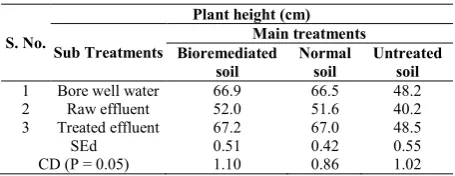
The effect of bioremediated soil and effluent on the height of paddy plants was studied and the results are given in Table-1. The maximum plant height was recorded in the bioremediated soil using treated effluent (67.2 cm) followed by normal soil irrigated with treated effluent (67.0 cm). The plant height is reduced to a greater extent when grown under untreated soil and effluent.
The number of tillers varied from 7.0 to 13.50 tillers per hill. The maximum number of tillers was recorded in the bioremediated soil irrigated with treated effluent (13.50 tillers/hill) and the results were shown in the Table-2.
Table 1 Effect of bioremediated lignite mine effluent and soil on plant height of paddy
S. No.
Plant height (cm)
Sub Treatments
Main treatments Bioremediated
soil
Normal soil
Untreated soil
1 Bore well water 66.9 66.5 48.2
2 Raw effluent 52.0 51.6 40.2
3 Treated effluent 67.2 67.0 48.5
SEd 0.51 0.42 0.55
Similar observations were made on black gram (Ravimycin and Lakshmanachary, 1993) and bhendi crops treated with bioremediated sugar mill effluent (Rathinaswamy and Lakshmi Narashimhan, 1998). Furthermore, the enhanced growth of plants might be due to the presence of nitrates and phosphates along with other nutrients in favourable concentration in the bioremediated effluent and soil (Rajannan and Oblisami, 1999; Mishra, 1987).
The total leaf area of paddy plants was measured and given in Table-3. The total leaf area showed an increasing trend in plants grown on bioremediated soil irrigating with bioremediated effluent.The similar trend was observed in rice treated with bioremediated paper mill effluent (Dutta and Biossya, 1998) and in Hodeum vulgare treated with bioremediated sugar mill effluent (Kumar, 2000). Tiwari et al.
(2006) found that the leaf area was affected by the coal mine effluent without any treatment. Jolly et al. (2012) found that the raw dying industry effluent reduced the total leaf area in wheat plant.
Yield Attributing Characters of Rice
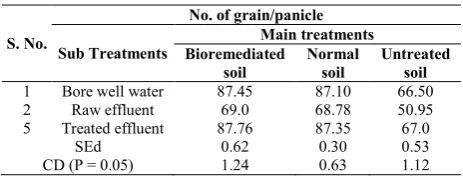
After harvesting the total number of grain was counted and presented in Table-4. The treatment of bioremediated soil irrigated with bacterially treated effluent recorded the highest number of grain (87.76 grains/panicle).
In the present experiment, different yield attributes were showed substantial increases when we used bioremediated soil and bioremediated effluent for the cultivation of paddy.
Similar results have also been reported in rice irrigated with bioremediated industrial effluents (Dutta and Biossya, 1998; Rathore et al., 2000).
After harvesting the data regarded the grain weight was taken and presented in Table-5. The maximum grain weight was recorded in bioremediated soil with treated effluent (227.52 g/pot), whereas the untreated soil with raw effluent showed minimum grain weight (140.20 g/pot).
The bioremediation of the effluent brought down the toxic effects of the effluent and acted as liquid fertilizer, which could be attributed as the reason for the increased growth and yield of the crop (Rani and Srivastava, 1990). The reduction in the yield of paddy irrigated with raw effluent might be due to the excessive amount of nitrogen, chlorides and bicarbonates in the effluent and polluted soil which were reported to be the retardants of plant growth and yield at high concentration (Rajannan and Oblisami, 1999). In all the treatments, the values recorded in normal soil were slightly decreased when compared with bioremediated soil. Several researchers reported that untreated industrial effluents found to be inhibited the growth and yield of several crops and other plants (Kaushik et al.,
2005; Soundarrajan and Pitchai, 2007; Muthalagi and Mala, 2007; Kalaiselvi et al., 2009; Alghobar and Suresha, 2016).
Biochemical Constituents of Paddy
The Table-6 shows the biochemical analysis of paddy that was grown on bioremediated soil, normal soil and untreated soil using bioremediated effluent, raw effluent and bore well water with recommended dose of fertilizer. Compared with different treatment, the bioremediated soil irrigated with biologically treated effluent stood out with total chlorophyll of 1.620 mg/g fr. wt. followed by 1.610 mg/g fr. wt. (bioremediated soil irrigated with bore well water), whereas the untreated soil irrigated with raw effluent showed minimum value (0.875 mg/g fr. wt).
The chlorophyll content was positively correlated with net photosynthetic rate, and hence it plays a major role in controlling growth and grain filling process. In the present research, the total chlorophyll content was declined in the paddy grown on untreated soil irrigated with raw effluent. A similar result was found by Tiwari et al. (2006). The decline in chlorophyll content, presumably due to inhibition of chlorophyll biosynthesis under various metals stresses (Padmaja et al., 1996; Vajpayee et al., 2000). Pandey and Rao Table 3 Effect of bioremediated lignite mine effluent and
soil on total leaf area index of paddy
S. No.
Total leaf area (cm2/plant)
Sub Treatments
Main treatments Bioremediated
soil
Normal soil
Untreated soil
1 Bore well water 59.61 59.15 47.65
2 Raw effluent 50.30 49.70 40.20
5 Treated effluent 60.02 59.75 47.95
SEd 0.56 0.71 0.45
CD (P = 0.05) 1.08 1.50 0.98
Table 4 Effect of bioremediated lignite mine effluent and soil on number of grain/panicle of paddy
S. No.
No. of grain/panicle
Sub Treatments
Main treatments Bioremediated
soil
Normal soil
Untreated soil
1 Bore well water 87.45 87.10 66.50
2 Raw effluent 69.0 68.78 50.95
5 Treated effluent 87.76 87.35 67.0
SEd 0.62 0.30 0.53
CD (P = 0.05) 1.24 0.63 1.12
Table 5 Effect of bioremediated lignite mine effluent and soil on grain weight of paddy
S. No.
Grain weight (g/pot)
Sub Treatments
Main treatments Bioremediated
soil
Normal soil
Untreated soil
1 Bore well water 225.46 217.39 164.25
2 Raw effluent 176.37 172.10 140.20
5 Treated effluent 227.52 223.60 165.55
SEd 2.26 3.32 2.13
CD (P = 0.05) 4.62 6.41 4.20
Table 2 Effect of bioremediated lignite mine effluent and soil on number of tillers/hill of paddy
S. No.
Number of tiller/hill
Sub Treatments
Main treatments Bioremediated
soil
Normal soil
Untreated soil
1 Bore well water 13.45 13.20 8.65
2 Raw effluent 9.28 9.05 7.0
5 Treated effluent 13.50 13.35 8.90
SEd 0.06 0.12 0.21
Growth And Yield of Paddy Adt-36
(1998) and Banerjee and Pandey (2002) have also reported the reduction in chlorophyll content as a result of pollution.
The pigment content showed an increasing trend in paddy grown with bioremediated effluent on bioremediated soil. The same trend was observed in wheat (Kaushik et al., 1994), rice (Dutta and Biossya, 1998), groundnut and paddy (Thamizhiniyan et al., 2000) in response to the treatment of bioremediated effluent
Reduction in pigment content of paddy grown in raw effluent might be due to the presence of the excessive amount of nitrogen and chlorides which increased the osmotic pressure that reduced the uptake of magnesium, potassium and other mineral ions and resulted in inhibition of pigment synthesis (Kadioglu and Algur, 2004).
Starch content in root and shoot were also high in the treatment of bioremediated soil irrigated with bacterially treated effluent (7.798 mg/g fr. wt for root and 12.099 mg/g fr. wt for shoot), while in untreated soil irrigated with raw effluent it was found to be 3.656 mg/g fr. wt and 8.015 mg/g fr. wt for root and shoot respectively.
The starch content in root and shoot of paddy grown on bioremediated soil irrigated with bioremediated effluent was more than other treatments. The same trend was also observed
(Vaidheswaran and Swaminathan, 1999; Srivastava Neeta
et al., 1999). The increase in starch content could be attributed to the increased number of leaves, total leaf area and chlorophyll content of the plant.
In the treatment of bioremediated soil irrigated with treated effluent, the amino acid content in root and shoot were also recorded to be high with 0.590 mg/g fr. wt and 0.394 mg/g fr. wt followed by the bioremediated soil irrigated with bore well water (0.588 mg/g fr. wt and 0.389 mg/g fr. wt), while 0.280 mg/g fr. wt and 0.195 mg/g fr. wt were recorded for root and shoot respectively in untreated soil irrigated with raw effluent.
The higher amount of amino acid content showed in the paddy grown on bioremediated soil using bioremediated effluent and decreased in paddy grown on untreated soil irrigated with raw effluent. Similar observations were also recorded in paddy and
groundnut, treated with sugar mill effluent (Thamizhiniyan
et al., 2000), Vigna amguiculata treated with fertilizer factory effluent (Subramani et al., 2002) and Cyamopsis tetregonoloba
treated with distillery effluent (Taghavi and Vora, 2002).
In overall, the bioremediated soil showed better results than the normal soil (unpolluted soil) in all the treatments. It might be due to the contamination of normal soil (collected near to the lignite mine effluent irrigated soil) from the atmospheric
deposition of pollutants from lignite fired thermal power plants. The bioremediated soil induces the growth and yield of crop plant. Increase growth and yield of crop plants observed by many researchers (Ajithkumar et al. 1998; Benimeli et al.
2008)
References
Ajithkumar, P.V., K.P. Gangadhara, P. Manilal, and A.A.M. Kunhi. 1998. Soil inoculation with Pseudomonas aeruginosa 3MT eliminates the inhibitory effect of 3-chloro-and 4-chlorobenzoate on tomato seed germination. Soil Biology and Biochemistry 30: 1053-1059.
Alghobar.M.A., and S.Suresha, 2016. Effect of waste water irrigation on growth and yield of rice crop and uptake and accumulation of nutrient and heavy metals in soil. Applied Ecology and Environmental Sciences., 4 (3):53-60
Banerjee, O. and G.S. Pandey. 2002. Rice mill effluents: Treatability studies. Indian J. Environ. Hilth., 32: 352- 356. Baskaran, L., P. Sundaramoorthy, A.L.A. Chidambaram and K.
Sankar Ganesh. 2009. Growth and Physiological activity of green gram (Vigna radiata L.) under effluent stress. Botany Research International, 2(2): 107- 114.
Benimeli, C.S., M.S. Fuentes, C.M. Abate. and M.J. Amoroso. 2008. Bioremediation of lindane- contaminated soil by
Streptomyces sp. M7 and its effects on Zea mays growth. Int. Biodeter. Biodegr. 61(3): 233-239.
Dutta, S.K. and C.L. Biossya. 1998. Effect of paper mill effluent on chlorophyll, leaf area and grain number of transplanted rice (Oryzae sativa L. var. Masuri) Ecol. Env. Cons., 5(4): 369- 372.
Gomez, K.A. and A.A. Gomez. 1976. Statistical procedures in Agricultural Research. New York. Chichester. etc: Wiley 2nd edition. p 1- 660.
Hamilton, A.J., F. Stagnitti, X. Xiong, S.L. Kreidil, K.K. Benke and P.Maher. 2007. Waste water irrigation: the state of play. Vadose Zone J., 6: 823-840.
Kadioglu, A. and O.F. Algur. 2004. The effect of vinasse on the growth of Helianthus annus and Pisum sativum. The effects on some enzymes and chlorophyll and protein contents. Environ. Poll., 67: 223-232.
Kalaiselvi, P., S. Shenbagavalli, S. Mahimairaja and P. Srimathi. 2009. Impact of post biomethanated distillery spentwash on seed germination and seedling growth of dryland crops. Madras Agric. J., 96: 331-334.
Kaushik, A., B.R. Kadyan and C.P. Kaushik. 1994. Sugar mill Table 6 Effect of bioremediated lignite mine effluent and soil on biochemical constituents of paddy
S. No Treatments
Bioremediated soil Normal soil Untreated soil
Total Chlorophyll (mg/g fr.wt)
Starch (mg/g fr. wt)
Amino acid (mg/g fr. wt)
Total Chlorophyll
(mg/g fr. wt)
Starch (mg/g fr. wt)
Amino acid
(mg/g Fr.wt) Total Chlorophyll (mg/g fr.wt)
Starch (mg/g fr. wt)
Amino acid (mg/g fr. wt)
Root Shoot Root Shoot Root Shoot Root Shoot Root Shoot Root Shoot
1 Bore well water 1.610 7.684 11.998 0.588 0.389 1.587 7.593 11.875 0.575 0.380 1.028 4.580 9.025 0.420 0.280
2 Raw effluent 1.286 5.876 10.081 0.398 0.243 1.205 5.745 9.975 0.383 0.236 0.875 3.656 8.015 0.280 0.195
3 Treated effluent 1.620 7.798 12.099 0.590 0.394 1.608 7.695 11.912 0.583 0.390 1.075 4.600 9.160 0.437 0.292
SEd 0.02 0.08 0.09 0.03 0.06 0.12 0.10 0.04 0.05 0.02 0.06 0.022 0.10 0.02 0.015
nutrient uptake in wheat seedlings in aqueous medium and soil medium. Water, Air and Soil pollution. 87: 39-46. Kaushik, P., V.K. Garg and B. Singh. 2005. Effect of textile
effluents on growth performance of wheat cultivars. Bioresour. Technol., 96: 1189-1193.
Mishra, L.S. 1987. Effect of fertilizer factory effluent on growth and development of corn and rice seedlings. Proc. Indian Sci. Cong. Sectn., 74 (6): 256.
Mohana V.S., Balakrishna Gowda, N. Nandina and K.T. Prasanna. 2011. Effect of Biodiesel spentwash on seed germination, seedling growth, dry weight production and chlorophyll content of paddy (Oryza sativa L.). Int. J. Res. Chem. Environ., 19: 19-23.
Muthalagi, S. and S. Mala. 2007. Impact of sewage on germination of Brassica nigra and Trigonella foenum. J. Ecotoxicol. Environ. Monit., 17: 55 - 60.
Padmaja, R., D.D.K. Prasad and A.A.K. Prasad. 1996. Inhibition of chlorophyll synthesis in Phaseolusvulgaris L. Seedlings by cadmium acetate. Photosynthetica, 24: 399-405.
Pandey, H and M, Rao. 1998. Study on crops irrigated with bioremeidated sugar mill effluent. Appl. Environ. Microbiol., 32: 192- 194.
Prasenjit, B. and S. Sumathi. 2005. Uptake of chromium by
Aspergillus foetidus. J. Mater. Cycles Waste Manage., 7: 88-92.
Rajannan, G. and G. Oblisami. 1999. Effect of paper factory effluents on soil and crop plants. Indian J. Environ. Hlth., 21(2): 120-130.
Rani, R. and M.M. Srivastava. 1990. Ecophysiological responses of Pisum sativum and Citrus maxima to distillery effluents. J. Ecol. and Environ. Sci., 16(2): 125-132. Rathinaswamy, A. and C.R. Lakshmi Narashimhan. 1998.
Effect of sugar factory effluent on growth, yield and quality of bhendi- var PKM- 1. Madras Agric. J., 85 (7-9): 403-405.
Rathore, N.P., S.A. Iqbal and K.S. Panwar. 2000. Role of sugar industry in Agriculture. Indian J. Appl. Biol., 15: 91-94. Ravimycin, T. and A.S. Lakshmanachary. 1993. Impact of
sugar factory effluent on seed germination, seedling growth
ad yield of black gram (Vigna mungo L.) Hepper). Bio-Science Research Bulletin. 9(1-2): 17-22.
Singh, K.P., D. Mohon, S. Sinha and R. Dalwani. 2004. Impact assessment of treated/untreated wastewater toxicants discharge by sewage treatment plants on health, agricultural, and environmental quality in wastewater disposal area. Chemos., 55: 227–255.
Soundarrajan, M. and G.J. Pitchai. 2007. Impact of distillery spentwash on seed germination, seedling growth and yield of Bhendi (Abelmoschus esculentus). J. Ecobiol., 20: 385-390.
Neeta, H., Kaushik, P., V.K Garg and S. Bhupinder. 1999. Impact of dye factory and fertilizer factory effluent on tomato. Biochem. Biophys. Res. Conn., 48: 523- 532. Subramani, A., S. Saravanan, P. Sundaramoorthy and A.S.
Lakshmanachary. 2002. Impact of fertilizer factory effluent on the morphological and biochemical changes of Cowpea (Vigna anguiculata L.) Walp. Ad. Plant Sci., 11(1): 137-141.
Taghavi, S.M. and A.B. Vora. 2002. Effect of industrial effluent on germination and growth, development of Guar seed (var PNB). J. Environ. Biol., 15(3): 209-212.
Thamizhiniyan, P., P. Sundaramoorthy and A.S. Lakshmanachary. 2000. Effect of sugar mill effluent on germination, growth and pigment content of groundnut and paddy.Indian J. Applied and Pure Biol., 15: 151-155. Tiwari, K.K S. Dwivedi, U. N. Rai, A. K. Pandey, C.
Chatterjee, N. K. Singh, and R. D. Tripathi.2006. Phytotoxic Effect of Coal Mine Effluent on Growth Behavior, Metabolic Changes and Metal Accumulation in Rice Plants (Oryza sativa L.) c.v. IR-36. Bull. Environ. Contam. Toxicol., 77:194–202.
Vaidheswaran, Y and A.P. Swaminathan. 1999. Effect of fertilizer factory effluent on seed germination and chlorophyll content in Phaselous radiatus. J. Industrial Pollution Control. 11(1): 63-66.
Vajpayee, P., R.D. Tripathi, U.N. Rai, M.B. Ali and S.N. Singh. 2000. Chromium accumulation reduces chlorophyll biosynthesis, nitrate reductase activityand protein content in
NympaeaalbaL. Chemosphere, 41: 1075–1082.
Viti, C., and L. Giovannetti. 2001. The impact of chromium contamination on soil heterotrophic and photosynthetic microorganisms. Annals of Microbiology, 51: 201-213. WHO.2006a. Guidelines for the safe use of wastewater, excreta
and greywater. Waste Water Use in Agriculture, vol. 2. World Health Organisation, Geneva.
WHO. 2006b. Guidelines for the Safe use of wastewater, excreta and grey water. Policy and regulatory aspects, vol. 1. World Health Organisation, Geneva.
Yoshida, S., D.A. Forno and J.H. Cock. 1971. Laboratory manual for physiological studies of rice. Int. Rice Res. Inst., 1: 9-12.
********
How to cite this article: