Please cite this article as: S. A. Torabi and I. Shokr, A Common Weight Data Envelopment Analysis Approach for Material Selection, International Journal of Engineering (IJE), TRANSACTIONS C: Aspects Vol. 28, No. 6, (June 2015) 913-921
International Journal of Engineering
J o u r n a l H o m e p a g e : w w w . i j e . i r
A Common Weight Data Envelopment Analysis Approach for Material Selection
S. A. Torabi*, I. Shokr
School of Industrial Engineering, College of Engineering, University of Tehran, Tehran, Iran.
P A P E R I N F O
Paper history:
Received 04 February 2015 Received in revised form 04 May 2015 Accepted 11 June 2015
Keywords: Material Selection Manufacturing Systems Data Envelopment Analysis (DEA) Multi-criteria Decision Making (MCDM)
A B S T R A C T
Material selection is one of the major challenges in manufacturing systems. The improper selection may lead to failure in the production processes and result in customer dissatisfaction and cost inefficiency. Every material has different properties which should be considered as major criteria during the material selection. Selection criteria could be quantitative or qualitative. Quantifying the performance of qualitative criteria is an inevitable issue in the multi criteria decision making (MCDM) problems. In this paper, a common weight data envelopment analysis (CWDEA) model is applied for the material selection problem which accounts for both quantitative and qualitative criteria in an effective manner. Through a numerical example borrowed from the literature, it is shown that CWDEA is not able to produce a full ranking vector in this case. Accordingly, the problem is solved under different normalization methods and the resulting ranking vectors are then aggregated by the linear assignment method to generate a final full ranking vector.
doi: 10.5829/idosi.ije.2015.28.06c.12
1. INTRODUCTION1
Choosing the appropriate set of material required for production processes from a large group of alternatives is a challenging issue in the presence of different qualitative and/or quantitative properties of material. Selecting the most suitable material is of vital importance in the initial stage of process design/redesign in the product life cycle [1, 2]. Material properties could include physical, magnetic, mechanical, chemical and manufacturing properties along with cost, availability, cultural aspects, etc. [3]. Low-quality products, failure in manufacturing processes, extra costs and so on are examples of unwanted outcomes originating from improper material selection. The importance of selecting the best set of materials is to achieve the best production conditions according to conflicting criteria and requirements. Most of the multi-criteria decision making (MCDM) methods like TOPSIS and data envelopment analysis (DEA) could be preferred for use in this context because of
1*Corresponding Author’s Email: [email protected] (S. A. Torabi)
their simplicity and ease of applicability. Almost, majority of MCDM techniques consist of generating alternatives, considering attributes (i.e. criteria) and assessment of alternatives according to the weights of criteria. MCDM techniques assist decision makers in selecting the best alternative in the presence of several qualitative and/or quantitative criteria. Selecting the most suitable material among a set of alternatives is a multi-attribute decision making (MADM) problem. Several methods have been proposed to solve the material selection problem so far and each of them has its own advantages and deficiencies. Usually, there are various alternatives with several criteria which should be considered in the material selection process. Criteria may be of quantitative or qualitative type, and in conflict with one another. Also, criteria could be grouped into beneficial and non-beneficial classes. Those criteria for which a higher performance value is more desirable are called beneficial, such as fatigue limit as a physical characteristic of some material. On the other hand, those for which a lower performance value is more favorable are called non-beneficial criteria such as cost, risk, etc. Majority of decision making problems involve a mixture of beneficial and
beneficial criteria. Accordingly, criteria should be consistent with each other and may have positive and/or negative effects on the decision process when deciding to solve these problems. It is suggested to transform the non-beneficial criteria into beneficial form with inversing the values of non-beneficial criteria [4]. Besides, some normalization methods can be applied to avoid any scaling problem while making all criteria as beneficial ones.
As mentioned before, MCDM approaches are commonly used in material selection problems. Jee and kang [5] utilized TOPSIS method to find the best material in flywheel. Shanian and Savadago [6] used TOPSIS to rank candidate materials in the problem of metallic bipolar plates for polymer electrolyte fuel cell. They used Ordinary and Block TOPSIS to improve efficiency of their proposed procedure. Rao and Davim [3] presented a procedure which is a combination of TOPSIS and AHP method and is able to consider infinite number of quantitative and qualitative attributes. Analytic Network Process (ANP) enables the decision maker to have feedbacks and investigate interactions between criteria and alternatives. Also, fuzzy AHP (FAHP) could be helpful when available data are imprcise as Kaboli et al. implemented FAHP for location problems [7]. Also, Mousavi et al. [8] proposed a MCDM approach with interval numbers which could be helpful when facing uncertainties. Their approach is based on decision tree (DT) and TOPISIS techniques. Jahan et al. [9] proposed a new normalization method and extended TOPSIS method. The presented normalization method is able to address both beneficial and non-beneficial criteria, and target values of criteria along with capability of overcoming difficulties in some cases where the current version of TOPSIS is deficient in selecting the best alternative. Jahan et al. [10] provided a new version of VIKOR for solving the problem by developing a novel normalization method and considering the target value of criteria. This new version of VIKOR method promotes the exactness of material selection especially in biomedical problems related to human subjects. Tavakkoli-Moghadam et al. [11] states that combination of AHP and VIKOR gives more power to decision makers which helps to more exploit implicit and explicit information. Chatterjee et al. [12] utilized ELECTRE and VIKOR as outranking and compromising methods, respectively, where the flywheel and the sailing-boat mast are investigated in the form of a hollow cylinder [13] problem. ELECTRE III is employed to solve the gear material selection problem by Milani and Shanian [14] by considering uncertainty and incomplete data, designer’s preference and criteria trade-off. Also, Shanian and Savadogo [15] used ELECTRE IV as a non-compensatory solution in the bi-polar plates for polymer electrolyte membrane fuel cell. A new approach of material selection is
proposed based on PROMETHEE method by Jiao et al. [16] and they claim that PROMETHEE performs better than ELECTRE in material selection and uses more candidate information. The major advantage of the proposed method is that it is not necessary for using normalization procedures. Different normalization procedures can produce different results. Chan and Tong [17] applied Grey Rational Analysis for material selection problem. They provided a new methodology and considered environmental factors besides technical and economic factors. Milani et al. [18] investigated the material selection problem based on ANP concept. They assigned different weighting factors to clusters and studied their impacts on final results. Final ranking may vary due to considering inner and outer dependencies between criteria and alternatives. So, a case study is provided to show the different results obtained by ANP and AHP methods. Milani et al. [19] evaluated different normalization techniques and their effects on final rankings in material selection problems. Entropy and TOPSIS are employed to rank candidate materials for producing gear for power transmission. Chatterjee and Chakraborty [20] employed four preference MCDM methods for solving the gear problem: PROMTHEE II, complex proportional assessment of alternatives with gray relations, operational competitiveness rating analysis and ORESTE.
AHP-PROMTHEE) on the material selection problem and compared their performance and applicability.
Jahan et al. [30] proposed the linear assignment method by considering different criteria for materials. The proposed method is also applicable when both quantitative and qualitative properties and attributes are considered. Implementing this linear program results in better performance in comparison with other MCDM methods such as VIKOR, ELECTRE, etc. Another advantage of the proposed model is that it does not need to normalize criteria performances. Athawale et al. [31] used Utility Additive Method (UTA) to solve material selection problem in flywheel and sail-boat problems. They used UTA in order to make an approximation of non-linear additive function by linear programming .
Since the first studies on material selection problems, various MCDM approaches have been developed to find the most appropriate material. However, they are not accurate enough especially in dealing with qualitative criteria. Past methods often use linguistic approaches like Likert scale on qualitative criteria to transform them into quantitative values. In the Likert scale, a number from one (1) to nine (9) is allocated to qualitative performances in a way that the nine (9) is assigned to the best performance and one (1) to the worst. In this paper, a well-used test problem in the literature (i.e. the flywheel problem [5]) is solved with more attention to qualitative criteria. The common weight DEA (CWDEA) model proposed by Hatefi et al. [32] that is originated from DEA model [33], is adopted here which is able to calculate weights of criteria in an objective and precise way especially in the presence of both quantitative and qualitative criteria. Requiring less information to be asked from expert is another advantage of this method. The model is implemented to provide a reliable ranking for the material selection problem. The results are compared with those of previous works and effects of different normalization methods on the final results are also investigated.
2. PROPOSED MADM TECHNIQUE
Data Envelopment Analysis (DEA) is a linear programming method which evaluates the relative efficiency of some homogeneous Decision Making Units (DMU). DEA is easy to understand and quite simple in computations. Moreover, less information is required in order to calculate the DMUs efficiencies.
Ramahatan [4] proposed a weighted linear optimization model to obtain the efficiency for each DMU. The Ramahatan’s model [4] measures the efficiency of each DMU in the range of [0, 1]. A higher value for objective function represents a better performance. So, the efficiency value 1 is assigned to
the best DMU according to the considered criteria. The model is presented below:
1
1 M
ij ij j
Max v y
=
å
(1)1
1
1 1, , M
ij nj j
v y n N
=
£ = ¼
å
(2)0 1, 2, , 1 ij
v ³ j= ¼ M (3)
It is assumed that there are M1 quantitative criteria. yij is
the performance of ith DMU, when jth criterion is under consideration and vij denotes the weight of jth criterion with respect to DMU i. This model should be solved for each DMU separately. The values obtained for objective function indicate the DMUs efficiencies. Hatefi et al. [32] modified the previous model by assuming that there are also M2 qualitative criteria and solved the ABC classification problem to validate their proposed model. The modified linear optimization DEA model proposed by Hatefi et al. [32] is as follows:
( )
1 2
1 1 1
M M L
i ij ij rl rl
j r l
Max v y w y i
= = =
+
å
åå
(4)( )
1 2
1 1 1
1 1, ,
M M L
j ij nj rl rl
j r l
v y w y n n N
= = =
+ £ = ¼
å
åå
(5)( )1 1,2, , 2 1, 2, , 1
i i rl r l
w -w + ³ò r= ¼M l= ¼ -L (6)
1, 2, , 2
i rL
w ³ò r= ¼ M (7)
1, 2, , 1 ij
v ³ò j= ¼M (8)
yrl(n) is defined as follows:
( )
f item is rated in the th level in respect to the t
1
0 h c
otherwise riterion rl
i n l
y n r
ì ï = í ï î
It is assumed that qualitative criteria can be categorized into L levels. For example, suppose that cost, the first qualitative criterion, is categorized into the three levels: low, medium and high. Then, L is equal to 3. In addition, suppose that the cost performance with respect to item 5 is medium, then y11(5)=0, y12(5)=1 and y13(5)=0. Also, denotes the weight of r-th criterion at l-th level when i-th item is under evaluation. Equations (3) and (4) represent the allowable set of weights for qualitative criterion. Parameter ε is introduced as discrimination parameter which is considered as a lower bound for weights of all criteria .
feasibility of the model is important. Hatefi et al. [32] suggested using εmax instead of ε so that the model
finds the most powerful discrimination in ranking DMUs. They proposed the following formulas:
1
, 1, 2, ,
max
n
min n m
e
y
ì ü
ï ï
= í = ¼ ý
ï ï
î þ (9)
( )
1 2
1 1
1
M M
n nj nr
j r
y L I
y
= =
=
å
+å
- + (10)where Ψn should be calculated for each DMU. Inr
denotes the place of r-th qualitative criterion performance for item n. Thus, yrl(n)=1according to the
above definition. It is noteworthy that CWDEA method [32] is able to calculate the weights of criteria in parallel to finding the ranking vector of alternatives by solving the linear programming model (4)-(8) in an objective manner where there is no need to judgmental opinions of experts. Notably, CWDEA finds the most suitable weights for all criteria fully objectively by solving the linear model (4)-(8). This is one of the main advantages of CWDEA as it is a simple in use and also computationally efficient approach in deriving the weights of criteria and the ranking vector of alternatives concurrently by solving N linear programming models.
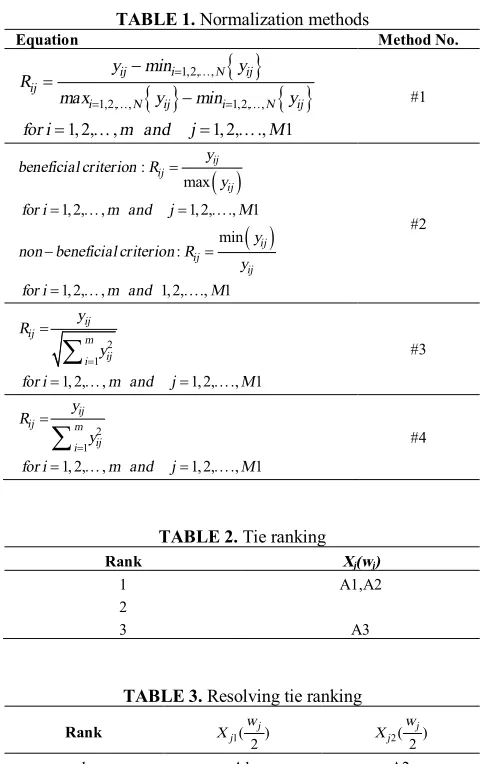
To avoid any scaling problem, it is also suggested to normalize the quantitative performance measures before solving the model. In this regard, Janan and Edwards [34] reviewed the different normalization methods and investigated their applicability on material selection problems. It is worth mentioning that different normalization method may lead to different results in multi criteria decision making procedures. In this paper, different normalization methods and their effects on the final results are investigated while applying the DEA model proposed by Hatefi et al. [32]. Here, the following normalization methods are considered (see Table 1).
3. THE APPLIED AGGREGATION METHOD
The linear assignment method proposed by Jahan et al. [30] has been applied in this paper to aggregate the results produced by different normalization methods for obtaining the final ranking vector. Jahan et al. [30] used this method to aggregate the different results obtained by MADM methods. The linear assignment method consists of the following steps: Step 1- Determine the importance weight of each method that is favorable to be aggregated. In this paper, all normalization methods are assumed to have equal weights of 0.25.
Step 2- Calculate the weighted number of times a rank k is allocated to each alternative by considering the
n attributes. It results in the matrix f where element fij
indicates the contribution of ith alternative assigned the
jth overall rank. It should be mentioned that tied ranking is not acceptable. In the tied situations, the solution is using the weights of attributes as follows (see Table 2) [30]. As can be seen from Table 2, the first and second alternatives are allocated to the first rank. So, as Table 3 shows, the attribute Xj with the weight wj is divided into
two attributes each of which has the weight
2
j
w (see Table 3).
TABLE 1. Normalization methods
Equation Method No.
{ }
{ }
1,2, ,{ }
1,2, , 1,2, ,
1, 2, , 1, 2, ., 1
ij i N ij
ij
i N ij i N ij
y min y
R
max y min y
for i m and j M
= ¼ = ¼ = ¼
-=
-= ¼ = ¼
#1
( )
( )
:
max 1, 2, , 1, 2, ., 1
min
:
1, 2, , 1 , 2, ., 1 ij ij ij ij ij ij y beneficial criterion R
y for i m and j M
y non beneficial criterion R
y for i m and M
=
= ¼ = ¼
- =
= ¼ ¼
#2
2 1
1, 2, , 1, 2, ., 1 ij ij m ij i y R y
for i m and j M =
=
= ¼ = ¼
å
#32 1
1, 2, , 1, 2, ., 1 ij ij m ij i y R y
for i m and j M =
=
= ¼ = ¼
å
#4TABLE 2. Tie ranking
Rank Xj(wj)
1 A1,A2
2
3 A3
TABLE 3. Resolving tie ranking
Rank j1(2j)
w
X j2(2j)
w X
1 A1 A2
2 A2 A1
3 A3 A3
Step 3- Solve the following linear programming to assign the appropriate rank to each material:
1
1 1, 2,3, ,
m ij j
N i m
=
= = ¼
å
(12)1
1 1, 2,3, ,
m
ij i
N j m
=
= = ¼
å
(13){0,1} 1, 2,..., 1,2,...,
ij
N Î i= m and j= m (14)
Nij is the decision variable. The Nij=1 signifies that the jth rank is assigned to the ith alternative.
Equation (11) ensures that the maximum value of assigning DMUs to ranks is achieved. Equations (12) and (13) assure that each DMU must be allocated to only one rank and vice versa. Equations (14) define Nij
variables as binary variables.
It is also noted that Jahan. et al. [35] have presented another aggregation method which is so similar to the linear assignment method [30] applied in this paper and one can utilize it as well.
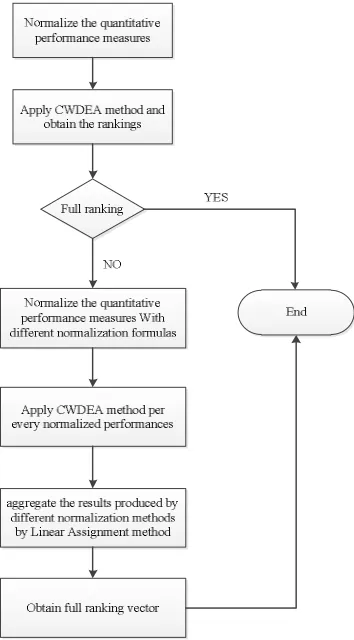
Figure 1 depicts the steps of the proposed methodology in a flowchart.
4. NUMERICAL EXAMPLE
To show the application of common weight DEA model [32] in material selection problem by considering both quantitative and qualitative criteria, a flywheel material selection problem borrowed from the literature has been studied. This example is one of the well-applied test problems in the material selection literature as the results of previous competing methods are available on this example. This is why we are using it for our comparative studies. Jee and Kang [5] performed a material selection problem including ten alternatives and four criteria (Table 4): fatigue limit (σlimit/ρ),
fracture toughness (KIC/ρ), price per mass and the fragment ability. Flywheel is a device for storing the kinetic energy in automobiles, urban subway trains, wind power generators, etc. Athawale et al. [31] illustrated criteria. Higher values for the fatigue limit criterion mean better performance of material and increase the opportunity of the candidate material to be selected as the best choice. Hence, the fatigue limit criterion is a beneficial one. Fracture toughness (KIC/ρ) is the performance measure for failure prior to brittle fracture, and consequently is a beneficial criterion, as well. Price per unit mass is a non-beneficial criterion for which the decision maker prefers lower values. The fourth criterion (fragmentability) signifies that if a flywheel breaks into small pieces, the hazard should be much reduced.According to the previous section, quantitative criteria presented Table 4 should be normalized. In all normalization methods except Norm No.2, Non-beneficial criteria like price/mass should be transformed into beneficial ones and then normalized
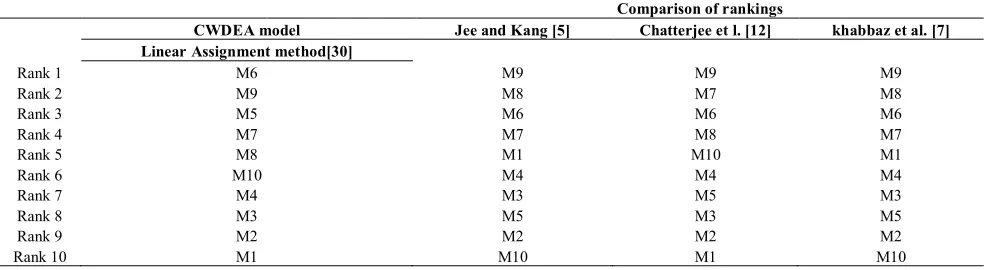
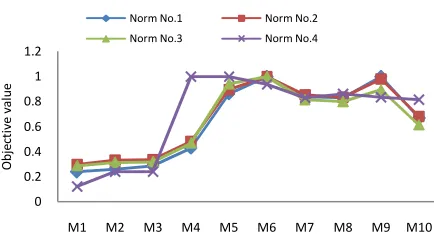
using the normalization methods introduced previously. For instance, the normalized data for the flywheel problem using Norm No.1 formulation is as Table 5.The model for each alternative is provided and solved by the Hatefi et al. model [32]. The efficiencies of each DMU using different normalization methods are indicated in Table 6.It can be concluded that the DEA model proposed by Hatefi et al. [32] is not capable of obtaining a full ranking when using the normalization methods No. 1 and No. 4. However, it is crucial to obtain a full ranking vector. For this purpose, the first example is solved by other normalization methods introduced in section 2. Then, the linear assignment method [30] is applied to aggregate the ranking vectors to obtain the final and full ranking vector. To apply linear assignment method, the weights of results obtained by different normalization methods are assumed to be equal. Thus, the weight of each result produced by each normalization method is equal to 0.25. Eventually, the final ranking vector is compared with final ranking vectors provided in the literature as Table 7.In addition, the graphical objective value for each material using different normalization methods is shown in Figure 2.
TABLE 4. Flywheel material selection problem
Alternatives Name σlimit/ρ KIC/ρ Price/Mass Fragmentability
M1 300 M 100 8.61 4200 Poor
M2 2024-T3 49.65 13.47 2100 Poor
M3 7050-T73651 78.01 12.55 2100 Poor
M4 Ti-6Al-4V 108.8826 10 500 Poor
M5 E glass-epoxy FRP 70 10 2735 Excellent
M6 S glass-epoxy FRP 165 25 4095 Excellent
M7 Carbon-epoxy FRP 440.25 22.01 35470 Fairly good
M8 Kevlar 29-epoxy FRP 242.86 28.57 11000 Fairly good
M9 Kevlar 49-epoxy FRP 616.44 34.25 25000 Fairly good
M10 Boron-epoxy FRP 500 23 315000 Good
TABLE 5. Normalized data under first normalization method
σlimit/ρ (Normalized) KIC/ρ (Normalized) 1
price ( )
1
price
Normalized Fragmentability
0.08883361 0.00000000 0.00023810 0.11764706 Poor
0.00000000 0.18954758 0.00047619 0.23688394 Poor
0.05003617 0.15366615 0.00047619 0.23688394 Poor
0.10450537 0.05421217 0.00200000 1.00000000 Poor
0.03590395 0.05421217 0.00036563 0.18151618 Excellent
0.20351453 0.63923557 0.00024420 0.12070441 Excellent
0.68914413 0.52262090 0.00002819 0.01252901 Fairly good
0.34088463 0.77847114 0.00009091 0.04393699 Fairly good
1.00000000 1.00000000 0.00004000 0.01844197 Fairly good
0.79456236 0.56123245 0.00000317 0.00000000 Good
TABLE 6. Efficiencies when different normalization method are applied
Alternatives The CWDEA linear programming method
Method No.1 Method No.2 Method No.3 Method No.4
M1 0.2402699 0.2993656 0.2881920 0.1211235
M2 0.2604782 0.3343817 0.3165893 0.2398931
M3 0.2870555 0.3381212 0.3198128 0.2398927
M4 0.4301561 0.4821860 0.4686355 1
M5 0.8624233 0.8962148 0.9416813 1
M6 1 1 1 0.9394364
M7 0.8401554 0.8537456 0.8151971 0.8293348
M8 0.8295986 0.8347357 0.7S994671 0.8606222
M9 1 0.9805305 0.8954803 0.8352317
M10 0.6686926 0.6805568 0.6148430 0.8145044
TABLE 7.Comparative results with previous methods
Comparison of rankings
CWDEA model Jee and Kang [5] Chatterjee et l. [12] khabbaz et al. [7] Linear Assignment method[30]
Rank 1 M6 M9 M9 M9
Rank 2 M9 M8 M7 M8
Rank 3 M5 M6 M6 M6
Rank 4 M7 M7 M8 M7
Rank 5 M8 M1 M10 M1
Rank 6 M10 M4 M4 M4
Rank 7 M4 M3 M5 M3
Rank 8 M3 M5 M3 M5
Rank 9 M2 M2 M2 M2
Figure 2. Comparison of objective values under different normalization methods
5. DISCUSSION
The flywheel example contains both qualitative and quantitative criteria. For measuring the DMU performances, qualitative criteria should be quantified first. One of the common methods to quantify the qualitative criteria is the Likert spectrum which scores linguistic expressions in the numeric scale of 1 to 9. While the applied CWDEA in this paper does not need any quantification of qualitative criteria as it computes their scores by the mathematical model. Thus, the main superiority of CWDEA method is treating the qualitative criteria in a more precise manner than the Likert scale.
Also, the previous methods included in Table 7use the Likert scale which is not as precise as the CWDEA method when quantifying the qualitative criteria. Therefore, it is expected to obtain different rankings with other MADM methods. For instance, M9 is ranked first when using the first normalization technique, which shows the applied CWDEA method is compatible with past techniques' results. However, when the problem is solved with other normalization techniques, different rankings are obtained in which M9 does not always occupy the first rank. So, we aggregated the results produced by different normalization methods to obtain the final ranking vector by which M6 is known as the first rank.
6. CONCLUSION
Material selection is a challenging issue in manufacturing organizations especially in the product design process. Choosing the appropriate material from a large group of alternatives in the presence of different properties, advantages and disadvantages for each alternative makes the decision making process a difficult task especially when considering qualitative criteria. Majority of the previous researchers have dealt with the material selection problems by using the Likert
scale to transform qualitative criteria performances into the quantitative equivalents. Nevertheless, the importance of quantifying the qualitative performance measures is well recognized in the decision-making processes. In this paper, the common weight DEA (CWDEA) model proposed by Hatefi et al. [32] is applied to the material selection problem while accounting for both quantitative and qualitative criteria. The DEA model applied in this paper performs more accurately than the previous MADM methods in evaluating the efficiency of each DMU, especially in the presence of qualitative criteria [32]. For constructing the DEA model, performance measures should be normalized for each criterion to avoid scaling problem. A numerical example selected from the literature, (i.e. the flywheel material selection [5])is used to test the efficiency and effectiveness of the proposed model. Rankings are obtained by solving the DEA models, but some normalization methods are not able to produce full ranking vectors. Hence, CWDEA models are solved again by other normalization methods introduced in section (2) and the results of different normalization methods are aggregated using the Linear Assignment method [30] to obtain a full ranking vector for each example. Comparative results with previous models demonstrate the applicability and usefulness of the proposed approach in the context of material selection.
7. REFERENCES
1. Edwards, K., "Selecting materials for optimum use in engineering components", Materials & Design, Vol. 26, No. 5, (2005), 469-473.
2. Deng, Y.-M. and Edwards, K., "The role of materials identification and selection in engineering design", Materials & Design, Vol. 28, No. 1, (2007), 131-139.
3. Rao, R.V. and Davim, J., "A decision-making framework model for material selection using a combined multiple attribute decision-making method", The International Journal of Advanced Manufacturing Technology, Vol. 35, No. 7-8, (2008), 751-760.
4. Ramanathan, R., "Abc inventory classification with multiple-criteria using weighted linear optimization", Computers & Operations Research, Vol. 33, No. 3, (2006), 695-700. 5. Jee, D.-H. and Kang, K.-J., "A method for optimal material
selection aided with decision making theory", Materials & Design, Vol. 21, No. 3, (2000), 199-206.
6. Shanian, A. and Savadogo, O., "Topsis multiple-criteria decision support analysis for material selection of metallic bipolar plates for polymer electrolyte fuel cell", Journal of Power Sources, Vol. 159, No. 2, (2006), 1095-1104.
7. Kaboli, A., Aryanezhad, M., Shahanaghi, K. and Tavakkoli-Moghaddam, R., "A holistic approach based on mcdm for solving location problems", International Journal of Engineering Transactions A Basics, Vol. 20, No. 3, (2007), 251-261.
8. Mousavi, S., Makoui, A., Raissi, S. and Mojtahedi, S., "A multi-criteria decision-making approach with interval numbers for
0 0.2 0.4 0.6 0.8 1 1.2
M1 M2 M3 M4 M5 M6 M7 M8 M9 M10
Ob
je
cti
ve
v
al
ue
Norm No.1 Norm No.2
evaluating project risk responses", International Journal of Engineering-Transactions B: Applications, Vol. 25, No. 2, (2012), 121-130.
9. Jahan, A., Bahraminasab, M. and Edwards, K., "A target-based normalization technique for materials selection", Materials & Design, Vol. 35, No., (2012), 647-654.
10. Jahan, A., Mustapha, F., Ismail, M.Y., Sapuan, S. and Bahraminasab, M., "A comprehensive vikor method for material selection", Materials & Design, Vol. 32, No. 3, (2011), 1215-1221.
11. Tavakkoli-Moghaddam, R., Heydar, M. and Mousavi, S., "An integrated ahp-vikor methodology for plant location selection",
International Journal of Engineering-Transactions B: Applications, Vol. 24, No. 2, (2011), 127.
12. Chatterjee, P., Athawale, V.M. and Chakraborty, S., "Selection of materials using compromise ranking and outranking methods", Materials & Design, Vol. 30, No. 10, (2009), 4043-4053.
13. Khabbaz, R.S., Manshadi, B.D., Abedian, A. and Mahmudi, R., "A simplified fuzzy logic approach for materials selection in mechanical engineering design", Materials & Design, Vol. 30, No. 3, (2009), 687-697.
14. Milani, A. and Shanian, A., "Gear material selection with uncertain and incomplete data. Material performance indices and decision aid model", International Journal of Mechanics and Materials in Design, Vol. 3, No. 3, (2006), 209-222.
15. Shanian, A. and Savadogo, O., "A non-compensatory compromised solution for material selection of bipolar plates for polymer electrolyte membrane fuel cell (PEMFC) using electre iv", Electrochimica Acta, Vol. 51, No. 25, (2006), 5307-5315. 16. Jiao, Q., Lan, Y., Guan, Z. and Li, Z., "A new material selection
approach using promethee method", in Electronic and Mechanical Engineering and Information Technology (EMEIT), International Conference on, IEEE. Vol. 6, (2011), 2950-2954. 17. Chan, J.W. and Tong, T.K., "Multi-criteria material selections
and end-of-life product strategy: Grey relational analysis approach", Materials & Design, Vol. 28, No. 5, (2007), 1539-1546.
18. Milani, A., Shanian, A., Lynam, C. and Scarinci, T., "An application of the analytic network process in multiple criteria material selection", Materials & Design, Vol. 44, (2013), 622-632.
19. Milani, A., Shanian, A., Madoliat, R. and Nemes, J., "The effect of normalization norms in multiple attribute decision making models: A case study in gear material selection", Structural and Multidisciplinary Optimization, Vol. 29, No. 4, (2005), 312-318.
20. Chatterjee, P. and Chakraborty, S., "Material selection using preferential ranking methods", Materials & Design, Vol. 35, (2012), 384-393.
21. Chatterjee, P., Athawale, V.M. and Chakraborty, S., "Materials selection using complex proportional assessment and evaluation of mixed data methods", Materials & Design, Vol. 32, No. 2, (2011), 851-860.
22. Maniya, K. and Bhatt, M., "A selection of material using a novel type decision-making method: Preference selection index method", Materials & Design, Vol. 31, No. 4, (2010), 1785-1789.
23. Mayyas, A., Shen, Q., Mayyas, A., Shan, D., Qattawi, A. and Omar, M., "Using quality function deployment and analytical hierarchy process for material selection of body-in-white",
Materials & Design, Vol. 32, No. 5, (2011), 2771-2782. 24. Cavallini, C., Giorgetti, A., Citti, P. and Nicolaie, F., "Integral
aided method for material selection based on quality function deployment and comprehensive vikor algorithm", Materials & Design, Vol. 47, (2013), 27-34.
25. Yang, S. and Ju, Y., "A novel multiple attribute material selection approach with uncertain membership linguistic information", Materials & Design, Vol. 63, (2014), 664-671. 26. Liu, H.-C., You, J.-X., Zhen, L. and Fan, X.-J., "A novel hybrid
multiple criteria decision making model for material selection with target-based criteria", Materials & Design, Vol. 60, (2014), 380-390.
27. Liu, H.-C., Liu, L. and Wu, J., "Material selection using an interval 2-tuple linguistic vikor method considering subjective and objective weights", Materials & Design, Vol. 52, No., (2013), 158-167.
28. Peng, A.-H. and Xiao, X.-M., "Material selection using promethee combined with analytic network process under hybrid environment", Materials & Design, Vol. 47, (2013), 643-652. 29. Anojkumar, L., Ilangkumaran, M. and Sasirekha, V.,
"Comparative analysis of mcdm methods for pipe material selection in sugar industry", Expert Systems with Applications, Vol. 41, No. 6, (2014), 2964-2980.
30. Jahan, A., Ismail, M.Y., Mustapha, F. and Sapuan, S.M., "Material selection based on ordinal data", Materials & Design, Vol. 31, No. 7, (2010), 3180-3187.
31. Athawale, V.M., Kumar, R. and Chakraborty, S., "Decision making for material selection using the uta method", The International Journal of Advanced Manufacturing Technology, Vol. 57, No. 1-4, (2011), 11-22.
32. Hatefi, S., Torabi, S. and Bagheri, P., "Multi-criteria abc inventory classification with mixed quantitative and qualitative criteria", International Journal of Production Research, Vol. 52, No. 3, (2014), 776-786.
33. Cook, W.D., Kress, M. and Seiford, L.M., "Data envelopment analysis in the presence of both quantitative and qualitative factors", Journal of the Operational Research Society, , (1996), 945-953.
34. Jahan, A. and Edwards, K.L., "A state-of-the-art survey on the influence of normalization techniques in ranking: Improving the materials selection process in engineering design", Materials & Design, Vol. 65, (2015), 335-342.
A Common Weight Data Envelopment Analysis Approach for Material Selection
S. A. Torabi, I. Shokr
School of Industrial Engineering, College of Engineering, University of Tehran, Tehran, Iran
P A P E R I N F O
Paper history:
Received 04 February 2015 Received in revised form 04 May 2015 Accepted 11 June 2015
Keywords: Material Selection Manufacturing Systems Data Envelopment Analysis (DEA) Multi-criteria Decision Making (MCDM)
ﺪﯿﮑﭼ ه
ﻟواداﻮﻣبﺎﺨﺘﻧا ﻪﯿ
ﺐﺳﺎﻨﻣ ﯽﮑﯾ ﮕﻧاﺮﺑﺶﻟﺎﭼﻞﺋﺎﺴﻣزا ﺰﯿ ﺳرد ﻢﺘﺴﯿ يﺎﻫ ﻟﻮﺗ يﺪﯿ ﺖﺳا .
ﻟواداﻮﻣﺐﺳﺎﻨﻣﺎﻧبﺎﺨﺘﻧا ﻪﯿ
ﻣ ﯽ ﺪﻧاﻮﺗ ﺚﻋﺎﺑ
آﺮﻓردﺖﺴﮑﺷ يﺎﻫﺪﻨﯾ
ﻟﻮﺗ يﺪﯿ ﺗﺎﻌﺒﺗوهﺪﺷ ﯽ ﺰﻫنﻮﭽﻤﻫ ﻪﻨﯾ ﻟﻮﺗندﻮﺑﺮﺑ ﺪﯿ ﺎﺿرﺎﻧو ﯽﺘﯾ ﻪﺘﺷادهاﺮﻤﻫﻪﺑارنﺎﮔﺪﻨﻨﮐفﺮﺼﻣ ﺪﺷﺎﺑ
.
ﺮﻫ ﮏﯾ ﻟواداﻮﻣزا ﻪﯿ ﺻﻮﺼﺧ تﺎﯿ ﻣ ﯽﻔﻠﺘﺨ ﺎﺑﻪﮐﺪﻧراد ﺪﯾ ﺮﺘﻬﺑبﺎﺨﺘﻧامﺎﮕﻨﻫرد ﻦﯾ
ﻟواهدﺎﻣ ﻪﯿ ﮔراﺮﻗﺮﻈﻧﺪﻣ ﺪﻧﺮﯿ . ﺧﺮﺑ ﯽ ازا ﻦﯾ ﻌﻣ ﺎﻫرﺎﯿ ﮐ ﯽﻔﯿ و ﺮﮕﯾدﯽﺧﺮﺑ ﻤﮐ ﯽ ﺪﻨﺘﺴﻫ . ﻌﺗ ﻦﯿﯿ ﻤﮐلدﺎﻌﻣ ﯽ اﺮﺑﺐﺳﺎﻨﻣ ي ﻌﻣ يﺎﻫرﺎﯿ ﮐ ﯽﻔﯿ ﺶﻟﺎﭼزاهراﻮﻤﻫ ﺎﻫ ي ﻠﺻا ﯽ ﺑرد ﻪ ﮔرﺎﮐ يﺮﯿ نﻮﻨﻓ ﻤﺼﺗ ﻢﯿ يﺮﯿﮔ ﻌﻣﺪﻨﭼ هرﺎﯿ ﺖﺳاهدﻮﺑ . ارد ﻦﯾ زاﻪﻟﺎﻘﻣ ﮏﯾ شور ﻞﯿﻠﺤﺗ ﺸﺷﻮﭘ ﯽ هداد نازواﺎﺑﺎﻫ نﺎﺴﮑﯾ ﺮﻈﻧردﺎﺑ
ﻢﻫﻦﺘﻓﺮﮔ ﻌﻣنﺎﻣز يﺎﻫرﺎﯿ ﮐ ﯽﻔﯿ ﻤﮐو ﯽ ﻟواداﻮﻣبﺎﺨﺘﻧاﻪﻠﺌﺴﻣرد ﻪﯿ
ﺖﺳاهﺪﺷ هدﺎﻔﺘﺳاﺐﺳﺎﻨﻣ
. ﻨﭽﻤﻫ ﻦﯿ ﺮﻃزا ﻖﯾ ﮏﯾ لﺎﺜﻣ دﺪﻋ ي اﻪﮐﺖﺳاهﺪﺷهدادنﺎﺸﻧ ﻦﯾ
ﻪﺒﺗرﻪﺋاراﻪﺑردﺎﻗهراﻮﻤﻫشور ﺪﻨﺑ ي ﻠﻣﺎﮐ ﯽ ﺰﮔزا ﻪﻨﯾ ﺎﻫ ﻧ ﺖﺴﯿ . اﺮﺑاﺬﻟ ي اﺮﺑﻪﺒﻠﻏ ﻦﯾ ،ﻞﮑﺸﻣ
شورزاهدﺎﻔﺘﺳاﺎﺑﻪﻠﺌﺴﻣ ﺎﻫ
ي لﺎﻣﺮﻧ زﺎﺳ ي زاهدﺎﻔﺘﺳاﺎﺑﺎﻬﺘﻧاردوهﺪﺷﻞﺣرﻮﮐﺬﻣشورﻂﺳﻮﺗﻒﻠﺘﺨﻣ ﮏﯾ مﺎﻏداشور زﺎﺳ ي ﺘﺒﻣ ﻨ ﯽ ﻪﻣﺎﻧﺮﺑﺮﺑ ر يﺰﯾ ﻄﺧ ﮏﯾ،ﯽ ﻪﺒﺗر ﺪﻨﺑ ي ﺑﻞﻣﺎﮐ ﻪ ﺖﺳاهﺪﻣآﺖﺳد
..