Prepared by David R. Jackson, forest resources educator, and James C. Finley, professor of forest resources.
Photo Credits
David Jackson, forest resources educa-tor (all photos except those listed below)
Howard Nuernberger, former photog-rapher, Penn State (photos 8, 9, 10, 18, 21, 22, 23, 24, 25, 26, 28, 29, 30, and 36)
Mitchell Blair, vegetation management research specialist, Department of Plant and Soil Sciences, University of Ken-tucky (photo 20)
Todd Hagenbuch, vegetation manage-ment specialist, Arborchem Products (photos 3, 13, and 31)
Mark Rice, area sales manager, Bayer Environmental Science (photo 19)
Barry Rose, forester, Forest Regenera-tion Services (photo 34)
Mike Santucci, assistant director of for-estland conservation, Virginia Depart-ment of Forestry (photo 35)
extension.psu.edu
Penn State College of Agricultural Sciences research and extension programs are funded in part by Pennsylvania counties, the Com-monwealth of Pennsylvania, and the U.S. Department of Agriculture.
Where trade names appear, no discrimina-tion is intended, and no endorsement by the Penn State College of Agricultural Sciences is implied.
This publication is available in alternative media on request.
The University is committed to equal access to programs, facilities, admission, and employ-ment for all persons. It is the policy of the University to maintain an environment free of harassment and free of discrimination against any person because of age, race, color, ancestry, national origin, religion, creed, service in the uniformed services (as defined in state and fed-eral law), veteran status, sex, sexual orientation, marital or family status, pregnancy, pregnancy-related conditions, physical or mental disability, gender, perceived gender, gender identity, genetic information, or political ideas. Dis-criminatory conduct and harassment, as well as sexual misconduct and relationship violence, violates the dignity of individuals, impedes the realization of the University’s educational mission, and will not be tolerated. Direct all in-quiries regarding the nondiscrimination policy to Dr. Kenneth Lehrman III, Vice Provost for Affirmative Action, Affirmative Action Office, The Pennsylvania State University, 328 Boucke Building, University Park, PA 16802-5901; Email: [email protected]; Tel 814-863-0471.
Produced by Ag Communications and Marketing
© The Pennsylvania State University 2016
There are a number of ways to manage vegetation: manual, mechanical, biolog-ical, cultural, and chemical. Integrated vegetation management (IVM) uses a combination of these approaches. This publication examines the use of herbi-cides to manage forest vegetation and provides information to address some misconceptions concerning herbicide use in forests. Forestry labeled herbi-cides are effective and environmentally sound; however, their use remains con-troversial. Out of necessity, forest land-owners and resource managers increas-ingly turn to herbicides for vegetation management.
Many factors are increasing the need for vegetation management using herbi-cides. These factors include vegetation interfering with forest regeneration, poorly planned and executed timber harvesting practices, declining pulp-wood markets, and increasing abun-dance of invasive plant species. Let us briefly examine each of these factors.
1. Dense shade cast by ferns interferes with seedling survival and establish-ment after germination. Excessive frond litter and root mats can also prevent adequate seedling germination and development.
4 5
Interfering vegetation consists of plants that inhibit the germination and growth of seedlings by casting dense shade on the forest floor. Interfering plants ben-efit from specific light conditions and selective browsing preferences by deer that remove or reduce native plants and provide growing space for more com-petitive species.
Poorly planned and executed timber harvests, known as “high grading,” leave behind trees with low commercial value. This has resulted in a shift toward less desirable tree species and poorer quality trees in our woodlots. With declining markets for small diameter trees, many overstocked stands that would benefit from thinning are not receiving treat-ment. Thinning improves tree growth and insect and disease resistance. Lastly, the increasing abundance of invasive plants directly influences the ability of forests to retain native plant and wildlife diversity. Herbicides, when properly ap-plied, can address all these issues safely, efficiently, and economically.
Herbicides are a proven safe and effec-tive method for managing forest vegeta-tion and are appropriate for achieving many objectives, including regeneration establishment, increased timber produc-tion, enhanced wildlife habitat, non- native plant control, and road and facility maintenance. When properly applied, herbicides can increase prop-erty value, productivity, aesthetics, and utility. However, understand that choices exist. A well-developed and im-plemented integrated pest management plan will include alternative vegetation control approaches with and without the use of herbicides. This publication will help you identify the most efficient, environmentally sound, and cost- effective solution for addressing your forest vegetation management needs.
2. Poorly executed timber harvests often leave behind trees of low commercial value.
4. Grasses can reduce regeneration potential by casting heavy shade and providing cover for seed-eating small mammals.
6 7
No single herbicide, rate, or application method works for all vegetation man-agement needs. Each situation requires advanced assessment to ensure that the lowest risk, most efficient, and most cost-effective control program is cho-sen. For a given situation the soil type, plant species, density, and size affect the herbicide prescription. Additional factors such as time of year and weather conditions are important because they affect plant growth, herbicide uptake, and translocation.
Herbicide summaries are available on the Penn State Extension Forest
Vegeta-tion Management Website (extension
.psu.edu/natural-resources/forests/ vegetation-management). The summa-ries will help you quickly compare her-bicides commonly used in forestry and registered for use in Pennsylvania. They convey key points from the product label and allow you to select those prod-ucts best suited to your situation. Always carefully read and follow the product label directions, precautions, and restric-tions before applying any pesticide.
The first consideration when select-ing an herbicide is the target plant’s location. Some examples of sites are
Choosing the Right Forestry Herbicide and
Application Method
Applicators of restricted use products must be certified and have a level of competence to ensure proper handling and application.
rights-of-way, wildlife openings, forests, wetlands, and industrial sites. The prod-uct label lists currently labeled sites. Applying a pesticide to a site not listed on the label is illegal.
The Environmental Protection Agency (EPA) approves pesticide use and establishes restrictions. Only certified applicators can apply “restricted use” pesticides. Restricted use pesticides have a prominently displayed statement on the product label (see “Specimen Label” below). The restricted use statement indicates the specific hazard of that pes-ticide. For example, a product may be harmful to humans, livestock, wildlife, or the environment. Other reasons for restricted use labeling include toxicity to non-target plants at low concentrations, posing a ground or surface water hazard, or having the potential to move off site.
Pesticides not containing the restricted use statement are referred to as “gen-eral use.” Gen“gen-eral use pesticides do not
require applicator certification as long as the product is applied to property owned or rented by the applicator or their employer. Virtually all forest vegetation control involves the application of gen-eral use herbicides. This provides forest landowners an opportunity to address vegetation management needs on their own properties without becoming certi-fied. Herbicide handling and use carries with it the responsibility to read, under-stand, and follow label directions.
Always consider product selectivity when choosing an appropriate herbi-cide. Selectivity refers to the resistance various classes of plants have to an herbicide. This will ensure that targeted species can be controlled by the chosen product. For example, some herbi-cides only control broadleaf weeds and woody vegetation and will not control grasses. Some herbicides are so selective that they can be applied directly over nontarget plants. On the other hand, broad-spectrum herbicides are non-
selective. Broad-spectrum herbicides can control all classes of plants. To protect nontarget plants, exercise care when applying these types of products.
Herbicide activity is an important con-sideration when selecting a product. Activity refers to how the product enters the plant—whether through the foliage, stem, or roots. Some herbicides have more than one type of activity. When treating vegetation in the forest under-story, be sure the product will not affect the overstory trees through soil activity.
The size and number of stems, number of acres, and time of year will influence your application method choice (see “Forest Herbicide Application Methods” on page 8). For example, if trees to be controlled are greater than 8 inches in diameter, a frill girdle or stem injection application method is appropriate. If the site contains 40 acres of fern in the understory, a ground foliar broadcast treatment using mechanization such as a skidder-mounted mist blower is the most appropriate application method.
The product label is your best source for application methods, rate informa-tion, and time of year. Be sure to select the application method that will use the least amount of product to control targeted plants.
Before applying any herbicide, it is important to properly calibrate equip-ment. A calibration check will show the amount of product applied under given field conditions and involves making a trial run over a known area and mea-suring the amount of material applied. By adjusting equipment to control application volume or chemical con-centration the proper rate is obtained. Calibration is important because
l applying herbicide at rate greater
than labeled is illegal;
l nozzles and other equipment settings
may vary depending on operating conditions;
l cost-effective applications need to be
8 9
Frill Applications (Hack and Squirt)
Use a hatchet or similar device to make frill or cut at a downward angle at proper spacing, following label recommenda-tions. Cuts should penetrate through the bark into the living tissue or sapwood (the outer area of lighter-colored wood in the stem cross section) and produce a cupping effect to hold herbicide. Spray measured quantity into cuts using a squirt bottle. Do not allow material to run out of cut. Not recommended for use during periods of heavy sap flow.
Uses
Generally used to control individual trees greater than 5 inches in diameter.
Stem Injection
Use a hatchet or lance-type tree injector calibrated to deliver the proper amount of herbicide with each blow. Follow-ing label recommendations, penetrate through the bark into the living tissue or sapwood (the outer area of lighter-col-ored wood in the stem cross section) at properly spaced intervals. Not recom-mended for use during periods of heavy sap flow.
Uses
Generally used to control individual trees greater than 5 inches in diameter.
Forest Herbicide Application Methods —Cut Surface Treatments
7. Hatchet, with ground down bit, and spray bottle for hack and squirt applications.
8. Make cuplike incisions at angle, to hold herbicide, spaced evenly around tree.
9. Hypo-hatchet blade showing
injec-tor port. 10. Hypo-hatchet injects calibrated volume with each blow.
11. The E-Z Ject lance injects
Forest Herbicide Application Methods —Cut Surface Treatments
Cut Stump
For water-soluble herbicide mixtures, spray or paint the living tissue or sap-wood (the outer area of lighter-colored wood in the stem cross section) of stumps immediately after cutting. If using an oil-soluble mixture, treatments can be applied to stumps up to 1 month following cutting. In this case, spray the sides of the stump to the root collar and the sapwood around the entire circum-ference of the cut surface until thorough-ly wet, but not to the point of runoff.
Uses
Used to control resprouting of hard-wood stumps.
13. Treat only the living tissue or
sap-wood area of large stumps. 14. For small stumps, treat the entire surface.
Forest Herbicide Application Methods —Stem
Basal Bark
Using a low-pressure backpack sprayer, thoroughly wet the lower 12 to 15 inches of the stem completely around tree, including the root collar area. Do not spray to the point of runoff.
Uses
Generally used to control thin-barked trees when they are less than 6 inches in diameter at the base.
16. For small trees, spray from ground line to a height of 12 to 15 inches. 15. Basal bark treatments use an oil
carrier to penetrate the bark.
10 11
Foliar Spray
Using aerial or ground spray application equipment such as a helicopter, skid-der, or backpack sprayer, mist herbicide mixture onto the foliage of targeted plants. Direct the spray to evenly cover plant foliage. Do not spray to the point of runoff.
Uses
Used to control many woody plants, herbaceous weeds, ferns, grasses, and vines.
17. Use a backpack sprayer to mist spray evenly over plants.
18. Mechanical air-blast sprayer treats understory vegetation up to 20 feet in height.
20. Spot spray mix to soil around plant base.
19. Spotgun dispenses measured volume with each trigger pull.
Forest Herbicide Application Methods —Foliage
Forest Herbicide Application Methods —Soil
Basal Soil
Using an exact-delivery spotgun appli-cator, direct the spray at the soil within 2 to 3 feet of the target plant root collar, or in a grid pattern across the entire treatment area. The square grid pattern can range from 3 to 6 feet between soil application spots.
Uses
Many people believe that any product referred to as a “pesticide” is highly toxic and unsafe at any application rate. This is simply not the case for forestry herbicides. Research and development have produced effective, low risk, and environmentally friendly products when applied and used according to the label. Active ingredients used in forestry have passed rigorous EPA testing for toxicity and environmental fate.
Toxicity refers to a product’s abil-ity to cause injury or illness to living organisms. A pesticide’s acute toxicity is the basis for assigning its toxicity category. Acute toxicity is based on a single, short-term exposure by one of three routes—swallowing (ingestion), breathing (inhalation), or through the skin (dermal). Acute toxicity is usually expressed as LD50 (lethal dose 50). This is the amount of the product lethal by ingestion to 50 percent of a popula-tion of test animals (usually rats) under laboratory conditions. LD50 values are expressed in milligrams of pesticide per kilogram of body weight (mg/kg). The larger the LD50 value, the less toxic the chemical.
The LD50, or acute toxicity value, is the basis for assigning the signal word (see Table 1, page 12). Signal words must appear in large letters on the front panel of every pesticide label. They are “Caution,” “Warning,” “Danger,” or “Danger-Poison” with skull and cross-bones. The designation indicates the rel-ative acute toxicity to humans and other animals. Signal words allow the user to quickly assess the acute toxicity rating. They also assist the user in selecting the least toxic product that will provide the desired level of plant control.
Forestry Herbicide Toxicity
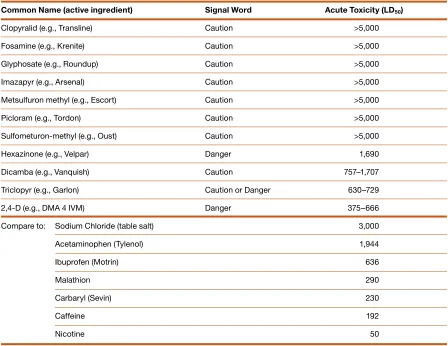
Table 2, page 12, provides the signal words and acute oral toxicity values for many commonly used forestry herbicide active ingredients. To provide a basis for comparison of relative acute toxicity, the table includes LD50 values for com-monly used products such as table salt and caffeine.
12 13 Table 1. Signal Words and Symbols.
By law, every pesticide label must include a signal word. The signal word gives the user an immediate indication of the product’s acute toxicity to humans and animals. The signal word is found on the front panel of the product label along with the statement “Keep Out of Reach of Children.” Signal words allow the user to select the least toxic chemical that will provide the desired control level.
Caution Product is slightly toxic or practically nontoxic either orally, dermally, or through inhalation; or it causes slight eye or skin irritation. Acute oral LD50 values are greater than 500 mg/kg.
Warning Product is moderately toxic either orally, dermally, or through inhalation; or it may cause moderate eye and skin irritation. Acute oral LD50 values range from 50 to 500 mg/kg.
Danger Without the skull and crossbones symbol, this word is used on products that cause severe skin irritation or eye damage, more so than what the acute oral LD50 might suggest.
Danger-Poison (skull and crossbones) Displayed with a prominent skull and crossbones to indicate that the product is highly toxic based on either oral, dermal, or inhalation toxicity. Acute oral LD50 values range from a trace to 50 mg/kg.
Note: LD50 is the quantity or dose of a chemical lethal to 50 percent of test animals under laboratory conditions. It is expressed in milligrams (mg) of chemical per unit of
body weight, expressed in kilograms (kg).
Source: Hock, W. K., ed. 1996. Pesticide Education Manual: A Guide to Safe Use and Handling. 3rd ed. University Park, Pa.: The Pennsylvania State University.
Table 2. Relative Toxicity of Common Forestry Herbicides.
Common Name (active ingredient) Signal Word Acute Toxicity (LD50)
Clopyralid (e.g., Transline) Caution >5,000
Fosamine (e.g., Krenite) Caution >5,000
Glyphosate (e.g., Roundup) Caution >5,000
Imazapyr (e.g., Arsenal) Caution >5,000
Metsulfuron methyl (e.g., Escort) Caution >5,000
Picloram (e.g., Tordon) Caution >5,000
Sulfometuron-methyl (e.g., Oust) Caution >5,000
Hexazinone (e.g., Velpar) Danger 1,690
Dicamba (e.g., Vanquish) Caution 757–1,707
Triclopyr (e.g., Garlon) Caution or Danger 630–729
2,4-D (e.g., DMA 4 IVM) Danger 375–666
Compare to: Sodium Chloride (table salt) 3,000
Acetaminophen (Tylenol) 1,944
Ibuprofen (Motrin) 636
Malathion 290
Carbaryl (Sevin) 230
Caffeine 192
Nicotine 50
Toxicity based on the active ingredient’s oral LD50 value for rats. Actual LD50 values may vary by products depending on percentage of active
ingredient, formulation, and inert ingredients. Be sure to check the Material Safety Data Sheet for the product you are using.
Sources:
Crop Data Management Systems, Inc. (CDMS): www.cdms.net/Home.aspx National Pesticide Information Retrieval System (NPIRS): state.ceris.purdue.edu The Vermont SIRIMSDS Index: hazard.com/msds/index.php
Personal Protective Equipment
Personal protective equipment (PPE) reduces exposure to pesticides. The type of PPE used depends on the product and the type of application. The greatest risk of pesticide exposure occurs when handling concentrates during mix-ing and loadmix-ing. Failmix-ing to follow appropriate safety precautions and application procedures can lead to exposure. Pesticide container labels specify the minimum amount of PPE recommended by the manufacturer. Exceeding the manufacturer’s recommendations for PPE lowers exposure risks.
Always check the label for the required PPE for the product you plan to use.
21. Minimum protection consists of long-sleeved shirt, long pants, shoes, and socks.
22. Some forestry herbicides may require additional PPE including protective eyewear and chemical-resistant gloves.
14 15
All of us need to be concerned about the long-term impacts of our forest management practices and the use of herbicides. After reviewing the chemi-cal properties and product safety, we can draw the conclusion that proper use according to the label may improve for-est productivity and not adversely affect biodiversity. The environmental impacts of forestry herbicide applications are generally minimal1 for the following reasons:
1. Forestry herbicides are applied at very low rates (2 ounces to 2 quarts per acre) and on a very small per-centage of the land annually.
2. Generally, only one application is made over an 80- to 100-year rotation for hardwood regeneration establishment.
3. Forestry herbicides are very low in acute toxicity. Of the 11 active in-gredients listed in Table 2, page 12, LD50 values range from 375 to more than 5,000 mg/kg, classifying them as moderately toxic to practically nontoxic.
4. Essentially all of our vegetation con-trol needs in forestry can be accom-plished through the use of “general use” herbicides. There is little need to use restricted use products.
5. Forestry herbicides do not bioac-cumulate in the food chain. When ingested, these chemicals pass very quickly through the body and are excreted in urine and feces.
Forestry Herbicide Application:
Talking Points
6. Forestry herbicides are biodegradable and do not persist in the environ-ment. All of these chemicals have relatively short half-lives and un-dergo biological decomposition.
7. The potential human health risks from forestry herbicides are negli-gible. They are less hazardous than manual and mechanical methods of vegetation control.
These points provide a strong argument for using forestry herbicides. Despite the relatively low risk to humans, animals, and the environment, practic-ing care and environmental stewardship during application is essential to ensure continued product availability. Re-member to always read and follow the label—it is a legal document.
Forest Stand Improvement
Objective
Remove poorly formed trees and/or un-desirable species from a forest stand to make room for more desirable growing stock. Regulates species composition and improves stand quality.
Herbicide Application Methods Frill Girdle (Hack and Squirt) Stem Injection
Basal Bark Foliar Spray
Silvicultural Objectives and Chemical Control Methods for Forestry
24. Hack and squirt application used to kill undesirable standing tree.
25. Spot treatments control undesir-able understory vegetation.
27. Basal bark applications are ef-fective at removing poorly formed, thin-barked trees.
26. Basal bark treatment to control grape vine (Vitis spp.).
Land managers can use forestry herbicides to increase forest productivity by controlling competing and interfering
vegetation. In general, herbicide applications reduce competition and improve survival and growth. Herbicides can
control herbaceous and woody competing vegetation for natural or artificial regeneration, as well as for timber stand
improvement practices and thinning.
continued on next page
16 17
Precommercial Thinning
Objective
To control stand density and species composition by thinning dense stands of conifers or hardwoods. Increases individual tree growth by reducing stand density-allowing for crown expansion.
Herbicide Application Methods Frill Girdle (Hack and Squirt) Stem Injection
Basal Bark
Site Preparation
Objective
To control preexisting competing herba-ceous and interfering woody vegetation prior to planting or establishing natural regeneration. Creates conditions con-ducive to the establishment and growth of desired species.
Herbicide Application Methods Foliar Spray
Basal Bark Basal Soil
28. Hack and squirt application releases desirable crop trees in hardwood poletimber.
29. Overstocked white pine stand thinned using hack and squirt.
31. Understory vegetation controlled to encourage natural regeneration.
33. Foliar herbicide application removes dense shade cast by hay-scented fern.
Silvicultural Objectives and Chemical Control Methods for Forestry (continued)
30. KMC track skidder with air-blast sprayer treats understory vegetation.
32. Basal bark application elimi-nates competition from undesirable saplings.
Release Operations
Objective
To free young stands of planted or naturally established seedlings from competing or interfering vegetation that threatens to suppress growth. Gives the released trees enough light and growing space to develop.
Herbicide Application Methods Frill Girdle (Hack and Squirt) Stem Injection
Cut Stump Foliar Spray Basal Bark
Invasive Plant Control
Objective
To remove invasive plants that influence the forest’s ability to retain native plant and wildlife diversity. Invasive plants are best controlled early when they are identified and before they have opportu-nities to spread.
Herbicide Application Methods Frill Girdle (Hack and Squirt) Stem Injection
Cut Stump Foliar Spray Basal Bark Basal Soil
34. Pine release using
skidder-mounted air-blast sprayer. 35. Aerial pine release operation with helicopter and support truck.
36. Spot treatments control grass and weed competition around planted seedlings.
37. Dormant season treatments of Japanese stiltgrass release hard-wood seedlings.
38. Foliar spot applications manage
invasive shrubs, like this autumn olive. 39. Basal bark application used to control tree-of-heaven.
Herbicide Summaries
A summary of forestry-labeled herbi-cides registered for use in Pennsylvania is available on the Penn State Extension Forest Vegetation Management Website (extension.psu.edu/natural-resources/
forests/vegetation-management). The site contains informative summaries of herbicides effective at controlling competing vegetation in Northeastern hardwood and coniferous forests.
The following are also provided on the Forest Vegetation Management Website:
l An overview of integrated
vegeta-tion management (IVM) including cultural, mechanical, biological, and chemical control
l An outline of herbicide treatment
guidelines
l A listing of herbicide
manufactur-ers, distributors, and applicators for Pennsylvania
l A table providing herbicides by
application method
l A table listing herbicides commonly
used in forestry by active ingredient with associated product summaries