What will we learn?
Describing wave
What is a wave
How are waves formed
Types of wave motion
Properties of wave motion
Think about it …
Can you give some
examples of
Examples of Waves
Water Waves
Light & Sound Waves
Radio Waves
Micro Waves
Lets do the …..
What have you noticed about
the wave or the
individual?
They are moving up and down
They remain at the same position The wave started from the side
What will we learn?
Describing wave
What is a wave
How are waves formed
Types of wave motion
Properties of wave motion
Menu for this section
Describe wave motion using vibrations in
ropes and springs, or waves in a ripple tank
Understand that waves transfer energy without transferring matter
Compare transverse and longitudinal waves
What is a
Wave
?
A wave is a phenomenon in which
energy
is
transferred through
vibrations
or
oscillations
.
Therefore, all waves transfer energy from
one place to another
without
the transfer of
matter
itself.
A wave is made up of
periodic motion
Let’s do the …
Wave Motion
describing wave motion
The effect of rope waves can be seen by
The rope is the medium through which the wave propagates.
A series of crests and troughs can be seen to pass along the rope.
describing wave motion
Similar effect for water waves (water is the medium through which energy transmits)
a cork on the water surface bobs up and down as the wave passes
it does not travel forward with the wave
How are
Waves
Formed?
The source of any wave is a vibration or oscillation.
It transfers energy from one point to another.
No matter or medium is transferred in the process.
Source
Up-and-down movements produce waves that transfer kinetic energy to the other end of the rope.
How are
Waves
Formed?
How are
Waves
Formed?
How are
Waves
Formed?
Recall …
They are moving up and down
They remain at the same position The wave started from the side
Types of Wave Motion
Transverse
Waves
What do you notice about the
direction of the vibrations
and
the direction of the wave?
Transverse
Waves
Longitudinal
Waves
What do you notice about the
direction of the vibrations
and
the
direction of the wave
?
Transverse Waves Longitudinal Waves
Direction of Vibration Direction of Vibration
Transverse Waves
Direction of Vibration
Transverse Waves
Transverse waves are waves that travel in a
direction perpendicular to the direction of vibration.
one wavelength coil vibrates
up and down when shook up
and down wave moves this way direction of the vibrations
Transverse Waves
Examples
Water waves
Light waves
Longitudinal Waves
Direction of Vibration
Longitudinal Waves
compression is the part where
particles are closest to one another rarefaction is the part where particles are spread apart one wavelength
coil vibrates forward and backward when
pushed in and out
wave moves this way
r c r c r c
Longitudinal Waves
Examples
What will we learn?
Describing wave
What is a wave
How are waves formed
Types of wave motion
Properties of wave motion
Menu for this section
Define the speed, frequency, wavelength,
period and amplitude of waves
State what is meant by the term wavefront
Recall and apply the relationship velocity = frequency × wavelength to solve related
Wave Terms
(Wavefront)
Wavefronts are imaginary lines that
• joins all the peaks of a water wave or • all identical points on a water wave.
• i.e. points that are in the same phase.
Circular wavefronts
finger dipping into water
Wave Terms
(Wavefront)
• Plane waves are produced by touching the water surface with a wooden bar.
• The wavefront of plane waves are straight lines.
• Direction of travel of waves is always perpendicular to the wavefront.
Wave Terms
(Crest and Trough)
Distance along rope displacement
CREST
TROUGH
The peak of a transverse wave
Wave Terms
(Compression and Rarefaction)
Wave Terms
(Amplitude)
Distance along rope displacement
Maximum displacement from the rest or central position
Wave Terms
(Wavelength,
λ
)
Distance along rope displacement
• The distance between two consecutive crests or troughs. • The distance between two identical parts on successive
waves
SI unit : metre (m) Wavelength
λ
Wave Terms
Wave Terms
(Period,
T
)
Time displacement
Time taken to generate one complete wave (or to complete one cycle)
SI unit : seconds (s)
T
Wave Terms
(Frequency,
f
)
• Number of complete waves generated per second • Number of cycles/oscillations per second
SI unit : Hertz (Hz)
Time (s) displacement
1 0.5
Example:
Wave Terms
(Speed,
v
)
• Distance moved by wave in one second
Relationship between
Period (T)
and
Frequency (f)
f
T
1
T
1
f
Relationship between
Speed (v)
,
Frequency (f)
and
Wavelength (
λ
)
T
v
or
f
General
Representation
Graphical Representation of Waves
displacement-position graph
Graphical Representation of Waves
displacement-time graph
What will we learn?
Describing wave
What is a wave
How are waves formed
Types of wave motion
Properties of wave motion
Menu for this section
Describe the effects of refraction, reflection
A wavefront is an imaginary line on a wave that joins all adjacent points that are in phase.
Wave Production and Ripple Tank
The bright and dark lines correspond to the crests and
troughs of the plane waves respectively.
The depth at which the dipper is placed affects the
amplitude of the waves.
The frequency of the waves is determined by the
Refraction
of waves and
Depth
of ripple tank
The wavelength of the plane waves shorten as
they travel from deep to shallow water, i.e. λ2 > λ1.
Using v = ƒλ, the speed of waves is slower at the
shallow water, i.e. v2 < v1
The frequency remains unchanged as it is
Refraction
of waves and
Depth
of ripple tank
Similar to light, when waves enter a region of
shallow water at an angle, the waves will be
Reflection
of Waves
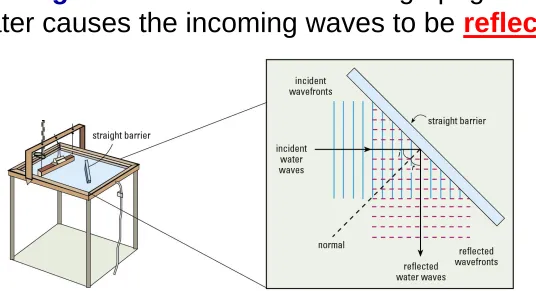
A straight smooth barrier standing upright in the
water causes the incoming waves to be reflected
Figure 13.25 A straight barrier is placed at an angle to the straight dipper. You can see the waves
Let’s try some …
Example 1
A wave has a frequency of 20 Hz. Calculate
the period of the wave.
Period = 1 / Frequency
= 1 / 20
Example 2
The diagram below show how the displacement of a wave
varies with time.
(a) State the period of the wave. ______________ (b) Calculate the frequency of the wave.
Displacement/m
time /s 0.1 0.2 0.3 0.4
0.0
0.2 s
Example 3
A source of frequency 100 Hz emits waves of
wavelength 0.05 m. What is the wave
velocity?
Wave velocity = f x λ
Example 4
Distance / m Displacement / m
5.0 0.4
Time / s Displacement / m
6.0 0.4
Determine
(a) the amplitude, of the wave.
(b) the wavelength, , of the wave. (c) the period, T, of the wave.
(d) the frequency, f, of the wave. (e) the speed, v, of the wave.
0.4 m
5/3 = 1.67 m
6/4 = 1.5 s
1/1.5 = 0.667 Hz