https://doi.org/10.5194/gmd-12-2401-2019 © Author(s) 2019. This work is distributed under the Creative Commons Attribution 4.0 License.
Challenges in developing a global gradient-based
groundwater model (G
3
M v1.0) for the integration
into a global hydrological model
Robert Reinecke1, Laura Foglia2, Steffen Mehl3, Tim Trautmann1, Denise Cáceres1, and Petra Döll1,4
1Institute of Physical Geography, Goethe University Frankfurt, Frankfurt am Main, Germany 2Department of Land, Air and Water Resources, University of California, Davis, CA, USA 3Department of Civil Engineering, California State University, Chico, CA, USA
4Senckenberg Leibniz Biodiversity and Climate Research Centre Frankfurt (SBiK-F), Frankfurt am Main, Germany
Correspondence:Robert Reinecke ([email protected]) Received: 2 May 2018 – Discussion started: 15 May 2018
Revised: 20 May 2019 – Accepted: 29 May 2019 – Published: 18 June 2019
Abstract.In global hydrological models, groundwater (GW) is typically represented by a bucket-like linear groundwater reservoir. Reservoir models, however, (1) can only simulate GW discharge to surface water (SW) bodies but not recharge from SW to GW, (2) provide no information on the location of the GW table, and (3) assume that there is no GW flow among grid cells. This may lead, for example, to an under-estimation of groundwater resources in semiarid areas where GW is often replenished by SW or to an underestimation of evapotranspiration where the GW table is close to the land surface. To overcome these limitations, it is necessary to re-place the reservoir model in global hydrological models with a hydraulic head gradient-based GW flow model.
We present G3M, a new global gradient-based GW model with a spatial resolution of 50 (arcminutes), which is to be integrated into the 0.5◦WaterGAP Global Hydrology Model (WGHM). The newly developed model framework enables in-memory coupling to WGHM while keeping overall run-time relatively low, which allows sensitivity analyses, cali-bration, and data assimilation. This paper presents the G3M concept and model design decisions that are specific to the large grid size required for a global-scale model. Model re-sults under steady-state naturalized conditions, i.e., neglect-ing GW abstractions, are shown. Simulated hydraulic heads show better agreement to observations around the world compared to the model output of de Graaf et al. (2015). Lo-cations of simulated SW recharge to GW are found, as is expected, in dry and mountainous regions but areal extent of SW recharge may be underestimated. Globally, GW
dis-charge to rivers is by far the dominant flow component such that lateral GW flows only become a large fraction of to-tal diffuse and focused recharge in the case of losing rivers, some mountainous areas, and some areas with very low GW recharge. A strong sensitivity of simulated hydraulic heads to the spatial resolution of the model and the related choice of the water table elevation of surface water bodies was found. We suggest to investigate how global-scale ground-water modeling at 50spatial resolution can benefit from more highly resolved land surface elevation data.
1 Introduction
subsidence, and increased pumping costs (Wada, 2016; Döll et al., 2014; Gleeson et al., 2012, 2016). The strategic impor-tance of GW for global water and food security will probably intensify under climate change as more frequent and intense climate extremes increase variability in surface water (SW) flows (Taylor et al., 2012). International efforts have been made to promote sustainable GW management and knowl-edge exchange among countries, e.g., UNESCO’s program on International Shared Aquifer Resources Management (IS-ARM) (http://isarm.org, last access: 1 June 2019) and the ongoing GW component of the Transboundary Waters As-sessment Program (TWAP) (http://www.geftwap.org, last ac-cess: 1 June 2019). To support prioritization for investment among transboundary aquifers, as well as identification of strategies for sustainable GW management, information on current conditions and possible trends of the GW systems is required (UNESCO-IHP, IGRAC, WWAP, 2012). In a glob-alized world, an improved understanding of GW systems and their interactions with SW and soil is needed not only at the local and regional scale but also at the global scale.
To assess GW at the global scale, global hydrological models (GHMs) are used (e.g. Wada et al., 2012; Wada, 2016; Döll et al., 2012, 2014). In particular, they serve to quantify GW recharge (Döll and Fiedler, 2008). Like typi-cal hydrologitypi-cal models at any stypi-cale, GHMs simulate GW dynamics by a linear reservoir model. In such a model, the temporal change of GW storage in each grid cell is computed from the balance of prescribed inflows and an outflow that is a linear function of GW storage. Linear reservoir models can only simulate GW discharge to SW bodies but not a reversal of this flow, even though losing streams may provide focused GW recharge that allows the aquifer to support ecosystems alongside the GW flow path (Stonestrom et al., 2007) as well as human GW abstractions. Losing streams typically occur in semiarid and arid regions but also seasonally in humid re-gions. In addition, such linear reservoir models provide no information on the location of the GW table and assume that GW flow among grid cells is negligible. To simulate the dy-namics of water flow between SW bodies and GW in both directions as well as the effect of capillary rise on evapotran-spiration, it is necessary to compute lateral GW flows among grid cells as a function of hydraulic head gradients and thus the dynamic location of the GW table. To achieve an im-proved understanding of GW systems at the global scale, and in particular of the interactions of GW with SW and soil, it is therefore necessary to replace the linear GW reservoir model in GHMs by a hydraulic gradient-based GW flow model.
Large-scale gradient-based GW flow models are still rare and mainly available for data-rich regions, e.g., Death Val-ley (Belcher and Sweetkind, 2010) and the Central ValVal-ley (Belcher and Sweetkind, 2010; Faunt, 2009; Dogrul et al., 2016) in the USA, but also for large fossil groundwater bod-ies in arid regions (e.g., the Nubian Aquifer System in north-ern Africa; Gossel et al., 2004). However, they are in most cases not integrated within hydrological models that
quan-tify GW recharge based on climate data and provide infor-mation on the condition of SW (e.g., streamflow and stor-age). For North America, Fan et al. (2007) and Miguez-Macho et al. (2007) linked a land surface model with a two-dimensional gradient-based GW model and computed, with a daily time step, GW flow, water table elevation, GW–SW interaction, and capillary rise, using a spatial resolution of 1.25 km. One challenge was the determination of the river conductance that affects the degree of GW–SW interaction. A computationally very expensive integrated simulation of dynamic SW, soil, and GW flow using Richards’ equation for variably saturated flow was achieved at a spatial resolu-tion of 1 km for the continental US by applying the ParFlow model (Maxwell et al., 2015). In both studies, GW abstrac-tions were not taken into account.
A first simulation of the steady-state GW table for the whole globe at the very high resolution of 3000 (arcseconds)
was presented by Fan et al. (2013) and compared to an ex-tensive compilation of observed hydraulic heads. However, there was no head-based interactions with SW; GW above the land surface was simply discarded. Global GW flow model-ing is strongly hampered by poor data availability, includmodel-ing the geometry of aquifers and aquitards as well as parame-ters like hydraulic conductivity (de Graaf et al., 2017), and by computational restrictions on spatial resolution leading to conceptual problems, e.g., regarding SW–GW interactions (Morel-Seytoux et al., 2017). Recently, some GW flow mod-els that are in principle applicable for the global scale were developed but were applied only regionally in data-rich re-gions (Rhine basin: Sutanudjaja et al., 2011; France: Vergnes et al., 2012, 2014). The first global gradient-based GW model that was run for both steady-state (de Graaf et al., 2015) and transient conditions (de Graaf et al., 2017) was driven by GW recharge and SW data of the GHM PCR-GLOBWB (van Beek et al., 2011). However, to achieve plausible discharge performance, they found it necessary to increase drainage from GW to rivers beyond the drainage driven by the hy-draulic head difference between GW and river. This addi-tional drainage, which accounts for about 50 % of global GW flow into SW, is simulated as a function of GW storage above the floodplain.
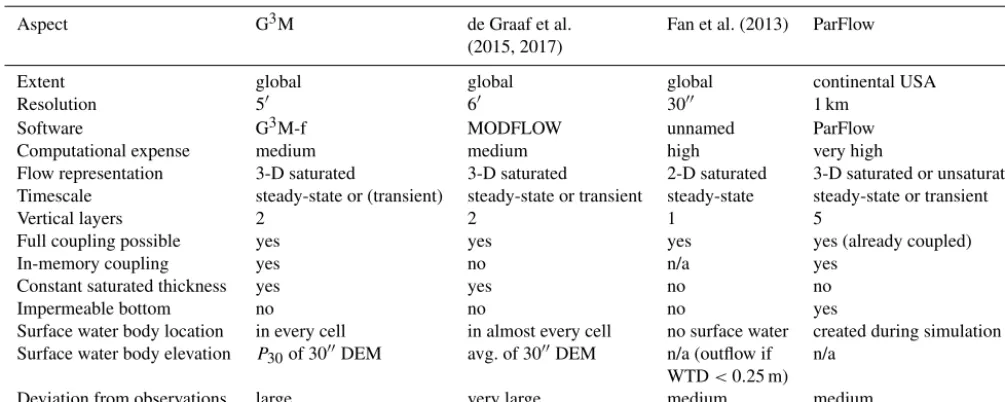
In this study, we present the Global Gradient-based Groundwater Model (G3M), which is to be integrated into the GHM WaterGAP 2 to improve estimation of flows be-tween SW and GW (affecting both streamflow and ground-water recharge and thus ground-water availability for humans and ecosystems) and implement capillary rise (affecting evapo-transpiration). Table 1 provides a comparative summary of G3M as well as the global groundwater models by Fan et al. (2013), de Graaf et al. (2015, 2017), and the continental-scale model ParFlow (Maxwell et al., 2015).
Table 1.Comparison of global- and continental-scale groundwater models. DEM is digital elevation model. n/a means not applicable.
Aspect G3M de Graaf et al. Fan et al. (2013) ParFlow
(2015, 2017)
Extent global global global continental USA
Resolution 50 60 3000 1 km
Software G3M-f MODFLOW unnamed ParFlow
Computational expense medium medium high very high
Flow representation 3-D saturated 3-D saturated 2-D saturated 3-D saturated or unsaturated Timescale steady-state or (transient) steady-state or transient steady-state steady-state or transient
Vertical layers 2 2 1 5
Full coupling possible yes yes yes yes (already coupled)
In-memory coupling yes no n/a yes
Constant saturated thickness yes yes no no
Impermeable bottom no no no yes
Surface water body location in every cell in almost every cell no surface water created during simulation Surface water body elevation P30of 3000DEM avg. of 3000DEM n/a (outflow if n/a
WTD<0.25 m)
Deviation from observations large very large medium medium
(2) providing insights into dominant processes and uncov-ering potential model-inherent characteristics difficult to ob-serve in a fully coupled transient model. A transient model might obfuscate model-inherent trends due to the slow-changing nature of groundwater processes e.g., trends to-wards large overestimation or underestimation due to wrong parameterization. A fully coupled model furthermore adds complexity and uncertainty to the model outcome. The pre-sented steady-state model is furthermore used to (3) inves-tigate parameter sensitivity and sensitivity to spatial resolu-tion. In addition, the steady-state solution can be used as (4) an initial condition for future fully coupled transient runs.
The model concept and equations as well as applied data and parameter values are presented in Sect. 2. In Sect. 3, we show steady-state results of G3M driven by WGHM data. Simulated hydraulic heads are compared to observa-tions world-wide and to the output of existing large-scale GW models (Table 1). Furthermore, sensitivity to parame-ters and grid size is shown for the example of New Zealand. Finally, the implications of modeling decisions and grid size are discussed (Sect. 4) and conclusions are drawn (Sect. 5).
2 Model description
2.1 G3M model concept
Although G3M is based on principles of the well-known GW flow modeling software MODFLOW (Harbaugh, 2005), G3M differs in its parameterization from traditional local and regional GW models. These models are generally based on rather detailed information on hydrogeology (including aquifer geometry and properties such as hydraulic conductiv-ity derived from pumping tests), topography, pumping wells, location, and shape of SW bodies as well as on observations
of hydraulic head in GW and SW. Local observations guide the developer in constructing the model such that local con-ditions and processes can be properly represented. The lat-eral extent of individual grid cells of such GW flow models is generally smaller or similar to the depth of the aquifer(s) and the size of the SW bodies that interact with the GW. The global GW flow model G3M, however, covers all continents of the Earth except Greenland and Antarctica. At this scale, information listed above is poor or non-existing, and the lat-eral extent of grid cells needs to be relatively large due to computational (and data) constraints. We selected a grid cell size of 50by 50(approx. 9 km by 9 km at the Equator) as this size fits well to WaterGAP and is smaller than the suggested 60of Krakauer et al. (2014). WaterGAP 3 (Eisner, 2016) has the same cell size, and 36 such cells fit into one 0.5◦ Water-GAP 2 cell. Global climate data are only available for 0.5◦ grid cells. The land mask of G3M, i.e., location and size of 50 grid cells, is that of WaterGAP 3 and encompasses 2.2 mil-lion 50grid cells on each layer.
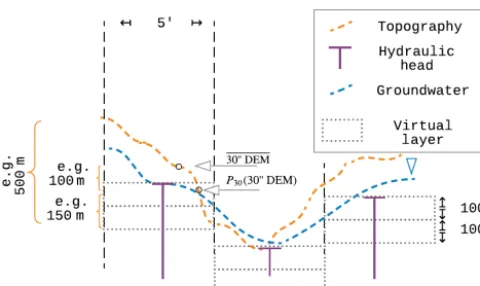
Due to the lack of the spatial distribution of hydrogeo-logical properties, we chose to use, in the current version of G3M, two GW layers with a vertical size of 100 m each (Fig. 1). We performed a sensitivity analysis that confirmed the findings of others (de Graaf et al., 2015) that the aquifer thickness has a relatively small impact on the model results. Therefore, selecting a uniform thickness of 100 m (moti-vated by the assumed depth of validity of the lithology data) (Fig. 1) worldwide for the first layer and also for the second layer is expected to lead to less uncertainties as compared to hydraulic conductivities and the surface water table eleva-tion.
Figure 1.Schematic of G3M’s spatial structure with 50grid cells, hydraulic head per cell, and the conceptual virtual layers (virtual because at this stage only confined conditions are computed). The underlying variability in the topography changes the perception of simulated depth to groundwater depending on what metrics are used to represent it on a coarser resolution. Layers in G3M are of a con-ceptual nature and describe the saturated flow between locations of head laterally and vertically. TheP30 is used in the presented steady-state model as SW elevation instead of an average or mini-mum per grid cell.
of WaterGAP is described in detail in Sect. S1 in the Sup-plement) and a lower one in which GW may flow laterally without such interactions. As land surface elevation within each 50grid cell, with an area of approximately 80 km2, may vary by more than 200 m (Fig. S4.1), neighboring cells in G3M may not be adjacent anymore (Fig. 1), in contrast to (re-gional) GW models with smaller grid cells. This makes G3M a rather conceptual model in which water exchange between groundwater cells is driven by hydraulic head gradients but flow can no longer be conceptualized as occurring through continuous pore space. In addition, due to the coarse spatial scale and the possible large variations in land surface ele-vations within each grid cell, the upper model layers should not be considered to be aligned with an average land surface elevation. The model layers can be rather thought to be verti-cally aligned with the elevation of the surface water body ta-ble, as this prescribed elevation is, together with the sea level, the only elevation included in the groundwater flow equation (Eq. 1).
The simulation of aquifers that contain dry cells and/or cells that oscillate between wet and dry states poses great challenges to solving Eq. (1) (Niswonger et al., 2011). G3 M-f (the M-framework code used to implement G3M) implements the traditional wetting approach from Harbaugh (2005) as well as the approach proposed by Niswonger et al. (2011) along with the proposed damping scheme. Both approaches have proven to be insufficient to simulate head-based trans-missivities (unconfined conditions) on the global scale. Large mountainous areas would be excluded if unconfined condi-tions are assumed from the beginning of the solution step, as the head is often far below the deepest model layer, resulting
in a no-flow condition and imposing convergence issues to the matrix solver. We choose to simulate both layers with a specific saturated thickness even though the upper layer can be expected to decrease in water level and thus in trans-missivity (hydraulic conductivity times saturated depth). The large uncertainties regarding hydraulic conductivities (possi-bly an order of magnitude), further justifies using the com-putationally more efficient assumption of specified saturated thickness. This approach is consistent with findings that this is accurate for large, complex groundwater models (Sheets et al., 2015). Furthermore, it is consistent with recent pre-sented large-scale studies, e.g., for the Rhine–Meuse basin of Sutanudjaja et al. (2011) (using one confined layer), the Death Valley Regional Flow Model (Belcher, 2004; Faunt et al., 2011), and the global groundwater model of de Graaf et al. (2017) (two layers and partially unconfined conditions are simulated by parametrization of the model input and not by a head-dependant transmissivity).
Three-dimensional groundwater flow is described by a partial differential equation (approximated in the model implementation by using the finite differences method, Sect. 2.4)
dGWS
dt =
∂
∂x
Kx ∂h ∂x
+ ∂
∂y
Ky ∂h ∂y
+ ∂
∂z
Kz ∂h ∂z
+W
1x1y1z=Ss ∂h
∂t1x1y1z, (1) whereKx,y,zis the hydraulic conductivity [LT−1] along the x,y, andzaxes between the cells (harmonic mean of grid cell conductivity values);Ssthe specific storage [L−1];1x1y1z [L3] the volume of the cell; andhthe hydraulic head [L]. In-and out-flows in the groundwater are accounted for as W 1x1y1z=Rg+Qswb−NAg−Qcr+Qocean, (2) whereQswb is flow between the SW bodies (rivers, lakes, reservoirs, and wetlands) and GW [L3T−1];Qcris capillary rise, i.e., the flow from GW to the soil; andQoceanis the flow between ocean and GW [L3T−1], representing the boundary condition. In the case ofQswb andQocean, a positive value represents a flow into the groundwater.
Qswb in Eq. (3) replaceskg GWS andRg_swbin the lin-ear storage equation of WaterGAP (Eq. S1), such that losing conditions of all types of SW bodies can be simulated dy-namically. It is calculated as a function of the difference be-tween the elevation of the water table in the SW bodieshswb [L] andhaqas
Qswb=
cswb hswb−haq
haq> Bswb,
Conductance of SW bodies is often a calibration param-eter in traditional GW models (Morel-Seytoux et al., 2017). Following Harbaugh (2005), it can be estimated by
cswb=
K L W
hswb−Bswb, (4) where K is hydraulic conductivity, L is length and W is width of the SW body per grid cell. For lakes (including reservoirs) and wetlands, cswb is estimated based on hy-draulic conductivity of the aquifer Kaq and SW body area (Table 2). For gaining rivers, conductance is quantified indi-vidually for each grid cell following an approach proposed by Miguez-Macho et al. (2007). The value of river conduc-tancecriv, according to Miguez-Macho et al. (2007), in a GW flow model needs to be set to such values so that, for steady-state conditions, the river is the sink for all the inflow to the grid cell (GW recharge and inflow from neighboring cells) that is not transported laterally to neighboring cells such that criv=
Rg+Qeqlateral
heq−hriv haq> hriv. (5) For G3M, we computed the equilibrium headheqas the 50
average of the 3000 steady-state heads calculated by Fan et
al. (2013). Using WGHM, diffuse GW recharge lateral equi-librium flow,Qeqlateral [L
3T−1], is the net lateral inflow into the cell computed based on the heq distribution as well as G3MKaqand cell thickness (Table 2). Elevation of the river water table,hriv [L], is provided by WGHM. Using a fully dynamic approach, i.e., utilizing the hydraulic head and lat-eral flows from the current iteration to recalculatecrivin each iteration towards the steady-state solution, has proven to be too unstable due to its nonlinearity affecting convergence. We limitcrivto a maximum of 107m2d−1; this would be ap-proximately the value for a 10 km long and 1 km wide river with a head difference between GW and river of 1 m and hy-draulic conductivity of the river bed of 10−5m s−1.
If the river recharges the GW (losing river), Eq. (5) can-not be used as the Fan et al. (2013) high-resolution equilib-rium model only models groundwater outflows but not in-flows from SW bodies. If haq drops below hriv, Eq. (4) is used to computecriv, withKequal toKaq.
The flux across the model domain boundary Qocean is modeled as a head-dependent flow based on a static head boundary.
Qocean=cocean hocean−haq, (6) where hocean is the elevation of the ocean water table [L], haqthe hydraulic head in the aquifer [L], andcoceanthe con-ductance of the boundary condition [L2T−1] (Table 2). We assume that the density difference to sea water is negligible at this scale.Qcris not yet implemented in G3M.
2.2 The steady-state uncoupled model version
In the first implementation stage, G3M was developed as a steady-state (right-hand side of Eq. 1 is zero) stand-alone
model that represents naturalized conditions (i.e., without taking into account human water use) during 1901–2013. In-put data and parameters used are listed in Table 2 and de-scribed below.
Gleeson et al. (2014) provided a global subsurface perme-ability dataset from whichKaq was computed. The dataset was derived by relating permeabilities from a large number of local to regional GW models to the type of hydrolitho-logical units (e.g., “unconsolidated” or “crystalline”). The geometric mean permeability values of nine hydrolithologi-cal units were mapped to the high-resolution global lithology map GLiM (Hartmann and Moosdorf, 2012). In continuous permafrost areas, a very low permeability value was assumed by Gleeson et al. (2014). The estimated values represent the shallow surface on the scale of 100 m depth. The unique dataset has three inherent problems when used as input for a GW model. (1) At this scale, important heterogeneities such as discrete fractures or connected zones of high hy-draulic conductivity controlling the GW flow are not visible. (2) Jurisdictional boundaries due to different data sources in the global lithological map lead to artifacts. (3) The differentiation between coarse- and fine-grained unconsol-idated deposits is only available in some regions resulting in 10−4m s−1 as hydraulic conductivity for coarse-grained unconsolidated deposits. If the distinction is not available, a rather low value of 10−6m s−1 is set for unconsolidated porous media (Fig. S4.3). The original data were gridded to 50by using an area-weighted average and used as hydraulic conductivity of the upper model layer. For the second layer, hydraulic conductivity of the first layer is reduced assuming that conductivity decreases exponentially with depth. Based on thee-folding factorf used by Fan et al. (2013) (a cali-brated parameter based on terrain slope), conductivity of the lower layer is calculated by multiplying the upper layer value by exp(−50m f−1)−1(Fan et al., 2007).
Mean annual GW recharge computed by WaterGAP 2.2c for the period 1901–2013 is used as input (Fig. S4.4), while no net abstraction from GW was taken into account. It would not be meaningful to try to derive a steady-state solution un-der existing net groundwater abstractions that in some re-gions cause GW depletion with continuously dropping water tables. The 0.5◦data of WaterGAP were equally distributed to the pertaining cells. Regarding the ocean boundary condi-tion,hocean is set to 0 m andcocean to 10 m2d−1 (Table 2), reflecting a global average conductance based on hydraulic conductivity and lateral surface area.
It is assumed that there is exchange of water between GW and one river stretch in each 50 grid cell, and additionally
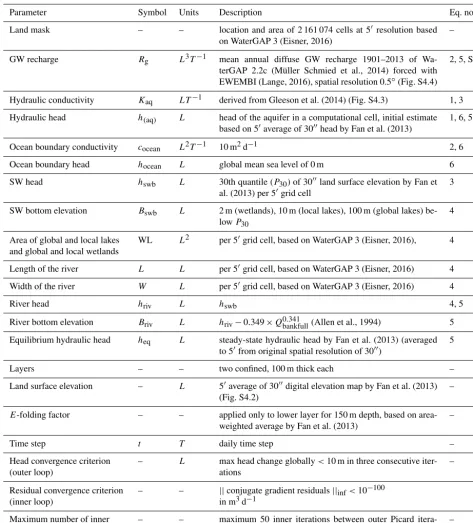
Table 2.Model parameter values, input data sources, and other information about the steady-state simulation.
Parameter Symbol Units Description Eq. no.
Land mask – – location and area of 2 161 074 cells at 50 resolution based on WaterGAP 3 (Eisner, 2016)
–
GW recharge Rg L3T−1 mean annual diffuse GW recharge 1901–2013 of Wa-terGAP 2.2c (Müller Schmied et al., 2014) forced with EWEMBI (Lange, 2016), spatial resolution 0.5◦(Fig. S4.4)
2, 5, S1
Hydraulic conductivity Kaq LT−1 derived from Gleeson et al. (2014) (Fig. S4.3) 1, 3 Hydraulic head h(aq) L head of the aquifer in a computational cell, initial estimate
based on 50average of 3000head by Fan et al. (2013)
1, 6, 5
Ocean boundary conductivity cocean L2T−1 10 m2d−1 2, 6
Ocean boundary head hocean L global mean sea level of 0 m 6
SW head hswb L 30th quantile (P30) of 3000land surface elevation by Fan et al. (2013) per 50grid cell
3
SW bottom elevation Bswb L 2 m (wetlands), 10 m (local lakes), 100 m (global lakes) be-lowP30
4
Area of global and local lakes and global and local wetlands
WL L2 per 50grid cell, based on WaterGAP 3 (Eisner, 2016), 4
Length of the river L L per 50grid cell, based on WaterGAP 3 (Eisner, 2016) 4 Width of the river W L per 50grid cell, based on WaterGAP 3 (Eisner, 2016) 4
River head hriv L hswb 4, 5
River bottom elevation Briv L hriv−0.349×Q0bankfull.341 (Allen et al., 1994) 5 Equilibrium hydraulic head heq L steady-state hydraulic head by Fan et al. (2013) (averaged
to 50from original spatial resolution of 3000)
5
Layers – – two confined, 100 m thick each –
Land surface elevation – L 50average of 3000digital elevation map by Fan et al. (2013) (Fig. S4.2)
–
E-folding factor – – applied only to lower layer for 150 m depth, based on area-weighted average by Fan et al. (2013)
–
Time step t T daily time step –
Head convergence criterion (outer loop)
– L max head change globally<10 m in three consecutive iter-ations
–
Residual convergence criterion (inner loop)
– – ||conjugate gradient residuals||inf<10−100 in m3d−1
Maximum number of inner iterations
– – maximum 50 inner iterations between outer Picard itera-tions (Naff and Banta, 2008)
–
affect the flow exchange between SW body and GW. Maps generally show the maximum spatial extent of SW bodies. This maximum extent is seldom reached, in particular in the case of wetlands in dry areas. For global wetlands (wetlands greater than one 50cell), it is therefore assumed in this model version that only 80 % of their maximum extent is reached. In the transient model SW body areas change over time. A
(Verzano et al., 2012). Globally constant values are used for Bswbfor wetlands, local lakes, and global lakes (Table 2).
For the steady-state model, all SW bodies in a grid cell are assumed to have the same head, i.e.,hriv=hswb. We found that for both gaining and losing conditions, Qswb and thus computed hydraulic heads are highly sensitive tohswb. The overall best agreement with the hydraulic head observations by Fan et al. (2013) was achieved ifhswb (Eqs. 3, 4, and 5) was set to the 30th percentile (P30) of the 3000land surface elevation values by Fan et al. (2013) per 50cell, e.g., the 3000 elevation that is exceeded by 70 % of the one-hundred 3000 elevation values within one 50cell. To decrease convergence time, we used heq derived from the high-resolution steady-state hydraulic head distribution by Fan et al. (2013) as initial guess of haq. In each outer iteration (Sect. 2.4) gaining and losing conditions may change depending on the current head solution.
2.3 Integration into WGHM
We intend to integrate G3M into WaterGAP 2, i.e., the 0.5◦ version of WaterGAP (for details see Sect. S1), to keep com-putation time low enough for performing sensitivity analy-ses and ensemble-based data assimilation and calibration, in-stead of integrating it into WaterGAP 3 (Eisner, 2016), which has the same spatial resolution as G3M. However, data from WaterGAP 3 were used to set up G3M. Location and area of the 50grid cells of G3M are the same as in the land mask of WaterGAP 3. In addition, the percentage of the 50grid cell area that is covered by lakes (including reservoirs) and by wetlands, based on Lehner and Döll (2004), is taken from WaterGAP 3, as well as the length and width of the main river within each 50grid cell as (Table 2).
2.4 Model implementation
G3M is implemented using a newly developed open-source model framework G3M-f (Reinecke, 2018a). The main moti-vation to develop a new model framework is the efficient in-memory coupling to the GHM and flexible adaptation to the specific requirements of global-scale modeling. Written in C++14, the framework allows the implementation of global and regional groundwater models alike while providing an extensible purely object-oriented model environment. It is primarily targeted as an extension to WaterGAP but allows for an in-memory coupling to any GHM or can be used as a stand-alone groundwater model. It provides a unit-tested (Dustin, 2006) environment offering different modules that can couple in-memory results to a different model or write out data flows to different file formats. G3M-f has the fol-lowing advantages over using an established GW modeling software such as MODFLOW. G3M-f enables an improved coupling capability. Unlike MODFLOW, it provides a clear development interface to the programmer coupling a model to G3M-f. It can be easily compiled as a library and provides
a clearly separated logic between computation and data read-in or write-out). It is written read-in the same language as the tar-get GHM enabling a straight-forward in-memory access to arrays without the need to write data to disk, required when coupling with MODFLOW (a very computationally expen-sive operation even if that disk is a RAM-disk). Even though it is possible to call FORTRAN functions from C++, it is very complicated to pass file pointers properly, as the I/O im-plementation of both languages differs substantially and it is widely considered bad practice to handle I/O in two different languages at once. As MODFLOW was never designed to be coupled or integrated to or into other models, it is not pos-sible to separate the I/O logic fully from the computational logic without substantial code changes that are hard to test. To this end, G3M-f provides a highly modularized framework that is written with extensibility as design goal while imple-menting all required groundwater mechanisms.
Equation (1) is reformulated as finite-difference equation and solved using a conjugate gradient approach and an in-complete LUT (inin-complete lower–upper factorization with dual-threshold strategy) preconditioner (Saad, 1994). In or-der to keep the memory footprint low, the conjugate gra-dient method makes use of the sparse matrix. Furthermore, it solves the equations in parallel (preconditioner currently nonparallel). As internal numerical library, G3M uses Eigen3 (http://eigen.tuxfamily.org, last access: 1 June 2019). G3M can compute the presented steady-state solution (with the right-hand side of Eq. 1 being zero and the heads by Fan et al., 2013, as initial guess, Tables 1, 2) on a commodity computer with four computational cores and a standard solid-state drive in about 30 min while occupying 6 GB of RAM.
Similar to MODFLOW, G3M-f solves Eq. (1) in two nested loops using a Picard iteration (Mehl, 2006): (1) the outer iteration checks the head and residual convergence cri-terion (if the maximum head change between iterations is below a given value in three consecutive iterations and/or the norm of the residual vector of the conjugate gradient (Harbaugh, 2005; Niswonger et al., 2011) is below a given value). It adjusts head-dependant values, for example, from gaining to losing conditions and updates the system of linear equations if flows are no longer head dependent. (2) The in-ner loop primarily consists of the conjugate gradient solver, which runs for a number of iterations defined by the user or until the residual convergence criterion is reached (Table 2), solving the current system of linear equations.
Different from Vergnes et al. (2014), G3M’s computations are not based on spherical coordinates directly but on an ir-regular grid of quadratic cells of different size depending on the latitude. Cell sizes are provided by WaterGAP3 and are derived from their spherical coordinates maintaining their correct area and center location. The model code will be adapted in the future to account for the different lengths in x andydirections per cell correctly.
3 Results
3.1 Global hydraulic head and water table depth distribution under natural steady-state conditions
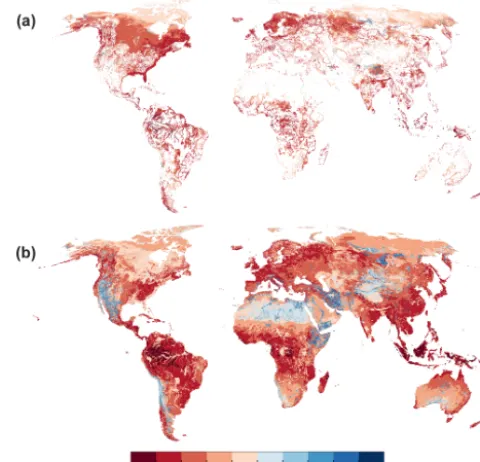
As expected, the computed global distribution of steady-state hydraulic head (in the upper model layer) under natural con-ditions (Fig. 2a) largely follows the land surface elevation (Fig. S4.2), albeit with a lower range and locally different ra-tios between the hydraulic head and land surface gradients (Fig. S4.6). Water table depth (WTD), i.e., the distance be-tween the groundwater table and the land surface, can be computed by subtracting the hydraulic head computed by G3M for the upper layer of each 50grid cell from the arith-metic mean of the land surface elevations of the one-hundred 3000grid cells within each 50cells (Fig. S4.2). The global map of steady-state WTD (Fig. 2b) clearly resembles the map of differences between surface elevation andP30, the assumed water level of SW bodies hswb, shown in Fig. S4.1, which indicates that simulated WTD is strongly governed by the assumed water level in SW bodies.
Deep GW, i.e., a large WTD, occurs mainly in mountain-ous regions (Fig. 2b). These high values of WTD are mainly a reflection of the steep relief in these areas as quantified either by the differences in mean land surface elevations between neighboring grid cells (Fig. S4.7) or the difference between mean land surface elevation andP30, the 30th percentile of the 3000land surface elevations (Fig. S4.1). When computed hydraulic head is subtracted not from average land surface elevation but from P30 (the assumed water table elevation of SW bodies), the resulting map shows that the groundwa-ter table is mostly above P30, in both flat and steep terrain (Fig. 2c). Thus, high WTD values at the 50 resolution do not indicate deep unsaturated zones and losing rivers but just high land surface elevation variations within a grid cell. In steep terrain, 50water tables are higher above water level in the surface water bodies than in flat terrain (Fig. 2c). Deep GW tables that are not only far below the mean land surface elevation but also below the water table of surface water bod-ies are simulated to occur in some (steep or flat) desert areas with very low GW recharge. Negative WTD only occurs in places were theP30is above the mean surface elevation, e.g., parts of the Netherlands (Fig. 2b). Fewer than 10 cells expe-rience WTD less than−10 m, which is very likely due to a not fully converged head solution.
Figure 2. (a)Simulated steady-state hydraulic head of groundwa-ter above sea level (megroundwa-ters). Maximum value 6375 m, minimum
−414 m (extremes included in dark blue and dark red).(b)Water table depth (meters).(c)Difference between 30th percentile of the 3000land surface elevation per 50grid cell (chosen elevation for sur-face water bodieshswb) and simulated groundwater head (meters). Maximum value 1723 m, minimum value−1340 m (extremes in-cluded in dark blue and dark red).
ground-Figure 3.Global sums of flows from different compartments into or from GW at steady state. Flows into the GW are denoted by the color blue, flows out of the GW into the different compartments by green. The compartment soil is the diffuse GW recharge from soil calculated by WaterGAP.
water withdrawals are not taken into account in the presented steady-state simulation of G3M.
3.2 Global water budget
Inflows to and outflows from GW of all G3M grid cells were aggregated according to the compartments ocean, river, lake, wetland, and diffuse GW recharge from soil (Fig. 3). The difference between the global sum of inflows and outflows is less than 10−6%. This small volume balance error indicates the correctness of the numerical solution.
Total diffuse GW recharge, model input from WaterGAP, from soil is 104km3yr−1 and approximately equal to the simulated flow of GW to rivers (Fig. 3). Rivers are the ubiq-uitous drainage component of the model, followed by wet-lands, lakes, and the ocean boundary. According to G3M, the amount of river water that recharges GW is more than 1 or-der of magnitude smaller than GW flow to rivers (Fig. 3). Possibly, flow from SW bodies to GW is overestimated, as outflow from SW is not limited by water availability in the SW, and depending on the hydraulic conductivity, Eqs. (4) and (5) can lead to rather large flows. Inflow from the ocean, which is more than 2 orders of magnitude smaller than out-flow to ocean, occurs in regions where hswb=P30is below hocean, e.g., the Netherlands. Globally, lakes and wetlands are computed to receive up to 103km3yr−1of water from GW, and lose 1–2 orders of magnitude less.
3.3 GW–SW interactions
Figure 4 plots the spatial distribution of simulated flows from and to lakes and wetlands (Fig. 4a) as well as from and to rivers (Fig. 4b). Parallel to the overall budget (Fig. 3), the map reveals the globally large, but locally strongly varying,
Figure 4.FlowQswb(mm yr−1) from or to wetlands, lakes(a), and losing or gaining streams(b)with respect to the 50grid cell area. Gaining surface water bodies are shown in red, surface water bod-ies recharging the aquifer in blue. Focused aquifer recharge occurs in arid regions, e.g., alongside the river Nile, and in mountainous regions where the average water table is well below the land surface elevation.
influence of lakes and wetlands (Fig. 4a). Rivers with ripar-ian wetlands such as the Amazon River receive comparably small amounts of GW as most of the GW is drained by the wetland (compare Fig. 4a and b). Similarly, areas dominated by wetlands and lakes (e.g., parts of Canada and Scandi-navia) show less inflow for rivers (Fig. 4b). In G3M, all SW bodies (rivers, lakes, and wetlands) in a grid cell either lose or gain water. Consistent with negative or positive differences betweenhswbandhaq(Fig. 2c), 93 % of all grid cells contain gaining rivers and only 7 % losing rivers. Gaining lakes and wetlands are found in 12 % and 11 % of the cells, respec-tively, whereas only 0.2 % contain a losing lake or wetland.
Gaining rivers, lakes, and wetlands with very high abso-luteQswbvalues over 500 mm yr−1(averaged over the grid cell area of approximately 80 km2) can be found in the Ama-zon and Congo basins as well in Bangladesh and Indonesia, where GW recharge in very high (Fig. S4.4). Values below 1 mm yr−1occur in dry and permafrost areas where ground-water recharge is low.
bod-ies are losing. In the Sahara, GW recharge is so low that SW bodies are losing even in relatively high terrain.
Rivers lose more than 100 mm yr−1in Ethiopia and Soma-lia, west Asia, northern Russia, the Rocky Mountains, and the Andes, whereas lower values can be observed in Aus-tralia and in the Sahara. High values of outflow from wet-lands and lakes are found in Tibet, the Andes, and northern Russia, and lower values in the Sahara and Kazakhstan. The river Nile in northern Republic of Sudan and Egypt is cor-rectly simulated to be a losing river (Fig. 4b), being an al-logenic river that is mainly sourced from the upstream hu-mid areas, including the artificial Lake Nasser (Elsawwaf et al., 2014) (Fig. 4a). Furthermore, the following lakes and ri-parian wetlands are simulated to recharge GW: parts of the Congo River, Lake Victoria, the IJsselmeer, Lake Ladoga, the Aral Sea, parts of the Mekong Delta, the Great Lakes of North America. On the other hand, no losing stretches are simulated along the Niger River and its wetlands and almost none in the northeastern Brazil even though losing conditions are known to occur there (Costa et al., 2013; FAO, 1997). This is also true when the minimum elevation for SW bodies is assumed (compare Fig. S4.10) leading to the conclusion that the misrepresentation might be linked to an inadequate representation of the local geology.
Simulated flows between GW and SW depend on assumed conductances for both rivers and lakes or wetlands (Eqs. 3, 4, 5) shown in Fig. 5.Qswb(Fig. 4) correlates positively with conductance. Conductance for gaining rivers correlates pos-itively with GW recharge (Eq. 5 and Fig. S4.4). High river conductance values are reached in the tropical zone due to a high GW recharge but are capped at a plausible maximum value of 107m2d−1in the case of a river (Sect. 2.1) (Fig. 5b). Lakes and wetlands can have larger values of conductance due to their large areas, e.g., in Canada or Florida.
3.4 Lateral flows
Figure 6 shows lateral GW flow (between grid cells, sum-ming up over all model layers) in percent of the sum of dif-fuse GW recharge from soil and GW recharge from SW bod-ies. The percentage of recharge that is transported through lateral flow to neighboring cells depends on five main fac-tors: (1) hydraulic conductivity (Fig. S4.3), (2) diffuse GW recharge (Fig. S4.4), (3) losing or gaining SW bodies (Fig. 4), (4) their conductance (Fig. 5), and (5) the head gradients (Fig. 2a).
On large areas of the globe, where GW discharges to SW bodies, the lateral flow percentage is less than 0.5 % of the to-tal GW recharge to the grid cell, as most of the GW recharge in a grid cell is simulated to leave the grid cell by discharge to SW bodies. For example, in the permafrost regions, the as-sumed very low hydraulic conductivity limits the outflow to neighboring cells of the occurring recharge, leading to these very low percent values. Such values also occur in regions with high SW conductances and rather low hydraulic
con-Figure 5.Conductance (m2d−1) of lakes and wetlands(a) and rivers(b). In regions close to the pole, conductance is in general lower due to the influence of the low aquifer conductivity (losing conditions), and relatively small GW recharge due to permafrost conditions (only applies for gaining conditions). Max conductance of wetlands is 108m2d−1.
Figure 6.Percentage of GW recharge from soil and surface water inflow that is transferred to neighboring cells through lateral out flow (sum of both layers). Grid cells with zero total GW recharge are shown in white (a few cells in the Sahara and the Andes).
outflow from GW other than in the lateral directions, and val-ues often exceed 100 % (Fig. 6).
3.5 Comparison to groundwater well observations and the output of two higher-resolution models
Global observations of WTD were assembled by Fan et al. (2007, 2013). We selected only observations with known land surface elevation and removed observations where a comparison to local studies suggested a unit conversion er-ror. This left a total of 1 070 402 WTD observations. An “ob-served head” per 50 model cell was then calculated by first computing the hydraulic head of each observation by sub-tracting WTD from the 50 average of the 3000 land surface elevation and then calculating the arithmetic mean of all ob-servations within the 50 model cell. This resulted in 78 664 grid cells with observations out of a total of 2.2 million G3M top-layer grid cells. Multiple obstacles limit the compara-bility of observations to simulated values. (1) Observations were recorded at a certain moment in time influenced by sea-sonal effects and abstraction from GW, whereas the simu-lated heads represent a natural steady-state condition. (2) Ob-servation locations are biased towards river valleys and pro-ductive aquifers. (3) Observations may be located in valleys with shallow local water tables too small to be captured by a coarse resolution of 50.
Simulated steady-state hydraulic heads in the upper model layer are compared to observations in Fig. 7. Shallow GW is generally better represented by the model than deeper GW. Especially the water table in mountainous areas is under-estimated, which may be related to observations in perched aquifers caused by low permeability layers (Fan et al., 2013) that are not represented in G3M due to lacking information. Because the steady-state model cannot take into account the impact of GW abstraction, the computed WTD values are considerably smaller than currently observed values in GW depletion areas like the Central Valley in California (where once wetlands existed before excessive GW use depleted the aquifer) and the High Plains Aquifer in the American Mid-west of the USA. Still, the elevation of the GW table in the nondepleted Rhine valley in Germany is overestimated, too. Overestimates in the Netherlands may partially be due to ar-tificial draining. Figure 8a shows the hydraulic head compar-ison as a scatter plot. Overall, the simulation results tend to underestimate observed hydraulic head but much less than the steady-state model presented by de Graaf et al. (2015) (their Fig. 6).
To compare the performance of G3M to the steady-state results of two high-resolution models by Fan et al. (2013) and ParFlow (Maxwell et al., 2015) (Table 1), heads in 3000 (Fan et al., 2013) and 1 km (ParFlow) grid cells were aver-aged to the G3M 50grid cells. The comparison of 50 obser-vations to the 50average of ParFlow seems to be consistent with the 1 km model comparison in Maxwell et al. (2015) (their Fig. 5), even though overestimates or underestimates
in the original resolution seem to be smoothed out by aver-aging to 50 (not shown). The heads by Fan et al. (2013) fit
better to observations than G3M heads, with less underesti-mation (Fig. 8b) and a RMSE (root mean square error) of 26.0 m compared to the 32.4 m RMSE of G3M. The com-parison of G3M heads to values by Fan et al. (2013) for all 50 grid cells, which are also the initial heads of G3M and the basis to compute river conductances, shows that heads computed with the G3M are mostly much lower except in re-gions with a shallow GW (Fig. 8c); RMSE is 46.7 m. This cannot be attributed to the 100 times lower spatial resolution per se but to the selection of the 30th percentile of the 3000 as the SW drainage level. Outliers in the upper half of the scatter plot, with much larger G3M heads than the initial val-ues (Fan et al., 2013), are mainly occurring in steep moun-tainous areas like the Himalayas where the 50 model is not representing smaller valleys with a lower head. For the con-tinental US, the computationally expensive 1 km integrated hydrological model ParFlow (Maxwell et al., 2015) fits much better to observations than G3M (Fig. 8d, e), with a RMSE of 14.3 m (ParFlow) compared to 34.2 m (G3M). G3M produces a generally lower water table (Fig. 8f), a main reason being that ParFlow assumes an impermeable bedrock at a depth of 100 m below the land surface elevation.
The global map of head comparison (Fig. 7) suggests that G3M performs reasonably well in flat areas compared to mountainous regions. This is corroborated by Fig. 9, which shows the difference between observed and simulated hy-draulic heads for five land surface elevation categories. It is evident that model performance deteriorates with increas-ing land surface elevation and positively correlates with variations in land surface elevation within each grid cell (Fig. S4.7).
Plotting hydraulic head instead of WTD has the disadvan-tage that the goodness of fit is dominated by the topogra-phy as the observed heads are calculated based on the sur-face elevation of the model. Well observations provide WTD and only sometimes contain complementary data specifying the elevation at which the measurements were taken. Even though hydraulic heads are a direct result of the model and are forcing lateral GW flows, WTD is more relevant for pro-cesses like capillary rise. For G3M, there is almost no corre-lation between WTD observations and simulated values. To our knowledge, no publication on large-scale GW modeling has presented correlations of simulated with observed WTD.
3.6 Testing sensitivity of computed steady-state hydraulic heads to parameter values and spatial resolution
con-Figure 7.Differences between observed and simulated hydraulic head (metres). Red dots show areas where the model simulated deeper GW as observed, blue shallower GW. In the gray areas, no observations are available.
Figure 9.Observed minus simulated hydraulic head for different land surface elevation categories. The whiskers of the boxplots show the interquartile range.
dition. All inputs and parameters are the same as in the global 50model.
3.6.1 Parameter sensitivity
To determine which parameters simulated hydraulic heads are most sensitive to, we used the established sensitivity tool UCODE 2005 (Hill and Tiedeman, 2007) to compute com-posite scaled sensitivity (CSS) values for seven model pa-rameters (Sect. S3). CSS of hswb is orders of magnitude larger than the CSS of the other parameters. This confirms our observations during model development when an appro-priate value had to be found (Sect. 2.2). The second-most important parameter isKaqand the third-most importantRg. CSS of the conductance of lakes is 1 order of magnitude less than CSS ofRgbut as only few cells contain lakes, the CSS value that averages over all grid cells indicates a large sensi-tivity tocLakesfor grid cells with lakes. Simulated hydraulic heads were found to be rather insensitive to changes in the conductance of rivers, wetlands, or ocean boundary.
3.6.2 Sensitivity to spatial resolution
The extremely high sensitivity of simulated hydraulic heads to the choice ofhswb(Sect. 3.6.1) and the better agreement of the continental models with a higher spatial resolution of ap-prox. 3000(the Fan et al., 2013, model and ParFlow, Sect. 3.5)
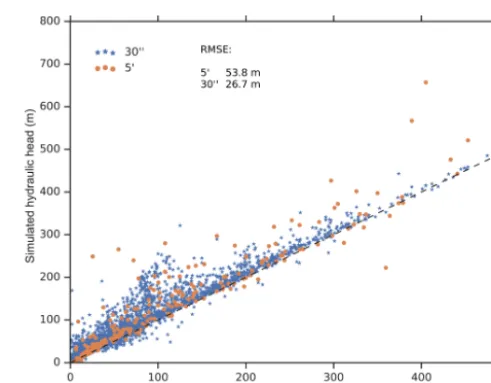
motivated us to run G3M for New Zealand with a spatial res-olution of 3000to understand the impact of spatial resolution on simulated hydraulic heads. The 3000G3M model uses the same input as the 50model except for the land surface eleva-tion,hswb, and the location of rivers. While the total lengths and widths of the rivers are equal in both models – a river is assumed to exist in all 50 grid cells – the river is
concen-Figure 10.Low (50) vs. high (3000) spatial resolution for the Canter-bury region in New Zealand: comparison of observed vs. simulated hydraulic head for both resolutions. The observed head is the geo-metric mean per 50and 3000, respectively.
trated – in the 3000model – to a few 3000grid cells within each 50 grid cell. The river cell locations at 3000 are determined
based on 3000HydroSHEDS (https://hydrosheds.org/, last ac-cess: 1 June 2019) information on flow accumulation. Start-ing with the 3000 cell with the highest number of upstream cells per 50 cell, a river is added to this 3000 cell using the length and information of HydroSHEDS until the size of the river of the 50 model is reached for all 3000 cells within a 50 cell. The areal fraction of all other SW bodies from 50 grid data is used for all 3000grid cells within the 50grid cell.hswb is set to the land surface elevation.
Figure 10 compares the performance of the two model ver-sions. The comparison of simulated hydraulic head to obser-vations for the Canterbury region (Westerhoff et al., 2018) shows that the overall performance of the 3000 model is bet-ter, with a smaller RMSE of 26.7 m as compared to a RMSE of 53.8 m in the case of the original spatial resolution of 50.
The 3000model results in generally lower simulated hydraulic heads leading to a closer fit to the observed values. This is likely caused by the improved estimation of SW body ele-vation, which generally leads to lower estimates ofhswb. On the other hand, overestimates of observed hydraulic heads prevails in the 3000 model, even though hswb was set to the land surface elevation, indicating that further investigation is necessary. The underestimates are likely due to large GW ab-stractions for irrigation in the particular region (Westerhoff et al., 2018).
4 Discussion
between SW and GW in the GHM WaterGAP, e.g., for an improved estimation of GW resources in dry regions of the globe that are augmented by focused recharge from SW bod-ies. We assume that the fully coupled model will lead to an improved WaterGAP performance during droughts with an increased drop in streamflow due to the now possible switch from gaining to losing conditions. It is presumable that a calibration of cswb andcriv is necessary to achieve a good discharge performance. The presented steady-state model is the first step in this direction. It helped to understand basic model behavior, e.g., the sensitivity to SW body elevation, and the necessary improvement of its parameterization, be-fore moving to the more complex integrated transient model. The reduced runtime of the steady-state model in comparison to a fully integrated transient run supported the investigation of parameter sensitivity and sensitivity to spatial resolution. Additionally, the presented steady-state model can be used in future fully integrated transient runs as initial condition.
A major challenge for simulating GW–SW interactions (but also capillary rise) at the global scale is the large size of grid cells that is required due to computational constraints. Within the 50grid cells, land surface elevation at the scale of 3000very often varies by more than 20 m, and often by 200 m and more (Fig. S4.1), while the vertical position of the cell and the hydraulic head are approximated in the model by just one value. The question is whether head-dependent flows be-tween grid cells, bebe-tween GW and SW, and from GW to soil (capillary rise) can be simulated successfully at the global scale, i.e., whether an improved quantification of these flows as compared to the simple linear reservoir model currently used in most GHMs can be achieved by this approach. This question cannot be answered before a dynamic coupling of G3M with a global hydrological model has been achieved, but one may speculate that some innovative approach to take into account the elevation variations within the grid cells is needed.
It is difficult to the assess quality of the presented steady-state G3M results. Model performance assessment is hin-dered by poor data availability and the coarse model reso-lution. (1) To our knowledge the data collection of depth to groundwater by Fan et al. (2013) is unique. However, they do not represent steady-state values. Apart from depth to groundwater observations, hardly any relevant data are avail-able at the global scale. Especially the exchange between sur-face water and groundwater is difficult to measure even at the local scale. Therefore, we compared G3M results with the results from other large-scale models. Comparison to the re-sults of catchment-scale groundwater flow models is planned for transient runs that will be possible after integration into WaterGAP. (2) Scale differences make the comparison to point observations of depth to groundwater difficult. Often, observations are biased towards alluvial aquifers in valleys. The calculated hydraulic head of the grid cell may represent the average groundwater level per grid cell correctly but can be still far off the local observations of depth to groundwater.
As the current model only represents an uncalibrated natural steady state, a comparison to observations only provides the first indicator where the model and the performance measure-ments need to be improved as we move to a fully transient model.
The presented development of the uncoupled steady-state global GW flow model enabled us to better understand how the spatial hydraulic head pattern relates to the fundamental drivers of topography, climate, and geology (Fan et al., 2007) and how the interaction to SW bodies governs the global head distribution. Simulated depth to groundwater is particularly affected by the assumed hydraulic head in SW bodies, the major GW drainage component in the model. As rivers rep-resent a naturally occurring drainage at the lowest point in a given topography, one would assume that the minimum el-evation 3000 land surface elevation per 50 grid cell is a rea-sonable choice. Experiments have shown that this will in-duce a head distribution well below the average 50elevation
that is much below observations by Fan et al. (2013). We also tested settinghswbto the average elevation of all “blue” cells (with a WTD of less than 0.25 m) of the steady-state 3000water table results by Fan et al. (2013) that indicate the locations where GW discharges to the surface or SW bod-ies. This leads to an overall underestimation of the observed hydraulic heads (Fig. S4.9) as the assumed SW elevation is too low. Furthermore, it leads to an increase in losing SW bodies (compare Fig. S4.10 with Fig. 4). However, it is dif-ficult to judge whether this improves the simulation. More stretches of the Nile and its adjacent wetlands and also of the Niger wetlands and rivers in northeastern Brazil are losing in the case of lowerhswb, which appears to be reasonable. Ad-ditionally, choosing the average as SW elevation provides, on the on hand, a better fit to observations (Fig. S4.9 right) but leads to a worldwide flooding (Fig. S4.9) and a much longer convergence time due to an increased oscillation be-tween gaining and losing conditions.
lead to a hydraulic head distribution that fits reasonably well to observed head values. This avoids the situation when the simulated GW table drops too low while also avoiding the excessive flooding that occurs ifhswbis set to the average of 3000land surface elevations, i.e., the 50land surface elevation (Fig. S4.9).
The constraint that the selected hswb value puts on sim-ulated hydraulic heads is also linked to the conductance of the SW bodies. A higher conductance will lead to aquifer heads closer tohswb. If the hydraulic head drops below the bottom level of the SW body, the hydraulic gradient is as-sumed to become 1 and the SW body recharges the GW with a rate of Kaq per unit SW body area. In the case of aKaq value of 10−5m s−1, the SW body would lose approximately 1 m of water each day. Further investigations are needed re-garding the appropriate choice of SW body elevation and conductance. The simple conductance approach applied in G3M could possibly be improved by the approach by Morel-Seytoux et al. (2017), who proposes an analytical, and phys-ically based, estimate of the leakance coefficient for coarse-scale models based on river and aquifer properties.
De Graaf et al. (2015) set their SW head (hswb) to the mean land surface elevation (Table 1) of the 60 grid cells minus river depth at bank-full conditions plus water depth at aver-age river discharge as compared toP30 in the 50 G3M. To-gether with the missing interaction between lakes and wet-lands and a different approach to river conductance, this might be a reason for the additional drainage above the flood-plain that was necessary to improve the discharge to rivers (Sutanudjaja et al., 2014). On the other hand, the additional drainage leads to drainage of water even if the hydraulic head is below the SW elevation, which might have led to the global underestimation of hydraulic heads. Thus, the difference in model heads seems to be closely related to the sensitivity to SW body elevation.
Due to the course spatial resolution and lack of data, G3M does not capture the actual variability in topography, aquifer depth (Richey et al., 2015) or (vertical) heterogene-ity of subsurface properties. The lack of information about the three-dimensional distribution of hydraulic conductivity is expected to negatively impact the quality of simulated GW flow. For example, the lateral conductivity and connectiv-ity of groundwater along thousands of kilometers from the Rocky Mountains in the central USA to the coast as well as the vertical connectivity are likely to be overestimated by G3M, as vertical faults and interspersed aquitards are not rep-resented; this is expected to lead to an underestimation of hydraulic head in those mountainous areas.
5 Conclusions
We have presented the concept and first results of a new global gradient-based 50 GW flow model G3M that is to be integrated into the 0.5◦GHM WaterGAP. The uncoupled
steady-state model has provided important insights into chal-lenges of global GW flow modeling mainly related to the necessarily large grid cell sizes (50 by 50). In addition, first
global maps of SW–GW interactions were generated. Simu-lated heads were found to be strongly impacted by assump-tions regarding the interaction with SW bodies, in particular the selected elevation of the SW table. We have demonstrated that simulated G3M hydraulic heads fit better to observed heads when compared to the heads of the comparable steady-state GW model by de Graaf et al. (2015), without requiring additional drainage. Furthermore, we provided insights into how the choice of surface water body elevationhswb affects model outcome. In a next step, approaches for utilizing high-resolution topographic data to improve the selection ofhswb will be investigated.
The presented results are the first step towards a fully cou-pled model in which SW heads are jointly computed, also taking into account the impact of SW and GW abstraction. Especially the interaction with SW bodies that can run dry will make the G3M behavior more realistic. The fully cou-pled model will simulate transient behavior reflecting climate variability and change. Simulated hydraulic head dynamics will be compared to observed head time series as well as to the output of large-scale regional models, while total water storage variations will be compared to GRACE satellite data. However, it will be challenging to judge the dynamics of GW and the quality of simulated GW–SW interactions due to a scarcity of observations.
Code and data availability. The model-framework code is avail-able at http://globalgroundwatermodel.org (last access: 1 June 2019) or at https://doi.org/10.5281/zenodo.1175540 (Reinecke, 2018b) with a description of how to compile and run a basic GW model. The code is available under the GNU General Public License 3. Model output is available at https://doi.org/10.5281/zenodo.1315471 (Reinecke, 2018c).
Supplement. The supplement related to this article is available online at: https://doi.org/10.5194/gmd-12-2401-2019-supplement.
Author contributions. RR led conceptualization, formal analysis, methodology, software, visualization, and writing of the original draft. LF and SM supported review and editing as well as the de-velopment of the methodology. TT and DC supported review. PD supervised the work of RR and made suggestions regarding analy-sis, structure, wording of the text, and design of tables and figures.
Acknowledgements. We are very grateful to Ying Fan and Gon-zalo Miguez-Macho for fruitful discussions and data provisioning. We thank the reviewers for their thoughtful comments that helped to improve the paper. Furthermore, we would like to thank Alexan-der Wachholz for contributing to the New Zealand figures and Ro-gier Westerhof for providing the observations for New Zealand.
Financial support. This research has been supported by the Friedrich Ebert foundation PhD fellowship.
Review statement. This paper was edited by Wolfgang Kurtz and reviewed by Edwin Sutanudjaja and four anonymous referees.
References
Allen, P. M., Arnold, J. C., and Byars, B. W.: Downstream chan-nel geometry for use in planning-level models, J. Am. Wa-ter Resour. As., 30, 663–671, https://doi.org/10.1111/j.1752-1688.1994.tb03321.x, 1994.
Belcher, W. R. (Ed.): Death Valley Regional Ground-water Flow System, Nevada and California-Hydrogeologic Framework and Transient Ground-water Flow Model, U.S. Geological Survey Professional Paper, 408 pp., available at: https://pubs.usgs.gov/ sir/2004/5205/ (last access: 1 June 2019), 2004.
Belcher, W. R. and Sweetkind, D. S.: Death Valley regional ground-water flow system, Nevada and California – Hydrogeologic framework and transient groundwater flow model, U.S. Geo-logical Survey Professional Paper 1711, 398 pp., available at: https://pubs.usgs.gov/pp/1711/ (last access: 1 June 2019), 2010. Costa, A. C., Foerster, S., de Araújo, J. C., and Bronstert, A.:
Anal-ysis of channel transmission losses in a dryland river reach in north-eastern Brazil using streamflow series, groundwater level series and multi-temporal satellite data, Hydrol. Process., 27, 1046–1060, https://doi.org/10.1002/hyp.9243, 2013.
de Graaf, I. E. M., Sutanudjaja, E. H., van Beek, L. P. H., and Bierkens, M. F. P.: A high-resolution global-scale groundwater model, Hydrol. Earth Syst. Sci., 19, 823–837, https://doi.org/10.5194/hess-19-823-2015, 2015.
de Graaf, I. E. M., van Beek, R. L. P. H., Gleeson, T., Moosdorf, N., Schmitz, O., Sutanudjaja, E. H., and Bierkens, M. F. P.: A global-scale two-layer transient groundwater model: Development and application to groundwater depletion, Adv. Water Resour., 102, 53–67, https://doi.org/10.1016/j.advwatres.2017.01.011, 2017. Dogrul, E., Brush, C., and Kadir, T.: Groundwater Modeling in
Sup-port of Water Resources Management and Planning under Com-plex Climate, Regulatory, and Economic Stresses, Water, 8, 592, https://doi.org/10.3390/w8120592, 2016.
Döll, P. and Fiedler, K.: Global-scale modeling of ground-water recharge, Hydrol. Earth Syst. Sci., 12, 863–885, https://doi.org/10.5194/hess-12-863-2008, 2008.
Döll, P., Hoffmann-Dobrev, H., Portmann, F. T., Siebert, S., Eicker, A., Rodell, M., Strassberg, G., and Scanlon, B. R.: Impact of water withdrawals from groundwater and surface water on con-tinental water storage variations, J. Geodyn., 59–60, 143–156, https://doi.org/10.1016/j.jog.2011.05.001, 2012.
Döll, P., Müller Schmied, H., Schuh, C., Portmann, F. T., and Eicker, A.: Global-scale assessment of groundwater deple-tion and related groundwater abstracdeple-tions: Combining hydro-logical modeling with information from well observations and GRACE satellites, Water Resour. Res., 50, 5698–5720, https://doi.org/10.1002/2014WR015595, 2014.
Dustin, E.: Effective software testing: 50 specific ways to improve your testing, 5th printing, Addison-Wesley, Boston, Mass., USA, XV, 271 s., 2006.
Eisner, S.: Comprehensive evaluation of the WaterGAP3 model across climatic, physiographic, and anthropogenic gradients, University of Kassel, Kassel, Germany, 2016.
Elsawwaf, M., Feyen, J., Batelaan, O., and Bakr, M.: Groundwater-surface water interaction in Lake Nasser, Southern Egypt, Hy-drol. Process., 28, 414–430, https://doi.org/10.1002/hyp.9563, 2014.
Fan, Y., Miguez-Macho, G., Weaver, C. P., Walko, R., and Robock, A.: Incorporating water table dynamics in cli-mate modeling: 1. Water table observations and equilibrium water table simulations, J. Geophys. Res., 112, D10125, https://doi.org/10.1029/2006JD008111, 2007.
Fan, Y., Li, H., and Miguez-Macho, G.: Global patterns of groundwater table depth, Science, 339, 940–943, https://doi.org/10.1126/science.1229881, 2013.
FAO: Irrigation potential in Africa, available at: http://www.fao.org/ docrep/w4347e/w4347e0i.htm (last access: 1 May 2018), 1997. Faunt, C. C. (Ed.): Groundwater Availability of the Central Valley
Aquifer, California, U.S. Geological Survey Professional Paper, 1766, 225 pp., available at: https://pubs.usgs.gov/pp/1766/ (last access: 1 June 2019), 2009.
Faunt, C. C., Provost, A. M., Hill, M. C., and Belcher, W. R.: Comment on “An unconfined groundwater model of the Death Valley Regional Flow System and a comparison to its confined predecessor” by R.W.H. Carroll, G.M. Pohll and R.L. Hershey [J. Hydrol. 373/3–4, pp. 316–328], J. Hydrol., 397, 306–309, https://doi.org/10.1016/j.jhydrol.2010.11.038, 2011.
Gleeson, T., Wada, Y., Bierkens, M. F. P., and van Beek, L. P. H.: Water balance of global aquifers re-vealed by groundwater footprint, Nature, 488, 197–200, https://doi.org/10.1038/nature11295, 2012.
Gleeson, T., Moosdorf, N., Hartmann, J., and van Beek, L. P. H.: A glimpse beneath earth’s surface: GLobal HYdrogeology MaPS (GLHYMPS) of permeability and porosity, Geophys. Res. Lett., 41, 3891–3898, https://doi.org/10.1002/2014GL059856, 2014. Gleeson, T., Befus, K. M., Jasechko, S., Luijendijk, E.,
and Cardenas, M. B.: The global volume and distribu-tion of modern groundwater, Nat. Geosci., 9, 161–167, https://doi.org/10.1038/ngeo2590, 2016.
Gossel, W., Ebraheem, A. M., and Wycisk, P.: A very large scale GIS-based groundwater flow model for the Nu-bian sandstone aquifer in Eastern Sahara (Egypt, north-ern Sudan and eastnorth-ern Libya), Hydrogeol. J., 12, 698–713, https://doi.org/10.1007/s10040-004-0379-4, 2004.
Harbaugh, A. W.: MODFLOW-2005, the US Geological Survey modular ground-water model: the ground-water flow process, US Department of the Interior, US Geological Survey, Reston, USA, 2005.
the Earth surface, Geochem. Geophy. Geosy., 13, Q12004, https://doi.org/10.1029/2012GC004370, 2012.
Hill, M. C. and Tiedeman, C. R.: Effective groundwater model cal-ibration: With analysis of data, sensitivities, predictions, and un-certainty, Wiley-Interscience, Hoboken, NJ, USA, 2007. Konikow, L. F.: Contribution of global groundwater depletion
since 1900 to sea-level rise, Geophys. Res. Lett, 38, L17401, https://doi.org/10.1029/2011GL048604, 2011.
Krakauer, N. Y., Li, H., and Fan, Y.: Groundwater flow across spa-tial scales: importance for climate modeling, Environ. Res. Lett., 9, 34003, https://doi.org/10.1088/1748-9326/9/3/034003, 2014. Lange, S.: EartH2Observe, WFDEI and ERA-Interim data Merged
and Bias-corrected for ISIMIP (EWEMBI), GFZ Data Services, https://doi.org/10.5880/pik.2016.004, 2016.
Lehner, B. and Döll, P.: Development and validation of a global database of lakes, reservoirs and wetlands, J. Hydrol., 296, 1–22, https://doi.org/10.1016/j.jhydrol.2004.03.028, 2004.
Maxwell, R. M., Condon, L. E., and Kollet, S. J.: A high-resolution simulation of groundwater and surface water over most of the continental US with the integrated hydrologic model ParFlow v3, Geosci. Model Dev., 8, 923–937, https://doi.org/10.5194/gmd-8-923-2015, 2015.
Mehl, S.: Use of Picard and Newton iteration for solving nonlin-ear ground water flow equations, Ground Water, 44, 583–594, https://doi.org/10.1111/j.1745-6584.2006.00207.x, 2006. Miguez-Macho, G., Fan, Y., Weaver, C. P., Walko, R., and
Robock, A.: Incorporating water table dynamics in cli-mate modeling: 2. Formulation, validation, and soil moisture simulation, J. Geophys. Res., 112, D13108, https://doi.org/10.1029/2006JD008112, 2007.
Morel-Seytoux, H. J., Miller, C. D., Miracapillo, C., and Mehl, S.: River Seepage Conductance in Large-Scale Regional Studies, Ground Water, 55, 399–407, https://doi.org/10.1111/gwat.12491, 2017.
Müller Schmied, H., Eisner, S., Franz, D., Wattenbach, M., Portmann, F. T., Flörke, M., and Döll, P.: Sensitivity of simulated global-scale freshwater fluxes and storages to in-put data, hydrological model structure, human water use and calibration, Hydrol. Earth Syst. Sci., 18, 3511–3538, https://doi.org/10.5194/hess-18-3511-2014, 2014.
Naff, R. L. and Banta, E. R.: The US Geological Survey mod-ular ground-water model-PCGN: a preconditioned conjugate gradient solver with improved nonlinear control, Geological Survey (US), 2008-1331, available at: https://pubs.er.usgs.gov/ publication/ofr20081331 (last access: 1 June 2019), 2008. Niswonger, R. G., Panday, S., and Ibaraki, M.:
MODFLOW-NWT, a Newton formulation for MODFLOW-2005, US Geological Survey Techniques and Methods, 6-A37, https://doi.org/10.3133/tm6A37, 2011.
Reinecke, R.: G3M-f a global gradient-based groundwater modelling framwork, JOSS, 3, 548, https://doi.org/10.21105/joss.00548, 2018a.
Reinecke, R.: G3M framework, Zenodo, https://doi.org/10.5281/ zenodo.1175540, 2018b.
Reinecke, R.: Model Output, Zenodo, https://doi.org/10.5281/ zenodo.1315471, 2018c.
Richey, A. S., Thomas, B. F., Lo, M.-H., Famiglietti, J. S., Swenson, S., and Rodell, M.: Uncertainty in global groundwater storage es-timates in a Total Groundwater Stress framework, Water Resour.
Res, 51, 5198–5216, https://doi.org/10.1002/2015WR017351, 2015.
Saad, Y.: ILUT: A dual threshold incomplete LU factorization, Numer. Linear Algebr., 1, 387–402, https://doi.org/10.1002/nla.1680010405, 1994.
Scanlon, B. R., Faunt, C. C., Longuevergne, L., Reedy, R. C., Al-ley, W. M., McGuire, V. L., and McMahon, P. B.: Groundwater depletion and sustainability of irrigation in the US High Plains and Central Valley, P. Natl. Acad. Sci. USA, 109, 9320–9325, https://doi.org/10.1073/pnas.1200311109, 2012.
Sheets, R. A., Hill, M. C., Haitjema, H. M., Provost, A. M., and Masterson, J. P.: Simulation of water-table aquifers us-ing specified saturated thickness, Ground Water, 53, 151–157, https://doi.org/10.1111/gwat.12164, 2015.
Stonestrom, D. A., Constantz, J., Ferre, T. P. A., and Leake, S. A.: Ground-water recharge in the arid and semiarid southwestern United States, U.S. Geological Survey Professional Paper 1703, 414 pp., available at: https://pubs.usgs.gov/pp/pp1703/ (last ac-cess: 1 June 2019), 2007.
Sutanudjaja, E. H., van Beek, L. P. H., de Jong, S. M., van Geer, F. C., and Bierkens, M. F. P.: Large-scale ground-water modeling using global datasets: a test case for the Rhine-Meuse basin, Hydrol. Earth Syst. Sci., 15, 2913–2935, https://doi.org/10.5194/hess-15-2913-2011, 2011.
Sutanudjaja, E. H., van Beek, L. P. H., de Jong, S. M., van Geer, F. C., and Bierkens, M. F. P.: Calibrating a large-extent high-resolution coupled groundwater-land surface model using soil moisture and discharge data, Water Resour. Res., 50, 687–705, https://doi.org/10.1002/2013WR013807, 2014.
Taylor, R. G., Scanlon, B., Döll, P., Rodell, M., van Beek, R., Wada, Y., Longuevergne, L., Leblanc, M., Famiglietti, J. S., Edmunds, M., Konikow, L., Green, T. R., Chen, J., Taniguchi, M., Bierkens, M. F. P., MacDonald, A., Fan, Y., Maxwell, R. M., Yechieli, Y., Gurdak, J. J., Allen, D. M., Shamsudduha, M., Hiscock, K., Yeh, P. J.-F., Holman, I., and Treidel, H.: Ground water and climate change, Nat. Clim. Change, 3, 322– 329, https://doi.org/10.1038/nclimate1744, 2012.
UNESCO-IHP, IGRAC, WWAP: GEF-TWAP Method-ology Transboundary Aquifers, available at: http://isarm.org/sites/default/files/resources/files/TWAP Methodology Groundwater Component (Revised Aug 2012).pdf (last access: 9 October 2017), 2012.
van Beek, L. P. H., Wada, Y., and Bierkens, M. F. P.: Global monthly water stress: 1. Water balance and water availability, Water Resour. Res., 47, W07517, https://doi.org/10.1029/2010WR009791, 2011.
Vergnes, J.-P., Decharme, B., Alkama, R., Martin, E., Habets, F., and Douville, H.: A Simple Groundwater Scheme for Hy-drological and Climate Applications: Description and Offline Evaluation over France, J. Hydrometeorol., 13, 1149–1171, https://doi.org/10.1175/JHM-D-11-0149.1, 2012.
Vergnes, J.-P., Decharme, B., and Habets, F.: Introduc-tion of groundwater capillary rises using subgrid spa-tial variability of topography into the ISBA land sur-face model, J. Geophys. Res.-Atmos., 119, 11065–11086, https://doi.org/10.1002/2014JD021573, 2014.