−
Effect of Exponential Stress Resultant on Buckling
Re-sponse of Functionally Graded Rectangular Plates
K. Khorshidi
∗, A. Fallah
Mechanical Engineering Department, Faculty of Engineering, Arak University, Arak, Iran.
Article info
Article history:Received 01 February 2017 Received in revised form 19 February 2017 Accepted 14 March 2017 Keywords:
Buckling
Functionally graded Rectangular plate Navier
Abstract
The effect of exponential stress resultant on buckling response of functionally graded rectangular plates based on exponential shear deformation theory is investigated in this paper. In exponential shear deformation theory, exponential functions are used in terms of thickness coordinate to include the effect of the transverse shear deformation and rotary inertia. The material properties of the functionally graded plate are assumed to vary according to a power low form according to the thickness direction. The equations of motions are derived based on Hamiltons principle. To validate the formulations, present results in specific cases are compared with available results in literature and good agreement could be seen. Finally, the influence of different parameters like power law indexes, aspect ratio, and the thickness ratio on the non-dimensional critical buckling load of rectangular FG plates are presented and discussed in detail.
Nomenclature
a Length of the plate b Width of the plate
h Thickness of the plate ϑ Poisson’s ratio
E Young’s modulus G Shear modulus
ρ Mass density g Power law index
u Displacement in thex1direction v Displacement in thex2 direction
w Displacement in thex3direction εii Normal strains
γij Shear strains σij Normal stresses
τij Shear stresses δ Variation operator
U Strain energy of the plate W Work done by external forces
N2 In plane loads perpendicular to the edgesx2 = 0, b N1 In plane load perpendicular to the edgesx1= 0, a
T Kinetic energy of the plate λmn Natural frequency of the plate
[K] Stiffness matrix [Kg] Stiffness matrix related to the in-plane forces Ncr Critical buckling load
1. Introduction
Functionally graded materials (FGMs) are comite materials intentionally designed so that they pos-sess desirable properties for specific applications, espe-cially for aircrafts, space vehicles and other
engineer-ing structures under high-temperature environments. FGMs are heterogeneous composite materials in which the material properties vary continuously from one in-terface to the other. Those are achieved by gradu-ally varying volume fraction of constituent materials.
∗Corresponding author: K. Khorshidi (Assistant Professor) E-mail address: [email protected]
http://dx.doi.org/10.22084/jrstan.2017.12894.1019 ISSN: 2588-2597
The advantage of using these materials is that they can survive the high thermal gradient environment, while maintaining their structural integrity. FGMs were initially designed as thermal barrier materials for aerospace structural applications and fusion reactors. Now they are developed for the general use as struc-tural components in high-temperature environments. Typically, a FGM is made of a ceramic and a metal for the purpose of thermal protection against large tem-perature gradients. The ceramic material provides the high-temperature resistance due to its low thermal con-ductivity while the ductile metal constituent prevents fracture due to its greater toughness. Reissner [1] de-veloped a stress based FSDT which incorporates the effect of shear and Mindlin [2] employed displacement based approach. In Mindlin’s theory, transverse shear stress is assumed to be constant through the thickness of the plate, but this assumption violates the shear stress free surface conditions on the top and bottom surfaces of the plate. Mindlins theory satisfies consti-tutive relations for transverse shear stresses and shear strains by using shear correction factor. Mokhtar et al. [3] studied buckling response of S-FGM plates in thermal environment according to first order shear de-formation theory. In their study material properties varied smoothly according to thickness direction based on Sigmond distribution. S¸im¸sek and Reddy [4] inves-tigated buckling of functionally graded material plates based on Higher order shear deformation plate theory. Matsunaga [5] studied the vibration and buckling re-sponse of functionally graded plates by taking into ac-count the influence of transverse shear, normal defor-mations, and rotatory inertia. By using the method of power series expansion of displacement components, a set of functionally graded (FG) plates was derived using Hamiltons principle. Yahia et al. [6] analyzed the wave propagation in functionally graded plates ac-cording to higher order shear deformation plate theory. Malekzadeh and Alibeygi [7] studied the free vibration of functionally graded arbitrary straight-sided quadri-lateral plates under the thermal environment and based on the first-order shear deformation plate theory. The differential quadrature method was adopted to dis-cretize the equilibrium equations. Ungbhakorn and Wattanasakulpong [8] presented thermo-elastic vibra-tion response of funcvibra-tionally graded plates caring dis-tributed patch mass-based on third order shear de-formation theory. The solutions were obtained using the energy method. Furthermore, the forced vibration analysis with external dynamic load acting on the sub-domain of the patch mass was discussed. Reddy [9] in-vestigated buckling analysis of simply supported func-tionally graded plates based on higher order shear de-formation theory (HSDT). Sayyad and Ghugal [10] pre-sented the bending and free vibration of thick isotropic rectangular plates by using Exponential shear defor-mation theory. In their work a displacement based
on Exponential shear deformation theory (ESDT) was used for the bending and free vibration analysis of thick isotropic square and rectangular plates containing ef-fect of transverse shear deformation and rotary iner-tia. The displacement field of the theory contains three variables like in the first order shear deformation plate theory. Khorshidi [11] studied a theory to calculate the natural frequencies of rectangular plate partially contacting bounded fluid in the bottom and vertical direction using the Rayleigh-Ritz method. In their de-veloped model, the von Karman linear strain displace-ment relationships were used in order to obtain the kinetic and strain energies of the plate. Senthilnathan et al. [12] used Reddy theory to present a simplified higher order theory in which a further reduction of the functional degree of freedom was introduced by split-ting up the transverse displacement in to bending and shear contributions. Khorshidi and Khodadadi [13] in-vestigated closed-form solution for out-of-plane vibra-tion of rectangular plates via trigonometric shear de-formation theory. Khorshidi and Pagoli [14] studied analytical solution for sound radiation of vibrating cir-cular plates coupled with piezoelectric layers. Thai and Choi [15] presented size-dependent functionally graded material for Kirchhoff and Mindlin plate models, ge-ometric nonlinearity, and material variation through the thickness of the plate. The equations of motion were derived from Hamiltons principle based on the modified Couple stress theory, Von Karman nonlinear strains, and Power Law variation of materials through the thickness. Analytical solutions for the static bend-ing, bucklbend-ing, and free vibration problems were pre-sented for a plate with all simply supported boundary conditions to accentuate the effects of material length scale parameter on the deflection, buckling load, and frequency. Khorshidi and Farhadi [16] performed hy-drostatic vibration analysis of a laminated composite rectangular plate partially contacting with a bounded fluid. In their research, natural frequencies of the plate coupled with sloshing fluid modes were calculated us-ing Rayleigh-Ritz method based on minimizus-ing the Rayleigh quotient.
In the present research, buckling response of func-tionally graded plate according to exponential shear deformation theory is investigated. In the exponen-tial shear deformation theory exponenexponen-tial functions are used in the thickness direction to include the influence of transverse shear deformation and rotary inertia. It is supposed that the material properties are changing through the thickness direction according to the power law distribution. The results of present work can be used as benchmarks for future studies.
2. Equations and Mathematics
Consider a flat rectangular FG-plate of lengtha, width
graded materials through the thickness as shown in Fig. 1. The plate is under in-plane loads perpendicular to the edges x1 = 0, a and x2 = 0, b. The properties of the plate were assumed to vary through the thick-ness of the plate according to a power-law distribution of the volume fractions of two materials between the two surfaces. In fact, the top surface (x3 = h/2) of the plate was ceramic-rich whereas the bottom surface (x3=−h/2) was metal-rich.
Fig. 1. Geometry of an FGM plate.
Poisson’s ratio ϑwas assumed to be constant and was taken as 0.3 throughout the analysis. Young’s modulus and mass density were assumed to vary con-tinuously through the plate thickness as [9];
E(x3) = (Ec−Em)V(x3) +Em (1) ρ(x3) = (ρc−ρm)V(x3) +ρm (2)
V(x3) =
( x3 h + 1 2 )g (3)
wheregis power law index and takes only positive val-ues. According to Eqs. (1) and (2) when the power law index g approaches zero or infinity, the plate is isotropic composed of fully ceramic or metal respec-tively. Typical values for metal and ceramics used in the FG plate are listed in Table 1.
Table 1
The material properties of concrete specimens.
Material Properties
E(Gpa) ϑ ρ(kg/m3)
Aluminum (Al) 70 0.3 2702
Alumina (Al2O3) 380 0.3 3800
2.1. Displacement Relations
The displacement field of the exponential shear defor-mation theory is given as below [13];
u(x1, x2, x3, t) = (4a)
u0(x1, x2, x3, t)−x3
∂w(x1, x2, t)
∂x1
+f(x3)φ1(x1, x2, t)
v(x1, x2, x3, t) = (4b)
v0(x1, x2, x3, t)−x3
∂w(x1, x2, t)
∂x2
+f(x3)φ2(x1, x2, t)
w(x1, x2, x3, t) =w(x1, x2, t) (4c)
wheref(x3) =x3e−2(
x3 h)
2
andu, v,andware displace-ments in thex1, x2, andx3directions respectively, and
u0 andv0 are the mid-plane displacements. With the linear assumption of Von-Karman strain, the displace-ment strain field will be as follows:
ε11=
∂u ∂x1
=∂u0
∂x1−
x3
∂2w
∂x2 1
+f(x3)
∂φ1
∂x1
(5a)
ε22=
∂u ∂x2
=∂u0
∂x2−
x3
∂2w
∂x2 2
+f(x3)
∂φ2
∂x2
(5b)
γ12=
∂u ∂x2
+ ∂v
∂x1 = ∂u0
∂x2 +∂v0
∂x1 − 2x3
∂2w
∂x1∂x2
+f(x3)
( ∂φ1
∂x2 +∂φ2
∂x1
)
(5c)
γ13=
∂u ∂x3
+ ∂w
∂x1
= df(x3)
dx3
φ1 (5d)
γ23=
∂v ∂x3
+ ∂w
∂x2
= df(x3)
dx3
φ2 (5e)
In the Eq. (5),εii are normal strains andγij are shear
strains. Considering Hooke’s Law for stress field, the normal stressσ33was assumed to be negligible in com-parison with plane stresses σ11 and σ22. Thus, stress-strain relationships will be as follows:
σ11=
E(x3)
1−ϑ2(ε11+ϑε22) =
E(x3) 1−ϑ2
⌊ f(x3)
( ∂φ1
∂x1
+ϑ∂φ2 ∂x2 ) + ( ∂u0 ∂x1
+ϑ∂v0 ∂x2
)
−x3
∂2w
∂x2 1 +ϑ∂ 2w ∂x2 2 ⌋ (6a)
σ22=
E(x3)
1−ϑ2(ε22+ϑε11) =
E(x3) 1−ϑ2
⌊ f(x3)
( ∂φ2
∂x2
+ϑ∂φ1 ∂x1 ) + ( ∂v0 ∂x2
+ϑ∂u0 ∂x1
)
−x3
∂2w
∂x2 2 +ϑ∂ 2w ∂x2 1 ⌋ (6b)
τ12=Gγ12=
E(x3) 2(1 +ϑ)
( ∂u0
∂x2 +∂v0
∂x1 − 2x3
∂2w
∂x1∂x2
+f(x3)
( ∂φ1
∂x2 +∂φ2
∂x1
))
(6c)
τ13=Gγ13=
E(x3) 2(1 +ϑ)
( df(x3)
dx3
φ1
)
τ23=Gγ23=
E(x3) 2(1 +ϑ)
( df(x3)
dx3
φ2
)
(6f)
where E(x3) is the Young’s modulus and G(x3) =
E(x3)/2(1 +ϑ) is the Shear modulus of the plate. The Hamilton’s principle was employed to extract equation of motion. The Hamilton’s principle can be defined as follows [13]:
∫ T
0
(δU+δW −δT)dt= 0 (7)
where δ is the variation operator, U is the strain en-ergy, W is the work done by external forces and T is the kinetic energy. U, T, andW in the Eq. (7) can be defined as below:
U = 1 2
∫
v
(ε11σ11+ε22σ22+ 2ε12σ12+ 2ε13σ13
+ 2ε23σ23) (8)
T = 1 2
∫
v
ρ(x3)( ˙u2+ ˙v2+ ˙w2)dv (9)
W= 1 2 ∫ a 0 ∫ b a [ N1 ( ∂w ∂x1 )2 +N2 ( ∂w ∂x2
)2]
dydx (10)
where dot-top index contract indicates the differen-tiation with respect to the time variable and N1 and
N2 are the in-plane loads in the x1 and x2 directions respectively. Exertion of variation operator on Eq. (7) should be as follows:
δ ( ∂i ∂j ) = ∂
∂jδ(i), i=φ1, φ2 j=x1, x2 (11)
δ
(
∂2i ∂j∂k
)
= ∂
2
∂j∂kδ(i) i=w,
j=x1, x2
k=x1, x2
(12) δ ( ∂i ∂t )2 = 2 ( ∂i ∂j ) ∂
∂jδ(i), i=u, v, w (13)
Finally, the nonlocal governing differential equations of motion of the rectangular nanoplates in terms of the stress resultants were derived by Hamilton’s principle (using Eq. (7)), which can be defined as Eqs. (14a) -(14e).
∂N11
∂x1
+∂N12
∂x2 =I0
( ∂2u0
∂t2
)
−I1
( ∂3w ∂x1∂t2
)
+I3
( ∂2φ1
∂t2
)
(14a)
∂N22
∂x2
+∂N12
∂x1 =I0
( ∂2v0
∂t2
)
−I1
( ∂3w ∂x2∂t2
)
+I3
( ∂2φ2
∂t2
)
(14b)
∂2M11
∂x2 1
+ 2∂ 2M
12
∂x2∂x2 +∂
2M 22
∂x2 2
=I0
( ∂2w
∂t2
)
+I1
( ∂3u0
∂x1∂t2 +∂ 3v 0 ∂x2 ∂t2 )
−I2
( ∂4w ∂x2
1∂t2
+ ∂
4w
∂x2 2∂t2
)
+I4
( ∂3φ1
∂x1∂t2
+ ∂
3φ 2
∂x2∂t2
)
+N1
∂2w ∂x2 1
+N2
∂2w ∂x2 2
(14c)
∂R11
∂x2
+∂R12
∂x1 −
Q1=I3
( ∂2u0
∂t2
)
−I4
( ∂3w ∂x1∂t2
)
+I5
( ∂2ϕ ∂t2
)
(14d)
∂R22
∂x2
+∂R12
∂x1 −
Q2=I3
( ∂2v0
∂t2
)
−I4
( ∂3w ∂x2∂t2
)
+I5
( ∂2φ2
∂t2
)
(14e) The following sets of boundary conditions at the
edges of the plate were obtained as a result of the ap-plication of the Hamiltons principle:
EitherR11= 0 or φ1 prescribed atx1= 0, a
and eitherR22= 0 orφ2 prescribed atx2 = 0, b (15a)
EitherR12= 0 or φ2 prescribed atx1= 0, a
and eitherR12= 0 orφ1 prescribed atx2 = 0, b (15b)
EitherM11= 0 or ∂x3
∂x1 prescribed atx1= 0, a
and eitherM22= 0 or ∂x3
∂x2 prescribed atx2= 0, b (15c)
Either ∂M1
∂x1 + 2 ∂M12
∂x2 = 0 or x3 prescribed atx1= 0, a
and either ∂M2
∂x2 + 2 ∂M12
∂x1 = 0 prescribed atx2= 0, b
(15d)
EitherN11= 0 atx1= 0, aand either
N22= 0 prescribed atx2= 0, b (15e)
where
(I0, I1, I2, I3, I4, I5) =
∫ h 2
−h 2
(R11, R22, R12) =
∫ h 2
−h 2
(σ11, σ22, σ12)f(x3)dx3 (16b)
(Q1, Q2) =
∫ h 2
−h 2
(σ13, σ23)
( df(x3)
dx3
)
dx3 (16c)
(N11, N22, N12) =
∫ h 2
−h 2
(σ11, σ22, σ12)dx3 (16d)
(M11, M22, M12) =
∫ h 2
−h 2
(σ11, σ22, σ12)x3dx3 (16e)
where I is the intertia, N, R and Qare the stress re-sultants andM is the moment which is acting on the body. It can be inferred that in Eqs. (16a)-(16e) the functions of displacements are coupled. The permissi-ble displacement and rotation functions that can sat-isfy the simply supported boundary conditions at all edges of the plate are trigonometric series. According to the Navier solution, the explanation of the displace-ments and rotations are [11]:
u0=
∞
∑
m=1
∞
∑
n=1
umncos(γx) sin(βy) sin(λmnt) (17a)
v0=
∞
∑
m=1
∞
∑
n=1
vmnsin(γx) cos(βy) sin(λmnt) (17b)
w=
∞
∑
m=1
∞
∑
n=1
Wmnsin(γx) cos(βy) sin(λmnt) (17c)
φ1=
∞
∑
m=1
∞
∑
n=1
ϕmnsin(γx) cos(βy) sin(λmnt) (17d)
φ2=
∞
∑
m=1
∞
∑
n=1
ψmnsin(γx) cos(βy) sin(λmnt) (17e)
where (umn, vmn, Wmn, ϕmn, ψmn) are unknown
con-stant coefficients and λmn is the natural frequency of
the plate. Substituting Eqs. (17a)-(17e) into (14a)-(14e) and settingλmnas zero, the formulation of
buck-ling problem is yielded as the following form:
([K]−Ncr[Kg])[∆] = 0 (18)
Where [K] collects all stiffness terms, [Kg] collects all
terms related to the in-plane forces and [∆] is the vec-tor of unknown coefficients. For each value ofmandn, the smallest value of Ncr is the critical buckling load
of the plate.
3. Results and Discussion
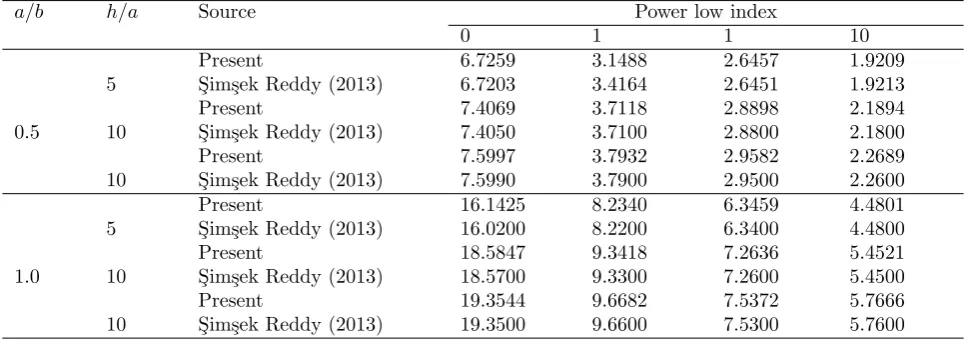
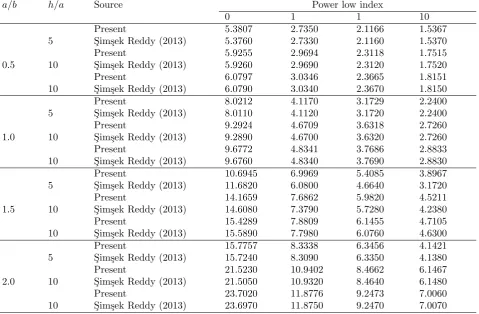
In order to validate the present formulation, the criti-cal buckling load of FG (Al/Al2O3) rectangular plate obtained by the present method were compared with those of S¸im¸sek Reddy (2013) as listed in Table 2 and Table 3. In Tables 2 and 3, the non-dimensional criti-cal buckling load,Ncr=
Ncra2
D of a simply supported
FG rectangualr plate are reported for different plate’s aspect ratios including a
b = 0.5,1.0,1.5 and 2.0, and
plate’s length to thickness ratios a
h = 5,10 and 20, and
power low indexes of the FG material g = 0,1,2 and 10. In Tables 2 and 3 calculations are illustrated for the FG rectangular plate which subjected to uniaxial compression load along the x1-axis (β1 =−1, β2= 0) and biiaxial compression load (β1 =−1, β2 =−1) re-spectively. From the results presented in Tables 2 and 3, it can be seen that there is a good agreement be-tween the present results and those of S¸im¸sek Reddy (2013).
Table 2
Comparison of non-dimensional critical buckling load ( ¯Ncr) of FG plate subjected to uniaxial compression load along thex1-axis (β1=−1, β1= 0).
a/b h/a Source Power low index
0 1 1 10
Present 6.7259 3.1488 2.6457 1.9209
5 S¸im¸sek Reddy (2013) 6.7203 3.4164 2.6451 1.9213
Present 7.4069 3.7118 2.8898 2.1894
0.5 10 S¸im¸sek Reddy (2013) 7.4050 3.7100 2.8800 2.1800
Present 7.5997 3.7932 2.9582 2.2689
10 S¸im¸sek Reddy (2013) 7.5990 3.7900 2.9500 2.2600
Present 16.1425 8.2340 6.3459 4.4801
5 S¸im¸sek Reddy (2013) 16.0200 8.2200 6.3400 4.4800
Present 18.5847 9.3418 7.2636 5.4521
1.0 10 S¸im¸sek Reddy (2013) 18.5700 9.3300 7.2600 5.4500
Present 19.3544 9.6682 7.5372 5.7666
Table 3
Comparison of non-dimensionalcriticalbucklingload ( ¯Ncr) of FG plate subjected to biaxial compression loads (β1=−1, β2=−1).
a/b h/a Source Power low index
0 1 1 10
Present 5.3807 2.7350 2.1166 1.5367
5 S¸im¸sek Reddy (2013) 5.3760 2.7330 2.1160 1.5370
Present 5.9255 2.9694 2.3118 1.7515
0.5 10 S¸im¸sek Reddy (2013) 5.9260 2.9690 2.3120 1.7520
Present 6.0797 3.0346 2.3665 1.8151
10 S¸im¸sek Reddy (2013) 6.0790 3.0340 2.3670 1.8150
Present 8.0212 4.1170 3.1729 2.2400
5 S¸im¸sek Reddy (2013) 8.0110 4.1120 3.1720 2.2400
Present 9.2924 4.6709 3.6318 2.7260
1.0 10 S¸im¸sek Reddy (2013) 9.2890 4.6700 3.6320 2.7260
Present 9.6772 4.8341 3.7686 2.8833
10 S¸im¸sek Reddy (2013) 9.6760 4.8340 3.7690 2.8830
Present 10.6945 6.9969 5.4085 3.8967
5 S¸im¸sek Reddy (2013) 11.6820 6.0800 4.6640 3.1720
Present 14.1659 7.6862 5.9820 4.5211
1.5 10 S¸im¸sek Reddy (2013) 14.6080 7.3790 5.7280 4.2380
Present 15.4289 7.8809 6.1455 4.7105
10 S¸im¸sek Reddy (2013) 15.5890 7.7980 6.0760 4.6300
Present 15.7757 8.3338 6.3456 4.1421
5 S¸im¸sek Reddy (2013) 15.7240 8.3090 6.3350 4.1380
Present 21.5230 10.9402 8.4662 6.1467
2.0 10 S¸im¸sek Reddy (2013) 21.5050 10.9320 8.4640 6.1480
Present 23.7020 11.8776 9.2473 7.0060
10 S¸im¸sek Reddy (2013) 23.6970 11.8750 9.2470 7.0070
In Fig. 2, the influence of the length to thickness ratios, (a/h), on the non-dimensional critical buckling load, Ncr =
Ncra2
D , is illustrated for a functionally
graded (Al/Al2O3) rectangular plate with simply sup-ported boundary conditions while gradient index, g, varies from 0 to 10. From the results presented in Ta-bles 2 and 3 and Fig. 2, it can be observed that the non-dimensional critical buckling load of the FG rect-angular plate increases monotonically, as the length to thickness ratio increases. This isn’t a surprising result since we know higher values of length to thickness ra-tios reduce the stiffness of the structure more effectively than its inertia, thus lower value of the critical buckling load and higher value of the non-dimensional critical buckling load, ¯Ncr=
Ncra2
D , should be expected.
Variation of non-dimensional critical buckling load,
Ncr = Ncra2
D , of a functionally graded (Al/Al2O3)
rectangular plate versus plate’s aspect ratio are illus-trated in Fig. 3 for simply supported boundary con-ditions while the aspect ratios of the plates vary from 0.5 to 3. From the results presented in Fig. 3, it can be observed that the non-dimensional critical buckling load are considerably increased by increasing the as-pect ratio of plate.
From Figs. 2 and 3 it can be observed that by increasing the value of the power law index leads to
re-duction of the amplitude of the critical buckling load. This is due to the fact that higher values of power law index correspond to high portion of metal in compari-son with the ceramic part. In other words, increase in the power-law index results in reduction of elasticity modulus and bending stiffnes implying that the plate becomes flexible. Therefore, it leads to reduction of the critical buckling load.
Fig. 2. Effect of length to thickness ratios (a/h) on non-dimensionalcritical buckling load under biaxial compression load.
4. Conclusions
A Navier method was applied to analysis buckling of functionally graded rectangular plates. The formula-tions were based on exponential shear deformation the-¯
ory and Hamilton’s principle isused to derive the equa-tions of motion and associated boundary condiequa-tions.
Fig. 3. Effect of aspect ratio (a/b) on non-dimensionalcritical buckling load under biaxial com-pression for an FG plate and various material variation parameters(n).
Comparison cases by those reported in the lit-erature for simply supported rectangular FG plates demonstrate high stability and accuracy of the present solution. Presented results herein show the effects of variations of thickness to length ratio, power law in-dexes, and aspect ratio on the critical values of an FG plate. It was shown that increase in the power law index causes the non-dimensional critical buckling to decrease, Also, The increase of aspect ratio increases the critical buckling load, and increase in the length to thickness causes increase in the critical buckling load. All analytical results presented here can provide other research groups with a reliable source to inspect their analytical and numerical solutions.
References
[1] E. Reissner, The effect of transverse shear defor-mation on the bending of elastic plates, J. Appl. Mech-T ASME., 12 (1945) 69-77.
[2] R.D. Mindlin, Influence of rotatory inertia and shear on flexural motions of isotropic, elastic plates, J. Appl. Mech-T ASME., 18 (1951) 31-38.
[3] B. Mokhtar, T. Abedlouahed, A. Abbas, M. Ab-delkader, Buckling analysis of functionally graded plates with simply supported edges, Leonardo J. Sci., 8 (2013) 21-32.
[4] M. S¸im¸sek, J.N. Reddy, Bending and vibration of functionally graded microbeams using a new higher order beam theory and the modified couple stress theory, Int. J. Eng. Sci., 64 (2013) 37-53.
[5] H. Matsunaga, Free vibration and stability of func-tionally graded plates according to a 2-D higher-order deformation theory, Compos. Struct., 82 (2008) 499-512.
[6] S. Yahia, H.A. Atmane, M.S.A. Houari, A. Tounsi, Wave propagation in functionally graded plates with porosities using various higher-order shear de-formation plate theories, Struct. Eng. Mech., 53(6) (2015) 1143-1165.
[7] P. Malekzadeh, A.A. Beni, Free vibration of func-tionally graded arbitrary straight-sided quadri-lateral plates in thermal environment, Compos. Struct., 92 (2010) 2758-2767.
[8] V. Ungbhakorn, N. Wattanasakulpong, Thermo-elastic vibration analysis of third-order shear deformable functionally graded plates with dis-tributed patch mass under thermal environment, Appl. Acousf., 74 (2013) 1045-1059.
[9] J. Reddy, Microstructure-dependent couple stress theories of functionally graded beams, J. Mech. Phys. Solid., 59(11) (2011) 2382-2399.
[10] A.S. Sayyad, Y.M. Ghugal, Bending and free vi-bration analysis of thick isotropic plates by using exponential shear deformation theory, Appl, Com-put, Mech., 6(1) (2012) 65-82.
[11] K. Khorshidi, Effect of hydrostatic pressure on vi-brating rectangular platescoupled with fluid, Sci. Iran: Trans A: Civ. Eng., 17(6) (2010) 41529. [12] N.R. Senthilnathan, K.H. Lim, K.H. Lee, S.T.
Chow, Buckling of shear deformable plates. AIAA J., 25(9) (1987) 1268-71.
[13] K. Khorshidi, M. Khodadadi, Precision closed-form solution for out-of-plane vibration of rectan-gular plates via trigonometric shear deformation theory, Compos. Struct., 3(1) (2016) 31-43. [14] K. Khorshidi, M. Pagoli, Analytical solution for
sound radiation of vibrating circular plates coupled with piezo-electric layers, Compos. Struct., 3(2) (2016) 89-98.
[15] H.T. Thai, D.H. Choi, Size-dependent function-ally graded Kirchhoff and Mindlin plate models based on a modified couple stress theory, Compos. Struct., 95 (2013) 142-153.