DISCUSSION PAPER SERIES
DP12398
THE SURVIVAL AND DEMISE OF THE
STATE: A DYNAMIC THEORY OF
SECESSIONS
Joan Esteban, Sabine Flamand, Massimo Morelli and Dominic Rohner
THE SURVIVAL AND DEMISE OF THE STATE: A
DYNAMIC THEORY OF SECESSIONS
Joan Esteban, Sabine Flamand, Massimo Morelli and Dominic Rohner
Discussion Paper DP12398 Published 26 October 2017 Submitted 26 October 2017 Centre for Economic Policy Research 33 Great Sutton Street, London EC1V 0DX, UK
Tel: +44 (0)20 7183 8801 www.cepr.org
This Discussion Paper is issued under the auspices of the Centre’s research programme in DEVELOPMENT ECONOMICS and PUBLIC ECONOMICS. Any opinions expressed here are those of the author(s) and not those of the Centre for Economic Policy Research. Research disseminated by CEPR may include views on policy, but the Centre itself takes no institutional policy positions.
The Centre for Economic Policy Research was established in 1983 as an educational charity, to promote independent analysis and public discussion of open economies and the relations among them. It is pluralist and non-partisan, bringing economic research to bear on the analysis of medium- and long-run policy questions.
These Discussion Papers often represent preliminary or incomplete work, circulated to encourage discussion and comment. Citation and use of such a paper should take account of its provisional character.
DYNAMIC THEORY OF SECESSIONS
Abstract
This paper describes the repeated interaction between groups in a country as a repeated Stackelberg bargaining game, where conflict and secessions can happen on the equilibrium path due to commitment problems. If a group out of power is sufficiently small and their
contribution to total surplus is not too large, then the group in power can always maintain peace with an agreeable surplus sharing offer every period. When there is a mismatch between
relative size and relative surplus contribution of the minority group, conflict can occur. While in the static model secession can occur only as peaceful outcome, in the infinite horizon game with high discount factor conflict followed by secession can occur. We discuss our full
characterization of equilibrium outcomes in light of the available empirical evidence. JEL Classification: C73, D74, H77
Keywords: Secession, conflict, Dynamic Game, Separatism Joan Esteban - [email protected]
Institut d'Anàlisi Económica, CSIC and BGSE
Sabine Flamand - [email protected] Universitat Rovira-i-Virgili and CREIP
Massimo Morelli - [email protected] Bocconi University, IGIER and Dondena and CEPR
Dominic Rohner - [email protected] University of Lausanne and CEPR
Acknowledgements
This paper has developed from an initial draft written as a contribution to the conference in honor of Shlomo Weber at SMU, April 30, 2016. Joan Esteban gratefully acknowledges financial support from the Ministry of Economy and Competitiveness Grant number ECO2015-66883-P and the National Science Foundation grant SES-1629370. Massimo Morelli wishes to thank the European Research Council, advanced grant 694583. Dominic Rohner is grateful for financial support from the ERC Starting Grant 677595.
Joan Esteban, Sabine Flamand, Massimo Morelli, and Dominic
Rohner2
October 17, 2017
Abstract
This paper describes the repeated interaction between groups in a country as a repeated Stackelberg bargaining game, where conict and secessions can happen on the equilibrium path due to commitment problems. If a group out of power is suciently small and their contribution to total surplus is not too large, then the group in power can always maintain peace with an agreeable surplus sharing oer every period. When there is a mismatch between relative size and relative surplus contribution of the minority group, conict can occur. While in the static model secession can occur only as peaceful outcome, in the innite horizon game with high discount factor conict followed by secession can occur. We discuss our full characterization of equilibrium outcomes in light of the available empirical evidence.
1 Introduction
Most empires or nation states in history have faced secession threats or collapsed due to wars or rebellions, and the types of secession incentives (or lack thereof) vary widely. Some secessions take place in peace: The Roman Empire chose to voluntarily and peacefully split into two similarly large and similarly rich halves characterized
1This paper has developed from an initial draft written as a contribution to the conference in
honor of Shlomo Weber at SMU, April 30, 2016. Joan Esteban gratefully acknowledges nancial support from the Ministry of Economy and Competitiveness Grant number ECO2015−66883−P
and the National Science Foundation grant SES-1629370. Massimo Morelli wishes to thank the European Research Council, advanced grant 694583. Dominic Rohner is grateful for nancial support from the ERC Starting Grant 677595.
2Joan Esteban: Institut d'Anàlisi Económica, CSIC and BGSE; [email protected];
by some salient dierences in social norms (i.e. Western Rome was more and more engaging in Christianity); more recently, after the Fall of Berlin Wall, Czechoslovakia was split peacefully into two similarly large and rich halfs characterised by ethnic dierences.
Other secessions proceed less harmoniously: The collapses of the Soviet Empire and Yugoslavia were accompanied by a series of bloody conicts, and disagreements on whether to split or stay together. In both cases the sizes of the composing regions varied a lot, and while the richest and most productive places were keen to split (i.e. Russia, the Baltic states, resp. Slovenia and Croatia) other regions opposed separation.
The existing academic literature on secessions focuses on static models, while the survival and demise of the state is an inherently dynamic phenomenon, where relative group sizes, inequalities in prosperity and heterogeneity in preferences and social norms aect the inter-temporal trade-os of the various groups engaging in strategic interaction.3 To address this gap in the literature we propose a full-blown
dynamic model of stability and break-down of states.
In the model we consider a country with two groups, which can dier in size, economic productivity and preferences over the type of public good to be supplied. The type of public goods we have in mind are culture, language, legislation, or other identity related collective decisions. There is a cost of setting up or maintaining a State. As long as a non-homogeneous State remains united (which we will call the "union" case), the group in power selects the public goods as well as the surplus sharing. Under secession there are two separate States where in each one a public good is produced and the constant cost of running the State is paid. The overall trade-o is hence between the economies of scale of larger states (due to being able to split the xed administrative cost amongst the full population) versus the cost of preference heterogeneity (the opposition group is not able to select its favored public good). These features of our model are chosen for comparability with the literature. However, we depart from the standard models by assuming that the group in power makes a proposal (either union, peaceful secession or conict), which the group in opposition can either accept or reject, triggering in the latter case costly conict.
3The relative size of groups seems to play an important role, as we will see in the paper.
The game continues with the winning group in power and thus choosing between seceding or becoming the new ruling group in the union. In the latter case, the threat of future conict may induce the group in power to compensate the opposition with larger transfers. The proposal will depend on the weight attached to the future continuation of the game. The game is innitely repeated with secession being an absorbing state (after secession no more strategic decisions are made).
in light of contemporary and historical examples.
There is by now a substantial body of literature on secessions and size of nations that we summarize in the next section. The bulk of the literature focuses on the trade-o between heterogeneity of citizens in terms of preferences and increasing returns to country size. This trade-o is present also in our stage game, but the dynamic analysis makes this static trade-o only one of the tensions to be considered. The focal point of many existing papers is whether there are inter-group [inter-regional] transfers that would prevent a group from choosing secession and the cre-ation of a new country. The various contributions dier in the speciccre-ation of the heterogeneity in the preferences within and across groups and in the nature of the benets of the size of the country. Our paper has a dierent starting point: While remaining together implies that the public decisions will have to be negotiated every period by groups with dierent preferences and priorities, secession implies a poten-tial cost today but no need to bargain with the other group ever again in the future. This inter-temporal argument is in our view an essential ingredient in the reasoning for or against secession, generating a very dierent equilibrium characterization than in a static game. The critical importance of this inter-temporal argument can be appreciated also when considering the complementary problem of union formation: we should expect such a decision to be guided by the expected future payos from the interaction within the union, rather than by the immediate gains.
A second major dierence between our setting and the existing literature is that we explicitly model conict as integral component of the trade-o about whether to secede or not. By conict we do not necessarily mean civil wars. In line with the literature, conict is characterized by the challenging of the status quo and by the expending of resources by both parties in order to increase the probability of being able to impose the preferred alternative. As discussed further below, in the literature on conict there are only few dynamic frameworks, and they typically do not include the option of secession.
producing the public good) goes up, the groups will be less inclined to challenge the status quo. But because of the inter-temporal nature of the problem, the increase in the conict cost also means that players know that challenging the status quo in the future will be more unlikely. This increases the expected payo of taking power and keeping the union: in a union the other party will hardly rebel and the group in power has command on the entire surplus, and produces the preferred public good. The remainder of the paper is organised as follows: Section 2 is devoted to a review of the existing literature. In Section 3 we set up the model. Section 4 characterizes the best Stackelberg equilibria and section 5 relates the equilibrium characterization to contemporary and historical examples. Section 6 concludes.
2 Literature review
The current paper belongs rst of all to the literature on border formation and se-cessionism.4 One key point made by this strand of economic literature is that the
size of countries results from the trade-o between the economies of scale of a larger country size and the costs in terms of heterogeneity of preferences over public goods and government policies.5 The literature distinguishes various potential
determi-nants of the incentives for secession such as region size (Goyal and Staal, 2004), the degree of international openness (Alesina, Spolaore and Wacziarg, 2000, 2005; Gancia, Ponzetto and Ventura, 2017); the degree of democratization (Alesina and Spolaore, 1997; Arzaghi and Henderson, 2005; Panizza, 1999); the optimal level of public spending (Le Breton and Weber, 2003; Le Breton et al., 2011); the presence of mobile ethnic groups (Olofsgård, 2003), the presence of natural resources in po-tentially secessionist regions of a country (Gehring and Schneider, 2017; Hunziker and Cederman, 2017)6; or the presence of external threats (Alesina and Spolaore,
2005, 2006; Wittman, 2000). Bolton and Roland (1996, 1997) focus on dierent preferences for income tax policies emerging from dierent regional income distri-butions.
Further, the literature on secessionism has studied whether there exist
interre-4Excellent reviews of the literature on secessionism are provided in Bolton et al. (1996), Alesina
and Spolaore (2003) and Spolaore (2014).
5See e.g. Friedman (1977), Buchanan and Faith (1987), Barro (1991) and Desmet et al. (2011). 6Collier and Hoeer (2006) provide case study evidence that secessionist movements emerge
gional compensation mechanisms such that potentially seceding regions are better o staying in the union. Haimanko et al. (2005) show that in an ecient union whose citizens' preferences are strongly polarized, a threat of secession cannot be eliminated without interregional transfers. Le Breton and Weber (2003) establish the principle of partial equalization, according to which the gap between advan-taged and disadvanadvan-taged regions must be reduced, but should not be completely eliminated.7 Alesina and Spolaore (2003) point out the diculties of implementing
compensation transfers, such as feasibility and administrative costs, political cred-ibility, or incompatibility with other social goals.8 The recent paper by Gibilisco
(2017) analyzes the potential eects of decentralization in a repeated game in which the periphery, when it is not repressed by the center, may start secessionist mo-bilization that they may win with a probability of success that depends on the accumulated resentment felt by the periphery. Repression feeds future resentment, while a policy of hands o fades it away. The paper nds that even when decentral-ization is optimally chosen by the center, the relationship between decentraldecentral-ization and likelyhood of secessionist unrest is non-monotonic.
A few authors have explicitly introduced a conict technology in the context of separatism. We have already mentioned that in Gibilisco (2017) the periphery may decide to start a costly mobilization that with some probability may end up in secession. Spolaore (2008) analyzes the choice of regional conict eorts when a peripheral (minority) region wishes to secede from the center, focusing on the trade-o between economies of scale and heterogeneity of preferences in a setting where transfers are not possible. Anesi and De Donder (2013) build a static model of secessionist conict with exogenous winning probability, showing the existence of a majority voting equilibrium with a government's type biased in favor of the minority. Our contribution is complementary to theirs, as our dynamic setting features general transfers, and links winning probabilities to group sizes.
In the conict literature there are only very few papers that have explicitly mod-elled incentives for secession. Morelli and Rohner (2015) have built a model allowing for both nationwide and secessionist conict, showing that the most conict-prone
7See also Flamand (2015).
8Related to this, Bordignon and Brusco (2001) analyze whether constitutions should include
situations are those in which the mineral resources of value are mostly concentrated in the minority group region, leading to secessionist pressures. Their empirical anal-ysis nds that indeed the set of situations where most oil revenues accrue in minority regions is a major driver of civil war. One major dierence between our current pa-per and Morelli and Rohner's (2015) static setting is that we have a dynamic model allowing for both conicted and peaceful secession.9
In sum, our paper displays the rst dynamic model of secession, taking into account conict incentives and potentially compensating transfers. This framework allows us to obtain a novel equilibrium characterization of zones of peaceful union, peaceful secession, centrist conict (i.e., endless conict path where no one secedes) and secessionist conict, which is later shown to dier very substantially from the characterization that would be obtained in a static framework.
3 The model
Consider a country with two main ethnic groups, i and j, with population size Ni
and Nj, Ni +Nj = N. If the country remains united, there is a total divisible
surplus denoted by S > 0, and the two groups consider their contribution to the
total surplus Sh, h =i, j, as an important indicator of what they could achieve in
case of secession, i.e.,Si+Sj =S.10 The total surplusSmay obtain from production
as well as from non-produced rents. We denote by A > 0 the cost of running the
State, so that the divisible surplus in a given period is S−A.
Assume WLOG that at the beginning of the game group j is in power. Taking
the equal per capita division of the surplus as a benchmark, we say that j makes
the strategic choice of treating i with λ fairness if the share of surplus received by
group i is λn, where n ≡ Ni/N denotes the share of the opposition group in the
population. On top of the share of divisible surplus, the utility of citizens depends on the type of public goods provided by the group in power. The two groups have dierent preferences over the type of public good to be supplied. The group in power
9Another article studying endogenous country borders and war is Caselli, Morelli and Rohner
(2015). Contrary to our current paper, their static model focuses on interstate wars.
10In reality, in a country in which the two groups are geographically segregated in two separate
chooses the public good they like the most and this gives each of their members a payo dierential, so that if group h is in power they obtains Ph > 0 extra utility
per member of the group over the group in opposition, which gets zero public good utility by normalization. We think of language, culture, legislation, government favored religion as primary examples, but the idea could extend more generally to policies and their dierent utility implications for people of dierent ideologies.
In case of an ethnic secession, with groupsiandj forming new states in dierent
regions, each group would have to incur a cost of setting up or maintaining the state institutions and re-organizing production activities. For simplicity, we assume that for each new State the cost of running it is A, without dierentiating between the
cost of the original State and the cost of each new State. After secession each group could produce its preferred type of public goods. We take the dierential public good utility levelsPj and Pi (in casej ori is in power respectively) as given, representing
the reduced form expected dierential eects.
The player in power j can make three types of proposals: (i) a distribution
of surplus in the union, with fairness λ; (ii) a peaceful secession; and (iii) trigger
conict.
The rejection of a proposal by the opposition opens a socially costly conictual period. The power is challenged and each group has a win probability equal to its population size. The winner can either aim to conquer the power of the union and capture the entire surplus or aim to secede and take away their own surplus forever, making the loser bear the cost of conict D. We assume D < min{Si, Sj} and
A <min{Si, Sj}.
We shall use the following normalized notation: s = Si
S, a= A S, d=
D S, σ =
S N.
Notice that min{Si, Sj} > A implies that S > A+ min{Si, Sj} > A+D. The
latter inequality, or its equivalent 1−a−d > 0, will appear at dierent stages of
our analysis. It is immediate that in a one-shot game the winner in case of conict will always opt for keeping the union. Since min{Si, Sj} −D >0, there is more to
grab if keeping the union. Hence a violent conict leading to secession can be an equilibrium phenomenon only if the game has more than one period.
• in case of equilibrium union
UiU(λ)≡λnS−A
Ni and (1)
UjU(λ)≡(1−λn)S−A
Nj
+Pj; (2)
• in case of secession
UiS ≡ Si−A
Ni
+Pi and
UjS ≡ Sj−A
Nj
+Pj; (3)
• and in case of conict, taking into account that the winner grabs the entire
surplus of that period,
UiC ≡n
S−D
Ni
+Pi
and
UjC ≡(1−n)
S−D
Nj
+Pj
. (4)
We conceive the game as a repeated leader-follower Stackelberg game, in which the group in power acts as leader and the opposition as follower. The timeline is as follows:
1. Production: Each period starts with a group in power, say j, output is
pro-duced, and the surplus S is obtained.
2. Proposal: The group in power chooses over three options: [i] continue as a united country distributing the surplus withλj fairness; [ii] peaceful secession;
or [iii] conict.
4. Exercise of power. If there has been peace, and hence j remains in power,
the announced policies are carried out, these being either (i) the announced distribution of the surplus or (ii) secession. Ifj remains in power because they
have been victorious in the conict, they can choose between implementing secession or keeping the union. In the rst case, they split and take with them their own created surplus (and let the loser bear the full cost of conict, D),
while in the second case they appropriate the entire remaining surplus and start the next period being in power.
If group i wins, they again have the choice between implementing secession
or keeping the union appropriating the entire remaining surplus. Then they enter the next period in power of an independent country or as the rulers of the union.
5. Consumption: At the end of every period the entire remaining surplus is consumed.
The expected payo of future periods is discounted as usual, with the discount factor denoted by δ ∈[0,1].
The only state variable is the identity of the group in power. We will characterize all SPE paths, to then focus on the best SPE selection.11
4 Equilibrium analysis
Due to stationarity, any SPE path ending with a peaceful agreement on a distribu-tion has to consist of an initial distribudistribu-tion proposal by the group in power j that is
immediately accepted by group i. Thus, any SPE path that starts with a rejection
must end either with endless conict or with conict followed by secession.
The group initially in opposition can inuence the initial oer by the group in power by threatening conict. But, this is a credible threat only if such one step deviation has a continuation that is itself sub-game perfect, SP. We now analyze the conditions under which such SP continuations of a rejection of the oer in the rst period do exist. When there are multiple SP continuations we shall choose the one
11Notice that this game bears some resemblance to the mass killings framework in Esteban,
that is best fori. In other words, we are interested in identifying the SP continuation
path starting with conict that the player in the opposition can precipitate. This will give us the minimum payo that any SPE has to grant to this player. Let us start by characterizing the conditions under which a threat of endless conicts is credible.
4.1 Indenite conict path of type
A
The only possibility for the game to last indenitely is when the two players reject each other's proposal every period. Such an innitely repeated sequence of conicts can potentially be a SP path because no player would have a protable deviation (it needs only one to provoke conict). This path involves the destruction ofD surplus
in every period and consists of a sequence of strategies each rejecting the other's proposal when in opposition and making an unacceptably unfair proposal when in power (for instance allocating zero surplus to the opposition).
After any conict, the winner decides whether to secede or to keep the union, appropriating the entire remaining surplus for that period. When the winner decides to secede, the strategic interaction stops.
Therefore, in order to check whether permanent conict is a SP path we need to verify whether the winner will prefer to deviate from continued conict and opt for secession. We shall now compute the value for i of being a winner and continue
with conict, Vcci , and compare it with the value of being a winner in conict and
deviate by choosing secession Vcsi . We shall denote by Vcci the value of being the
loser in the event of conict.
Vcci = S−D−A
Ni
+Pi+δ
Ni NV cc i + Nj N V cc i , and
Vcci = 0 +δ
Ni NV cc i + Nj N V cc i .
Solving, we obtain
Vcci = δ
N i N
1−δN jN V
cc i ,
and hence
Vcci = 1−δ
Nj
N
1−δ
S−D+NiPi−A
Ni
Let us now compute the value of being the winner and secede Vcsi :
Vcsi = 1
1−δ
Si+NiPi−A
Ni
. (6)
Therefore,i will prefer to continue conict rather than deviate and secede if
Sj−D≥
δNj
N (S−D+NiPi−A). (7)
Mutatis mutandis the condition for j to continue to play conict rather than
deviate and secede is:
Si−D≥
δNi
N (S−D+NjPj−A). (8)
Clearly, permanent conict is a SP path followingi's rejection of a proposal byj
whenever (7) and (8) are both satised. We will denote by[A]the set of parameters
satisfying these conditions.
The two conditions above can be rewritten as
s≤(1−d) [1−δ(1−n)]− δ
σ(1−n)(nPi−aσ),
and
s≥d− δ
σn[(n−1)Pj−(1−a−d)σ].
These expressions are constraints on the value of the share of surplus produced by the oppositioni,s, relative to their population size,n. Groupiin opposition prefers
conict to secession if the share of their surplus is suciently small, that is, if the surplus they will grab from the defeated group, 1−s, is suciently large. Similarly
for group j: the size of the surplus produced by the opposition has to be suciently
large to make them prefer conict over secession.
The following lemma summarizes the characterization of the set[A]of parameter
values for which a continuation path of endless conict (type A path) is a SPE.
Lemma 1. Let the opposition player start by triggering conict. Then the necessary and sucient condition for the sequence of endless conicts to be a SPE is that
s≤(1−d) [1−δ(1−n)]− δ
σ(1−n)(nPi−aσ), (9)
and
s≥d− δ
Furthermore, a < d is the necessary and sucient condition for the existence of δA ∈(0,1) such that for any δ > δA the set [A] is empty. The precise threshold on
δ is
δA≡
(1−2d)σ
(1−n)n(Pi+Pj) + (1−a−d)σ
. (11)
We have obtained that the conditions for the most destructive path to be a SPE are rather stringent. For permanent conict to be a SPE, a situation must display low δ and low d.
4.2 The secession threat
If one of the two conditions characterizing[A]is violated, we can study the conditions
under which the continuation threat involves secession.
Let us consider rst the case in which player i chooses secession after being
victorious while j continues to play indenite conict. For player i the payo from
seceding after victory is exactly the one we have computed in (6) and this payo should be larger than continuing conict as in (5). Therefore, player i will trigger
conict and secede after the rst victory knowing that j will always play conict i
Sj−D≤
δNj
N (S−D+NiPi−A). (12)
Using the same notation as before, this condition can be rewritten as
s >(1−d) [1−δ(1−n)]− δ
σ(1−n)(nPi−aσ).
We now have to check the conditions under which player j would continue to
play conict even knowing that i will eventually secede. The value after a victory
of continuing with conict is
Vccj = S−D+NjPj−A
Nj +δ Nj N V cc j + Ni N 1
1−δ
Sj+NjPj−A
Nj − D Nj . Therefore,
Vccj = 1
1−δNj
N
S−D+NjPj −A
Nj
+ δ
1−δ
Ni
N
Sj +NjPj−A−(1−δ)D
Nj
.
The valueVccj has to be larger than the value of opting for secession instead after
the rst victory. That is
Vccj ≥ 1
1−δ
Sj +NjPj −A
Nj
This inequality simplies to
Si ≥D
1 +δNi
N
. (13)
Bringing together inequalities (12) and (13) we completely characterize the set of parameter values for which the path starting with i triggering conict followed by
permanent conict by j and secession by i after rst victory is a SPE. We shall
denote this set by [Bi]. Using the same simplifying notation as above we have the
following result.
Lemma 2. Let the opposition player start by triggering conict. Then the contin-uation path with j playing conict at every iteration and i seceding after the rst
victory is a SPE i the following two inequalities are satised:
s >(1−d) [1−δ(1−n)]− δ
σ(1−n)(nPi−aσ), (14)
and
s > d+δdn. (15)
Furthermore, the set [Bi] is always non-empty.
We now turn to the case in which group j opts for secession at the rst victory
while the opposition group ichooses indenite conict. Groupj prefers secession to
conict when the opposition plays conict whenever inequality (8) is reversed, that is, when
Si−D <
δNi
N (S−D+NjPj−A).
In our simplied notation this inequality can be written as
s < d− δ
σn[(n−1)Pj−(1−a−d)σ]. (16)
Following the same steps as before we can obtain that the condition for i to prefer
continued conict knowing that j seeks secession is
Sj ≥D
1 +δNj
N
,
that is
s <[1−(1 +δ)d] +δdn. (17)
Inequalities (16) and (17) completely characterize the set[Bj]of all the parameter
values for which after i has rejected the starting proposal the continuation with i
Lemma 3. Let the opposition player start by triggering conict. Then the contin-uation path with i playing conict at every iteration and j seceding after the rst
victory is a SPE i the following two inequalities are satised:
s < d+ δ
σn[(1−n)Pj+ (1−a−d)σ] (18)
and
s <[1−(1 +δ)d] +δdn (19)
The set [Bj] is always non-empty.
One nal case in which an initial rejection by i can be sustained by a credible
secession threat is the case in which both groups opt for secession after the rst victory. We can obtain the parameter values for which such continuation of the initial rejection by i is SP. Let us consider the opposition player i. Once victorious,
the payo from secession for player i is
Vcsi = Si+PiNi−A
(1−δ)Ni
.
The payo from triggering a new conict Vcci is
Vcci = S−D+PiNi−A
Ni
+δ
Ni
NV
cc i +
Nj
N
Si+PiNi−A
(1−δ)Ni
− D
Ni
.
Simplifying, one can easily obtain that Vcsi ≥Vcci i
Sj ≤
1 +δNj
N
D. (20)
Using our simplied notation, this inequality can be rewritten as
s≥[1−(1 +δ)d] +δdn.
Doing the same calculations for player j one can easily obtain thatVcsj ≥Vccj i
Si ≤
1 +δNi
N
D. (21)
Using our simplied notation, this inequality can be rewritten as
s≤d+δdn.
Inequalities (20) and (21) completely characterize the set[C]of all the parameter
values for which after i has rejected the starting proposal the SPE continuation is
Lemma 4. Let the opposition player start by triggering conict. Then the con-tinuation path where whoever wins decides to secede is a SPE i the following two inequalities are satised:
s≥[1−(1 +δ)d] +δdn, (22)
and
s≤d+δdn. (23)
The set [C] is empty whenever d < 2+1δ.
4.3 Worst credible punishment after rst rejection
For the sake of simplicity, we assume in what follows that a < d <1/3and δ > δA,
so that, given the above results, both [A] and [C] are empty sets, and hence the
worst SP continuation equilibria in case of initial rejection are either path Bi or
path Bj.
Proposition 5. Let us assume that 0< a < d <1/3 and thatδA< δ <1. Then:
• Under the above assumptions the sets [A] and [C] are empty.
• The union of the sets [Bi]and [Bj] contains all the pairs n, swith n, s∈[0,1].
The intersection of the two sets is non-empty.
The payo foriin the continuation of an initial rejection ofj's oer must be the
maximum that i could guarantee itself. Thus, in the intersection of [Bi] and [Bj],
we assume that the relevant SP is the one giving the highest payo to i.
4.4 The value of rejecting an oer
Let us start by computing the value for i of rejecting the rst proposal followed by
a SP path of type Bi, which we denote ViBi. If in any iteration playeri wins, they
secede and the game ends, and if they lose they get a period pay of zero and enter the new period with j in power playing conict. Hence we have
VBi
i =
Ni
N
Si+NiPi −A
(1−δ)Ni
+ Nj
N δV
Bi
i .
Solving forVBi
i and using our compact notation we obtain
VBi
i =
nPi+σ(s−a)
Let us now compute the value for i of rejection followed by a path of type Bj.
In this case, whenever iwins, they capture the entire surplus (minus destructionD)
and trigger a new conict in the next iteration. When j wins they secede.
The valueVBj
i is
VBj
i =
Ni
N
S+NiPi−A−D
Ni
+δVBj
i
+Nj
N
Si+NiPi−A
(1−δ)Ni
− D
Ni
.
Solving now for VBj
i we obtain
VBj
i =
nPi−aσ
n(1−δ) +
σ(n−d)
n(1−δn)+
sσ(1−n)
(1−δ)n(1−δn). (25)
Solving forVBi
i =V Bj
i we obtain the following threshold:
s= [1−δ(1−n)] (n−d) + (1−n)(1−δn)
n σPi−a
2n−1 .
The implicit function ofsin terms ofnis discontinuous atn= 1/2and it is easy
to show that as n → 1/2 from below, s → −∞ and the opposite from above. We
can also compute that s(n = 0) =a+ (1−δ)d < d given our previous assumptions
and s(n = 1) = 1−d. Therefore, it holds thatVBi
i < V
Bj
i everywhere in [Bi]∩[Bj].
4.5 Full Characterization of Best SPE
We can now characterize the best SPE of the game. In (24) and (25) we have computed the payos to player i from rejection of the initial proposal.
We now compute the equivalent payos forj, VBi
j andV Bj
j . Following the same
steps as above we obtain
VBi
j =
Pj
1−δ +
σ
1−n
1−d
1−δ(1−n) −
a
1−δ +
ns−δn
(1−δ) [1−δ(1−n)]
, and (26)
VBj
j =
Pj(1−n) + (1−a−s)σ
(1−δ)(1−δn) (27)
The potential SPE for the full game can be of the following types: -U: agreement on a distribution of the surplus within the union;
-S: agreement on secession;
-B: conict followed by secession.12
12We have excluded permanent conict A because we have already restricted the parameter
We start by computing the value of keeping the union. For individuals of group
i, VU
i is:
ViU =λNi
N
S−A
(1−δ)Ni
=λ S−A
(1−δ)N =λ
σ
1−δ (1−a), (28)
where λ >0captures the degree of fairness of the allocation of the surplus. Clearly,
λ = 1 corresponds to full equality in the distribution of the monetary surplus.
For individuals of the group in powerj the value of union VjU is
VjU =
1−λNi
N
S−A+NjPj
(1−δ)Nj
= (1−λn) [(1−n)Pj + (1−a)σ]
(1−δ)(1−n) (29)
The value of a peaceful secession VS
i and VjS is
ViS = Si+NiPi−A
(1−δ)Ni
= nPi+σ(s−a)
n(1−δ) and, (30)
VjS = Sj+NjPj−A
(1−δ)Nj
= Pj(1−n) + (1−a−s)σ
(1−δ)(1−n) . (31)
Let us start by comparing the value of a proposal of peaceful secessionVS i with
either VBi
i or V Bj
i . Using (24), (25), and (30), we can immediately obtain that
VS
i > V
Bi
i for all the parameter values. Hence a necessary condition for the rejection
of the secession proposal is that the parameters belong to the set [Bj], that is, it
has to be playerj who will secede after the rst victory. In fact, it is easy to obtain
that rejection can only happen if in addition the parameters satisfy that s <1− d n.
As an additional notation, denote by [R] the set of parameters satisfying the
inequality s <1− d n.
Lemma 6. Let j start by proposing secession. Then the peaceful secession will be
rejected by i if and only if the parameter values belong to the set [R], otherwise the
peaceful secession will be accepted by i. The set [R] is a subset of [Bj].13
Denoting by[K]the complement of[R], playerj knows that for all the parameter
values in [K] they can obtain for sure the maximum between secession and the
associated conict path. Therefore, this will be the minimum payo that player j
has to obtain from a distribution within the union. If the parameter values belong to [R], so that i would not accept a secession, a distribution within the union is
13The last statement follows from strictly increasing and concave s(n) = 1− d
n with respect to
a SPE if the two players obtain a payo at least as high as the one they obtain by following the conict path of type Bj. Otherwise, the SPE starts with conict
followed by the secession of j.
Denote by λS
j the fairness oer by j that, if accepted, would make j indierent
betweenU and S outcomes. Similarly, denote byλBj
i and λ Bj
j the λ's of indierence
with respect to the conict payo for i and j respectively. Using this notation and
the simple partition of the space described above with [R] and [K], we prove the
following characterization result:
Proposition 7. For every array of feasible parameter values there is a unique SPE. The types of SPE are as follows:
• Peaceful Union: j proposes a distribution with λi fairness and i accepts it
when:
(n, s)∈[R] and λBj
i ≤λ Bj
j and λ Bj
i ≤
1
n
(n, s)∈[K]∩Bi, s≤ 1−dn and λBi i ≤λSj and λ Bi
i ≤
1
n
(n, s)∈[K]∩Bi, s > 1−dn and λ
Bi
i ≤λ Bi
j and λ Bi
i ≤
1
n
(n, s)∈[K]∩Bj and λ Bj
i ≤λSj and λ Bj
i ≤
1
n
• Peaceful Secession: j proposes secession and i accepts it when:
(n, s)∈[K]∩Bi, s≤ 1−dn and λSj < λ
Bi
i
(n, s)∈[K]∩Bj and λSj < λ
Bj
i
• Conflict Secession: j's proposal is rejected and either i or j secedes after
the rst victory when:
(n, s)∈[R] and λBj
i > λ
Bj
j or λ Bj
i > n1
(n, s)∈[K]∩Bi, s > 1−dn, and λBi i > λ
Bi
j or λ Bi
i >
1
n
4.6 Characterization result for
δ
→
1
The key λ thresholds permitting to identify the dierent equilibria become simpler
when δ →1:
λj ≡λ
Bj
j =λ Bi
j =λ S j =
σs
nhPj(1−n) +σ(1−a)
i (32)
and
λi ≡λ
Bj
i =λ Bi
i =
nPi+σ(s−a)
nσ(1−a) . (33)
It becomes irrelevant which group provokes secession after the rst victory. After all, in both cases the two players will have the secession payo forever. It also becomes undistinguishable from the case in which secession starts in the rst period. In other words, the great simplication of the limit case is that we have just one critical fairness level for each group.
We can easily obtain
Lemma 8. The degrees of fairness (λi, λj) satisfy
λi < λj i s < sU ≡
[(1−n)Pj
σ + (1−a)][a−n Pi
σ]
(1−n)Pj
σ
. (34)
Further, the feasibility of transfers implies that
λi 6
1
n i s6s
λ ≡1− nPi
σ . (35)
Using this information we can characterize the SPE in terms of the parameter values. We know that unless the group in power prefers secession, λj ≥ λi is a
necessary and sucient condition for a peaceful union to be a SPE in which the group in power will oer λi to the opposition. Here we give a complete characterization of
the SPE.
Proposition 9. For δ →1 the SPE is:
• Peaceful Union i s ≤sU;
• Peaceful Secession i s > sU and either s < 1−dn and (n, s) ∈ Bi or
s >1− d
• Conflict Secession i s > sU and either s ≥ d
1−n and (n, s) ∈ Bi or
s ≤1− d
n and (n, s)∈Bj.
Inequality (34) tells us whether the degree of fairness that j has to display to
make the opposition accept union rather than conict is not as high as the maximum
j would tolerate before preferring any other option. Therefore, the necessary and
sucient condition for there to exist a level of fairness that makes union a SPE is that the pair (n, s) satises that s ≤ sU(n). Let us examine the properties of
the sU(n) function. We start by noting that sU is strictly decreasing and concave
function. Since we are assuming that min{Pi
σ, Pj
σ } > a,14 we have that s
U(0) =
a+ (1−a)aPσ
j < 1 and limn→1s
U = −∞. Therefore the larger P
i and Pj relative
to the economic surplus σ, the smaller is the set of parameter values for which a
peaceful union is a SPE. Finally, an increase in the cost of running an independent state a enlarges the set of parameter values for which union is a SPE.
Summing up the analysis of the SPE with peaceful union, we nd that the opposition should not be too powerful neither in population size nor in the share of surplus they produce. The size of the threshold values for the population and economic power yielding union as a SPE increases with a and decreases with the
size of Pi and Pj. Note that these threshold values are independent of d.
When a peaceful union is not possible we have that secession is a SPE, either by a peaceful agreement or after a preceding conict.
There are two areas of parameter values in which the SPE entails conict followed by secession, and both display a mismatch between the relative strength and the relative productivity of the opposition group. One area corresponds to the case in which the opposition produces a high share of the surplus (high relative productivity) and they are not very large in population (low relative strength). Secession is protable to the opposition group because they will control a large surplus. Because of this reason, the group in power nds unacceptable the size of the transfer to the opposition necessary to making them accept the union. Since the group in power is the largest, they have a high probability of winning in conict and grab a large surplus. Hence, group j prefer to postpone secession as much as possible by
triggering conict until the opposition wins and secedes.
14This is equivalent to assuming that min{N P
i, N Pj}> A, that is the aggregate benet of the
The second area consists of the SPE paths in which the opposition triggers conict in every period until group j wins and secedes. Because the opposition is
relatively low productivity but is large in population size (high relative strength), they have an advantage in conict. To see this clearly, think of the group in power being a tiny minority producing almost the entire surplus. It is immediate that it pays the super-majoritarian opposition to trigger conict indenitely with the near certainty of victory. In view of this, the group in power nds it optimal to aim to separate from the large and poor group.
In both cases, not surprisingly, an increase in the cost of conict reduces the set of parameter values for which conict followed by secession is a SPE. Also aligned with intuition, the value of the public good payos relative to the economic surplus is not relevant here. The reason is that we are comparing two paths both yielding secession and that hence dier on whether to reach it either by agreement or after conict. And this essentially depends on d.
Peaceful secession is a SPE when the opposition group is large and the dierences in productivity with the other group are small. In this case, the opposition has a signicant chance of winning a conict. Since the productivities of the two groups are not very dierent, the main advantage of conquering power or of seceding is the possibility of producing the most preferred public good. In order to keep the union, the group in power would have to compensate economically the opposition for giving up on their preferred public good. Since the productivity of the two is similar, and given that the opposition is too large to be compensated from the perspective of the group in power, they both prefer to bear the cost of a separate state and enjoy the public good most preferred by each group.
Figure 1 depicts the dierent equilibria on the (n, s) space ([0,1]×[0,1]) for
δ = 1, σ = 1.5, Pi =Pj = 0.5, d= 0.3and a= 0.15.15
Figure 1: Equilibria with δ= 1
1 0 0,1 0,2 0,3 0,4 0,5 0,6 0,7 0,8 0,9 0,7
0,3 0,35 0,4 0,45 0,5 0,55 0,6 0,65
n
s Peaceful
Conflict
Conflict
Union
Secession i secedes
j secedes
Let us use this set of parameter values to compare the implications of our model with the basic results in the literature. In Alesina and Spolaore (1997) and Spolaore (2008) the larger the size of the minority group in opposition the more likely secession will take place. The increase in the winning probability also has the same eect. In contrast, Anesi and De Donder (2013) obtain that such an increase in population size has ambiguous eects on the likelihood of secession. Here the eect of an increase
in n which also increases the win probability depends on the productivity of
the group in opposition. Even if the opposition group is arbitrarily small, if their productivity is high say, they produce above half of the total surplus they will reject any proposal and reach secession after a sequence of conict periods. Union requires the opposition be small in population size and not too productive. If the opposition group is larger than 25% of total population, union is not an option. If
the group is suciently productive they will opt for conictual secession, else we shall have a peaceful secession. But, once the opposition goes beyond 43% it is the
group in power that might precipitate a violent separation, else a peaceful secession.
And the larger is n hence smaller the group in power the larger is the set of
parameter values with conictual secession.
will take place only when there is a substantial imbalance between population size and share of surplus, that is when there are important dierences in productivity".
4.7 Equilibria with short-sighted players
In order to show the importance of a dynamic theory for rationalizing secessions, in this section we characterize the equilibria for the alternative extreme case of δ= 0,
i.e., the static benchmark.
Fundamental aspects of the model change when only the present costs and bene-ts count. Challenging a proposal leads to conict with a value that solely depends on the one period cost and potential benets from grabbing surplus. Clearly, as long as D <min{Sj, Si}, the winner of this conict will take the power of the entire
country and expropriate the entire surplus, rather than seceding. In terms of the model, in the static benchmark the only threat the opposition has is standard con-ict, while the path A of endless conict is not, as we have seen, a credible threat
for suciently high discount factor.
The static Stackelberg game has a simple equilibrium, where the group in power chooses the best proposal, taking into account the only threat available to the group in opposition.
Let us start the analysis by characterizing the best reply by the opposition group to any proposal. Then, knowing this, we shall obtain the equilibrium proposals made by the group in power.
There always exists a level of fairness which we denote by λA
i for which the
oppositioniweakly prefers the union over conict. However, the transfer associated
with λA
i might be unfeasible or unacceptable to the group j in power.16
Let us examine the conditions under which i will accept or reject a peaceful
secession proposal. In view of (3) and (4) player i accepts a secession proposal i
Si+NiPi−A
Ni
≥ S+NiPi−A−D
N .
Using our normalized notation, the condition can be rewritten as follows Lemma 10. Player i accepts secession if proposed by j i
s≥ζ(n) = a+
1−a−d−Pi
σ
n+ Pi
σn
2. (36)
16The other type of subgame is the case in which the group in power triggers conict. In that
In sum, we have the following points: (i) conict is responded with conict; (ii) proposed secession is responded with acceptance if s ≥ ζ(n) and with conict
otherwise; and nally (iii) the union will be accepted provided λ≥λA
i , otherwise it
will be rejected.
Given the above characterization of the best reply by the opposition group, we now examine the preferred proposals by the group in power. The following proposition is proven in the appendix. Denote by nc the value of n such that
1
n −
1−a−d+Pi
σn
1−a = 0.
Similarly, denote by ncc the value of n that constitutes the positive solution of
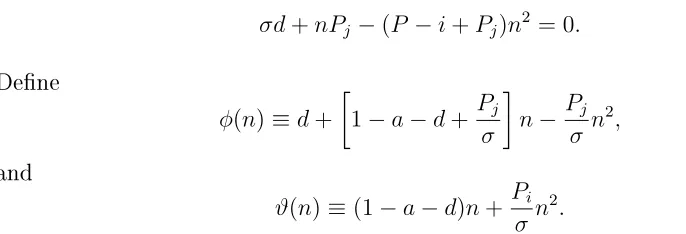
σd+nPj −(P −i+Pj)n2 = 0.
Dene
φ(n)≡d+
1−a−d+Pj
σ
n− Pj
σ n
2,
and
ϑ(n)≡(1−a−d)n+Pi
σn
2
.
Proposition 11. The unique equilibrium when δ= 0 is as follows:
• Letn≤min{nc, ncc}.17 Then, for the parameter values such thats∈[ζ(n), φ(n)]
the equilibrium is peaceful secession and otherwise the equilibrium is a fair union.
• Let min{nc, ncc} ≤n <1 so that d < Pi
σ. Then,
for all s≥ϑ(n), the unique equilibrium is conict;
for all φ(n)< s < ϑ(n), the unique equilibrium is conict.
for all ζ(n)≤s≤φ(n), the unique equilibrium is secession; and
for all s < ζ(n), the unique equilibrium is conict.
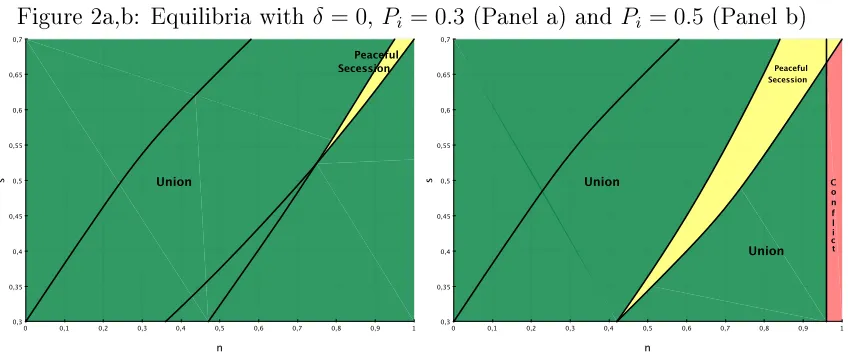
Figure 2a,b depicts the dierent equilibria on the (n, s) space ([0,1]×[0,1]) for
δ = 0 and same other parameter values as for Figure 1: σ = 1.5, P j = 0.5, d = 0.3
and a= 0.15.
17Note that whend >Pi
Figure 2a,b: Equilibria withδ = 0, Pi = 0.3(Panel a) and Pi = 0.5 (Panel b)
1 0 0,1 0,2 0,3 0,4 0,5 0,6 0,7 0,8 0,9 0,7 0,3 0,35 0,4 0,45 0,5 0,55 0,6 0,65 n s Union Peaceful Secession 1
0 0,1 0,2 0,3 0,4 0,5 0,6 0,7 0,8 0,9
0,7 0,3 0,35 0,4 0,45 0,5 0,55 0,6 0,65 n s Peaceful Union Secession C o n l f i c t Union
The intuition is as follows. Let us start with the cased > Pi
σ (Panel a). Since the
cost of conict is high relative to the gain of implementing the most preferred public good, conict is never an equilibrium. It is always feasible for the group in power to buy o the opposition. Hence the only possible equilibria are a fair distribution within the union and agreed secession. If the opposition is suciently large and productive, then the equilibrium is peaceful secession. On the one hand, a relatively large and rich opposition prefers peaceful secession to conict, since the benets from going to conict and possibly grabbing the whole surplus are not that high (the cost of conict is high and the opposition is almost as productive as the group in power). On the other hand, such relatively large and rich opposition is expensive to buy o, and thus the group in power prefers peaceful secession to union.
When d < Pi
σ (Panel b) and the opposition is suciently large, group j is no
longer willing to concede a very high λ to group i, and hence the red conict area
appears in the right Panel b of Figure 2. Observe, however, that there is no conict when s is suciently large, since in that case the opposition prefers a peaceful
secession to conict, and so does the group in power.
With a higher cost of conict, the cost of rejection of a proposal goes up. Knowing this, the group in power can buy o the opposition for less. An increase in Pi,
starting fromPi < σd= DN, has the eect of broadening the set of parameter values
for which agreed secession is the equilibrium behaviour. Further, as soon as Pi > DN,
power and the opposition prefer peaceful secession to conict.
Increasing the returns to scale lowering A or the preference diversity
increasing Pi has the eect of broadening the set of parameter values for which
secession is the equilibrium. These predictions are broadly in line with the ones obtained by Alesina and Spolaore (1997): when the size of the opposition becomes suciently close to 1/2 the possibility of secession reaches its maximum. In our
case, this prediction is qualied by requiring the productivity of this group, s/n, be
around 2/3 of the national average.
However, when we compare Figures 1 and 2 with and without valuing the future the predictions of our dynamic model profoundly depart from the predic-tions referred to above. When the future doesn't count, the peaceful union is the equilibrium, except for a very restricted set of parameter values, as described above. In a dynamic setup the weighing of the future benets from seceding can outweigh the one-shot cost of conict. Hence the demands for accepting to remain in the union become unaordable and a peaceful union becomes less likely.18 This leads to
either agreed secession or one party triggering conict in order to enjoy the innite stream of utility from secession.
We now examine the dierent SPE for intermediate values of the time discount factor.
4.8 Intermediate
δ
To see the role of the time discount factorδbeyond the sharp comparison of Figures 1
and 2a,b, consider rst the space of parameters where the continuation equilibrium after a proposal rejection would be one where j would aim for secession at rst
victory while i would continue ghting for power in the united country. The value
of eventually seceding forj increases as the discount factor increases. Hence j wants
to retain a higher share of the surplus in case of peace with respect to low values of
δ where the outside option is continuous conict. Consequently, the set of equilibria
with a peaceful union has to be smaller in the dynamic than in the static game. And the higher is the discount factor the greater the dierence between the predictions. The same argument holds true for the case in which the opposition plans to secede after the rst victory, i.e., we are in Bi. The time discounted payo from
18A similar logic can be found in McBride and Skaperdas (2014). In a model of repeated conict
this strategy is larger than the continued conict path, and the more so the higher is the discount factor. Therefore, their demands to accept a peaceful distribution in the union will be higher and hence harder to satisfy.
To clarify further the role of the future, let us now consider a few intermediate examples for δ= 0.6,0.8,0.96, and 1 (as in Figure 1). The rest of parameter values
are as above: σ = 1.5, d = 0.3, a = 0.15, and Pi =Pj = 0.5. Notice that with such
high dwe shall not have permanent conict as a SPE for high time discount factors.
We discuss later the case of a small d relative to a.
Figures 3a, 3b: Equilibria with δ= 0.6,0.8.
1 0 0,1 0,2 0,3 0,4 0,5 0,6 0,7 0,8 0,9 0,7 0,3 0,35 0,4 0,45 0,5 0,55 0,6 0,65 n s Peaceful Conflict Union Secession j secedes Union 1 0 0,1 0,2 0,3 0,4 0,5 0,6 0,7 0,8 0,9 0,7 0,3 0,35 0,4 0,45 0,5 0,55 0,6 0,65 n s Peaceful Conflict Conflict Union Secession i secedes j secedes
Figures 3c, 3d: Equilibria with δ= 0.96,1.
1 0 0,1 0,2 0,3 0,4 0,5 0,6 0,7 0,8 0,9 0,7 0,3 0,35 0,4 0,45 0,5 0,55 0,6 0,65 n s Peaceful Conflict Conflict Secession i secedes j secedes Union 1
0 0,1 0,2 0,3 0,4 0,5 0,6 0,7 0,8 0,9
0,7 0,3 0,35 0,4 0,45 0,5 0,55 0,6 0,65 n s Peaceful Conflict Conflict Union Secession i secedes j secedes
The sequence of the four Figures 3a,b,c,d has some common features. In all cases, we have an area in which peaceful secession is the SPE. This is the case when the opposition group is suciently large. At the same time, the productivity of this
spite of these common features we observe that, in line with our argument above, as the future counts more and more the benets from seceding (i.e., producing own public good and enjoying own surplus) enjoyed forever dominate the one-shot cost of conict. Hence, we observe that the parameter values for which union is a SPE shrink towards the lowest group size for the opposition and at the same time the case for conict leading to secession expands. Overall, we shift from a situation where union is the SPE for most of the parameter values to a situation where secession peaceful or conictual becomes the dominant SPE.
In contrast with the existing static models of secession, we obtain in our dynamic setting the novel prediction that as the time discount factor increases, the case for secession becomes more general. More interestingly, the set of parameter values for which conictual secession is the SPE becomes the largest. As for a peaceful union, the maximum size of the opposition group compatible with this being the SPE depends on the size of the surplus they produce. The smaller is the population size of the opposition, the higher the surplus share compatible with union being a SPE.
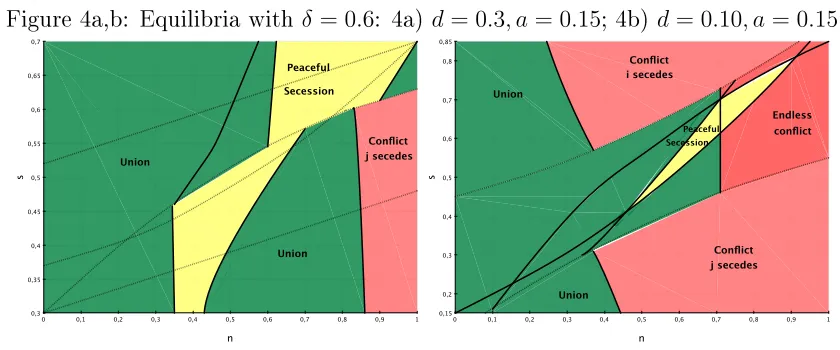
Figure 4a,b: Equilibria with δ= 0.6: 4a) d= 0.3, a= 0.15; 4b) d= 0.10, a= 0.15
1 0 0,1 0,2 0,3 0,4 0,5 0,6 0,7 0,8 0,9 0,7 0,3 0,35 0,4 0,45 0,5 0,55 0,6 0,65 n s Peaceful Conflict Union Secession j secedes Union 1
0 0,1 0,2 0,3 0,4 0,5 0,6 0,7 0,8 0,9
0,85 0,15 0,2 0,3 0,4 0,5 0,6 0,7 0,8 n s Peaceful Conflict Conflict Union Secession i secedes j secedes Union Endless conflict
In order to complete our analysis, let us now examine the case with d < a in
which innitely repeated conict can be a SPE. Figure 4a is the same as Figure 3a with δ = 0.6. This is to be contrasted with Figure 4b, which also has δ = 0.6 but
d = 0.10 and a = 0.15. Since conict is less costly, we see now a larger share of
of the opposition group is suciently large about 0.7 in our numerical example and their productivity is moderately below the national average.
5 Empirics
The equilibrium characterization of our model contains predictions about parameter values where union or secession should prevail, and about conditions for peaceful vs conictual secessions. We take the case of δ → 1 as our baseline and evaluate rst
how such predictions align with the existing evidence.
5.1 Existing evidence
5.1.1 Presence of particularly rich or particularly poor minorities being associated with secessionist conict
In our theory there is a zone of secessionist conict where the opposition group is small or intermediate in size yet highly prosperous. In such a situation our theory predicts that this prosperous group seeks secession and this if necessary by force. There are many examples of secessionist conicts with resource-rich ethnic mi-nority groups wanting to split.19 Examples include the armed separatist movement
in the now independent Timor-Leste, historical ghting in Nigeria's Biafra region and recent ghting in the Niger Delta regions of Nigeria, Katanga's attempt to secede from the Congo from 1960 to 1963, Basque country's armed struggle for in-dependence from Spain, the rebellion of the Aceh Freedom Movement in Indonesia starting in 1976 and the armed ght of the Sudan People's Liberation Army be-ginning in 1983. Other ethnically divided countries with separatism linked to large local natural resources include Angola, Myanmar, Democratic Republic of Congo, Morocco and Papua New Guinea.
While in the examples above the prosperity of separatist regions has been linked to natural resource abundance, there are many more cases where prosperous regions aim to secede even if the source of wealth are not spoils from nature. Conicted se-cessions from regions that were substantially richer than the country average include Slovenia and Croatia's bids to split from Yugoslavia, or Eritrea's war of
indepen-19This draws on the more detailed accounts of Ross (2004), Collier and Hoeer (2006) and
dence from Ethiopia.20 In all of these cases the secessionist region is prosperous
relative to the rest of the country and is small or intermediate in size. In line with our model, this creates an explosive blend.
Not only the richest but also some of the poorest regions seek to split. Namely, there are anecdotal and case study accounts that both the poorest and the richest regions tend to develop grievances against the central state and build nationalist movements (see Gourevitch, 1979; Horowitz, 1985; Bookman, 1992). Further, draw-ing on a sample of 31 federal states, Deiwiks, Cederman and Gleditsch (2012) show that secessionist conict takes place in regions that are either substantially below country average or substantially above average, with average-income regions being the most peaceful. While the rich wanting to split is perfectly in line with our model, the other part of their results requires explanation.
First of all, it seems empirically undistinguishable who of the two parties did trigger conict. We observe conict and eventual secession. Further notice that in the case with the group in power being the one wanting to split, this could as well materialize in an unfair share over the collective surplus, thus inducing the opposition to rebel. Therefore, the theoretical distinction on which party is the one interested in triggering conict and split seems unlikely to be discernable on the basis of observed data.
Second, the important thing here is that the measures for horizontal inequality used are post-transfer measures, while our variable sreects the pre-transfer
poten-tial. Put dierently, a region can end up poor either (i) due to lack of economic potential (in which case it denitively does not want to split), or (ii) due to exploita-tion by the government (in which case it actually may want to split if the economic potential s is large and poverty is only due to exploitation). The currently
avail-able data does not allow to distinguish between poverty by lack of potential versus poverty by exploitation. Take for example the case of separatist Chechnya, which has a living standard well below the Russian average, but lies in an oil- and gas-rich region, hence having a potentially large s. According to Cederman, Gleditsch and
Buhaug (2013: 113), Chechen separatism has been fuelled by the fact that the So-viet state had economically discriminated Chechen to the benet of Russians. And
20In 1993 when Eritrea obtained independence, its GDP per capita (at constant 2005 US
if indeed Chechnya's poverty is due to discrimination rather than lack of economic potential, then its pushing for secession is perfectly in line with our framework.21
5.1.2 Evidence on separatism being less violent when the groups involved are of intermediate or large size and of similar prosperity
Our framework generates further predictions. In particular, according to our equi-librium characterisation there is peaceful secession when the opposition group is of intermediate or large size and is similarly rich as the governing group. For exam-ple the split between Czech Republic and Slovakia two places of comparable size and prosperity has been peaceful, as has the split of ancient Rome in two similar halves West and East Rome. Britain is of similar GDP per capita as the EU average and of large size. Its split from the EU has been so far carried out within the boundaries of the law. Other examples of peaceful secessions between similarly sized and prosperous partners include Singapore-Malaysia, Austria-Hungary and Norway-Sweden (see Young, 1994).
Another telling illustration is oered by the collapse of the Soviet Union at the beginning of the 1990s. While separatist demands were met with violence in groups of relatively small size (e.g. Tbilisi, Georgia, in April 1989; in Baku, Azerbaijan, in January 1990; and in Vilnius, Lithuania, in January 1991), the declaration of sovereignty of Yeltsin's Russia, the heavyweight of the USSR, in June 1990 and its further drifting towards independence did not result in signicant violence (see McCauley, 2017).
5.1.3 Evidence on peaceful union when minority groups are small
According to our setting, we expect the survival of peaceful union when the groups out of power are of small size and not overly productive or endowed.
When confronting this prediction to the empirical facts, note that many long-lasting states are either characterised by ethnic homogeneity or extreme ethnic frac-tionalisation, while ethnically polarized countries are less likely to experience per-sistent peaceful union (Montalvo and Reynal-Querol, 2005; Esteban, Mayoral and Ray, 2012). As predicted by our model, when potential separatist groups are absent
21According to Collier and Hoeer (2006) also Bangladesh's split from Pakistan and the Southern
(in the case of ethnic homogeneity) or very small in size (in the case of high eth-nic fractionalization), setting up their own state would be very costly, and peaceful union can be more easily sustained. One can think for example about the cases of German-speaking Südtirol in Italy, Martinique and Guadeloupe in France, Galicia in Spain or the Sami people in Northern Scandinavia.
5.1.4 Evidence on permanent conict
As shown above, for permanent conict to occur in equilibrium a country must be characterized by low δ and low d, a situation that could describe e.g. some
Sub-Saharan countries. Recall that a lowdis the correct parametric assumption when the
few sources of wealth are mineral resources yet to be extracted and the destruction costs of battles are low. It is a standard result in the literature that conict incidence correlates positively both with poverty and natural resource abundance (see e.g. Collier, Hoeer and Rohner, 2009). There is also statistical evidence that conict is associated with low redistribution levels (Rohner, 2009), which is also a feature of the permanent conict path characterized above.
5.2 New stylized facts
5.2.1 Words of caution: Three pitfalls
Below we shall present some simple stylized descriptive statistics, linking n and s
to union, secessionist conict, centrist conict and accepted secession.
To start with, some words of caution are in order. There are a variety of problems ruling out a complete empirical analysis, and hence all that will be presented below can be seen as suggestive correlations at best.
There are three important limits to any formal empirical test of our theory: (i) measurement error, (ii) conceptual mismatch between our variables and the currently available data, (iii) variability of model predictions depending on other parameter values.
survey data suers from rather limited coverage and reporting bias (dierent groups may interpret the same question dierently, and have dierent wealth structures hampering comparison based on simple survey questions). Second, there are night-light measures from satellites (NOAA, 2014) which can serve as proxies for economic activity in ethnic group homelands (see Henderson et al., 2012; Alesina et al., 2016). Given that these measures are left- and right censured, they are not very good at picking up neither very low levels of income in very rural areas nor very high income levels in urban regions. While this may not be a major problem for other applications, it is particularly problematic in our case, as many secessionist conicts take place in areas close to the border and far from the capital. If these places are on average more rural than for other outcomes, then estimations could suer from non-classical measurement error (i.e. measurement error could be higher for secessionist conicts than for other outcomes). The third, and for our purpose maybe most promising option are G-Econ data (Nordhaus et al., 2006) which can be used to proxy ethnic group level incomes. However, the units of G-Econ are rather large with respect to the typically ne-grained patterns of ethnic group location, making also such measures relatively imprecise.
The second pitfall for measurement is conceptual: In our model, the variable
s captures the pre-transfer economic production and hence the economic potential
after a potential secession. What is picked up, in contrast, by all measures above is the post-transfer incomes. If for example a group is very productive and with high economic potential, but heavily exploited by the governing group, this ethnic group would be classied as poor in our data, while however its potential after secession would be large.22 This could lead to the misleading correlation that poor groups
want to split, while according to our framework it is the groups with big economic potential that seek secession.
The third empirical complication is that especially for the variablesthe outcomes
for a given s can depend quite substantially on other variables such as δ (see the
Figures 1, 2 and 3). The fact that some of these other parameters are not easy to measure adds a further diculty for confronting the model to the data.
With all these limitations and pitfalls in mind, we still present a set of descriptive stylized facts below. This should be seen as purely suggestive correlations, as no
22For instance, Burgess et al. (2015) show that the location of public infrastructures is strongly