Volume 5 • Issue 2 • October 2019
ISSN 2206-4346
www.anjsbes.net.au
Development Strategy of Corn Commodity in the Framework
of Rural Farm Enhancement in Grobogan Regency
Yoga Nindhita1, Avi Budi Setiawan2, Rokhmad Budiono3
1Department of Management, STIESA Surabaya, Indonesia, 2Department of Economic Development, Universitas
Negeri Semarang, Indonesia, 3Department of Management, Semarang School of Economics, Indonesia
1. Introduction
The development of agriculture sector needs to be implemented to improve agriculture sector in the form of increasing production output and quality and able to increase the welfare of farmers. Therefore, it is expected that agriculture sector will have competitiveness and capable of prospering business actors in it socially and economically. The formulation of agricultural sector development policy strategy needs to be implemented. Therefore, considering the agricultural problems in Indonesia require a comprehensive solution. Many factors of production affect the output of agriculture commodities so that it needs to be done a clear identification for the compilation of a series of agricultural sector development policies.
The high production of agricultural commodities and food crops in the Central Java contributed by each district/city in the region. Most of the regencies/cities are agrarian areas where the agricultural sector becomes the economic base so with the agrarian economic structure of the regencies/cities directly contributes to the production of agricultural commodities in Central Java. Regencies that have agrarian structures and have a large contribution to the production of agricultural commodities usually are districts/cities that have a relatively large area and have a large population as well.
Grobogan regency is the third largest district in Central Java consisting of 18 districts. With large area potential makes Grobogan regency as one of the food granaries in Central Java even Indonesia, majority of Grobogan peoples also work in agriculture sector. The agricultural sector is the largest contributor in gross regional domestic product (GRDP) from year to year. With large agricultural land area and availability of various factors of production and output of large agricultural sector and there are various kinds of agricultural commodities (rice, corn, and soybean), the development of agriculture sector is needed to be done to increase the competitiveness of agriculture sector and increase farmer’s welfare.
Abstract
The policy strategy arrangement to develop agricultural sector is an important thing because agricultural sector in Indonesia has various problems and needs a comprehensive solution. Mainly regencies in Central Java provinces are agriculture region where agricultural sector became a base economy so that with agriculture economic structure from regencies in Central Java provinces directly give a contribution toward agriculture commodities production in Central Java provinces. Corn is one of the main agriculture commodities after paddy in Grobogan regency. There is a big demand of corn in the market. The strategy to develop corn farming in Grobogan regency needs to do with various criteria and alternative. It is also important to consider several aspects which have an important role on agriculture sector where all of the aspects are a manifestation of agricultural agenda from upper course until lower course.
Keywords: Strategy; Agriculture; Grobogan Regency
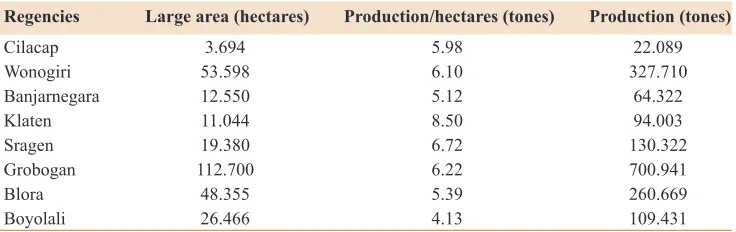
Corn is the main commodity of Grobogan regency after paddy, the necessity for corn in the market is huge. Corn crops are commonly used for animal feed and public consumption. Grobogan regency is also the backbone of corn production map in Central Java. Farmers in Grobogan regency generally grow corn once a year if their rice field is irrigated, but if the land is characterized by rainfed, the maize will be planted twice a year. In addition, if the farmers grow maize with intercropping system in the forest or fields, then every year there will be corn harvest for 3 times (Table 1).
The high contribution of Grobogan regency to the total production of agricultural commodities in Central Java, especially maize makes Grobogan regency become one of the corn centers in Central Java. Therefore, this condition will impact on the bigger potential farming land. However, the GRDP value of Grobogan regency is low compared to other regencies and cities (Central Statistics Bureau, 2015).
The potential of agriculture sector owned by Grobogan regency must be balanced with a series of clear and applicative development strategies, considering that corn is an excellent commodity which is also a major contributor to the overall agricultural output of Grobogan regency, besides, it is also the main crop grown by farmers in Grobogan district.
Increasing the welfare of corn farmers and increasing the output of maize farming are a goal to be achieved by the government and all elements of interest in the agricultural map of Grobogan regency; therefore, a comprehensive set of strategies and policies for corn commodity development is needed. The strategy approach of corn farming development in Grobogan district should prioritize the aspect of community welfare. Therefore, in this research, the approach of strategy development of corn farming is done based on the analysis of choice of criteria and alternative strategy of corn commodity development.
In a study that conducted by Puspitasari (2008) to look at the corn agribusiness system in Grobogan district and the strategy of strengthening its performance. Researchers conducted a study in Pulokulon subdistrict because this subdistrict is the largest land and corn production area in Grobogan regency. The data analysis used is using Analysis Hierarchy Process to formulate strategy of strengthening agribusiness system of corn.
2. Research Methods
In the preparation of this study, the type of data that used by researchers is primary data and secondary data. Primary data were obtained from direct interview with key person in corn farming using questionnaire and interview guide. The secondary data were obtained from another sources such as form of text, papers, research report, books and others. The required secondary data are obtained from the Central Java BPS record, the Food Crops, and Horticulture Agency of Grobogan District and from the Agricultural District records of Grobogan.
In analytical hierarchy process (AHP) analysis for the strategy of corn farming development, 10 respondents were used with the assumption that the respondents were key persons and had the competence to be the respondent. Determination of the sample of 10 people is based on the adequacy
Table 1: Corn Producer in Central Java Provinces in 2015
Regencies Large area (hectares) Production/hectares (tones) Production (tones)
Cilacap 3.694 5.98 22.089
Wonogiri 53.598 6.10 327.710
Banjarnegara 12.550 5.12 64.322
Klaten 11.044 8.50 94.003
Sragen 19.380 6.72 130.322
Grobogan 112.700 6.22 700.941
Blora 48.355 5.39 260.669
Boyolali 26.466 4.13 109.431
of the sample results where for analysis AHP respondents selected to be sampled are the people who are competent in the related field. In this study, the respondents key persons are as follows: Small Farmers, large farmers, department of agriculture, development planning agency at subnational level, agricultural extension, UPTD agriculture, production factor traders (fertilizer agents, seeds, medicines, and saprotan), post-harvest businessman, academics (agricultural observers), and farmers.
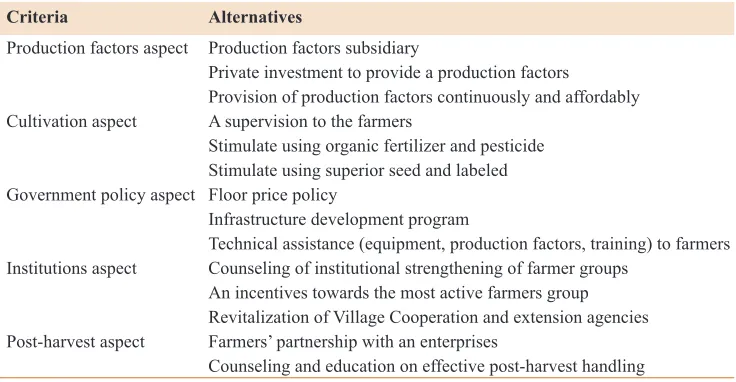
In the preparation of this study, researchers used descriptive analysis of quantitative and descriptive qualitative, descriptive analysis itself is defined as a problem-solving process investigated by describing the state of the subject and object research at the present moment based on facts that appear or how it is. Sucihatiningsih (2010) uses the term triangulation to conceptualize the use of combined methods in one such study. Combined method in this research is quantitative approach as main method and qualitative approach as enrichment. After getting, the description from descriptive analysis then continued with analysis of corn farming strategy development through using model AHP to determine corn commodity development strategy in Grobogan regency. The AHP methods used to select the criterias and alternatives to achieve the developing strategies for corn farming in Grobogan Regency. The criteria and alternatives of corn farming development strategy in Grobogan regency are as follows (Table 2).
Qualitative descriptive analysis approach is used to complement and support the wealth of data on quantitative analysis. To obtain information in qualitative descriptive analysis conducted through interviews and in-depth observations. Interviews and observations made to farmers, this analysis is used to focusing the description of (1) the overview of agricultural conditions, (2) farming methods, and (3) agricultural policy development strategy of agriculture.
3. Results and Discussion
The agricultural sector is the main livelihood for most people in Grobogan district. In general, farmers in Grobogan regency use paddy as the main commodity that is planted. However, the intensity of the cultivation depends on the condition of the land. If the paddy field is irrigated rice, then the rice can be planted twice in 1 year, but if the rice field is rainfed, then the rice can only be planted for one time in a year. Farmers in Grobogan district are mostly people living in rural areas, considering that the agricultural sector is a growing sector and the main support in rural areas.
The problems faced by farmers are, among others, the availability of subsidized fertilizers that are not balanced with the needs of farmers. This condition makes farmers are forced to use another fertilizer variant as a substitute to meet the needs of fertilizer during the planting period.
Table 2: Criteria and alternatives in AHP methods
Criteria Alternatives
Production factors aspect Production factors subsidiary
Private investment to provide a production factors
Provision of production factors continuously and affordably Cultivation aspect A supervision to the farmers
Stimulate using organic fertilizer and pesticide Stimulate using superior seed and labeled Government policy aspect Floor price policy
Infrastructure development program
Technical assistance (equipment, production factors, training) to farmers Institutions aspect Counseling of institutional strengthening of farmer groups
An incentives towards the most active farmers group Revitalization of Village Cooperation and extension agencies Post-harvest aspect Farmers’ partnership with an enterprises
In corn commodities, farmers use hybrid seeds to plant. Corn farmers consider that hybrid corn types are more suitable and resistant to weather conditions, more resistant to dry, and no water conditions and are able to produce more crops. The development of “pioneer” hybrid corn is the kind of corn most grown by farmers. The first generation of hyperpioneer called P7 followed by the launch of P11 seeds. Moreover, right now farmers have planted the Pioneer type P 21. Development of pioneer hybrid corn seed is more directed to product innovation.
4. Strategy of Corn Farming Development in Grobogan Regency
Corn farming character has different cultivation and marketing mechanisms with other farms. Therefore, based on the AHP analysis to determine priority aspects in the development of corn crops commodity in Grobogan regency, it is known that priority aspects are different from the results of the analysis for other farming. AHP analysis is used to formulate priority strategies in developing corn commodities in Grobogan district. The formulation of these alternatives and priorities is made as comprehensive as possible to touch all possible possibilities that contribute to the development of corn commodities.
The development of the maize processing plant is also considered to provide a solution to improve the welfare of farmers and develop corn commodities in the future. This is because with the maize processing plant it will make at least a guarantee that the corn planted by farmers will be purchased at a reasonable price as long as it meets the quality. The selling price will also be better because it will be purchased by the buyer at the final level before being changed into another commodity. For the task of fulfilling the quality of maize then becomes the task of farmers and farmers groups with the support of appropriate assistance.
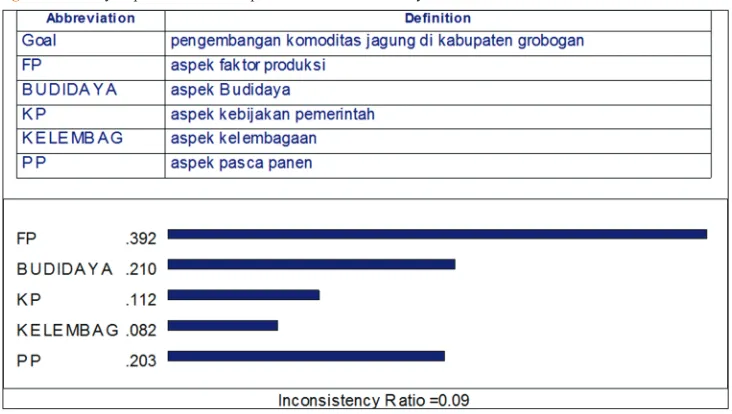
Based on the results, it can be seen that aspects of production factors (input provision) are the most important aspect and priority in the development of corn commodities with priority percentage of 39.2%. The second most important criterion is the aspect of cultivation with a priority percentage of 21.0%. Furthermore, the post-harvest aspect is the third priority criterion with a percentage of 20.3%. The government policy aspect is ranked fourth priority with a priority percentage of 11.2%. Moreover, last is the institutional aspect that is the last priority or the least important among the four other aspects with a percentage of 8.2%. The following presents the AHP analysis results of the order of criteria from the most priority to the least priority (Figure 1).
Figure 1: Priority Aspect in the Development of Corn Commodity
Based on the results, it is known that the priority aspect necessary for the development of corn crop food commodities is quite different from other farming commodities. It does not stop at determining criteria of priority aspects. However, in each of these criteria, there are also alternatives that support the development of corn crops commodities so also do the calculation of priority alternatives in each criterion.
4.1. Production factors aspect (input supply)
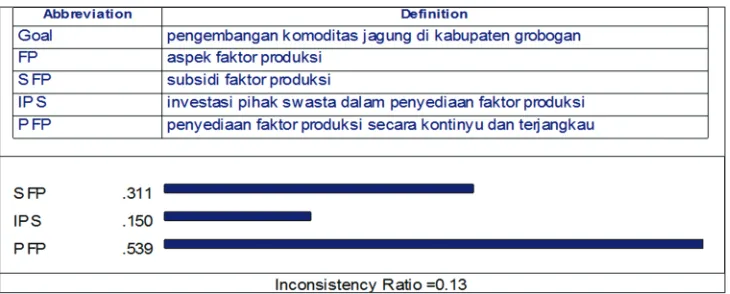
Aspects of production factors (input supply) in corn commodities are the priority aspect. This is indicated by the percentage of priority aspects of factor production is the highest. In determining the strategy of corn commodity development in Grobogan regency from production factor aspect (input supply), there are three alternatives. First is the production factor subsidy, then private investment in the provision of factors of production and the last is the supply of production factors continuously and affordably. Based on the results of AHP analysis obtained the following results (Figure 2).
The first priority alternative is the provision of production factors in a contest and affordable with a priority percentage of 53.9%. Next is an alternative to production factor factors with a priority percentage of 31.1%. The least priority criterion from the aspect of production factor is private sector investment in the supply of production factor with the percentage of 11.5%.
4.2. Cultivation aspect
Next, the cultivation aspect becomes the second priority of the five existing aspects. In the aspect of cultivation as the criterion itself; there are three alternatives, namely the assistance to farmers, stimulate organic fertilizer and organic pesticides, and then stimulate using superior seeds and labeled. From these three alternatives then selected which alternatives are the most priority. The results of AHP analysis for the aspect of cultivation are as follows (Figure 3).
Assistance to farmers became the most priority alternative with a percentage of 59.4%. Assistance to farmers is considered to be a very important and priority alternative considering the needs of corn farmers for the support of agricultural extension workers is very important. The second alternative is to stimulate the use of organic fertilizers and organic pesticides with a percentage of 24.9%. Then, the last one is stimulating using superior seeds and labeled with a priority percentage of 15.7%. These three alternatives are considered to be representative alternatives in explaining aspects of cultivation and important for the development of corn commodities based on research results and literature studies.
4.3. Post-harvest aspect
The third aspect to be a priority among all aspects is the post-harvest aspect. However, this aspect should still get a portion in the framework of efforts to develop corn commodities in Grobogan district.
Figure 2: A development priority from production factors aspect
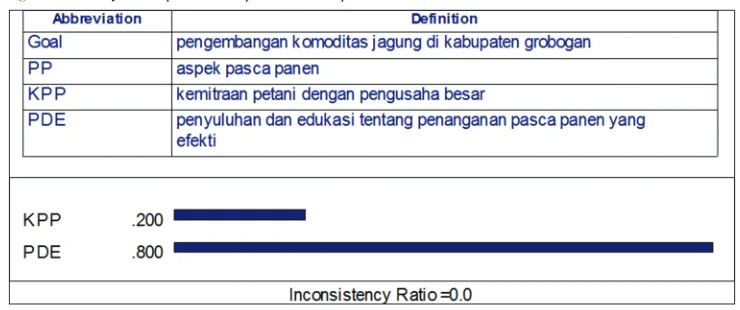
In the post-harvest aspect, there are two alternatives, namely partnership of farmers and large company and counseling and education about effective post-harvest handling. Using AHP analysis, the most priority alternatives between the two aspects are presented. The following picture presents an alternative priority based on the post-harvest aspect (Figure 4).
Counseling and education to farmers on effective post-harvest handling became the most important alternative with a percentage of 80.0%. However, the partnership of farmers with large scale is the last alternatives because of the percentages only 20%.
4.4. Government policy aspect
In the aspect of government policy which is the fourth most important aspect, there are three alternatives such as the support of pricing policy of floor price, then infrastructure development policy, and last technical assistance to farmers. Of the three alternatives were then selected the most priority alternative based on primary data research results (Figure 5).
Based on the results of AHP analysis as can be shown in Figure 5, it can be seen that the costing of floor price is the least priority alternative. This is indicated by the priority percentage value of 14.0%. The second most important alternative is the infrastructure development policy with a percentage of 33.3%. Then, the most important aspect is technical assistance to farmers with a percentage of 52.8%.
Figure 3: Priority aspect from cultivation aspect
Source: Primary data, processed
Figure 4: Priority development from post-harvest aspect
Technical assistance to these farmers includes assistance in the provision of farm equipment, provision of production factors, and so forth. The alternative technical assistance to farmers is the most priority criterion between the two alternatives.
4.5. Institutional aspect
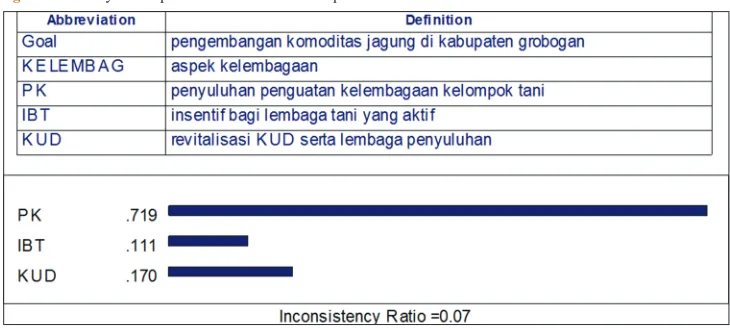
The institutional aspect becomes the last priority aspect in the priority development of corn food commodity. In the institutional aspect describes into three alternatives, namely the strengthening of farmer group institutions, then the second alternative is the incentive for the active farming institution and the third criterion is the revitalization of KUD and extension institution. The following results of AHP data are presented on the most priority alternatives of the institutional aspect (Figure 6).
The results of the data analysis above show that counseling institutional strengthening of farmer groups becomes the most important alternative between the two aspects that exist with the percentage of 71.9%. Therefore, alternative revitalization of KUD and extention agency become the second priority with 17% percentage. The last priority of the institutional aspect is the incentive for active farming institutions with a percentage of 11.1%.
Figure 5: Priority development from Government Policy Aspect
Source: Primary data, processed
Figure 6: Priority development from institutional aspect
5. Alternative Sequence of Corn Commodity Development Strategy from the Most Priority
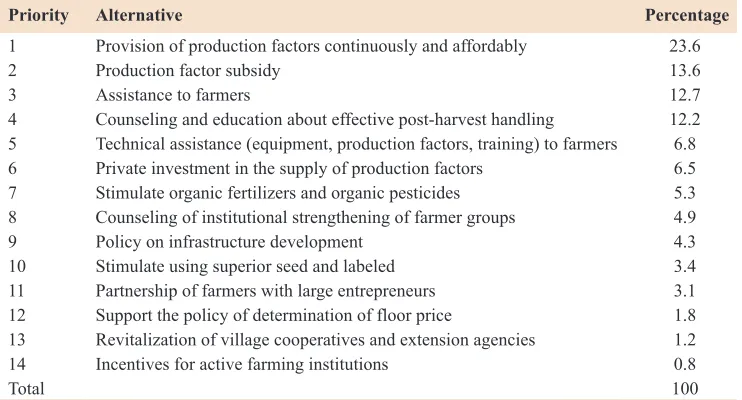
In each aspect of the criteria is still parsed again in sections called alternatives which amounted to 14 alternatives. At the top has been shown on the results of research to see the most priority aspects and criteria of the most priority in each of these aspects. However, in this section will be explained about the most priority alternatives overall. Hence, we will present the order of 14 alternatives from the most priority to the least priority based on AHP analysis (Table 3).
The picture above shows that the alternative in the form of continuous and affordable supply of production factors is the most priority alternative in the strategy of corn commodity food development in Grobogan regency with a percentage of 23.6%. Then, production factor subsidies became the second most important alternative with a percentage of 13.6%. The third most important alternative is farmer assistance with priority percentage of 12.7%.
The least priority alternatives is the support of the determination of floor price with a priority percentage of 1,8%. Then, revitalization of Village Cooperatives and extension agencies amounted to 1.2%. Moreover, the last priority alternative for corn commodity development is the incentive for active farming institutions with a priority percentage of 0.8%.
6. Conclusion
From the research result, it can be concluded that the condition of corn farmers in Grobogan regency is mostly dominated by farmers who are past productive age, low education background, and still carrying out traditional agricultural activities for generations. In corn commodities, farmers use hybrid seeds to plant. Corn farmers consider that hybrid corn types are more suitable and resistant to weather conditions, more resistant to dry, and no water conditions and are able to produce more crops.
The development of the maize processing plant is also considered to provide a solution to improve the welfare of farmers and develop corn commodities in the future. This is because with the maize processing plant it will make at least a guarantee that the corn planted by farmers will be purchased at a reasonable price as long as it meets the quality. Strategy of corn farming development based on priority order of development criteria is as follows: Priority aspect is aspect factor of production, cultivation, post-harvest, government policy, and last institutional aspect.
Table 3: Alternative sequence of corn commodity development strategy from the most priority
Priority Alternative Percentage
1 Provision of production factors continuously and affordably 23.6
2 Production factor subsidy 13.6
3 Assistance to farmers 12.7
4 Counseling and education about effective post-harvest handling 12.2
5 Technical assistance (equipment, production factors, training) to farmers 6.8
6 Private investment in the supply of production factors 6.5
7 Stimulate organic fertilizers and organic pesticides 5.3
8 Counseling of institutional strengthening of farmer groups 4.9
9 Policy on infrastructure development 4.3
10 Stimulate using superior seed and labeled 3.4
11 Partnership of farmers with large entrepreneurs 3.1
12 Support the policy of determination of floor price 1.8
13 Revitalization of village cooperatives and extension agencies 1.2
14 Incentives for active farming institutions 0.8
Total 100
References
Arikunto, S. (2002), Research Procedure: A Practice Approach. Jakarta: Rineka Cipta. Arsyad, L. (2004), Development Economics. Yogyakarta: STIE YKPN.
Baehaqi, A. (2007), Development of Leading Commodity of Food Crops in Central Lampung District. Thesis, Bogor Agricultural University.
Budi, S.A. (2008), Efficient Efficiency Analysis of Corn Production Factors in Grobogan District 2008, Thesis, UNNES.
Central Java Provincial BPS. (2007), Central Java in Figures: Central Java. Central Java Provincial BPS. (2009), Central Java in Figures: Central Java.
Department of Agriculture and Plantation Grobogan District. (2006), Implementation Guidelines for Food Crops and Plantation Intensification Program: Grobogan.
Department of Agriculture and Plantation Grobogan District. (2007), Harvest Area and Corn Crop Production 2002-2007: Grobogan.
Food Security Bimas Agency. (2001), Strategic Plan and Program of Food Security Enhancement Work 2001-2004. Jakarta: Food Security Bimas Agency.
Grobogan District Grocery BPS. (2008), Grobogan in Figures: Grobogan. Grobogan District Grocery Bureau. (2007), Grobogan in Figures: Grobogan.
Mason, R.D. (1996), Statistics Engineering for Business and Economics. London: Erland.
Mosher, A.T. (1978), An Introduction to Agricultural Extension. New York: Agricultural Development Council. Mosher, A.T. (1985), Moving and Building Agriculture Saddry Krisnandhi C.V. Yasaguna: Jakarta.
Mubyarto, E.K. (1989), Introduction to Agricultural Economics. Jakarta: LPES. Nicholson, W. (2002), Micro-Economy Intermediate. Jakarta: Erland.
Official Website of Central Java Provincial Government. Available from: http://www.jawatengah.go.id. [Last accessed on 2017 Sep 12]
Official Website of Grobogan District Government. Available from: http://www.grobogankab.go.id. [Last accessed on 2017 Sep 12]
Permadi, B. (1992), Analysis Hierarchy Process. Jakarta: PAU EK University of Indonesia.
Puspitasari, Listya. Farmers Perception Towards Agricultural Extension in Soybeans Cultivation. Media Agro. Vol. 5. 1: 2008.
Saaly, T.L. (1987), The Analytic Hierarchy Process - What it is and How it is used, Math Modeling. Great Britain: Pergamon Journals Ltd.
Soekartawi, B.B. (2003), The Theory of Production Economics with the Principles of Analysis of the Cobb-Douglas Function (Theory of Production Economics with Special Discussion on Cobb-Douglas Production Function). 3rd ed. Jakarta: Raja Grafindo Persada.
Sucihatiningsih, D.W.P. (2010), Institutional Empowerment Capacity Model of Agricultural Extension in Improving Farmer’s Business Performance: Empirical Study in Central Java Province. Dissertation: UNDIP.
Sukirno, S. (2005), Micro Economic Introduction Theory. Jakarta: Raja Grafindo Persada.
Suryana, S. (2007), Analysis of Factors Affecting Maize Production in Blora Regency (Case Study of Hybrid Maize Production in Banjarejo Sub-district of Blora Regency). Thesis. UNDIP.
Susilowati, B. (2009), Strengthening Agribusiness Performance of Superior Food Crops of Central Java Province in Supporting Food Security. Deptan: Agricultural Socio Economic Research. Cooperation UNDIP and R and D Agency.
Susilowati, I., Mudjahirin, T.W., Tri, W.A., Agung, S. (2004), Development of Micro, Small and Medium Enterprises Empowerment Model in Supporting Food Security in Regency and City of Pekalongan. Jakarta: RUKK Office of State Minister of Research and Technology and LIPI.
Syahyuti, B. (1995), Group Approach in Implementation of Agricultural Development Programs/Projects. Agro Economic Forum Magazine.
Syahyuti, B. (2002), Formation of Agrarian Structures in Sub-Forest Societies. Thesis in the Department of Rural Sociology. IPB, Bogor. Vol. 3. 1: 2002.
Syahyuti, B. (2003), Indonesia’s Agricultural Development in the Influence of World Capitalism: Analysis of the Economy of Rice Politics. Center for Agricultural Socio-Economic Research and Development.
Vu, L.H. (2004), Efficiency of Rice Farming Households in Vietnam: A DEA with Bootstrap and Stochastic Frontier Application. USA: University of Minnesota.
Yotopoulos, P.A., Nugget, J.B. (1976), Economic of Development: Empirical Investigation, Harper International. USA. Yulianik, S. (2006), Analysis of Efficiency of Production Factors in Red Onion Farming in Kabupaten Brebes (Case