ISSN 2324-805X E-ISSN 2324-8068 Published by Redfame Publishing URL: http://jets.redfame.com
Problem Solving Skills in Social Studies Education and Problem Solving
Skills of Social Studies Teachers
Selma GüleçCorrespondence: Selma Güleç, Assist. Prof. Dr., Bursa Uludağ University, Bursa, Turkey.
Received: December 3, 2019 Accepted: January 3, 2020 Online Published: January 16, 2020 doi:10.11114/jets.v8i3.4686 URL: https://doi.org/10.11114/jets.v8i3.4686
Abstract
Problem solving skills are mentioned among the skills which need to be acquired in the Social Studies course. In this study, how the social studies teachers perceived problem solving skills was examined by emphasizing the importance of having individuals acquire problem solving skills through social studies teaching. The sample of the study was composed of social studies teachers. In order to evaluate the preservice teachers' perceptions in relation to problem solving skills, the "Problem Solving Inventory" developed by Heppner and Petersen (1982) and adapted by Şahin, Şahin and Heppner (1993) into Turkish was used. In the analysis of the data, firstly if the obtained data distributed normally was tested with Kolmogorov-Smirnov test. Since the data obtained from the problem solving inventory showed normal distribution, the Independent Samples T test was used for paired comparisons and One-Way ANOVA was used for multiple comparisons. It was found that the teachers' problem solving skills did not differ significantly according to the variables of gender, age, marital status, length of service and educational status, satisfaction from school of service, frequency of experiencing problems at their schools and the teachers' problem solving skills were at sufficient level. Keywords: social studies, social studies teaching, problem solving skill, social studies teacher
1. Introduction
Social sciences forming the basis of the Social Studies course cover such social disciplines as anthropology, communication sciences, economy, education, geography, history, linguistics, political sciences, psychology, sociology and law (Tay and Öcal, 2008). According to Öztürk (2006), social studies is a teaching program which integrates and uses the knowledge which it derives from social sciences and human sciences with the aim of raising effective individuals who can solve problems under domestic and world conditions changing in every respect. Social Studies is a process of establishing a relation based on proving social facts and, as a result of this, deriving knowledge from life (Sönmez, 1999).
At educational institutions, students are made to acquire an important part of knowledge, skills and values which are necessary to be an effective citizen in the Social Studies course. Social studies education has an important role in equipping individuals with knowledge and skills which will help them fit into social life. The Social Studies course is important in terms of having students acquire personal characteristics and democratic attitudes which are required to participate in a democratic society effectively (Ersoy and Kaya, 2008). Thanks to this course, students are raised as individuals being capable of thinking critically in every area by using their upper level thinking skills, knowing how to obey the rules, acting in harmony with other individuals around them and having democratic citizenship skills. Social Studies is an area of study taking the interaction of humans with their physical and social environments within the dimension of time with an interdisciplinary approach by benefiting from the contents and methods of social sciences and other disciplines related to humanity and aiming to raise thinking and skillful democratic citizens equipped with basic democratic values related to life in a globalizing world (Doğanay, 2004). Social studies is defined as a program examining human relationships with the aim of raising responsible and good individuals in a democratic society and also passing down basic characteristics of cultural heritage to next generations (Garcia and Michaelis 2001, cited by Kılıçoğlu, 2009).
knowledge, skills and values to be acquired by children within this period will be difficult to change in the coming years. For this reason, for a child of this age group, the course of social studies has a separate importance (Akdağ, 2009). The course of social studies is of particular importance in terms of having students acquire knowledge, skills and attitudes to help students in their individual and social lives.
The Ministry of National Education stated in the Social Studies Course Teaching Program (Primary and Secondary 4th, 5th, 6th and 7th Grades) that the rapid change experienced in science and technology, the changing needs of the individual and the society, novelties and developments in learning and teaching-learning theories and approaches have directly affected the roles expected from individuals as well. This change defines an individual having such qualities as generating the knowledge, using it functionally, being capable of solving problems, thinking critically, being entrepreneurial and decisive, having communication skills, being capable of empathizing with others, making contributions to the society and culture, etc. The teaching programs to serve the raising of individuals having these qualities have been prepared not in a structure transferring knowledge only but rather in a simple and understandable structure that pays attention to individual differences and aiming to have them acquire values and skills (MEB, 2018). A skill is an ability which needs having individuals acquire within the learning process, developing continuously and transferring to daily life (Baldemir et al., 2017). In the Ministry of National Education Social Studies Course Teaching Program, the basic skills were listed as follows (MEB, 2018): Researching, environmental literacy, perceiving change and continuity, digital literacy, critical thinking, empathy, financial literacy, entrepreneurship, observation, map literacy, law literacy, communication, collaboration, noticing stereotypes and prejudices, using evidence, making decisions, location analysis, media literacy, space perception, self-control, political literacy, problem solving, social participation, drawing and interpreting tables, graphs and diagrams, using Turkish accurately and eloquently, innovative thinking and perceiving time and chronology. In the Social Studies Course Teaching Program, it is emphasized that students should be made to acquire the problem solving skills while teaching the learning domain of "Effective citizenship" and "Humans, Places and Environments".
According to Dewey, a problem is defined as anything which causes a confusion in human mind, presents a challenge and obscures a belief (Cited by Güçlü, 2003). According to Öğülmüş (2001), a problem is obstacles and difficulties encountered during transition from an environment or a situation to another more preferred environment or situation. According to Altun (2013), a problem is a situation in which a person wants to do something but does not know what to do immediately.
A problem is a situation of conflict in which an individual encounters a frustration in the way toward reaching a target. Frustration makes it difficult to reach a target. In such a case, problem solving is finding the best way of overcoming the obstacle (Morgan, 1999). Problem solving is the process of overcoming difficulties encountered when reaching a target and requires benefiting from not only knowledge but also methods related to creativity and solution (Yalçın, Tetik and Açıkgöz, 2010).
When previous studies were examined, it was seen that not only the concept of problem but also problem solving were defined differently. Heppner and Krouskopf (1987) defined problem solving as cognitive and effective behavioral processes for the harmony of complex internal and external wants and desires and Morgan (1999) defined it as finding the best way of overcoming an encountered obstacle. Solution of a problem differs according to the complexity and the kind of the problem; logical approach, emotional maturity and different points of view are effective on solving the problem. The common point of problem solutions is removing obstacles before reaching an aim (Dağlı, 2004).
Problem solving is a process which a person undergoes starting from the feeling of a problem until finding a solution to it (Güçlü, 2003). Problem solving skill is one of the most determining roles in the process of an individual's becoming an individual and adapting to his/her environment. An individual is obliged to cope with his/her environment and problems by using his/her own power and at the capability of his/her own problem solving skill without being captive of problems which s/he encounters in his/her daily life. According to this, a problem can be defined as a situation bothering the individual. Problem solution is a process covering efforts to eliminate encountered difficulties for a certain aim (Bingham, 2004).
are comfortable and emotional, are active, full of energy, creative and productive and have a critical structure (Cited by Güçlü, 2003).
Solution of a problem depends on many variables. Such factors as suitability of the encountered problem to the age of the individual, the individual's level of possessing preliminary knowledge or education for the solution, his/her ability, health, attitude, benefit of the solution for the individual, the individual's personal characteristics can be effective on problem solving. Problem solving also includes attitudinal and cognitive components. In order to solve problems, learners are required to desire to do so, and also they should believe that they can. Motivation and attitudinal aspects such as effort, confidence, anxiety, persistence and knowledge of self are important to the problem solving process (Jonassen and Tessmer, 1996).
According to Heppner et al. (2004), individuals regarding themselves as ineffective problem solvers generally believe that problems will suddenly disappear. They mostly use emotion-focused coping strategies while solving a problem. In difficult interpersonal encounters, they mostly experience emotional arousal. They encounter emotional problems which they cannot cope with more frequently. Problem solving as a goal-directed behavior requires an appropriate mental representation of the problem and the subsequent application of certain methods or strategies in order to move from an initial, current state to a desired goal state (Metallidou, 2009).
At the same time, individuals criticizing, inquiring and generating creative solutions to problems will be effective on the achievement of social development. It can be stated that raising of individuals being able to solve problems is possible through teachers having high problem solving skills (Polat and Tümkaya, 2010). In order for teachers, who are in intensive interaction with people as required by the social life and the profession of teaching, to establish healthy relationships, spend effort to solve encountered problems, stand upright against negative situations, not to reflect this to their environment negatively and be a good role model, they are required to acquire sufficient social skills. One of the most important social skills playing a determining role in an individual's positive interaction with his/her environment making him/her an individual is problem solving skill. Problem solving is one of the most important skills which can be acquired at school and in life (Jonassen, 2004). For this reason, it is clear that especially preservice teachers' describing problems which they encounter, making inquiries about the problem, solving the problem by using information which they obtain in the solution of the problem, that is to say, having acquired problem solving skills will be effective on their future students' acquiring problem solving skills (İnel et al., 2011). Students learn better when opportunities for teaching are increased, they directly participate in prepared activities and become successful at solving presented problems (Dale and Balloti, 1997). Problem solving is one of the most important learning skills which can be acquired at school and in life (Jonassen, 2004).
Today, one of the most basic aims of educational institutions is to have individuals acquire problem solving skills and prepare them for life. Students are expected to be successful individuals at adapting their problem solving skills to their individual and social lives (Erden, 2005). Educational programs are examined, it is observed that some skills which students are required to acquire rise to prominence. The main ones are these: being able to establish communication, having the skill of thinking scientifically, reasonably and logically, using technology, being investigative and productive, sharing knowledge, protecting humanistic values and having problem solving skills. In order to have students acquire these skills, teachers and preservice teachers possessing these qualities are needed. Education given at schools has a great role in having students acquire problem solving knowledge and skills and developing existing ones. With no doubt, this important duty falls to teachers having effective problem solving skills.
In this study, it was aimed to examine the Social Studies teachers' problem solving skill levels according to various variables. In order to achieve this aim, the Social Studies teachers' problem solving skills were examined according to the variables of gender, age, marital status, length of service, educational status, satisfaction from school of service and frequency of experiencing problems at school.
2. Method
2.1 Data Collection Tool
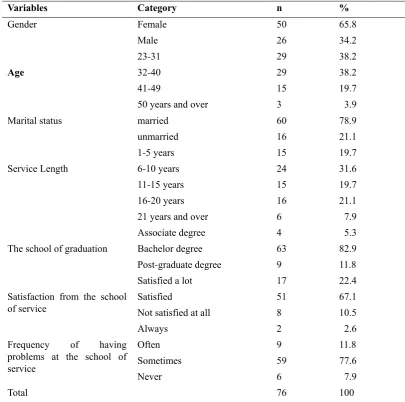
Table 1. Distribution of the participant teachers according to various variables
Variables Category n %
Gender Female 50 65.8
Male 26 34.2
Age
23-31 29 38.2
32-40 29 38.2
41-49 15 19.7
50 years and over 3 3.9
Marital status married 60 78.9
unmarried 16 21.1
Service Length
1-5 years 15 19.7
6-10 years 24 31.6
11-15 years 15 19.7
16-20 years 16 21.1
21 years and over 6 7.9
The school of graduation
Associate degree 4 5.3
Bachelor degree 63 82.9
Post-graduate degree 9 11.8
Satisfaction from the school of service
Satisfied a lot 17 22.4
Satisfied 51 67.1
Not satisfied at all 8 10.5
Frequency of having
problems at the school of service
Always 2 2.6
Often 9 11.8
Sometimes 59 77.6
Never 6 7.9
Total 76 100
When Table 1 is examined, it is observed that 50 (65.8%) of the participant social studies teachers were female and 26 (34.2%) of them were male; 29 of them were aged 23-31 years, 29 of them were aged 32-40 years, 15 of them were 41-49 years and 3 of them were aged 50 years and over; 60 of them were married and 16 of them were unmarried; 15 of them had a service length of 1-5 years, 24 of them had a service length of 6-10 years, 15 of them had a service length of 11-15 years, 196 of them had a service length of 16-20 years and 6 of them had a service length of 21 years and over; 4 of them had an associate degree, 63 had a bachelor degree and 9 had a post-graduate degree. 17 of the teachers stated having been satisfied very much from their schools; 51 of them stated having not been satisfied from their schools; 8 of them stated having never been satisfied from their schools; 2 of them stated having always experienced problems; 9 of them stated having frequently experienced problems; 59 of them stated having sometimes experienced problems; 6 of them stated having never experienced problems at their schools. The Social Studies teachers stated having experienced problems at their schools most frequently with students (46 teachers). 22 teachers stated having experienced problems with parents; 15 teachers stated having experienced problems related to their profession; 14 of them stated having experienced problems related to the administration.
2.2 Data Analysis
Table 2. Distribution of the problem solving skills inventory
Kolmogorov-Smirnow N
X
Ss K-Smirnov Z pProblem solving 76 139.50 19.60 .725 .669
As a result of the T-test with two independent samples used in parametric tests and One-Way ANOVA, the findings were reached.
3. Results
As a result of the Independent Samples T test applied with the aim of determining the problem solving skills of the social studies teachers according to their gender and marital status, no significant difference was found between gender (p= .378; p> .05) and marital status (p= .850; p> .05).
Table 3. Social studies teachers' problem solving skills according to the variables of gender and marital status (Independent Samples T test)
Pr ob le m So lving
n X Sd t P
Gender Female 50 140.92 19.98 .890 .378
Male 26 136.76 18.92
Marital status Married 60 139.73 19.42 .191 .850
Unmarried 16 138.62 20.88
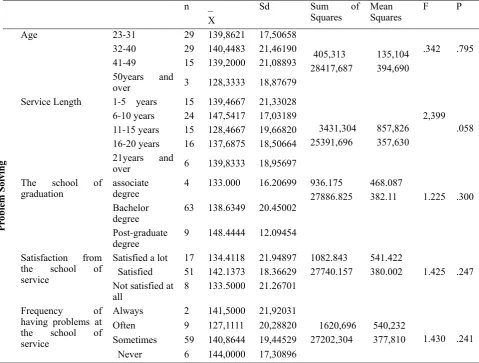
Table 4. Social studies teachers' problem solving skills according to the variables of age, service length, educational status, satisfaction from school of service and frequency of experiencing problems at school (One Way ANOVA)
n _
X
Sd Sum of
Squares Mean Squares F P
Pr ob le m So lving
Age 23-31 29 139,8621 17,50658
405,313 28417,687
135,104 394,690
.342 .795
32-40 29 140,4483 21,46190
41-49 15 139,2000 21,08893
50years and
over 3 128,3333 18,87679
Service Length 1-5 years 15 139,4667 21,33028
3431,304 25391,696 857,826 357,630 2,399 .058
6-10 years 24 147,5417 17,03189
11-15 years 15 128,4667 19,66820
16-20 years 16 137,6875 18,50664
21years and
over 6 139,8333 18,95697
The school of
graduation associate degree 4 133.000 16.20699 936.175 27886.825 468.087 382.11 1.225 .300 Bachelor
degree 63 138.6349 20.45002
Post-graduate
degree 9 148.4444 12.09454
Satisfaction from
the school of
service
Satisfied a lot 17 134.4118 21.94897 1082.843
27740.157
541.422
380.002 1.425 .247
Satisfied 51 142.1373 18.36629
Not satisfied at
all 8 133.5000 21.26701
Frequency of
having problems at
the school of
service
Always 2 141,5000 21,92031
1620,696 27202,304
540,232
377,810 1.430 .241
Often 9 127,1111 20,28820
Sometimes 59 140,8644 19,44529
Never 6 144,0000 17,30896
difference was found between the teachers according to the variables of age (p= .795; p> .05), service length (p= .058; p> .05) and the school of graduation (p= .300; p> .05), satisfaction from school of service (p= .247; p> .05) and frequency of experiencing problems (p= .241; p> .05).
4. Discussion
According to the results of the study, the social studies teachers stated that their problem solving skills were at sufficient levels. It can be stated that teachers did not drift apart by chance by applying the first idea that comes to mind in order to solve a problem, but instead, they applied possible solution ways by giving a thought while solving a problem, if they became unsuccessful, they inquired reasons why they had become unsuccessful and perceived themselves as highly sufficient at spending effort to solve an existing problem. In the study by Saracaloğlu, Yenice and Karasakaloğlu (2009), the preservice teachers' problem solving skills were found to be at sufficient levels. This finding shows consistency with that of this study.
With the aim of determining the teachers' problem solving skills according to the variables of gender and marital status, the Independent Samples T test was applied. No significant differences were found between the Social Studies teachers' problem solving skills according to the variables of gender and marital status. Nazlı (2013) found in a study that problem solving skill did not differ according to gender and Çetin (2011) reached the result that the teachers' problem solving skills did not differ according to gender. In the same way, Üstündağ and Beşoluk (2012) found that the preservice teachers' and Kösterelioğlu (2007) determined that the school administrators' problem solving skills did not differ according to gender. In the study made by Çilingir (2006) and Gültekin (2006), too, it was found that gender did not affect the problem solving skills. This finding shows consistency with that of this study. However, Biber and Kutluca (2013) reached in a study that the female students' problem solving skills were higher than the male students'. However, in the study by Ofşin (2019), it was found that the male nurses' perceptions of their problem solving skills were found higher, though not statistically significant, than the female nurses'. Similarly, Çelik and Yurdakul (2009) found the male administrators' problem solving skill perceptions high but they were not statistically significant.
The Social Studies teachers' problem solving skills did not differ significantly according to the variables of age, service length, educational status, either. Çetin (2011) determined in a study that the teachers' problem solving skills differed significantly according to the variable of service length. This finding overlaps the results of this study. Üstün and Bozkurt (2003) found that the elementary school principals', Kösterelioğlu (2007) determined that the school administrators', and Çınar, Hatunoğlu and Hatunoğlu (2009) reached the result that the teachers' problem solving skills did not differ significantly according to their service lengths. In a study with the preservice teachers, Saracaloğlu et al. (2009) found that their problem solving skills did not differ significantly according to their age levels. In a study, Yılmaz (2011) examined the preschool education teachers' problem solving skill scores and found that they did not differ significantly according to the variable of "age". In the studies made by Güven and Akyüz (2001) and Çam (1997) on the preservice teachers, it was found that the preservice teachers' problem solving skill perceptions did not differ significantly according to the variable of age. In a study made by Özgül (2009), it was determined that the teachers' problem solving skills did not differ significantly according to the variable of age. This finding shows similarity to that of this study.
In a study, Çetin (2011) did not find a significant difference according to the variable of educational status, which seems to support this study. Activities should be organized to provide teachers with problem solving skills and theoretical education as well as practice having them involve actively. Studies can be made by using experimental and control groups. It is vitally important for the lives of individuals that teachers having undertaken the duty of raising future's building stones correctly, healthily, knowingly should have high problem solving skills and be able to share these skills with their students. In this case, teachers should be arranged environments where they can exhibit their problem solving skills at the highest level in order to maintain their educational duty healthily, effectively and permanently. In order to achieve this, with the aim of developing teachers and preservice teachers' problem solving skills, problem solving skills training programs can be prepared and implemented through various programs.
References
Akdağ, H. (2009). The definition of social studies, purpose, importance and place in Turkey. R. Turan, A. M. Sünbül and H. Akdağ (ed). New Approaches in Social Studies Teaching-1, 1-24, Ankara: PegemA Publications.
Altun, M. (2013). Teaching mathematics for faculties of education and classroom teachers (18th edition). Bursa. Baldemir, I., Zaman, S., Teker, S., Sahin, A., Zengin, M., Tokgoz, H., Kor, K., & Bayraktar, B. (2017). Social repellent.
Ankara: Rector Publications.
Bingham, A. (2004). Developing Problem Solving Skills in Children, Trans. Ferhan Oguzkan, MEB Publications, Istanbul.
Çam, S. (1997). The effect of communication skills training program on pre-service teachers' ego situations and problem-solving skills perceptions. Doctoral Thesis. Ankara University Institute of Social Sciences, Ankara. Çelik, C., & Yurdakul, M. (2009). Problem Solving Skills of Hospital Managers: A Field Study. Journal of Cukurova
University Institute of Social Sciences. 18(1), 95-108.
Çelikkaya, T. (2013). Importance of using tools and materials in social studies teaching. R. Sever and E.
Çetin, E. (2011). Relation between the problem-solving skills and the level of being subjected to mobbing off the primary school teachers. Master's Thesis, Bolu: Abant Izzet Baysal University Institute of Social Sciences.
Çilingir, A. (2006). The comparison of social and problem solving skills of science high school and general high school students. Master's Thesis, Erzurum, Atatürk University.
Çınar, O., Hatunoğlu, A., & Hatunoğlu, Y. (2009). Teachers' problem solving skills. Erzincan Faculty of Education Journal Volume-Number: 11-2 Year: 2009.
Dağlı A. (2004). Problem solving and decision making. Dicle University, Ziya Gökalp Faculty of Education,
Dale, P. M., & Balloti, E. (1997). An Approach to Teaching Problem Solving in the Classroom. College Student. Mart 97, 31(1), 40.Department of Educational Sciences, Electronic Journal of Social Sciences, 3(7).
Doganay, A. (2004). Social studies teaching, Ankara, Pegem Academy.
Erden, M. (2005). Introduction to Teaching Profession. Istanbul: Epsilon Publishing.
Ersoy, A. F., & Kaya, E. (2008). According to classroom teachers 'students' approaches to social studies curriculum (2004). Anadolu University Journal of Social Sciences, 8(1), 285-300.
Güçlü, N. (2003). Problem solving skills of high school principals. National Education Journal, Fall(160), 273-279. Gultekin, A. (2006). Problem solving skills of the psychological consultancy an guidance students. Department of
Educational Sciences. Master's Thesis. University of Erzurum.
Güven. A., & Akyüz, M. (2001). Candidate teachers' views on communication and problem solving skills. Journal of the Aegean Education Faculty, 1(1), 13-22.
Heppner, P. P., & Krauskopf, C. J. (1987). The Integration of Personal Problem Solving Processes Within Counseling.
The Counseling Psychologist, 15. https://doi.org/10.1177/0011000087153001
Heppner, P. P., & Petersen, C. H. (1982). The development and implications of a personal problem solving inventory.
Journal of Counseling Psychology, 29(1), 66-75. https://doi.org/10.1037/0022-0167.29.1.66
Heppner, P. P., Witty T. E., & Dixon W. A. (2004). Problem solving appraisal and human adjustment: a review of 20 years of research using the problem solving inventory. The Counseling Psychologist, 32, 344-428. https://doi.org/10.1177/0011000003262793
İnel, D., Evrekli, E., & Türkmen, L. (2011). Investigation of problem solving skills of candidate classroom teachers.
Pamukkale University Faculty of Education Journal, 29, 167-178.
Jonassen, D. H. (2004). Learning to solve problems: an ınstructional design guide. San francisco: Pfeiffer an imprintof Wiley. http://books.google.com.tr
Jonassen, D. H., & Tessmer, M. (1996). An outcomes-based taxonomy for the design, evaluation, and research on instructional systems. Training Research Journal.
Kılıçoğlu, G. (2009). Definition of Social Studies, Development and Importance of Turkey and the World. M. Safran, (Ed.), Social Studies Teaching. (4-16). Ankara: Pegem A Publishing.
Koçoğlu. (Editors). Educational Technologies and Material Design in Social Studies teaching. Pegem Academy Publishing, 39-68.
Kösterelioglu, M. A. (2007). Relation between the levels of problem solving skills and burnout of school administrators.
Master's Thesis, Bolu: Abant İzzet Baysal University Institute of Social Sciences. MEB (2018). Social studies course teaching program, Ankara: MEB Publications.
Metallidou, P. (2009). Pre-service and in-service teachers’ metacognitive knowledge about problem-solving strategies.
Teaching and Teacher Education, 25, 76-82. https://doi.org/10.1016/j.tate.2008.07.002
Nazlı, S. (2013). Examining the relationship between emotional intelligence and problem solving skills in nurses.
Master's Thesis. Selçuk University: Institute of Health Sciences.
Ofşin, O. (2019). Nurses' listening and problem-solving skills.Master's Thesis. Marmara University: Institute of Health Sciences.
Öğülmüş, S. (2001). Interpersonal problem solving skills and education. Ankara: Nobel Publication Distribution. Özgül, E. (2009). Examining the relationship between preschool teachers' problem-solving skills and teaching attitudes.
Master's Thesis. Abant İzzet Baysal University Social Sciences Institute, Bolu.
Öztürk, C. (2006). Social studies: An interdisciplinary view of social life. C. Öztürk, (Ed.), Life and Social Studies Teaching in a Constructivist Approach (p.21-50). Ankara: Pegem A Publishing
Polat, R. H., & Tümkaya, S. (2010). An investigation of the students of primary school problem solving abilities depending on need for cognition. Elementary Education Online, 9(1), 346-360.
Saracaloğlu, A. S., Yenice, N., & Karasakaloglu, N. (2009). The relationship between teacher candidates' communication and problem solving skills and reading interests and habits. Yüzüncü Yıl University, Faculty of Education Journal,
6(2), 186-206.
Sönmez, V. (1999). Social Studies Teaching and Teacher Guide, Ankara, Anı Publishing.
Tay, B., & Öcal, A. (2008). Teaching Social Studies with Special Teaching Methods. Ankara: Pegem A Publications. Ulusoy, H, Tosun, N., &Aydın, J. C. (2014). Problem Solving Skills of Health Management Students. Journal of Health
and Nursing Managament, 1(1), 1-8. https://doi.org/10.5222/SHYD.2014.001
Üstündağ, S., & Beşoluk, Ş. (2012). Examining the problem-solving skills of candidate science teachers in terms of various variables. X. National Science and Mathematics Education Congress, Niğde University, 532, 27-30 June 2012, Niğde.
Yalçın, B., Tetik, S., & Açıkgöz, A. (2010). A study on the determination of the perceptions of the problem-solving skills and the levels of the locus of control of the high school students. Journal of Organization and Management Sciences,
2(2), 19-27.
Yılmaz, N. (2011). Pre-school teachers' communication skills, problem solving skills and levels of empathic tendency.
Master's Thesis, Muğla: Muğla University Institute of Educational Sciences.
Copyrights
Copyright for this article is retained by the author(s), with first publication rights granted to the journal.