This is anearly accessversion of
Hunter, Julie, Nicholas Asher & Alex Lascarides.2018. A formal semantics for situated conversation.Semantics and Pragmatics 11(10).https://doi.org/ 10.3765/sp.11.10.
This version will be replaced with the final typeset version in due course. Note that page numbers will change, so cite with caution.
A formal semantics for situated conversation
*Julie Hunter
Universitat Pompeu Fabra & IRIT, Université Paul Sabatier
Nicholas Asher
IRIT, CNRS
Alex Lascarides
University of Edinburgh
Abstract While linguists and philosophers have sought to model the various ways in which the meaning of what we say can depend on the nonlinguistic context, this work has by and large focused on how the nonlinguistic context can be exploited to ground or anchor referential or otherwise context-sensitive expressions. In this paper, we focus on examples in which nonlinguistic events contribute entire discourse units that serve as arguments to coherence relations, without the mediation of context-sensitive expressions. We use both naturally occurring and constructed examples to highlight these interactions and to argue that extant coherence-based accounts of discourse should be extended to model them. We also argue that extending coherence-based accounts in this way is a nontrivial task. It forces us to reassess basic notions of the nonlinguistic context and rhetorical relations as well as models of discourse structure, evolution, and interpretation. Our paper addresses the conceptual and technical revisions that these types of interaction demand.
Keywords:situated communication, nonlinguistic context, discourse structure, rhetorical relations
1 Introduction
Consider the following commonplace exchange. Suppose a man, Peter, comes home to find his wife, Anne, looking upset. Peter looks at Anne inquiringly, and she says:
(1) Our daughter was sent to her room.
early
access
Just after she says this, she nods suggestively over her shoulder, and Peter, taking her cue, notices some scratches on the wall behind her. He immediately infers that the scratches are the outcome of aneventof their daughter scratching the wall and that this event, call it ‘e’, provides an explanation of the punishment described in
(1). The eventecan then support discourse continuations, such as(2):
(2) I was cooking dinner.
Here, the inferred eventeaffects the temporal interpretation of(2): withoute, the discourse(1)+(2)implies that Anne cooking dinner and sending her daughter to her room temporally overlap, but this is not the message Anne is conveying.
Let Scratches be the discourse above, involving (1)+e+(2). Now imagine a different discourse, but in the same context. Peter comes home to find Anne looking upset, but she utters(3)rather than(1):
(3) I moved the table into the living room this morning.
She nods suggestively, just as inScratches, but then continues with(4).
(4) I had to buy some new paint.
Here again, the inferred wall-scratching event,e0, plays a crucial discursive role: if we ignoree0, the discourse(3)+(4)is barely coherent. We’ll call this discourseTable.
The fact that nonlinguistic events can influence the interpretation of a discourse is old news. Nevertheless, the particular way in whiche and e0 contribute to the content ofScratchesandTable, respectively, has not been a central topic of research. In these discourses, the nonlinguistic events do not provide referents for referential or anaphoric expressions; in fact, their relevance need not be signalled by the presence of any particular linguistic expression. Nor does the linguistic unit describe a concurrent nonlinguistic event, a focus of research on modelling multimodal demonstrations (Stojnic et al. 2013,Forbes et al. 2015). The discursive contributions of the nonlinguistic events are rather like those of the italicized clauses in(5)and
(6):
(5) Our daughter was sent to her room.She scratched up the wall.I was making dinner.
(6) I moved the table into the living room this morning andI scratched up the wall. I had to buy some new paint.
early
access
in part to show that by extending work on rhetorical structure, which has thus far focused on linguistically-specified discourse, we can develop a model for discourses likeScratchesandTable, in which nonlinguistic events somehow contribute the con-tents of entire discourse units; that is, in which they do not simply provide referents for, or otherwise specify the interpretation of, context dependent expressions in the linguistic units. At the same time, we also aim to show that despite the intuitive connection between(5)&Scratchesand(6)&Table, such an extension is far from trivial. Using both naturally occurring and constructed examples, we argue that the extensions required to modelScratchesandTablenot only introduce technical complications but also require significant shifts in the way that one should conceive of discourse interpretation.
We begin in Section 2 by more carefully circumscribing the particular type of semantic interactions that we aim to model and by situating our contribution relative to other formal and computational work on the nonlinguistic context. In Section 3, we introduce a corpus of naturally occurring data that we will use to supplement constructed examples likeScratchesandTable. Section 4 explores the conceptual consequences of our proposed extension, and in particular, the way that it requires us to reassess certain notions of the nonlinguistic context and of rhetorical relations. Section 5 tackles two problems: first, it shows how modelling our motivating examples requires modifying constraints on discourse salience and the rules governing the shape of allowable discourse structures; second, it provides a dynamic semantic model theory in which nonlinguistic events become part of an interpreted discourse structure all the while changing the world of evaluation. This results in a different view of the role of semantics in a dynamic, nonlinguistic environment. Section 6 discusses further related work on discourse structure.
2 The context sensitivity ofScratchesandTable
early
access
2.1 From nonlinguistic events to the interpretation of discourse
It is well-known that nonlinguistic events and entities can influence the interpretation of a discourse. They can serve, for example, as referents for referential or anaphoric expressions. Suppose that instead ofScratches, Anne had uttered(7)and pointed at the scratches on the wall while sayingthis:
(7) Our daughter was sent to her room forthis.Ithappened while I was cooking dinner.
In(7), as inScratches, both the scratching event and the scratches that result from it contribute to the content of the discourse. Also as inScratches, Peter must infer that the scratches that he sees on the wall are the outcome of a scratching eventefor which his daughter was somehow responsible. This inference is required for Peter to understandwhyhis daughter was sent to her room andwhathappened while Anne was cooking — that is, it is required to compute the references forthisandit.
Despite these similarities, examples such as Scratches and Table force us to confront challenges that have received little attention in referential semantics. A deictic use of a pronoun can simply be assigned an interpretation by an assignment function, thereby allowing us to put aside the question of what factors actually determine its interpretation and instead address questions such as how to model its contribution givena certain interpretation. By contrast, there is no expression in
Scratchesthat we can associate with the nonlinguistic event of Anne and Peter’s daughter scratching up the wall. Nor is there an expression that triggers a search for a nonlinguistic entity.ScratchesandTabletherefore raise several questions: (i) How doeande0come to be semantically relevant? (ii) What is their semantic contribution to their respective discourses? (iii) Where should these contributions be reflected in the logical forms forScratchesandTable? (iv) And finally, how doeande0come to be associated with the semantic content that they convey? Extant work on referential semantics is not designed to answer these questions.
Recent work in computational linguistics and robotics also tackles a different set of questions. There are efforts in distributional semantics to learn how to ground referents for words in the visually salient scene (Baroni 2016), while work in robotics has yielded computational systems that can automatically find extra linguistic ref-erents for referring descriptions (e.g.,Kranstedt et al. 2006,Matuszek et al. 2012). The study of multimodal interactions in Human Robot Interaction (HRI) has also led to systems that map speech and visual signals into a unified semantic representation of speaker meaning in order to estimate intentions and beliefs (Perzanowski et al.
2001,Chambers et al. 2005,Foster & Petrick 2014). By and large, this work, like
early
access
a different dimension of multimodal meaning than that exhibited byScratchesand
Table, in which none of the linguistic phrases denoteeore0.
In this paper, we propose that the semantic mechanisms at work inScratches
andTableare akin to those that have been studied extensively in work on rhetorical structure, although this body of work has so far focussed almost exclusively on semantic interactions between linguistically-specified contents. In answer to question (i) (How do e and e0come to be semantically relevant?), there is no expression that signals the relevance ofeore0; it is rather the need to find a coherent relation between Anne’s utterance of(1)and her nod that triggers the search for an appropriate entity from the nonlinguistic context. In answer to (ii) (What is the semantic contribution of e and e0to their respective discourses?), we propose that the semantic contributions ofeande0are roughly like those of the italicized clauses in(5)and(6):
(5) Our daughter was sent to her room.π1 She scratched up the wall.π2 I was
making dinner.π3
(6) I moved the table into the living room this morning andI scratched up the wall. I had to buy some new paint.
Accordingly, these contributions interact with the content of the surrounding dis-course units in roughly the same way as the italicized sentences in(5)and(6)do. In(5), for instance, the content of the italicized sentence, labelledπ2above, serves to explain that of sentenceπ1, whileπ3provides background information regarding what was going on when the event described byπ2took place. In other words, the content ofπ2affects the logical form of(5)by entering into two semantic relations: Explanation(π1,π2) and Background(π2,π3). In answer to question (iii) (Where
should the contributions of e and e0be reflected in the logical forms forScratches
andTable?), we propose thateaffects the logical form ofScratchesin a similar way, althoughπ2should be replaced with a labelε that stands for the content assigned to
e. The contribution ofe0toTablecan be analyzed along similar lines.
Our claim, then, is thatenot only affects the interpretation ofScratches, but its very structure or logical form. Regardless of how one chooses to represent discourse structure — with trees, graphs, or stacks of discourse moves — it is impossible to build a representation of Scratches without countenancing a discourse unit that describese. Given these observations, we can formulate a general hypothesis (NDU) about the way thateaffects the interpretation ofScratches(and likewise fore0and
Table):
The Nonlinguistic Discourse Unit Hypothesis (NDU): A nonlinguistic evente
early
access
with other, linguistically-specified discourse units. In so doing,echanges the very structure or logical form of the discourse, and it can do this without any explicit expression signalling its relevance. Rather, its relevance is inferred through the kind of reasoning used to infer rhetorical connections between linguistically expressed contents.
The main goal of this paper is to extend extant work on rhetorical structure to develop a model of situated discourse that takes (NDU) as a starting point. While (NDU) might seem very intuitive at first glance, it has nontrivial consequences for discourse structure and content that have not been explored in extant work. The sections that follow are dedicated to elucidating and modelling those consequences.
In pursuing (NDU), our work complements that ofLascarides & Stone(2009)
andStojnic et al.(2013), who have claimed that rhetorical relations play a key role
in the semantic representation of multimodal interaction.Lascarides & Stone(2009) posit that coverbal hand gestures contribute discourse units to the logical form of a discourse, and they use rhetorical relations to model their contribution.Stojnic
et al.(2013) allow nonlinguistic situations to contribute discourse units and posit a
discourse relationSummarythat connects linguistically-specified discourse units to situations (cf. topic situations in the work ofKamp(1981),Stanley & Szabó(2000),
Elbourne(2005), among others). They use these connections to model how utterances
can affect a salience ranking of nonlinguistic entities. Little is understood, however, about the range of coherence relations to which nonlinguistic events can contribute, or the nature and interpretation of the resulting structures. Our study expands upon this work by examining nonlinguistic events that are neither gestural nor coverbal and that are not necessarily salient in the way that topic situations are. We also consider a much wider range of interactions between nonlinguistic events and linguistic discourse. Finally, we examine the effects of multimodal interactions on global discourse interpretation and develop a perspective on discourse interpretation that has not, to our knowledge, been made explicit before.
2.2 From discourse to the interpretation of nonlinguistic events
early
access
scratching up the wall, but inTable, we infer an event for which Anne is the agent. The nonlinguistic context remains constant, but the discourses as a whole support different conceptualizations of that context. Interpreters need a means for selecting a conceptualization that endows a nonlinguistic event with an appropriate, recursively structured content in a given context. Question (iv) (How do e and e0 come to be associated with the semantic content that they convey?) inquires about the factors that determine this selection.
A consequence of the account that we will develop is that the content ultimately assigned toeande0is inferred via rhetorical reasoning. That is, while nonlinguistic events can influence discourse content and interpretation by contributing content to discourse relations, information flows in the opposite direction as well: discourse structure influences the way that nonlinguistic events are interpreted or concep-tualized. It is in trying to understand the coherent connections between Anne’s utterances, her nod, and the visual environment that Peter will come to conceptualize
eas an event of his daughter scratching up the wall. In fact, becauseeis not actually taking place at the time of utterance, coherence-based reasoning about the connection between Anne’s signals and the wall must account for the inference that there is even a salient event that caused the (visible) scratch on the wall. Likewise fore0.
The co-dependence between the task of building discourse structure and the task of specifying the content of discourse units is well-known from work on purely linguistic discourse and rhetorical structure (Hobbs 1979). Moving to nonlinguistic events greatly complicates the latter task, however, because the typing information supplied by the nonlinguistic context is far more impoverished than that supplied by linguistic specification, and so the range of different possible interpretations (or conceptualizations) is greater.
Although we will make some remarks on the relation between discourse inter-pretation and conceptualization in this paper, a full answer to question (iv), as well as a full derivation of the content of eitherScratchesorTableis beyond its scope (though see the Appendix for a partial derivation). Providing such an answer would involve developing a model of discourse parsing that ties (probabilistic) models of perception of visual data with discourse information. Our main focus in this paper is to model the information flow from the nonlinguistic context to discourse structure and interpretation so that we have a solid foothold for studying conceptualization in the future. In other words, our goal is to develop the linguistic theory that could (and we think should) be used to inform a more sophisticated model of visual processing; one that draws on the coherence of embodied conversation as well as purely visual features. Our work thus complements that ofLarsson(2013),Dobnik et al.(2013),
andZarrieß & Schlangen(2017), who investigate the conceptualization problem of
early
access
nonlinguistic context, in which the goals and interests of the agents are also clear and fixed.
If we are right that a successful classifier for visual information must rely on a theory of situated discourse of the sort that we develop in this paper, then our results will ultimately bear on the study of referential semantics as well.1 A full story of reference to nonlinguistic entities will need to confront question (iv) — the conceptualization problem is by no means unique to our examples. Yet the fact that this problem rears its head even in the absence of any lexical triggers underscores our call for a more general model of conceptualization that looks beyond lexical semantics and composition. In our view, discourse structure is always a major factor in the conceptualization of the nonlinguistic context, whether or not this conceptualization serves as the interpretation of a lexical item.
3 A corpus for situated discourse
The semantic interactions between linguistic moves and nonlinguistic events that we aim to model take different forms and exhibit complexities beyond those we have discussed informally in connection withScratchesandTable. To facilitate the discussion of these complexities, we will exploit a corpus of chats taken from an online version of the game The Settlers of Catan, which we have annotated for rhetorical structure in the style ofSegmented Discourse Representation Theoryor SDRT (Asher & Lascarides 2003).2Our corpus has numerous advantages, which we will highlight shortly. First, however, we begin with some background on bothThe Settlers of Catanand the particular version of it that was used to build our corpus (for more details, seeAsher et al. 2016).
The Settlers of Catan is a multi-party, win-lose game in which players use resources such as wood and sheep to build roads, settlements and cities on a game board. Players acquire resources in various ways, including trading with other players and rolling the dice. As shown in Figure1, the game board is divided into hexes, each associated with a certain type of resource and a number between 2-6 or 8-12. A dice roll of, for example, a 4 and a 2 gives any player with a building on a hex marked “6” one or more resources associated with that hex. Rolling a 7 triggers a series of moves: the current player must move a game piece known as “the robber” to a hex of her choice and then steal a resource from a player with a building on that hex. The robber will then stay on that hex until moved in another turn, and its
1 While we do not have space to elaborate on this point here, an account of how discourse relations influence the interpretation of referentially used expressions would complement work by Andy Kehler and colleagues that considers how discourse relations influence the interpretation of anaphoric expressions (Kehler 2002).
early
access
Figure 1 A snapshot of the game board forThe Settlers of Catan
presence will continue to impact the game by blocking resource distributions for the occupied hex, regardless of the dice rolls.
Figure1illustrates the game interface that was used to collect our corpus. This particular snapshot is the way the game board looks to the player Simon. We can see Simon’s resources in the upper left-hand rectangle of the game interface, but as in the physical version of the game, Simon cannot see the resources of his opponents. Figure1also shows that Simon is preparing to make a trade via aTrade Panel: he has prepared an offer to the (red) player Din, but has not yet clicked “Register Trade”. The window labelledGameat the top of Figure1reflects game events that are public to all players. Once Simon registers his trade, for instance, then Din’s response, whether he accepts or rejects the trade, will be described in the Game window.
To construct ourSettlerscorpus, a chat option was added to the online game interface, as shown in Figure1(Afantenos et al. 2012). A player types in theChat
early
access
(8) 433.0.3 Server william played a Monopoly card. 433.0.4 Server william monopolized wheat. 433.0.5 Server It’s william’s turn to roll the dice. 434 GWFS noooo!
435 Server william rolled a 2 and a 1.
436 Server GWFSgets 1 sheep.LJAYgets 2 wood. T.K. gets 2 wood.
436.0.0.1 UI GWFShas 4 resources.LJAYhas 3 resources. william has 13 resources.
437 GWFS greedy :D 438 william :D
439 GWFS spend it wisely then
440 LJAY :)
441 LJAY 13! :o
Every turn in our corpus, whether it is a chat move or a game event, is assigned a turn number; the turn numbers for(8)are indicated in the left column.3Each turn is also identified with an agent, as shown in the middle column of(8). For chat moves, the agent is the player who typed the chat message (e.g.,GWFSfor turn 434);4game
events and states are either described in Server messages, many of which were visible to all players in the Game window, or reconstructed (by our team) using information from the User Interface (UI). In(8), William plays a Monopoly card, which allows him to steal all instances of a particular resource of his choice that are possessed by the other players. In turn 433.0.4, he steals all of the wheat. BothGWFSandLJAY
comment on William’s move. There is some ambiguity as to whetherLJAYin 440
comments on the theft itself or onGWFS’ comments in 437. Immediately after, in 441, LJAYcomments on the result of the theft: that William has 13 resources.
(8)illustrates clearly the point that we made in Section2.1that building a com-plete and correct representation of a situated discourse can force us to countenance discourse units contributed by nonlinguistic events. We cannot build a discourse graph that accurately reflects the connections accounting for the coherence of(8)
using only the moves 434, 437, 438, 439, 440, and 441. In fact, because theSettlers
corpus was not originally created to study situated discourse, annotators were ini-tially given only the chat moves to annotate for discourse structure. The resulting annotations were often incomplete — annotators could not find a reasonable point of
3 Annotations of theSettlerscorpus have taken place over multiple stages. Game messages that were added in a later stage are given decimal numbers in order to preserve the original numbering of the chat and game events that were present in the first stage.
early
access
attachment for many chat moves, and so left them as ‘orphans’ (i.e., disconnected) in the discourse structure. Turn 434 in(8)was such an orphan.
These observations triggered a second round of annotations in which annotators had access to both chat moves and game events, and a comparison of the two rounds of annotation has allowed us to quantify the incompleteness of the original discourse structures. The results show, for example, a complete reduction in orphaned discourse units in the second round of annotations. (The first set of annotations contained 364 dialogue internal orphans, where dialogue boundaries were principally determined by dice rolls,5 and 1501 orphans total out of a total of 12588 linguistic moves in the 45 games of the corpus.) While this comparison reflects features specific to the
Settlerscorpus, it also has the general effect of highlighting the extent to which nonlinguistic events can contribute directly to discourse structure.
The inability to build complete discourse representations without the game moves is not the only issue. The comparison between the two sets of annotations also shows that we cannot even reliably reconstruct the partial structures to which the linguistic moves contribute. This is because the game events affect inferences about which relations hold between even the linguistic-only moves. In more detail, 2006 of the 9879 discourse connections in the first round of annotations, which were posited based on linguistic-only information, were judged incorrect once annotators gained access to game moves (for more details, see Hunter et al. 2015). In addition, we found that adding the game events affected judgments about the way that chat-only moves are grouped together. Sometimes, a group of discourse units work together to provide a single, collective argument to a discourse relation. We found that about 10% of the 1450 groupings of chat moves in the chat-only annotations either changed or disappeared, and about 34% new groupings of chat moves (only) were added as a result of taking the nonlinguistic context into account.(9)illustrates a common pattern in which linguistic moves are grouped together because they jointly cause a nonlinguistic event.
(9) 71 T.K. anyone can offer any wood? 72 william sry no
73 GWFS sorry - more 6s and I can oblige then :)
74 LJAY move the robber and sure :p
75 Server T.K. traded 3 sheep for 1 wood from a port. 76 Server T.K. built a road.
early
access
Intuitively, neither 72, 73, nor 74 isindependentlyresponsible forT.K.’s decision to trade from a port.675 is rather the result of his entire failed attempt to trade with the other players; that is, the first argument of the inferred Result to 75 is acomplex
discourse unit composed of 71-74.7The first graph below illustrates the structure inferred from the first round of annotations; the second graph illustrates the new structure that groups moves 71-74 together into a complex discourse unit, indicated by the box, so that it serves as the first argument to the Result relation. QAP stands for the relation Question-Answer-Pair.
71
72
73
74 QAP
QAP QAP
71
72
73
74 75 76
QAP
QAP QAP
RESULT SEQUENCE
Figure 2 The original graph for chat moves 71-74 (left) and the updated graph, in which 71-74 form a complex discourse unit (right).
(8) also highlights a great advantage of our corpus: the Server and UI messages allow us to disentangle the co-dependent tasks involved in more natural examples likeScratchesand Tablebecause they almost always settle the conceptualization of the basic game events (see Section 2.2).8 This makes our corpus particularly interesting for researchers in computational linguistics and human-robot interaction, who wish to empirically study semantic dependence on nonlinguistic events. One of the biggest hurdles of such a study comes from the fact that the nonlinguistic context often involves a seamless evolution of perceptual input, yet to study the semantic effects of the nonlinguistic context, we must be able to individuate semantically relevant events and objects, and we must be able to assign them an appropriate typing or interpretation.
The fact that ourSettlerscorpus largely circumvents the conceptualization prob-lem is partly due to its game-centered environment: even in a physically embodied version of theSettlers of Catanboard game, the mutually known rules of the game enable observers to individuate events like dice rolls and card plays, and to describe
6 A port is a particular location on the Catan board where players can get preferential trades under certain circumstances.
7Asher et al. 2016describes the SDRT-inspired annotation of the corpus. For more on SDRT represen-tations see Section5.1and the Appendix.
early
access
them in terms of their role in game play. But in a physically embodied environment, there would also likely be other linguistic/nonlinguistic interactions that would be harder to control. The virtual environment of ourSettlersgame avoids these com-plications. In addition, for every game in our corpus, game events and states are either already described by Server messages, or easily recovered from UI infor-mation, meaning that individuation and typing of these events is almost entirely straightforward.
Of course, one might worry that because the Server and UI yield descriptions, the game events in our corpus should not be counted as nonlinguistic events, meaning that our corpus does not, in fact, shed light on information flow from the nonlinguistic context to discourse interpretation. We do not think this is a concern. First of all, the Server messages that a player sees often fail to fully specify a game event. The location of the robber, for instance, is never verbally presented. When a player moves the robber, the Server message broadcast to the players in the Game window is[player i] has moved the robber, but this does not specifywhereit has moved: the players must perceive that on the game board. In fact, UI information, such as who is sitting where, when a turn is ended, and to whom a Trade Panel offer is made, is given only visually to the players, rather than encoded in Server messages in their Game windows; and players regularly engage with this type of information. The UI descriptions found in our examples were reconstructed by our team after the corpus was collected, using information in the game logs.
Moreover, the players do not need to rely on the Server messages to know what is going on in the game any more than a player needs to rely on a sportscaster to know what is going on in a football game. The messages are helpful as a record for annotators and for players who might have a lapse in attention, but all of the information conveyed by the Server is represented visually to the players. Players can tell when the dice have been passed to a new player because a pointer on the screen moves to the part of the screen dedicated to that player; other players can tell when the Red player gets a resource via the visualised dice rolls and where the Red player has built settlements; and so on. The fact that the Server linguistically describes the game events might pose a problem if we were studying conceptualization, but as we stated earlier, we are concerned in this paper with information flow in the opposite direction. We want to know how allowing events such as dice rolls and card plays to contribute discourse units in a semantic representation of an embodied conversation affects the development and interpretation of a discourse structure, and our corpus facilitates this study even if on occasion the players learn about the events via the Server messages.
early
access
and linguistic events is not the only one relevant to the interpretation of situated, multimodal discourse. What is interesting about the game events in(8)is that while we understand(8)as an integrated, coherent discourse, the game events actually form a substructure whose nature is largely independent of the content of the chat moves. Thus while these events happen to contribute to the content of(8)via their coherence relations to linguistic discourse units, this is not theirraison d’être. The agents clearly do not make their game moves with the intention that they contribute to the content of a discourse, but rather with the intention of winning the game. Nevertheless, the speakers exploit the game events andappropriatethem for their discourse purposes, making the chat moves parasitic on the game structure (regardless of whether we classify the game events as linguistic or nonlinguistic).
4 Conceptual shifts
Developing an adequate model of examples likeScratches,Table, and similar ex-amples from our corpus requires rethinking the status of nonlinguistic events and reexamining standard assumptions about coherence relations. In Section 4.1 we introduce a distinction between discourse dependent and discourse independent events. This is relevant for studying situated discourse, but we also explain that it cuts across the linguistic/nonlinguistic distinction. In Section4.2, we apply the discussion of discourse independent events and multimodal interactions to an old discussion about the role of intentions in interpretation.
4.1 Discourse independent and discourse dependent events
Like most activities, conversations are typically goal directed. Though such goals might be hard to articulate and we will leave this point implicit here, we take the intuition to be clear.9 As with most activities, some events that occur during the course of a conversation will occur in order to further the conversation’s goal; other events might simply happen to occur at the same time, possibly contributing to some other goal, independent of that of the conversation. In a situated discoursed, for example, cars whose drivers are unaware ofdmight pass on the streets; a busker who hasn’t noticed d’s participants might start playing music in the background; a group of people walking by the participants ofdmight be carrying on their own conversation, oblivious to the conversations of others in the situation, and so on. Such events are clearlydiscourse independentevents; they take place in the context ofd, or may have effects that are apparent in that context, but they are not constrained to be relevant tod. Adiscourse dependentevente, on the other hand, takes place in order
early
access
to further the main goals ofd; had the goals ofd been different,ewould not have occurred, or at least would not have entered into the same discourse connections.
Sometimes, conversational participants will exploit discourse independent events and incorporate them into their discourse, effectively turning them into discourse moves. In this case, the content, structure, and goals of the conversation will depend on the discourse independent events in the same way that they depend on discourse dependent moves; at the same time, the discourse independent events will still be intuitively understood as occurring for reasons independent of the conversation. This kind of asymmetric dependency — in which a discourse depends on discourse moves whose existence and interpretation do not themselves depend on the discourse — is common in theSettlerscorpus. Let’s return to(8):
(8) 433.0.3 Server william played a Monopoly card. 433.0.4 Server william monopolized wheat. 433.0.5 Server It’s william’s turn to roll the dice. 434 GWFS noooo!
435 Server william rolled a 2 and a 1.
436 Server GWFSgets 1 sheep.LJAYgets 2 wood. T.K. gets 2 wood.
436.0.0.1 UI GWFShas 4 resources.LJAYhas 3 resources. william has 13 resources.
437 GWFS greedy :D 438 william :D
439 GWFS spend it wisely then
440 LJAY :)
441 LJAY 13! :o
In (8), the game moves form a kind of independent structure of their own in the sense that were we to ignore the chat moves, the structural connections between the game moves would remain intact, and their interpretation, unchanged — the
raison d’êtreof the game moves is independent of the accompanying discourse. By contrast, the chat moves depend on the game moves in the sense that were we to ignore the game events (as we in fact did in the first round of annotations on the
Settlerscorpus), then we could infer different structural connections between certain chat moves while other chat moves would be left “orphaned” as anaphoric fragments without antecedents. Theraison d’êtreof the chat moves is ultimately to interact in a coherent fashion with certain game moves.
early
access
moves in pdepend on the connected elements ofCin the sense that they presuppose them for their coherence whileCdoes not presuppose the existence of structures inP to form a coherent structure. A result of this asymmetric dependence is that whileCwill be a connected substructure ofS, the moves inPneed not form a single connected substructure ofSbut rather a set of connected substructures, each one connected to some element of the coreC. Accordingly, we can characterizePmoves as “appropriating” elements inC, while elements ofCdo not appropriate any part of
P.
While the core of(8)contains all and only the game moves in(8)and its periphery contains all and only the chat moves, the distinction between asymmetric structures and other structures actually cuts across the linguistic/nonlinguistic distinction. For one thing, the core of an asymmetric structure could contain both linguistic and nonlinguistic moves, thereby forming aninterleaved structure— a notion that we introduce below. Asymmetric dependencies are moreover not restricted to multi-modal interactions — conversational participants who overhear another conversation or listen to a public speech, for example, might appropriate linguistic moves from the external discourse and incorporate them into their own conversation leading to a fully linguistic asymmetric structure. An asymmetric dependency is not characterized by the types of moves that figure in its core and periphery, but by the ways in which the moves affect the development of discourse structure.
Another type of structure manifested by multimodal discourse in which a nonlin-guistic event can contribute a whole discourse unit is what we will call aninterleaved structure. Interleaved structures feature units derived from linguistic and nonlin-guistic material that function together on an “equal” basis, contributing together to causal, narrative, and dialogical (e.g., question answer pair) substructures to the discourse structure. One frequent case in our corpus is when a trade negotiation leads to a nonlinguistic trade, as in(9), repeated below.
(9) 71 T.K. anyone can offer any wood?
72 william sry no
73 GWFS sorry - more 6s and I can oblige then :) 74 LJAY move the robber and sure :p
75 Server T.K. traded 3 sheep for 1 wood from a port. 76 Server T.K. built a road.
In this structure, as opposed to the asymmetrically dependent structure in(8), the chat moves bring about a change in the game state.
The connections between nonlinguistic events and linguistic moves in an inter-leaved structure are in many ways like those familiar from purely linguistic discourse.
early
access
structures are nevertheless different from structures for purely linguistic discourse, at least as the latter are normally conceived.
(10) 534 GWFS anyone want to trade their ore for my wood? 535 LJAY nope
538 GWFS it may prove a prudent trade, lj. . . 539 LJAY nope
539.1 Server GWFSplayed a Soldier card.
539.4 Server GWFSstole a resource fromLJAY
540 GWFS apologies. . . 541 LJAY :(
In this example,GWFShas tried, but failed, to trade withLJAY. Despite the warning in 538 that it might be a good idea forLJAYto trade, she rejects his trade offer (again)
in 539.GWFSreacts by playing a Soldier card, which allows him to steal from her. LJAY then expresses her disappointment in 541.
A reasonable follow up question toGWFS’s warning in 538 would beWhy?or
Why would it be prudent?. The moves 539.1 and 539.4 answer this question; they
explain why he said 538. The fact that GWFS plays a Soldier card shows that his stealing from LJAYwas a planned attack, and after he carries out the robbery, we
come to understand that he was not merely telling LJAY that the trade might pay
off for her in the long run, but giving her a specific warning in light of his chosen backup plan. Reasoning about the connection between 538 and 539.4 helps us to interpret 538.
At the same time,GWFS did not play the Soldier card and steal a resource from
LJAY in order to explain his warning any more than Peter and Anne’s daughter scratched up the wall in order to explain why she was sent to her room.GWFSmade
his moves in order to get a resource from LJAY and to place himself in a better position to score a victory point in the game. Theraison d’êtreof the warning was to encourage the development of the game in one direction rather than another; as such, the warning is internal to the game structure, which yields an interleaved structure. At the same time, the explanation that we infer, which is a meta-level relation concerningGWFS’s strategy, is external to the game structure. Thus even
early
access
4.2 The hermeneutical stance
In the previous section, we saw how Hypothesis (NDU) and data like(8)and(10)
lead to the existence of asymmetric dependencies and interleaved structures. In this section, we consider how these structures impact basic assumptions about the nature of discourse relations and structure. We take it to be a standard assumption that if the contentpof a discourse movemstands in an Explanation relation to the contentqof a discourse movensuch that pprovides the explanans, then theraison d’êtreofmis to provide an explanation ofq. That is the function ofm, and that is whypwas added to the content of the discourse. Discourse independent events that are appropriated in discourse as well as the nonlinguistic events in interleaved structures undermine this assumption by contributing arguments to rhetorical relations to which it is not theirraison d’êtreto contribute.
This has consequences for an old debate about the role of communicative inten-tions in discourse interpretation. On one side of this debate are Griceans who hold that communicative intentions are constitutive of interpretation: for an interpreter to infer an Explanation between pandq, she must recognize that the speaker expressed
pwith the intention of using pto explainqand she intended for this intention to be recognized. Thus the reasoning in interpretation flows from inferences about intentions to inferences about content. On the other side of the debate are those who ascribe a less central role to communicative intentions: an Explanation can be inferred on the basis of features of pand qand from there, an interpreter can defeasibly infer that the speaker had the intention of using pto explainq(Lepore &
Stone 2015,Asher et al. 2017). In other words, the reasoning flows the other way,
from a preferred pragmatic interpretation to intentions.
When it comes to nonlinguistic, discourse independent events and nonlinguistic events in interleaved structures, the events do not arise from an intention to com-municate. Theirraison d’êtreis to make things happen in the world. At the same time, we have argued that these events contribute to a discourse structure (or game structure, etc.) inthe very same wayas discourse moves do. We need this claim in order to explain the coherence of an example such as(10): the chat moves in 538, 539, 540, and 541 are intuitively a part of a connected and coherent interaction, but representing the coherent connections requires the game moves to contribute to the representation of(10)’s structure. These claims together render moot the question of whether communicative intentions enter the picture before or after the inference to a coherence relation, because the requisite events, and in many cases the inferred relations to which they contribute, are simply not produced from an intention to communicate.
early
access
moves) are just a subclass of the kinds of structures that we can use such moves to build. In fact, we think that the kinds of semantic structures built up from coherence relations need not involve any discourse moves at all. Suppose Peter looks out into the garden and sees his cat, Lupin, staring at a pile of leaves. The leaves suddenly move, and Lupin pounces. Peter goes to investigate and finds a baby whipsnake. He now understands why Lupin was staring at the leaves and why the leaves rustled; he also understands that Lupin’s pounce was a result of the leaf movement. Yet, neither the snake nor the cat intended to communicate anything, and certainly the snake didn’t intend its presence to explain Lupin’s behaviour and Lupin didn’t intend his pounce to be a result of the leaf movement. Nevertheless, both the result and meta-level explanation are inferred.
Interpreting the asymmetric and interleaved structures in ourSettlerscorpus often requires inferring coherence relations between game events. In(11), the distribution of resources in 205 is a result of the dice roll in 204.
(11) 204 Server J rolled a 2 and a 3.
205 Server mmatrtajova gets 1 sheep. Ash gets 1 sheep. 206 mmatrtajova nicee
207 J my dice rolls SUCK
J’s comment in 207 brings not only the moves 204 and 205 into a larger semantic structure, but the relation between them as well: J’s dice roll sucked precisely because itresulted in a resource distribution for her opponents while yielding nothing for her. In other words, by Hypothesis (NDU), 207 is coherently related to a complex unit ε, whose content is Result(204,205). But communicative intentions are not responsible forε’s content; indeed,nointentions are, at least not directly. 204, 205, and their causal relationship stem from the rules of theSettlersgame, but 207 makes this Result relation semantically relevant in a way that requires us to interpret it as contributing to a larger, asymmetric structure.
early
access
(12) 154.1 Server GWFSplayed a Soldier card. 154.3 Server GWFSstole a resource fromLJAY
155 Server GWFSrolled a 5 and a 1.
157 Server GWFSbuilt a settlement. 158 GWFS sorry laura
159 GWFS needed clay the mean way :D
159.1 Server LJAY played a Soldier card. 159.4 Server LJAY stole a resource fromGWFS
160 Server LJAY rolled a 4 and a 4.
161 Server GWFSgets 2 wheat. 163 GWFS touché
WhenGWFS typestouché, he comments on the fact thatLJAY made a successful
counter move — rather than accepting his apology she “retorted” by attacking him back. InterpretingGWFS’s comment in this way therefore requires that we infer a
parallel structure betweenLJAY’s complex play in 159.1-159.4 and GWFS’s prior
complex move in 154.1-154.3. In inferring this connection between complex dis-course units, we add information to the representation of (12) that goes beyond what is strictly required by the game structure alone. Still, the substructure of game events — what we have called the core — yields a complete discourse structureC
that is consistent with this reconceptualization.
The need to infer semantic connections between real-world, noncommunicative events has general consequences for the way we think of discourse. Dynamic seman-tic theories of discourse interpretation are based on the assumption that discourse is fundamentally about information exchange, and so concentrate on how speakers convey information, looking at questions such as: How does the content of a given utterance affect the information state(s) of conversational participants? How does it restrict the set of possible subsequent discourse contributions (e.g., how does it affect salience)? And how does the packaging of information in a given utterance serve to further a larger, information-seeking discourse goal? Once we expand our view to the full set of interactions with real-world events, however, we see that the set of questions that we must pursue, and thus the models of discourse evolution and interpretation that we develop to answer them, must change significantly.
early
access
structureof nonlinguistic events (or multimodal interactions). Discourse salience cannot be understood only in terms of the production of discourse moves, but also in terms of how speakers can exploit discourse external events. We explore these issues in more detail in Section5.1.
Discourse interpretation likewise needs to take real-world events into account. There is an illustrative analogy with deixis: the interpretation of a deictic expression is determined ultimately by the way the world is, not the way that a speaker describes it as being, and its interpretation does not vary. A speaker might be wrong about what she takes the referent of a deictic expression to be, but the real world has the final say as to what the referent is. Similarly, the introduction of a variable and associated content for a nonlinguistic event characterizes or describes something that actually happens in the world. Once that nonlinguistic event is introduced, it determines an intensional content that does not vary with circumstances of evaluation and that escapes the scope of operators such as negation or modality. It is this intensional content that various conceptualizations may or may not correctly capture, that speakers may get wrong or right. But in an important sense, when speakers interact with a nonlinguistic event in an asymmetric or interleaved structure, they become committed to the event itself, not only to a particular conceptualization of it. And the event, regardless of whether conversational participants realize it or not, can limit possible discourse continuations and force a discourse to take a turn in a way that no amount of discussion can change. We develop this point in Section5.2.
The interpretation of deictic expressions has traditionally been handled using mechanisms that are external to dynamic discourse interpretation: Discourse Rep-resentation Theory, for example, uses external anchors to fix a unique assignment function for deictic expressions (Kamp 1990). Kaplan’s (1989) model of deixis is importantly similar: the referents of deictic expressions are fixed antecedently by a special characterfunction, and then discourse interpretation can proceed as standardly construed.Hunter(2014) andMaier(2009) have already argued for a more integrated model of deixis, but the need to take real-world effects into account during dynamic discourse update itself is even clearer in the kinds of exchanges that we are considering. Simply adding anchoring or character functions is not an option in these cases, for there is no expression to anchor. The events are integral to the very construction of the discourse.
5 Technical changes to discourse structures
early
access
way leads us to countenance asymmetric and interleaved discourse structures, which, as we argue in this section, require us to revise standard models of discourse structure and interpretation. In Section 5.1, we examine the consequences of asymmetric structures for discourse structure and evolution. Section5.2explores the ways in which incorporating nonlinguistic events into discourse content, be it in interleaved or asymmetric structures, affects dynamic semantic models of discourse.
To make our discussion more concrete, we will adopt some of the language and formalisms ofSegmented Discourse Representation Theoryor SDRT (Asher
& Lascarides 2003). Few of the general points that we make in this section depend
on details specific to SDRT, however, though they do rest on the assumption that the content and structure of a coherent discourse can be represented as a weakly connected graph that permits long distance dependencies; the consequence of this is that a discourse move is coherent in the context of a discourse only insofar as it is coherently related to some other (potentially nonadjacent) part of that discourse. Details of the formal implementation in SDRT can be found in the Appendix.
5.1 Structural constraints on situated discourse structures
Asymmetric structures are formed when discourse moves interact with an inde-pendently developing structure to form a coherent whole. This interaction often involves discourse units playing the double role of engaging in connections with other discourse moves while simultaneously engaging with elements of the inde-pendently developing structure, which we have called thecore. This double role in turn requires that we rethink constraints on discourse salience and development: whereas these constraints are normally modelled in terms of how a speaker should formulate and present her discourse contributions, asymmetric structures lead us to ask how a speaker can exploit events in an independently evolving structure to achieve her discourse goals. To spell out these changes, we begin in Section5.1.1
by defining asymmetric structures, including the notion of a core and a periphery, more precisely. Section5.1.2then describes two patterns of discourse attachment exhibited by asymmetric structures in the Settlerscorpus that are disallowed by extant theories of discourse. Finally, in Section5.1.3, we propose a new constraint on discourse salience and evolution that takes these new patterns of attachment into account.
5.1.1 Asymmetric structures
early
access
asymmetric structures precisely, we therefore need to define the core of a structure and its periphery. We begin by defining a discourse graph in SDRT10— a weakly connected graph with directed edges or arrows that are labelled with names for discourse relations (e.g., Contrast, Elaboration, Result, Commentary, among others). The nodes in our graphs will be either: (i)elementary discourse units(EDUs), which we will take to be the contents of linguistically-specified clauses; or (ii)elementary event units(EEUs), which are contents assigned to nonlinguistic events in the context; or (iii)complex discourse units(CDUs). A CDUis a discourse unit whose content constitutes coherently connected discourse sub-units of types (i), (ii) and/or (iii).
Definition 1 Adiscourse graphGis a tuple(V,E1,E2, `,Last), whereVis a set of
nodes(EDUs,EEUs, andCDUs);E1, a set of edges representing discourse relations;
E2, a set of edges relating each complex discourse unit(CDU)to its sub-units;`, a labelling function from elements ofE1to discourse relation types; andLast, a label
for the last unit inVrelative to textual order.
Thecoreof an asymmetric structure can now be defined as a particular kind of subgraph. For a graphG, a coreCwill be a subgraphG0ofGthat consists of a chain of edges that connect the first element ofGto the last element ofG.
Definition 2 LetG= (V,E1,E2,`,Last)be a discourse graph and let i be the initial DU inVwith respect to the textual order. A subgraphG0= (V0,E10,E02, `GE01,Last) ofGforms acoreCjust in case: (i){i,Last} ⊆V0; (ii) the transitive closure ofE01 induces a transitive, asymmetric ordering R overV0in which for every element a, other thanLastand i, R(i,a)and R(a,Last).
Note that any maximal chain overV, defined in the standard way, is a core, and any set of chains overVall with the same endpoints forms a core as well.
When a graphGrepresents an asymmetric structure, theperipheryof the structure is the set of edges that remain when we remove a core from the graph. To make this precise, Definition3first defines the set of edges that is left in a graphGwhen a subgraphG0is removed fromG. Definition4makes such a remainder aperiphery
when the subgraph that is removed is a coreC. Definition5entails that an asymmetric structure is a graph with a core and a nonempty periphery.
Definition 3 LetGbe a discourse graph, andG0a subgraph ofG. Let End(e)be the endpoints of an edge e and End(E) ={x: ∃e∈E.x∈End(e)}. Let\stand for set-theoretic difference, and let End(E1\E01) =VP(forperiphery). ThenG−G0=defn
early
access
(VP, E1\E01, E2VP, `(E1\E01), x), with x the last element inV\V0ordered by a linear ordering≺overV.
Note thatG−G0 may not be a discourse graph in our sense in that it is no longer weakly connected; nevertheless, it corresponds to a set of discourse graphs. We will assume this correspondence below. Note also that for a given discourse graphGand substructureG0,G0andG−G0may share nodes but form a partition over the set of relation instances or arcs inE1.
Definition 4 P(G,C), theperipheryof a structureG with respect to a coreC, is such thatP(G,C) =G−C.
Definition 5 Anasymmetric structureGis a graph with a coreCsuch thatC6=G.
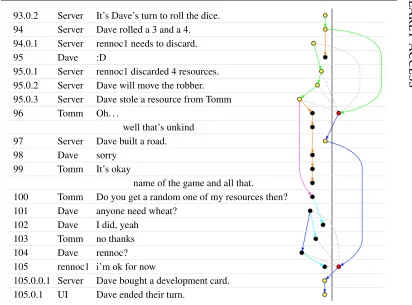
A core in an asymmetric structureGis like the backbone ofG; the periphery on its own typically does not form a connected graph. Figure3illustrates an asymmetric discourse structure, representing the content of an entire situated dialogue. The black nodes representEDUs; the yellow nodes,EEUs. The two red nodes representCDUs
and the dashed edges extending from them indicate their members. The top CDU
(red node) contains the four EEUs (yellow nodes) that result from Dave’s rolling a 7 (so 94.0.1 and 95.0.1-95.0.3). The bottomCDUcontains theEDUs (black nodes)
101, 103, 104 and 105 that constitute a failed bargaining attempt. The core consists of all the yellowEEUnodes plus the four black nodes contained in the bottomCDU.
The periphery in Figure3 contains two structures. The first is a tree of depth one that links theEDU95 to theEEU 94 in the core; the orange arc indicates that 95
is a commentary on 94. The second structure in the periphery is a more complex tree hanging offEEU 95.0.3, the lastEEUfiguring in the topCDU. A pink arc, which
signifies a clarification question, links 95.0.3 with 100; the blue arc following the pink arc indicates that the question was answered byEDU102. The line of orange arcs extending from 95.0.3 signifies a series of commentaries made in the twoEDUs
in turn 96 (indicated by brackets), 98, and the twoEDUs in 99. Taking the periphery
away from the structure leaves an intact connected structure, while taking away the core from the whole structure would lose connectedness.
early
access
93.0.2 Server It’s Dave’s turn to roll the dice. 94 Server Dave rolled a 3 and a 4. 94.0.1 Server rennoc1 needs to discard.
95 Dave :D
95.0.1 Server rennoc1 discarded 4 resources. 95.0.2 Server Dave will move the robber. 95.0.3 Server Dave stole a resource from Tomm
96 Tomm Oh. . .
well that’s unkind 97 Server Dave built a road.
98 Dave sorry
99 Tomm It’s okay
name of the game and all that.
100 Tomm Do you get a random one of my resources then? 101 Dave anyone need wheat?
102 Dave I did, yeah
103 Tomm no thanks
104 Dave rennoc?
105 rennoc1 i’m ok for now
105.0.0.1 Server Dave bought a development card. 105.0.1 UI Dave ended their turn.
Figure 3 A dialogue and its asymmetric structure. The core consists of all the yellow EEU nodes plus the four black EDU nodes contained in the bottom redCDUnode.
relative clauses, for example, generally function as danglers even in discourse representations of single authored text. The periphery of an asymmetric structure thus resembles a collection of one or more danglers. However, while we do not have the space to develop this point here, danglers provided by appositive relative clauses or presuppositional constructions typically interact differently with content in the core. Speakers often use them to provide more information about an entity under discussion, and so the appositive relative clause helps an interpreter to situate discourse content in a way that the commentary in our corpus generally does not.
early
access
Fact 1 Every weakly connected directed, acyclic graphG0∈P(G,C), whereGis an asymmetric structure with a maximal coreC, has a maximal element in VC.
LetG0∈P(G,C). Given thatGis a directed, acyclic graph, it has a maximal element
mG that is the first element of its coreC, by definition. SinceG0 is a substructure of G, the the transitive closure of EG1 must have an edge(mG,d) for eachd ∈G0.
By definition ofP(G,C), the edges inG0cannot be inC. SinceG0is also a directed, acyclic graph it must have a maximal elementmd. But then any edge(s,md)∈EG1 is inEC1, and we know that there is at least one such edge (mG,md). Thus,md ∈VC. Hence, Fact1follows.
Fact 2 Let G be an asymmetric structure with a maximal core C. Then P(G,C)
contains no edges e∈EP1 such that e= (a,b), a∈VPand b∈VC.
The proof of this fact follows immediately from Fact 1 and the observation that wereP(G,C)to contain an edge(a,b)witha∈VPandb∈VC, thenP(G,C)would contain a chain that could be added toCto obtain a core of whichCwas a proper substructure. This would contradict the fact thatCis maximal.
In principle, a discourse structure can contain several cores; this can happen, for example, in conversations that include multiple threads (Wang et al. 2011). In our corpus, however, the vast majority of conversations have one clearly defined core (given by the game moves and interleaved linguistic moves). In fact, given that the playing of the game is the primary concern of our dialogue participants (and each has as his or her overall goal to win the game), we conclude that for every discourse graph G for our corpus, all of the nonlinguistic game EEUs in G are contained in the core ofG. This asymmetry between the nonlinguistic events and linguistic moves might be different for other dialogues. Someone using facial expressions and gestures to react to a speech or story they are hearing, for example, might contribute to an asymmetric structure if these nonlinguistic movements have no effect on the associated linguistic moves.11 In this case, the relationship between nonlinguistic events and discourse moves would be reversed compared with theSettlerscorpus: the linguistic moves would by and large form the core and the nonlinguistic ones, the periphery.
early
access
5.1.2 New patterns of attachment
The asymmetric structures in ourSettlerscorpus permit discourse attachments that yield “rectangular” discourse structures that we have not encountered in previous annotation campaigns on single-authored texts and which are not countenanced in other coherence-based theories of discourse (indeed, RST is restricted to trees; see
Mann & Thompson 1987). This attachment pattern arises when one dangler attaches
to another dangler that extends from a separate node of the core. To illustrate this, consider(13), which involves a fragment of a negotiation dialogue that ends with a nonlinguistic move:
(13) 341 Server GWFSrolled a 6 and a 3.
342 Server inca gets 2 wheat. dmm gets 1 wheat. 344 GWFS 9 nooo!
344.0.1 UI GWFSended their turn. 344.0.2 Server It’s inca’s turn to roll the dice. 345 Server inca rolled a 1 and a 3.
346 Server CheshireCatGrin gets 1 ore, 1 wood. GWFSgets 2 wood. 347 GWFS 4 better :)
348 Server inca ended their turn.
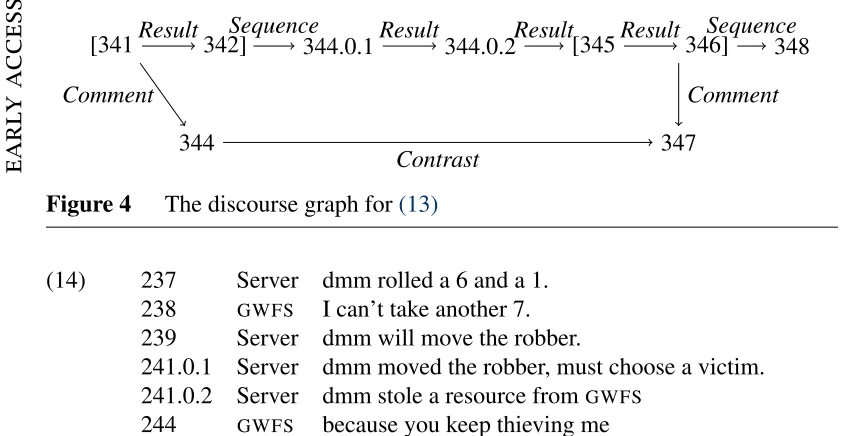
(13)yields an asymmetric structure depicted in Figure4below. The game advances without interference from the chat moves, which provide only commentary on the game. The core of the structure is the chain of connected units[341→342]→
344.0.1→344.0.2→[345→346]→348. Intuitively, 344 is a stand-alone comment on the dice roll in 341 or the CDUcontaining the dice roll and the distribution of wheat (which is what makes the roll of a 9 disappointing for GWFS); that is, it is
a dangler. Similarly, turn 347 is a comment on 345 and 346, and it is not picked up by subsequent discourse. Unlike a normal dangler, however, it is also intuitively related to the previous dangler, 344. In fact, given the established ways in which discourse structure is used to constrain the interpretation of anaphora and other elided constructions (Hobbs 1985,Polanyi 1985,Asher 1993,Kehler 2002), it must be related to 344 so as to resolve the linguistically implicit arguments of the relation
betterto their intuitive values.
early
access
[341 342] 344.0.1 344.0.2 [345 346]
347
348
344
Result Result Sequence Sequence
Result Result
Comment Comment
Contrast
Figure 4 The discourse graph for(13)
(14) 237 Server dmm rolled a 6 and a 1. 238 GWFS I can’t take another 7. 239 Server dmm will move the robber.
241.0.1 Server dmm moved the robber, must choose a victim. 241.0.2 Server dmm stole a resource fromGWFS
244 GWFS because you keep thieving me
(14) is a semi-constructed example. In the original, GWFS says, “also you keep thieving me" rather than 244. Still, we find(14)to sound natural, and it perhaps more clearly illustrates the rectangular structures we are describing. Turns 238 and 244 are comments on game events, and so dangle off the game moves; at the same time, 244 relates to 238 via Explanation, as indicated by the explicit connectivebecause, yielding a rectangular structure.
The preceding examples concern structures with maximal or even unique cores. When a discourse unit d bears multiple discourse relations to different elements
d1, . . .dnin a structureG, however, more than one edge(d,di)may serve to define a core of G. In such a case, that link is part of one core but perhaps not part of another, more minimal core. In addition, the structure that includes those elements that involve the main purpose of the dialogue, the playing of the game, may be such a nonmaximal core. Thus, a pair ofDUs may support one discourse relation in the periphery and another in the core.
early
access
(10) 534 GWFS anyone want to trade their ore for my wood? 535 LJAY nope
538 GWFS it may prove a prudent trade, lj. . .
539 LJAY nope
539.1 Server GWFSplayed a Soldier card. 539.4 Server GWFSstole a resource fromLJAY
540 GWFS apologies. . . 541 LJAY :(
The failed trade negotiation (turns 534-539) results in GWFS’s playing a Soldier
card and stealing fromLJAY (539.1-539.1). As explained in Section4.1, the chat moves and the game moves are a part of the game; this is a classic example of an interleaved structure. In addition, however, we infer an Explanation betweenGWFS’s
utterance of “it may prove a prudent trade, lj. . . ” (538) and his Soldier card play, and this relation isnotcentral to advancing the game play; theraison d’êtreof his move is not to provide an explanation of his warning, so the Explanation is structurally independent of the game structure. The explanatory role played by 539.1 and 539.4 towards 538 could be removed without endangering the coherence of the core, while removing the core from this example would leave us wondering whyGWFSasserted
538 and whyLJAY is sad in 541.
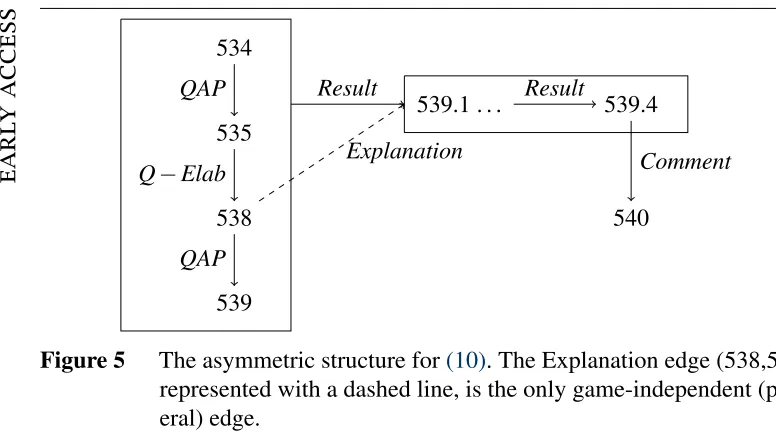
The graph below gives the representation of(10); the dashed arrow represents the only game-independent edge in this example. To improve the readability of the graph, we note that following SDRT andPolanyi 1985,12 we distinguish subordi-natingedges, which are labelled with names for subordinating relations such as Elaboration, Explanation, and Background, from coordinating edges, which are labelled with coordinating relations such as Contrast, Narration (Sequence),13 and Result. Coordinating edges are generally represented with horizontal arrows, while subordinating edges are generally represented by vertical arrows. The import of the subordinating/coordinating distinction will be brought out in the next subsection. The asymmetric configuration illustrated in this graph is another example of a structure that is unfamiliar from work on rhetorical structure.
To make the point abstractly, consider a relational structureRwith two relations
inRrepresented extensionally as sets of pairs, i.e.,R= ({a,b,c},{(a,b),(a,c)},{(a,b),(b,c)}). Removing one of the pairs,(a,b), will yield two substructuresR1andR2ofR:R1=
({a,b,c},{(a,c)},{(a,b),(b,c)}), andR2= ({a,b,c},{(a,b),(a,c)},{(b,c)}). For a given discourse unituwith such multiple relations, one of these rhetorical
rela-12 Rhetorical Structure Theory (Mann & Thompson 1987) also has a similar distinction.
early
access
534
535
538
539
539.1 . . . 539.4
540
QAP
Q−Elab
QAP
Result
Comment Result
Explanation
Figure 5 The asymmetric structure for(10). The Explanation edge (538,539.1), represented with a dashed line, is the only game-independent (periph-eral) edge.
tions might be a part of the core substructure, while another might contribute to the periphery. That one and the same pair of discourse units can be elements of both the core of an asymmetric structureG and of the periphery ofGmight seem strange. Nevertheless, the situation is consistent with our core/periphery distinction, which yields a partition of the edges inGbut not of its nodes.
5.1.3 Discourse salience and the right frontier
Rectangular structures like that given by(13)violate the Right Frontier Constraint (RFC) for monologue or text (Polanyi 1985,Webber 1988,Asher 1993). The Right Frontier (RF) is a set of nodes in a discourse structure — the nodes along the right edge of a discourse graph — that dynamically evolves as a discourse proceeds, and is designed to track the accessible and salient nodes in a discourse at any given time. The RFConstraintrequires a new node to attach to a node from the RF.14
Normally, a coordinating relation such as Sequence or Result is understood as pushing the discourse forward, thereby shutting off the accessibility of its left argu-ment. To make this more precise, we introduce SDRT’s Right Frontier Constraint; RFCs from other accounts are roughly similar. The RF in SDRT includes (i) the node
Last— which is the node most recently attached to the discourse graph — as well as (ii) any unit that is superordinate to a unit on the RF through a subordinating relation
early
access
and (iii) any CDU that includes a node on the RF.15 Definition 6 formalizes this
definition, using the definition of a discourse graph from Definition1. Definition6
defines those nodesxon the RF of an SDRT graph G, written RFG(x), which are accessible for the next unit to rhetorically attach to:
Definition 6 LetG= (V,E1,E2, `,Last)be a discourse graph;∀x∈V,RFG(x)iff(i) x=Last; or(ii)∃y∈VRFG(y)and∃e∈E1, e(x,y)and Sub(e); or(iii)RFG(y)and ∃e∈E2, e(x,y).
The definition of the RF entails that attaching to the RF via a subordinating (Sub) relation places both arguments on the RF, but attaching via a coordinating relation removes the first argument from the RF, leaving it inaccessible for further rhetorical qualification. Many of the rectangular structures in our corpus violate this constraint. The rectangular structure produced by(13), as pictured in Figure4, is one example: the Result and Sequence relations intervening between 342 and 345 should render 344 inaccessible to future discourse moves, yet the comment in 347 is still interpretable as standing in a Contrast relation with 344.
If we look more closely at the rectangular structures in theSettlerscorpus, we see that coordinating relations between nonlinguistic events do not necessarily shut off the accessibility of prior nonlinguistic events, either, which gives rise to further violations of Definition6. Examples like(12), repeated below, are frequent in our corpus. In(12), turn 155 is attached to 154.1-154.3 via Sequence. The attachment of 155 should render 154.1-154.3 inaccessible, yet the Explanation provided by 159 makes clear that 158 should be understood as a Comment on those earlier moves. Likewise, 163 is understood as a Comment on 159.1-159.4 despite the intervening coordinating relations.
(12) 154.1 Server GWFSplayed a Soldier card. 154.3 Server GWFSstole a resource fromLJAY
155 Server GWFSrolled a 5 and a 1.
157 Server GWFSbuilt a settlement. 158 GWFS sorry laura
159 GWFS needed clay the mean way :D
159.1 Server LJAY played a Soldier card. 159.4 Server LJAY stole a resource fromGWFS
160 Server LJAY rolled a 4 and a 4.
161 Server GWFSgets 2 wheat. 163 GWFS touché
early
access
At the same time, while rectangular structures show that the structure of game moves does not effect the development of a chat in the way predicted by Definition6, we should not conclude that the structure of game moves is entirely irrelevant to chat development. Consider(15), a minimal variant of(12).
(15) 159.1 Server LJAY played a Soldier card. 159.4 Server LJAY stole a resource fromGWFS
160 Server LJAY rolled a 4 and a 4.
161 Server GWFSgets 2 wheat.
162 GWFS finally some wheat
163 GWFS touché
The introduction of 162 in (15) makes it far more difficult to return to the prior Soldier card event, thereby making 163 less coherent in(15).
The discussion of(12) and(15) brings out a general point about situated dis-course. The original RFC, conceived as a constraint on how a speaker should present information and as a constraint on monologue and text, has strong empirical support
(Polanyi 1985,Afantenos & Asher 2010). In situated discourse, however, the
devel-opment of a discourse is not always under the speaker’s control. We need to recast constraints on discourse attachment as constraints not only on how information can bepresented, but on how it can be exploited. Already, moving to multi-party dialogue introduces complications for the RFC not only because speakers can engage in multiple, separate threads of conversation (see also the interruption moves from
Polanyi 1985), but also because an interlocutor might not agree that information
that a speaker has presented as the most salient is the information that should be discussed in the subsequent discourse. Consider the following constructed example:
(16) 100 T.K. Anyone want ore for sheep?
101 GWFS I’m