Optimum Utilization of Rice Husk Ash
for Stabilization of Sub-base Materials
in Construction and Repair Projects
of Forest Roads
Mehran Nasiri, Majid Lotfalian, Amir Modarres, Wei Wu
Abstract
Forest roads play an important role in forest management, timber transportation and forest protection. However, minimum standards are considered for pavement materials due to the traffic volume and economic situation of forestry projects. Therefore, this paper aims to (a) evaluate the role of Rice Husk Ash (RHA) as a soil stabilizer of sub-base layer to improve the quality of materials and (b) determine the optimum utilization among 10 combinations of soil, lime and RHA regarding the environmental factors. The results of laboratory studies on soil A–6 (AASHTOO classification) indicates a general decrease in the maximum dry density (MDD) and an increase (21.9%) in optimum moisture content (OMC) with increase in RHA content. Adding RHA (9%) causes a decrease (13.3%) in liquid limit and plasticity index (PI) of soil. However, this improving effect is not as much as the influence of lime. The California bearing ratio (CBR) of stabilized soil in both saturated condition and optimum water content was 28% and 37.5% more than the natural soil, respectively. The maximum unconfined compressive strength (UCS) values were recorded for 9% RHA, 237 KN m-2 after 28 days curing time, which was 23 KN m-2 more than the natural soil. According to the results, the combination of Soil+4% Lime+9% RHA could be used as the optimum consumption of mate-rials for stabilization of sub-base layer in construction of forest roads.
Keywords: forest road, stabilization, rice husk ash (RHA), CBR, UCS, OMC, MDD
and A–7. These soils generally contain silt and clay
and are classified in bad to average classes in terms of
road construction (AASHTO 1986).
To have the required strength against tensile stress
-es and strains spectrum, the materials used for con
-structing sub-base layer should have suitable specifi
-cation. The use of soil stabilizers is one of the ways to improve the mechanical specification of these soils (Nair et al. 2008, Jamil et al. 2013). Lime has been used several times in forest road projects as a stabilizer (Péterfalvi et al. 2015). The reaction between soil and lime is performed very slowly. In addition, in the pres
-ence of organic matters in forest road materials, pure lime cannot be a suitable stabilizer. However, the ex
-tensive use of lime is harmful to the environment and roadside vegetation in the area with non-calcareous
1. Introduction
Forest roads are designed under substantially lim
-ited conditions. In most cases, minimum standards are considered for layers due to the traffic volume and economic situation of forestry projects. The most im
-portant pavement layer of forest roads (access roads) is sub-base layer, since the construction of base layer on forest roads is not justified according to its stan
-dards. Several types of sub-base materials can be used considering the type of materials in borrow area, weather conditions, number of traffic and economic situation. Usually, borrow materials are used for the construction of forest roads. Experiences have re
bedrock. Due to limitations in the use of stabilizers such as cement in forest roads (Khan et al. 2012), rice husk ash (RHA) with a huge amount of silica and high specific surface could play a major role in soil stabiliza
-tion method with lime (Weiting et al. 2012). Given that RHA is not suitable for cattle feeding and it is also non-biodegradable, it could be considered as an inex
-pensive stabilizer. Low cost and availability as well as the stabilization specification of RHA have led many researchers to investigate RHA as an alternative for soil stabilization (Basha et al. 2005, Jha and Gill 2006, Onyango et al. 2007, Nair et al. 2008, Ramezanianpour et al. 2009, Chobbasti et al. 2010, Sabat and Nanda
2011, Harichane et al. 2011, Milani et al. 2012, Weiting et al. 2012, Trivedi et al. 2013, Jamil et al. 2013).
Onyango et al. (2007) in Tanzania used the natural pozzolan as the road pavement stabilizer. He showed that pozzolan was one of the most appropriate stabi
-lizers in low-volume road and that it was economi
-cally effective. Chobbasti et al. (2010) showed that RHA was effective in reducing the liquid and plastic limits of soil. Alhassan (2008) reported that the Uncon
-fined Compressive Strength (UCS) would improve with the use of RHA and the highest UCS was mea
-sured by 6–8% in the combination of soil and RHA. The values of optimum moisture content (OMC) and
maximum dry density (MDD) were also reported in studies of Basha et al. 2005 and Trivedi et al. 2013. They concluded that the OMC increased and MDD reduced by increasing in RHA percent. Several studies have examined the California Bearing Ratio (CBR) of soil (Jha and Gill 2006, Chobbasti et al. 2010, Purbi Sen et al. 2011, Sabat and Nanda 2011). They stated that the addition of lime to the soil had quickly affected the soil CBR, which had increased over time. By conducting a CBR test, Sabat and Nanda (2011) showed that the ad
-dition of mentioned materials to the soil had increased its strength by 20% compared to the natural soil sam
-ples.
By further investigations, it was found that most of the conducted studies were performed for urban and rural roads and important environmental factors have not been examined. The amount of lime used in some of these studies was very high and reached an amount of 10%, while in this study, the environmen
-tal issues i.e. the use of less lime and finding a com
-bination that improves the mechanical properties of soil were considered. Therefore, this paper aims to (a) evaluate the role of Rice Husk Ash (RHA) as a soil stabilizer of the sub-base layer and (b) determine the optimum utilization among 10 combinations of soil, lime and RHA regarding the environmental factors.
2. Materials and Method
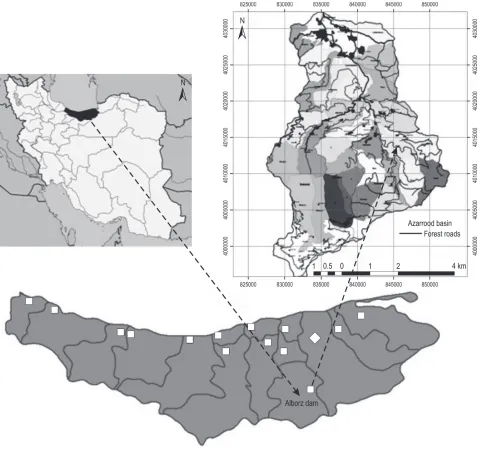
2.1 Study AreaThis study was conducted in a road of Caspian forest (Azarrood basin), north of Iran (Fig. 1). The latitude and longitude of Azarrood basin are 36°08′5″ N and 52°45′58″ E, respectively. In this region, there is a moderate mountainous climate with cold winters and humid summers. The forest altitude ranges from 360 to 1490 meters above sea level and average an
-nual precipitation is 800 mm. Alborz earth dam with a height of 72 m was constructed in this area (Latifi et al. 2012). Therefore, due to the earth dam and soil ero
-sion, one of the most important solutions to prevent sediment delivery from forest roads and to strengthen the road materials is the use of stabilizers.
2.2 Identification of Soil
About 350 kg of soil were collected from the bor
-row area (excavation slopes) near the Alborz Dam. Soils were put in 50 kg bags and transferred to the soil mechanics laboratory. In the laboratory, soils were re
-mixed well together and used with respect to the ob
-jectives of this study. In order to identify the soil, tests such as sieve analysis and specific gravity (Gs) were
done. For this purpose, the dried soil samples were placed in the topmost sieve and dry sieving was per
-formed using a mechanical sieve shaker for a mini
-mum period of 10 min. The specific gravity (Gs) of soil
samples were determined using a pycnometer (ASTM-D854) and the average of soil Gs was recorded 2.74.
Also, the liquid and plastic limits of the soil were de
-termined in order to study the Aterrberg limits and classify the soil. According to the AASHTO soil clas
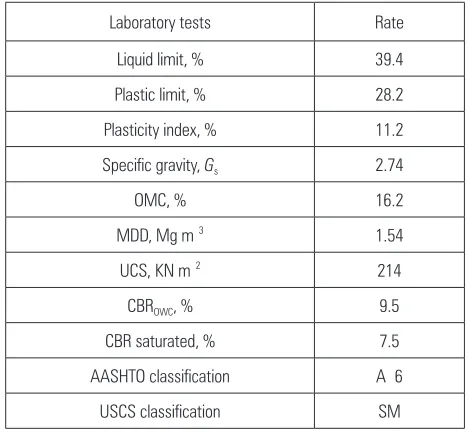
-sification system, the studied soil is classified as A–6 soil and according to the Unified Soil Classification System (USCS), it is named SM (Silty Sand with Grav
-el). Table 1 shows more information about engineering properties of the studied soil.
In order to stabilize the sub-base soil, at first rice husk and hydrated lime were prepared from farm fields of northern Iran and Alborz Industrial factory, respectively. The type of used lime is slaked lime and some of its characteristics are shown in Table 2. To make rice husk, rice husk must be burned at high tem
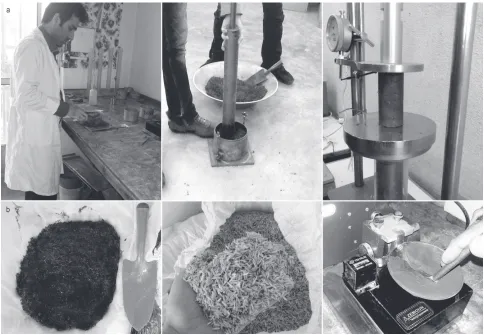
-peratures (about 500°C) (Chobbasti et al. 2010). After burning, the obtained RHA were placed in the open air to complete the ash production process (Fig. 2b). Some characteristics of Tarom husk ash are shown in Table 3 (Chobbasti et al. 2010).
Table 1 Properties of the natural soil
Laboratory tests Rate
Liquid limit, % 39.4
Plastic limit, % 28.2
Plasticity index, % 11.2
Specific gravity, Gs 2.74
OMC, % 16.2
MDD, Mg m–3 1.54
UCS, KN m–2 214
CBROWC, % 9.5
CBR saturated, % 7.5
AASHTO classification A–6
USCS classification SM
Table 2 Characteristics of the used lime
Non Hydrated CaO %
Non Hydrated MgO
% pH
CO2 %
Ca(OH)2 %
2.3 Mix Designs
By examining different studies, it can be concluded that soil properties are one of the most important fac
-tors of mix design. Some studies have considered the value of 6% of lime consumption (Muntohar 2002); some other proposed the value of 10%. According to the objects i.e. the minimum use of lime, a combination of 4% and 6% was considered in this study. However, the addition of RHA varied in different studies. For example, Alhassan (2008) and Chobbasti et al. (2010) considered a maximum of 12% and 7% RHA for A–7–6 and A–4 soils, respectively. In this study, the RHA val
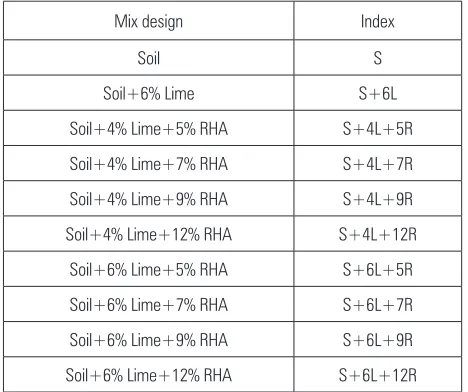
-ues of 5, 7, 9 and 12% were considered regarding the Liquid limit (LL) = 39.4, Plastic Limit (PL) = 28.2 and A–6 soil, respectively. Table 4 shows the mix design of materials.
2.4 Methods of Testing
Soil mechanics tests were designed in order to evaluate the effect of stabilizers. So, materials were prepared according to the mix design and studied us
-ing tests of CBR, UCS (7, 14 and 28 days cur-ing times), ATERBERG and Compaction. For a more accuracy, the number of replications for CBR, UCS, ATERBERG and Compaction test were considered 3 times (for each sample). The California Bearing Ratio test, or CBR-test, is an empirical test, which is used as an important cri
-terion in pavement design. With this test, the bearing value of road sub-base and sub-grade can be estimat
-ed. In addition, it is one of the common tests for assess
-ing the strength of stabilized soils. This test was con
-ducted in accordance with the standard ASTM D1883-07(2002) in two conditions of saturation and optimum water content. According to the purpose of the study, this test can examine the strength of stabi
-lized samples compared to the natural soil samples. Also, the proctor compaction tests were performed in accordance with the standard ASTM D069807E01(2002) in CBR mould; by conducting this test, it can be seen
Table 3 Chemical characteristics of the Tarom husk ash (* 10-6)
P, % Mg2+, % Ca2+, % K, % Na, % SiO
2, %
24.7 66.1 0.016 0.124 0.114 83.7
how much free space of aggregates is filled by stabiliz
-ers and how the optimum water content is affected. The CBR test is carried out on material passing the 20 mm test sieve. Regarding weather conditions of northern Iran, CBR samples are saturated for about 4d (Chobbasti et al. 2010). Soil samples were moved into cylindrical plunger (proctor cylinder) and compacted in 5 layers with 56 blows per layers. The CBR tests were performed using the load-measuring device, which is connected to the compression machine with the loading rate of 1 mm/min. The mould with the sample and the surcharge weights were placed in the machine and loading rates were measured at every 2.5 mm displacement and CBR rates were calculated for each sample. One of the most useful methods of eval
-uating the strength of stabilized soil is UCS test. The required amount of additive to be used in stabilization of soil could be determined by this test. In this study, the test was performed for samples with 7, 14 and 28 days curing time to consider the time factor (Alhassan 2008). This test was performed in accordance with the standard ASTM D 2166. The compression device (a hydraulic-actuated loading piston with the capability of infinite rates of strain and stress loads) was used to measure the UCS rates (Fig. 2a). Also, special trim
-ming was not needed because the California sampler was used in this test. After extruding the soil sample, specimens were placed on the bottom plate of the com
-pression machine and com-pression load was applied. Then the rates of UCS were calculated. The ATER
-BERG limits test was performed in accordance with the standard ASTM D4318-05 (2002). According to the purpose of this study, this test can show how much the added pozzolanic materials could improve soil prop
-erties in terms of ATERBERG limits. To measure the liquid limit, about 250 gr of the studied soils (the mate
-rial passing the No. 40 sieve) were weighted and thor
-oughly mixed with 15 to 20 ml of distilled water. Mix
-ing was done on a glass plate to keep the whole sample at the same moisture content. The liquid limit was measured using a Casagraunde cup. Plastic limit of fine-aggregates in sandy materials have a major influ
-ence on the strength of used materials. Materials with a PI (plasticity index) exceeding the allowed values should not be used on base and sub-base layers, be
-cause materials with higher PI have lower shear strength. The plastic limit is often used together with the liquid limit to determine the plasticity index. To measure the plastic limit, about 20 g of the studied soils (the material passing the No. 40 sieve) is needed. Samples were mixed with the distilled water for 10 min to form a plastic ball and then rolled out under the fingers on a glass plate. The rate of rolling should be between 80 to 90 strokes per minute to form a 3 mm diameter. After crumbling, the pieces of crumbled soil were collected to determine the moisture content.
2.5 Data Analysis
Statistical comparisons were done using the SPSS 16 software to compare means among treatments. Data (different combination of materials) were ana
-lyzed using ANOVA and Tukey HSD test in terms of soil mechanical properties. Also, the graphical dis
-plays were made using the SigmaPlot 12.0 software.
3. Results and Discussion
3.1 Compaction CharacteristicsThere was an increase in OMC with the increase of RHA contents (Fig. 3). The trend is in line with Alhas
-san 2008 and Roy et al. 2010. According to Fig. 3, it can be found that the soil OMC for combinations of S+4L+7R and S+6L+9R had increased 19% and 21.9%, respectively, compared to the natural soil samples. The increase was a result of the addition of RHA, which reduced the quantity of free silt and clay fraction and coarser materials with larger surface areas were formed (these processes require water). Furthermore, this indicates that more water was needed to compact the soil-RHA mixtures (Ramezanianpour et al. 2009).
According to Fig. 4, adding RHA to the soil caused a decrease in MDD. The trend is in line with Alhassan 2008, Basha et al. 2005, Trivedi et al. 2013. Given that the MDD for the natural soil and S+6L was 1.54 Mg m-3
and 1.42 Mg m-3, respectively, by adding 9% RHA it
was possible to reduce the soil MDD to 1.21 Mg m-3.
Table 4 Investigated mixtures and mentioned indices
Mix design Index
Soil S
Soil+6% Lime S+6L
Soil+4% Lime+5% RHA S+4L+5R
Soil+4% Lime+7% RHA S+4L+7R
Soil+4% Lime+9% RHA S+4L+9R
Soil+4% Lime+12% RHA S+4L+12R
Soil+6% Lime+5% RHA S+6L+5R
Soil+6% Lime+7% RHA S+6L+7R
Soil+6% Lime+9% RHA S+6L+9R
The reduction in MDD can be related to the replace
-ment of soil by RHA in the mixture, which has a rela
-tively lower specific gravity compared to the soil (Osinubi and Katte 1997). It may also be related to the coating of soil by RHA, which results to large particles with larger voids and less density (Chobbasti et al. 2010). The reduction in the MDD may also be ex
-plained by considering the RHA as filler (with lower specific gravity) in the soil voids.
3.2 ATERBERG Limits
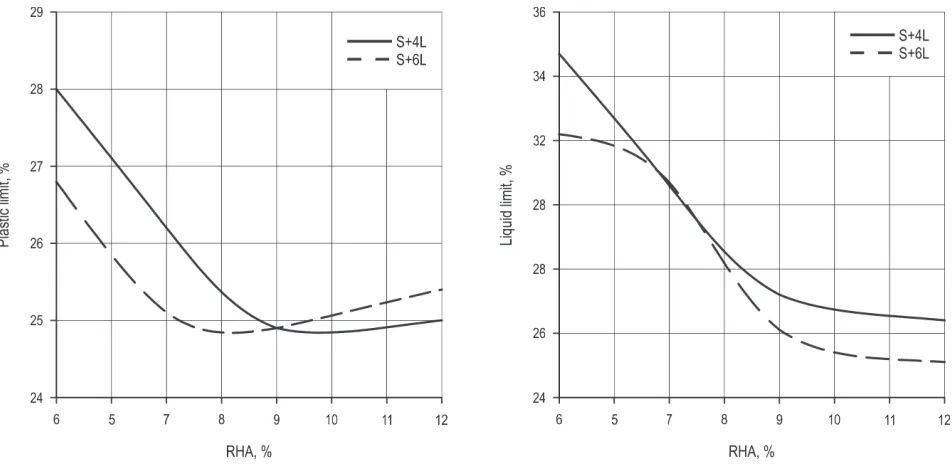
The results showed that the soil liquid limit de
-creased with an increase in the RHA (Fig. 5). The trend is in line with Jha and Gill 2006, Onyango et al. 2007, Purbi Sen et al. 2011. The liquid limit of the natural soil and S+6L was 39.4 and 29.7, respectively. Accord
-ing to Fig. 5, it can be found that 9% RHA can reduce the soil liquid limit to 26.1%. The comparison of re
-Fig. 5 Influence of RHA and lime on plastic and liquid limits
Fig. 4 Influence of RHA and lime on MDD parameter
duction ratio between treatments indicated that the lime can have a much greater effect on the reduction of the soil liquid limit (a reduction of 10%). The reason for this reduction could be the chemical reaction be
-tween the limes and soil that require more moisture and provides this moisture from the soil.
The results showed the plastic limit decreased with an increase in the RHA (Fig. 5). The results are consis
-tent with Muntohar 2002, Trivedi et al. 2013. The plas
-tic limit of the natural soil and S+6L was 28.2% and 25.8%, respectively. Similar to the soil liquid limit, the comparison of the reduction ratio between treatments revealed that lime can have a much greater effect on the soil plastic limit.
3.3 California Bearing Ratio
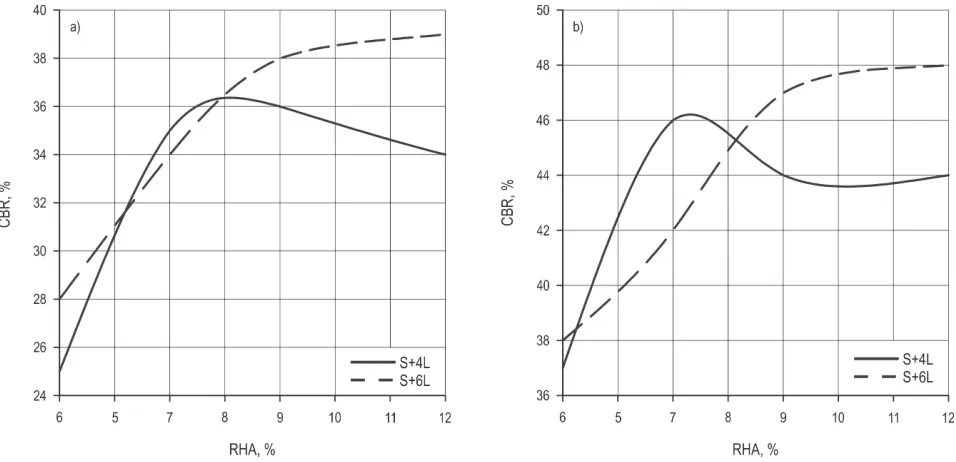
The results indicated in both saturated condition and optimum water content that the addition of RHA could increase the soil CBR; however, the increasing trend varied for different percentages (Fig. 6). Trends shown in Fig. 6 are in agreement with Chobbasti et al. 2010, Purbi Sen et al. 2011, Sabat and Nanda 2011. In the saturated condition, the treatment of S+4L+7R reached the highest effectiveness on CBR (an increase of 27%) and then decreased. Alhassan (2008) reported that the highest effectiveness on CBR for saturated condition was 18.5%. The comparison results showed that the CBR of saturated condition was 28% and 19% higher than the natural soil and S+6L, respectively. The results of optimum water content also indicated that the CBR reached its maximum values in the treatment
of S+4L+7R (46%) and then dropped. The maximum differences recorded for CBR were 37.5% and 28% higher than the natural soil and S+6L.
3.4 Unconfined Compressive Strength
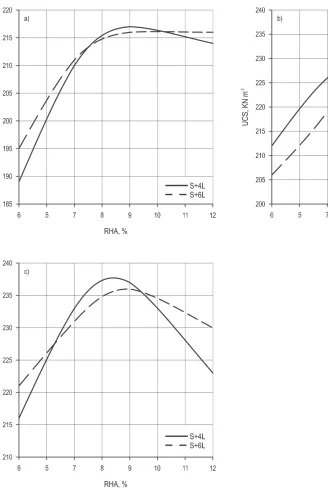
According to Fig. 7, it can be found that the UCS did not have a lot of changes with increasing in lime (4% lime or 6% lime). The UCS values increased with the addition of RHA to its maximum at between 7–9% RHA and then dropped from 12% RHA. According to Fig. 7, the highest rate of increase in UCS occurs in the first 28 days. The trend is in line with Alhassan 2008 and Jha and Gill 2006. Alhassan (2008), stated that the high
-est UCS was related to 8% RHA and 28 days samples. The comparison results showed that the maximum UCS of stabilized soil (237 KN m-2) was 23% and 16%
higher than the natural soil (214 KN m-2) and S+6L
(221 KN m-2). The subsequent increase in the UCS is
att ributed to the formation of cementitious compounds between the CaOH present in the soil and RHA as well as the pozzolans present in the RHA (Jami et al. 2013). The reason of this reduction in the UCS values after the addition of 9% RHA could be excess RHA intro
-duced to the soil and hence forming weak bonds be
-tween the soil and cementitious compounds formed.
4. Conclusion
We concluded that pozzolanic materials, such as rice husk ash (RHA), increase the materials quality in soil stabilization method with lime. Since the rice husk
is an agricultural waste material and it is available in many countries at little or no cost (1$ for each gunny-bags in Iran), the produced ash from rice husk can be used as an appropriate and inexpensive stabilizer in sub-base layer of forest roads. So, this study introduc
-es the b-est combination of sub-base soil, rice husk ash and lime by examining ten mix designs:
According to CBR results, the combinations of S+4L+7R and S+6L+12R had best performance. By ex
-amining the values of UCS, the combinations of
S+4L+9R and S+6L+9R were selected as the most ef
-fective ones. According to the OMC, the combina
-tions of S+4L+9R, S+6L+9R as well as S+6L+12R were selected as the best combinations and according to MDD, the combinations of S+4L+9R, S+4L+12R and S+6L+9R had almost the same performance. The re
-sults of soil plastic and liquid limits indicated that the combinations of S+4L+9R and S+6L+9R had the best performance in reduction of both plastic and liquid limits. So, accurate examinations between the men
tioned treatments showed that the combination of S+4L+9R and S+6L+9R could be considered as an op
-timum utilization to stabilize sub-base materials. The positive effects of these two combinations in im
-provement of mechanical properties of A–6 soil are shown in Fig. 8. However, the important aspect is the use of less lime due to environmental issues sur
-rounding forest roads and economic situation of for
-est roads projects. Thus, the combination of S+4L+9R was selected as the best combination for stabilizing
the sub-base materials of forest roads due to less con
-sumption of lime.
Acknowledgements
The authors would like to thank the University of Sari Agricultural Sciences and Natural Resources for funding this research and to acknowledge the support of Mr. Bozorgpour, Mr. Valizadeh and Mr. Savadkoohi for their invaluable assistance in soil sampling and laboratory tests.
5. References
Alhassan, M., 2008: Permeability of lateritic soil treated with lime and rice husk ash. Assumption University Journal of Thailand 12(2): 115–120.
American Association of State Highway and Transportation
Officials (AASHTO), 1986: Standard Specifications for Clas
-sification of Soils and Soil-Aggregate Mixtures for Highway Construction Purposes (M145). Washington D C, USA. American Society for Testing and Material (ASTM), 2002: Test Methods for Laboratory Compaction Characteristics of Soil Using Standard Effort (D0698-07E01). Annual Books of ASTM Standard. Section 4 Vol. 0408 USA.
American Society for Testing and Material (ASTM), 2002: Test Methods for Liquid Limit, Plastic Limit, and Plasticity Index of Soils (D4318-05). Annual Books of ASTM Standard, Section 4 Vol. 0408 USA.
American Society for Testing and Material (ASTM), 2002:
Test Methods for CBR (California Bearing Ratio) of Labora
-tory Compacted Soils (D1883-07). Annual Books of ASTM Standard, Section 4 Vol. 0408 USA.
Basha, E.A., Hashim, R., Mahmud, H.B., Muntohar, A.S., 2005: Stabilization of residual soil with rice husk ash and cement. Construction and Building Materials 19(6): 448–453. Chobbasti, A.J., Ghodrati, H., Vahdatirad, M.J., Firouzian, S., Barari, A., Torabi, M., Bagherian, A., 2010: Influence of using rice husk ash in soil stabilization method with lime. Frontiers of Earth Science in China 4(4): 471–480.
Jamil, M., Kaish, A.B.M.A., Raman, S.N., Zain, M.F.M., 2013:
Pozzolanic contribution of rice husk ash in cementitious sys
-tem. Construction and Building Materials 47: 588–593. Jha, J.N., Gill, K.G., 2006: Effect of rice husk ash on lime stabilization. Journal of the Institution of Engineers 87: 33–
39.
Harichane, K., Ghrici, M., Kenai, S., 2011: Effect of curing
time on shear strength of cohesive soils stabilized with com
-bination of lime and natural pozzolana. International Jour
-nal of Civil Engineering 9(2): 90–96.
Khan, R., Jabbar, A., Irshad, A., Khan, W., Naeem Khan, A., Mirza, J., 2012: Reduction in environmental problems using
rice-husk ash in concrete. Construction and Building Materi
-als 30: 360–365.
Latifi, N., Matro, A., Khari, M., 2012: Monitoring results of Alborz earth dam during construction. Electronic Journal of Geotechnical Engineering 17: 2474–2484.
Milani, S., Silva, A., Paula, D., 2012: Physical, Mechanical and Thermal Performance of cement-stabilized rammed earth-rice husk ash walls. Journal of Materials in Civil Engineering 24(6): 775–782.
Muntohar, A.S., 2002: Utilization of Uncontrolled Burnt Rice
Husk Ash In Soil Improvement. Dimensi Teknik Sipil Jour
-nal 4(2): 100–105.
Nair, D.G., Fraaij, A., Klaassen, A.K., Kentgens, P.M., 2008: A structural investigation relating to the pozzolanic activity of rice husk ashes. Journal of Cement and Concrete Research 38(6): 861–869.
Osinubi, K.J., Katte, V.Y., 1997: Effect of elapsed time after mixing on grain size and plasticity characteristics, soil lime mixes. Nigeria Soc. Engin. Tech Trans 32(4): 65–76.
Onyango, M., Macha, I., Busch, C., 2007: Use of Naturally
Occurring Pozzolans for Road Construction in Tanzania. 9th
International Conference on Low-Volume Roads. June 24– 27, Austin, Texas.
Péterfalvi, J., Primusz, P., Markó, G., Kisfaludi, B., Kosztka,
M., 2015: Evaluation of the Effect of Lime-Stabilized Sub
-grade on the Performance of an Experimental Road Pave
-ment. Croat. j. for. eng 36(2): 269–282.
Purbi, S., Mukesh, N., Dixit, M., 2011: Evaluation of Strength
Characteristics of Clayey Soil by Adding Soil Stabilizing Ad
-ditives. International Journal of Earth Sciences and Engineer
-ing 4: 1060–1064.
Ramezanianpour, A.A., Khani, M.M., Ahmadibeni, G.H., 2009: The Effect of Rice Husk Ash on Mechanical Properties
and Durability of Sustainable Concretes. International Jour
-nal of Civil Engineering 7(2): 83–91.
Roy, T.K., Chattopadhyay, B.C., Roy, S.K., 2010: Effect of Al
-ternative Materials on Engineering Properties of Alluvial
Soil for Construction of Road Subgrade. Proceeding of Traf
-fic and Transportation Studies 1331–1340.
Sabat, A.K., Nanda, R.P., 2011: Effect of marble dust on strength and durability of Rice husk ash stabilised expansive soil. International journal of civil and structural engineering 1(4): 939–948.
Trivedi, J.S., Sandeep, N., Chakradhar, I., 2013: Optimum
Utilization of Fly Ash for Stabilization of SubGrade Soil us
-ing Genetic Algorithm. Procedia Engineer-ing 51: 250–258.
Weiting, X., Tommy, Y.L., Shazim, A.M., 2012: Microstruc
-ture and reactivity of rich husk ash. Construction and Build
Received: October 27, 2015 Accepted: February 02, 2016
Authors’ address:
Mehran Nasiri, PhD. student *
e-mail: [email protected]; [email protected] Assoc. prof. Majid Lotfalian, PhD.
e-mail: [email protected]
Sari university of agricultural sciences
and natural resources
Department of Forest engineering P.O Box 576, Badeleh, Sari, Mazandaran IRAN
Assoc. prof. Amir Modarres, PhD. e-mail: [email protected] Babol University of Technology Department of civil engineering
P.O. box 484, Shariati Av., Babol, Mazandaran IRAN
Prof. Wei Wu PhD. e-mail: [email protected]
University of Natural Resources and Life sciences Institute of Geotechnical Engineering
P.O. Box 85084, Vienna AUSTRIA