Copyright by Science in China Press 2005
Environmental friendly nitrogen fertilization
Avi Shaviv
Faculty of Civil and Environmental Engineering Technion-IIT, Haifa (email: [email protected])
Received July 26, 2005
Abstract With the huge intensification of agriculture and the increasing awareness to human health and natural resources sustainability, there was a shift towards the development of envi-ronmental friendly N application approaches that support sustainable use of land and sustain food production.
The effectiveness of such approaches depends on their ability to synchronize plant nitrogen demand with its supply and the ability to apply favored compositions and dosages of N-species. They are also influenced by farming scale and its sophistication, and include the following key concepts: (i) Improved application modes such as split or localized (“depot”) application; (ii) use of bio-amendments like nitrification and urease inhibitors and combinations of (i) and (ii); (iii) use of controlled and slow release fertilizers; (iv) Fertigation-fertilization via irrigation systems in-cluding fully automated and controlled systems; and (v) precision fertilization in large scale farming systems. The paper describes the approaches and their action mechanisms and exam-ines their agronomic and environmental significance. The relevance of the approaches for dif-ferent farming scales, levels of agronomic intensification and agro-technical sophistication is examined as well.
Keywords: nitrogen pollution, environmentally friendly application.
DOI: 10.1360/062005-285
Nutrient use efficiency (NUE) and recovery of N remained low during the last five decades despite re-markable developments in crop production. Applica-tion of N often done under poor fertilizaApplica-tion and water supply management poses serious environmental, health, and resource conservation concerns. In addi-tion, plants are exposed to far from optimal conditions, and the yields and crop/food quality get adversely af-fected.
The greatest N losses are associated with: nitrate leaching into water sources[1,2]; volatilization of am-monia[3]; volatilization of di-nitrogen or nitrous ox-ides[4,5]; and runoff losses of N leading also to euthro-phication[6].
Excessive (local or temporal) nutrient supply, re-sulting from application of conventional fertilizers, may result in a high concentration of soluble salts in the root zone[7,8]. This may induce osmotic stress and cause specific injuries to plants at different growth stages, or undesired development such as lodging. Excessive accumulation of nitrate or nitrite in plant parts consumed by humans or animals is likely to cause detrimental effects similar to those associated with nitrate contamination of water sources[9].
ac-cording to a sigmoidal pattern[10,11]. Realization of the advantages expected from exposing plants to optimal and preferred N-species in soil solution (e.g. maintain desired ammonium/nitrate ratio, induce rhizosphere acidification[11]) has rare chances with the basal appli-cation.
This presentation focuses on different fertilization techniques and approaches aiming at a more environ-mentally friendly application of nitrogen, while sus-taining food production. They are all based on two main principles (i) improved synchronization of nitro-gen supply with plant demand (temporal and quantity wise) and (ii) supply of favored compositions of N-species. These include:
Application mode: split (side dressing) or localized (“depot”) application (e.g. bands, nests, super-gran- ules); use of Bio-Inhibitor amendments (e.g. nitrifica-tion and/or urease inhibitors) and combinanitrifica-tion of the application mode with amendment; controlled and Slow Release Fertilizers-CRF/SRF; fertigation; auto-mated and controlled greenhouse production with wa-ter and nutrient re-circulation; “precision fertilization”.
1 Application mode―Split or localized applica-tion
Split application of nitrogen (also denoted side dressing) and spatial dosing in bands, nests or su-per-granules (also denoted “depot”) may induce simi-lar beneficial results despite the different principles and action of each approach. They can reduce losses of N, increase availability of of P, K and micronutrients compared to basal application[12].
While split application requires repeated use of ap-plication machinery (or manpower) and may also be restricted by crop status/stand and traficability in the field the “depot” can be practiced only once. The in-creased NUE and improved environmental perform-ance with side dressing stems from improved (tempo-ral) distribution of the nitrogen along the growth sea-son, thus reducing N losses and at the same time im-proving availability on the other nutrient.
The localized, “depot” application is based on for-mation of “micro sites” having high local ammonium
concentration. This can be done by banding, nesting or application of super-granules of of N-fertilizers and also by the co-placement of P and/or K or micro-ele- ments in such sources. Application of ammonium- based fertilizers in “depots” offers the potential to re-duce nitrification rate in soil due to the local increase of ammonium concentration[13―16]. This in turn in-creases NUE and reduces leaching losses of nitrogen in the soil[7,17].
The nitrification in and around the “microsite” in-duces a pH reduction in the vicinity of the ammonium source[18]. This effect was also simulated on the mi-crosite scale[19]. The uptake of ammonium from the source induces local acidification due to proton excre-tion from root tips[20]. This in-turn, assists in increas-ing the bio-availability of P and micro-element which solubility is pH dependent[18,20,21]. Similar effects due rhizosphere acidification by potassium ions that sulted in raising the bio-availability of Fe were re-ported by Barak and Chen[22]and Shaviv and Hagin[23].
2 Use of bio-inhibitor-amendments
Addition of bio-inhibitor amendments such nitrifi-cation inhibitors (NI’s) or urease inhibitors (UI’s) to urea or ammonium based fertilizers can stabilize the forms they are added to. It induces several agronomic and environmental advantages[7,24]. Below is a brief description of the major NI’s and Urease Inhibiotrs, which provides their modes of action, summarizes their main advantages and limitations.
2.1 Nitrification inhibitors
The addition of NI’s to ammonium based fertilizers aims at retarding the activity in soil of bacteria such as
Nitrosomonas, which oxidize ammonium to form
low cation exchange capacity (CEC) and in many cases have poor microbial activity. The activity of NI’s in soils strongly depends on temperature, pH, and or-ganic matter content (see e.g. refs. [8, 25, 26])
Addition of the NI’s has thus the potential of re-ducing expected losses of nitrate due to leaching or due to de-nitrification[8,24]. At the same time it in-creases the ratio of NH4/NO3 in soil. This in turn can
induce effects such as rhizosphere acidification thus increasing uptake of P and micro-elements from neu-tral and basic soils[8,27]and/or increase grain yield and protein content[7,28,29].
Trenkel[8] provides a list of about 20 products that have been tested as nitrification inhibitors during last decades. Of these, Nitrapyrin [2-chloro-6-(trichloro- methy)-pyridine] and DCD (dicyandiamide) are sin-gled out as NI’s, which gained practical and commer-cial importance. In the last years ENTEC (DMPP) seems to emerge as an effective NI.
2.2 Nitrapyrin (N-serve)
This NI is selectively acting on the Nitrozomonas bacteria. According to some researchers this NI may not only retard the bacteria but also destroy them[8]. It can not be added to fertilizers (during granulation) as a stabilizer due to its volatility and it is commonly added to the fertilizer or directly to soil prior to fertilisation with the ammonium based source (24). McCarty and Bremner[25] considered the N-Serve more effective than DCD. Yet, it was found by several researchers that the activity of N-S strongly reduces with OM and in soil and with the rise of temperature[25,30]. These finding practically imply that the application of N-Serve to soils having high OM and at temperatures above 20℃ may require higher application rates. The application of N- Serve in the US is commonly in a band or area where the N fertilizer/source is placed and this is done by injecting a liquid solution of N-Serve.
2.3 DCD-(dicyandiamide)
Unlike the N-Serve it can be granulated with am-monium sources such as urea, amam-monium sulfate and UAN. In Europe the material is classified in many
countries as a nitrification inhibitors used for stabiliz-ing the ammonium in fertilizers. Unlike the Nitrapyrin, the DCD is a bacteriostatic agent and only depresses the Nitrosomonas bacteria in soil[31,32]. The DCD can stabilizes the ammonium for up to 5, 6 or even 8 weeks[25,29,33]. Like the N-S it is reported to be less effective as the soil temperature increases[34, 35]. Yet, according to Puttanna[35] it is almost unaffected by the OM content. Yadvinder-Singh and Beauchamp[14] showed in laboratory and field studies, respectively, that incorporation the DCD in 3 g urea inhibited nitrification much more than the same rate of DCD in 0.02 g granules. This effect can be attributed to the effect of nitrification inhibition due to high local con-centrations of ammonium[13,15,36]. Glasskok et al.[16] demonstrated a synergistic effect of increasing ammo- nium concentration in increasing the effectiveness of DCD or N-S added to the fertilizer.
2.4 Other nitrification inhibitors
Reports on inhibitors such TU (Thiourea), CMP (1- carbamoyle-3-methylpyrazole); ATS (ammonium thi-osulphate) are also found in quite a number of publi-cations dealing with their effectiveness as single addi-tives or as compounds used with other NI’s[8,37,38]. In recent years a new nitrification inhibitor, ENTEC or DMPP was launched. The producers consider it to be more effective than the NI’s prevailing in practice[39]. 2.5 Urease inhibitors
The main role of this type of bio-amendment is to reduce the rate of urea hydrolysis[8,24,40]. Under normal field conditions urea may hydrolyse to ammonium carbamate within few hours. This compound is unsta-ble and decomposes to ammonia and carbon dioxide, thus increasing soil pH and enhancing volatilisation of ammonia. These in turn may affect plants (i.e., ammo-nia burning), reduce the microbial of oxidation of ni-trite and thus induce accumulation of nini-trite, and cause significant losses of ammonia[40,41]. Such problems are prominent when urea is surface applied and the chances for ammonia volatilisation are greatest (e.g.. calcareous or basic soils).
prac-tice[8,40]. It has been usefully applied to crops under flood conditions[42], vegetable crops in greenhouse[43] and to various filed crops like maize and wheat and grasslands[8,40].
Several interesting efforts were made to combine NI’s with UI’s in which case both problems of ammo-nia volatilisation (upon surface application) and nitrate losses are taken care of. Montemurro et al.[43] suc-cessfully combined NBPT with DCD. Xu et al.[44] found the combination of hydroquinone and DCD as a very effective one.
2.6 Bio-inhibitors combination with the “depot” concept
The possibility of farther increasing the inhibition of nitrification by combining the effect of high local ammonium concentration with the action of bio- amendments such as NI’s was reported by refs.
[14,16,45]. Shaviv and Nedan[46] demonstrated the
possibility of farther increasing the availability of P by co-placement of ammonium, phosphate and NI’s in one granule or in a band.
3 Controlled and slow release fertilizers
Controlled and slow release fertilizers offer an ef-fective way to improve nutrient and particularly nitro-gen use efficiency and reduce environmental hazards, with one single application[11,24,27,47,48]. The use of CRFs has almost doubled over the past decade, but still comprises only about 0.15% of the total use of nutrients[8]. The largest proportion of these fertilizers is consumed in non-agricultural markets (e.g., for lawn care, golf courses, landscaping). The use of CRFs in agriculture slightly exceeds 10% of the total amount of CRFs in use, but the demand increases impressively at an annual rate of about 10%[11].
The term CRF is more acceptable when applied to fertilizers in which the factors controlling the rate, pattern and duration of release are well-known and controllable during the manufacturing[11,49]. In general the release pattern of such CRF’s is linear or sigmoidal and good synchronization between fertilizer release and plant demand can be achieved. Slow release fer-tilizers (SRFs) involve the release of the nutrient in a
slower manner than common fertilizers but the rate, pattern and duration of release are not well-controlled. Practically, the matching between plant demand and the release are less precise as with the CRF’s. com-monly, the microbially or chemically decomposable products (e.g., urea-formaldehyde or sulphur coated urea-SCU) are denoted SRFs[8, 11].
Controlled or slow release fertilizers can be gener-ally classified into the following three types:
Organic-N low-solubility compounds – they are di-vided into[8,11]: biologically decomposing compounds usually based on urea-aldehyde condensation products, such as urea-formaldehyde (UF), and chemically (mainly) decomposing compounds, such as isobutyle-dene-diurea (IBDU).
Fertilizers in which a physical barrier controls the release - they appear as cores or granules coated by hydrophobic polymers or as matrices in which the soluble active material is dispersed in a continuum that restricts the dissolution of the fertilizer. According to Shaviv[11,50] coated fertilizers can be further divided into: those coated with organic polymer coatings, which are either thermoplastic or resins. In most cases they are considered CRF’s due to reasonable to good control over their release characteristics; and fertilizers coated with inorganic materials such as sulphur (e.g. SCU).
Inorganic low-solubility compounds-fertilizers such as metal ammonium phosphates (e.g., Mg NH4PO4),
and partially acidulated phosphates rock (PAPR), are typical slow releasing fertilizers of this type[24,51]. 3.1 Potential benefits from controlled nutrient supply
Effective CRF’s (e.g., polymer coated ones) offer good synchronisation of nutrient supply with plant and have the potential to provide optimal nutrient compo-sition for plants and at the same time reduce losses by the processes competing with nutrient uptake[10,11,24,49].
Among the economic advantages of using CRF/ SRF’s the following are of importance:
ni-trate leaching, volatilisation of ammonia and emission of denitrification gases are significantly lower when using CRF’s[8, 11, 24, 27, 52].
Cost of Fertilizer Applications-CRF/SRF’s can meet the crop nutrient demand for the entire season through a single application, involving savings in spreading costs. CRFs displaying a lag in release could be used to apply nutrients prior to the “annual spring rush,” or when trafficability in the field is less restricted, such as fall application for winter- or spring-planted crops. Moreover, CRFs can reduce the demand for short- season manual labour for top dressing, such as for rice paddies[52], that is required during critical periods.
The physiological factors that are of great impor-tance are:
Stress reduction and lower specific toxicity-The use of CRFs involves improved germination and crop quality together with reduced leaf burns, stalk break-age and disease infestation[8, 24, 53]).
Supply of nutrient forms that are preferred by plants and induction of synergistic effects-Significant in-creases in grain yields and protein content induced by mixed ammonium-nitrate nutrition compared to nitrate or ammonium alone have been reported[7, 28, 29]. The synergistic effects between different types or species of nutrients, simultaneously supplied or co-placed near absorption sites on the root surface play an important role in improving NUE. For example, ammonium or potassium can significantly increase the availability of Fe in calcareous soils due to the physiological acidifi-cation of the rhizosphere[21, 22]. Ammonium was also found very effective in increasing P bio-availability via the rhizosphere acidification mechanism[7, 20, 29]. Such advantages can be achieved with compound CRFs containing N-P-K (with proper ammonium to nitrate ratios) and microelements.
From the environmental point of view-nutrient losses to the environment depend on their concentra-tion in soil soluconcentra-tion. Any applicaconcentra-tion method that im-proves NUE, and consequently reduces the surplus of nutrients over plant needs, also has the potential to reduce losses to the environment[24]. Shoji and
Kan-no[10] and Shaviv[49] demonstrated this principle in experiments with in which nitrogen release from CRFs was well-synchronized with plant demand. Nitrogen release from SCU was less synchronized with plant demand and thus plant response was poor and the losses of N due leaching significantly greater. An es-sential requirement for good synchronization is getting proper information regarding N release from CRF’s (see, e.g., [11]).
3.2 Disadvantages and shortcomings
The most prominent problem with CRFs is their high cost, which limits their use to high cash crops or to specialties such as professional turf, landscaping and horticulture. The fertilizers based on coating, which have the best release characteristics, are also the more expensive ones.
The cheaper SRF’s have the potential of inflicting environmental damage if the users are not aware to release characteristics such as “burst” or “lock-off” (tailing) effects[11]. The prevailing polymer coatings of the well performing CRF’s are such that their decom-position is too slow and may lead to accumulation of undesired polymeric materials (polyethylene, poly-urethane, alkyds) in the soil.
The application of CRFs is by its nature, un-re-versible, and once the expensive CRFs is placed in soil it can not be removed or its release can not be stopped/slowed if plant development is retarded. This problem does not exist with fertigation.
4 Fertigation
Fertigation is defined as the application of fertiliz-ers though irrigation water allowing good control over, timing, concentration and composition of nutrient so-lution. If properly practiced it can optimize yield and product quality while maintaining a safer environment as compared to conventional fertilization practices (see, e.g., [54, 55]).
Reduced time fluctuations in nutrient concentration in the root zone;
Flexible supply of optimal nutrient concentra-tion/composition and bio-availability according to plant requirements;
Possibility to deliver the nutrients and water di-rectly to the active root zone, thus assuring increased NUE and reducing undesired losses;
Reduced dependence on labor and/or application machinery (but high dependence on infra-structure and high installation costs);
Use of micro-irrigation adds advantages related to problems associated with irrigation system such as – improved (local) leaching of salinity, increased water use efficiency and reduction of problems related to wet foliage.
Despite the significant advantages, the use of mi-cro-fertigation is limited due to its high investment costs (including the irrigation system). This is also due to the required infrastructure for pressurized irrigation systems and due to the limited availability and high cost of good quality soluble fertilizers (see, e.g., refs.
[56, 57]). Micro-fertigation introduces also high sensi-tivity to the quality of the irrigation water due to the fact that the roots utilize the water from a restricted volume of wet soil or growth-medium. In such case, the salinity of the solution in the confined volume may reach undesired levels and thus proper and well man-aged leaching are essential[54].
The most intensively fertigated agricultural systems are the protected crops grown on soilless cultures (also denoted “substrate” or “detached media”). Fertigation in these systems has several characteristics, which are different from fertigation of field crops. Precipitation of salts in the detached-substrates, which are inert, is much lower than in soil. The control over water and nutrient supply is improved, but there is an inherent disadvantage of salinity build-up, which needs to be leached out from the substrate. This is of particular importance in low volume substrates (e.g. rock-wool, perlite, tuff, pumice, etc.) and even more so with high nutrient-demanding crops[58]. For instance, the volume
of water available per unit area of greenhouse soil is about 7-8 times larger than that available with rock- wool slabs[58]for high yielding tomatoes. This implies that fertigation frequency in the inert substrate has to be much higher and the control/management of nutri-ent and water supply must be much better in case of rock-wool as compared to greenhouse soil. If not properly managed, salinity in the soilless culture may accumulate much faster than in soil and thus high os-motic values are likely to reduce yields[59] and par-ticularly so in regions where the evapo-transpiration is high and/or where irrigation water quality is poor.
The need to supply nutrients to a relatively small bed volume and at relatively high concentrations (e.g. 150 to 300 ppm-N, 170-350 ppm-K for tomatoes, 60) make the control over nutrient supply and salinity (EC) important factors for obtaining high yields and of good quality . At the same time the control over the amount of nutrients leached out to the environment becomes a difficult task. In many cases, the supplied nutrient so-lution has two counteracting tasks: to supply nutrients at relatively high (and constant) levels at one hand and to leach the excess salinity on the other hand! The fi-nal result is that nitrogen and phosphorus supply in greenhouse production in Holland is about 2 to 3 time higher than the uptake by the plants[58, 60]. Under the conditions prevailing in Israel and other locations in the Mediterranean basin (higher water salinity and stronger irradiation) the situation is even worse due to the larger leaching fractions (LF) needed to maintain salinity at reasonable levels. This implies that main-taining the high yields and quality crops may be reached on the expense of relatively high “point pollu-tion” (drainage) and calls attention for special care and more sophisticated management of the fertigation in such systems[61].
North America. In such systems, each crop receives its required nutrient solution based on accumulating knowledge. The composition of the solution is adjusted according to phenological stages during the growth period and is based on solution analysis in the root environment, the composition of the irrigation water, and that of the drainage water[64, 65]. Recircula-tion of nutrient soluRecircula-tion can be performed in different ways. In liquid hydroponics growing systems the roots are continuously exposed to the nutrient solution, whereas solid hydroponics growing systems use solid substrates, such as rock-wool, perlite, peat, combined with nutrient irrigation[66, 67]
Such systems are of great promise from agronomic, environmental and food/crop safety and quality as-pects but they strongly depend on high technology, highly developed infrastructure and reliable and spe-cific knowledge regarding the grown crops.
5 Precision fertilization in large-scale farming
Precision farming is a management approach that promotes environmental monitoring and control in agriculture[68,69]. This approach was first adopted in the USA in the mid-1980s but has now spread to Europe and other parts of the world[69]. The system is a technology-and information-based management sys-tem that promotes controlled agricultural prac-tices[70,71]. It aims to: (i) understand the spatial distri-bution of factors affecting the growth of the crop; (ii) manage this spatial variability by applying a variable rate treatment of agrochemicals and plant nutrients within a field according to site conditions; and (iii) maximize profits and minimize environmental im-pacts.
The main technologies available to farmers for pre-cision farming include[68,69]: global positioning sys-tems (GPS); field sensors; variable rate applicators (VRT) for nutrients and agrochemicals; yield monitors for harvesting; computer systems in the cab; user- friendly software for data collection storage and feed-back control systems; remote sensing devises and tems; soil sampling ; and geographic information sys-tems (GIS).
It is possible to adopt the above technologies for use in site-specific applications at varying levels of sophistication according to the needs and capacities of the individual producer. In its most extensive form, there will be precise management of every step in the management program. By contrast, the simpler inter-pretation will require manual application and non- automated implementation. The former is, in the main, more suitable for the larger highly capitalized farms.
A schematic of the system is shown in Fig. 1. A central database (GIS) is used to control and analyze input and output data functions. Inputs include raw data on the physical, chemical and biological nature of the soil and the factors that affect plant growth. Data are collected using a wide range of tools, including remote sensing, field sensors, topography, soil type, drainage, rainfall, yield sensors and soil analysis. Out-puts take the form of yield/nutrient maps and managerial decisions for variable rate treatments of plant nutrients to crops.
5.1 Advantages and potential
Robert[69] summarizes in his review the main bene-fits expected from precision farming, stating that “It offers a variety of potential benefits in profitability, productivity, sustainability, crop quality, food safety, environmental protection, on-farm quality of life, and rural economic development”.
The potential of precision agriculture to reduce the emission of N2O while maintaining high agricultural
yield was investigated by Shey et al.[72]. In a high- yield area within a field, emissions from 2 plots re-ceiving different amounts of fertilizer were not sig-nificantly different. In this area, the content of nitrate in the soil did not appear to be limiting for N2O
emis-sions, which may be attributed to intensive mineraliza-tion from the soil N pool. However, in a low yield area, the reduction of the amount of fertilizer resulted in the reduction of N2O emissions by 35%.
5.2 Difficulties and problems to be solved
Fig. 1. Scheme sowing main components and processes involved in precision fertilization.
Table 1 Characteristic features of the different Environmentally Friendly N application methods and approach
Method: feature Split
appli-cation “Depot”
Bio-inhibitor
amendments SRFs/CRFs Ferigation
Automated &
recir-culated fertigation Precision farming Relative appl.
cost1 1 1 2 2 to 3 4 5 5
Appl. equip.
requirements common common common common fertigation equip.
fertigation & Re-circulation
variable rate applica-tors
Infrastructure
requirements common common common common
pressurized irri. constructions, control
systems
pressurized irri. constructions,
con-trol systems common
Fertilizer
re-quirements common common
amended fertil-izers
specially
pro-duced high quality/solubility
high qual-ity/solubility
common (+modifications)
High-tech re-quirements
no no no no computerized-control advanced Control sys; monitoring
advanced distribution; monitoring;
GPS2 GIS3
Required opera-tional knowledge
& information
common common product
effec-tiveness
release charac. & dependences
operation skill plant optimal- response
operation skill advanced plant opti-mal-response decision-support
operation & integra-tion skill plant response
data-bases decision-support
Knowledge & technology gaps
straight forward
traight for-ward
improved per-formance
improved per-formance,
more cost-effective
products
straight forward
wider & better plant-response
data-bases, more cost-effective
tech-nologies
wider site/plant re-sponse databases imprv. monitoring cost-effective
tech-nologies
Crop/farming systems
rain-fed, Flood/ Surface-
irrtd. common
crops
rain-fed, flood/ sur-face-irrtd. common
crops
rain-fed, flood/ surface-irrtd. common crops
turf intensive -vegetables fruit, flowers
ornamentals
intensive -vegetables fruits, flowers
ornamentals
high-income vegetables fruits, flowers
ornamentals
rain-fed, flood/surface-irrtd.
large scale
1) 1=lowest and 5 = highest cost; 2) Geographical Positioning Systems; 3) Geographical Information Systems.
rameters, such as soil pH, nitrates or indicators of plant health. Rugged, low power, high precision tools need to be developed for this purpose. Traditional methods involve manual data collection, but this is
limited by time and cost and is not suitable for preci-sion farming practices. There is an immediate need for
[image:8.571.141.429.113.342.2] [image:8.571.42.531.371.660.2]com-ponents of a precision farming system. The develop-ment of appropriate sensors is a major hurdle that needs to be overcome, and a concerted program of research and development is required to attain this objective. Haneklaus and Schnug[70] state that site- specific fertilization promises to meet both demands, but even after more than a decade since precision ag-riculture technologies have been available their im-plementation on farms is low, because they do not sat-isfy economic returns. Other problems are the efficient capturing of geo-coded soil and crop information and the development of tailor-made algorithms for the variable input of different nutrient sources such as mineral, organic and secondary raw material fertilizers
6 Conclusion
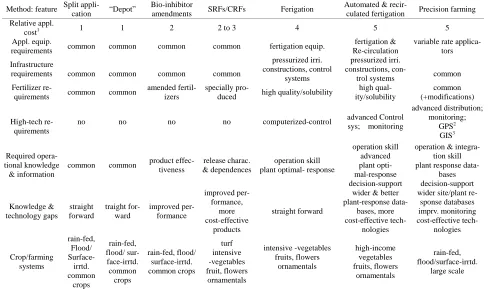
The systems described and discussed in this paper deal with a variety of agronomic concepts and tech-niques, some of which are basically very different from the others. Some are based on simplified and easily available technologies and less capital and skill demanding like the split application, the “depot” and even use of Bio-Inhibotir Amendments. On the cutting edges of high technology and high skills and invest-ment demanding are the emerging techniques of recirculated systems and the “precision fertilization”. The CRFs and fertigation are positioned somewhere in between but still costly and/or infrastructure depend-ent and thus far from being implemdepend-ented in large scales agriculture.
The big differences between the methods and ap-proaches make it difficult to compare them in a rather systematic manner. Instead, Table 1 was constructed, which emphasizes the main features of each of them trying to point to the niches associated with each and to show the special requirements, advantages and drawbacks of each.
References
1. Feigin, A., Halevy, J., Irrigation-fertilisation-cropping manage-ment for maximum economic return and minimum pollution of ground water, Research Report Inst. Soil Water, ARO, The Vol-cani Center, Bet Dagan, 1989.
2. Smith, S. J., Schepers, J. S., Porter, L. K., Assessing and manag-ing nitrogen losses to the environment, Adv. Soil Sci., 1990, 14: 1―45.
3. Fenn, L. B., Hossner, R. L., Ammonia volatilisation from ammo-nium and ammoammo-nium-forming fertilizers, Adv. Soil Sci., 1985, 1: 123―169.
4. Delgado, J. A., Mosier, A. R., Mitigation alternatives to decrease nitrous oxides emissions and urea-nitrogen loss and their effect on methane flux, Environ. Qual.,1996, 25: 1105―1111.
5. Smith, K. A., Effect of fertilizers on greenhouse gas fluxes: Mechanisms and Global Trends, in Third Int. Dahlia Greidinger Sym. on Fertilisation and The Environment, April 1997, Mortwedt, J. J. and Shaviv, A. Eds., Technion, Haifa, 1997,
6. Bockman, O. C., Kaarstad, O., Lie, O. H. et al., Agriculture and Fertilizers, Agricultural Group, Norsk Hydro, Oslo, 1990. 7. Shaviv, A., Controlled supply of fertilizers for increasing use
effi-ciency and reducing pollution, in VIII International Colloquium on Optimization of plant nutrition, Lisabon, September, 1992 (eds. Fragoso et al.), Dordrecht: Kluwer Academic Pubs., 1993, 651― 656.
8. Trenkel, M. E., Controlled Release and Stabilized Fertilizers in Agriculture, IFA, Paris, 1997.
9. Nelson, D.W., Effect of nitrogen excess on quality of food and fi-ber, in Nitrogen in Crop Production (ed. Hauck, R.D.), ASA, Madison WI, 1984, 643―661.
10. Shoji, S., Kanno, H., Use of polyolefcoated fertilizers for in-creasing fertilizer efficiency and reducing nitrate leaching and ni-trous oxide emissions, Fert. Res., 1994, 39: 147―52. [DOI]
11. Shaviv, A., Advances in controlled release fertilizers. Advan. Agron., 2000, 71: 2-49.
12. Shaviv, A., Evaluation and Modeling of the Impact of Environ-mentally Friendly Fertilization Techniques” in Rubin, H. (ed.), Preserving the Quality of our Water Resources, New York: Springer Verlag., 2001,
13. Darrah, P. R., Nye, P. H., White, R.E., The effect of high solution concentration on nitrification rate in soil, Plant and Soil, 1987, 97: 37―45. [DOI]
14. Yadvinder-Singh and Beauchamp, E.G., Nitrification inhibition with large urea granules, dicyandiamide, and low soil temperature. Soil Sci., 1987, 144: 412―419.
15. Shaviv, A., Control of nitrification rate by increasing ammonium concentrationm Fert. Res., 1988, 7: 177―188. [DOI]
16. Glasscock, G. Shaviv, A. d Hagin, J., Nitrification Inhibi-tor-interaction with applied ammonium concentration, J. Plant Nut., 1995, 18: 105―116.
17. Hauck, R. D., Significance of nitrogen fertilizer microsite reac-tions in soil, in Nitrogen in Crop Production (ed. Hauck, R. D.), ASA, Madison, WI, 1984, 507―533.
18. Shaviv, A., Schnek, M., Reactions of a granulated su-per-phosphate and ammonium sulphate mixtures in calcareous soils, Geoderma, 1989, 44: 17―27. [DOI]
19. Wang, F., Bear, J. Shaviv, A., Modeling simultaneous release, dif-fusion and nitrification of ammonium in the soil surrounding a granule or nest containing ammonium-fertilizer, European J. Soil Sci., 1998, 49: 351―364. [DOI]
20. Nye, P. H., Acid-base changes in the rhizosphere, Adv. Plant Nutr., 1986, 2: 129―153.
22. Barak, P., Chen, Y., The evaluation of iron deficiency using a bio-assay-type test, Soil Sci. Soc. Am. J., 1982, 46: 1019―1022. 23. Shaviv, A., Hagin, J., Correction of lime induced chlorosis by
ap-plication of iron and potassium sulphatesm Fert. Res., 1987, 13: 161―167. [DOI]
24. Hauck, R. D., Slow release and bio-inhibitor-amended nitrogen fertilizers, in Fertilizer technology and use”, (ed. Engelstad, O.P.), 3rd ed., SSSA Madison, WI. 1985, 293―322.
25. McCarty, G. W., Bremner, J. M., Persitence of effects of nitrifica-tion inhibitors added to soil, Commun. in Soil Sci. Plant Anal., 1990, 21: 639―648.
26. Zerulla, W., Kummer, K. F. Wisemeier, A. et al., The development and testing of new nitrification inhibitor, Proceeding No. 455. In-ternational fertilizer Society, York, 2000.
27. Shaviv, A., Mikkelsen, R. L., Slow release fertilizers for a safer environment maintaining high agronomic use efficiency, Fert. Res., 1993, 35: 1―12. [DOI]
28. Bock, B. R., Agronomic differences between nitrate and ammo-niacal nitrogen, in Proceedings of the 37th annual meeting, Fertil-izer Industry round table, New Orleans, Louisiana, 1987, 105― 110.
29. Hagin, J., Olsen, S. R., Shaviv, A., Review of interaction of am-monium-nitrate and potassium nutrition of crops, J. Plant Nutr., 1990, 13, 1211―1226.
30. Hendrickson, L. L., Keeney, D. R., Soil Biol. Biochem., 1979, 11: 51―55.
31. Zacherl, B., Amberger, A., Effect of the nitrification inhibitors di-cyandiamide, nitrapyrin and thiourea on Nitrosomonas europaea. Fert. Res., 1990, 22: 37―44. [DOI]
32. Biau, E. E., Zaiko, A. S. Muravin, E. A., Influence of systematic application of nitrification inhibitors on the marked fertilizer ni-trogen balance in the pot experiment, Agrokhimiya, 2000, 3: 30― 40.
33. Shaviv, A., Hagin J., Neumann, P., Effects of nitrification inhibitor on efficiency of nitrogen utilization by wheat and millet, Commn. Soil Sci. Plant Anal., 1987, 18: 815―833.
34. Sachdev, M. S., Sachdev, P. Effect of dicyandiamide on the nitri-fication of fertilizer nitrogen, J. Nucl. Agric. Biol., 1995, 24: 145―153.
35. Puttanna, K., Gowda, N. M., Nanje, R. E, et al., Effect of concen-tration, temperature, moisture, liming and organic matter on the efficacy of the nitrification inhibitors benzotriazole, o-nitrophenol, m-nitroaniline and dicyandiamide, Nutr. Cycling Agroecosyst., 1999, 54: 251―257. [DOI]
36. Malhi, S. S., Nybor, M., Methods of placement for increasing the efficiency of N fertilizers applied in the fall., Agron. J., 1985, 77: 27―32.
37. Orphanos, P. I., Inhibition of ammonium sulfate nitrification by methylpyrazol in a highly calcareous soil, Plant Soil, 1992, 143: 145―7. [DOI]
38. Blaise, D., Amberger, A. Tucher, S. von, Efficacy of CMP [1-carboxamide, 3-(5)-methylpyrazole] and DCD (dicyandiamide) as nitrification inhibitor, J. Indian Soc. Soil Sci., 1999, 47: 80― 84.
39. Zerulla, W., Erhardt, K., Dressel, J, Horchler, K. et al., DMPP, a new nitrification inhibitor for agriculture and horticulture,
VDLUFA-Schriftenr., 1999, 52: 525―528.
40. Watson, C. J., Urease activity and inhibition principles and prac-tice, Proceeding No. 454. International fertilizer Society, York, 2000.
41. Bremner, J. M., Chai, H. S., Effects of phosphoroamides on am-monia volatilization and nitrite accumulation in soils treated with urea, Biol. Fertil. Soils, 1989, 8: 227―30.
42. Phongpan, S., Freney, J.R. Keerthisinghe, D.G. et al., Use of urease inhibitors to reduce ammonia loss from broadcast urea and increase grain yield of flooded rice in Thailand, Soil Sci. Plant Nutr. (Tokyo), 1997, 43: 1057―1060.
43. Montemurro, F., Capotorti, G. Lacertosa, D. et al., Effects of urease and nitrification inhibitors application on urea fate in soil and nitrate accumulation in lettuce, J. Plant Nutr, 1998, 21: 245― 252.
44. Xu, X. K., Zhou, L. K. Wang, Z. J. et al., Fate of urea-15N in a soil-wheat system as influenced by urease inhibitor hydroquinone and nitrification inhibitor dicyandiamide, Plant and Soil, 2000, 220: 261―270. [DOI]
45. Nedan, S., Control of nitrification rate by ammonium and inhibi-tors, MSc Thesis, Agric. Eng. Technion (in Hebrew, Tables and Figures in English), 1990.
46. Shaviv, A., S., Mixed N-P granulated fertilizer amended with ni-trification inhibitors: Less pollution and higher efficiency, Ex-tended Abstract, 7th Nitrogen workshop, Edinburgh, 1992. 47. Peoples, M. B., Freney, J. R., Moiser A. R., Minimizing gaseous
losses of nitrogen, in Nitrogen Fertilization in the Environment” (ed. Bacon, P. E.), New York: Marcel Dekeker Inc., 1995, 565― 601.
48. Du, Changwen, Zhou, Jianmin, Progress in study of con-trolled-release fertilizers (CRF), Turang (Nanjing, China) 2002, 34(3): 127―133.
49. Shaviv, A., Plant response and environmental aspects as affected by rate and pattern of nitrogen release from controlled release N fertilizers, in Progress in Nitrogen Cycling Studies (eds. Van Cleemput et al.), Dordrecht: Kluwer Academ Pub., 1996, 285― 291.
50. Shaviv, A., Preparation methods and release mechanisms of con-trolled release fertilizers: Agronomic efficiency and environ-mental significance, International Fertilizer Society, York, UK, Proceedings N 1999, 431: 1―35.
51. Hagin, J., Harrison, R., Non-acidulated and partially-acidulated phosphate rocks as controlled release P fertilizers, Fert. Res., 1993, 35: 25―31. [DOI]
52. Shoji, S., Gandeza, A.T., Controled Release Fertilizers with Poly-olefin Resin Coating, Sendai: Konno Printing Co., 1992. 53. Allen, S. E., Slow-release nitrogen fertilizers, in Nitrogen in crop
production (ed. Hauck, R.D.), Madison: WI., 1984, 195―206. 54. Bar-Yosef, B., Advances in fertigation. Advan. Agron., 1999, 65:
1―77.
55. Hagin, J., Lowengart-Aycicegi, A., Fertigation-State of the art, The International Fertilizer Society, York, Proceedings No 429, 1999.
56. Bucks, D. A., Historical development in micro-irrigation, Proc. 5th Int. Microirrigation Cong. Orlando, FL, 1995, 1―5.
initial season for implementation of four tomato production sys-tems, J.A. Soc. Hort. Sci., 1995, 120: 48―156.
58. Sonneveld, C., Fertigation in greenhouse industry, in Dahlia Greidinger Int. Symposium on Fertigation. Technion, Haifa Israel, 1995, 121―140.
59. Sonneveld, C, d Welles, G. W. H., Yield and quality of rock-wool-grown tomatoes as affected by variations in EC-value and climatic conditions, Plant and Soil, 1988, 111: 37―42. [DOI]
60. Hagin, J., G. Segelman, Shaviv. A., Strategy for development of fertilizer solutions for greenhouse tomatoes, Fertilizer Research, 1990, 26(1-3): 3―60.
61. Eiswenstadt, Y. Wallach, R., Shaviv, A., Water saving and reduced nutrieny pollutionin greenhouse production, in Proc. # 529 Int. Fer. Soc. Nutrient, Substrate and Water Management in Protected Cropping Systems, Izmir December 2003, IFS.
62. Raviv, M., Krasnovsky, A., Medina, S. et al., Assessment of vari-ous control strategies for recirculation of greenhvari-ouse effluents under semi-arid, J. Hortic. Sci. Biotechnol., 1998, 73: 485―491. 63. Langlais, C., Deniel, F., Wolbert, D. et al., Study of the treatment
and the recirculation of water from soil-less horticulture, Rev. Sci. Eau., 2000, 13: 5―12.
64. De Kreij, C., Latest insights into water and nutrient control in soilless cultivation, Acta Horticulturae, 1995, 408( International Seminar on Soilless Cultivation Technology for Protected Crops in Mild Winter Climates, 1993), 47―61.
65. Avidan, A., Recycling of the drainage water in Israel - State of the Art, in Abstracts-Annual meeting on Automation, Control and
Recycling in Greenhouses, 1997, Volcani Center (in Hebrew). 66. Jung, V., Chimuka, L., Jonsson, J.-A. et al., Supported liquid
membrane extraction for identification of phenolic compounds in the nutrient solution of closed hydroponic growing systems for tomato, Analytica Chimica Acta, 2002, 474(1-2): 49―57. [DOI]
67. Graves, C. J., The nutrient film technique, 1983, Hort. Rev. 5: 1― 44.
68. Roblin, P., Barrow, D. A., Microsystems technology for remote monitoring and control in sustainable agricultural practices, J. En-vironmental Monitoring, 1983, 2(5): 385―392. [DOI]
69. Robert, P. C., Precision agriculture: a challenge for crop nutrition management, Plant and Soil, 2002, 247(1): 143―149. [DOI]
70. Cook, S. E., Bramley, R. G. V., Coping with variability in agricul-tural production-implications for soil testing and fertilizer man-agement, Commn. in Soil Sci. Plant Anal., 2000, 31(11-14): 1531―1551.
71. Haneklaus, Silvia, Schnug, Ewald., Decision-making strategies for the variable-rate application of compound fertilizers, Commn. in Soil Sci. Plant Anal., 2000, 31(11-14): 1863―1873.