MASTER THESIS
TOWARDS
PREDICTING
BRONCHOSCOPIC
SKILL ACQUISITION
USING BASIC
BRONCHOSCOPIC
SIMULATOR TASKS
Marlise W. Westerhof
FACULTY OF BEHAVIORAL, MANAGAMENT AND SOCIAL SCIENCES (BMS)
DEPARTMENT OF COGNITIVE PSYCHOLOGY AND ERGONOMICS (CPE)
30/08/2018 Supervisors
Abstract
Introduction: Bronchoscopy is a very complex skill, and surgeons seem to differ at learning this skill. In order to minimize patient risk, it is crucial to only enable proficient surgeons to perform bronchoscopies. However, adequate selection and assessment methods do not exist at present. A promising solution would be to include simulator-base prediction of surgical performance. The current study aims at exploring whether bronchoscopy simulator performance can be used to individually assess prospective trainees based on the maximum performance they are expected to reach after training, based on learning curves. By means of this assessment method, it is explored which individuals are more suitable for becoming a bronchoscopist and which individuals will experience more difficulties. First, it was analysed whether learning curves exist in the performance of basic bronchoscopy simulator tasks. Moreover, it was explored whether individual differences exist in acquiring bronchoscopic skills to confirm the need for individualized training. Finally, it was tested whether the simulator tasks together form a reliable test to select prospective trainees based on their performance.
Method: Nineteen students took part in a repeated-measure study. Participants had to perform two or three basic bronchoscopy simulator tasks fifteen times each on the
GI-BRONCH Mentor TM. Exponential learning curves have been estimated per task and
participant. Maximum performance, based on time-on-task, was the primary parameter of interest. Correlations between the asymptote for each task on population-level were calculated.
Results: All participants improved performance over time for all three tasks, as the time to complete each trial decreased. Moreover, individual differences in acquiring
Table of Content
1. Background ... 9
1.1 Risks and Challenges of Bronchoscopy ... 9
1.1.1 Complications. ... 10
1.1.2 Psychomotor ability. ... 11
1.2 Psychomotor Skill Acquisition in MIS ... 13
1.3 Predicting MIS-performance Using Learning Curves ... 15
1.4 Individual Differences in Learning and Performing Bronchoscopy ... 17
1.5 History of Bronchoscopy Education ... 19
1.5.1 Current state of research on the prediction of MIS-performance. ... 21
1.6 Low-fidelity Assessment ... 25
1.7 High-fidelity Simulator Assessment ... 26
1.8 Research Questions ... 27
2. Method ... 28
2.1 Participants ... 28
2.2 Design ... 28
2.3 Materials ... 29
2.3.1 GI-BRONCH Mentor™ ... 29
2.4 Procedure ... 33
2.4.1 Briefing ... 33
2.4.2 Debriefing. ... 35
2.5.1 BronchMentor™. ... 35
2.5.2 Workload Questionnaire. ... 37
2.6 Statistical Analysis ... 37
2.6.1 Learning curve model ... 37
2.6.2 Non-linear regression ... 38
3. Results ... 40
3.1 Compliance and Overview of Collected Data ... 40
3.1.1 Simulator tasks. ... 40
3.2 Bronchoscopic Skills Acquisition ... 42
3.2.1 Time-on-task. ... 43
3.2.2 Wall contact. ... 45
3.3 Individual Differences in Bronchoscopic Skill Acquisition ... 46
3.3.1 Individual learning curves. ... 46
3.3.2 Random factor variation. ... 46
3.4.2 Wall contacts. ... 47
3.4 Internal Consistency Reliability of Simulator Tasks ... 48
3.4.1 Time-on-task. ... 49
4. Discussion ... 50
4.1 Findings ... 51
4.1.1 Bronchoscopic skill acquisition. ... 51
4.1.2 Individual differences in bronchoscopic skill acquisition. ... 51
4.2 Limitations of the Current Study ... 54
4.2.1 Lack of external validation. ... 54
4.2.2 Time-on-task. ... 55
4.2.3 Task discrimination. ... 55
4.3 Implications for Future Research ... 56
4.4 Implications for Medical Education ... 57
4.5 Conclusion ... 58
5 References ... 59
Appendix A. Materials ... 66
Appendix B. Instructions ... 66
Appendix C. Informed Consent ... 70
Appendix D. Figures ... 71
The number of performed minimally invasive surgeries (MIS) has rapidly increased over the last years (Tsui, Klein, & Garabrant, 2013). A frequently performed MIS procedure is bronchoscopy. Bronchoscopy enables visual inspection and tissue sampling from the airways by inserting a bronchoscope through the nose or mouth (Evison & Munavvar, 2016; Shah, 2003). MIS offers several short-term and long-term advantages over traditional open surgery, such as less blood loss, reduced pain and shorter length of hospital stay (Pache, Hubner, Jurt, Demartines, & Grass, 2017). However, in contrast to traditional surgery, surgeons need to master different complex skills while performing MIS procedures (Gallagher, Leonard, & Traynor, 2009). Challenges in learning MIS include interpreting 3D information about the human body from 2D images presented on a screen, a lack of haptic feedback, visual-spatial ability and psychomotor skills (Gallagher et al., 2009). As a consequence, surgeons showed prolonged learning curves, in contrast to conventional open surgery (Fuchs, 2002). Thus, patient safety during MIS might be endangered since surgeons may not have achieved competency (yet).
It has been found that surgical residents differ in the amount of performed procedures necessary to acquire proficiency in MIS skills, with estimations that some individuals will not even reach proficiency at all despite practice (Grantcharov & Funch-Jensen, 2009; Louridas et al., 2017). Identifying the expected performance level and skill acquisition rate of residents is crucial to ensure effective individualized training. Residents who show proficiency could be allowed for taking the next step in surgery training, while those who experience difficulties may benefit from either providing intensified training or the recommendation to pursue a different career (Hofstad et al., 2013). To ensure learning efficiency, it is crucial to predict applicant’s future surgical performance at an early stage in surgical training.
prospective trainees still relies on cognitive selection tools, such as pre-university performance and aptitude tests, and non-cognitive selection tools including unstructured interviews, reference letters, personal references and psychometric questionnaires (Epstein & Hundert, 2002). However, as current selection tools do not align with skills necessary to perform bronchoscopy, the validity of these objective selection methods is widely criticized (Fielding, Maldonado, & Murgu, 2014).
Moreover, surgical trainees are still being inconsistently assessed based on the number of performed MIS procedures and supervisors’ subjective evaluations (Fielding, Maldonado, & Murgu, 2014). For example, according to the American College of Chest Physicians, pulmonary trainees should perform at least 100 supervised flexible bronchoscopies to achieve basic competency (Ernst, Silvestri, & Johnstone, 2003). However, according to Konge et al. (2011), such threshold numbers are neither scientifically proven nor universally accepted by bronchoscopists. While one trainee might need only 25 simulation procedures to reach a pre-set performance level, another one still struggles with acquiring technical bronchoscopy skills after the 50th procedure (Wahidi et al., 2010). By developing a method for predicting skill
acquisition, it may also become possible to predict the amount of procedures an individual needs before mastering technical bronchoscopic skills in the future.
An alternative approach to the current selection and assessment in bronchoscopy education would be to include simulator-based prediction of surgical performance and skill acquisition. Besides providing bronchoscopy training in a zero-risk environment,
2008). In addition, feedback based on performance metrics enhances MIS learning (Samia, Khan, Lawrence, & Delaney, 2013). However, little research has been conducted about using simulators as assessment and selection instruments within the field of bronchoscopy (Ernst & Herth, 2013).
The present study explores individual differences in learning bronchoscopy while aiming for a valid and reliable tool to predict future bronchoscopic performance among novices. We aim at exploring whether bronchoscopy simulator performance can be used to individually assess prospective trainees based on the maximum performance they are expected to reach after training, based on learning curves. By means of this assessment method, we want to identify which individuals are more suitable for becoming a bronchoscopist and which individuals will experience more difficulties. First, we are interested in whether learning curves exist in the performance of basic bronchoscopy
simulator tasks. Moreover, we will explore whether individual differences exist in acquiring bronchoscopic skills to confirm the need for individualized training. Finally, we will explore whether the simulator tasks together form a reliable test to select prospective trainees based on their performance.
1. Background
1.1 Risks and Challenges of Bronchoscopy
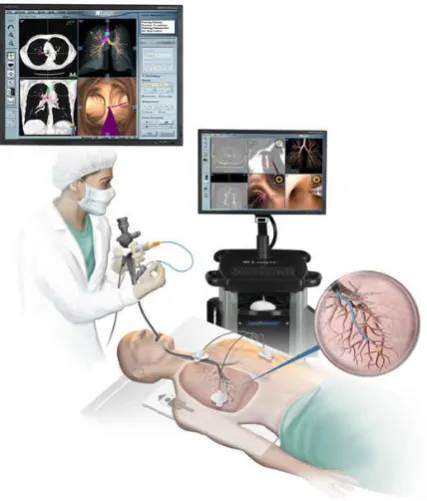
inserting sampling tools, such as brushes, forceps and needles, into the working channel (Leiten, Martinse, Bakke, Eagan & Gronseth, 2016) (see Figure 1).
Figure 1. Visualization of a flexible bronchoscopic procedure. Retrieved from http://iacharitygolf.com/ project/electromagnetic-bronchoscopy/
on 16-08-2018
1.1.1 Complications. Flexible bronchoscopy is a generally save procedure, but rare complications often have life threatening consequences. The most common complication during flexible bronchoscopy is hypoxemia, an abnormal low level of oxygen in the blood (Schramm et al., 2017; Shah, 2003). Other bronchoscopy-induced injuries include
specific, novice bronchoscopists show increased complication rates when performing bronchoscopy during the acquisition phase, the first trimester, of bronchoscopist training (Ouellette, 2006). Notably, even after several years of MIS training complications persist among bronchoscopic surgeons (Wahidi et al., 2010).
1.1.2 Psychomotor ability. In contrast to traditional open surgery minimally invasive surgeries, such as bronchoscopy, require a completely different set of complex skills. During bronchoscopy, the surgeon needs to perform several complex actions simultaneously:
withdrawing or advancing the shaft, flexing or extending the scope’s tip, and rotating the scope’s shaft and tip. Simultaneously, the surgeon has to observe a screen for visual feedback (Colley & Freund, 1997). During open surgery, the surgeon has direct visual and manual access to the operation side, whereas MIS-procedures, such as bronchoscopy, involve remote manipulation of instruments together with an indirect view of the surgical field provided by a camera (Fuchs, 2002). Interpreting 3D information about human anatomical structures from 2D images presented on a screen results in a lack of depth perception. Moreover, as the surgeon no longer manipulates the instrument directly, haptic feedback is reduced. Since bronchoscopy requires the integration of, among others, spatial perception, dexterity and muscle function, it is a very complex technical skill (Silvennoinen, Mecklin, Saariluoma, & Antikainen, 2009).
The success of a surgery depends to a large extent upon the use of adequate
depth perception and eye-hand coordination are two of the main challenges for surgeons (Breedveld, Stassen, Meijer, & Stassen, 1999). For this reason, these two components of psychomotor ability will be explained in more depth.
Compensation for insufficient depth cues. Due to indirect sight of the operative field, the surgeon’s depth perception is reduced during bronchoscopy. Spatial perception is the ability to “judge the relations of objects in space, to judge their shapes and sizes, to manipulate them mentally, and to visualize the effects of putting them together of turning them around.” (Breedveld, Stassen, Meijer, & Stassen, 1999, p. 3). Spatial perception is an important factor in psychomotor functioning in bronchoscopic skills, on the contrary, it is crucial during bronchoscopy to deal with a loss in depth perception (Fielding et al., 2014; Madan et al., 2005). Three-dimensional anatomical structures of the airways are presented on a two-dimensional video screen which results in a lack of depth indicators, such as pictorial cues, visuomotor cues and the comparison of pictures seen by the right and left eye.
Additionally, bronchoscopists cannot use shadows as depth cues, since the tip of the
bronchoscope includes a light source to increase brightness of the picture. The lack of depth-perception cues interfere with accurately determining spatial relations of the scope with respect to anatomical structures and performing. As a result, surgical residents require time-consuming and intensive training curricula to learn to compensate for the absence of depth cues (Breedveld et al., 1999).
required, which includes e.g. the shape, motion, orientation and size of objects. The visual cortex sends visual-spatial information to the motor cortex, which elicit muscle controlling signals to coordinate contractions hand- and arm muscles. Information about perceived positions of the hand and the target are used to send motor signals to the muscles (Breedveld et al., 1999; Lee et al., 2014). In contrast to direct observation of the instruments and
operative field by looking down during open surgery, a surgeon indirectly observes the operative field via a camera view displayed on a screen during bronchoscopy. The distance between the operative field, displayed on a screen, and the surgeon’s hands, makes it
impossible to observe both the operative field and the hands simultaneously (Breedveld et al., 1999; Wentink, Breedveld, Meijer, & Stassen, 2000). In addition, the use of a long scope results in a lack of direct haptic feedback, the bronchoscope’s camera has a different point of view than when the surgeon had direct visual access to the surgical field, and the scope as well as the screen magnify the operative field (Lee et al., 2014). Consequently, similar to compensate for insufficient depth cues, surgeons need intensive training to adapt to impaired eye-hand coordination during bronchoscopy (Konge et al., 2011). Thus, both impaired depth perception and eye-hand coordination suggest that bronchoscopy is a procedure of higher cognitive demand in contrast to traditional open surgery, which indicate the need of adequate long-term training.
1.2 Psychomotor Skill Acquisition in MIS
According to the theory of Fitts and Posner (1967), three stages are completed during psychomotor learning: a cognitive, an associative and an autonomous stage. During the cognitive stage, the surgeon relies on past experience, reasoning and instructions to
& Groenier, 2017). This might be due to the fact that the used simulator tasks were rather simple to understand, which could indicate that the cognitive stage is only applicable to complex procedures.
After gaining experience with the task, cognitive strategies will be improved during the associative stage. The surgeon works on reducing errors and making skill performance more efficient by optimizing and integrating strategies. According to Fitts and Posner, the ultimate goal of the learner is being able to perform the task at the autonomous stage: achieving advanced levels of performance by requiring little or no attention with few or no errors. Although bronchoscopists aim for as few errors as possible, it is crucial to keep optimizing strategies which means that total automatization of bronchoscopic procedures is not desirable. As a bronchoscopist gains more experience with bronchoscopy, less attention is required to perform these skills. Due to limited workingmemory’s capacity, the
automatization of motor skills frees up cognitive resources for other processes, such as
1.3 Predicting MIS-performance Using Learning Curves
The current study investigates how individuals learn complex bronchoscopic skills by exploring individual learning curves for different simulator tasks. According to Wanzel, Ward and Reznick (2002) learning curves are suitable as prediction and assessment tools for
surgical performance. Learning curves enable quantitative exploration of an individual’s learning process of skills over time, including previous experience, improvement and maximum performance. Rather than one-time performance measurements, learning curves focus on repeated measurements of performance over time. Previous research on learning curves in minimally invasive surgery mainly focused on visualizing (averaged) data using learning curves. In contrast, to our knowledge, statistical estimation of learning curves is actually rather new. An exponential learning curve model based on the law of practice was already applied to explore learning of laparoscopy in previous theses of students of the University of Twente (Huijser, Schmettow, & Groenier, 2015; Kaschub, Schmettow, & Groenier, 2016; Arendt, Schmettow, & Groenier, 2017)
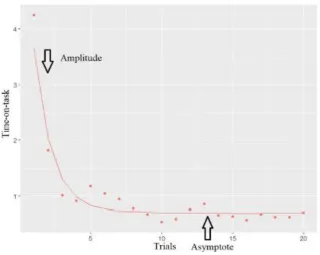
Improvements in performance due to practice and training proceed in a non-linear way. During early trials, improvement rates in performance outcomes, such as reduced error and increased speed, will be high but slows down with increased practice, which is known as a learning curve (Heathcote, Brown, & Mewhort, 2000). Once an individual reached its maximum performance, additional training won’t lead to performance increasement due to boundaries in performance caused by physical constraints, including neural integration time and motor response time. This is called a saturation effect: the more training is performed, the closer the level of performance gets to the individual performance limits and the less
Figure 2. Exponential learning curve. Trials is depicted on the x-axis, whereas the y-axis shows time-on-task (Arendt et al., 2017).
Learning curves based on performance data could provide valuable information about surgical performance during simulator training. Simulator-based prediction of surgical performance and skill acquisition is a more structured and performance-based alternative to the current unstructured selection and assessment in bronchoscopy education. Besides providing training in a zero-risk environment, simulators enable new means to tailor surgery training to the needs of an individual. Individual learning curves based on performance metrics provided by simulators, such as procedural time and wall contact, could provide objective and structured assessments about a trainee’s proficiency level, track the training progress over time and provide continuous feedback and motivation for learning and evaluating the training curricula (Epstein & Hundert, 2002; Grantcharov, 2008).
Unfortunately, simulator training is highly expensive which impede the global implementation of simulator-based training and assessment. In addition, since most evidence on minimally invasive surgery is derived from laparoscopic surgery, less is known about using simulators as assessment and selection instruments within the field of bronchoscopy (Ernst & Herth, 2013). This indicates the need for research on using simulators as selection and assessment methods. 1.4 Individual Differences in Learning and Performing Bronchoscopy
Surgical trainees differ in the learning rate of acquiring technical skills, while some students are unable to achieve competence despite training. Recent studies were able to discriminate subsets of students who differed in learning curves patterns for laparoscopic skills training (Alvand, Auplish, Khan, Gill, & Rees, 2011; Grantcharov & Funch-Jensen, 2009; Louridas et al., 2017; Schijven & Jakimowicz, 2004). Studies differed in among others in tasks and performance parameters. High performers (6-22%), students who were
finding is that 8-24% of the individuals, low performers, experienced difficulties to learn technical skills and were unable to achieve an acceptable performance level despite training. More precisely, Grantcharov and Fuch-Jensen (2009) identified percentages of high, moderate and low performers of 5.4, 70.3 and 24.3, respectively, whereas Louridas et al. (2017)
identified percentages of 21, 71 and 8, respectively.
At present, evidence for individual differences in surgical skills, as well as for the cost-effectiveness, improved patient safety and efficacy of simulator-based training within other medical fields exceeds the amount of studies covering simulator-based training in bronchoscopy (Pastis et al., 2014). In general, most evidence on minimally invasive surgery skill acquisition is derived from laparoscopic surgery, whereas bronchoscopic skill acquisition is far less covered. Therefore, careful translations from laparoscopic research to bronchoscopy are necessary. Nevertheless, individual differences within technical bronchoscopic skills have been found for learning bronchoscopic skills as well. A study of Wahidi et al. (2010) on competency metrics in learning bronchoscopy among novices bronchoscopy fellows found that participants still showed significant differences in performance at the 50th bronchoscopy.
In addition, Dalal and colleagues (2011) demonstrated that a wide variation exists in learning curves among novice resident performing fiberoptic upper airway endoscopy. The number of attempts necessary to achieve proficiency varied between 27 and 58. Moreover,
Individual differences in MIS-performance could be due to differences in innate abilities. It has been found that cognitive abilities, such as perceptual ability and visuospatial ability, are related to the learning curve of surgeons for minimally invasive surgery
performance (Groenier, Schraagen, Miedema, & Broeders, 2014; Luursema, Buzink, Verwey, & Jakimowicz, 2010; Maan, Maan, Darzi, & Aggarwal, 2012). However, individuals show differences in the visual-spatial ability they possess (Madan et al., 2005). In addition,
Gallagher et al (2003) were able to identify different levels of laparoscopic basic psychomotor skills among experienced surgeons by means of basic laparoscopic tasks. Notably, among experienced surgeons (> 50 laparoscopic procedures) between 2 and 12% of surgeons showed deficits in basic psychomotor skills. Psychomotor ability affects the rate at which actions automatize: it has been found that when task complexity increases, surgical trainees with lower psychomotor ability experience more difficulties in automating their performance (Jabbour, Reihsen, Sweet, & Sidman, 2011). To compensate for lesser psychomotor ability, an individual needs more practice in order to reach necessary levels of competence in
psychomotor skills. But the acquisition of psychomotor skills is unattainable if an individual does not possess psychomotor ability. According to Jabbour et al (2011), prospective
bronchoscopic surgical trainees with low levels of psychomotor ability, who will need high amounts of training which extend regular training curricula, should be advised to pursue different careers during screening of prospective surgeons.
1.5 History of Bronchoscopy Education
since surgery training curricula strive for more efficient education, there is a rising interest in the prediction of surgical skill acquisition and performance. On the contrary, as previously discussed, surgeons differ in the amount of innate ability they possess and the acquisition of technical surgical skills. Early prediction of surgical skill performance and acquisition enables both training tailored to individual skill acquisition rates and baseline performance, as well as recommendations to pursue different career paths for those who will not meet the
requirements despite practice (Ernst et al., 2015). However, as described earlier, international accepted and scientific proven benchmarks on how to select future pulmonologists do not exist yet (Ernst & Herth, 2013). Fortunately, during the last years, a growing interest exists towards factors predicting bronchoscopy performance and international objective benchmarks at which to aim (Konge et al., 2012; Wahidi et al., 2010).
The virtual reality simulator is a ground-breaking invention within the field of medical education. As a response to the need for training and assessment within the medical field, VR-training simulators provide a complete different approach by enabling bronchoscopic skills to be trained and assessed in a zero-risk and efficient environment (Herth, Shah, &
Gompelmann, 2017). Bronchoscopy simulators provide a more patient centred and individual tailored alternative to the conventional training- and assessment methods due to several reasons. First off all, simulation-based training of technical bronchoscopy skills improves surgical skill proficiency (Ost et al., 2001). Secondly, simulators provide objective
performance metrics, such as procedural time and scope-wall contact, which enables
environment. Last but not least: simulator-based prediction of skill performance increases patient safety (Konge et al., 2012). Instead of procedural training and assessment on alive patients, residents can train in a zero-risk environment. Moreover, by identifying which individuals will become proficient surgeons and who will not, and by assessing residents based on proficiency, residents will be allowed to operate on patients only after possessing the necessary skills. Thus, bronchoscopy simulation education ensures patient safety, and learning effectiveness and efficiency. However, due to the scarcity of these highly expensive
simulators, working hours restrictions and variable training durations due to individual differences simulator-based training and assessment is not widely implemented in the field of medical education yet (Sadideen, Hamaoui, Saadeddin, & Kneebone, 2012).
1.5.1 Current state of research on the prediction of MIS-performance.
The misconception of cognitive aptitude testing. Recently, there has been growing interest in the predictive value of innate aptitude for minimally invasive surgery performance, to enable controlled and systematic trainee selection. Innate abilities, including visual-spatial and perceptual abilities, of surgeons are related to the duration of learning to acquire
prospective laparoscopy trainees for surgical training. More specifically, Stefanidis (2006) stated that psychomotor testing by means of innate ability tests has limited value in prediction of baseline laparoscopic performance, but these innate tests would be more suitable for predicting the skill acquisition speed.
However, research of Groenier, Schraagen, Miedema and Broeders (2014) concluded that cognitive aptitude tests did not predict laparoscopic performance as the relationship between MIS performance and cognitive aptitude is very complex. Groenier et al (2014) showed that independently examined individual cognitive abilities only mediated parts of MIS performance. Therefore, they suggested the importance of more general reasoning and
cognitive abilities. Given the mixed results in the literature for cognitive aptitude, a study of Huijser, Schmettow and Groenier (2016) aimed at providing more insight in the relationship between cognitive aptitude and laparoscopic simulator task performance. However, no
predictive relationship was found for visual spatial ability and maximum performance, neither for spatial memory and learning speed. In 2004, Veenman, Wilhelm & Beishuizen already stated that independently assessing single cognitive abilities does not predict the amount of training needed to reach proficiency or the learning rate on laparoscopic tasks.Thus, it can be concluded that the predictive value of cognitive aptitude tests is insufficient to allow for laparoscopy applicant solution.
As far as we know, no previous research has investigated whether single cognitive tests predict bronchoscopy performance. In contrast, most studies covering this topic concern laparoscopic procedures. We concluded that splitting up cognitive aptitude into separate abilities by means of cognitive aptitude tests may not resemble the complexity of abilities when integrated in a task like a bronchoscopic procedure. Since bronchoscopy and
compensate for a lack of depth perception (Hofstad et al., 2013; Simoff, 2018), we tend to expect that cognitive aptitude tests may not resemble the complexity of bronchoscopy. To perform bronchoscopic procedures successfully, it requires the coordination of several skills, so it is impossible to attribute bronchoscopic performance to one single skill. Therefore, our surmise is that cognitive aptitude tests may not be valid prediction tools for future
bronchoscopy performance either, whereas taking a more holistic approach could be more adequate. To explore a holistic approach to resident selection, we will apply the resemblance spectrum.
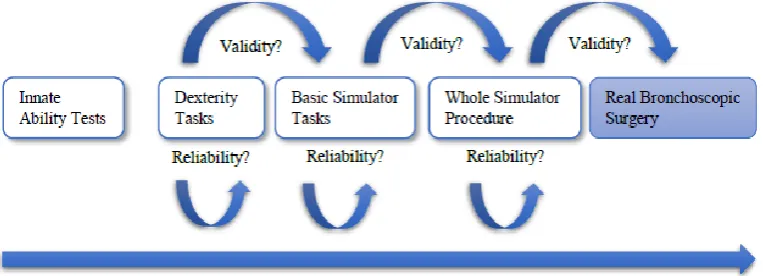
The resemblance spectrum. The resemblance spectrum provides a framework for exploring the resemblance of test suites to reliably predict future surgery performance. Previous studies used it to categorize psychometric tests in terms of resemblance to real laparoscopic procedures (Arendt et a., 2017; David et al., 2018). While innate ability tests resemble real-life laparoscopy surgery the least and real-life laparoscopic tasks the most, basic simulator tasks are in between both (see Figure 3). Thus, the spectrum varies from
Figure 3. The resemblance spectrum.
The resemblance spectrum could be an explanation for the finding of Groenier et al. (2014) that cognitive aptitude tests do not predict laparoscopic performance, since cognitive aptitude tests are not as complex as real laparoscopic tasks. According to Arendt et al. (2017), it might be that cognitive aptitude tests do not cover the combination of manual dexterity and cognitive demand which is necessary for performing laparoscopic skills. However, it remains unclear how far psychometric tests should be on the right part of the spectrum to reliably predict laparoscopic performance. In order to evaluate the applicability of the resemblance spectrum, the concepts validity and internal consistency will be applied.
suite. The concepts validity and internal consistency are necessary to evaluate the resemblance of a test suite.
1.6 Low-fidelity Assessment
Several studies by students of the University of Twente focused towards (subparts of) the prediction of minimally invasive surgery skill acquisition (Arendt, Schmettow, &
Groenier, 2017; Mührmann, Schmettow, & Groenier, 2018; Warnke, Schmettow, & Groenier, 2018; Küpper, Schmettow, & Groenier, 2018). A recent study of Arendt et al. (2017) focused on exploring what it takes to adequately predict laparoscopic performance. They estimated exponential learning curves on time-on-task to explore whether basic laparoscopic tasks and dexterity tasks enable valid and reliable prediction of MIS-performance to allow for
laparoscopic surgery to predict laparoscopic performance. On the contrary, Kramp (2016) suggested the implementation of simulator-based assessment. While innate ability tests only predict part of individual differences in MIS performance, simulator-based assessment provides a more holistic approach by measuring several innate abilities in a more realistic environment at once. Consequently, the aim of the current study is to take one step right on the resemblance spectrum and to explore the test suite of basic simulator tasks.
1.7 High-fidelity Simulator Assessment
Although research has illuminated the usefulness of simulator-based training in the medical field, only few studies have examined the use of simulators as prediction and assessment tools of bronchoscopic skill acquisition. The studies of Ost (2001) and Pastis (2014) demonstrated construct validity of two different bronchoscopy simulators in differentiating between levels of experience. Ost (2001) was able to distinguish between novices (0 bronchoscopies, n = 11), intermediates (25 to 500 bronchoscopies, n = 8) and expert bronchoscopists (> 500 bronchoscopies, n = 9) in terms of wall collisions, percentage of segments visualized and procedure time measured by a bronchoscopy simulator. In addition, Pastis et al. (2014) demonstrated construct validity of the Simbionix GI-BRONCH Mentor™ in discriminating skill level in scope manipulation and airway anatomy among novice (<10 bronchoscopies, n = 7), experienced (200 to 1000 bronchoscopies, n = 6) and expert pulmonologists (> 1000 bronchoscopies, n = 7).
over the population mean. On the other hand, studies which do report a wide variation in bronchoscopic skill acquisition used either manual performance assessment tools (Wahidi et al., 2010) or an unknown performance algorithm including time and number of collisions (Dalal et al., 2011), instead of raw simulator metrics such as time or wall-contact. Since predicting bronchoscopic performance, or minimally invasive surgery performance in general, by means of individual simulator performance is still in its infancy, the current study will cover this approach from the ground up.
1.8 Research Questions
The aim of our work is to explore whether basic bronchoscopy simulator tasks can be used to allow for a valid prediction of bronchoscopic skills. Bronchoscopic skills are very complex and hard to learn: bronchoscopists show increased complication rates when performing bronchoscopy during the first trimester of training (Quellette, 2006). Moreover, individuals differ at learning bronchoscopic skills which might be due to differences in innate psychomotor ability (Dalal et al., 2011; Ernst et al., 2015). In order to ensure patient safety, adequate selection, training and assessment are crucial. To explore individual differences in bronchoscopic skill acquisition, the current study uses three basic simulator tasks which are expected to rely on psychomotor ability.
As current research in simulator-based learning of bronchoscopic skills remains limited due to methodological shortcomings, this study addresses learning bronchoscopic skills on a simulator by starting from scratch. We will estimate individual exponential learning curves based on time-on-task, our main parameter of interest is maximum performance
basic simulator tasks are predictors of individual performance of technical bronchoscopic skills, we will test whether the asymptote of the three tasks correlate with each other in the performance parameter time-on-task. The current study is exploratory in nature, no
hypotheses were formulated.
2. Method
2.1 Participants
The current study consists of a convenience sample of nineteen students of the University of Twente (68.4% female, Mage = 20.2 years, age range: 19-24 years) who
participated voluntarily in turn for three course credits. Five participants were Dutch, thirteen were German and one was Bulgarian. Two participants reported to be left-handed. One participant wore eyeglasses. All participants were novices without prior endoscopy
experience. Fifteen participants were recruited by use of the test subject pool SONA of the faculty of Behavioural, Management and Social sciences of the University of Twente. Four participants were recruited from the direct environment of the researchers. Participants were included if they had the minimum age of 18 years, speak and understand English and have normal or corrected to normal vision. Prior to participation, all participants gave written permission by signing an informed consent form (See Appendix C). Ethical approval was obtained from the Ethics Committee at the Faculty of Behavioural Sciences of the University of Twente, The Netherlands (request number: BCE18198).
2.2 Design
completed the Guided Anatomical Navigation task. The routes in the Basic Scope
Manipulation task were randomly assigned. Participants had to identify ten lightbulbs for the Guided Anatomical Navigation task. During an optional second session, participants
performed the Step-by-Step Diagnostic Manoeuvres task, first taking a forceps sample and then taking a brush sample, but only after having completed the first and second task. For all three tasks, a workload questionnaire was conducted after each uneven trial, starting with the first. 1
2.3 Materials
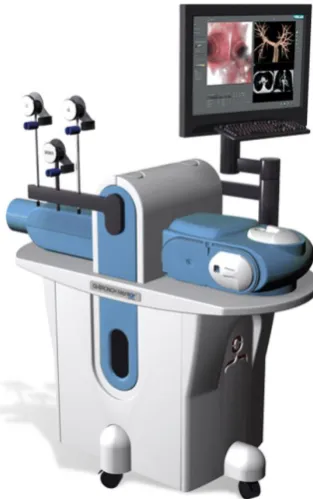
2.3.1 GI-BRONCH Mentor™ . The three simulator tasks were administered with the GI-BRONCH Mentor™ virtual reality simulator. The GI-BRONCH Mentor™, developed by 3D Systems, Cleveland, OH, USA (formerly Simbionix), is a flexible bronchoscopy training simulator used for the simulation of a wide range of basic bronchoscopy tasks and clinical bronchoscopy procedures(Simbionix, 2018b). The GI-BRONCH Mentor™ consists of a plastic mannequin with a mouth and nose entrance for bronchoscopy or upper endoscopy (see Figure 4). The simulator provides a realistic training environment including an authentic bronchoscope with tactile feedback (Pentax ECS-3804F) and bronchoscopy tools, such as a biopsy forceps, cytology brush and aspirating needle (See Figure 12 and 13 in Appendix A). The computer generates a dynamic endoscopic view, based on the bronchoscope’s movement captured by a sensor on the tip of the scope. The endoscopic view is displayed on a 24-inch LCD touch screen. The software running on the simulator is MentorLearn LMS (version 1.4.0.68).
1 The workload questionnaire is beyond the scope of the current study. The current study is part of a
Figure 4. BronchMentor™ (Simbionix, 2018a)
The GI-BRONCH Mentor™ incorporates a bronchoscopy training curriculum with scenarios with varying degrees of complexity of tasks and difficulty of anatomy, divided over four modules: Essential Bronchoscopy, Emergency Bronchoscopy, Essential EBUS and CHEST Standardized Curriculum. The current study only uses three basic skill tasks, Basic Scope Manipulation (Cyberscopy) and Guided Anatomic Navigation, from the Essential Bronchoscopy module. This module provides tasks to acquire and integrate bronchoscopic capabilities to accelerate the trainee’s learning curve. Objectives of the module are for instance to acquire basic bronchoscope manoeuvring capabilities, to improve hand-eye coordination, to enhance 3D anatomical perception and to objectively assess bronchoscopic skills level.
bronchoscopy motor skills should be trained by breaking down one task into component parts, both for training and assessment. Task deconstruction into easier subtasks improves learning because it decreases frustrations and mental demands, and provides a feeling of success when mastering easier to acquire subtasks (Gallagher, Smith, et al., 2003; Jabbour et al., 2011). In a previous study, the Basic Scope Manipulation task was able to discriminate between various degrees of skills among novice, experienced and expert bronchoscopists based on final score, total time, % at mid-lumen and total wall hits (Pastis et al., 2014).
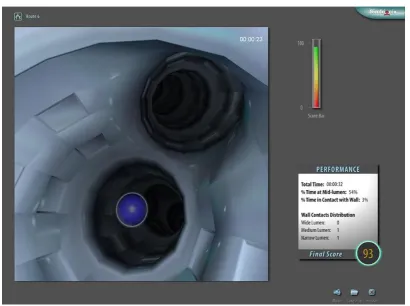
[image:31.595.69.480.423.729.2]Basic Scope Manipulation (Cyberscopy). The first skill task was Basic Scope Manipulation. This task aimed at acquiring basic scope control skills such as developing hand-eye coordination. The user should follow a blue ball in a cyber environment while trying to stay in the centre of the lumen and avoiding wall contact (see Figure 5). The computer randomly selected a path. To account for differences in difficulty of the randomly chosen paths, paths were taken into account at the data analysis.
Guided Anatomic Navigation. The second skill task was Guided Anatomic
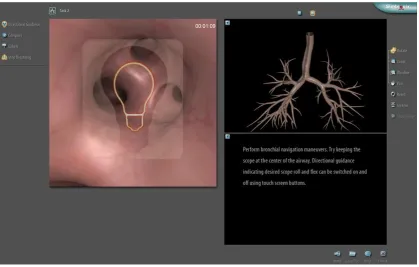
Navigation. The goal of this task was to learn and practice correct scope navigation within the anatomical environment in order to perform a complete airway inspection by passing all bifurcations of the trachea. By matching the bronchoscope’s view finder to a presented light bulb, directional guidance was provided to help the user find the right scope roll and tip flexion or extension to pass the carina (see Figure 6). Correct alignment of the scope’s view finder to the presented light bulb resulted in a change in colour and auditory feedback. Wall contact was indicated by visual and auditory feedback as well.
[image:32.595.72.492.455.722.2]It was expected that novice participants without prior anatomical knowledge could experience difficulties with reaching hard to reach lumen, such as right and left upper lobe, because they will overlook these carinas. Furthermore, during the task no indication is given about the amount of to-be-completed bifurcations; it is expected that novices do not know how many they have to complete. Thus, we decided that participants had to identify ten of twenty-eight available light bulbs per trial.
Step-by-Step Diagnostic Manoeuvres. The third skill task was Step-by-Step
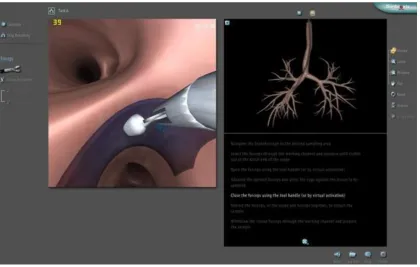
[image:33.595.73.494.317.584.2]Diagnostic Manoeuvres. The goal of this task was to acquire skills needed to perform forceps, brush and transbronchial needle biopsy from a purple-marked area of interest. However, the current study only used the tools for brush and forceps biopsy, due to the complexity of the transbronchial needle biopsy. Step-by-step instructions were provided on the screen for each diagnostic manoeuvre (See Figure 7). After completion of each diagnostic manoeuvre, feedback was provided on the screen about whether tissue was obtained successfully and whether or not the tool was used correctly during sampling. Participants took a forceps biopsy and then a brush biopsy.
Figure 7. Simulator task 3. Step-by-Step Diagnostic Manoeuvres (Simbionix, 2018a)
2.4 Procedure
The study took place in the advanced Simulation Room 2 at the Experimental Centre for Technical Medicine (ECTM) at the University of Twente. Participants were tested individually.
consent form). Next, a demographic questionnaire was conducted with questions concerning gender, age, nationality, vision, gaming experience and bronchoscopic experience (See
Appendix for the demographic questionnaire). In order to prevent fatigue, the experiment was divided over two sessions of 120 and 60 minutes, respectively. The first and second task were performed during the first session, whereas the third task was performed during the second session which was at least 24 hours after the first session, with a maximum of three weeks. Participants repeated all three tasks fifteen times. The simulator digitally stored the data in the MentorLearn cloud. After each uneven trial number of each task, starting with the first trial, participants filled out the six subscales of the NASA-TLX questionnaire on a laptop. After the fifteenth trial, participants ranked the perceived impact of these six subscales from high to low as part two of the NASA-TLX scale. All instructions which were given to the participants can be found in Appendix D.
Simulator task 1: Basic Scope Manipulation. In the first part of the first session, participants performed the Basic Scope Manipulation task. First, participants were instructed about the simulator and scope handling by means of a short video instruction, after which they started the first task on the simulator. Instruction about the basic scope manipulation task was presented on the simulator’s screen. During this task, routes differed in difficulty.
Simulator task 2: Guided Anatomic Navigation. After a five-minute break, participants started with the second part of the first session by performing the Guided
Anatomic Navigation task. Like the first simulator task, instruction about the guided anatomic navigation was presented on the simulator’s screen. Participants had to identify ten of twenty-eight available light bulbs.
they started the first task on the simulator. Participants were instructed to always take the left carina when arriving at a bifurcation. A step-by-step instruction about the procedure was presented on the simulator’s screen. Participants had to take a forceps tissue sample first, after which they performed a brush tissue sampling. During both procedures, tissue samples should be taken from a purple-marked area of interest in the simulated lung. First, the researcher handed the sample tool over to the participant when arriving at the location of interest. After inserting the tool into the working channel, the participant had to choose the correct sampling tool on the screen. Then, the researcher handed the tool to the non-dominant hand. The tissue sample was obtained by holding the scope at the sampling area and either pushing the lever up or down. When the feedback on the screen showed a successful tissue sample, the tool needed to be rejected until the tool-selection screen was shown again. Next, the sampling brush had to be chosen. A brush sample was obtained by holding the scope at the sampling area and
moving the tool back and forth in the working channel. After completing the second tissue sampling correctly, the trial was finished.
2.4.2 Debriefing. After completion of the second or third task, depending on whether the participant would participate in the second session or not, the participants were debriefed. A short explanation of the study and its aim was given, after which the participants had the opportunity to ask questions and finally were thanked for participation.
2.5 Measures
skipped bifurcations. However, as the simulator is designed for educational rather than for research purposes, not all data were useful for our study.
The main parameter of the current study was time on task. Van Dongen et al. 2007 stated that the amount of time needed to complete a task is a suitable indicator of the
participant’s skill. However, using the duration to complete a task as a performance measure has both benefits and drawbacks. On one hand, time as an performance parameter does not indicate whether a procedure was performed successfully and safe. However, as time is an important patient safety factor due to possible complications and the performance under moderate sedation (Jabbour et al., 2011), time-on-task (in minutes) was used as the primary performance parameter. According to a study of Pastis and colleagues (2014) on the construct validity of the Simbionix BronchMentor™ the parameters final score, total time, % at mid-lumen and total wall hits of task 1 were able to discriminate correctly between experts,
experienced and novice bronchoscopists. In order to include accuracy of performance, we also included all hits of the Basic Scope Manipulation task as a parameter. Unfortunately, the parameter Wall Hits was not available for the tasks Guided Anatomical Navigation and Step-by-Step Diagnostic Manoeuvres. Due to the unknown formula of the final score, this
parameter was not used in current study. For each task and trial, time-on-task was measured in seconds. This performance parameter was used to establish individual learning curves for all tasks and participants.
For the first simulator task, the total procedural time provided by the simulator was used as time-on-task parameter. However, for the second and third task, times were
seconds until passing the vocal cords, handling the instrument to the participant, completing the forceps biopsy and completing the brush biopsy.
2.5.2 Workload Questionnaire. For assessing self-reported workload of the three tasks the multi-dimensional NASA Task Load Index (NASA-TLX) scale was used. As
described earlier, the workload questionnaire is described for the sake of completion, as it was not covered by the current research questions. The NASA-TLX provides an overall workload score based on a weighted average of ratings on six subscales: mental demand (How mentally demanding was the task?), physical demand (How physically demanding was the task?), temporal demand (How stressed were you by the speed of the task?), own effort (How hard did you have to work to achieve your result?) and frustration (How frustrated were you about the task or parts of it?) (National Aeronautics and Space Administration (NASA), n.d.). After completing fifteen trials, the participant had to rank the weight of the factors, beginning with the factors with the highest impact. The overall workload score per trial per task for each participant was computed by multiplying each rating by the weight given to that factor by the participant (NASA, n.d.). Then, the sum of the weighted ratings for each task was divided by fifteen, which is the sum of the weights.
2.6 Statistical Analysis
A non-linear mixed-effects model with an exponential learning curve as a likelihood function was performed to create regression models for estimating learning curves for each participant (Heathcote et al., 2000).No major data cleanings were performed.
YptN = Asympt + Amplptexp(-RateptN)
The exponential learning curve model includes the parameters maximum performance (asymptote), amplitude and rate, as described earlier in the introduction. A learning curve has been estimated for each participant and task based on time-on-task, including the parameters summarizing previous trials or the initial performance, the learning rate and the estimated maximum performance. The nonlinear multilevel mixed effect model was performed using the regression package ‘brms’ 2.3.0 (Bürkner, 2018) in the statistical computing environment R version 3.5.0 (R Core Team, 2018). The multilevel model was used to estimate individual learning curves per task and combine these separate learning curves, which allowed for an variation analysis on population-level. Non-linear functions were built using the package Asymptote (Schmettow, 2018a).
2.6.2 Non-linear regression. We set up the LARY (Linked Amplitude Rate
Asymptote) model which was used to compute the expected performance (ToT) after practice trials based on the exponential law of practice (Schmettow, 2018a). Random effects indicate the variance in a population which is caused by individual performance differences. In order to explore random effects, the parametrizations amplitude and asymptote were linearized through link functions on a log-scale and logit-scale, all with a range from -∞ to +∞. Generalized linear mixed-effects models were estimated using the Bayr package (version 0.8.8). The Generalized Linear Models (GLM) framework consists of three elements: A random probability distribution, a linear predictor and a link function. Random distributions take into account the relationship of variance and mean, and the expected pattern of
linearity is established between μ and θ. In doing so, link functions meet two essential
requirements: Firstly, the order in magnitude in link functions must be maintained, a so-called monotonically increasing function. Moreover, to ensure linearity, link functions are required to map variables to the range [-∞; ∞].
The LARY model estimated random effects for the amplitude, rate and asymptote parametrizations for each task, based on the parameter time-on-task with credibility intervals of 95%. Weakly informative priors were used for this data model. To allow for the variance in the difficulty of randomly chosen routes during task one, the model included route as a
variable for computing the parameters asymptote and amplitude.
We used the Gamma distribution of random probability for modelling the error
component within the LARY model instead of the Gaussian distribution, because time-on-task measures typically show left-skewed random patterns and by approaching maximal
performance, variance of residuals decreases. Errors in time-on-task are typically negatively-skewed distributed, which means that the mean is to left of the peak. Moreover, time-on-task measures are continuous and positive, but lower boundaries are rather at the lowest human possible time to complete a task than at zero. Additionally, exponential distribution rises only if all events have the same probability to occur. However, this will never happen in
behavioural research. As a solution, we use the gamma distribution since, in contrast to
exponential distributions, the peak of the gamma distribution can move along the x-axis rather than fixed at zero.
3. Results
First, exploratory plots of raw time-on-task data will be given to provide an overview of the collected data. Next, we established the LARY-model to estimate the performance parameters on population-level, followed by an analysis on participant-level. Then, we calculated correlations between the parameters of the three task. Finally, we criticised our used model to determine the robustness of the performed analyses.
3.1 Compliance and Overview of Collected Data
Nineteen participants performed task 1 and 2, whereas only five participants
completed the third task due to technical difficulties with the simulator and time constraints. Moreover, since six participants took part in the study of Küpper, Schmettow and Groenier (2018) as well, the number of trials performed by these participants was constrained by the experiment’s duration. The average amount of performed trials per task are 13.6 for Basic Scope Manipulation (SD = 2.63, range = 7-16), 12.2 for the Guided Anatomical Navigation (SD = 4.7, range = 4-15) and 14.0 for Step-By-Step Diagnostic Manoeuvres (SD = 1, range = 5-15). For a full syntax and an overview of the dataset see Appendix E.
Figure 8. Raw time-on-task of participants for the three simulator tasks. Time-on-task (in seconds) on the y-axis, amount of trials on the x-axis.
The performance on the first task, Basic Scope Manipulation, looks more homogenous than on the second and third task, Guided Anatomical Navigation and Step-By-Step
Diagnostic Manoeuvres, respectively. Since time-on-task is a reaction-time performance parameter, a lower score on the y-axis indicates a better performance. As all participants show decreasing time-on-task values over time for all three tasks, this indicates that performance increases and thus participants become better at performing the three basic tasks. However, the decline in ToT differs in magnitude among both participants and tasks. During the first task, only one participant shows a steep initial decrease in ToT ending in approaching the asymptote, whereas all other participants show curves approaching the asymptote initially. For the second task, we see an initially steep fall, after which curves become less steep. Moreover, almost all participants show a general parallel decline of time-on-task on the second task.
the asymptote or increasing again, we can conclude that the ToT performance depicts non-linear curves.
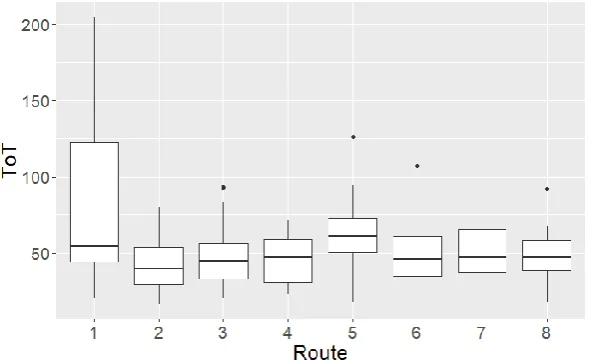
Notable is the finding that of randomly chosen routes of task 1, route 1 shows the highest spread in ToT. Figure 9 shows the ToT distribution per route of task 1. The x-axis depicts the route, the y-axis the time-on-task in seconds. The median weights of most routes are estimated to be centred between 40 and 50 seconds, whereas routes 1 and 5 show median weights estimated around 55 and 65 seconds respectively. However, time-on-task-scores are highly variable for route 1 of the task Basic Scope Manipulation, since values lie between 20 and 205 seconds. Moreover, it is estimated that 25% of the measurements of route showed a task completion time between 55 and 120 seconds. Thus, we conclude that it is recommended to add route as a control variable to our model in order to account for variation in task
[image:42.595.74.369.404.586.2]duration.
Figure 9. Time-on-Task distribution (in seconds) per route of task 1.
3.2 Bronchoscopic Skills Acquisition
parametrizations for each task, including the Gamma distribution for modelling the error component. Since we found that routes of the Basic Scope Navigation task showed variation in time-on-task, we included route as a random level effect variable for computing the parameters asymptote and amplitude. First, a visual exploration from individual learning curves was performed, after which a population-level analyse was conducted to explore the learning of individuals in all three simulator tasks.
3.2.1 Time-on-task.
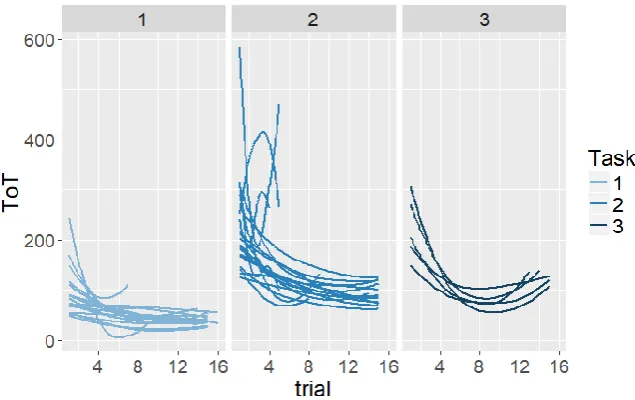
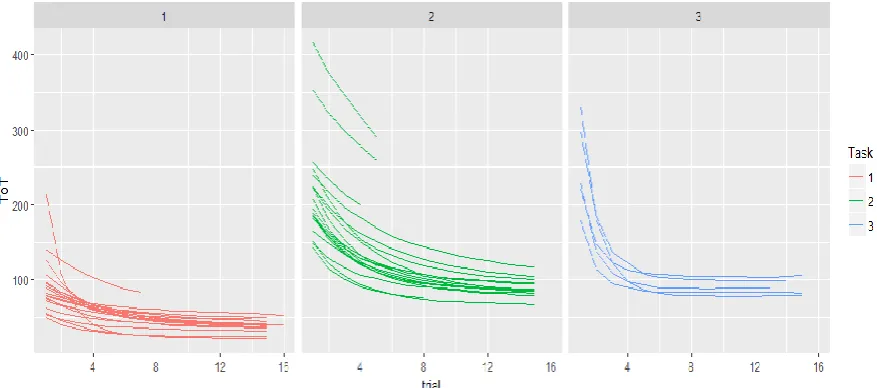
[image:43.595.75.514.377.571.2]In order to explore whether individuals show learning in all three simulator tasks by decreased time-on-task, learning curves were estimated for each participant. Figure 10 shows the individual learning curves of all participants for all three tasks, whereas Figure 16 in Appendix D shows learning curves per individual.
Figure 10. Estimated time-on-task learning curves of all participants for the three simulator tasks. Low values on the y-axis indicate superior performance.
relatively easy to complete. In contrast to the first task, learning curves on the second task show lower initial performance, followed by a more gradual decrease resulting in reaching the asymptote between the tenth and twelfth trial. Notable is the coherence between asymptote and amplitude as curves run in parallel: low asymptote is associated with low amplitude and vice versa. Whereas only five participants performed Step-by-Step Diagnostic Manoeuvres, relatively consistent individual learning curves are visible. Notably is the low initial
performance, followed by a sudden steep fall which results in reaching the asymptote between the sixth and eight trial.
Table 1
Fixed effects and corresponding random factor variation of the three parameters per task
Fixed Effects Random Factor Variation Parameter Task Center Lower
CI95
Upper CI95
Center Lower CI95
Upper CI95 Amplitude Basic Scope
Manipulation
4.19 3.69 4.61 0.77 0.44 1.33
Amplitude Guided Anatomical Navigation
5.11 4.75 5.45 0.44 0.14 0.78
Amplitude Step-by-Step Diagnostic Manoeuvres
6.06 4.86 7.11 0.60 0.04 2.91
Rate Basic Scope Manipulation
-1.24 -1.96 -0.68 0.63 0.27 1.25
Rate Guided
Anatomical Navigation
-1.34 -1.98 -0.78 0.62 0.12 1.23
Rate Step-by-Step Diagnostic Manoeuvres
-0.04 -0.72 0.66 0.33 0.01 1.78
Asymptote Basic Scope Manipulation
3.60 3.34 3.82 0.31 0.19 0.51
Asymptote Guided Anatomical Navigation
4.47 4.24 4.68 0.19 0.04 0.51
Asymptote Step-by-Step Diagnostic Manoeuvres
4.53 4.26 4.79 0.21 0.04 0.81
Note. Estimates with 95% credibility
3.2.2 Wall contact. Next to estimating population-level effects for time-on-task, we also estimated fixed effects for the amount of wall contacts during task Basic Scope
Manipulation. Population-level effects for amplitude (-0.18, 95% [-10.24; 7.28]), rate (0.80, 95% [-8.38; 10.83]) and maximum performance (0.89, 95% [-9.37; 1.39]) are highly
3.3 Individual Differences in Bronchoscopic Skill Acquisition
In order to explore whether individuals show differences in learning bronchoscopic skills, we conducted the following two analysis. Since performance prediction of trainees is only required if participants differ at performance, this question will be answered next. We estimated the maximum performance parameters on participant-level using the posterior distribution of the LARY-model. As described in the data analysis section, maximum
performance runs on the log scale. First, a visual exploration from individual learning curves was performed, after which a group-level analyse was conducted to explore the diversity of performance in the sample.
3.3.1 Individual learning curves. To explore whether individuals differ in acquiring basic bronchoscopic tasks, learning curves were estimated for each participant. Figure 10 on page 41 shows the individual learning curves of all participants for all three tasks, whereas figure 16 in Appendix D shows learning curves per individual. For all three tasks, participants show variation in performance. The first task depicts the most homogenous curves, which indicates a lower inter-individual variability compared to the other two tasks. In contrast, the greatest individual differences are visible within the second task, Guided Anatomical
Navigation. We see that most learning curves run in parallel but differences exist in initial- and maximum performance. Since learning curves for the second task run in parallel, including the first and last trials, it may be possible that initial performance could be a predictor of maximum performance.
3.3.2 Random factor variation.
variation, which indicates the standard deviations of the population average, can be extracted from the posterior of the mixed-effects model. Thus, the we’ll explore the overall variation of performance in the population by analysing the random factor variation. The random factor variation of maximum performance was highest for the task Basic Scope Manipulation (0.31, 95% CI [0.19; 0.51]), followed by Step-by-Step Diagnostic Manoeuvres (0.21, 95% CI [0.04;
0.51]) and Guided Anatomical Navigation (0.19, 95% CI [0.04; 0.81]). This means that the greatest variation from the population-average of maximum performance is within the Basic Scope Manipulation task. The first task shows a moderate level of certainty, whereas
uncertainty is high for the second and third task. Fixed effects random effects variation for the three parameters are presented in Table 1.
Figure 11. Participant-level random effects per parameter for wall-contact of task 2.
3.4 Internal Consistency Reliability of Simulator Tasks
In order to answer the question whether the basic simulator tasks are predictors of individual performance of technical bronchoscopic skills, we tested whether the three tasks correlate with each other. Firstly, correlations were estimated between the three tasks on population-level amplitude, rate and maximum performance for time-on-task. Table 2 presents the correlation between the three simulator tasks for the amplitude, rate and asymptote
parameters. As maximum performance is our parameter of interest, we will mainly focus on this parameter. Next, correlations were estimated between population-level amplitude, rate and maximum performance for wall contacts during the Basic Scope Manipulation task.
maximum of 0.2, whereas credibility limits which include values between -0.1 and 0 indicate high uncertainty. In the current study, positive correlations were expected between the
performances on the simulator tasks.
Table 2
Correlation between simulator tasks for the three parameters
Parameter Correlation1 Correlation2 Estimate Lower CI95 Upper CI95 Amplitude Basic Scope
Manipulation
Guided Anatomical Navigation
0.58 -0.13 0.94
Amplitude Basic Scope Manipulation
Step-by-Step Diagnostic Manoeuvres
0.25 -0.82 0.94
Amplitude Guided Anatomical Navigation
Step-by-Step Diagnostic Manoeuvres
0.24 -0.81 0.92
Rate Basic Scope Manipulation
Guided Anatomical Navigation
0.32 -0.48 0.90
Rate Basic Scope Manipulation
Step-by-Step Diagnostic Manoeuvres
-0.04 -0.90 0.85
Rate Guided
Anatomical Navigation
Step-by-Step Diagnostic Manoeuvres
0.31 -0.79 0.95
Asymptote Basic Scope Manipulation
Guided Anatomical Navigation
-0.41 -0.92 0.47
Asymptote Basic Scope Manipulation
Step-by-Step Diagnostic Manoeuvres
-0.11 -0.88 0.91
Asymptote Guided Anatomical Navigation
Step-by-Step Diagnostic Manoeuvres
-0.02 0.88 0.90
Note. 95% estimated credibility limits in square brackets.
4. Discussion
the three simulator tasks correlate with each other. Individual learning curves were estimated to answer these research questions.
4.1 Findings
Bronchoscopy is a highly complex procedure which requires the integration of several skills to accurately control the bronchoscope without creating discomfort and trauma. To compensate for reduced depth perception and disturbed hand-eye coordination, surgeons are required to possess psychomotor ability. In the current study, the tasks Basic Scope
Manipulation, Guided Anatomical Navigation and Step-by-Step Diagnostic Manoeuvres of the Simbionix GI-BRONCH Mentor™ were selected to explore how individuals learn complex psychomotor skills, such as bronchoscopic procedures.
4.1.1 Bronchoscopic skill acquisition. Firstly, we checked whether individuals show learning in all three simulator tasks by decreased time-on-task. We found that all participants improved their performance over time for all three tasks, as the time to complete each trial decreased. In line with previous studies, improvement rates slowed down after a few trials. Thus, we were able to estimate individual learning curves based on time-on-task as our main performance parameter.
4.1.2 Individual differences in bronchoscopic skill acquisition. Since candidate selection makes only sense if individuals differ at learning bronchoscopic skills, we explored whether individuals differ in acquiring basic bronchoscopic tasks. Based on our analysis and visually exploring individual learning curves, we were able to identify differences in
performance between participants. Exploring variation of random effects revealed that maximum performance on tasks was scattered across individuals. This means that the
MIS-skill acquisition (Grantcharov & Funch-Jensen, 2009; Louridas et al., 2017). Thus, our findings emphasize the need for effective individualized training and assessment.
Based on our analysis, the largest individual differences were found in the Basic Scope Manipulation task. This finding is in line with Pastis (2014), who stated that the
time-parameter for Basic Scope Manipulation differentiates between performance levels. Moreover, participants did not only differ at the maximum performance on all tasks, large individual differences were also found for amplitude and rate. These findings were highly uncertain. However, effect sizes showed that the first task was completed the fastest which may indicate that the Basic Scope Manipulation task is the easiest to complete.
For the second task, Guided Anatomical Navigation, individual differences were clearly visual in learning curves between initial performance and maximum performance. As most curves were parallel, it might indicate that initial performance predicts maximum performance. However, due to high uncertainty of our results more research is required.
4.1.3 Internal consistency of simulator tasks. To explore which of the three tasks contribute to a reliable and valid psychometric test, we tested whether the three tasks correlate with each other in the performance parameter time-on-task. Based on our analysis, we cannot state with certainty whether or not the used basic bronchoscopy simulator tasks are suitable predictors of basic bronchoscopic technical skill acquisition. Since internal consistency between the three basic simulator tasks was low and highly uncertain, it remains unclear if there is internal consistency at all between Basic Scope Manipulation, Guided Anatomical Navigation and Step-by-Step Diagnostic Manoeuvres. Notably, we found the highest internal consistency between Basic Scope Manipulation and Guided Anatomical Navigation for amplitude. Hence, certainty was low. Overall, our findings implicate weak reliability between three basic bronchoscopy simulator tasks, which questions the potential for using the
together are not a valid objective assessment for selection of prospective surgeons. However, it is important to note that our study faces some limitations, which will be discussed later.
A possible explanation of these findings could be that the three tasks require different skills. The highest internal consistency were found between Basic Scope Manipulation and Guided Anatomical Navigation for all three learning parameters. These two tasks show the highest similarity between tasks, since both depend mainly on being able to navigate the scope. However, the second task may be more cognitive complex, since participants keep searching for unidentified lightbulbs in an environment which might feel like a labyrinth due to a lack of anatomical knowledge. In contrast, the first and third task do not show any internal consistency at all. A possible explanation is that the Step-by-Step Diagnostic
Manoeuvres task deviates the most from the first task, since it requires a relatively small part of repeatedly navigating to the same tissue whereas keeping the scope still and controlling tools represent the main part of the task. The increased cognitive complexity might be also an explanation for the weak correlations between the second and third task. However, it is important to note the high uncertainty of all correlations.
We expected the third task to be the most advanced since participants had to integrate what they learned so far in terms of manoeuvring the scope while acquiring additional fine motor skills to use the diagnostic tool. However, participants reached maximum performance at a similar pace to the first task, which is against our expectations. Notably was the finding that for the Step-by-Step Diagnostic Manoeuvres, participants showed low initial
performance, followed by a high increase in performance and resulting in constant