1 o
Designing a persuasive mobile alcohol avoidance
training by using persona-based design briefs
The development of a prototype within a User-Centered Design approach
Master thesis Health Psychology & Technology
Faculty of Behavioural, Management and Social Sciences
Enschede, July 2018
Roos Wolbers (s1462288)
First supervisor: dr. Marcel Pieterse
Second supervisor: drs. Melissa Laurens
2
Abstract
Background. Breindebaas is a smartphone app with the aim to break through the unconscious processes that maintain an alcohol addiction, by retraining automatic approach tendencies. A prior study showed low adherence, due to the repetitive nature of the training task which was experienced as boring. The primary aim of the current study is to design a persuasive prototype of the app that improves adherence and acceptability by professionals. The
secondary aim is to study the impact of persona-based design briefs on the design process and prototypes, in which different presentation formats are compared.
Methods. In sub study A, semi-structured interviews were conducted with potential users (n=7) and professionals (n=5), with the aim of mapping out their needs, wishes and
acceptance for adding persuasive (game) elements. The transcribed interviews were converted into user requirements. In sub study B, these requirements were used to create a persona-based design brief in two different formats. Two design teams were instructed to develop a persuasive prototype of the new app by using either a text-based design brief or a pictorial design brief. The impact of the persona-based design briefs on the prototypes and process, including the comparison of the different presentation formats, was studied by means of self-reports, a recall test, an expert-based usability test and observations.
Results. Sub study A showed that participants had a positive attitude towards the addition of persuasive (game) elements, with performance feedback and positive reinforcement being the most desirable. Furthermore, there seemed to be a need for more explanation about the aim and effect of the training. Sub study B showed that overall, the persona-based design brief had a considerable impact on the design. Regardless the format, the persona seemed to have several benefits, such as more insight into the user and detecting design flaws at an early stage. The results regarding the impact of the different presentation formats are equivocal. On the one hand there are indications in favour of the pictorial design brief, but on the other hand there are no convincing differences between the prototypes.
Conclusion. The current study suggests that persona-based design briefs have a positive impact on the design of a prototype. Several advantages of personas were shown, such as the enhancement of user-centered thinking. With regard to the presentation of the design briefs, there are careful indications that a pictorial design brief is more effective than a text-based design brief. Both design briefs can be perceived as having a narrative style, which might be an explanation for the positive findings of the current study. Possibly, the narrative style was enhanced by the increased vividness of the pictorial design brief. The current study applied the use of personas in a practical, real-life design project, of which promising results were shown. More empirical research with regard to the use of personas in design is highly needed.
3
Samenvatting
Achtergrond. Breindebaas is een app met als doel de onbewuste processen die een
alcoholverslaving in stand houden te doorbreken, door het hertrainen van de automatische toenaderingstendens. Een eerdere studie toonde lage therapietrouw, vanwege het repetitieve karakter van de trainingstaak dat als saai werd ervaren. Het primaire doel van deze studie is het ontwerpen van een persuasief prototype dat therapietrouw van gebruikers en acceptatie van professionals verbeterd. Het secundaire doel is om de impact te bestuderen van op
persona gebaseerde design briefs op het ontwerpproces en de prototypes, waarin verschillende presentatievormen worden vergeleken.
Methode. In deelstudie A zijn er semigestructureerde interviews afgenomen bij potentiële gebruikers (n=7) en professionals (n=5), met als doel het in kaart brengen van hun behoeftes, wensen en acceptatie over het toevoegen van persuasieve (spel) elementen. De
getranscribeerde interviews werden omgezet in user requirements. In deelstudie B werden deze requirements gebruikt om een op persona gebaseerde design brief te creëren in twee verschillende stijlen. Twee ontwerpteams kregen ofwel een tekstuele brief ofwel een geillustreerde brief aangeboden en werden geïnstrueerd aan de hand hiervan een persuasief prototype te ontwerpen. Invloed van de op persona gebaseerde design brief op het prototype en proces, inclusief de vergelijking van de verschillende presentatie stijlen, werd onderzocht door zelfrapportage, een herinneringstest, een expert-gebaseerde gebruiksvriendelijkheidstest en observaties.
Resultaten. Deelstudie A liet zien dat deelnemers een positieve houding hadden tegenover het toevoegen van persuasieve (spel) elementen, waarbij feedback en positieve bekrachtiging het meest gewenst waren. Daarnaast bleek er behoefte te zijn aan meer uitleg over het doel en effect van de training. Deelstudie B toonde aan dat de op persona gebaseerde design brief over het algemeen een aanzienlijke invloed had op het ontwerpproces. Ongeacht de
presentatie stijl leek de persona verschillende voordelen te hebben, zoals het creëren van meer inzicht in de gebruiker en het ontdekken van ontwerpfouten in een vroeg stadium. De
resultaten met betrekking tot de verschillende presentatie stijlen zijn niet eenduidig. Enerzijds zijn er aanwijzingen ten gunste van de geillustreerde design brief, anderzijds zijn er geen overtuigende verschillen te zien tussen de prototypes.
Conclusie. De huidige studie suggereerde dat op persona gebaseerde design briefs een
4
Table of contents
Introduction………...5
1.1. Alcohol consumption………...5
1.2. Theoretical approach: the role of implicit cognition………5
1.3. Cognitive Bias Modification………6
1.4. Mobile application Breindebaas………...7
1.4.1. Rationale for the current study……….…….7
1.5. Motivation according to the Self-Determination Continuum……….….8
1.6. Persuasive technology………..9
1.7. Gamification to improve motivation………..10
1.7.1. Gamified training paradigms………..11
1.7.2. Active ingredients of gamification………...11
1.8. The CeHRes Roadmap: Center for eHealth Research Roadmap………...13
1.8.1. User-Centered Design……….13
1.8.2. Personas in User-Centered Design……….14
1.8.3. Scenarios in User-Centered Design………15
1.9. Study aims and research questions………...………..17
1.9.1. Sub study A: From User Expressions to User Requirements……….….17
1.9.2. Sub study B: From Persona to Prototype………...……….17
Methods A………18
Results A………..22
Discussion A……….31
Methods B………39
Results B……….…..45
Focus groups……….45
Persona recall test……….……….50
Usability assessment……….52
Observations………..53
Discussion B……….58
Conclusion………..…..64
References………65
5
Introduction
1.1. Alcohol consumption
Alcohol consumption is one of the most important risk factors for disease and death worldwide, causing 5.1% of the global burden of disease and injury and 5.9% of all deaths (WHO, 2014). Alcohol consumption has multiple health consequences, such as diabetes, gastrointestinal diseases, cardiovascular diseases, and several types of cancer. Furthermore, it can cause neuropsychiatric conditions, in which Alcohol Use Disorders (AUDs) are the most important. AUDs are a combination of alcohol abuse and alcohol dependence, as defined by the fifth edition of the Diagnostic and Statistical Manual of Mental Disorders (DSM-5) (American Psychiatric Association, 2013). Besides the impact on mental and physical health, alcohol consumption may also lead to socioeconomic consequences and harm to other
individuals (WHO, 2014).
Alcohol-related problems are a major public health concern, with overconsumption being very common. In the Netherlands, almost 9% of adults consume excessive amounts of alcohol, which is defined as more than 21 glasses a week for men and more than 14 glasses a week for women (Van Laar & van Ooyen-Houben, 2016). The paradox in this unhealthy addictive behaviour is that people continue excessive alcohol consumption, despite their knowledge of the negative consequences (Wiers & Stacy, 2006).
1.2. Theoretical approach: the role of implicit cognition
Traditional cognitive models, such as the Theory of Planned Behaviour (Ajzen, 1991), explain the existence of unhealthy behaviour (such as alcohol abuse) by the influence of subjective norms, attitudes and perceived behavioural control on the intention to change behaviour. However, these models lack explanation why people continue excessive alcohol use, even if they are aware of the harmful consequences. It seems that addictive behaviour is often not a reflective decision, in which a person carefully considers the advantages and disadvantages (Stacy & Wiers, 2010). Dual process models of addiction (Stacy, Ames & Knowlton, 2004; Wiers et al, 2007) assume that excessive drinking behaviour is not only produced by rational processes, but also by implicit cognitive processes.
6
behaviours derive from an imbalance between these two systems (Wiers & Stacy, 2006; Wiers et al., 2007). The impulsive system becomes sensitized when alcohol is repeatedly consumed. As a result, people become more sensitive to alcohol-related stimuli and might develop a stronger tendency to automatically approach alcohol (Robinson & Berridge, 2001). These impulses can be inhibited by the reflective system, when there is enough ability and motivation. However, alcohol consumption can impair the ability to inhibit (Bechara, Noel, & Crone, 2006), which makes it more difficult to modify this behaviour. The imbalance between the systems will make addictive behaviour more driven by automatic impulses than rational cognitive processes. Existing interventions, that are usually information-based and require users to reflect on their own behaviour, do not always show the desired results (Marteau, Hollands, & Fletcher, 2012).
1.3. Cognitive Bias Modification
Nowadays, more and more attention is being paid to interventions that focus on the implicit processes. Increasingly, Cognitive Bias Modification (CBM) programs are used to re-train the implicit processes involved in addiction (Eberl et al., 2013). CBM is a collection of training techniques that aim to change the automatic and impulsive reactions by training the brain to break learnt thought patterns ('biases').
The CBM Alcohol Approach Avoidance Training already showed to be successful in modifying the approach bias in hazardous drinkers (Wiers, Rinck, Kordts, Houben, & Strack, 2010). In this computer task, users have to avoid pictures of alcoholic beverages and approach pictures of non-alcoholic beverages by respectively pushing and pulling a joystick. The task contains a zooming feature, in which the picture size will decrease when the picture is avoided and increase when the picture is approached. This zooming feature enhances the feeling of approaching and avoiding (Neumann & Strack, 2000).
The CBM Alcohol Approach Avoidance Training was previously tested in a clinical setting (Wiers, Eberl, Rinck, Becker, & Lindenmeyer, 2011). There were two experimental groups, who received a real training which was either a relevant feature version or an
irrelevant feature version, both consisting of four sessions of two hundred responses each. In the two control groups, patients received either a sham training or no training at all. The experimental groups showed better treatment outcomes one-year post-intervention.
7
In a replication study of Eberl et al. (2013), patients who received CBM next to their
treatment as usual (Cognitive Behavioural Therapy), showed a significant lower relapse rate at one-year follow up compared to patients who only received treatment as usual. This effect was mediated by a retrained alcohol-approach bias (Eberl et al., 2013). More recent research showed positive results of approach bias modification on the reduction of both approach bias and alcohol consumption (Kakoschke, Kemps & Tiggemann, 2017).
1.4. Mobile Application Breindebaas
Recently, this proven to be effective desktop computer CBM Alcohol Avoidance Training was converted into a smartphone app called Breindebaas. Breindebaas is a mobile application developed by Tactus Addiction Institute. The goal of this app is to reduce alcohol intake among problem drinkers by letting users repeatedly train, independent of treatment. During a training session in the Breindebaas app, one hundred pictures of both alcoholic beverages and non-alcoholic beverages are displayed. Users have to bring pictures of non-alcoholic
beverages closer and swipe pictures of the alcoholic beverages away from them. The ratio between alcoholic and non-alcoholic pictures is fifty-fifty and completing one training session takes about 5 to 10 minutes.
1.4.1. Rationale for the current study
Recently, a pilot study has been carried out to examine the effects of the Breindebaas app in a non-clinical setting (Somsen, 2017). Participants that performed the CBM training were people from the general population who consumed alcohol regularly and were motivated to reduce intake, but were not in treatment. Somsen (2017) used a single-group design to compare alcohol consumption at baseline with alcohol consumption post-intervention. Participants were asked to complete the training twice a week for a total period of three weeks. The results showed that alcohol consumption, compared to baseline, declined with an average of eight standard units a week. A follow up study showed that reduction of alcohol-use is not only short-term, but still visible and even more declined at three months post-treatment (Nijen Es, 2017). These findings suggest that the Breindebaas app has potential for reducing alcohol consumption among problem drinkers in a non-clinical setting.
Somsen (2017) used open-ended questions to evaluate participants’ opinion about the Breindebaas app. Although the app was described as easy and user-friendly, many
8
sessions (Somsen, 2017). These findings converge with a qualitative study concerning attitudes towards Cognitive Bias Modification. The repetition that is required in CBM often makes the tasks tedious and boring (Beard, Weisberg & Primack, 2012). Therefore, it is important to motivate the participants to keep training (Wiers & Salemink, 2015). On the basis of the pilot results, two important points for improvement emerged (Somsen, 2017). The first point is to tailor the images to the individual, so that participants can select their own favourite drinks and thus create a personal training. The second point is adding game elements to challenge participants more and encourage them to keep training. Hence, the practical motive for the current study is to implement these adjustments by developing a new version of the Breindebaas app that improves adherence.
1.5. Motivation according to the Self-Determination Continuum
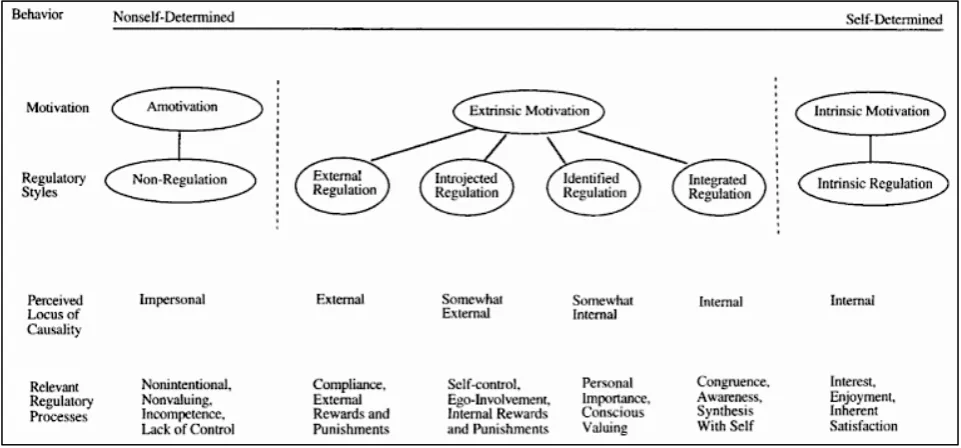
[image:8.595.72.553.457.681.2]On the basis of the pilot study results, that showed low adherence, the question that arises is: how can we improve the motivation to adhere? A popular theory of moitivation is the Self-Determination Theory by Ryan & Deci (2000). The Self-Self-Determination Theory makes a distinction between intrinsic motivation and extrinsic motivation. Defining those terms can be confusing, while they can be closely entangled. Therefore, the Self-Determination Continuum (Ryan & Deci, 2000) can be used to define the different types of motivation.
Figure 1.1 The Self-Determination Continuum (Ryan & Deci, 2000).
9
people are purely amotivated, they will not be able to be stimulated to display certain
behaviour. On the other hand, when people are intrinsically motivated, they will show certain behaviour by themselves without having to use external stimulation. They are “doing
something because it is inherently interesting or enjoyable” (Ryan & Deci, 2000, p.55). Everything in between amotivation and intrinsic motivation is called extrinsic motivation, varying in the extent to which their regulation is autonomous. While users in the pilot study showed low adherence, it is presumed that users will not be fully intrinsically motivated to train in the Breindebaas app. Therefore, extrinsic motivation needs to be amplified to foster the motivation to adhere (McCallum, 2012).
With regard to motivation, it should be noted that there is a difference between motivation to change and motivation to train. The motivation to change includes the motivation to tackle the excessive substance use, while the motivation to train concerns the completion of a CBM training (Boffo, Pronk, Wiers, & Mannarini, 2015). In this paper the focus is on improving the motivation to train, or in other words, the adherence to treatment.
1.6. Persuasive technology
The Self-Determination Theory provided explanation and definition of motivation, suggesting that extrinsic motivation needs to be amplified to improve adherence in the Breindebaas app. The question that remains is how the new app should be designed in order to increase
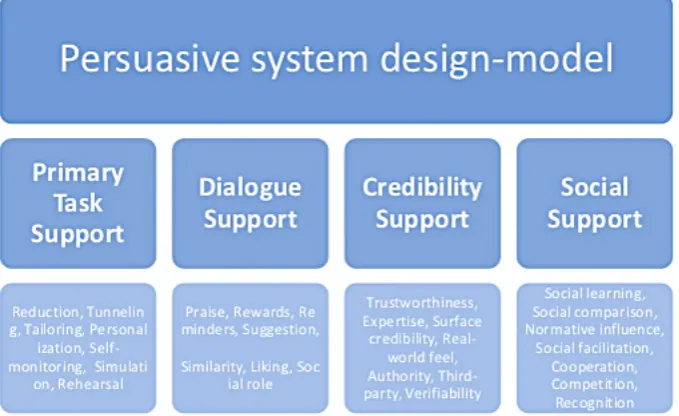
motivation and engagement of users. This can be explored by using the Persuasive System Design (PSD) model (Figure 1.2), which provides a more concrete guideline on how technology can affect motivation (Oinas-Kukkonen and Harjumaa, 2009).
[image:9.595.81.421.540.748.2]10
Technology that is designed to change people’s behaviour, engage and motivate them is also called persuasive technology (Hamari, Koivisto & Pakkanen, 2014). Persuasive systems can be defined as “computerized software or information systems designed to reinforce, change or shape attitudes or behaviours without using coercion or deception” (Oinas-Kukkonen & Harjumaa, 2008, p. 164). Therefore, the new Breindebaas app, that is aimed at improving motivation to adhere, can be defined as a persuasive system. The PSD-model provides a framework for designing such persuasive systems.
In the PSD-model, several persuasive system principles are divided into four
categories. The first category of the PSD-model is the primary task support, which focuses on supporting the user in carrying out the primary task. Design principles related to this category are for example reduction, tunnelling and self-monitoring. The second category of the PSD-model is the dialogue support, which concerns the interaction between the user and the system. Design principles related to this category are for example rewards, reminders and liking. The third category of the PSD-model is credibility support, which refers to designing a system that is credible and therefore more persuasive. Design principles related to this
category are for example trustworthiness, expertise and authority. The fourth category of the PSD-model is social support, focusing on using social support within the system to increase persuasiveness. Design principles related to this category are for example social learning, normative influence and cooperation. According to Oinas-Kukkonen and Harjumaa (2009), including persuasive design principles from each category into the system will make technology more persuasive. Therefore, including persuasive elements in the new Breindebaas app might improve the motivation to adhere.
1.7. Gamification to improve motivation
A theory that draws upon persuasive technology design principles, is gamification theory (Fogg, 2002). Gamification is the use of game elements in non-game context to improve user experience and user engagement (Deterding, Sicart, Nacke, O’Hara, & Dixon, 2011).
11
create a serious game, which is a relatively new term for games used for other purposes than merely entertainment. Serious games can also be described as persuasive games, while they are designed to engage and motivate people (Bogost, 2010).
1.7.1. Gamified cognitive training paradigms
Several studies suggest that adding game elements can help to increase motivation to train (Boendermaker, Boffo, & Wiers, 2015; Boendermaker, Prins, & Wiers, 2015). Although the use of game elements in apps concerning cognitive training seems to be a relatively new topic, several attempts have been made to gamify cognitive training paradigms, such as Braingame Brain. Braingame Brian is a cognitive control training, in which gaming elements were added to computerized Executive Functions tasks (Prins et al., 2013). Research already showed that Braingame Brian is effective in children with obesity (Verbeken, Braet,
Goossens, & van der Oord, 2013) and children with ADHD (Van der Oord, Ponsioen, Geurts, Ten Brink, & Prins, 2014). More recently, a working memory capacity training in adolescents has been shown to benefit from the use of game-elements by increasing motivation to train (Boendermaker, Gladwin, Peeters, Prins, & Wiers, 2018). These results are promising for using gamification to improve adherence in CBM training tasks, such as the Breindebaas app.
1.7.2. Active ingredients of gamification
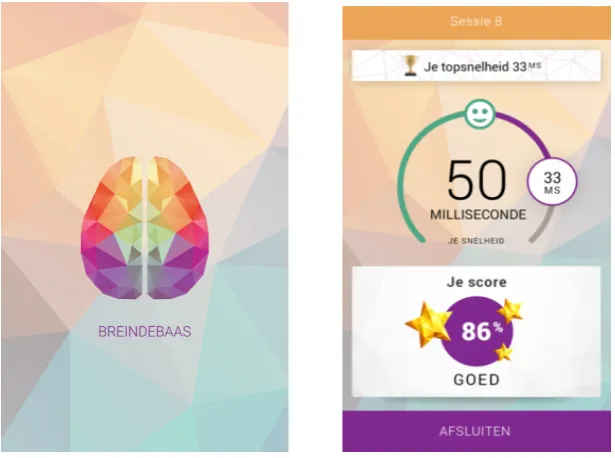
In the Breindebaas app, gamification was slightly used by adding a high score and encouraging words. Several screens of the Breindebaas app are shown in Figure 1.3.
[image:11.595.72.380.506.735.2]
12
In the pilot study (Somsen, 2017), participants of the Breindebaas training mentioned the creation of more levels or game options as a suggestion to improve the app. They described the app as boring and monotonous, and participants indicated that they would like to see more game-elements in the app.
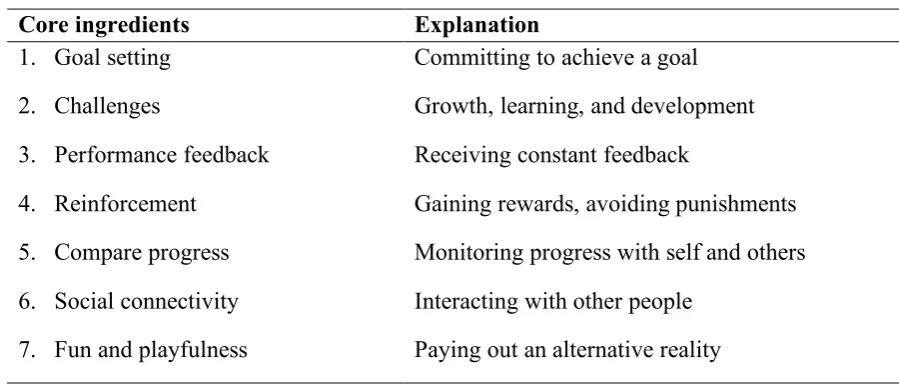
[image:12.595.68.518.357.551.2]There is no consensus yet on which elements are ‘active ingredients’ of gamification. However, Cugelman (2013) reviewed several popular gamification taxonomies and identified seven core ingredients of gamification. According to Cugelman (2013), these core ingredients are broad principles that make technology persuasive and adding (some of) these strategies will instigate behaviour change. Cugelman (2013) argues that technology is no longer persuasive if these ingredients are removed. These seven core ingredients, including their explanation, can be found in Table 1.
Table 1.
The seven core ingredients of gamification (Cugelman, 2013).
Core ingredients Explanation
1. Goal setting Committing to achieve a goal
2. Challenges Growth, learning, and development
3. Performance feedback Receiving constant feedback
4. Reinforcement Gaining rewards, avoiding punishments
5. Compare progress Monitoring progress with self and others
6. Social connectivity Interacting with other people
7. Fun and playfulness Paying out an alternative reality
A relatively new way of motivating, that was not addressed by Cugelman (2013), is the use of motivational agents (Mumm & Mutlu, 2011; van der Meij, van der Meij & Harmsen, 2015). While these motivational agents embody human-like qualities, they seem to have a positive effect on how users process verbal feedback (Mumm & Mutlu, 2011). These virtual coaches personalize the learning task and give people a positive feeling, which increases engagement and motivation (Lester et al., 1997).
Although results of adding game-elements to cognitive trainings are promising,
acceptance of users is essential. Therefore, potential users of the app should be involved in the process of designing a persuasive version of the Breindebaas app. A framework for
13
1.8. The CeHRes Roadmap: Center for eHealth Research Roadmap
The CeHRes Roadmap is a framework for holistic eHealth development and evaluation (van Gemert-Pijnen et al., 2011; Nijland, 2011). This approach is characterized by the emphasis on User-Centered Design (UCD) principles.
1.8.1. User-Centered Design
User-Centered Design includes the involvement of potential users throughout the design process, empirical measurement of usage and the use of iterative design (Gould & Lewis, 1985; Norman, 1986). Adopting a UCD approach, in which users are actively involved throughout the entire design process, has been shown to have several advantages over a technology-driven approach, in which the focus is on the technical aspects of the system with taking minimal account of the needs of the user. UCD has been shown to lead to more
acceptance of the system, better adherence, greater user satisfaction and better implementation of the technology (van Gemert-Pijnen, Peters, & Ossebaard, 2013). The CeHRes Roadmap advocates the use of UCD principles.
The CeHRes Roadmap consists of five different components (Figure 1.4): 1. Contextual Inquiry: identify the users and stakeholders’ needs and problems.
2. Value Specification: determine values of the users and translation into requirements. 3. Design: creating the prototypes.
4. Operationalization: implementation of the intervention.
[image:13.595.72.525.525.708.2]5. Summative Evaluation: evaluation of the uptake and effect of the intervention.
14
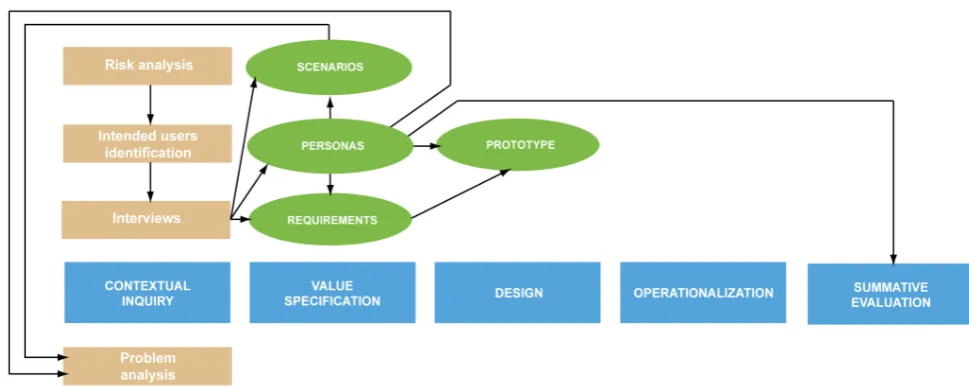
[image:14.595.70.555.276.470.2]The development of the Breindebaas app was an iterative process. When the first version of the app was developed, the cycle of the CeHRes Roadmap has already been completed. In the summative evaluation, clear points for improvement emerged, such as the addition of game-elements to improve adherence. This led to the decision to redevelop the app and to start the cycle again from the beginning, in which stakeholders should be included to improve the suitability of the app and foster successful implementation. Therefore, the primary aim of the current study is to design a persuasive prototype of the app that improves adherence and acceptability by professionals. As can be seen in a more detailed version of the CeHRes roadmap (Figure 1.5), prototypes can be created by using requirements, personas and scenarios.
Figure 1.5. A more detailed version of the CeHRes Roadmap (Van Velsen et al., 2012).
1.8.2. Personas in User-Centered Design
When developing a prototype within a UCD approach, the use of personas is an increasingly common way to enhance user-centered thinking among designers (Pruitt & Adlin, 2010). Personas were originally invented by Alan Cooper (1999), who defined them as “hypothetical archetypes of actual users”. Personas are non-existent, fictional characters that are
representatives of a target group, and thus 'embody' the end users (Cooper, 1999). Multiple personas can be used to symbolize the different user types of a product.
15
tended to make the best fitting decisions. In this way, it is easier to avoid unnecessary and poorly functioning functionalities, which is also cost-effective (Cooper, 1999).
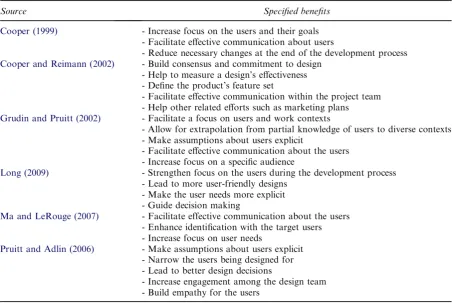
Miaskiewicz & Kozar (2011) provided an overview of persona benefits that are suggested in literature (Table 2). Although this literature does not seem to reach consensus about the universal benefits of personas, it appears that personas can make a substantial contribution to the design process, for example by strengthening the focus on the users.
Table 2.
Benefits of persona use suggested in literature (Miaskiewicz & Kozar, 2011).
In a case study, in which personas were used to redesign a learning support system, personas were found to be a useful way of communicating user data (Dotan, Maiden, Lichtner, & Germanovich, 2009). Personas made the information about end users referable, meaningful and prominent, which stimulated the user-centered design process (Dotan et al., 2009).
1.8.3. Use-case scenarios in User-Centered Design
[image:15.595.74.529.261.564.2]16
the system or product (Cooper, 1999). They can be used to communicate the requirements to the designers. Long (2009) investigated whether different presentation formats of these scenarios affected the design results. Industrial Design students, who were asked to conduct a design project, received either a visual storyboard or a text-based scenario. Results showed that the visual storyboard seemed to be more effective than the text-based version, while it led to more detailed and user-centered design solutions. A possible explanation for this finding was that the storyboard might make it easier for the designers to visualize user problems (Long, 2009). Besides the study of Long (2009), further empirical evidence about the best way of presenting scenarios to designers is lacking. Literature concerning the addition of pictures to written text suggests that illustrations are valuable text adjuncts (Fang, 1996; Carney & Levin, 2002). Several advantages of adding pictures to written text are named, such as contributing to the text’s coherence, reinforcing the text, motivating the reader and
promoting creativity (Fang, 1996). The advantages of adding pictures to written text are supported by dual-coding theory (Paivio, 1971). This theory states that by combining a picture with the written word, two processing systems are addressed: a visual and a verbal process. Written or spoken text is stored once, but images are stored both verbally and visually (Paivio, 1990). Adding images is preferable, while this information is stored in two different ways leading to an increased chance of retention and comprehension (Paivio, 1971). Therefore, a pictorial presentation of a scenario is possibly superior to a text-based version.
Rationale secondary study aim
Although personas and scenarios seem to have several advantages in design, empirical literature is very sparse. Besides, evidence is lacking about how to brief a persona and scenario and what is the most effective presentation format when briefing designers. Very limited studies have addressed the use of personas in design, suggesting that this is a
17 1.9. Study aims & research questions
The current study focuses on the redevelopment of a new and better version of the
Breindebaas app. The primary aim of the current study is to design a prototype of a persuasive mobile alcohol avoidance training that improves adherence and acceptability by professionals. The secondary aim is to study the impact of persona-based design briefs on the design process and prototypes, in which different presentation formats are compared. The CeHRes Roadmap is used as a guideline for both study aims, in which the focus is on the first three phases: the contextual inquiry, the value specification and the design phase. The current study is
separated into two sub studies, which are both supported by a more detailed version of the CeHRes Roadmap (Figure 1.5).
1.9.1. Sub study A: From User Expressions to User Requirements
Sub study A involves the contextual inquiry and value specification. In this study the needs and wishes of potential users and professionals are examined by means of interviews, with the aim of mapping out their needs, wishes and acceptance for adding persuasive (game)
elements. The input of participants is used for the creation of user requirements. Sub study A contains the following research question:
• What are the needs and wishes of potential users and professionals regarding the Breindebaas app and which adjustments have to be made in the app according to their perspective?
1.9.2. Sub study B: From Persona to Prototype
Sub study B involves the value specification and design phase of the CeHRes Roadmap. This sub study includes the creation of two persona-based design briefs, on the basis of the user requirements. Two design teams are provided with different design briefs: one team receives a pictorial design brief and the other a text-based design brief, based on the approach of Long (2009). It is expected that the pictorial presentation of the scenario might be somewhat more effective in design than the text-based version.
Sub study B contains the following research questions:
• What are the influences of the persona-based design brief on the prototype and design process?
18
Methods A:
From User Expressions to User Requirements
Design
Sub study A consisted of the contextual inquiry and value specification. This was a qualitative study, using semi-structured interviews. The aim was to get input from potential users and professionals, to determine their needs, wishes and acceptance towards the addition of persuasive (game) elements. Expressions from stakeholders in the interviews were translated into user requirements, which are the features a product or system should have according to the users’ perspective (Courage & Baxter, 2005).
Participants
Twelve participants were recruited by means of purposive sampling (Tongco, 2007). Participants were potential users of the app and professionals in the field of addiction care.
Potential users
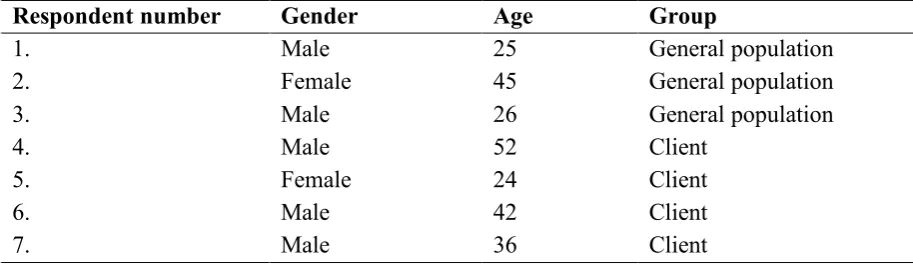
The potential users were people from the general population who wanted to decrease their alcohol consumption (n=3) and alcohol (ex)-clients of Tactus Addiction Institute (n=4). Inclusion criteria for the potential users from the general population were that (1) participants consumed alcohol regularly, (2) would possibly use the Breindebaas app when their alcohol consumption would become a problem, (3) were familiar with a smartphone and (4) were 18 years or older. Inclusion criteria for the potential users from addiction care were that (1) participants were clients or ex-clients with alcohol addiction from Tactus Addiction Institute, (2) would possibly use the Breindebaas app, (3) were familiar with a smartphone and (4) were 18 years or older. Characteristics of the potential users can be found in Table 3.
Table 3.
Characteristics of the potential users.
Respondent number Gender Age Group
1. Male 25 General population
2. Female 45 General population
3. Male 26 General population
4. Male 52 Client
5. Female 24 Client
6. Male 42 Client
[image:18.595.71.528.627.759.2]19 Professionals
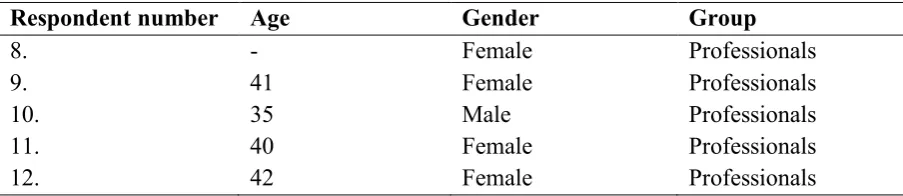
[image:19.595.72.524.236.334.2]The professionals (n=5) included a psychiatrist, clinical psychologist, psychological wellbeing practitioner, social worker and general practitioner. Inclusion criteria for the professionals was that participants had an occupation in the field of alcohol addiction. Characteristics of the professionals can be found in Table 4.
Table 4.
Characteristics of the professionals.
Respondent number Age Gender Group
8. - Female Professionals
9. 41 Female Professionals
10. 35 Male Professionals
11. 40 Female Professionals
12. 42 Female Professionals
Materials
Two interview schedules with open questions were developed for conducting the semi-structured interviews. The interview schedule for the potential users can be found in Appendix A. The interview schedule for the professionals can be found in Appendix B. By using semi-structured interviews, the structure of the interview was maintained, while having the option to ask for explanations or examples (Van Teijlingen, 2014). The interview for the potential users started with a few demographic questions and a general question about smartphone use related to health. After these questions, the actual interview started. The first part of the interview included questions about the aim and explanation of the training. The second part of the interview included questions about the training session itself. This included for example the participant’s opinion about the length of the session and the pictures. The last part of the interview included questions about the motivation to train in the app. This included discussing options for improving motivation to train, such as gamification, of which multiple examples were shown. The interview for the professionals included the same questions, but some questions were adjusted to what they thought their clients would want or need.
20 Procedure
The current study has received ethical approval from the Ethics Committee. Before the start of the interviews, participants were asked to sign informed consent (Appendix C). The informed consent explained the aim of the study and guaranteed anonymity and confidentiality.
Participants were informed that the interviews were recorded with a voice-recorder. In the interview, the instruction video was shown to the participants prior to the questions about this topic. Furthermore, participants were asked to complete one training session before or during the interview. The interviewer encouraged participants to give their own honest opinion. Interviews were alternately conducted by two researchers.
Analysis
Coding and transcribing
While the results were used as input for the design of the Breindebaas app, only expressions relating to the purpose of this research were transcribed verbatim (Poland, 1995). The
recordings were rewound multiple times to transcribe accurately. After transcription, thematic analysis was conducted (Braun & Clarke, 2006). This process started with the familiarization with the data and the generation of initial codes. Then, the codes were transformed into themes and sub themes and the potential themes were reviewed. This was an iterative process, in which generating themes was both deductive and inductive (Joffe & Yardley, 2004). The labels for the final themes and sub themes can be found in Appendix D.
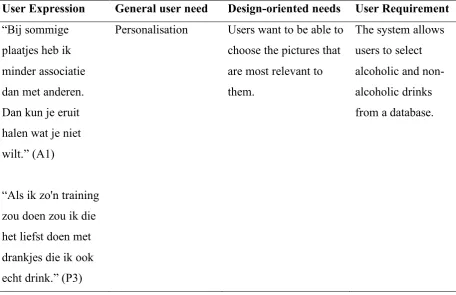
Formulating user requirements
21
[image:21.595.75.532.278.573.2]pictures that are relevant to them. Therefore, the ‘general user need’ related to the expressions was personalization. In the third step, the user expressions and needs were translated into ‘design-oriented user needs’, which included that users want to be able to choose the pictures that are most relevant to them. Finally, the design-oriented user needs were translated into ‘user requirements’. These ‘user requirements’ described the desired features or performance of the system according to the users. In the case of the example, this was that the system allows users to select alcoholic and non-alcoholic drinks from a database.
Table 5.
Example of the translation process from user expression to user requirement.
User Expression General user need Design-oriented needs User Requirement “Bij sommige
plaatjes heb ik minder associatie dan met anderen. Dan kun je eruit halen wat je niet wilt.” (A1)
“Als ik zo'n training zou doen zou ik die het liefst doen met drankjes die ik ook echt drink.” (P3)
Personalisation Users want to be able to choose the pictures that are most relevant to them.
22
Results A:
From User Expressions to User Requirements
This section describes the results of the interviews, in which participants were potential users (i.e. ex-clients of alcohol addiction treatment and people from the general population who were motivated to reduce alcohol intake) and professionals. In principle, the results are described for all participants in general. When there were clear differences between the sub groups, there was referred to the name of the sub group.
Use of smartphone apps regarding health
The interview started with an introduction question, with the intention to map the participants’ attitudes towards using health-related smartphone apps. Most participants indicated that they have used these apps before, either for personal use or recommendation to clients. All participants had a positive attitude towards health-related apps, even when they did not use these apps themselves: “Ik gebruik ze zelf niet, maar ik denk wel dat dat voor mensen helpend kan zijn. Ik zie dat wel als iets nuttigs.” (C4).
Information and explanation of the training session
23
alcohol use: “Wat uiteindelijk het effect is van het spelletje op het laten staan van
alcoholische drankjes, dat komt niet duidelijk naar voren.” (P4). Besides, they also want to have an indication about when they can expect these effects: “Ik zou ook graag van tevoren willen weten wanneer ik effect kan verwachten, zodat je niet te vroeg wonderen verwacht.” (A2). Participants indicate that it should be emphasized that they have to train repeatedly in the app: “Volgens mij mag je dat [herhaaldelijk trainen] wel vaker horen. Het is 1 keer uitgelegd. Het mag wel duidelijker en vaker herhaald worden. Ook wel bij aanvang.” (P2). The term ‘repeatedly training’ should be specified as well: “Daarnaast specifieker aangeven wat die 'herhaalde oefening' moet zijn, bijvoorbeeld twee of drie keer in de week.” (P1).
General opinion about training session
All participants were asked to complete one training session in the app. Afterwards, they indicated several positive and negative points. In general, participants had fun in completing a training session: “Ik vond het leuk om te doen.” (P2) and they mentioned that the app was user-friendly: “Ik vond hem ook gemakkelijk te gebruiken.” (A1). Participants were satisfied with the visual appearance and design: “Ik vond hem ook mooi en hip vormgegeven, het zag er lekker fris uit.” (A1). However, participants indicated that the training was somewhat boring: “De training was ook wel een beetje saai.” (P3). Several participants mentioned that they had to wait too long before a new picture appeared: “Ik vind dat het swipen niet snel genoeg kan, er zit teveel tijd tussen de plaatjes.” (P1). Furthermore, the zooming feature was indicated as too subtle: “Ik had ook verwacht dat als je een plaatje van je af swiped, dat hij dan veel verder weg verdwijnt. Het zooming effect mag wel sterker aanwezig zijn.” (P3).
Length of the training session
24 Pictures in the training session
Participants mentioned that the content of the pictures was not always clear: “Sommige plaatjes mogen wat helderder, dat je ook direct weet wat het is.” (A3). This seemed to be relevant especially for (ex)-clients of addiction care: “Om even terug te denken hoe ik zou denken als verslaafde, wie zegt dat dat koffie of thee is? Dat kan ook heel wat anders zijn, dat is dan niet heel erg duidelijk.” (C4). Participants indicated that several beverages were
missing: “Ik miste ook wel veel populaire drankjes, zoals shotjes of mixdrankjes.” (C1), and they would like to see more variation in pictures: “Ik zou een grotere beeldbank willen zien.” (A3).Participants mentioned that not all pictures were relevant to them: “Bij sommige plaatjes heb ik er geen mening over of die naar me toe moet of van me af. Ik drink
bijvoorbeeld geen koffie, en dat ik die naar me toe moet halen gaat dan tegen mijn idee in.” (P3). One way to solve this problem is to let participants select their own pictures. This idea was presented to the participants, who seemed to be enthusiastic about this feature: “Ja dat vind ik een goed idee. Ik denk dat het belangrijk is dat je aansluit bij wat mensen feitelijk ook drinken.” (P4). Even though this idea was positively received, professionals expressed some doubts about whether the effect of the app also continued for untrained pictures. They mentioned that alcohol clients often consume the same type of drink. Therefore, they were concerned that when users only select this type of drink, they remain sensitive for alcohol drinks that were not included in the training. Thus, they suggested to let users select a minimum number of several types of drinks: “Ik merk wel dat mensen vaak heel eenzijdig drinken, dus dat zou je dan aan kunnen vullen met andere dranken.” (P4).
About the presentation of the beverages is no consensus. Most participants indicated that type of drink and brand are important: “Type drankje en merk zijn belangrijk.” (P1). The brand is important for some participants:“Ik ben wel merkgevoelig. Ik heb liever coca-cola dan pepsi.” (A1), but not for others: “Het merk boeit mij niet zoveel. Wel het type drankje.” (A3). In general, it became clear that the pictures should resemble the actual situation: “Ik denk dat het visueel zoveel mogelijk moet lijken op de situatie die jij ook tegenkomt. Dus dat het jouw merk halve liter bier blik is.” (P4). For some this meant the presentation in a glass came close to the temptation in real life: “Ik heb het liefst het drankje gepresenteerd in een glas, want dan is het al klaar om te drinken. En de fles daarnaast staat er dan meer zodat je weet wat erin zit.” (A1).
25
really sensitive to pictures of alcohol: “Als je echt alcoholist bent kan zo'n plaatje al een enorme trigger zijn. Ik merk zelf ook dat ik de alcohol bijna proef en ruik.” (C1). Therefore, some ex-clients suggested to not recommend this app in the first phase of recovery: “… ik kan mij voorstellen dat als iemand net in herstel zit en je krijgt dit voor je kiezen, dan weet ik niet of het heel handig is dat je steeds met die plaatjes geconfronteerd wordt.” (C3).
Implementation
The interviews with the professionals included some questions about implementation. Some professionals indicated that they would recommend the app to clients, providing that the client is familiar with a smartphone: “Ja, ik zou het mijn cliënten aanraden, op voorwaarde dat zij goed overweg kunnen met een smartphone.” (P1). Others were more hesitating: “Ik ben zelf ook een beetje sceptisch: ik vraag me af hoe werkt het en waarom. Ik moet nog wat wennen aan de geloofwaardigheid ervan en dat het ook echt iets doet.” (P3).When it comes to
implementation, all professionals would like to have more information about the effectiveness of the app: “De effectiviteit, dat ik weet dat het uit een onderzoek komt. Dat zou het voor mij betrouwbaarder maken.” (P2).
In general, all professionals showed a positive attitude towards the app and most of them mentioned they would recommend the app to clients. There seems to be a need for these kind of self-help apps in addition to traditional treatment: “We zijn ook steeds op zoek naar welke alternatieven er al zijn, en daarin zou dit wel een welkome zijn.” (P2). However, they mentioned that they lack knowledge about this kind of apps and have no time to explore such interventions themselves: “Het komt door tijdsgebrek en kennisgebrek, het zou met
nascholing aan bod moeten komen.” (P5). While one of the target groups of the Breindebaas app is clients of alcohol addiction treatment, it seems interesting to elaborate further on the question what this means for implementation and possible requirements.
Frequency of sessions
26
denk ik dat cliënten 2 keer per week een training volgen.” (P3). Participants indicated that it is important that the app reminds them of the training: “… dat de app je om de zoveel tijd waarschuwt dat je hem moet gebruiken door een reminder of pushbericht.” (A1).
Motivation to train
Participants were asked about how their motivation to train could be increased. More clarity about the training was mentioned as helpful: “Ik denk dat het zou helpen als de deelnemer weet hoelang het ongeveer duurt. […] Als je daar meer helderheid en inzicht in geeft kun je het makkelijker volhouden.” (P1). Furthermore, it was named multiple times that participants liked the addition of game-elements: “Er zit al een vorm van spel in, misschien moet het spelelement nog wat uitgebreid worden.” (C4). Participants described the app as monotonous and indicated that they would like the training to be more challenging in order to improve the motivation to train: “Het belangrijkste voor mij is dat er een vorm van uitdaging in zit. Dat ik niet na twaalf keer nog steeds hetzelfde zit te doen en er helemaal niets veranderd.” (C4).
Gamification
27 Performance feedback
All participants indicated that they would like the addition of performance feedback in the app: “Ik denk dat het belangrijk is dat je wat meet en dat dat teruggekoppeld wordt.” (C3). Receiving feedback about their performance would give them a sense of usefulness: “Dan heb je het idee dat je niet doelloos bezig bent. Dat het duidelijk is waar doe ik het voor.” (C1). As example of performance feedback, more insight in their alcohol use was mentioned: “En een grafiek met het aantal glazen alcohol lijkt mij ook wel heel gunstig, dan zou ik daar meer op gaan letten.” (A2). However, participants indicated that timing is important: “Maar dat zou dan wel na twee weken moeten, want je gaat niet al na 3 dagen minder drinken. Dan krijg je een schuldgevoel.” (A2). Another example of performance feedback that was
mentioned by participants, was that they would like to have more insight in their progress: “Ik zou het fijn vinden om te zien hoeveel sessies ik heb gedaan en hoeveel sessies ik nog moet doen.” (A3). Some participants would like to receive feedback about their reaction times: “Feedback over snelheid tijdens het swipen zou ik ook fijn vinden” (A1). Lastly, the bias score was explained. Participants showed a positive attitude towards feedback about the bias score. However, they also mentioned that a good explanation is needed: “Bias zou ik ook wel willen weten, maar daar is wel een uitleg voor nodig.” (A1). Furthermore, they indicate that it could be too complicated for some users: “Feedback over de bias zou mij wel inzicht geven over dat het werkt, maar het kan ook te ingewikkeld zijn voor veel mensen.” (A2).
Goal-setting
28 Storyline
Some participants showed a positive attitude towards a simplified version of a storyline: “Zo'n visuele weg vind ik wel leuk.” (A2). However, a whole game shell around the training was mentioned as undesirable: “Ik denk dat je dan hele andere verwachtingen hebt, dat je dan meer richting entertainment gaat dan wat het nu is.” (A1). According to participants, this could even be detrimental to motivation: “Dan ligt er een verwachting van het moet leuk en uitdagend zijn, en als dat niet bevestigd wordt raak je misschien de motivatie kwijt.” (A1).
Challenge
A few participants mentioned that a challenge could be motivating, although the majority named the disadvantages: “Ik ben bang dat dit teveel teleurstelling in de hand zou werken.” (A2). Besides, they described it would become too much: “Ik denk dat dat te ingewikkeld wordt.” (A3), but possibly they would use it when they are familiar with the app: “Ik denk dat ik dit zou gebruiken na 2 of 3 weken, als ik het gevoel heb dat ik grip heb op die app.” (A2). Furthermore, it was mentioned that it might enhance motivation if users can compete with others: “Alleen een uitdaging met jezelf uitgaan blijft lastig. Als je dit ook met anderen kan doen zou dat nog een extra motivatie zijn denk ik.” (P4).
Motivational agents
The game-element that was described as least positive was motivational agents. In general, participants had a negative attitude towards these virtual coaches. Some even indicated that it would annoy them: “Dat vind ik verschrikkelijk. Ik vind het nep en irritant.” (A3).
Motivational agents were also described as childish: “Dat vind ik wel erg kinderachtig.” (P4), and more suitable for younger target groups: “Misschien voor andere jongere doelgroepen.” (C3). Furthermore, participants had the feeling that they did not need a virtual coach, because the task was relatively simple and easy: “Dan denk ik waarom moet ik een coach nodig hebben om plaatjes te vegen.” (C3).
Other persuasive features
Although participants in general had a positive attitude towards the use of gamification, they indicated that the app should stay simple: “Maar ook niet teveel [spelelementen], het moet simpel blijven.” (P2). Besides, it was named that the focus should be on the training itself. Therefore, transparency about the goal of the training was mentioned as important:
29
According to participants, it would be desired that users can choose whether they want to include certain elements in the app or not: “Het mooiste zou zijn dat alles een optie is, dat je zelf kunt kiezen of je het wel of niet wilt zien of doen.” (A2). Other important points were that many participants would like to have a reminder: “… dat de app je om de zoveel tijd
waarschuwt dat je hem moet gebruiken door een reminder of pushbericht.” (A1).
Requirements
The outcomes of the interviews were translated into user requirements. For example, the user expression “Ik vind dat het swipen niet snel genoeg kan, er zit teveel tijd tussen de plaatjes” was translated into the requirement “In de training sessies zit er zo min mogelijk tijd tussen de opeenvolgende plaatjes.” All user requirements can be found in Table 6.
Table 6.
User-generated requirements of the new Breindebaas app
User Requirements
1. The app contains an information page including the following aspects:
- Link to the website www.tactus.nl/breindebaas for more information about the effect and aim of the training and the results of the pilot study.
- Instruction to watch the video
- Disclaimer (explaining the pictures could possibly be a trigger and advise to contact GP or Tactus Addiction Institute if user thinks more help is needed)
- Privacy
2. The app contains an option menu in which participants can switch features on or off
3. The zooming feature in the app is stronger (pictures swiped towards the user become larger and pictures swiped away from the user become smaller)
4. The app contains a database in which users can select pictures of alcoholic and non-alcoholic beverages (minimum X and maximum Y)
5. The app is visually attractive and simple
30
Besides the user requirements, there were several requirements created by the researchers, such as the inclusion of a bias measurement at baseline and after an X number of training sessions. Furthermore, the app should have a back-end to which the researchers have access for data extraction. The requirements generated by the researchers can be found in Table 7.
Table 7.
Requirements of the new Breindebaas app generated by the researchers
Research-based requirements
1. In the app there must be space for a short video (prior to the training) and there should be a possibility to add this video later without the app having to be completely rebuilt
2. The app contains a bias measurement before the first session and after an X number of sessions 3. The app contains the possibility for the researchers to fill the database with pictures
4. The app contains an option menu, including:
- Reminders (yes/no, how often, allow without WIFI connection) - Ability to change the selected of pictures
- Sounds on/off and choose sounds - Adjust the font size
31
Discussion A:
From User Expressions to User Requirements
Main findings
The research question of sub study A was: What are the needs and wishes of potential users and professionals regarding the Breindebaas app and which adjustments have to be made in the app according to their perspective? When looking at the interviews in general, it appeared that all participants had a positive attitude towards the app. Participants were satisfied with the simple and user-friendly design, but experienced the training as somewhat boring. Several points for improvements were named, which were translated into user requirements.
Interestingly, the results of the current study confirm the findings of the pilot study of Somsen (2017), in which a short user evaluation was conducted using open-ended questions. In both the pilot study and the current study, the training was described as boring and
monotonous and there were doubts among users about the effectiveness of the training. The points for improvement named in the pilot study were that there should be a greater variety of pictures, a shorter time interval between the pictures and the option to personalize the picture set. Furthermore, participants in the pilot study indicated they would like to see more game-elements and improved reminders. These findings were all confirmed by the current study. Besides the confirmation of the findings of the pilot study, there were also new findings that emerged from the current study. The current study showed that both potential users and professionals had a positive attitude towards adding game-elements, in which performance feedback and positive reinforcement were mentioned as most desirable. Furthermore, users expressed the need to have more insight into their progress. From the interviews it appeared that the adjustment of certain features and the addition of game-elements would make users experience the training as less tedious and thus would increase their motivation to train.
32
autonomy, relatedness and competence (Ryan & Deci, 2000). The SDT suggest that when people are intrinsically motivated, but this behaviour is controlled by external rewards, it can undermine people’s autonomy. Thus, this theory supports the finding that too many external rewards, including game-elements, can lead to demotivation.
Another important finding of the current study was that both potential users and professionals showed the need for more information about aim and effect of the training. It appeared that this should be more emphasized in the app, as well as in a new introduction video. Wiers & Salemink (2015) support this finding by the suggestion that it is important to explain the rationale behind repetitive training. This can address the lack of understanding and by explaining why repetitive training is important, the training can possibly make more sense. In anxiety patients, it has already been shown that the results achieved with cognitive training are better if the rationale is explained to the patients in a credible and understanding way (Beard et al., 2012). Providing users with more information about aim and effect seems to be equally important as adding game-elements, while previous research suggests that giving meaning to a task improves motivation of users to the same extent as rewarding them with points (Mekler, Brühlmann, Opwis, & Tuch, 2013). The need for more information about aim and effect can also be related to the need for competence of the SDT, while this theory
suggests that promoting feelings of efficacy can facilitate intrinsic motivation (Ryan & Deci, 2000). Furthermore, the SDT states that providing positive feedback and rewards, which were desired by the potential users in the current study, can as well contribute to a feeling of
competence and in turn enhance intrinsic motivation (Ryan & Deci, 2000).
Lastly, the interviews showed that the images of alcoholic beverages can be a trigger for people in the first phase of recovery. While users perform the training individually without the attendance of a supervisor, they should be warned in the app for the possible risks of being confronted with alcoholic beverages.
Relating the results to the Persuasive System Design (PSD) model
33 Primary task support
The first category of the PSD-model is the primary task support, which focuses on supporting the user in carrying out the primary task. One design principle of this category that clearly arose in the interviews is personalization. Users often named that not all pictures of the current database were relevant to them and they would prefer to select the pictures of
beverages themselves. The PSD-model suggests that this would be beneficial, stating that the persuasiveness of a system can be enhanced by offering personalized content. This is
confirmed by O’Keefe (2008), who stated that motivation can be increased by emphasizing personal relevance. These findings suggest that letting users select their own pictures can possibly enhance the motivation to train in the app. On the other hand, it should be taken into account that personalization of the training can also have negative consequences, such as users who still remain sensitive for alcoholic drinks that were not selected in the training. However, in a study of Wiers et al. (2011), it was found that the retrained effects on the automatic approach tendencies could be generalized to an untrained picture set.
Another finding of the interviews was that participants would like to have more insight into their own behaviour by means of performance feedback. This can be linked to the design principles simulation (i.e. improved persuasiveness when link between cause and effect of own behaviour can be observed) and the design principle self-monitoring (i.e. system should enable users to keep track of their own performance). This finding is in line with earlier studies, which showed that positive performance feedback can enhance intrinsic motivation (Deci & Ryan, 1985; Harackiewicz, 1979).
In the interviews, the simplicity and straightforwardness of the Breindebaas app were regularly emphasized as important assets. This finding can be related to the design principle reduction, which states that a system should reduce complex behaviour into simple tasks. The design principle tailoring can be related to (ex)-alcohol clients, who mentioned that they are a little slower in understanding. They expressed the need for very simple and clear information. Therefore, information provided by the system should be tailored to the user group.
34 Dialogue support
The second category of the PSD-model is the dialogue support, which concerns the
interaction between the user and the system. The design principle rewards was often named in the interviews, in which several users mentioned that they would like to receive a simple reward for their performance. Furthermore, professionals indicate that clients are sensitive to compliments and positive reinforcement, which can be related to the design principle praise. According to the PSD-model, praising and rewards can make users more open to persuasion. The persuasive design principles reminders and liking were also found in the interviews. Users indicated that they want the system to regularly remind them to perform a new training and mentioned that a visually attractive app is important to them.
The design principles that could not be related to the interviews are similarity (i.e. imitate users and remind them of themselves), suggestion (i.e. system should suggest to carry out certain behaviours)and social role (i.e. system should adapt a social role).The design principle suggestion can possibly be related to the system suggesting that the user has to train again. The other two design principles are perceived as not applicable.
Credibility support
The third category of the PSD-model is credibility support, which refers to designing a system that is credible and therefore more persuasive. The interviews showed that there were some doubts about the effectiveness of the training. Professionals named it more likely that they would implement the app if it was proven to be effective or if they could read something about the preliminary results. This can be related to the design principle third-party
endorsement. Furthermore,the design principles trustworthiness and expertise relate to the expressed need for information about aim and effect shown in the interviews. According to the PSD-model, providing information, knowledge and competence can increase the persuasive powers of a system.
The design principles real-word feel and authority suggest that a system should provide information of the organization behind the system. This can be related to the app because it was developed by Tactus Addiction Institute. The users’ satisfaction of the look and style of the app that arose in the interviews, can be related to the design principle surface credibility. This principle states that a system should have a competent look and feel.
35 Social support
The fourth category of the PSD-model is social support, focusing on using social support within the system to increase persuasiveness. In the interviews, some users mentioned that they would like to compare their response times with that of other users. This finding can be related to the design principles social comparison, social learning, socialfacilitation and competition. According to the PSD-model, letting users compare their own performance with the performance of others can increase the motivation. Possibly, this finding can also be related to the design principle normative influence, because it can make them aware of the fact that others who have the same goal are training in the app as well. This finding is
supported by the SDT, with in particular the need for relatedness, suggesting that fulfilling the need to be connected can enhance intrinsic motivation (Ryan & Deci, 2000).
Although these social support elements are perceived as motivating and persuasive, it should be taken into account that it can possibly give users the feeling that privacy and anonymity are harmed. Privacy and anonymity are perceived as very important assets and thus should be carefully considered when designing a certain feature. This can for example be done by letting users share their performances by using anonymous user names.
The design principles recognition and cooperation from the category social support could not be related to the interviews. The design principle cooperation can be perceived as not applicable, while the training is a relatively simple task that should be performed
individually. The design principle recognition, which includes that the system should provide public recognition for users performing the target behaviour, could also not be related to the interviews. Potential users of the app are people who consume excessive amounts of alcohol and might experience feelings of shame (O’Connor et al., 1994). Therefore, it is possible that this design principle in the current situation would not contribute to a more persuasive system. Comparing the results of the current study with the PSD-model made it clear that the main findings of the interviews are in line with persuasive design principles. Therefore, including these elements in the new Breindebaas app seems to be promising for improving adherence.
Subgroup similarities and differences
36
sub group indicated that the pictures of the alcoholic beverages could be a trigger for people who have or did have an alcohol addiction. They mentioned that especially in the first phase of alcohol addiction recovery people are advised to stay away from alcohol, but in the app they will be constantly confronted with alcoholic beverages. The interview outcomes showed that (ex)-clients of alcohol addiction treatment could almost smell and taste the alcohol by only seeing the picture of an alcoholic beverage. Several interviewees from this sub group mentioned that the pictures could possibly be a trigger.
As far as is known, there are no studies yet that describe the possible risks of
Cognitive Bias Modification. However, in exposure therapy, in which patients are repeatedly exposed to a feared stimulus or situation, there is always a supportive therapist present to prevent any negative consequences (Davis, Ressler, Rothbaum, & Richardson, 2006). Users in the Breindebaas app will train individually, independent of treatment, which makes supervision not possible. Therefore, a disclaimer should be included in the app, to inform people about the possible risks.
Another interesting statement, that was only expressed by professionals, was that they had some doubts about goal-setting. They mentioned overestimation could play a role. Strecher et al. (1995) confirm that goal-setting does indeed not always instigate behaviour change. Self-set goals can even be counterproductive, especially when a person is not committed. They suggest using a counsellor when goals are set too high or too low, as they have a more realistic view of the goals to be set (Strecher et al., 1995). However, including a supervisor is in this case is no option, as the app will also be used independent of treatment. To prevent any negative consequences, it is preferred to not include goal-setting in the app.
Limitations & strengths