University of Warwick institutional repository: http://go.warwick.ac.uk/wrap
A Thesis Submitted for the Degree of PhD at the University of Warwick
http://go.warwick.ac.uk/wrap/4476
This thesis is made available online and is protected by original copyright. Please scroll down to view the document itself.
High-fidelity Rendering on Shared
Computational Resources
Vibhor Aggarwal
A thesis submitted in partial fulfilment of the requirements for
the degree of
Doctor of Philosophy in Engineering
School of Engineering
Contents
Acknowledgements ix
Declaration x
List of Publications xi
Abstract xii
1 Introduction 1
1.1 High-fidelity Rendering . . . 1
1.1.1 Applications . . . 2
1.2 Shared Computing Resources . . . 4
1.3 Rendering on Shared Resources . . . 5
1.4 Research Objectives . . . 7
1.5 Organisation . . . 8
2 High-fidelity Rendering 10 2.1 Radiometry . . . 10
2.1.1 Radiometric Quantities . . . 11
2.1.2 Bidirectional Reflectance Distribution Function . . . 12
2.2 The Rendering Equation . . . 13
2.3 Rasterisation . . . 14
2.4 Radiosity . . . 15
2.5 Ray Tracing . . . 16
2.6 Point Sampling Methods . . . 18
2.6.1 Distributed Ray Tracing . . . 18
2.6.2 Path Tracing . . . 20
2.6.3 Irradiance Caching . . . 21
2.6.4 Instant Radiosity . . . 22
2.7 Sparse Sampling and Image Reconstruction . . . 23
2.7.1 Image Reconstruction Techniques . . . 23
2.7.2 Sparse Sampling . . . 25
2.8 Time-constrained Rendering . . . 27
2.9 Parallel Rendering . . . 28
2.9.1 Parallel Irradiance Cache . . . 30
2.10 Summary . . . 30
3 Computing on Shared Resources 31 3.1 Taxonomy of Grid Computing . . . 31
3.1.1 Computational Grid vs. Desktop Grids . . . 32
3.1.2 Internet-based vs. LAN-based Desktop Grids . . . 32
3.2 Computational Grid . . . 33
3.2.1 Examples . . . 35
3.3 Desktop Grids . . . 36
3.3.1 Advantages . . . 37
3.3.2 Challenges . . . 38
3.4 Fault-tolerance . . . 39
3.4.1 Fault-tolerant Strategies . . . 40
3.5 The Master-Worker Paradigm . . . 42
3.6 Grid Middleware . . . 43
3.6.1 Globus Toolkit . . . 43
3.6.2 Condor . . . 45
3.7 Parallel Rendering on Grid . . . 46
3.8 Summary . . . 47
4 Quasi-random Sequences 48 4.1 Discrepancy . . . 48
4.2 Types of Quasi-random Sequences . . . 49
4.2.1 van der Corput Sequence . . . 50
4.2.2 Sobol Sequence . . . 51
4.3 Scaling and Quantisation of Quasi-random Sequences . . . 54
4.4 Summary . . . 57
5 Animation Rendering on Computational Grids 58 5.1 Introduction . . . 59
5.2 Rendering on the grid . . . 59
5.2.1 Single-pass Approach . . . 60
5.2.2 Two-pass Approach . . . 60
5.3 Results . . . 63
5.3.1 Visual Quality . . . 63
5.3.2 Timing and Speed-up . . . 66
5.4 Discussion . . . 68
5.5 Summary . . . 68
6 Time-constrained Offline Rendering on Desktop Grids 70 6.1 Introduction . . . 70
6.2 Time-constrained Fault-tolerant Parallel Rendering Algorithms . . 72
6.2.1 Straightforward Approach . . . 76
6.2.2 Component-based Algorithm . . . 77
6.3 Results . . . 81
6.3.1 Time-constraints . . . 82
6.3.2 Fault-tolerance . . . 85
6.4 Summary . . . 88
7 Interactive Rendering on Desktop Grids 90 7.1 Introduction . . . 90
7.2 Fault-tolerant Interactive Rendering System . . . 92
7.2.1 Communication . . . 94
7.2.2 Scheduling . . . 94
7.2.3 Display and Reconstruction . . . 95
7.2.4 The Worker . . . 98
7.3 Implementation Details . . . 98
7.4 Evaluation . . . 99
7.4.1 Interactive Sequence . . . 103
7.4.2 Static Image . . . 107
7.4.3 Frame Reconstruction . . . 109
7.5 Summary . . . 110
8 Time-constrained Animation Rendering on Desktop Grids 112 8.1 Introduction . . . 112
8.2 Fault-tolerant time-constrained animation rendering . . . 113
8.2.1 Straightforward Approach . . . 113
8.2.2 Multi-dimensional Quasi-random Sampling Approach . . . 114
8.3 Implementation Details . . . 117
8.4 Results . . . 120
8.4.1 Visual Quality . . . 120
8.4.2 Fault-tolerance . . . 125
8.5 Summary . . . 129
9 Conclusions and Future Work 130 9.1 Conclusions . . . 130
9.2 Contributions . . . 132
9.3 Impact . . . 132
9.4 Limitations and Directions for Future Work . . . 133
9.5 Final Remarks . . . 134
References 135
List of Figures
1.1 High-fidelity rendering examples . . . 2
1.2 A novel fault-tolerant mechanism for high-fidelity rendering . . . . 5
1.3 A sequence of frames rendered interactively . . . 6
2.1 Description of quantities for calculating radiance . . . 12
2.2 The graphics pipeline for rasterisation . . . 15
2.3 Classic ray tracing algorithm . . . 17
2.4 Ray traversal . . . 19
2.5 Path traced image with different number of samples per pixel (SPP) . . . 20
2.6 k-Nearest neighbour algorithm . . . 24
3.1 Grid computing taxonomy . . . 31
3.2 Four-layered hourglass grid architecture . . . 35
4.1 Two-dimensional Halton and Sobol sequences . . . 55
5.1 Irradiance value interpolation . . . 61
5.2 Selection of frames for the first pass . . . 62
5.3 BFM graphs comparing the two approaches. Kalabsha Walk-through animation was calculated on a single processor while the others were computed on the NGS. . . 64
5.4 The portion of the frame used for calculating the BFM graphs. . . 66
6.1 Quasi-random subdivision of an image . . . 71
6.2 Image subdivision techniques and the resultant image in case of faults. . . 73
6.3 Image reconstruction comparison . . . 74
6.4 The pipeline for the straightforward approach. . . 76
6.5 Image subdivision based on components. . . 77
6.6 The pipeline for the component-based approach. . . 78
6.7 Indirect lighting calculation for the Sibenik model . . . 79
6.8 The scenes used for the experiments . . . 82
6.9 The VDP results. . . 84
6.10 VDP comparison for the Sibenik model . . . 85
6.11 Cornell Box visual comparison . . . 86
6.12 Fault-tolerant nature of the component-based algorithm. . . 87
7.1 The pipeline for interactive rendering on a desktop grid. . . 91
7.2 The overview of the interactive rendering system . . . 93
7.3 The scenes used for evaluation . . . 100
7.4 The comparison of visual quality of an interactive sequence . . . . 101
7.5 A frame of the Race Car interactive sequence rendered on different number of resources. . . 103
7.6 The VDP comparison for frame 70 from the Kiti interactive se-quence. . . 104
7.7 The convergence of visual quality of static images . . . 105
7.8 The efficiency comparisons for rendering on different number of resources. . . 107
7.9 The visual quality comparison of reconstruction methods for in-teractive sequences. . . 108
8.1 The pipeline for the ETPF approach . . . 114
8.2 Three-dimensional Sobol Sampling . . . 115
8.3 The time-constrained pipeline for the MQS approach. . . 115
8.4 The overview of the time-constrained animation rendering system 116 8.5 The description of scenes used for evaluation . . . 118
8.6 The Temporal Fault variation (TF50) . . . 121
8.7 The VDP comparisons for the animations . . . 122
8.8 The VDP comparison for a frame of the Kiti animation . . . 123
8.9 The RMSE comparisons for the animations . . . 124
8.10 Count versus SPP for different frames . . . 126
List of Tables
4.1 Generation of first 10 numbers of a base-2 van der Corput sequence 49
5.1 Animation Description and Timings . . . 67
6.1 Component-based approach versus straightforward approach . . . 81 7.1 Fixed frame rate used for various scenes. . . 107
8.1 Time-constraints used for various animations . . . 120
8.2 Average RMSE Values . . . 125
Acknowledgements
This thesis would not have been possible, had Alan not replied to one of the many random emails he gets daily and if Kurt had not instigated me into the intriguing world of research during my undergraduate internship. It is only fitting that both of them jointly supervised me on this thesis. I am highly indebted to them for their constant support and encouragement while enthusiastically motivating me through this journey.
The Visualisation Group at the University of Warwick has been immensely helpful in providing a strong sense of a research community. Both Tom and Piotr provided invaluable assistance during the research, offering useful insights and advice. Vedad and Jass were always present whenever I got stuck. Alena, Alessandro, Belma, Carlo, Ela, Elmedin, Francesco, Gabriela , Jasminka, Matt, Mike, Peter, Remi, Sandro, Silvester, Simon: it was great working with all of you and I especially enjoyed our outings together.
Usama, who tragically passed away in October 2007, deserves a special men-tion. He once showed me how he could do “magic” by reconstructing images from sparse samples and thus inspired me to use these techniques for my research. His ever-smiling face will always be an inspiration.
The thesis writing group: Claire, Jayne, Kim, Rosario and Shaobo, had a crucial role in getting this thesis written. They were always there when I struggled to put words on the paper.
My wonderful experience at Warwick has been enriched by countless number of friends I made here. They have been responsible for providing a truly inter-national environment, exposing me to the multitude of cultures from around the world. Ankit, David, Hardik, Himanshu, Hitesh, Katty, Kavit, Marvin, Marzia, Max, Merve, Mouz, Nagesh, Nur, Prakash, Ramina, Saurin: being so far away from home would not have been so easy without you.
Finally, my parents and family have always supported me tirelessly in all my endeavours. I could not have done this without your affection and kind thoughts! I would like to express my gratitude to all the people, not only just those mentioned above, but numerous others as well who were part of the whole PhD process and assisted me in various ways during the past three years. I am also thankful to the University of Warwick for funding my research through the Vice Chancellor’s scholarship.
Declaration
The work in this thesis is original and no portion of work referred to here has
been submitted in support of an application for another degree or qualification
of this or any other university or institute of learning.
Signed: Date: 15 October 2010
Vibhor Aggarwal
List of Publications
The following have been published as a result of the work contained within this
thesis.
Journal paper
• Aggarwal V., Debattista K., Bashford-Rogers T., Dubla P., Chalmers A.: High-fidelity Interactive Rendering on Desktop Grids. IEEE Computer
Graphics and Applications, PrePrints (2010).
Peer-reviewed Conference Papers
• Aggarwal V., Chalmers A., Debattista K.: High-Fidelity Rendering of Animations on the Grid: A Case Study. In Eurographics Symposium on
Parallel Graphics and Visualization (Crete, Greece, 2008), Eurographics
Association.
• Aggarwal V., Debattista K., Dubla P., Bashford-Rogers T., Chalmers A.: Time-constrained High-fidelity Rendering on Local Desktop Grids. In
Eurographics Symposium on Parallel Graphics and Visualization (Munich,
Germany, 2009), Eurographics Association.
Peer-reviewed Poster
• Aggarwal V., Debattista K., Chalmers A.: High-fidelity Rendering using Distributively-controlled Multi-programmed Computing. In TCPP PhD
Fo-rum, IEEE International Parallel and Distributed Processing Symposium
(Rome, Italy, 2009), IEEE Computer Society.
Abstract
The generation of high-fidelity imagery is a computationally expensive process
and parallel computing has been traditionally employed to alleviate this cost.
However, traditional parallel rendering has been restricted to expensive shared memory or dedicated distributed processors. In contrast, parallel computing on
shared resources such as a computational or a desktop grid, offers a low cost
al-ternative. But, the prevalent rendering systems are currently incapable of
seam-lessly handling such shared resources as they suffer from high latencies, restricted
bandwidth and volatility. A conventional approach of rescheduling failed jobs in
a volatile environment inhibits performance by using redundant computations.
Instead, clever task subdivision along with image reconstruction techniques
pro-vides an unrestrictive fault-tolerance mechanism, which is highly suitable for
high-fidelity rendering. This thesis presents novel fault-tolerant parallel render-ing algorithms for effectively tapprender-ing the enormous inexpensive computational
power provided by shared resources.
A first of its kind system for fully dynamic high-fidelity interactive rendering
on idle resources is presented which is key for providing an immediate feedback
to the changes made by a user. The system achieves interactivity by monitoring
and adapting computations according to run-time variations in the computational
power and employs a spatio-temporal image reconstruction technique for
enhanc-ing the visual fidelity. Furthermore, algorithms described for time-constrained
of-fline rendering of still images and animation sequences, make it possible to deliver the results in a user-defined limit. These novel methods enable the employment
of variable resources in deadline-driven environments.
CHAPTER 1
Introduction
In the past few decades, many researchers have been attracted to the field of
high-fidelity rendering in search of techniques which can generate realistic
im-ages of virtual environments quickly and accurately, by exploiting the advances
made in modern computing architectures. Recently, computational platforms
have emerged which are designed for sharing resources between the users. These
platforms allow their users to benefit from increased computational power at a reduced cost by aggregation of resources. This thesis is the first to investigate
the challenges for high-fidelity rendering on such shared computational resources,
and presents novel algorithms to tackle them.
1.1
High-fidelity Rendering
Rendering is the process of digital generation of imagery using the description
of a virtual scene containing information about its geometry, lighting, material properties and camera attributes. This can be classified into two main categories:
photorealistic and non-photorealistic rendering. The former deals with generation
of images which are similar to a real photograph of the scene while the latter
imitates artistic representations such as paintings and cartoons.
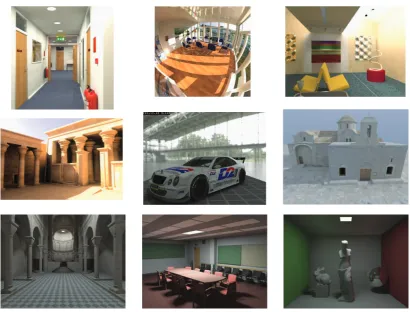
High-fidelity rendering uses physically-based quantities for generating
photo-realistic images and is the focus of this thesis, see for example Figure 1.1. This
involves computation of light transport through a virtual scene by simulating
light interactions between the surfaces present in it, thereby determining the
amount of light reaching the camera. A global illumination lighting model is
used such that light interactions between all the surfaces are taken into account for the image generation process, resulting in effects which occur in real world
1. Introduction 2
Figure 1.1: High-fidelity rendering examples
such as colour bleeding, soft shadows, caustics etc. A mathematical model for the whole process was formulated by Kajiya [Kaj86], known as the rendering
equation. The major challenge lies in solving this equation, due to the associated
computational expense.
1.1.1
Applications
The application of high-fidelity rendering techniques has been restricted due to
their computationally expensive nature. However, the advancements in the
ren-dering techniques and computer hardware, including specialised Graphics
Pro-cessing Units (GPUs), have increased their scope to a great extent as evident
from the following examples [DBB06]:
• Architecture: Architects employ high-fidelity rendering to generate realis-tic images and walk-throughs of building designs [BHWL99, ASKCK03], to
help their clients visualise them under different interior and exterior
1. Introduction 3
conditions and modify the designs according to the client’s preferences
be-fore the construction starts.
• Archaeology: Many archaeological sites around the world have been dam-aged with time and archaeologists reconstruct them to be able to preserve
and study cultural heritage [HMD∗10]. High-fidelity renderings of virtual reconstructions assist them to view sections of the sites which may not
ex-ist any more. Relighting the cultural heritage sites with authentic lighting
conditions helps them recreate the past with a greater accuracy.
• Visual Effects: The modern movie industry relies heavily on computer gen-erated imagery [TL04,PFHA10]. This allows them to add virtual characters
into a scene or enhance the visual appeal of the scene using special effects.
For these additions to be believable, the lighting conditions used for virtual components need to be similar to that of the real scene and high-fidelity
rendering provides this facility.
• Lighting Design: High-fidelity rendering techniques provide a practical tool for lighting engineers [GGHS03]. It helps them to design and study light
sources and characterise their emission properties by placing them in virtual
environments. They can then verify these findings by conducting physical
measurements.
• Computer Games: For the past few years, the computer games industry has been constantly pushing the limits of the current computer graphics
capabilities to offer gamers an immersive environment by generating ever
more realistic images [Mit07]. Computer games these days are increasingly
using high-fidelity techniques for this, however, due to the computationally
expensive nature of these techniques, they have been usually limited to
pre-rendered visuals.
• Product Design: Product designers also benefit from high-fidelity render-ings. This provides them with a useful tool for enhancing their designs of products such as cars, furniture, appliances, consumer electronics by
simu-lating their appearance under various lighting conditions [RMS∗08,KLN09]. Furthermore, such images can also be used for advertising new products
1. Introduction 4
• Training Simulators: An accurate visual stimulus enhances the effectiveness of training simulators as it provides the users with a good representation of
real environments, preparing them for scenarios they are likely to encounter in real life. For example, generating precise visuals for different visibility
levels for use in a flight simulator is very important to train the pilots for
adverse weather conditions [Nie03].
High-fidelity rendering allows these applications to study and visualise
real-world scenarios at a much lower cost in a safe and controlled manner. For
ex-ample, physical construction of a building would require much more money and
time than creating a virtual model. Also, modification of a virtual prototype
is a lot more simple than changing a physical entity. Furthermore, it may not
always be feasible to create a real-world alternative. For example, replacement of virtual characters used in movies and recreation of scenarios used for training
simulators. Hence, high-fidelity rendering is crucial for these applications and
any future advancements made in rendering would be beneficial for them.
1.2
Shared Computing Resources
The advances made by the semiconductor industry following Moore’s Law have
led to a considerable increase in computational power of modern day Central Processing Units (CPUs). This has resulted in a widespread use of computers
to solve a multitude of challenges faced by science, engineering and businesses.
However, the computational demands of such applications have continuously
ex-ceeded the processing power of the current generation computers. Hence, parallel
and distributed computing in various shapes and forms have been employed to
address this issue.
Traditional parallel systems have been either shared memory machines
(su-percomputers) or distributed multi-processors connected by high speed networks
(clusters). The high cost of installing and maintaining such systems has restricted
their user base. There is a growing class of applications which process information from a combination of heterogeneous components and they are usually
unsup-ported by such traditional parallel systems. Researchers have been looking to
overcome these problems of cost and heterogeneity by creating mechanisms for
aggregating shared distributed resources across multiple domains. This is known
1. Introduction 5
Work Subdivision based on Quasi-random
Sampling
Progressive Parallel Rendering using Master-Worker Paradigm
Image Reconstruction
Figure 1.2: A novel fault-tolerant mechanism for high-fidelity rendering which forms the basis of many algorithms presented in this thesis.
grid [FK99]. Grid computing is typically employed to tackle large problems that
can not be solved using resources owned by a single user.
Grid computing inherits the obstacles faced by distributed computing such as
fault-tolerance, synchronisation, communication, heterogeneity, load balancing and scheduling. In addition to these challenges, grid computing needs to tackle
effective sharing and management of distributed resources for a seamless user
experience.
1.3
Rendering on Shared Resources
The computationally expensive nature of high-fidelity rendering has led the
re-searchers to employ parallel computing to alleviate this cost. Many parallel rendering algorithms have been devised exploiting either data parallelism by
de-composing the computations in object space or task parallelism by dede-composing
them in image space [CDR02]. The traditional parallel rendering algorithms
are designed for supercomputers or clusters known as render farms and rely on
quick and frequent communication between the rendering processes. These render
farms are prohibitively expensive, typically costing in excess of £100,000, which
restricts the scope of parallel rendering. Shared computational resources provide
a much cheaper alternative by aggregating idle (already present) resources. But
parallel rendering until now, has not been designed to be fault-tolerant and han-dle run-time variation of resources and hence it is incapable, in any traditional
form, of effectively employing these shared resources.
The conventional fault-tolerance mechanisms for tackling unreliable systems
employ checkpointing or replication or a hybrid of the two approaches. This
results in an extra computational load which limits the performance of algorithms
employing these fault-tolerance strategies. A tradeoff between fault-tolerance and
performance is usually made for computing on shared resources. A novel
1. Introduction 6
Figure 1.3: A sequence of frames rendered interactively, using the novel fault-tolerance mechanism on volatile resources.
employs quasi-random sequences and image reconstruction techniques without
inhibiting performance, see Figure 1.2.
The variable computational power provided by shared resources makes it
difficult to employ them in a deadline-driven environment. The use of
time-constraints to restrict the computational time is an elegant way of employing
these volatile resources in a production environment where strict deadlines need
to be met. A progressive rendering technique along with the novel fault-tolerant
mechanism allows maximisation of the visual quality of the generated imagery within a given time limit.
qual-1. Introduction 7
ity imagery to be used as a regular tool in many visualisation applications for
providing an immediate response to the changes made by the user. This would
allow the users to test various parameters of a scene, which is challenging while rendering in an offline environment due to the time involved in such a process.
Interactive rendering requires high-performance computing due to the rate at
which the imagery is calculated and updated. Shared computing resources have
been traditionally used for high-throughput computing. The novel fault-tolerant
mechanism proposed in this thesis enables them to act as a high-performance
resource, as illustrated by the interactively rendered images shown in Figure 1.3.
The generation of high-fidelity animations is a time consuming process even
on render farms, as all individual frames of an animation need to complete before
they can be viewed. An animation studio usually renders multiple drafts of such
animations before finalisation. Time-constrained rendering of such animations on idle resources of an institution would increase their utilisation, while decreasing
the reliance on render farms. Enabling efficient utilisation of existing resources
would help in reducing operational costs, avoiding the need for expensive render
farms.
1.4
Research Objectives
The conjunction of high-fidelity rendering and shared computational resources has been, until now, mostly unexplored. This thesis aims to develop novel
fault-tolerant rendering algorithms for taking advantage of inexpensive shared
resources, building upon the existing knowledge in both the areas of high-fidelity
rendering and shared computational resources. The main research objectives of
this thesis are:
• to develop high-fidelity rendering algorithms with restricted communication to take advantage of massive computational power offered by computational
grids.
• to devise a fault-tolerance mechanism for high-fidelity rendering which does not restrict performance unlike existing fault-tolerance strategies.
1. Introduction 8
• to create an interactive rendering system capable of handling run-time vari-ations in computational power.
• to develop time-constrained animation rendering algorithms to employ desk-top grids in a production environment.
1.5
Organisation
This thesis is organised as follows:
Chapter 2: High-fidelity Rendering presents an overview of high-fidelity ren-dering and describes the relevant previous work which has been carried out
in this field.
Chapter 3: Computing on Shared Resources covers the background on grid computing and its relevance for high-fidelity rendering.
Chapter 4: Quasi-random Sequences The novel algorithms presented in this thesis rely heavily on quasi-random sequences and this chapter provides a
practical guide on them.
Chapter 5: Animation Rendering on Computational Grids presents and compares two algorithms developed for rendering animations on computa-tional grids and discusses the issues encountered while employing them.
It shows how a two-pass approach can achieve speed-up and better visual
fidelity than existing techniques.
Chapter 6: Time-constrained Offline Rendering on Desktop Grids de-scribes a novel fault tolerant mechanism which uses quasi-random sampling
and image reconstruction techniques. This does not inhibit performance
unlike traditional fault-tolerance strategies. It employs this mechanism for
time-constrained rendering on desktop grids and presents and compares two
algorithms for offline rendering. The advantage of using a component-based approach, by task subdivision at finer granularity, for parallel rendering is
demonstrated.
1. Introduction 9
on desktop grids. A real-time spatio-temporal image reconstruction
mech-anism is presented which helps in achieving better visual fidelity in the case
of sparse sampling. To the best of the author’s knowledge, this is the first interactive desktop grid system that was developed by creating a new job
scheduling architecture.
Chapter 8: Time-constrained Animation Rendering on Desktop Grids
describes and compares two algorithms developed for rendering
anima-tion with a time-constraint. It shows that an approach based on
multi-dimensional quasi-random sampling has a superior performance than
tra-ditional animation rendering techniques as it progressively refines the whole
animation, even in the presence of faults.
CHAPTER 2
High-fidelity Rendering
This chapter presents a background on high-fidelity rendering concepts and
algo-rithms while highlighting relevant previous research which has been carried out
in this field. It begins by introducing radiometric quantities to derive the
render-ing equation. Subsequently, three approaches for solvrender-ing the renderrender-ing equation:
rasterisation, radiosity and ray tracing are discussed. Next, a description of
ren-dering techniques used in this thesis is provided. This is followed by an overview of image reconstruction and sparse sampling. Finally, research work carried out
in the areas of time-constrained rendering and parallel rendering is presented.
2.1
Radiometry
The generation of high-fidelity renderings requires computation of light energy
in a scene. Radiometry is a field which studies the measurement of light energy
and hence it is employed for high-fidelity rendering computations. Photometry is another related area of study which deals with perceived brightness of light to
the human eye. The human visual system is not equally sensitive to all the
wave-lengths in the visible spectrum and photometric quantities take this into
consid-eration. However, radiometric quantities are used for high-fidelity rendering and
corresponding photometric quantities can be successively computed [DBB06]. A
description of some radiometric quantities, which are important from the
per-spective of high-fidelity rendering, are presented below following the notations
from [DBB06].
2. High-fidelity Rendering 11
2.1.1
Radiometric Quantities
2.1.1.1 Radiant Power
This radiometric quantity is useful for estimating the rate of light energy
ema-nating from a light source or reaching a surface. It is also known as flux (Φ) and
is measured in watts, W (joules/sec). Radiant power is independent of the size of source or the surface or the distances between them. A common use of radiant
power is to categorise the light sources, for example a light bulb labelled 100W
transforms approximately 100J of energy every second.
2.1.1.2 Irradiance
Irradiance (E) denotes the radiant power per unit area received on a surface. It is measured in watts/m2.
E = dΦ
dA
2.1.1.3 Radiant Exitance/Radiosity
The amount of radiant power emanating per unit area is termed radiant exitance (M) or radiosity (B). It is also measured in watts/m2. The need for defining
two radiometric quantities to express radiant power per unit area arises since the
incident and exitant light can be potentially different at the same point.
M =B = dΦ
dA
2.1.1.4 Radiance
Radiance is used to measure the amount of light arriving at a point in a given direction. It is the radiant power per unit projected area per unit solid angle
(watts/steradian·m2). The projected area refers to the area of the surface
per-pendicular to the direction. The radiance,L(x→Θ), at a pointxin the direction Θ is given by (see Figure 2.1):
L(x→Θ) = d
2Φ dωdAcosθ
Radiance is the preferred radiometric quantity for generating high-fidelity
2. High-fidelity Rendering 12
dA x
Θ
[image:26.595.235.401.97.197.2]dω
|Θ| = θ
Figure 2.1: Description of quantities for calculating radiance,L(x,Θ), at a point
x in direction Θ, after [DBB06]
appearance of an object [SM09, Jen01]. Furthermore, it is invariant across a line
in space in a vacuum.
The relationships between the radiometric quantities described above can be
defined as:
Φ =
Z
A
Z
Ω
L(x→Θ) cosθdωΘdAx
E(x) =
Z
Ω
L(x←Θ) cosθdωΘ
B(x) =
Z
Ω
L(x→Θ) cosθdωΘ (2.1)
where Ω is the total solid angle and A is the total surface area. L(x → Θ) represents the radiance leaving andL(x←Θ) represents radiance reaching point
x.
2.1.2
Bidirectional Reflectance Distribution Function
The characterisation of surface properties of the materials is needed while
per-forming light transport computations in a scene. When light falls on a surface it
may be absorbed, reflected or transmitted at the same or a different point from the original point of incidence. For example, materials such as marble and human
skin exhibit subsurface scattering phenomenon, that is the light incident on them
gets absorbed and scatters at different points. A Bidirectional Scattering
Sur-face Reflectance Distribution Function (BSSRDF) is defined to model the light
interaction properties of materials. A simpler function, Bidirectional Reflectance
Distribution Function (BRDF), fr, was defined by Nicodemus [Nic65] with the
assumption that light is incident and reflected at the same point, ignoring
sub-surface scattering. BRDF represents the ratio between the radiance reflected in
2. High-fidelity Rendering 13
is given by:
fr(x,Ψ→Θ) = dLr(x→Θ)
dE(x←Ψ) =
dLr(x→Θ)
L(x←Ψ) cos(Nx,Ψ)dωΨ
(2.2)
where, Nx is the normal vector at x.
Many types of BRDFs have been proposed to model different types of mate-rials such as diffuse, glossy and specular. Kurt and Edwards [KE09] present a
survey of these.
2.2
The Rendering Equation
The equilibrium of light energy in a scene can be mathematically formulated, using the radiometric quantities defined in the previous section, to define the
radiance at any point in that scene. This equation is termed as the rendering
equation [Kaj86] and it forms the basis for high-fidelity rendering algorithms. It
states that the outgoing radiance, L(x → Θ) at a point is equal to the sum of the emitted radiance, Le(x → Θ) and the reflected radiance, Lr(x → Θ) based
on the conservation of energy.
L(x→Θ) =Le(x→Θ) +Lr(x→Θ) (2.3)
Integrating Equation(2.2):
Lr(x→Θ) =
Z
Ωx
fr(x,Θ↔Ψ)L(x←Ψ) cos(Nx,Ψ)dωΨ (2.4)
Substituting in Equation(2.3), to obtain the rendering equation:
L(x→Θ) =Le(x→Θ) +
Z
Ωx
fr(x,Θ↔Ψ)L(x←Ψ) cos(Nx,Ψ)dωΨ (2.5)
This can be also transformed into an area formulation such that the radiance can
be computed by integrating over all the surfaces of a scene represented by set A:
L(x→Θ) =Le(x→Θ) +
Z
A
fr(x,Θ↔Ψ)L(y→ −Ψ)V(x, y)G(x, y)dAy (2.6)
where,
G(x, y) = cos(Nx,Ψ) cos(Ny,−Ψ)
r2 xy
2. High-fidelity Rendering 14
and V(x, y) represents the visibility term between two points x and y which is 1 if x and y are mutually visible and 0 if not. The above equations assume that the light travels instantaneously through a vacuum and there is no participating media within the scene. Furthermore, they are valid for a single wavelength only
and do not account for phenomena such as diffraction, polarisation and
inter-ference. Modifications to the rendering equation for incorporating participating
media, for example smoke and dust, can be found in [Jen01].
The rendering equation can be classified as second degree Fredholm integral
equation since the quantity to be calculated, radiance, appears on the left hand
side and on the right hand side as part of an integral and it cannot be solved
analytically. There are two approaches to solve the rendering equation: Finite
element methods and point sampling methods. The radiosity approach (see
Sec-tion 2.4) is a finite element method, while rasterisaSec-tion (see SecSec-tion 2.3) and ray tracing based algorithms (see Section 2.5) are point sampling methods for
estimating the rendering equation for a scene. The algorithms proposed in this
thesis are suited for point sampling methods only.
2.3
Rasterisation
There are two major categories of digital image synthesis techniques: object-order
and image-order [SM09]. Object-order methods iterate through each object in the scene for generating images while image-order methods iterate through each
image pixel and find the objects which influence its colour. Rasterisation
tech-niques are object-order methods which map the scene geometry to image pixels
whereas ray tracing based algorithms are image-order methods. Rasterisation has
been brought to the forefront in comparison to ray tracing methods, due to the
support provided by GPUs which implement these techniques in hardware and
APIs such as OpenGL and DirectX. Although lately, with the increased flexibility
of GPU programming, ray tracing methods [PBD∗10] have also been developed for exploiting the performance boost provided by the GPU.
Rasterisation has been the popular technique for generating interactive visuals
due to its speed. However, as it does not natively handle global illumination
effects, generation of realistic images is difficult. It approximates effects such as
shadows, reflections and refractions which ray tracing techniques can calculate
2. High-fidelity Rendering 15
Display
Application Geometry Rasterisation
Figure 2.2: The graphics pipeline for rasterisation, after [AMHH09]
as it deals with polygons, in contrast to ray tracing which is not bound by such
a requirement.
The graphics pipeline for generating images using rasterisation can be broadly
classified into three stages [AMHH09]: application, geometry and rasterisation
(see Figure 2.2), where each of these stages can be further decomposed. The
application stage is responsible for the generation of primitives which need to be
displayed. The geometry stage performs various operations on these primitives
such as modelling transformations, per-vertex illumination, viewing
transforma-tions, clipping and projection before they can be rasterised. The process of rasterisation can be broken into three main subtasks [FvDFH97]: visible
sur-face determination, scan conversion and shading. First, it identifies the polygons
which are visible from the current camera view, then it determines the pixels
which are covered by the visible polygon and finally it colours the pixels based on
a shading algorithm. A plethora of techniques exist for accelerating rasterisation
while increasing the degree of realism such as texture filtering, bump mapping,
environment mapping, level of detail, shadow volumes etc. and an overview of
these can be found in [AMHH09].
2.4
Radiosity
Radiosity methods provide a view-independent approach for computing light
transport in a scene using finite element methods. Goral et al. [GTGB84]
de-scribed the classical radiosity approach which discretised the scene geometry and
computed radiosity for each patch of the surface geometry by solving a system
of linear equations. All the surfaces in the scene were considered to be diffuse,
hence the radiance and the BRDF were only dependent on the position.
Rewrit-ing Equation(2.6) as:
L(x) = Le(x) +ρ(x)
Z
A
2. High-fidelity Rendering 16
where ρ(x) represents the BRDF. Also, B(x) = πL(x) and Be(x) = πLe(x) for
diffuse environments. Therefore:
B(x) =Be(x) + ρ(x)
π
Z
A
B(y)V(x, y)G(x, y)dAy
This radiosity equation can be solved by a summation over the patches, using
a system of linear equations to compute radiosity, Bi, for each patch of the
discretised geometry as:
Bi =Bei+ρi
X
j
FijBj
whereFij refers to the form factor between two patches which defines the fraction
of power arriving from one patch to the other. The classical radiosity approach
first discretises the geometry, calculates the form factors and then solves the system of linear equations using Jacobi or Gauss-Seidel iterations. The two major
issues with this approach lie in geometry discretisation and form factor calculation
and storage [DBB06]. Research has been carried out to tackle these issues and a
review of other approaches can be found in [DBB06, CW93].
The major advantage of computing light transport using radiosity is that it
is view-independent and once it has been computed it can be used to generate
interactive walk-throughs. Also, form factor calculations can be reused in case of
static scenes with dynamic lighting. However, the major disadvantage of radiosity
is that it is only applicable for scenes with diffuse surfaces. Algorithms have been developed to incorporate non-diffuse surfaces, for example [ICG86, SP89,
SAWG91, AH93], but they usually try to estimate both rendering and radiosity
equations, making them computationally expensive.
2.5
Ray Tracing
Ray tracing is a popular technique for generating high-fidelity images which
com-putes the inter-reflections of light around a scene to simulate the light transport.
It is an image-order rendering approach [SM09], whereby objects in a scene that are needed for shading computations of a pixel are identified for each pixel of the
image to determine its colour value. A light ray is usually traced in a direction
opposite to which the light travels, that is from the viewpoint to the light source
and hence it is also termed a camera or an eye ray. This is done to prevent
2. High-fidelity Rendering 17
Image Plane Viewpoint
Light Source
Shadow Rays
Camera Rays
Reflected Ray
Figure 2.3: Classic ray tracing algorithm
terminate at the viewpoint.
The first ray tracing approach in computer graphics is attributed to Appel
[App68] who shot one ray for each pixel to determine the closest intersecting object in the scene for visible surface detection. This approach is known as ray
casting and is the simplest form of ray tracing, as it does not propagate the light
rays after the first intersection. When light falls on a surface it may be absorbed,
transmitted or reflected depending on the surface properties of the material. The
classic ray tracing approach [Whi80] on the other hand, simulates the interaction
of light with object surfaces by shooting reflected or transmitted rays, recursively
upon intersection with a specular surface. Also, at each diffuse intersection point,
a shadow ray is shot towards the light source to determine if a point is in shadow.
If the shadow ray intersects another object before hitting the light source then the point is considered in the shadow (see Figure 2.3). The classic ray tracing
approach is also termed Whitted-style ray tracing.
A basic ray tracer consists of three components [SM09]: ray generation, ray
intersection and shading. The first component generates the rays at various steps
of the process. The second determines the closest object which intersects with
the generated ray. Finally, the last component calculates the pixel colour using
2. High-fidelity Rendering 18
2.6
Point Sampling Methods
Many algorithms with different sampling strategies have been proposed to
gener-ate high-fidelity images using point sampling methods, for example: distributed
ray tracing [CPC84], path tracing [Kaj86], bi-directional path tracing [LW93],
Metropolis light transport [VG97], photon mapping [Jen96], irradiance caching
[WRC88], instant radiosity [Kel97], instant global illumination [WKB∗02] etc. This section provides an overview of the rendering algorithms which are
impor-tant from the perspective of this thesis. An overview of the other algorithms can
be found in [DBB06].
2.6.1
Distributed Ray Tracing
The classical ray tracing approach generates unnatural images due to the fact
that the algorithm supports only point light sources and ideal specular reflection or transmission. This gives rise to artefacts such as hard shadows and mirror-like
reflections and does not account for realistic phenomena such as soft shadows,
glossy reflections, depth of field, motion blur etc. This limitation in the generation
of ray direction was overcome by Cook et al. [CPC84], who accounted for all these
subtleties in the light interactions by stochastic sampling, which generated
high-fidelity images. Their algorithm is also known as distributed ray tracing.
The distributed ray tracing algorithm employs the Monte Carlo integration
technique to estimate the rendering equation. Monte Carlo methods estimate an
integral by randomly sampling the function repeatedly and then averaging the results. The larger the number of samples used, the more accurate the estimation.
Mathematically, if:
I =
Z
D
f(x)dx
thenI can be estimated by drawing outN random samples ofxfrom the domain
D using Monte Carlo integration as:
hIi= 1
N N
X
i=1 f(xi) p(xi)
Ap-2. High-fidelity Rendering 19
plying Monte Carlo integration principle to estimate the rendering equation; the
reflected radiance,Lr(x→Θ) (from Equation(2.4))can be estimated as [DBB06]:
hLr(x→Θ)i=
1
N N
X
i=1
fr(x,Θ↔Ψi)L(x←Ψi) cos(Nx,Ψi) p(Ψi)
by selectingN random directions, Ψi, with probabilityp(Ψi) over the hemisphere
Ωx. However, the incoming radianceL(x←Ψi) needs to be evaluated. For this,
a ray is traced in direction−Ψi to estimate the incoming radiance, also known as
indirect illumination if the ray does not hit a light source directly. This process
is repeated recursively and results in a ray explosion. To curtail the size of the
tree, termination conditions such as maximum depth or Russian roulette are employed [DBB06]. The shadow rays are generated at each hit point, similar
to the classical ray tracing approach. However, the direction of shadow rays
is chosen by sampling different points on the light surface to estimate what is
termed as the direct illumination. The process of averaging the radiance using
multiple shadow rays accounts for soft shadows.
The variance in the incoming radiance from the different randomly sampled
directions gives rise to noise in the resultant image. This high frequency noise
is minimised by increasing the number of samples which translates into shooting
more rays into the scene at each point. This makes the process computation-ally expensive for generating high-fidelity images using Monte Carlo techniques
and researchers in the field have focussed their efforts at reducing the noise and
accelerating the process.
Objects Lights
(a) Distributed Ray Tracing
Objects Lights
(b) Path Tracing
2. High-fidelity Rendering 20
(a) 10 SPP (b) 100 SPP
[image:34.595.118.520.108.437.2](c) 1,000 SPP (d) 10,000 SPP
Figure 2.5: Path traced image with different number of samples per pixel (SPP)
2.6.2
Path Tracing
Path tracing is one of the simplest high-fidelity rendering algorithms, introduced
by Kajiya [Kaj86]. The distributed ray tracing approach can be considered as an
inorder traversal of the tree of rays generated in a scene, while path tracing
re-peatedly traverses a random path from the root to a leaf node, see Figure 2.4. At
each hit point, rather than sampling N random directions as in distributed path tracing, only one direction is sampled for path tracing which prevents a ray
explo-sion and reduces memory requirements. Each path gives a crude approximation of the incoming radiance but averaging many such paths gives a good estimate
of the radiance value for each pixel. Furthermore, every path is a Markov Chain
through the scene which can be terminated based on criteria similar to those used
for limiting the tree depth in distributed ray tracing. A pixel represents a small
area of the image and by shooting paths through different points in the pixel area
2. High-fidelity Rendering 21
is that it does not employ any optimisations for calculating the light transport
and hence it is computationally expensive for obtaining noise-free images. As an
example, Figure 2.5 shows the convergence of a path traced image with varying samples per pixel. This algorithm is widely used for generating reference images
to compare with other algorithms due to its simplicity and correctness.
2.6.3
Irradiance Caching
Traditionally, in a distributed ray tracing system, a large number of rays are shot
at each ray intersection point to sample incoming radiance from the hemisphere
around that point. Ward et al. [WRC88], observed that the indirect diffuse
component in a scene is a continuous function in space over the surface of an
object and unlike specular or highly glossy components, it is not subject to high
frequency variations. To exploit this nature of the rendering computation, they
proposed an acceleration data structure to store the world space irradiance values
computed in the scene. Whenever a new irradiance sample is needed, the cache is consulted to check if there is another sample already calculated in the cache
within the user-specified error metric. If there exists such a sample in the cache,
the sample to be calculated is interpolated from it, preventing generation of
additional rays which would otherwise be traced. The authors show that this
strategy of reusing computations provides an order of magnitude speed-up over
traditional methods.
The irradiance cache samples are stored in an octree data structure which
accelerates the search process for selecting relevant samples. Irradiance gradients
[WH92] are employed to choose cached samples which provide a good estimate of the irradiance. Each sample is weighed according to the given formula:
wi(P) =
1
||P−Pi||
Ri +
p
1−NP ·NPi
wherewi(P) represents the weight of the cache samplePifor estimating irradiance
at point P. Ri refers to the mean harmonic distance of the visible objects from Pi and NP denotes the surface normal at P. It can be observed that the larger
the distance to the cached sample, the lower the weight assigned to it. Also,
smaller weight is used for samples whose surface orientation differs significantly.
2. High-fidelity Rendering 22
The advantages of using irradiance caching are that it is independent of the
geometry and as opposed to other methods such as photon mapping and radiosity
it is view-driven, conforming to the more traditional ray tracing approach of computing from the point of view of the camera. With a view-driven approach,
a walk-through animation path may visit only certain parts of the model being
rendered and since this is known beforehand, only those values which are required
are computed rather than computing global illumination for the whole model.
Moreover, irradiance caching is an established method used in film production
[TL04, Her04] and there are many other algorithms based on irradiance caching
[TL04, AFO05], adaptations used for dynamic scenes [TMD∗04, SKDM05] and adaptive versions of it [YPG01, KBPv06, Deb06, DCG∗07]. Yet others perform similar approaches to compute rendering features, such as participating media
[JDZJ07], glossy interreflections [KGPB05] and subsurface scattering [KLC06].
2.6.4
Instant Radiosity
Keller [Kel97] proposed a two-pass algorithm for calculating the light transport in
a scene. In the first pass of the algorithm, photons are traced from the light source
similar to photon mapping or bidirectional path tracing. They are deposited on
non-specular surfaces of the scene and act as light sources, termed Virtual Point
Lights (VPLs), in the second pass of the algorithm. A GPU is then employed
to generate images for each VPL with shadows and the resultant images are
averaged to obtain the final image.
Wald et al. [WKB∗02] extended this idea for computing global illumination interactively using parallel machines. In the second pass instead of using raster-isation, ray tracing was employed and the VPLs were sampled with shadow rays
for estimating the indirect illumination. They used interleaved sampling and
fil-tering techniques to reduce the computational costs. The complete set of VPLs
was divided into groups of VPLs and each pixel in a tile used a different group
of VPLs to approximate the lighting. The resultant image was filtered using a
discontinuity buffer to generate the final image. The advantage of using VPLs
for approximating the indirect lighting is that the high frequency noise observed
in path tracing type methods is eliminated, resulting in smoother images in less
2. High-fidelity Rendering 23
2.7
Sparse Sampling and Image Reconstruction
The generation of high-fidelity images using the algorithms described before is a
computationally expensive process and research has focused on reducing this cost.
An important property of such imagery is its spatial and temporal coherence, that
is pixels of an image which are close in space and time are highly correlated. This
characteristic of an image can be exploited to reduce the computation by sparsely
sampling the image and then using image reconstruction techniques to interpolate
the missing pixels. This idea has been widely used for generating high-fidelity
images in reasonable times. Quasi-random sequences (see Chapter 4) have been
typically used for approximating the solution to the rendering equation by sparse sampling, and Shirley et al. [SEB08] provide an overview of such techniques.
However, the primary purpose of employing these sequences in this thesis is to
enable fault-tolerant rendering.
2.7.1
Image Reconstruction Techniques
Image reconstruction refers to the process of estimating missing pixels from a
set of given pixels in order to complete the image. There are many techniques
for reconstructing image pixels and they can be classified into global and local
methods. Global methods utilise all the samples present in an image for
inter-polating the missing pixels.Estimation using local methods is influenced only by
samples near the missing pixel. Global methods can be only applied to smaller
data sets due to the amount of computational complexity. On the other hand, local methods can be used for reconstruction of larger data sets.
One of the widely used local methods is the nearest neighbour algorithm
[Ban09]. In the simplest form, the value of a valid sample, closest to the pixel
being estimated, is copied to reconstruct the image. Other variations interpolate
the value using k-nearest neighbours, that is they find k closest valid pixels and estimate using different interpolation functions. Figure 2.6 shows an example of
k-nearest neighbour algorithm; the black pixels depict valid samples, the grey pixels denote missing samples and the red pixel is the one being reconstructed.
The valid pixels inside the dotted circle are used for reconstructing the pixel value.
A variety of functions have been proposed and used for interpolating from k
2. High-fidelity Rendering 24
Figure 2.6: k-Nearest neighbour algorithm
uses weighted average, such that farther pixels are assigned lower weights based on
the idea that the influence of a sample decreases with distance. The reconstructed
value, s(p) of pixel, p using k valid pixels, pi with values, fi is given by:
s(p) =
k
X
i=1
wi(pi)∗fi
where weight, wi(pi) is defined as:
wi(pi) =
hi(pi)
Pk
i=1hi(pi)
and hi(pi) varies with inverse Euclidean distance, d(pi) betweenpi and p:
hi(pi) =
1 [d(pi)]α
such that α > 1. Other functions, such as Radial Basis Function [MDH07], polynomial spline [Doo76] etc. have also been employed for interpolation of
two-dimensional data sets. They may offer better interpolation, but they are usually
more computationally expensive requiring at least a few seconds to compute
[MDH07].
While reconstructing using k-nearest neighbours, care must be taken not to interpolate across edges as this leads to generation of visual artefacts. Bilateral filtering [TM98] is commonly employed to preserve edges while filtering an image.
2. High-fidelity Rendering 25
it with a spatial filter, which for image reconstruction can bek-nearest neighbour. Recently a class of algorithms has been developed, [CPD07, AGDL09, ABD10]
which accelerate bilateral filtering by using a multi-dimensional representation of the image. Colour values are also represented as distinct dimensions, in addition
to the spatial dimensions. This class of algorithms uses a splat-blur-slice approach
to accelerate bilateral filtering, where the multi-dimensional data is projected to
a low-resolution spatial data structure, then a Gaussian blur is performed and
finally the data is sampled at the original positions.
2.7.2
Sparse Sampling
The generation of interactive visuals has traditionally followed a double-buffering
approach, that is two buffers are used for displaying interactive renderings. The
front buffer contains the image which is displayed on the user screen and the next
image to be displayed is rendered in a back buffer. Once rendering finishes, the
back and the front buffers are swapped. This model restricts the interactivity of the system as the minimum time between frames is the amount it takes to render
a full frame. For high-fidelity rendering, this imposes a severe constraint and
hence the idea of sparse sampling has been successfully employed to overcome
this issue. This was first proposed by Bishop et al. [BFMZ94] in the form of
Frameless Rendering. Their idea was to compute a fraction of the frame using a
highly simplified version of Cook’s distributed ray tracer [CPC84]. They rendered
a randomised set of pixels, between screen updates using the latest parameters
for rendering, to prevent image tearing, and a simultaneous partial update of the
full image. In the transient state, this appeared as motion blur and when a stable state was achieved, the image was eventually fully rendered.
The idea of Frameless Rendering was further improved by the Render Cache
algorithm [WDP99]. It stores every sample generated from the ray tracing engine
into a data structure containing information about the hit point, colour and its
age. These samples are reprojected onto the current view and depth information
is used for occlusion. Any holes in the resulting image are filled by using linear
interpolation and filtering. Also, new samples are recalculated after they age
be-yond a particular threshold. Heuristics are employed to prematurely age samples
which are in the areas most likely to change, hence offering a progressive refine-ment of the view. The rendering process is decoupled from the viewing process
2. High-fidelity Rendering 26
with quick changes and the transient images show visible artefacts. Walter et
al. proposed an improved version of the Render Cache algorithm [WDG02] by
adding an additional filtering pass and lowering the visual artefacts by employ-ing predictive samplemploy-ing. Furthermore, they optimised the algorithm for coherent
memory access to gain speedup. Other similar techniques have been presented
by Ward and Simmons [WS99], and Simmons and S´equin [SS00].
The Render Cache methods used image-based techniques for interpolating
from sparse samples. Tole et al. [TPWG02] improved on this idea by performing
reconstruction in the object space using a Shading Cache. Their data structure
stored the samples on the scene geometry and used GPU for interpolating
miss-ing samples. This helped in limitmiss-ing the visual artefacts, however it took time
to update global illumination effects in dynamic scenes with moving lights and
objects. Bala et al. [BWG03] extended the Shading Cache by preserving dis-continuities during the image reconstruction process. They determined object
silhouettes and shadow edges in real-time and prevented reconstruction across
these boundaries for a better visual fidelity. These algorithms have been
im-plemented and enhanced using the advanced flexibility provided by modern day
GPUs and presented in [VALBW06, SaLY∗08].
Dayal et al. [DWWL05] presented ideas to optimise the process of generation
of new samples and the reuse of older samples in the form of Adaptive Frameless
Rendering. They used a guidance mechanism to adaptively generate new
sam-ples based on spatio-temporal colour variations. Furthermore, they employed filtering in temporal domain based on temporal gradients and implemented the
reconstruction process on GPU. All the methods described above provide a
sub-stantial gain while presenting visual feedback to a user, however they suffer from
distracting artefacts such as image tearing, missing pixels etc.
Adaptive or progressive rendering techniques, for example [BFGS86, Mit87,
PS89, LWC∗02], are also similar to sparse sampling methods. These compute a coarse approximation of the rendered image and then refine it over time. While
using such algorithms in a double-buffering approach, it is very important to
decide when to switch between the buffers. Woolley et al. [WLW02] presented a scheme for making this decision, which they termed interruptible rendering. The
idea was to continue the rendering process until the temporal error exceeds the
spatial error. The temporal error refers to the error which is the result of time it
takes for the computation of an update from when the user triggered it and the
2. High-fidelity Rendering 27
2.8
Time-constrained Rendering
Rendering systems have often been subjected to time-constraints due to the
var-ious possibilities of continually adapting and refining the computation. The use
of time-constraints thus allows algorithms to be designed such that they aim
to achieve the best possible quality within a given time period. These become
extremely useful in the case of interactive rendering, where screen updates are
generally required at a fixed rate to maintain smooth interactivity.
Funkhouser and S´equin [FS93] devised a mechanism for rendering models
interactively using rasterisation at a fixed frame rate. The models in the scene
were pre-processed at discrete level of detail and their greedy algorithm predicted which version to render in order to maintain the time-constraint. This was done
to maximise the benefit obtained by rendering at a particular level of detail,
such that the cost associated with rendering at that refinement was less than
the constraint. Maciel and Shirley [MS95], and Mason and Blake [MB97] further
extended this idea by creating a single hierarchy of all the objects rather than
treating each object individually and used variations of multiple choice
knap-sack problem for selecting the appropriate representation. Gobbetti and
Bou-vier [GB99] enhanced this approach by using continuous level of detail models.
Zach et al. [ZMK02] presented an algorithm which incorporated both continuous
and discrete level of detail for rendering of terrains at a guaranteed frame rate using polygonal and point-based rendering. An importance metric was presented
by Gao et al. [GLH∗08] for distributed visualisation of large data sets to deter-mine the rendering order and the level of detail for a block of data set based on
view-dependent, application-dependent and data-dependent criteria.
Reisman et al. [RGS00] used time-constraints for interactive parallel ray
trac-ing. They used a progressive sampling strategy based on Delaunay triangulation
while treating the image plane as a continuous space. They refined their solution
until a given deadline and then reconstructed the image from calculated samples
using piecewise linear interpolation. Debattista et al. [DSSC05] provided a frame-work for controlling the pixel quality in a time-constrained setting for generation
of high-fidelity images without perceivable difference. They proposed a regular
expression to specify the pixel computations based on different components.
De-battista [Deb06] further enhanced the approach by using time-constraints with a
2. High-fidelity Rendering 28
2.9
Parallel Rendering
The large computational complexity exhibited by high-fidelity rendering has
en-couraged researchers to tackle the rendering problem with parallel computing.
An early survey of parallel rendering techniques and related issues is provided
by Crockett [Cro97]. A detailed survey of these methods especially in context of
global illumination and ray tracing is presented by Chalmers et al. [CDR02]. Ray
tracing algorithms are relatively easy to parallelise if the entire scene description
can be duplicated on each processor, as each processor can be designated to
in-dependently work on a part of the image-space. However, load balancing can be
challenging.
Parallel rendering tasks can be constructed by subdividing either in
image-space or object-image-space. The former is suitable if the scene data can be replicated on
each processor and the latter is generally used when the scene data is larger than
the memory size of an individual processor. A uniform load balancing is easier
to achieve with image-space subdivision (for example [Woo84, PB85, LS91]) but
it leads to poor memory usage. In contrast, a scene can be distributed evenly
using object-space subdivision (for example [DS84, PB89, Pit93]) but it results
in complex load balancing strategies. Many algorithms have been proposed in
both categories taking advantage of hardware and application environments. A
hybrid task subdivision strategy was developed independently by Salmon and Goldsmith [SG88], and Scherson and Caspary [SC88], where object data is
hi-erarchically subdivided. The upper portion of this hierarchy is replicated on all
processors while the lower part with most of the scene data is distributed allowing
dissociation of image-space and object-space.
Load balancing can be static or dynamic based on the scheduling policy
adopted by the algorithm. Heirich and Arvo [HA98] provided a good comparison
of various load balancing techniques and showed that any static task subdivision
strategy is affected by load imbalances. In their experiments, they observed that
a hybrid method reduced the load imbalance cost such that it was smaller than other costs of parallelisation. Badouel and Priol [BP89] described a dynamic
demand-driven load balancing based on the master-worker paradigm whereby
each worker is assigned a 3×3 tile of pixels when it becomes idle. But this ap-proach suffered from poor scalability and therefore, Green and Paddon [GP90]
used a hierarchical approach to overcome this. They connected the distributed
2. High-fidelity Rendering 29
the tree and all the other workers would communicate with their parents only,
limiting the number of requests being sent across the network. This resulted
in better scalability. Reisman et al. [RGS00] devised a dynamic load balancing strategy for progressive ray tracing on distributed clusters exploiting temporal
coherence for obtaining interactive rates. The image was subdivided into regions
which were assigned to separate processors and during run-time the regions were
dynamically adjusted to rectify load imbalances.
One of the first parallel architectures designed for interactive ray tracing
us-ing a 96-processor supercomputer was proposed by Muuss [Muu95]. He needed
interactive rendering for radar systems which had been modelled using large
number of Constructive Solid Geometry (CSG) primitives. These could not be
rasterised as the tessellation of the primitives would have resulted in several
mil-lion polygons. Using traditional ray tracing the author was able to render the CSG primitives directly, preventing the memory and time costs of tessellation.
Keates and Hubbold [KH95] presented an interactive ray tracing system based
on a virtual shared-memory machine which took advantage of cache coherence
by using regular gridcells. Dynamic load balancing was achieved with thread
synchronisation mechanisms to achieve interactivity on 64 processors.
Another such rendering system was proposed by Parker et al. [PMS∗99] using an optimised static load balancing approach. This supported image-based
ren-dering with realistic shadows which also ran on a shared-memory supercomputer.
Interactivity was achieved by designing the jobs to match the caching granular-ity and exploiting fast synchronisation available on the target hardware. They
were also able to perform volume rendering [PPL∗99] and iso-surface visualisa-tion [PSL∗98] using their system which supported frameless rendering in addition to synchronous operation.
Wald et al. [WSBW01] enhanced the methods presented in [PMS∗99] by using object dataflow strategy to run on a distributed cluster. Using a highly optimised
SIMD code they were able to achieve interactivity. Wald et al. [WKB∗02,BWS03] further enhanced this by adding global illumination and handling a few dynamic
scene changes by modifying instant radiosity (see Section 2.6.4).
Purcell et al. [PBMH02] exploited the programmability of the modern GPU
and used it as an efficient and massively parallel stream processor for ray tracing,
demonstrating similar performance to the optimised CPU version of Wald et

![Figure 2.1: Description of quantities for calculating radiance, L(x, Θ), at a pointx in direction Θ, after [DBB06]](https://thumb-us.123doks.com/thumbv2/123dok_us/9705881.471761/26.595.235.401.97.197/figure-description-quantities-calculating-radiance-pointx-direction-after.webp)