
Development of a Framework for the
design for maintenance solutions based
on a biomimicry methodology
3 Development of a Framework for the design for maintenance solutions based on a biomimicry methodology
Master thesis
17 January 2018 University of Twente
Faculty of Engineering Technology
Department of Design, Product and Management Chair of Maintenance Engineering
In collaboration with Arcadis Supervisor:
Dr. Ir. Alberto Martinetti Ir. Bianca Nijhof Committee:
Prof. Dr. Ir. Leo van Dongen Dr. Ir. Alberto Martinetti Dr. Thomas van Rompay Ir. Verali von Meijenfeldt Author:
Martijn Bergsma
Student number: s1217844 [email protected] Keywords:
Biomimicry Design Maintenance
Design for Maintenance Methodology
Maintenance is all around us. In small things, as: doing the dishes or servicing a car, but also in larger assets: think of trains, machinery at a production plant, buildings or infrastructure. The maintenance of these large or complicated structures can be very costly over their whole lifecycle. To make assets more cost effective we can
design them to be more resilient, effective, efficient and
sustainable. Nature has been found to be very effective,
efficient and resilient. Organisms have evolved and have adjusted to their environments for 3.8 billion years, finding
solutions to survive. As humans, we can learn from that
library full of knowledge by looking at nature and finding
out how it is done. Getting inspiration from nature and applying the solutions in technology is called biomimicry. In this research design for maintenance is combined with biomimicry in a framework, to include biomimicry based
design in the field of maintenance.
This thesis provides a literature review of existing design processes, maintenance / system engineering methodology and especially the biomimicry methodology. Interviews with employees from Arcadis provide insight in the work processes in practice and how design for maintenance is handled.
Based on the literature review and interviews a framework is created that guides the design process to improve design for maintenance and to incorporate nature-inspired solutions. The framework is based on general system engineering and
design processes and it is filled with categorized tools which
come from maintenance engineering and the biomimicry methodology. This combination could provide more resilient,
efficient, effective and sustainable designs. Resulting in benefits as less maintenance, longer asset lifetime and less
lifecycle costs.
After the creation of the framework, it is tested by
application in a workshop at Arcadis. During the workshop, an existing case on renovation opportunities for a block
of flats is re-executed to find nature-inspired solutions for
5
Onderhoud is overal om ons heen. In kleine taken zoals:
afwassen of onderhoud aan een auto, maar ook in grotere systemen: denk aan treinen, machines in een fabriek,
gebouwen of infrastructuur. Het onderhoud van deze
grotere of gecompliceerde systemen kan heel kostbaar
zijn over de gehele levensduur. Om systemen kosten
effectiever te maken kan een ontwerp gemaakt worden
dat robuuster, effectiever, efficiënter en duurzamer is. De natuur heeft deze kwaliteiten. Organismen zijn over 3.8 miljard jaar geëvolueerd en hebben zich aangepast aan
hun leefomgeving en hebben oplossingen gevonden om te
overleven. Als mens kunnen wij leren van die verzameling
aan kennis door de natuur te ontdekken en uit te vinden hoe de natuur het doet. Inspiratie halen uit de natuur en het toepassen in de techniek is een gebied dat biomimicry heet.
In dit onderzoek is ontwerp voor onderhoud gecombineerd
met biomimicry in een framework. Hiermee wordt ontwerp met behulp van biomimicry toegepast in het gebied van onderhoud.
Deze thesis presenteert een literatuuronderzoek
over bestaande ontwerpprocessen, een onderhoud/
system engineering methodologieën en de biomimicry
methodologie. Interviews met werknemers van Arcadis
geven inzicht in de praktijk van ontwerpen voor onderhoud
en de werkprocessen die daarbij komen kijken.
Gebaseerd op het literatuuronderzoek en de interviews
wordt een framework ontworpen dat het ontwerpproces begeleid. Daarmee wordt het ontwerpen voor onderhoud verbeterd en oplossingen geïnspireerd door de natuur worden meegenomen in het ontwerpproces. Het framework is gebaseerd op algemene system engineering en
ontwerpprocessen en is gevuld met gecategoriseerde tools.
Deze tools zijn verzameld uit het gebied van onderhoud en de biomimicry methodologie. Deze combinatie zou
robuustere, efficiëntere, effectievere en duurzamere ontwerpen kunnen opleveren. Resulterende voordelen zijn
dan: minder onderhoud, langere levensduur en minder kosten over de gehele levensduur.
Na het ontwerp van het framework wordt het getest in een workshop bij Arcadis. Tijdens de workshop is een bestaande
casus over de renovatiemogelijkheden van flats opnieuw
uitgevoerd. Met als doel om op de natuur geïnspireerde oplossingen voor isolatie- en ventilatieproblemen te bedenken. De resultaten en terugkoppeling van de casus worden gebruikt voor het verder ontwikkelen van het framework.
Abstract 4
Samenvatting 5
Table of contents
6
Nomenclature and Definitions
8
Chapter 1: Introduction
11
Motivation 11
Problem/opportunity statement
11
Aim of the research
11
Scope of research
12
Requirements 12
Significance of the research
13
Research questions
13
Company introduction: Arcadis
13
Chapter 2: State of the art
14
Design models
14
Design for Maintenance
15
Design for Maintenance 17
Design phases of equipment design 17
Biomimicry 20
Definitions 20
Biomimicry line of thought 20
Chapter 3: Current design practice
24
Interviews with Arcadis
24
Implementing new methodologies 24
Application of (design for) maintenance 24
Tools for the framework 25
Innovation in a company 25
Development of biomimicry in a company 27
Chapter 4: Framework
28
The project phases
29
The tools
31
Visual aid
34
Chapter 5: Case
38
The comparison
38
The case
38
The workshop
39
Execution of the workshop
39
Results of the workshop
40
Further development of solutions
42
Ventilation 42 Insulation 42 Comparison of new measures with measures from the regular process 42
Feedback on the workshop and framework
44
Conclusions of the workshop
45
Discussion 46
Conclusions 47
Recommendations 48
7
Recommendations for Arcadis
49
References 50
List of Figures
54
List of Tables
55
Appendix A
56
Appendix B
60
Appendix C
62
Interview 1
62
Interview 2
64
Interview 3
67
Interview 4
71
Interview 5
73
Appendix D
76
Appendix E
78
• BID - Bio-inspired Design
• Bio-assisted - “involves domesticating an organism to accomplish a function” [1]
• Bio-utilization - “entails harvesting a product or producer from nature” [1]
• Bioinspiration - ‘Creative approach based on the observation of biological systems’.[2,3]
• Biomimetics- - ‘Interdisciplinary cooperation of biology and technology or other fields of innovation with
the goal of solving practical problems through the function analysis of biological systems, their abstraction into models and the transfer into and application of these models to the solution’.[2,3]
• Biomimicry - ‘Philosophy and interdisciplinary design approaches taking nature as a model to meet the challenges of sustainable development (social, environmental, and economic)’.[2,3]
• Bionics - ‘Technical discipline that seeks to replicate, increase, or replace biological functions by their electronic and/or mechanical equivalents’.” [2]
• Design for Maintenance - “Design for maintainability is concerned with achieving good designs that consider the general care and maintenance of equipment and the repair actions that follow a failure.” [4]
• Maintenance - “combination of all technical, administrative and managerial actions during the life cycle of an item intended to retain it in, or restore it to, a state in which it can perform the required function” [5]
• Methodology - In product design: ‘‘a collection of procedures, tools and techniques for designers to use when designing.’’[6]
• Technique - A specific way of performing or using a tool.
• Technique and technique - ‘‘In product design, the combination of tools and techniques is a means to apply and exploit the skill and craftsmanship [] in order to examine a solution path (or alternative)
while pursuing a specified aim in the context of a chosen or enforced design method or
approach.’’ [6]
• Tool - “instruments or certain tangible aids in performing a task”[6]
• TS - Technical System
This thesis starts with an explanation of the motivation, the research challenge and the research questions. The introduction lays the foundation of a useful project and structured approach towards the research problem.
Motivation
This graduation project is started in the end of February 2017 in consultation with Alberto Martinetti. The initial combination of topics of biomimicry and design for maintenance is brought together by Alberto in the assignment description. This is developed into a more
specific research approach where both interests were satisfied. My attention was attracted by the combination of different fields and the possibilities to add value with
design. Biomimicry and design for maintenance are relatively new and interesting subjects for me, giving
opportunities to learn about different fields. I am interested
in design processes and combining two completely different
fields in a design methodology is a challenge that I was
curious for. In addition, the research could support the
improving field of design for maintenance and a sustainable
practice of biomimicry.
Problem/opportunity statement
Design for maintenance is a developing practice. Companies are more and more interested in reducing maintenance and
the related costs. Maintenance can be planned efficiently,
however, reducing or avoiding maintenance at all is more effective. Therefore, it is interesting to look at the design phase of the assets to improve maintenance performance.
What is recognized in systems is that they are often not efficient and inflexible when it comes to changes. They
cannot adapt to changes in their environment - adapting to
future needs. Including sustainable, environmentally friendly and circular economy requirements.
To improve the designs of systems it is necessary to design in a way that supports all these requirements. Since nature
is very efficient, sustainable and can adapt to changing
conditions it[7] is interesting to use a nature-based design approach. Biomimicry is such an approach. Creating ideas and solutions through a methodology that involves nature in the design process as inspirational input. Therefore, biomimicry is an interesting approach that can improve the created designs.
Approaching together - design for maintenance and biomimicry can offer an opportunity to radically improve
design and solutions creating resilient, agile and efficient solutions to improve the field of maintenance by the design
of new systems.
Aim of the research
The aim of the project is crystal and clear: codifying and creating a tool/methodology to help engineers and designers in creating bio-inspired winning solutions in the
field of maintenance operations and maintainable and
sustainable products. By codifying and creating is meant that a new system is made where things can be arranged in. [8] [9]. In the study case, this will help to re-think a particular activity or a system of ways of doing. [10] [11]. Thus, a new system to arrange how engineers and designers create solutions should be made. Additionally, it should be a structured tool/methodology that could help to consider the usefulness of biomimicry solutions early in the process of a design task without demanding extensive resources. This sets a requirement that the process should give as an option for choosing biomimicry, based on a checkpoint that
evaluates the feasibility of the bio-inspired solution. A discussion set the direction to apply the full biomimicry idea where not just copying nature is applied, but also
other tools and the idea that the solutions should be ‘fitting
in on earth’. This is explained in the biomimicry chapter. Expectations are that implementing biomimicry in full will provide more sustainable maintenance solutions when using the methodology.
The usefulness of applying psychological principles in
design for maintenance is recognized. E.g. improvement
of maintenance work itself by employees and the ‘maintenance’ of employees during work or recovery (breaks). Setting the goal of consideration of psychological principles in the design process for maintenance.
In a nutshell: the aim is to create a methodology that structures the design for maintenance process. This methodology should include the principles of biomimicry. A toolbox of or multiple methods will be created to guide the practical process of a design task. However, a check must be in place to use biomimicry only if it is advantageous.
The psychological principles influencing maintenance will be
11
Scope of research
As stated in the section Biomimicry - Definitions; biomimicry
is not biomimetics, albeit they lie close together in meaning. Biomimicry adds a philosophy to the interdisciplinary design approaches. The basis of biomimicry and biomimetics is a design process of transferring biological solutions to technology. The process in short is: abstracting the problem for research in biology world, abstracting the found solution from biology and implement it as a technological solution. Biomimicry includes the encouragement to explore nature and the idea to develop sustainable solutions. Therefore, biomimicry is chosen over biomimetics. However, the main input for this research will be the design process to generate nature-inspired solutions.
Since the application of biomimicry is a new approach
within the field of maintenance engineering and operations a well fitted process does still not exist. Therefore, this
research follows a top down process, starting with a methodology that structures the general design process of maintenance engineering, followed by the categorisation of
tools and finally by a guidance in using them. This approach
allows matching biomimicry on the same strategic level. To achieve practical applicability for companies, practice will be considered in the research. The creation of products and technologies itself is not considered, but the design process is structured to provide guidance to designers and engineers.
Requirements
To have a starting point for initial reflections, a small list
of requirements is set up. This list also provides a sort of “menu” of the project. It does exist besides the research questions.
Requirements for the methodology:
• Structuring the design process of maintenance, including biomimicry.
• Focussed on use within companies: must apply to
a large variety of companies and must fit in the work
process.
• Robust: must be flexible to variation on a tool level. • The methodology must be a framework for lower level activities.
• Must be understandable and usable with poor
knowledge on the field maintenance, nor biomimicry.
• Visual representation and ‘how to use’ appendix are required.
• Forms basis for translation to other fields of science.
• Gives a direction for sustainable innovation.
• Supports integration of other fields (such as psychology). • Guiding the design process by helping with a tool selection and with a design process route.
• Giving enough freedom on the tools to use and being open to various ways of designing. Every company can
choose the tools to use throughout the design process.
• Supports the use of biomimicry/bio-inspired tools and sustainable innovation.
• The framework improves design thinking for new
innovative solutions in the maintenance field, by input of
biomimicry knowledge.
Significance of the research
As mentioned, this research is focussed on the creation of a design methodology for the design process of maintenance solutions. The addition of the biomimicry approach in the design process for maintenance is new and should offer a
way to design more robust, agile, efficient and sustainable
solutions. Moreover, these solutions create, in the end, the possibility of cost reductions, less maintenance, more
effective and efficient systems and solutions that could be
much more sustainable in their lifecycle on earth.
The framework is thus a first starting point for combining the field of maintenance with nature-inspired methods. Maybe a further step to develop more tools that find itself on the edge between different fields of research and
another opportunity to bridge biomimicry to practice.
Research questions
Based on the previous sections, four main research questions (with consequent sub questions) are formulated. These questions will be answered through this research and
in the conclusions the answers will be summarized. The
questions are the following:
• Does a design for maintenance methodology or model exist?
• If not, a new design methodology for maintenance will be created, what elements does such
methodology exist of?
• If it does exist, can the methodology be used in combination with biomimicry?
• What would the unified problem-driven process of
biomimicry for maintenance be?
• What a biomimicry methodology is?
• How does a new methodology looks like, combining design for maintenance and biomimicry?
• What tools would support the combined biomimicry – design for maintenance process and in which stages are these applicable?
• Which tools does the field biomimicry have? • Which tools does the field design for maintenance
have?
• How are these tools combined in a methodology?
• How can the methodology be used in practice?
Company introduction: Arcadis
Arcadis is a multinational company, with 27.000 people active in over 70 countries. Arcadis provides services in design and consultancy for natural and built assets, which includes activities as: Business Advisory, Program Management, Cost management, Engineering and Master Planning and Sustainable Urban Development. Arcadis is active in many sectors, for example: Cities, Financial Institutions, Industrials, Natural Resources, Public Sector, Retail, and Water and Utilities. Arcadis develops complex solutions for assets by combining technical, consulting and management skills.
For this research, contact is made with Arcadis to get
insight in practice. The first step is to find out what the
current practice is around maintenance and design for
maintenance. The findings will be used in the research to
improve the methodology. With the assistance of Bianca Nijhof this resulted in several interviews with employees of Arcadis. After the creation of the methodology, a workshop
is organized to get feedback for improvement. Verali von
Meijenfeldt assisted in the project and supported the
organization of the workshop. The workshop also showed
To create a design methodology for use in a design for
maintenance process, it is necessary to find the border
of current research progresses. The aimed for design methodology would have several subjects that are reviewed in this chapter. Design processes are described to create a basis for the design methodology. This will consist of a review of system engineering processes and (product) design processes. The following subject is the biomimicry methodology. This methodology is aimed for bringing the innovative ideas and solutions to the design. At last, maintenance processes are reviewed. Maintenance is the
field that is aimed for to improve using biomimicry in a
design process for maintenance.
Design models
Design models guide the activities to create new artefacts or ideas. Because of the changing nature of design, it is not possible to capture a design process that will be useful in every occasion. During projects, between
projects and as well between field of operation can design
activities change. [6] This change is often created by the process itself, creating a requirement for iteration. Otherwise the change can be induced by the context of the design process. Example given: change in organisation/ management, change in project team, change stakeholders, resulting in a change of requirements and solution scope. Therefore, design models can only be a tool of guidance. They help structuring an extensive process to achieve the goals of creating something. By this structure they can help to control quality and induce new ways of thinking and
development. Tools and techniques fill the project phases
with guided activities for one smaller step in the process. A
couple together can fulfil the requirement imposed by the
project phase. The selection of tools and techniques to be used during a project therefore highly depends on the goal to achieve. Not only in the project phase, but as well during the entire project itself. Thus, project phases create an outline which guide a design process within a
scope that is specific for the subject, the
chosen process and stakeholders. Within these phases of the selected design model there must be freedom to operate, to allow
multiple projects and flexible projects to
be developed. The selection of tools and techniques to be used for a project, must be based on the requirements and goals of that project. In this way give tools and techniques the opportunity to work on different projects within a framework that is the same every time.
One of the most known systematic design processes is developed by Pahl
and Beitz. [12] They developed a
linear design process with the following
phases: Planning and Task clarification: specification of information, Conceptual design: specification of principle
solution (concept), Embodiment design:
specification of layout (construction), and Detail design: specification of production. These phases can be found in the model; Figure 1. The model of Pahl and Beitz is a sufficient base to start development of the
[image:14.842.487.786.63.531.2]15 The advantages are the following:
• Linear
• Common, often taught
• General
• Concrete
Linearity of a model simplifies the process, which is ideal
for presenting a model to non-designers. This also explains
the commonality; this model is used on many universities to
teach design engineering. Furthermore, generality creates applicability to a wide range of products. The prescriptive nature of this model[13] makes it very concrete and clear for users. However, a prescriptive methodology does not
allow much flexibility. Therefore, this also appears in the
list of disadvantages. Another disadvantage is the lack of
efficiency principles during the design, such as concurrent
engineering. For many companies, this is a crucial for their time to market. The disadvantages are the following:
• Prescriptive
• Lacking efficiency principles
However, each design process described in literature may focus on different aspects and therefore look and feel different. For example, the importance of feedback, communication, deadlines and decision moments, iteration
or field specific steps to take. However, they all describe
a process of creating an artefact, physical or virtual. The following phases represent the basis of the new framework: Analysis, Concept generation, Detail design and construction/implementation. Feedback, iteration processes, ease of use, clarity and descriptions of input and results will be considered for the development of the framework.
Design for Maintenance
In this research for a design approach the term maintenance is best applicable to capital goods as machinery, rolling stock or buildings, amongst others. The design approach is all-embracing and focussed on everything that has an industrial or technological materialisation.
Maintenance is defined as: “the process of making sure that something continues in the same way or at the same level”
[5] [14]. Thus, the technological ‘things’ should be working at a certain level and when this level is not achieved, it should be adjusted (repaired) to be able to continue to work at this level.
Maintenance activities can be grouped in three levels, also
shown in figure …:
• Maintenance Action - Basic maintenance intervention, elementary task carried out by a technician (What to do?)
• Maintenance Policy - Rule or set of rules describing the triggering mechanism for the different maintenance actions (How is it triggered?)
• Maintenance Concept - Set of maintenance policies and actions of various types and the general decision structure in which these are planned and supported. (The logic and maintenance recipe used?) [15]
Maintenance actions can be divided over the categories Corrective Maintenance and Precautionary maintenance. Corrective maintenance actions repair or restore functions after a breakdown or loss of function has happened. It is reactive of nature. An important factor is the unpredictability of these failures. Precautionary maintenance is focussed on anticipating on or avoiding failures or its consequences. These actions can be: preventive, predictive, proactive or
passive in nature. These actions often require failure rate and moment predictions. [15]
Maintenance policies can also be categorised under corrective maintenance and precautionary maintenance, as they drive the maintenance activities. Policies are chosen on their economic impact. They determine expenses by triggering an amount of maintenance activities.
The following maintenance policies are most generic: Failure-Based Maintenance (FBM), Time/Used-Based Maintenance (TBM/UBM), Condition-Based Maintenance (CBM), Opportunity-Based Maintenance (OBM) Design-Out Maintenance (DOM), and e-maintenance. [15]
To optimise the combination of activities and policies for a certain system companies create maintenance concepts.
[image:15.842.557.817.133.345.2]Maintenance concepts are holistic views on the system and include the context of the system. Resulting in maintenance approaches that include strategies and even mindsets.
Examples and maybe the most influential concepts are:
Reliability Centred Maintenance (RCM)[16], Total Productive Maintenance (TPM) or Life Cycle Costing (LCC) approaches. [17] [15].
These activities, policies and concepts play a role in a maintenance plan. The maintenance plan describes the approach of a company towards maintenance. These plans can be developed according to the model presented in Figure 3 [18]
Performance measures are a must to control a system and develop a maintenance plan. Apart from that do performance measures give input to design for new developments. For evaluation of performance of assets, the concept of RAMSSHEEP is used. RAMSSHEEP has
clear definitions of the most important maintenance characteristics and how these can be measured. The first four are already recognized by most companies, these are:
Reliability, Availability, Maintainability and Supportability.
However, secondary context influences: Safety, Health,
Environment, Economics and Politics, give the possibility to design, plan, realise, use and dispose and asset with
increasing efficiency, reducing costs and environmental
impacts. [19] See Table 1.
Element
Definition
Contextualization
Reliability “The probability that an asset can perform a required function under given conditions for a given time interval”
The reliability of a train is for example 90 %. This means that there is a certainty of 90 % that the train could travel.
Availability “The ability of an asset to be in a state to perform a required function under given conditions at a given instant of time assuming that the required external resources are provided”
The availability of a train is for example 85%. This means that the train should be operational circa 310 days/year.
Maintainability “The probability that following the occurrence of a failure of an asset will once again be operational within a
specific time”.
The maintainability of a train is for example 90 %. This means that there is a certainty of 90 % that the train will be put in service on time after a maintenance action.
(To note that, in addition to the stochastic definition, the
Maintainability could also represent the level of easiness to maintain an asset/product/component. In other words, how quickly maintenance activities can be performed reaching the required level of quality.)
Supportability “The characteristic of an asset to
influence the easiness with which logistic
resources can be available at the right time at the right place”.
The supportability of an asset can heavily affect the logistic
organization causing delays (waiting for spare parts, technicians,
equipment available) during the maintenance operations and
influencing the Mean Time To Maintain (MTTM).
Safety “A state in which or a place where you
are safe and not in danger or at risk”;
“Freedom from unacceptable risks of harm”.
The Safety has to be included to ensure a safe asset for the final
users and safe working places for the personnel involved in the production and in the maintenance operations. To note, how the absence of safety could change the cost-effectiveness of an asset. Health “Health is a state of complete physical,
mental and social well-being and not merely the absence of disease or
infirmity”.
Health has to be included to ensure that an asset does not cause
diseases for the final users and for the personnel involved in the
production and in the maintenance operations.
Environment “The environment represents the earth, including rocks, soils, water, air, atmosphere and living things”.
The asset should reduce as much as possible, for example by using the Best Available Techniques (BAT) the impact on the Environment during the entire life-cycle. Here lies the difference between environmental compatibility and environmental sustainability.
Economics “The economic perspective is concerned
with the financial aspects of the asset
and its operation.”
The economic factors often drive the main direction and the investment from the design phase to the decommission phase of a product/asset.
Politics “The first definition of politics was used
in the Aristotle’s book Πολιτικά, Politika, The politic decisions should affect the main direction of a capital assets investment pinpointing and underlining the needs of the
[image:16.842.294.807.48.557.2] [image:16.842.33.287.53.199.2]17
Design for Maintenance
The following definition shows what design for maintenance
is about:
“Design for maintainability is concerned with achieving good designs that consider the general care and maintenance of equipment and the repair actions that follow a failure.” [4]
Design for maintenance is already applied in various forms. Designers of assets think about accessibility, modularity and the many other possibilities presented in guidelines [20] or by personal experience. A special kind of design for maintenance is: Design-out maintenance, where a part of maintenance is made obsolete by designing an asset to not require maintenance or less maintenance.
Thompson wrote the book: Improving Maintainability and Reliability through Design. Design for reliability considers just a different subject that is not discussed in this
research. Defined as:
“Design for reliability is concerned with achieving good
designs that will perform a specified duty without
failure.” [4]
The book is one of the few resources that specifically
connects design processes and skills with maintenance. Thompson describes the main design process, how it is learned by design scholars, refer to section Design Process. The main phases of design for maintenance or systems are discussed, which will be discussed in the following section. The main part of the book considers various tools and how to apply them regarding maintenance, these are collected and listed in appendix A, for use in the developed
framework. The book finalizes with creative skills and tools
for the design practice, which is kept out of scope of this research.
Design phases of equipment design
Thompson describes three phases in design for equipment:
Specification, Concept design and Detail design. Shown in Figure 4. This is based on the Pahl and Beitz design process. The Specification phase handles the definition of requirements in a specification. In concept design,
various ideas are generated and feasible concepts are
selected. Specific analyses, detail drawings and selection
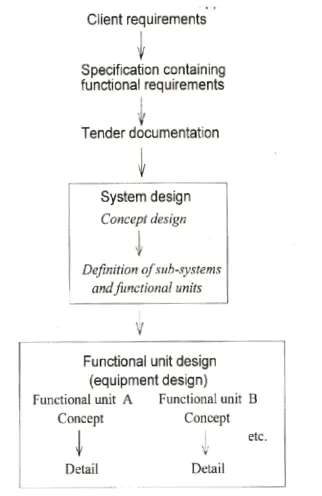
of components are made in detail design. This process could be extended for systems of a larger scale. Shown
in Figure 5. Client requirements are first documented in
the tender document. Followed by system design, where
sub-systems and functional units are defined. After which
the Equipment design model is used for every functional unit. [4] This more elaborate model seems to involve more
system engineering principles. Specification and definitions
are made on multiple system levels and possibilities are shown to create multiple subsystems that can be developed apart from each other. This can be shown by the analysis
and requirement definition phases that are specified in the model by Blanchard; Figure 6. [21]
In the book: Maintenance engineering and management from K. Smit [22] is a more elaborate project plan and design process provided. This model starts with a feasibility study before the concept design phase. The feasibility study is alike the (market)analysis phase in other models. Business and commercial objectives, planning, market expectations and product portfolio are examples of the variables that are considered. Where Thompson’s model is limited to detail design and component selection, does Smit add three additional phases: Construction & Commissioning, Operation & Maintenance and Life Extension & Reuse, based on Blanchard’s model. These phases represent the
Figure 4. Equipment design model
[image:17.842.585.782.53.265.2] [image:17.842.599.760.295.543.2]technical realisation of the system, its operational phase with maintenance and the end of life decisions of life extension, reuse or demolition of the system. Shown in Figure 6.
Smit also presents a maintenance design process consisting of the following phases: specifying maintenance behaviour, design for RAMS, development of the maintenance concept and lifecycle
costs. Remarkable is the reoccurrence of maintenance
concepts of RAMS and LCC. See figure XXX. The design
for maintenance process is a sub-process of the technical system design process. However, it is applied as an integral part of each phase of the design process. Thus, the four design for maintenance phases are applied in every system design phase. For every combination of these phases there
are specific tools that can be applied. These tools are listed for each phase in table XXXXXX. The phases recognized by
19
Figure 8. Design for Maintenance model [22]
[image:19.842.29.821.97.507.2]Biomimicry
In this research biomimicry will act as resource for a sustainable approach to design for maintenance. In this chapter, the biomimicry methodology will be introduced, including its philosophy and the tool Life’s Principles.
Definitions
As stated in the definition section, biomimicry is very closely
related to other nature-inspired methods and for clarity it is
important to follow a standardized terminology. As presented by Fayemi [2], and defined by ISO/TC266 2015[3], the following definitions are adhered to:
• “Bioinspiration: Creative approach based on the observation of biological systems.
• Biomimicry: Philosophy and interdisciplinary design approaches taking nature as a model to meet the challenges of sustainable development (social, environmental, and economic).
• Biomimetics: Interdisciplinary cooperation of biology and
technology or other fields of innovation with the goal of
solving practical problems through the function analysis of biological systems, their abstraction into models and the transfer into and application of these models to the solution.
• Bionics: Technical discipline that seeks to replicate, increase, or replace biological functions by their electronic and/or mechanical equivalents.”
Additionally, the definition of biomimicry by the Biomimicry
Handbook is the following: Biomimicry is learning from and then emulating natural forms, processes, ecosystems
to create more sustainable designs. [1] This definition is more specific than the ISO standard and influenced by the
methodology created by the organisation Biomimicry 3.8.
However, it does fit within the definition of ISO and therefore
the latter is used in this research.
Biomimicry line of thought
Biomimicry is a methodology that influences in two ways; as
an idea, it covers the direction and mindset of people and its tools create the pragmatic application of this idea. This is brought together in three elements of biomimicry, which are: Ethos, (Re)Connect and Emulate. Shown in Figure 10.
The idea behind biomimicry is called the Ethos. It is about
fitting in on earth as human species. We separated us from nature by trying to control it; we build and invent things that
make use of nature and deplete its resources. The practice of biomimicry should create conditions conducive to life. The second element of biomimicry is (Re)Connect. This is about reconnecting with nature, as in discovering what it is, what
it does and how it does live. It is possible to find principles
and patterns in nature of organisms that solve problems in the same way. Often a method to survive. These ideas can be used in the third element of biomimicry: Emulate. Emulation is the part that will be built on in this research. To achieve the goals of biomimicry it proposes a method to
create solutions that would ‘fit in on earth’. These solutions
are emulated from nature and therefore follow the principles
and advantages of nature. Including the efficiency, effectivity
and resiliency that organism have developed to survive. In this way it can be seen as a way to view and value nature, as a problem-solving method and as a branch of science. [1]
As the definition of biomimicry by the Biomimicry Handbook indicates; the main goal is to learn from nature and use this
knowledge to create a sustainable way of living with nature. This is done through emulating or being inspired by natural
solutions to fit our way of living. This is not copying, but
reapplication of nature’s designs.
The conscious intent to look for nature’s solutions forms the basis of the design processes by Biomimicry 3.8. These Biomimicry Thinking processes, formerly known as the
Design Spirals[23], have a workflow that is either
solution-based or problem-solution-based. The problem-solution-based process,
follows the following process: define the problem, transfer
[image:20.842.314.509.310.510.2]problem to biology, look for solutions, transfer solution
21 back to engineering and develop and evaluate the result.
The steps of the design processes are the second basis for the phases of the framework to be developed. For
the application in engineering fields it is more useful to
follow a problem-based design process. That would help in creating new products, which are mostly designed to solve
a specific problem. Thus, the challenge-to-biology approach,
which is the same as problem-based[2], will be used in the framework. See Figure 11.
Next to the general design process of biomimicry there are many tools available to support each part of it[24]. One essential tool for biomimicry is Life’s Principles. Biomimicry 3.8 developed the Life’s Principles based on Janine Benyus work[25]. The resulting designs created with the biomimicry
design process should be in conformity with the Life’s Principles, which form an assessment to ensure that the
solutions fit within the larger natural system ensuring
their long-term sustainability. [1] The principles, also shown in Figure 12 are:
1. Adapt to changing conditions 2. Be locally attuned and responsive 3. Use life-friendly chemistry
4. Be resource efficient (material and
energy)
5. Integrate development with growth 6. Evolve to survive [26]
All organisms on the planet follow some of these ‘requirements’. With these principles, it is possible to survive the conditions of earth. And since those conditions can be very hard to survive in, the principles promote
efficiency and responsiveness of the
organisms to the environment. This
efficiency and sustainability applied by
nature is exactly what could improve our technological solutions. The Life’s
[image:21.842.518.813.223.518.2]Principles is only one tool, in literature many other tools are explained and developed to guide the biomimicry design process in more detail.
[image:21.842.49.497.231.542.2]As explained before; biomimicry includes the same design
process as biomimetics. Therefore, biomimetic methods and tools can also be used in the design process to be developed. The design process by Fayemi [2] presents
an overall project flow of biomimetic design. See Figure
13. The biomimicry (challenge to biology) design process is remodelled over two axes. On the y-axis, it shows the abstractness of the material that is worked with. In the phases on top are the problem and solutions described in their most abstract form. This abstraction creates the
possibility to transfer a concept between fields of study. In this case; biology and engineering. The flow through the
lemniscus shows the phases to follow within the project.
The flow is straightened and shown on the left side in the
decision tree, Figure 15, page 23. The phases are related to engineering and biology, shown by the gears and cord of DNA. This clearly shows the previously mentioned steps between engineering and biology. One starts in engineering,
transposing the problem to biology and after finding ideas or
principles, then these are transposed back to engineering. These project phases are a basis to classify and divide tools.
Fayemi [2] presents a classification of tools based on the
project phases. The tools are divided over four categories: Analysis, Abstraction, Transfer and Application. Thus, tools within the same category end up in the same project phase. To choose between the tools during a phase, a decision diagram is made. This helps users to select the tools by asking questions that will sort out tools on their characteristics. Many TRIZ tools are included next to
biomimetic tools. TRIZ is a known tool for solution finding and has a variant for bio-inspired solution finding as well
[27].
Developing tools to work within a design process is important to overcome gaps during
this process. [24] The gaps recognized are
shown in Figure 14. In their research, a list has been compiled and a comparison is made on biomimicry, biomimetic or bionic tools. The list is added in appendix B. The list of tools presented is currently one of the most complete and therefore it is used as main input of tools in the framework to be developed. A comparison showed that it covered all tools (except for some the TRIZ tools) mentioned by Fayemi.
[image:22.842.350.736.77.296.2]Figure 13. The unified problem-driven process of biomimetics [2]
23 The current efforts on enabling a systematic bio-inspired design (BID): “a) focus on different aspects of the process, b) do not yet interface together, and c) are not openly accessible to practitioners.” [28] These statements
are partially solved by Fayemi [2]. The unified biomimetic design process systemizes the biomimetic process, including all development phases
of the design process and an overview on which tools to apply in each phase. Which is a starting point for connecting the different tools together. The tools themselves, however, are not accessible enough to be instantly applicable for practitioners. This is substantiated by Fayemi [2] and
Volstad [29] as in that the practical implementation is not sufficiently
evolved to be applicable in companies. Probably due to the large process change and the investment costs to modify the development cycle. This would support a remark of [28]: “Industry as a whole has been generally
slow to adopt BID approaches likely due to resource and organizational
constraints.”
On the other hand, Nagel [28] expresses the potential impact of BID on society. It underlines the potential of systematic BID in three points:
• “Alleviate the knowledge gap, assist with transferring valuable
biological knowledge to the field of engineering.
• Remove the element of chance, and/or reduce the amount of time and effort required to developing bio-inspired solutions.
• Bridge the seemingly immense disconnect between the engineering and biological domains.”
These points strengthen the case for bio-inspired design and its new application in domains as maintenance engineering.
Biomimicry is a method of approaching a design problem. Just like any other tools and methods it adds more working time and costs to a
project. However, the tools and methods are systemizing the process,
which creates advantages as reliability, reducing risk and better results.
In addition, it is important to recognize the following statement: “How
companies implement the design phase is varying between all companies.
[image:23.842.44.467.28.560.2]An inflexible, prescriptive approach will be difficult to put in practice.” [4]
Chapter 3: Current design practice
Practice and research often do not adopt new ideas and
methodologies at the same time. Research often recognizes
added value of new developments long before businesses do. Businesses, of course, work in a market environment. It is important to create value for customers and new
developments must add values recognized by the company.
Therefore, it is logical that new developments must prove its value before they are picked up by the market.
To develop a methodology that is as close as possible to a useful product for business, it must be adjusted for being used in a business environment. By having interviews with employees of Arcadis about maintenance, management and implementation of new methodologies, interesting information is gathered to consider practice during the development of the framework. In the following section, the conclusions of these interviews will be described. The summaries of the interviews are available in appendix C.
Interviews with Arcadis
Implementing new methodologies
Experience during a thesis showed that Rijkswaterstaat is more progressive in maintenance management and asset management than water boards. In these traditional and
smaller management organisations, a fixed style of working dominates. The style of working consists of unformalized
coordination, standardised work, working a lot from experience, the idea that if something works no change is needed and a limited view for the future. Therefore, it can
be difficult to implement innovative methodologies.
Application of (design for) maintenance
Maintenance and design for maintenance are not used extensively in design or building projects. It seems to be more important for bigger organisations and larger, often more complicated, projects. Smaller organisations and projects often do not have the amount of management, structure, knowledge and the large costs of failure, required to consider or implement maintenance as a structured
approach. What counts for any size of organisation is the
fact that lots of work is based on standards and guidelines and the experience of the designer. Large and important subjects are discussed within the teams. In projects where the problem and risk have developed and time pressure is high, quick and dirty solutions are applied. These insights give that solutions are not created in a structured way and problems can be solved in many, inconsistent, ways. The importance of maintenance is also often neglected. It is stated that tools and approaches as: LCC,
RAMS(SHEEP), Failure Mode Effect and Criticality Analysis
(FMECA), and RCM depending on the field, are generally
known. However, the application of methods heavily relies
on the size of the project (complexity), the time available
and the amount of funds available. Maintenance is often only considered as part of these methods. Within the domain of asset management condition and risk based management is a relevant often applied methodology, combining FMECA and condition measurements. Moreover, during the investments and tender processes maintenance can only have a dedicated project phase
if it yields more profit than invested efforts, which is currently difficult to support. Maintenance could also be not
remarkably considered in the RAMSSHEEP and risk analysis, stressing more safety and availability aspects. Unfortunately,
the added value of maintenance appears not to be sufficient or is not recognized to be sufficient to commit more
attention to it.
However, maintenance is more and more considered and used. The traditional idea of design, which resulted in over-the-wall engineering, is slowly being renounced.
Previous results of flawed design acknowledge the need for
an integral design and management approach, in order to
improve efficiency, safety and reducing cost.
In relation to that, the Dutch water boards (waterschappen) are an example, they involve people responsible for the maintenance solutions in a project team. Bringing maintenance knowledge for improvement and representing these interests. Generally speaking, in specialty and bigger projects there is often more time and funds available to consider maintenance properly.
25 do not allow this way of working. This culture change is
difficult to put in place and always needs the full support of the clients (in this specific case Rijkswaterstaat) and of
the contractors since they deliver the essential work for the organisation.
In increasing extent, a RAMS analysis is made from
the first design on, this is also standard in projects for
Rijkswaterstaat. Then the failure rates are added to the components, which can be used to question the constructor. Between each phase there are validation moments, to check if delivered work is as it should be.
One of the most important concerns is the difference of interests from stakeholders, which holds back (design for) maintenance development. As a company, it could be a goal to satisfy the client with as little investment as possible. If maintenance is not important or not requested by the client it can be neglected. Design can be optimised to deliver satisfying RAMS values. Managers request maximum availability and availability, which is not possible from a design perspective. This difference in view can result in
oversized designs. Only calculated proposals show that
chances of failure do not outweigh the costs.
An indicated problem with recognition of the importance of maintenance is that the maintaining party is different from the party that designs and builds the asset. The latter does not concern itself with the care during the lifetime of the
asset. If this party is related to lifetime expenses or profits,
then they will also see the value of better design. For the
field of the national road network, the revenue model of
Rijkswaterstaat and incentive of the contract do not allow much room for innovation. Rijkswaterstaat is the ideal organisation to take a lead in design for maintenance during investments.
A short-term view is also seen by boards of companies. Resulting in quick prestige projects with little thought into future maintenance.
Feedback for design teams is available in a moderate level. The designing team or organisation is obligated to be replaced for the building phase of the project. Adjustments initiated by the subcontractor are discussed directly. But notes taken by the design team during building is presented to the client, who decides to make use of that information. Within the design team there is often room for iterations and redesigns of parts of the project.
The Netherlands is a kind of finalized, importance will
transfer from building new things to repurposing existing assets (buildings and infrastructure). Therefore, it is very interesting to apply new maintenance methodologies to existing assets (areaal). Which could be a developing market with opportunities.
Tools for the framework
‘Duurzaam GWW’ (Sustainable Land-, Road, and Water
construction) is a cooperation between organisations to work on long term sustainable developments, to achieve the climate targets. It involves agreements on targets to achieve, example given: CO2-reduction of 20% between 1990 and 2020.Such guidelines and rules made by the governments and related organisations can be useful tools to set advanced requirements and project goals. Such agreements can be used for input in requirement setting or evaluation.
Cost estimations become more specific during a project,
starting with a margin of +-50 percent. If a project is considered too expensive after the design phase, it could be stopped despite the possibility that the whole project could
fit within the budget. This is partially a result of different
project managers. A tool, which is out of the scope for this research project, could improve the communication on budget estimations and budget spending during a project.
Innovation in a company
The amount of innovation that companies incorporate is
influenced by the type of company, its vision or approach
and the discussions with clients. Generally, solutions are developed beforehand and implemented many times in an optimised form for clients. Clients are often attracted trough these developed solutions. Only on client request are
brainstorms and specific new solutions developed during
a project. This process of creating specialised solutions sometimes triggers innovations. The ideas can come from anyone within and outside the company or consortium,
everyone has its own field of expertise.
the people in the tactical layer, are often engineers and technology-driven and able to think out-of-the-box about new technologies and maintenance engineering from a process and business perspective. In contrast to the old guard and operational level who are more specialists, task-oriented and activity guided. People between the tactical and operational levels (thinking about the system/planning (thus operation planners) should watch the developments in the tactical layer and try to implement it in the operational layer.
The organisational layers can be recognized in Figure 16.
Further innovation can be recognized in the development
of combinations of existing solutions. It has been said that education (research) has the time and money available to study and design new developments.
Types of innovation that are growing in popularity are innovation for sustainability and social innovation (which includes working together with stakeholders). Lessening costs is always a reason for development.
As is recognized on a maintenance specific level, innovation
is initiated by boards of an organisation. They are an internal employer and should ask for development of low life cycle costs, sustainability and maintainability. This can be complicated in a political organisation where focus lies on goals to be achieved in the term of the then current board.
The incentive to structurally change work flows lacks in
some organisations. Therefore, money should be reserved and business cases should be made to sell it to the management. Innovations must be proven to get accepted.
This could be difficult when only soft data is available.
Solutions created in the tactical level should therefore also be presented in a proper way (including advantages) to the operational level. They will be working with it and will be affected. Developing innovation through an already existing,
sustainability, program, could quicken the implementation
on the work floor.
[image:26.842.391.735.199.512.2]In fields where standardization is common, innovation is inhibited by the rules and predefined properties.
27
Development of biomimicry in a company
Biomimicry is a sustainable concept that is still in development. Another sustainable concept that already is implemented is Natural Capital. “Natural capital can
be defined as the world’s stocks of natural assets which
include geology, soil, air, water and all living things.” [30] Humans can derive a wide set of services from natural
capital, example given: natural flood defences provided by
forests or pollination of crops by insects. Contributing to a company is not only done through generating money, but also through added environmental value. This idea came together with university concepts that evolved to Natural Capital. Biomimicry is coming up via the same steps and given the sustainability aspect and being relatively new, natural capital is comparable with biomimicry. However, Natural Capital is already further implemented than biomimicry and therefore it is possible to learn and follow the successful path of natural capital for the implementation of biomimicry.
Biomimicry and Natural Capital are only implemented by leading companies and often only picked up by some individuals in those companies. However, Natural Capital is already having a larger support base, creating a platform for projects as the Natural Capital Protocol, which provides companies with a universal standard to measure and value natural capital.[31] Since the business case, which is the value of nature, behind biomimicry is less visible than with Natural Capital and should therefore be communicated clearly.
Such as Natural Capital, Biomimicry is a way of thinking and it does not bring ready-to-use solutions. A company should be open for that and its use is dependent on people
who want to pick it up. To sell a concept as Biomimicry in a company, everything from concepts to operation plans should be ready. A sales person could start to pose the body of thoughts, present a business case and show concrete examples. It is important to show the advantages for the company, in euro’s, less risk or distinctiveness. The advantages of a new concept should be followed by ideas to implement and execute the concept in the companies’ processes and in the products.
Changes in the way of working will get resistance from employees. Therefore, people that are open to new ideas
and have the ability to influence should lay the foundation of
a concept within a company.
In the end, and as said before, companies will only use a new development if they are able to create added value with it. Therefore, their caution should be refuted by examples
and cases to show their ability to profit with a new concept.
At the moment, Arcadis does not have a structured approach for implementing biomimicry in its business. A structured protocol or framework could help develop a more consistent approach within the boundaries of biomimicry. Especially, when useful and applicable solutions are proposed. Next to a structured approach for biomimicry, a framework could also improve the approach for maintenance. Maintenance does receive some attention, however there is not structured approach available that supports design for maintenance or the development of new maintenance practices. This can be addressed in the framework. At last, the framework could also be a platform that initiates the development of innovative solutions. Unfortunately, two main problems that fall out of the scope of the framework are over-the-wall engineering
In this chapter, the creation of the new framework will be discussed. The aim of the framework is to implement biomimicry in the development cycle for design for maintenance and categorise tools to support the development process by making them accessible for
designers and engineers. One by one, every component of the framework will be explained.
The framework is mainly based on the literature review, further inspiration comes from the interviews and personal experience with design methods. Discussions contributed to
incremental improvements.
First, the project phases are discussed, followed by the tools and the representation of the framework.
Chapter 4: Framework
Figure 17. Simplified design model of Pahl and Beitz. [12]
Figure 18. System engineering design model [22]
29
The project phases
The project phases are designed from a combination of systems engineering, biomimicry and industrial design methodologies. The systems engineering process developed by Blanchard and Smit[22], shown in Figure 18, is the basis for the projects phases. It is chosen to keep the process linear. This creates simpler feel, people can get an idea on
how far they are in the process and it is easier to learn. This
is recognized from the fact that the linear design model of Pahl and Beitz[12], shown in Figure 17, is often used as the first design process to learn.
The biomimicry process is compared with the system
engineering process to find similar phases. These phases
are merged to prevent duplicates and over-complicated
process schemes. The leftover biomimicry phases are fitted
in the system engineering process. Since the biomimicry process is almost completely consistent of phases that support idea generation and early solution development this has replaced the idea phase of industrial design processes.
The used biomimetics model is from Fayemi[2]; see Figure
[image:29.842.32.827.247.524.2]19. The framework is shown in Figure 20, the entire poster with examples is available in Appendix D.
Context and requirement analysis
This results in an analysis and defining phase as the first
phase of the framework. In this phase are all the inputs from the clients and stakeholders gathered and analysed. With additional analysis the context and requirements are
defined. This phase creates the basis, ground layer, of
the project by creating the reference documents with all information to refer to when required during the further project.
The second phase to sixth phases are biomimicry phases,
of which the goal is to find the ideas and solutions to the problems defined in the Context and requirements definition
phase. The naming and process used for these phases have the models of Fayemi[2] as basis. This model is more abstract and direct than the biomimicry process terms of Biomimicry 3.8.
Discover solutions
The steps for identifying and selecting biological models are merged into the phase Discover solutions. This decision is
made based on a project management and industrial design experience. In some models, it is common to end every
phase with a reflection moment, considering feedback and
iteration. In this case it is important to check the solutions through the set requirements and use iterations to make sure the right solution is developed within this phase. The Discover solutions phase is about the exploration of nature
and its principles to find ideas and solutions. Following
[image:30.842.150.819.267.550.2]31
Abstract the problem and Abstract biological strategies
In the abstraction phases the problem and the found solutions are abstracted. The abstraction is used to
disconnect the problem or idea from its field, engineering
or biology. In the abstraction, an analytical model is made, which creates a view that focusses on the essential parts of
the problem or idea. This abstraction is very useful to find
the keywords or functions in the following phases.
Transpose to biology and Transpose to engineering
In these phases is a bridge formed from the engineering
field to the biology and the other way around. The keywords
or functions are used in the presented tools to connect
these fields. They are words that can be used in both fields or can help to translate specific engineering terms to biology
terms. When the translation is done, it is possible to work
further within the other field, finding solutions or developing
the ideas.
Conceptual engineering and Detail Design
Following the biomimicry phases and the translation back to engineering the last two phases are well known in design: Conceptual Engineering and Detail design. During these phases, the found ideas and principles are developed further into implementable solutions. Starting with Conceptual engineering the basic characteristics are
defined and the general outline of the solutions is known.
The concepts are analysed for expected performance and evaluated to see if iterations can be made or if iteration is necessary.
During the detail design phase, the designs are developed in full. The following phases, which are not considered in this research, will be construction, implementation and use. The solution is therefore optimised for its use and
maintenance properties are developed in detail. In this
phase are reflection, evaluation and iteration again very
important. The function of the system must be working, the
solutions must fulfil the set requirements and feedback for
the project team and for future projects must be gathered and communicated.
The tools
For each phase implemented in practice, it is necessary to show how this could be done. Therefore, an extensive list of tools to be used during the design process is compiled. The tools are then divided over the design phases to show the possibilities for each design phase. It must be said that a list of tools is always incomplete. Current developments,
fields not reviewed and design decisions contribute to
that fact. The list of tools is a compilation of biomimicry tools presented by Wanieck[24], more information in literature [1,33–81], and Fayemi[2], shown in Figure 22. The maintenance tools are collected from the books of Thompson[4] and Smit[22]. Available in appendices A and B. TRIZ tools presented by Fayemi, which did not appear on the list of Wanieck, are not included. These tools are general design tools and fall out of the focus on biomimicry and maintenance tools.
Figure 22. Tools considered by Fayemi, divided over the
![Figure 1. Design model by Pahl and Beitz [12]](https://thumb-us.123doks.com/thumbv2/123dok_us/9665211.468441/14.842.487.786.63.531/figure-design-model-by-pahl-beitz.webp)
![Figure 2. Actions, policies and concepts in maintenance [15]](https://thumb-us.123doks.com/thumbv2/123dok_us/9665211.468441/15.842.557.817.133.345/figure-actions-policies-concepts-maintenance.webp)
![Table 1. Elements of RAMSSHEEP [19]](https://thumb-us.123doks.com/thumbv2/123dok_us/9665211.468441/16.842.294.807.48.557/table-elements-of-ramssheep.webp)
![Figure 6. The system engineering process in the life cycle [21]](https://thumb-us.123doks.com/thumbv2/123dok_us/9665211.468441/18.842.387.797.301.535/figure-engineering-process-life-cycle.webp)
![Figure 8. Design for Maintenance model [22]](https://thumb-us.123doks.com/thumbv2/123dok_us/9665211.468441/19.842.29.821.97.507/figure-design-for-maintenance-model.webp)
![Figure 10. Biomimicry Essential Elements [1]](https://thumb-us.123doks.com/thumbv2/123dok_us/9665211.468441/20.842.314.509.310.510/figure-biomimicry-essential-elements.webp)
![Figure 11. Biomimicry design process: Challenge to Biology [1]](https://thumb-us.123doks.com/thumbv2/123dok_us/9665211.468441/21.842.518.813.223.518/figure-biomimicry-design-process-challenge-biology.webp)
![Figure 14. Gaps between fields in the biomimetic design process [2]](https://thumb-us.123doks.com/thumbv2/123dok_us/9665211.468441/22.842.350.736.77.296/figure-gaps-fields-biomimetic-design-process.webp)
![Figure 15. Biometic design model desicion tree [2]](https://thumb-us.123doks.com/thumbv2/123dok_us/9665211.468441/23.842.44.467.28.560/figure-biometic-design-model-desicion-tree.webp)
