University of Warwick institutional repository: http://go.warwick.ac.uk/wrap
This paper is made available online in accordance with
publisher policies. Please scroll down to view the document
itself. Please refer to the repository record for this item and our
policy information available from the repository home page for
further information.
To see the final version of this paper please visit the publisher’s website.
Access to the published version may require a subscription.
Author(s): Colm Connaughton, Sergey Nazarenko, Brenda Quinn
Article Title: The life-cycle of drift-wave turbulence driven by small
scale instability
Year of publication: Forthcoming
Link to published article:
Colm Connaughton,1, 2 Sergey Nazarenko,1 and Brenda Quinn1 1Mathematics Institute, University of Warwick, Coventry CV4 7AL, UK 2
Centre for Complexity Science, University of Warwick, Coventry CV4 7AL, UK
(Dated: December 17, 2010)
We demonstrate theoretically and numerically the zonal-flow/drift-wave feedback mechanism for the LH transition in an idealised model of plasma turbulence driven by a small scale instability. Zonal flows are generated by a secondary modulational instability of the modes which are directly driven by the primary instability. The zonal flows then suppress the small scales thereby arresting the energy injection into the system, a process which can be described using nonlocal wave turbulence theory. Finally, the arrest of the energy input results in saturation of the zonal flows at a level which can be estimated from the theory and the system reaches stationarity without damping of the large scales.
PACS numbers: 52.35.Ra,52.35.Kt,47.27.-i
Designing a device capable of controlled, self-sustained nuclear fusion is one of the principal technological chal-lenges of the 21st century. Attention is now heavily fo-cused on the construction of the International Thermonu-clear Test Reactor (ITER) which aims to demonstrate the feasibility of controlled fusion for the first time. Of the myriad of engineering challenges posed by ITER, one of the most critical, the problem of magnetic plasma con-finement, relates intimately to foundational issues in tur-bulence theory, the topic of this Letter. One difficulty of magnetic plasma confinement is due to instabilities (such as the ion temperature gradient, drift-dissipative and electron temperature gradient instabilities). These generate waves which interact to produce wave turbu-lence thereby greatly enhancing transport. Heat and plasma then diffuse more quickly from the hot, dense core to the periphery resulting in a loss of confinement. Common features of these instabilities are that they are small scale, typically of the order of the ion gyro-radius or below, and principally generate meridional waves (with wave crests along the minor radius of the torus).
Significant progress in the confinement problem came with the experimental discovery [1] that, under the right conditions, the turbulent transport coefficient suddenly drops. This effect, called the Low-to-High (LH) confine-ment transition, can be exploited to design more effi-cient confinement. Although traces of the LH transition were replicated in numerical simulations [2], including full gyro-kinetic calculations [3], the underlying mechanism was initially poorly understood since realistic numerical simulations of tokamaks are universally incapable of re-solving the full range of scales involved. It is now gen-erally accepted [4] that the LH transition is triggered by the self-organisation of coherent zonal flows (ZF’s) in the poloidal direction which act as transport barriers since they act to shear away turbulent fluctuations which try to cross them. Current research is heavily focused on understanding and parameterising these ZF’s and their interaction with the drift wave turbulence at the
experi-mental, numerical and theoretical levels.
In this Letter we present a simple theoretical model of the confinement mechanism described above. Our model uses the Charney-Hasegawa-Mima (CHM) equation [5], the simplest single-fluid description of a strongly mag-netised plasma. This equation is rarely used in mod-ern plasma research because drastic simplifications are required to obtain it from the true dynamical equations. On the other hand, simple models often repay in terms of analytical tractability and conceptual clarity what they lose in terms of direct applicability. This is certainly the case here. Our model gives a semi-analytical description of the full life-cycle of turbulence generated by a small-scale primary instability. Before presenting details, we outline the main results. Meridional waves - drift waves in the case of the CHM model - are generated by a pri-mary instability at the scale of the ion gyro-radius. The subsequent evolution has three main stages. In stage 1, waves grow until they generate seeds of a ZF via a sec-ondary modulational instability [6–8]. The ZF is large-scale compared to the waves. In stage 2, the ZF’s grows bydirectinteraction with the small scales rather than by a Kraichnan-style inverse cascade which would involve lo-cal transfer of energy between slo-cales. This is because the nonlocal interaction in drift wave turbulence is intrinsic, i.e. it typically develops in time even for broadband ini-tial spectra. However, the fact that the primary instabil-ity produces a relatively narrow initial drift-wave spec-trum helps nonlocality. Due to nonlocality, the kinetic energy of the small scales is not conserved as it would be in a local cascade. In fact, the growing ZFremoves
energy from the turbulence since the combined energy of large and small scales is conserved. The wave turbu-lence which gave birth to the ZF in stage 1 is thus sup-pressed by its growth. In stage 3, this negative feedback reaches a steady state in which suppression of turbulence by the large-scale ZF exactly balances its generation by the small scale instability. We note that Eq. (1) also has a geophysical interpretation which we do not discuss (see
2
references in [8]).
The CHM model does not contain small scale instabil-ities of the kind mentioned above. In what follows, we
modelthese instabilities with a multiplicative linear forc-ing term applied to selected wavenumbers. We solve the following equation on a plane with the x-axis along the plasma density gradient ∇n0 and the y-axis transverse
to this:
(∂t− L) ρ2∆ψ−ψ
+v∗∂yψ−ρ2J[ψ,∆ψ] = 0. (1)
Hereψ(x, y, t) is the streamfunction, ∆ is the 2D Lapla-cian, J[ψ,∆ψ] = ∂xψ∂y∆ψ−∂yψ∂x∆ψ and L is a
lin-ear operator having Fourier-space representation Lk =
γk−νmk2m with γk > 0 modeling the instability and
νm a hyperviscosity coefficient. Here, ρ is the ion
Lar-mor radius at the electron temperature, v∗ =ωBρ2/Ln
is the drift velocity, ωB is the ion gyro-frequency and Ln =n0/|∇n0| is the density profile length-scale. ρand
v∗are both taken to be constant. For the instability
forc-ing,γk, we seek the simplest form which retains the key
features of the relevant plasma instabilities mentioned above, namely that they act at small scales and primar-ily generate meridional waves. For these purposes it suf-fices to takeγk =γ δk,ki, withki = (0, ρ
−1) and γ >0,
which forces a single meriodinal mode at the scale of the gyro-radius. In principle, a more realistic form for
γk can be obtained by considering the linear dynamics
of a higher level model which does contain an intrinsic instability such as the Hasegawa-Wakatani (HW) model in the case of the drift-dissipative instability [2]. The dimensionless parameter,χ= γρv
∗, is a measure of
nonlin-earity of the system assuming that the linear instability saturates at a level determined by the amplitude of the nonlinear term in Eq.(1). Eq. (1) has exact plane wave solutions ψ= exp(−i(ωkt−k·x) +γkt−νmk2mt) with
dispersion relation,ωk=−v∗ky/(1 +ρ2k2).
Without instability or dissipation (L ≡ 0), Eq. (1) has two invariants: E = 12R
[ρ−2ψ2 + (∇ψ)2]dx and
Ω = 12R
[ρ−2(∇ψ)2+ (∇2ψ)2]dx. These are closly
re-lated to the energy and enstrophy in the 2D Euler equa-tions. 2D Euler turbulence exhibits an inverse cascade of energy from small scales to large. Likewise, CHM tur-bulence transfers energy to large scales. In the weakly nonlinear limit, however, CHM turbulence differs from 2D Euler turbulence in some important respects. Firstly, in this limit, the energy transfer turns out to be nonlocal in scale [9] meaning that it is dominated by interactions between the smallest and largest scales. Secondly, there is an additional statistical invariant, thezonostrophy[10], which renders the transfer anisotropic [10, 11]. The the-ory of nonlocal drift wave turbulence was first worked out in [9, 12] and a detailed summary can be found in [13]. In this Letter, we will present a self-consistent but qual-itative physical argument to arrive at the same results.
Consider a drift wavepacket with wavenumberk mov-ing on a background consistmov-ing of a large-scale ZF with
FIG. 1: (color online) Energy contained in the forced mode (crosses), the zonal sector (circles) and meridional sector (tri-angles) as functions of time forχ= 3.75×10⁻⁴. The inset
shows the saturation level of the ZF as a function ofβ.
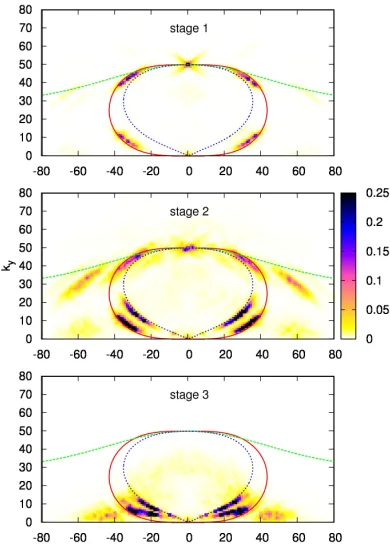
FIG. 2: (color online) Snapshots of the 2D energy spectrum at times 11.0, 11.5 and 20 for the caseχ= 3.74×10⁻⁴
typical wavenumberp. The ZF need not be perfect and can have finite px, but we insist that it is large scale: p k and p 1/ρ so that a the WKB approxima-tion is appropriate [14]. The ZF is staapproxima-tionary in a frame moving in they-direction with the drift velocityv∗ [13].
[image:3.612.353.531.59.234.2] [image:3.612.343.538.309.584.2]packet frequency must be conserved in this frame:
v∗ky+ωk=
v∗kyρ2k2
1 +ρ2k2 =k 2ω
k=v= const. (2)
Hence, askchanges due to distortion of the wavepacket by the ZF, it is restricted to remain on the 1D curve in the 2D k-space given by (2), hereafter called a v-curve. A typicalv-curve is indicated by the green (dashed) line in Fig. 2. According to WKB theory, it is waveaction of the small scales,nk =ek/ωk, which is conserved rather
than the energy, ek. On each v-curve, nk ∼ k2ek from
Eq. (2). Sincek2increases as a wavepacket moves along av-curve from the source (at theky-axis) to the sink (at
high k’s), ek must decrease to keep nk constant. The
energy thus lost is transferred to the ZF.
There are two qualitatively different regimes corre-sponding to weak and strong ZFs. The weak regime oc-curs when drift wave packets live long enough to cross many ZF oscillations, experiencing multiple random dis-tortions and executing a random walk in k-space along thev-curves. It can be described by a diffusion equation:
∂nk
∂t =∂v(Dk∂vnk) +γknk−νmk
2mn
k, (3)
where ∂v is the derivativealong thev-curve. A detailed
quantitative derivation of Eq. (3) is presented in [13]. The diffusion coefficient, Dk, is proportional to the
in-tensity of the large-scale ZF, and can be estimated as
Dk ∼( ˙kx)2τ,where ˙kx∼ −kyS is the rate of change of kx due to the ZF shear S = ∂xU ∼ pU, and τ is the
correlation time τ = 1/(p|x˙|) = 1/(p|∂kxωk|)∼1/(pv∗).
In these estimates we took into account that the essential dynamics happens at the scaleskx∼ky ∼1/ρ. Thus
Dk∼
S2
ρ2v∗p ∼
SU
ρ2v∗. (4)
For fixedDk, Eq. (3) indicates thatnkevolves
indepen-dently on eachv-curve and is controlled by the maximum value ofλk=γk−νmk2mon the curve. Ifλk is positive,
nk will initially grow exponentially. Correspondingly, if
λk is negative, nk will be exponentially damped. Large
positive λk are obtained on curves passing close to the
maximum of γk. In our case this is the forcing mode, k = (0, ki). Negative values are found away from this
maximum, where dissipation dominates. The growth of
nk on av-curve with positiveλk cannot, however,
con-tinue indefinitely. Diffusion along a curve transfers en-ergy to large scales. This in turn increases Dk so that
the growth due to positiveλk can begin to be tempered
by increasingly rapid diffusion of wavepackets from the instability region to the dissipation region. The region of growingnk shrinks until a steady state is reached (stage
3). Thosev-curves which originally had positive growth reduce their growth rates to zero and the spectrum on them dies out. The large-scale ZF in turn saturates at a
finite intensity determined by balancing the forcing and the diffusion terms on the right hand side of Eq. (3), giv-ingDkρ2∼γmax.Eq. (4) gives the saturation criterion:
UrmsSrms∼v∗γmax. (5)
where rms denotes root-mean square. Counterintuitively, the saturation velocity increases withv∗ as the flow
be-comes more linear. Eq. (5) fails for large χ when tur-bulence is strong and the v∗-term in Eq. (1)can be ne-glected. In the strong turbulence regime, a wavepacket cannot cross even a single ZF oscillation since rapid dis-tortion by the zonal shear brings its wavenumber to the dissipation scale. This gives the saturation criterion
Srms∼γmax. (6)
Comparing Eqs. (5) and (6), the crossover between the two regimes occurs whenγmax∼v∗por whenUrms∼v∗.
The estimate (6), previously put forward in [15], is valid only for strong ZF’s withUrms&v∗.
We performed numerical simulations using a standard pseudo-spectral code at a resolution of 256×256 with
m = 8, νm = 1.0×10⁻²⁹, ρ = 0.02 and γ = 1.2.
The initial condition was spatial white noise of very low amplitude. Fig. 1 summarizes results obtained with
β = 1.6×10⁵ giving χ = 3.75×10⁻⁴. We divided k
-space into a zonal sector, |kx| > |ky|, and a meridional
sector, |kx| ≤ |ky| (excluding the forced mode). Fig. 1
shows the energy of each sector and of the forced mode as functions of time. Initially, the forced mode grows exponentially, and the zonal and meridional energies re-main at a level set by the initial noise. This is followed by a sharp growth of the the zonal and the off-zonal en-ergies once the amplitude of the forced mode gets high enough to facilitate nonlinear mode coupling (stage 1). Next, the meridional modes, including the forced mode itself, are suppressed while the zonal modes retain their energy (stage 2). Finally a steady state is reached (stage 3) in which the instability forcing is switched off and the majority of the energy is zonal.
Fig. 2 shows the time evolution of the 2D energy spec-trum ink-space normalized by the maximum. The forced mode initially dominates but such waves are modulation-ally unstable [6–8]. The first indication of the nonlinear evolution seen in stage 1 is therefore the growth from the background noise of those modes whose modulational in-stability growth rate is greatest. In the limit of weak non-linearity, the modulationally unstable modes concentrate on the resonant curve passing through the forcing mode,
ω(k) =ω(k1) +ω(k2) with k=k1+k2 fork3= (ki,0)
4
at stage 2 is related with the ZF-induced diffusion along the v-curves with a diffusion coefficient growing as the ZF is becoming stronger. This diffusion process is clearly visible in the middle frame of Fig. 2. Deviations from the theoreticalv-curve can be attributed to absence of a large scale separation between the forcing and the zonal modes assumed in the derivation of Eq. (3). We remark that if there is a nonlocal interaction withsmall-scaleZF’s then diffusion proceeds along different curves, the level sets of zonostrophy [12, 13]. One such curve, passing through the forced mode is shown in Fig. 2 by the blue dashed line. A secondary ZF branch emerges on this curve, a point which we hope to explore in a future publication.
At stage 3, the zonal flow saturation estimates Eqs. (5) and (6) are in reasonable agreement with the numerical measurements in the inset of Fig. 1. The saturation val-ues ofUrmsSrmsare compared against the estimated
val-ues over a range ofv∗ values. For low v∗ there is good agreement with the strong turbulence estimate, Eq. (6). For largev∗ there is reasonable agreement with the weak
turbulence estimate Eq. (5) (the discrepancy is a factor of 2 – 3). The departure at largev∗ from the prediction UrmsSrms ∝ v∗ is likely due to the fact that the scale
separation becomes less pronounced for largev∗.
To conclude, we have analyzed the zonal-flow/drift-wave feedback loop mechanism for the LH transition in an idealised model of plasma turbulence driven by a small scale instability. The process has 3 stages: (i) ZF’s are generated by a modulational instability of the small-scale modes which are directly excited by the instability, (ii) the ZF’s feed back on the small-scale modes and suppress them via a nonlocal mechanism which closely follows the scenario predicted in [9, 12] , (iii) the energy injection into the system stops and the zonal energy saturates at a level which is in reasonable agreement with the theoretical es-timates, Eqs. (5) and (6), obtained from the nonlocal weak and strong turbulence theories respectively.
The ZF saturation mechanism described in this Letter is remarkable because it is achieved entirely dynamically without the need to remove the small scale driving insta-bility or to invoke a dissipation mechanism for the large scales. The fact that it works transparently in a sim-ple model like the CHM model is encouraging for more realistic applications since it suggests that the mecha-nism is quite robust. We conclude with some physical estimates aiming to establish the extent to which this mechanism could, in principle, be observable in real toka-maks. The strong turbulence scaling Eq. (6), appropri-ate for U & v∗, has been widely used in tokamak
the-ory since [15]. On the other hand, the weak turbulence estimate (5) is new. It should be used when U . v∗.
Zonal flows in the DIIID and JET tokamaks have been
reported with U ∼ 5−35 km/sec [16, 17] and v∗ for both systems ranges from 5 km/sec in the core to 100 km/sec in the pedestal region. Both the weak and the strong regimes should therefore be realisable. Some idea of the feasibility of the weak vs strong saturation regimes can be obtained for the most typical instability in the tokamak plasma core, the Ion-Temperature Gradient in-stability for which γmax = vT/
√
RLT, where R is the
major radius andLT is the temperature gradient length.
The weak/strong crossover occurs whenγmax/p∼v∗, i.e.
whenρp∼Ln
√
RLT whereLnis the typical lenght scale
of the density gradient. For ZFs which appear inside pedestal regions,Ln ∼LT and ρp∼0.1. The crossover
condition is thusR/Ln∼100. In large tokamaks R&1
m and in the pedestal region Ln & 1 cm. Thus, both
the weak and the strong regimes of the ZF generation can be expected. For the edge region, one should use another estimate forγmax which is based on the
drift-dissipative instability. In this case one can show that the weak regime should be expected when the electron mean free path exceedsR.
[1] F. Wagner et al., Phys. Rev. Lett.49, 1408 (1982). [2] R. Numata, R. Ball, and R. L. Dewar, Phys. Plasmas14,
102312 (2007).
[3] L. Villard et al., Nucl. Fusion44, 172 (2004).
[4] P. H. Diamond, S.-I. Itoh, K. Itoh, and T. S. Hahm, Plasma Phys. Control. Fusion47, R35 (2005).
[5] A. Hasegawa and K. Mima, Phys. Rev. Lett. 39, 205 (1977).
[6] D. Y. Manin and S. V. Nazarenko, Phys. Fluids6, 1158 (1994).
[7] O. Onishchenko, O. Pokhotelov, R. Sagdeev, P. Shukla, and L. Stenflo, Nonlin. Proc. Geophys.11, 241 (2004). [8] C. Connaughton, B. Nadiga, S. V. Nazarenko, and B. E.
Quinn, J. Fluid Mech.654, 207 (2010).
[9] A. M. Balk, S. V. Nazarenko, and V. E. Zakharov, Phys. Lett. A146, 217 (1990).
[10] A. M. Balk, S. V. Nazarenko, and V. E. Zakharov, Phys. Lett. A152, 276 (1991).
[11] S. Nazarenko and B. Quinn, Phys. Rev. Lett.103, 118501 (2009).
[12] Nazarenko, S.V., JETP Lett.53, 628 (1991).
[13] C. Connaughton, S. V. Nazarenko, and B. E. Quinn (2010), arXiv:1012.2714v1 [nlin.CD].
[14] A. Dyachenko, S. V. Nazarenko, and V. E. Zakharov, Phys. Lett. A165, 330 (1992).
[15] O. T. Kingsbury and R. E. Waltz, Phys. Plasmas1, 2319 (1994).
[16] W. M. Solomon et al., Rev. Sci. Instrum.75(2004). [17] K. Cromb´e, in 33rd EPS Conference on Plasma Phys.