University of Warwick institutional repository: http://go.warwick.ac.uk/wrap A Thesis Submitted for the Degree of PhD at the University of Warwick
http://go.warwick.ac.uk/wrap/4453
This thesis is made available online and is protected by original copyright. Please scroll down to view the document itself.
IMPROVED PROCESSES FOR
THE PRODUCTION OF
SOIL-CEMENT BUILDING
BLOCKS
AUTHOR
SUBMITTED FOR
THE DEGREE OF
SUBMITTED TO
RESEARCH
CONDUCTED AT
DATE SUBMITTED
• •• •
• •
• •
• •
DOMINIC EDWARD MAXWELL
GOODING
DOCTOR OF PHILOSOPHY
IN THE FACULTY OF ENGINEERING
THE UNIVERSITY OF WARWICK
DEPARTMENT OF ENGINEERING
THE UNIVERSITY OF WARWICK
NOVEMBER 1994
SUMMARY
Stabilised-soil cement building blocks are an established building material in many areas of the Less Developed World. This thesis has been split into three parts. Part A presented an overview of the process of soil-stabilisation and outlined the roles which soil structure and curing play in stabilisation. It examined methods of testing soils, highlighting errors presented in the published literature and presenting corrected testing procedures and unified plans for their implementation.
Part B examined the conventional quasi-static block compaction process (slowly applied pressure) and established that no cost-effective increase in the compacted block density can be achieved by altering such moulding configurations as mould-wall roughness, mould-wall taper, number of applied pressure cycles and double-sided pressure application. The tests were also used to assess the plausibility of several theoretical mechanisms underlying quasi -static compaction.
Cement may be traded against compaction pressure for a given final cured strength. The relation of compaction pressure and cement content to well-cured strength was established for 50 mm diameter cylinders and used to assess the financial benefit of high-pressure compaction. It was shown that savings in the cost of cement associated with high-pressure compaction were outweighed by the additional cost of such machinery. However there were additional benefits found to high-density compaction, beyond the saving in stabiliser costs. It was established that a high-density moulding machine in the range £1000 - £1500 would allow these benefits to become cost competitive.
1
1.1 1.2
CONTENTS
INTRODUCTION
pageSOIL AS A BUILDING MATERIAL . . . 15
LITERATURE REVIEW . . . . . . . . . . . . . . . . . . . . .. 18
1.2.1 SOIL STABILISATION METHODS AND MECHANISMS. 18 1.2.2 SOIL AND STABILISER SELECTION AND TESTING . .. 19
1.2.3 LITERATURE DESCRIBING THE STANDARD QUASI-STATIC MOULDING PROCESS . . . 21
1.2.4 THE DYNAMIC MOUWING PROCESS . . . 27
1.3 THE STRUCTURE OF THIS THESIS . . . . . . . . . . . .. 35
1.3.1 OUTLINE OF PART A . . . 35
1.3.2 OUTLINE OF PART B . . . 36
1.3.3 OUTLINE OF PART C . . . 37
PART A SOIL STABILISATION
2
SOIL STABILISATION METHODS AND MECHANISMS
2.1 UNST ABILISED-SOIL WALLING . . . 402.1.1 INTRODUCTION . . . 40
2.1.2 THE EFFECT OF WATER ON UNSTABILISED SOIL . .. 41
2.1.3 SOIL PROPERTIES AFFECTING STRENGTH . . . 43
2.2 STABILISED-SOIL WALLING . . . 45
2.2.1 INTRODUCTION . . . 45
2.2.2 IMPROVED BUIWING DESIGN (ARCHITECTURE) ... 45
2.2.3 INCREASED DENSITY . . . 46
2.2.4 WATERPROOFING . . . 47
2.2.5 CEMENTITIOUS BINDERS . . . 49
2.2.6 SUMMARY OF STABILISATION METHODS . . . 51
2.2.7 CEMENT-STABILISED SOIL WALLING . . . 52
2.3 PRODUCTION AND CURING OF STABILISED SOIL-CEMENT BUILDING BLOCKS . . . 54
2.3.1 INTRODUCTION. . . . .. 54
2.3.2 OPTIMUM MOISTURE CONTENT . . . 54
2.3.3 SOIL MIXING, BATCHING AND MOULD FILLING ... 58
2.3.4 SOIL COMPACTION, BLOCK EJECTION AND CURING . . . 61
3
SOIL TESTING FOR SOIL-CEMENT PRODUCTION
3.1 PROPERTIES OF SOIL FOR SOIL-CEMENT . . . 64
3.1.1 GENERAL PROPERTIES . . . 64
3.1.2 PARTICLE GRADING . . . . . . . . . . . . . . . . . . . . . .. 65
3.1.3 PLASTICITY (FINES CONTENT) . . . 67
3.2 SIDT ABLE SOILS . . . . . . . . . . . . . . . . . . . . . . . . . . . . . . . .. 69
3.2.1 OVERVIEW . . . 69
3.2.2 SURVEY OF AVAILABLE CRITERIA FOR SOIL SUITABILITY . . . 69
3.2.3 THE SOIL USED FOR EXPERIMENTAL INVESTIGATIONS CONTAINED IN THIS THESIS ... 75
3.3 TESTS FOR SOILS . . . . . . . . . . . . . . . . . . . . . . . . . . . . . . . 75
3.3.1 TYPES OF TEST. . . . . . . . . . . . . . . . . . . . . . . . . . . . 75
3.3.2 FIELD TESTS . . . 76
3.3.3 LABORATORY TESTS . . . 79
3.4 COHERENT SOIL TESTING PLANS . . . 93
3.4.1 INTRODUCTION. . . . . . . . . . . . . . . . . . . . . . . . . 93
3.4.2 PRELIMINARY ON-SITE SOIL TESTING PLAN . . . . . 97
3.4.3 FIELD TESTING TREE TO ILLUSTRATE A COHERENT SOIL-TESTING PLAN . . . . . . . . . . . . .. 100
3.4.4 LABORATORY TESTING PLANS . . . 101
PART B SLOW COMPACTION
4
QUASI-STATIC COMPACTION OF SOIL-CEMENT BLOCKS
4.1 INTRODUCTION TO QUASI-STATIC COMPACTION . . . 1044.2 MODELS TO DESCRIBE THE INTERNAL COMPACTION MECHANISM FOR COMPRESSED BLOCKS PRODUCED BY QUASI-STATIC COMPRESSION . . . 106
4.2.1 SIMPLE HYDROSTATIC FLUID MODEL . . . 107
4.2.2 PIPE FLOW MODEL . . . 107
4.2.3 SOLID MODEL (POISSON'S RATIO) . . . 109
4.2.4 FRICTIONAL POISSON FLOW . . . . . . . . . . . . . . . . . .. 111
4.2.5 EFFECTIVE-PRESSURE MODEL . . . . . . . . . . . . . . . .. 112
4.3 INTRODUCTION TO QUASI-STATIC EXPERIMENTATION .. 114
4.4 SINGLE-SIDED COMPACTION - THE DATUM PROCESS .... 116
4.4.1 ANALYSIS OF THE SINGLE-SIDED COMPACTION PROCESS . . . 120
4.6 REDUCTION IN MOULD-WALL FRICTION . . . 126
4.7 MOULD-WALL TAPER . . . 127
4.8 PRESSURE CYCLING . . . 129
4.8.1 FULL PRESSURE CYCLING . . . .. 130
4.8.2 PARTIAL PRESSURE CYCLING ... . . . .. 132
4.8.3 ANALYSIS OF APPLIED PRESSURE CYCLING ... 133
4.9 THE EFFECTS OF QUASI-STATIC SINGLE AND DOUBLE-SIDED COMPACTION ON CEMENT-STABILISED SOIL BLOCKS. . . . 137
4.9.1 INTRODUCTION. . . . .. 137
4.9.2 THE COMPRESSIVE STRENGTH OF CEMENT-STABILISED BLOCKS COMPACTED BY SINGLE AND DOUBLE-SIDED COMPACTION METHODS . . . .. 138
4.9.3 A COMPARISON OF THE INTERNAL DISTRIBUTION OF STRENGTH RESULTING FROM SINGLE AND DOUBLE-SIDED COMPACTION . . . .. 139
5
THE RELATION OF STRENGTH AND DURABILITY TO
CEMENT CONTENT AND MOULDING PRESSURE
5.1 INTRODUCTION. . . . . . . . . . . . . . . . . . . . . . . . . . .. 1465.2 EXPERIMENTAL INVESTIGATION OF THE RELATION OF STRENGTH TO CEMENT CONTENT AND MOULDING PRESSURE . . . . . . . . . . . . . . . . . . . . . . . . . . . . . . . . . . .. 149
5.3 THE EFFECT OF COMPACTION PRESSURE AND ENERGY ON SEVEN-DAY WET COMPRESSIVE STRENGTH . . . 151
5.4 THE EFFECT OF CEMENT CONTENT ON SEVEN-DAY WET COMPRESSIVE STRENGTH . . . 153
5.5 THE PRESSURE-CEMENT-STRENGTH RELATIONSHIP ... 154
5.6 A SIMPLE ECONOMIC COMPARISON BETWEEN MACHINES GIVING RESPECTIVELY 2 AND 10 MPa COMPACTION .... 157
5.7 THE EFFECT OF COMPACTION PRESSURE ON GREEN BLOCK STRENGTH. . . . . . . . . . . . . . . . . . . . . . . . . . . . . . .. 168
5.8 THE RELATION OF BLOCK DURABILITY TO COMPACTION PRESSURE AND CEMENT CONTENT . . . 169
5.9 THE EFFECT OF POOR CURING ON STRENGTH AND DURABILITY RELATED TO COMPACTION PRESSURE AND CEMENT CONTENT . . . 175
5.9.1 INTRODUCTION. . . . .. 175
5.9.2 EXPERIMENTAL INVESTIGATION OF THE EFFECT OF SIMULATED SOLAR CURING ON BLOCK COMPRESSIVE STRENGTH AND SURFACE SCRATCH RESISTANCE . . . 177
5.9.3 DISCUSSION OF EXPERIMENTAL RESULTS ... 179
5.10 RECOMMENDATIONS FOR BLOCK CURING . . . 185
5.11 CONCLUSIONS CONCERNING CHAPTER FIVE . . . 187
PART C DYNAMIC COMPACTION
6
INTRODUCTION TO DYNAMIC COMPACTION
6.1 INTRODUCTION. . . . .. 1916.2 MACHINE IMPLICATIONS OF DYNAMIC COMPACTION ... 192
6.3 THE POTENTIAL BENEFITS OF DYNAMIC COMPACTION FOR BLOCK PROPERTIES . . . 189
6.4 THE APPLICATION OF AN IMPACT BLOW . . . 194
6.5 MODELS TO DESCRIBE THE PROCESS OF COMPACTION BY IMPACT . . . .. 196
6.5.1 FAST QUASI-STATIC MODEL . . . 196
6.5.2 AIRLOCK MODEL . . . 197
6.5.3 SOFT HYSTERIC SPRING . . . 198
6.5.4 COMPRESSION WAVE MODEL . . . 199
6.6 INTRODUCTION TO THE EXPERIMENTAL INVESTIGATION OF DYNAMIC COMPACTION . . . 201
6.7 EXPERIMENTAL DESIGN . . . .. 202
6.7.1 CALCULATION OF THE ENERGY APPLIED BY THE IMPACT RIG. . . .. 203
7
ANALYSIS OF EXPERIMENTAL INVESTIGATION OF
DYNAMIC COMPACTION
7.1 IMPACT COMPACTION EFFICIENCY . . . 2067.2 THE COMPRESSIVE STRENGTH OF IMPACT AND QUASI-STATIC CYLINDERS . . . .. 210
7.3 OPTIMISATION OF IMPACT COMPACTION . . . 212
7.3.1 TOTAL APPLIED ENERGY . . . 213
7.3.2 NUMBER OF BLOWS . . . .. 214
7.3.3 IMPACTOR MOMENTUM. . . . .. 216
7.3.4 IMPACTOR ENERGY . . . 218
7.4 ANALYSIS OF DYNAMIC COMPACTION MODELS ... 220
7.4.1 FAST QUASI-STATIC MODEL . . . 220
7.4.2 AIRLOCK MODEL . . . 221
7.4.3 SOFT HYSTERIC SPRING . . . 222
7.4.4 COMPRESSION WAVE MODEL . . . 223
7.4.5 COMBINED MODEL . . . .. 223
7.5 IMPLICATIONS FOR MACHINE DESIGNS FOR STANDARD-SIZE BLOCK COMPACTION . . . 226
8
COMPUTER SIMULATION OF CONFINED DYNAMIC
SOIL COMPACTION
8.1 INTRODUCTION. . . . .. 231
8.2 SIMULATION LOGIC . . . 232
8.3 RESUL TS OF SIMULATION . . . 236
CONCLUSIONS
9
CONCLUSIONS AND AREAS FOR FURTHER WORK
9.1 CONCLUSIONS CONCERNING SOIL STABILISATION ... 2419.2 QUASI-STATIC COMPACTION . . . 243
9.3 DYNAMIC COMPACTION . . . 250
9.4 AREAS FOR FURTHER WORK . . . 255
BIBLIOGRAPHY ...
258APPENDICES
APPENDIX A: DESCRIPTION OF SOIL-A . . . 263APPENDIX B: R E CO MM ENDE D SOIL - TE S TI N G PROCEDURES FOR FIELD USE . . . 265
APPENDIX C: R E CO MM ENDED SOIL - TE STI NG PROCEDURES FOR LABORATORY USE ... 277
APPENDIX D: EXPERIMENTAL METHOD USED TO PRODUCE STANDARD-SIZE BLOCKS AND SMALL CYLINDERS (50mm diammeter) BY QUASI-STATIC COMPACTION . . . 287
APPENDIX E: EXPERIMENTAL EQUIPMENT AND INSTRUMENTATION USED DURING QUASI-STATIC COMPACTION OF STANDARD-SIZE BLOCKS . . . 292
APPENDIX F: EXPERIMENTAL READINGS FOUND DURING QUASI-STATIC COMPACTION OF STANDARD-SIZE BLOCKS . . . 300
APPENDIX G: COMPRESSIVE STRENGTH VALUES OBTAINED BY SECTIONING STANDARD-SIZE BLOCKS STABILISED WITH 5% CEMENT ... 316
APPENDIX H: EXPERIMENTAL DATA USED TO CONSTRUCT THE PRESSURE-CEMENT-STRENGTH RELATION . . . 319
APPENDIX I: DESCRIPTION OF THE SCRATCH TESTING
APP ARA TUS . . . 323
APPENDIX
J:
EXPERIMENTAL READINGS CONCERNINGTHE SCRATCH TEST . . . 325 APPENDIX K: DESCRIPTION OF THE EXPERIMENTAL RIG
USED FOR IMPACT COMPACTION . . . 328 APPENDIX L: EXPERIMENTAL METHOD USED DURING
IMPACT COMPACTION . . . 338 APPENDIX M: NUMERICAL RESUL TS FOUND DURING
IMPACT COMPACTION . . . 340 APPENDIX N: UNCOMPILED FORTRAN LISTING OF FINAL
LIST OF TABLES
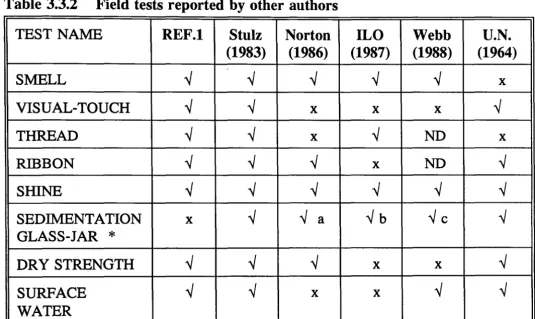
3.3.2 Field tests reported by other authors . . . 78
4.4 Average transmitted pressure recorded by L VDT' s . . . 119
4.8a Pressure transmission on full-pressure cycling . . . .. 130
4.8b Pressure values relating to figure 4.8c . . . 133
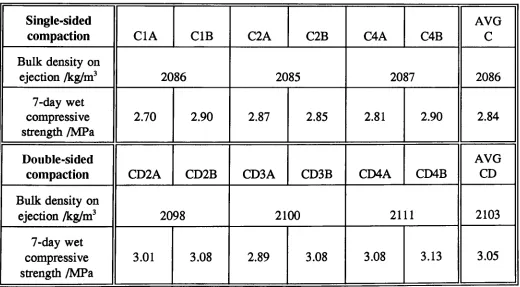
4.9.2 The compressive strength and bulk ejection density resulting from single and double-sided compaction methods. . . . 138
4.9.3a Pattern of strength distribution for standard single-sided compaction .. 142
4.9.3b Pattern of strength distribution for double-sided compaction . . . .. 144
5.5 The relative effects of pressure, energy and cement on compressive strength . . . 156
5.6a Block production cost comparison (Sri Lanka) . . . 163
5.6b Percentage breakdown of block costs (Sri Lanka) . . . 164
5.6c Block production cost comparison (rural Zimbabwe) . . . 165
5.6d Percentage breakdown of block costs (Zimbabwe) . . . .. 165
5.6e Block production cost comparison (if £6.00 per 50 kg of cement in Sri Lanka) . . . 166
5.6f Capital cost required of a high pressure compaction machine for economic parity with low pressure compaction ... . . .. 168
5.9a The effect of solar curing on block-side surface strength . . . 179
5.9b The effect of solar curing on surface strength for top and base block faces . . . 182
5.9c Wet compressive strength comparison between blocks manufactured by high and low pressure compaction subjected to standard and solar cunng . . . 183
6.7 Impact combinations used to generate a total impact energy of 464J .. 205 7.2 Comparison of compressive strength for a constant bulk density
LIST OF ILLUSTRATIONS
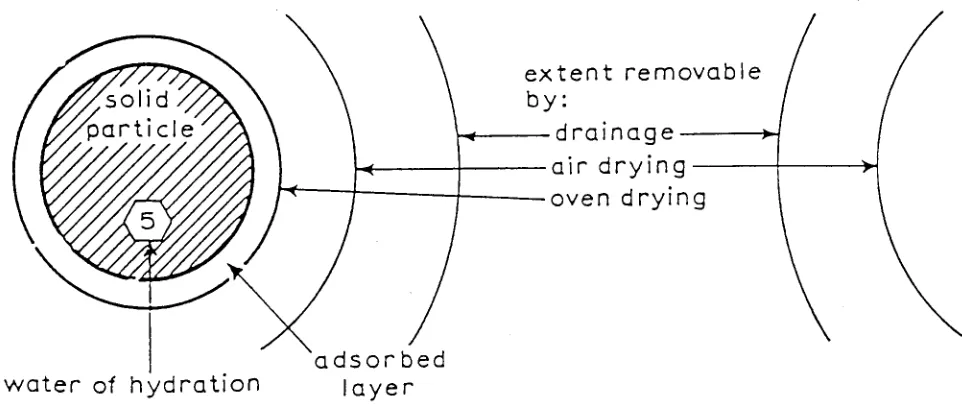
2.1.2 Water layers surrounding a clay particle . . . . . . . . . . . . . . . . . 41
2.3.2a Dry density plotted against water content . . . 55
2.3.2b Flocculated structure . . . 57
2.3.2c Dispersed structure . . . 58
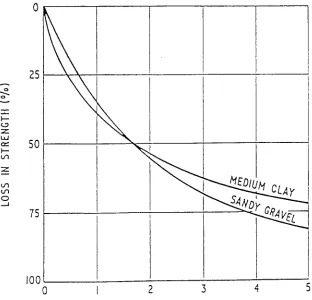
2.3.3 Cured strength loss due to compaction delay after West in Ingles & Metcalf (1972) . . . 60
3.2.2a Interpretation of Atterburg Limits . . . 70
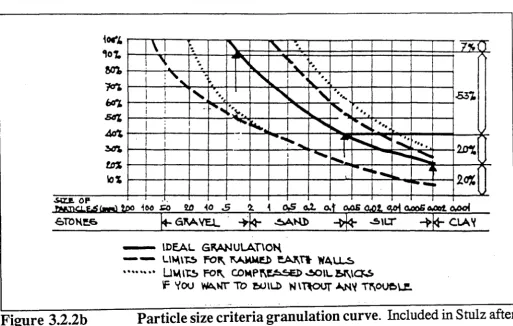
3.2.2b Particle size criteria granulation curve . . . 72
3.2.2c Triangular chart for particle size classification of soils . . . 73
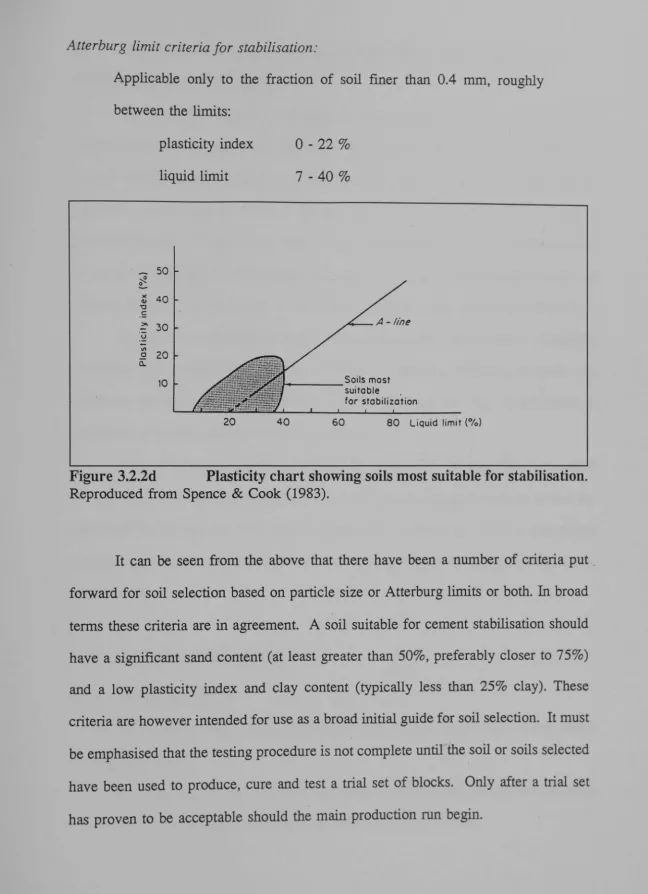
3.2.2d Plasticity chart showing soils most suitable for stabilisation . . . 74
3.4.3 Field testing tree to illustrate a coherent soil-testing plan . . . 100
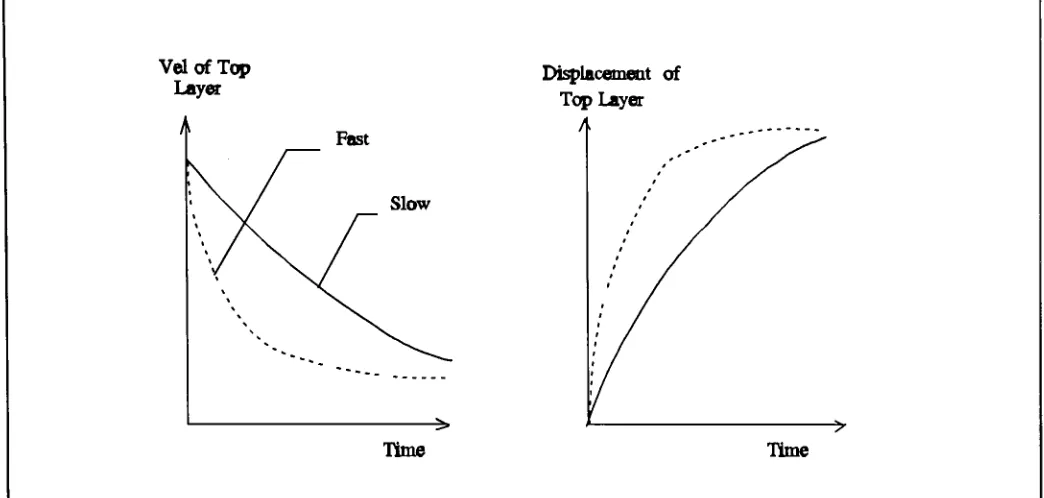
4.2.2 The rate of change of top layer velocity and displacement with time for pipe-flow behaviour . . . . . . . . . . . . . . . . . . . . . . . . . .. 109
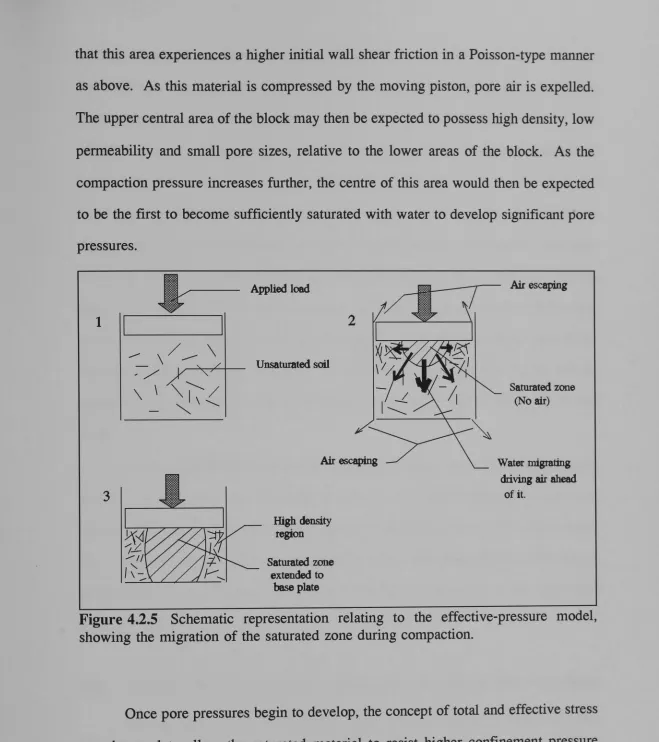
4.2.5 Schematic representation relating to the effective-pressure model, showing the migration of the saturated zone during compaction ... 113
4.4a The effect of applied top compaction pressure on pressure transmitted to the mould by the compacting soil . . . 117
4.4b The location of the LVDT transducers in the mould wall. . . . . .. 118
4.4c The effect of top pressure on block height during initial compaction and 4 subsequent full pressure cycles . . . . . . . . . . . . . . . . . . .. 120
4.5 The effect of double-sided pressure application on the pressure transmitted to the mould. . . . . . . . . . . . . . . . . . . . . . . . . . . . . . . .. 124
4.6 The effect of smooth walls on applied top pressure transmission . . . .. 126
4.7 The effect of 10
mould wall taper on applied top pressure
t . .
ranSffilSSlon . . . . 128
4.8a Pressure recorded on the mould wall (upper, central and lower) at the
peaks of 5 successive full-pressure cycles. . . . .. 130 4.8b The effect of top pressure on block height during compaction for 5
successive full-pressure cycles. . . . .. 131 4.8c The effect of partial pressure cycling on applied top pressure
transmission to the mould walls
.
. . .
.
. .
. .
. .
. . .
.
. . . .
.
.
.
.
132 4.9.3 Schematic representation of the identification sequence used whensectioning the blocks . . . 140 5.3a The effect of increasing compaction pressure on seven-day wet
compressive strength . . . 151 5.3b The effect of compaction energy on seven-day wet compressive
strength . . . 152
5.4 The effect of cement content on seven-day wet compressive strength.. 153 5.5a A contour plot relating compressive strength to cement content and
compaction pressure . . . .. 154 5.5b The relation of compacted bulk density to seven-day compressive
strength, when the cement content is kept constant . . . 157 5.8a The correlation of durability with the inferred compressive strength .. 171 5.8b The correlation of durability with dry density ... . . .. 172 5.8c The correlation of durability with compaction pressure. . . . .. 173 5.8d The correlation of durability with cement content . . . 174 5.9 The effect of compaction pressure on water loss when subjected to
simulated solar curing . . . 178 6.7 Energy used by the quasi-static compaction of a standard-size block to
7.1 a The effect of the number of impact blows on bulk density . . . .. 207
7.1b The density-energy-pressure relations for a quasi-statically compacted (standard-size) block . . . 208
7.1c The density-energy-pressure relations for a sample compacted quasi-statically in the impact cylinder mould. . . . .. 209
7.3.1 Density gain during discrete impact compaction . . . 213
7.3.3a The effect of momentum per blow on compacted bulk density ... 216
7.3.3b The effect of cumulative momentum on bulk density . . . 217
7.3.3c The effect of impact velocity on bulk density . . . 218
7.3.4a The effect of energy per blow per kg on bulk density . . . 219
7.3.4b The effect of Joules per blow on bulk density at different levels of total energy . . . 219
8.2a Schematic diagram indicating the spring/mass orientation used during the simulation . . . .. 233
8.2b Schematic representation of the spring constants used to simulate hysteresis . . . 235
8.3a Absolute layer displacement against time for a single blow from the 64 blow sequence of the 23.35kg impactor mass . . . 237
8.3b Absolute layer displacement against time for a single blow from the 1 blow sequence of the 23.35 kg impactor mass . . . .. 238
E1 LVDT transducer assembly drawing . . . 294
E2 L VDT transducer spring body . . . .. 295
E3 L VDT transducer parts . . . .. 296
E4 Calibration of the LVDT transducer No.1 . . . 297
E5 Calibration of the LVDT transducer No.2 . . . 297
E6 Transducer location sites in mould-side wall . . . .. 298
G Schematic diagram to illustrate the number sequence used to identify
the block sections tested for compressive strength 318
I Schematic illustration of scratch testing apparatus . . . 324
Kl Assembly drawing of the impact rig showing the pneumatic ram, guide tube, mounting points and base plate . . . . . .. 333
K2 Detail showing dimensions of the impact base on which the mould is located . . . .. 334
K3 Detail showing dimensions of lower mount collar which couples the lower guide pipe with the impact mould . . . 334
K4 Detail showing dimensions of top access mounting plate . . . 335
K5 Detail showing dimensions of top access mounting collar . . . 335
K6 Detail showing dimensions of datum mounting plate . . . 336
K7 Detail showing dimensions of upper ram mounting plate . . . 336
K8 Detail showing dimensions of upper ram mounting collar . . . 337
ACKNOWLEDGEMENTS
The author wishes to express his gratitude to Dr T H Thomas and Dr C E
Dram of the University of Warwick for their supervision of this thesis and their
valuable time spent discussing aspects of this research.
The author also wishes to thank Dr D J Petley and Dr D Anderson for the use
of their laboratory and office space.
Sincere thanks also to Mr eBanks, Mr D Smith and Mr G Hackett for their
assistance with the construction and operation of the experimental apparatus used.
DECLARATION
This thesis is the exclusive work of the author except for the numerical results
presented in section 5.8, The relation of block durability to compaction pressure and
cement content (pages 166 - 169). These results were obtained by Sutcfiff (1994), a
third-year undergraduate engineering student at the University of Warwick, who was
advised by the author.
1 INTRODUCTION
1.1
SOIL AS A BUILDING MATERIAL
Soil is one of the oldest building materials in the world. It is usually readily won and processed with only simple hand tools. The processed soil may be easily moulded or compressed to form a building material which possesses good compressive strength, while it remains dry. As some form of soil covers virtually the whole land surface of the earth it is not surprising that soil has been traditionally used for construction in all but the wettest climates, indeed it is probably still true that there are "more buildings in the world whose walls are built with soil than with any other material" Spence and Cook (1983). The large scale use of soil in the past and its continued widespread availability as a raw material suggests that it will continue to be a significant building material for the foreseeable future.
and poor dimensional stability. This experience with unstabilised soil structures has led to the association of soil with substandard or temporary buildings in the minds of many. This thesis is concerned with stabilised earth walling and stabilised soil building blocks in particular. Some mention will be made of the densification techniques common to rammed earth walling but other than this the traditional techniques for unstabilised construction are not covered. The bulk of the thesis focuses specifically on soil-cement.
The prime drawback to building with earth is that its compressive strength is lost when it becomes wet; even highly compressed rammed earth will revert to mud if it is subjected to prolonged water saturation. The aim of the various soil stabilisation processes is two fold, to increase the wet strength of the wall such that even after prolonged saturation the wall will not collapse and to increase the wall's durability thereby reducing the maintenance cost and extending the building's life. With successful stabilisation, soil may be fully comparable with other types of walling material.
Historically in many countries any buildings which were considered to be of importance were built of brick or stone, both of these materials being substantially more durable and requiring much lower maintenance than soil. However with the emergence of Soil Mechanics (the scientific study of soil) in the 1930's it became possible to specify and select soils for building in terms of their properties. The particle grading, plasticity and organic or soluble salt level could be used to help predict the suitability of soils for certain construction uses.
The modern methods of soil stabilisation were first developed forty years ago for the construction of roads and runways. Fitzmaurice (1958) noted that "There is now a large fund of scientific knowledge of soils and methods of stabilising them, but with a strong bias towards the special requirements of the highway and airfield engineer .... the problem at the present time is to translate some of the large fund of
knowledge in earth engineering to the needs of the builder in earth walling". Twenty five years later Spence and Cook (1983) seemed to echo Fitzmaurice, saying "There is a shortage of recent good works on soil and stabilised soil construction technology; some of the best reviews were published some years ago." Another ten years on Fitzmaurice's (1958) observation that "On the scientific plane, (earth) building has been somewhat neglected" is still true. Moreover the "large fund of scientific knowledge" to which he refers is becoming progressively harder to access as the various works are now long since out of print.
It is these early studies which form the basis for much of the construction done in the field. Indeed in many cases the more recent publications are somewhat misleading, reproducing earlier work out of context and misquoting to the extent that the original meaning of the work is lost.
As a result of this rather loose reporting, the literature review conducted at the outset of this research raised rather more questions than were answered. The following sections will describe the state of knowledge which has become apparent from the literature available to the author and outline the work which has been conducted to extend and unify this knowledge.
1.2
LITERATURE REVIEW
1.2.1 SOIL STABILISATION METHODS AND MECHANISMS
In general the published literature may be divided into two categories, one biased towards an academic overview and one towards the field practitioner. Very little laboratory-type academic research has been conducted.
The field practitioner texts describe how to stabilise a soil in various ways without conveying the basis for understanding why the various methods work. The stabilisation methods are frequently described in practical detail, even to the level of when and how to add water to the soil mix. However they appear to have been written as the result of practical field projects rather than the result of scientific study. They tend to make definitive statements on methodology which are unfortunately not universally applicable to all soil types, possible locations or machinery. The detailed level of instruction suggests to the inexperienced reader that the indicated method is the only acceptable one. Although practical detail is useful to the field worker, it is impossible to describe the most appropriate method for every situation. Instead it would appear far better to include sufficient theoretical background, presented in simple terms, to enable the individual project to determine which methodology is most useful. The general trend is to oversimplify or omit explanation of the mechanisms thought to be responsible. The more modem publications are particularly susceptible to this criticism.
Conversely the academically orientated texts provide explanations of the mechanisms involved but without the practical detail to enable actual production. There is no adequate text on soil stabilisation which contains both the practical and the theoretical information necessary to promote understanding and hence enable maximum production efficiency. Although the field-worker texts do contain references to the academic texts it is unlikely that their readers would be able to gain access to such material particularly as the references are frequently 30-40 years old. In summary, soil stabilisation methods are broadly understood although when examined closely the practical details are frequently misleading. Soil stabilisation is highly susceptible to faults resulting from poor understanding and consequent poor quality control, a comprehensive publication which includes both the practical and the theoretical information required to develop understanding is lacking.
1.2.2 SOIL AND STABILISER SELECTION AND TESTING
The selection of a suitable soil or the modification of an unsuitable soil is one of the most important stages in the production of stabilised soil-cement blocks. As soil constitutes at least 90% of the fmal block it should not be surprising that the type of soil has a profound effect both on the type and amount of stabiliser required and on the final properties exhibited by the block.
The soil testing procedures which are recommended by the literature may be divided into two groups; field tests and laboratory tests. The laboratory tests are generally recommended for "large" projects. These tests are either the British or American standard tests (B.S. or A.S.T.M). Both sets of test are well proven and accurate, however they require specialised equipment which is frequently not available in developing countries.
The field tests are simplified versions of the standard tests, requiring less complicated equipment which should be more readily available. These field tests are neither well proven nor adequately reported. The methodology described in the literature is frequently inadequate and in some cases incorrect.
At the outset of this research the author attempted to use a number of the field tests to classify several soils and as a consequence of the poor results conducted a systematic review of the tests in the available literature. The results of this review are presented in chapter three, while a recommended field testing procedure is included in Appendix B. Subsequent to this investigation, Dr Peter Walker of the University of Zimbabwe conducted a similar set of trials for the field tests reported in Norton (1986) and also concluded that the methods reported are inadequate.
A fundamental discussion which is frequently absent from the soil selection and testing literature is whether an existing and available soil should dictate the type of stabilisation process used or whether the type of stabilisation should infer the type of soil to be found. This issue is discussed briefly in chapter three although it is essentially beyond the scope of this thesis.
The criteria for selecting suitable soil varies significantly from publication to publication and usually lacks a discussion of how the various soil properties interact with the stabiliser and the effect of compaction pressure on soil selection. The concept of soil modification (improving soil properties by blending different soils) is very poorly covered from a practical viewpoint: soil modification is frequently
mentioned but no guidelines are given. Although the decision to modify the soil must be made on the information relevant to each individual site certain simple guidelines would be useful to the practitioner.
1.2.3 LITERATURE DESCRIBING THE STANDARD QUASI-STATIC MOULDING PROCESS
Introduction
The general trend in stabilised soil block production has been to use slowly applied pressure (quasi-static compaction) rather than either impact or vibration (dynamic compaction) to compact the soil-cement mixture. This course seems to have been followed without any detailed investigation into the benefits and drawbacks associated with this form of compaction. Rather it appears that pressure has been used as a result of early work done with the Cinva Ram, a very simple and robust pressure compaction device. This machine compacted the soil-cement mixture to a comparatively low pressure of typically 1.5 - 2 MPa. For pressure in this range such a manually operated lever-type press is adequate, however the blocks produced at this low pressure display poor properties (low values for wet compressive strength, fresh demould strength and durability) unless quite large quantities of cement are used. Moulding may be carried out under higher compaction pressures to enable a reduction in the amount of cement required, however above compaction pressures of 3-4 MPa a simple lever press is inadequate and a hydraulic circuit must be used. The incorporation of a hydraulic circuit renders the machines expensive (typically ten times as expensive as the Cinva Ram type) and slow (the hydraulic circuit must be
parts rather than simply the availability of a competent local fabricator as would be the case for a Cinva Ram.
Process factors affecting the strength of blocks
During the course of the literature review it became rapidly apparent that little study has been made of the quasi -static compaction process in terms of such process factors as the type of moulding machinery, orientation and force application.
No references have been found which describe the effect of altering moulding parameters, with the exception of the effect of compaction pressure on the cured strength of lime-stabilised blocks (Lunt 1980). The other parameters which could affect the block compaction process in terms of the absolute densification, distribution of density through the block and the ease of block ejection are mould-wall friction, mould-wall taper, applied pressure cycling and double-sided pressure application.
Lunt (1980) has shown for lime stabilisation of two soils with a high fines content, that an increase in quasi-static compaction pressure gives rise to an increase in cured compressive strength. This may be intuitively expected, as an increase in compaction pressure will result in an increase in green block density and hence an increase in cured block strength.
Lunt used the same stabiliser content throughout his investigation of increased compaction pressure concluding that "presses operating in the range 8 to 16 MPa could give satisfactory and economical results". If it is assumed that by increasing compaction pressure the block density and hence the compressive strength will be increased, then an important corollary is that for a constant strength raising compaction pressure allows cement content to be reduced. If highly compacted blocks are to be economical then for a given strength the increased plant costs and compaction time must be offset by an equivalent or greater cost saving in the stabiliser
quantity required. No investigation of such pressure-stabiliser trade off appears to have been conducted.
Moreover Lunt reported that the long term durability of the fmal cured blocks would be improved by higher compaction pressures, in this case durability was judged by a water spray-erosion test. As all of the blocks were made with the same stabiliser content and hence increased in strength as the compaction pressure was raised, it would be expected that durability would increase. What has not been examined is the change in durability of blocks of equal compressive strength produced under different combinations of compaction pressure and stabiliser content.
The cured strength required of the blocks appears to have been one of the prime reasons for the investigation of high pressure compaction. Webb (1988) has recommended that the cured wet strength should be 2.8 MPa (the minimum strength required of conventional concrete blocks), as with such a high wet strength the wall should be adequately durable without resorting to any external renderings. For low pressure compaction significant quantities of cement are required to produce such a strength (frequently greater than 10%). A less stringent strength standard of 0.7 - 1.4 MPa has also been used by a number of authors (first quoted by Fitzmaurice, 1958). These lower strength standards provide sufficient structural strength for single storey buildings but are generally inadequate for long term durability. Low strength blocks are therefore usually rendered to increase the building's durability. However rendering a low strength block has its own associated problems, because of the low dimensional stability of such blocks renders must be maintained at frequent intervals.
strength but moulded at different compaction pressures (hence having different dry
density, permeability and cement content) will have different durabilities. It is the
author's opinion that adequate durability, rather than high compressive strength, is the
key to widespread acceptance of soil-cement.
It may be argued that higher pressure compaction produces higher density
blocks which are hence less permeable to water and therefore will be more durable.
However it could also be argued that low pressure blocks, having a higher cement
content to compensate for their lower density, will exhibit increased particle restraint
and hence increased durability. Without testing it is impossible to say which factor
if either will dominate durability.
No report of any investigation of the transmission of pressure through the
block during the compaction process has been found. The transmission of the pressure
applied to the soil during compaction is of interest to mould designers to enable the
forces acting on the mould walls during compaction to be estimated and hence allow
the most economic use of mould-wall material to be made. It is also of interest in
evaluating the effectiveness of varying the moulding parameters.
It appears unclear on what basis the prevailing moulds have been designed.
As pressure transmission has not apparently been studied, the internal state of the soil
during moulding is unknown. If the soil attains a hydrostatic condition then the entire mould-box should be designed to withstand the pressure applied to the moving face.
Moreover if the internal conditions were hydrostatic then it may prove possible to
apply the compaction pressure to one of the smaller block faces, hence requiring a
lower static load, and still gain the same degree of densification. However if the soil
behaves as a very viscous fluid generating significant shear forces with the mould-wall
(as seen in fluid pipe flow) then the depth from the moving mould face which applies
the compaction pressure would be more significant. If this pipe flow-type wall friction were to prove significant then either true double-sided or "floating mould"
compaction should give increased densification without increasing the static load applied.
The compaction of semi -dry soil-cement shares certain similarities with the formation of both compacted sintered bearings and precast concrete elements. Both fields have been examined by the author in the course of the literature review but neither have been helpful. Several researchers have attempted to predict the internal compaction state for sintered bearings but none have been successful. Sintered bearing compaction is therefore only empirically tested.
A commercial literature search was conducted by the British Concrete Association to find any experimental or theoretical investigations concerning the compaction of semi -dry concrete used in the production of precast elements. This revealed little information, any predictive information which may exist appears to be regarded as a commercial secret and is not available in the public domain. The production of these elements is facilitated by very high pressure compaction with the purpose of expelling water from the mould through porous filter paper. The low initial water content of soil-cement mixes, typically 8-15% and the high cost of the expUlsion equipment and filter paper do not make this a viable process for the production of stabilised soil-cement blocks. Moreover the literature concerned with the "optimisation" of this compaction process centres around production efficiency in terms of plant and equipment location rather than compaction methodology. Concrete compaction by impact and vibration were also examined and are discussed below under "the dynamic moulding process".
Material properties affecting the strength of blocks
the field of block compaction is incomplete, particularly in terms of the behaviour of
freshly demoulded blocks that have been compacted at differing pressures.
The optimum moisture content for compaction is a prime example of a material
factor whose effects are well documented in the soil mechanics field but somewhat
lacking in the soil-cement literature. It is frequently not realised that the optimum moisture content is a variable which for a particular soil depends on the compaction
pressure used and to a lesser extent on the type and quantity of stabiliser added.
The field practitioner literature frequently sites an optimum moisture content
hand-test. For this test a ball of soil is dropped onto a hard surface from a height of
one meter. The manner in which the soil ball behaves on hitting the floor is taken to
be indicative of the moisture content relative to the ideal moisture content. This test
has been reported with at least four interpretations which are significantly different
and contradictory. As the optimum moisture content depends on the soil grading and
on the magnitude of force used to compact the sample this is not surprising. However
the lack of explanation, including mention of the compaction pressure for which the
test is suitable, renders such a test inadequate and possibly highly misleading. In at
least two papers (Hawkins (1988) & Perera (1993» the drop test was used to
determine the optimum moisture content for compaction. It was not clear which
interpretation of the test had been used and therefore whether the moisture content
used was the optimum for the situation.
Soil grading and plasticity are frequently used to define a soil's suitability for
stabilisation with cement as mentioned above. What is not clear from the literature
is the influence of compaction pressure on these selection criteria. In particular
breakage rates as high as 50%, for freshly demoulded blocks, have been reported by
Lawson (1992). The strength of freshly demoulded blocks depends on the fraction of
soil which is cohesive (clay) and on the demoulded density which in turn depends on
the compaction pressure used.
In summary, quasi-static compaction is sufficiently understood for a skilled practitioner to make useful blocks, if a thorough empirical testing procedure is followed. However there is little understanding of the compaction process at a
scientific level. High pressure compaction has been put forward as an economical
method of improving block properties but without sufficient scientific justification.
It has been proved that for a given soil with a given quantity of stabiliser high pressure compaction will produce stronger, more durable blocks. It appears that high
pressure compaction does have advantages if a wet strength of 2.8 MPa is required of
the blocks, as low pressure compaction requires large quantities of cement to achieve
such a strength. Even if high strengths are not required from the block, high pressure compaction and consequent increased density may provide increased strength for the
freshly demoulded block and reduce block breakage rates.
Regardless of the compaction pressure used the internal condition of the soil
mixture during compression is unknown. If the internal pressure transmission could be improved then the fundamental advantage of high pressure compaction, namely
high demould density, could be achieved without increasing the pressure beyond the
range which may be applied by a simple lever press machine.
1.2.4 THE DYNAMIC MOUWING PROCESS
In order to achieve the benefits of high pressure compaction without incurring the cost of a machine capable of supplying a sustained high force, alternative methods
of high force application need to be examined. The most simple way to generate a
high force is through impact. Although the magnitude of the force which may be
generated in this way is high, depending on the kinetic energy of impacting weight,
the duration of this force is very short, fractions of a second. Dynamic moulding is
the term used to refer to the compaction processes of impact and repeated impact
to investigate this method of compaction even though it appears to have potential advantages over quasi -static compaction. Research into dynamic compaction has been confmed to rammed earth walling. In this type of construction the soil-cement mix
is compacted either by a manual or a pneumatic ramming implement. The mix is placed inside solid shuttering and hence may be imagined to have considerably less lateral confinement than would be the case for block production. The data published in this field deals with the selection of ergonomic rammer heads such that the operator may continue to work for extended periods without diminishing compaction efficiency. This data is not transferable to the field of block compaction where hand or discrete pneumatic ramming would not be used.
Only one reference to block compaction by impact has been found, the work of Agas Groth (Groth 1984) conducted at the University of Warwick. This work showed that adequate soil-cement blocks could be made by impact-type dynamic compaction. This paper contained no firm information on how best to apply the impact blow or blows as only a small number of blocks were produced and the scatter in the results was too great. However this project did illustrate that blocks could be made by impact which were broadly similar to blocks compacted quasi-statically to 8 MPa. Agas's subsequent application of the technique to build two houses in Botswana in 1986 has not been documented.
The study of soil compaction techniques in the field of road construction and sublayer foundation preparation is somewhat more advanced, though still not completely understood. In particular, much attention has been given to the question of how best to compact a quantity of unconfmed soil. The link between road construction and block making is likely to be moderately close, the major difference being that for road and sublayer foundation compaction the soil is not finitely contained, at least not to the extent of a rigid mould-box. From a study of this
literature there appears to be pronnse in methods of compaction other than by pressure, namely impact and vibration (repeated impaction).
One early study of the performance of soil compaction plant conducted by the Road Research Laboratory, Road Research Technical Paper No. 17 (Williams & Maclean, 1950) studied the differing effects and efficiencies of six soil compaction machines: three smooth-wheeled rollers, two sheepsfoot rollers and one frog-rammer. The areas of the study which appear to be relevant to stabilised soil block production concern:
1. The number of passes of the plant required to bring the soil to a given degree of compaction, allowing a tentative estimate of process efficiency may be made.
2. The depth to which the soil may be compacted, and the degree of compaction reduction with depth, yielding a measure of the uniformity of compaction which may be expected.
The study was conducted with commercial compaction machines on a full size test track. Unfortunately the energy transferred to the soil by the machines was not quantified for each machine, in particular only the deadweight and base diameter of the frog-rammer machine were given, hence it is not possible to make a direct comparison on an applied energy basis. However general trends may be drawn if it is assumed that the machines are similar as suggested by Williams & Maclean.
The smooth-wheeled rollers may be considered to approximate to a slowly applied pressure which is repeated with successive passes. The sheepsfoot roller may be assumed to be a somewhat more remote approximation to a rammed earth (Pise de Terre) method, repeated discrete loads or small impacts. The frog-rammer may be
considered to approximate larger dynamic impact.
The general trend for all types of machine tested was an initial rapid increase in dry
density over the first few passes but thereafter the increase became progressively less.
This is a corroboration of the work conducted by Lunt (1980), confirming that density
increase diminishes with successive increases in applied compaction pressure.
The smooth-wheeled rollers gave full compaction (compaction to "refusal")
between 8 and 16 passes depending on the type of soil in question. The frog-rammer
gave full compaction with from 2 to 4 passes. The sheepsfoot rollers did not compact
to refusal, additional densification was still apparent after 64 passes. It should be
noted that for an unexplained reason one pass with the frog-rammer was equated to
six with the other types of plant for the purpose of comparison. It is not at all clear
from the text why this has been done, namely whether this was an attempt to equate
compaction energy entering the ground or the total energy required for the complete
operation, including the energy required for the necessary forward backward strokes
to cover the same area as a roller type. However by examining the graphical results
presented in the paper it could be seen that even equating one frog-rammer pass to six
roller passes, the rate of increase of dry density falls in the same range as that for the other equipment. If a unity comparison is possible, namely equating one compaction coverage of the rammer to one pass of the roller then the rammer rate of density gain
would exceed all others. Further the ultimate compacted dry density obtained with the
rammer was consistently one of the highest for all of the plant over all the types of
soil tested.
There was a correlation between the soil type and the more successful method
of compaction. Both the non-plastic (granular) soils, sand and gravel-sand-clay were
best compacted by smooth-wheeled rollers, while the most plastic (cohesive) soils,
heavy clay, silty clay and sandy clay were best compacted by the sheepsfoot rollers.
The frog-rammer was always just below the best compacting machine. Soil for
soil-cement blocks would ideally lie between the two soil types mentioned above.
The results of the field experiments to determine the density of compaction at depth showed that the frog-rammer was consistently able to compact a considerably greater depth of soil with a smaller falloff in density with depth than any of the other types of machine. (A rapid reduction of dry density with depth was found for the other plant.) This indicates that more uniform compaction is apparently possible with impact than slowly applied pressure.
The above results then suggest that compaction efficiency by impact, may be of the same (or greater) order as that for pressure, as judged by the rate of density gain. If efficiency is regarded in terms of soil surface area compacted per hour, as it was for this paper, then the frog-rammer is considerably less efficient, due to its lower net forward speed. However as the rammer's compaction is deeper than the rollers', if efficiency were judged on volume of soil compacted the balance would change. In
the case of stabilised soil block manufacture the efficiency would be judged in terms of the energy expended for the uniform compaction of a volume of soil and so impact would appear promising in terms of the uniform compaction with depth apparently obtainable. This supports the view that soil compaction may be successfully performed by methods other than slowly applied pressure. However it must be remembered that the soil tested was essentially unconfmed perhaps allowing easier escape for air and free water than would be the case for a confmed sample in a comparatively small mould. It would intuitively be the faster force application process, namely impact, which would be most affected by this. This factor could well negate the deep compaction benefit seen in road base construction, the trapped air
perhaps acting as an elastic shock absorber.
consequently the bearing capacity of many soils. A heavy weight, typically several tonnes, is dropped from a large height, typically 15-40m. The resulting "very high intensity" impacts have improved the soil mechanical characteristics to depths of 10-30m. The normal technique consists of dropping the mass over well defined intervals of time and space appropriate to the particular site character.
Two papers have been examined which deal with this method of compaction, "Theoretical and practical aspects of dynamic consolidation" by Menard & Broise and "Soil compaction by impact" by Scott & Pearce both contained in "Ground treatment by deep compaction" (I.C.E., 1976). Although these papers are again dealing with an essentially unconfined situation, where the movement of trapped gas and water may be significantly easier, some possibly relevant information may be gained from them. Menard's paper is primarily concerned with attempting to theoretically explain the practical aspects of the compression of saturated clay soil, a medium classically considered as incompressible when subject to rapid loadings, its low permeability opposing any rapid movement of pore water. Menard puts forward the theory that the observed compaction occurs as a result of the presence of micro-bubbles whose conditions of equilibrium are "more or less" (Menard) irreversibly modified by shocks or vibration. As energy is applied to the soil in the form of repeated impacts the gas gradually becomes compressed. As the gas volume approaches zero the soil starts to react as an incompressible material and begins to liquify. As a result of this liquefaction "a very slight local increase of pore-water pressure is sufficient to start a tearing of the soil tissues by splitting, and quite naturally the flow of liquid concentrates in these newly created fissures" (Menard). It is this apparent high permeability which would account for the escape of the pore-water and trapped gas. The regular pattern of tamping providing a network of these fissures sufficient to enable a general densification of the soil. It should be noted that these fissures are
"created regularly around the impact points", not directly beneath the impact zone.
This theory, if correct, could then explain the greater penetrating power of the
impact compaction devices in use for road base stabilisation. However compaction
of stabilised soil cement blocks by impact may appear less attractive. If it is the creation of these fissures around the impact point which are responsible for the greater
effect, then in the confined case these fissures may not form. Furthermore if they
were to form within the structure of the block they could act as possible stress
concentrators and hence reduce the strength despite an increased density.
However if the interface between the soil mixture and the mould could act as
such a fissure then impact may be viable, the distance for any trapped gas to travel
to an interface would be small for a typical block. If the soil-mould interface could act as a suitable fissure this would suggest that impact compaction may be better
applied to the smallest face of the block thus allowing the smallest travel path, rather
than the largest, as is currently the case. Indeed the primary drawback to "end
compaction", the poor compaction of the lowest material due to poor pressure
transmission in the case of slowly applied pressure would be overcome. Full
advantage of the greater compaction depth seen with impact could then be taken. The
pressure wave produced by the rapid deceleration of the weight is analogous to a
concentrated band of energy and penetrates further into the medium than the more
dispersed energy resulting from slowly applied pressure. However Menard's
explanation leaves several uncertainties for the confined compaction of a loose
essentially aerated soil, as would be the case for block making. Does the required
increase in soil permeability depend on soil liquefaction and if so can an aerated soil
be liquified at realistic energy levels? The key for block production by impact
appears, from Menard's work, to be fmding a suitable method of removing the
majority of air entrained within the soil to allow full compaction. Complete removal
of the contained air is not likely to occur without excessive energy application.
subsequently by compression then the effective stiffness of the soil may be increased such that an applied shock wave may propagate unattenuated to a greater depth. The cohesive nature of soil used for soil-cement might then restrain the expansion of this highly compressed air, generating a pressure gradient which would result in continued air expulsion even after the applied pressure peak has passed.
A third area which was considered was the compaction of conventional concrete by vibration. However the conventional concrete compaction process is concerned with the removal of air from a viscous liquid. Vibration is used to reduce the viscosity of the concrete such that air migration becomes possible under the influence of buoyancy. Conventional concrete vibration is not relevant to the compaction of soil-cement, soil-cement is a much drier medium.
One author has been found who examines the compaction of semi -dry concrete for the formation of precast elements (Manasjew, 1986). However this publication is only available in Russian, translation of which revealed that the information contained was somewhat confused and entirely empirical. It examined among other things the effect of decoupled vibration (small impacts) on submerged reinforcing bar but did not provide any relevant information for confmed compaction of cement stabilised soil.
A large scale machine has been developed which compacts soil-cement blocks by pressurised vibration. This machine is called the Dynaterre and is produced by Ets Raffin (France). As reported in Mukerji (1988), the research for this machine was carried out by the School of Architecture of Saint Etienne. Unfortunately it has not proved possible to gain access to this work. Repeated requests have been made to CRA Terre for information relating to the operating parameters of this machine but
these have not been successful.
1.3
THE STRUCTURE OF THIS THESIS
The preceding literature review has shown that the production system for
stabilised soil-cement blocks is not fully understood. This thesis has been split into
three parts, each of which deals with a separate aspect of production. The first, Part
A, examines the general processes of soil selection and stabilisation. Part B analyses
the process of compacting soil by slowly applied pressure (quasi-static compaction)
and presents the results of the research conducted in this area. Part C puts forward
dynamic-impact as an alternative method of compaction and presents the supporting
experimental evidence.
1.3.1 OUTLINE OF PART A (Chapters 2 and 3)
The first issue which is addressed is the fundamental one of theoretical
understanding of soil strength and stabilisation. If the users' theoretical understanding of the process is improved, then the need for care in soil selection and consistency in
production methods should become self evident, and self perpetuating. This part of
the thesis is concerned with assembling this theoretical information and presenting it
in a useful format alongside practical details of its application.
Chapter 2 explores what gives unstabilised soil its dry strength and how
successful stabilisation, by whatever path, allows some strength to persist even if the soil becomes completely saturated. The most common methods of stabilisation are
examined and an explanation of how certain soils are best suited to certain types of
stabilisation is given.
Cement-based stabilisation is then examined in more detail, paying special
attention to the much misunderstood concept of optimum moisture content and the
achieve a uniform quality and maximum benefit from the added stabiliser. A similar
discussion of soil compaction, block ejection and curing is given. It is shown that a process which on frrst sight appears to be very simple is in fact highly dependant on
skilled implementation for success.
By examining soil stabilisation in this theoretical way, it was hoped that a
more unified understanding of soil stabilisation techniques, in particular those
applicable to cement stabilisation would be forthcoming.
Chapter 3 examined the soil itself and methods of selecting a suitable soil. As
soil is the major constituent of a soil-cement block it is important that the most
appropriate soil available is selected. With a comprehensive set of field tests and a
good understanding of the role of each element of the soil constitution, the number of
soils used for any trial block production run may be greatly reduced by rejecting less
suitable soils at an early stage.
It was found that descriptions of field methods of soil testing in the literature
were confusing and on occasion incorrect, the drop test has already been sited above
as one such example. Chapter 3 surveys the published criteria for suitable soils and
examines the reported soil tests, highlighting methodological errors and areas for
caution. This chapter concludes with a proposal for a unified testing procedure,
illustrating how these tests may be best combined to maximise efficiency and
minimise experimental time. Such a unified testing plan has been universally omitted
from the published literature.
1.3.2 OUTLINE OF PART B (Chapters 4 and 5)
Part B of this thesis presents the results of a scientific study of the quasi-static
compaction process. Quasi-static compaction is the most common production method
for soil-cement blocks and yet none of the literature which has been examined has
attempted to describe the mechanisms behind it. Moreover the effects of relatively
simple variations to the moulding process are unknown. Both physical mould variations such as mould-wall friction and process variations such as pressure cycling might improve the efficiency of compaction, by increasing the compacted density resulting from a given compaction pressure. If simple process variations could provide the same benefit as higher pressure compaction then production economics could be easily improved.
Chapter 4 examines the effects of variations to the quasi -static moulding process by examining both the variation in pressure transmission through the soil and the overall gain in density. In this way the subsequent study of dynamic compaction in Part C has a fixed reference against which to be judged. The study of process variations also allows recommendations to be made concerning machine design.
The theory of the compaction process is also addressed. A number of simple models are put forward to describe the compaction process and then compared with the experimental results observed to assess their accuracy.
In order to assess the real economic benefit or disadvantage of the high pressure quasi-static compaction route advocated by Lunt (1980), the relationship between compaction pressure, cement content and fmal wet compressive strength is examined in Chapter 5. By producing a mathematical relation which allows the compressive strength of a certain soil to be predicted from its compaction pressure and cement content, an economic analysis can be constructed. This model can then be
used to investigate the fmancial saving resulting from reducing the cement content as a consequence of using high pressure compaction and compare this with the increased capital cost of a high pressure machine.
1.3.3 OUTLINE OF PART C (Chapters 6, 7 and 8)
high machine cost of quasi -static compaction machines out weighs them. Dynamic impact compaction is one method of generating very large forces, without requiring that a high force is sustained. It is likely that for a given degree of compression an impact-based machine would be less expensive than quasi-static one and hence might allow the practical advantages of high pressure compaction to become fmancially beneficial.
This Part examines the process of impact compaction to establish whether it can produce compacted samples of density equivalent to that produced by high pressure quasi-static compaction and whether the energy expenditure is broadly equivalent. The TRRL report has indicated that there may be additional benefits associated with impact compaction such as a more uniform density distribution resulting in a higher compressive strength and durability for a given total density. Chapter 7 examines the process of dynamic compaction, comparing energy, density and compressive strength with those occurring under high pressure quasi-static compaction. It establishes the potential merit of dynamic compaction. It examines the significance of impact blow momentum and energy on final compacted density and puts forward theoretical models to extend the understanding of confined dynamic compaction. Chapter 8 presents a computer simulation which is able to confmn some of the pertinent factors relating to the theoretical models put forward to describe dynamic compaction.
Chapter 9 is the final section of the thesis. It presents the conclusions from each Part of the thesis and argues the case for further research. The most pressing
areas for future work are then identified.
PART A:
CHAPTER 2
SOIL STABILISATION
METHODS AND MECHANISMS
2.1 UNST ABILISED-SOIL WALLING
2.1.1 INTRODUCTION
Naturally occurring soil is one of the most variable materials known. It is made up by five main solid fractions, organic matter, clay, silt, sand and gravel, besides air and
water. Organic matter is the decomposed remains of vegetable material and is
normally only present in the top stratum of soil. Gravel, sand, silt and clay form
bands in a size continuum1• Gravel and sand are generally referred to as the coarse
fraction while silt and clay are termed the fine fraction. Gravel, sand and silt are
usually chemically inert products of the mechanical weathering of rock, while clay is
usually the product of chemical attack and is able to take part in ion substitution
reactions2• The large variation in soil characteristics is a result of the differing
chemical compositions and angularities of these different size fractions which vary
with the type of parent rock from which they originate. The percentage shares of a
1. A number of different particle sizes have been used to define the break points
between gravel, sand, silt and clay. The standard used in this thesis is British Standard
1377.
2. Silt may be considered to have some cohesive properties but these are usually
negligible compared to the clay fraction.