warwick.ac.uk/lib-publications
A Thesis Submitted for the Degree of PhD at the University of Warwick
Permanent WRAP URL:
http://wrap.warwick.ac.uk/109296
Copyright and reuse:
This thesis is made available online and is protected by original copyright.
Please scroll down to view the document itself.
Please refer to the repository record for this item for information to help you to cite it.
Our policy information is available from the repository home page.
T H E B R IT IS H L I B R A R Y
BRITISH THESIS SERVICE
COPYRIGHT
Reproduction of this thesis, other than as permitted under
the United Kingdom Copyright Designs and Patents Act
1988, or under specific agreement with the copyright
holder, is prohibited.
T h is copy has been supplied on the understanding that it
is copyright material and that no quotation from the thesis
m ay be published without proper acknowledgement.
REPRODUCTION QUALITY NOTICE
T h e quality of this reproduction is dependent upon the
quality of the original thesis. Whilst every effort has been
m ade to ensure the highest quality of reproduction, some
pages which contain small or poor printing m ay not
reproduce well.
Previously copyrighted material (journal articles, published
texts etc.) is not reproduced.
E x c h a n g e R a te I n s ta b i lity a n d E conom ic R efo rm
w ith specific re fe re n ce to R u ssia n e x c h a n g e ra te refo rm s in th e e a rly 1990’s
M ichele C a ’Zorzi
T h esis S u b m itte d for th e D eg ree of PhD in E conom ics
Department o f Economics
University o f Warwick
March 1998
A b s tr a c t
This thesis is concerned with the origins of exchange rate instability and the scope for economic reform. Several aspects of recent macroeconomic instability in Russia are discussed which, we argue, reveal the origins of this problem.
The first chapter combines currency substitution and price stickiness. It aims to account for the weakness of the real exchange rate and the net accumulation of foreign exchange, that so frequently characterise unstable economies. The essence of the discussion is that, when faced with severe tight controls on capital, agents are able to substitute foreign currency for local currency via the current account. The model has a simple dynamic structure, similar to the Dombusch model.
The second chapter uses the Cohen and Michel procedure to extend the time inconsistency approach to an open economy, a-la-Dombusch framework. A special loss function is used, but the same methodology may be applied to address other economic issues. When time consistency is assumed, future loose monetary policies are foreseen and hence have current consequences We argue that the more the government has an inflationary instinct, the greater the experience of undervaluation and the fall in liquidity.
The third chapter builds on the work of the second. It is argued that even in this open economy. a-la-Dornbusch framework, the standard result holds: credibility is enhanced by delegating monetary policy to a conservative central banker. The economic consequences of this are twofold: a smaller real exchange rate undervaluation and a reduced fall in liquidity. In addition, we propose an extension of this analysis by letting currency substitution, between domestic and foreign assets, be the alternative assumption to perfect capital mobility. The assumption of currency substitution leav es largely unchanged the dynamic structure of the analysis, but gives rise to a quite different economic interpretation.
The fourth chapter describes the reasons why policy makers decide on restrictive foreign exchange policies. A currency substitution framework is used to highlight the consequences of foreign exchange leakages between official and black markets. The model is solved by applying the technique suggested by Dixit and Currie to determine the free variable as a function of the predetermined variables of the system
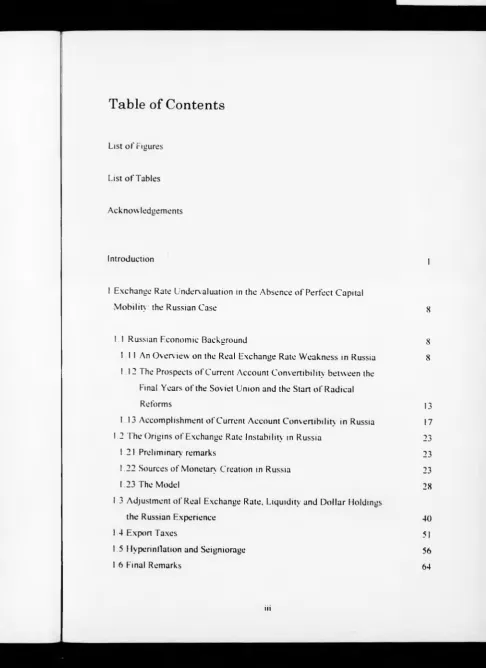
T a b le o f C o n te n ts
List of Figures
List of Tables
Acknowledgements
Introduction I
I Exchange Rate Undervaluation in the Absence of Perfect Capital
Mobility: the Russian Case 8
1.1 Russian Economic Background 8
111 An Overview on the Real Exchange Rate Weakness in Russia 8
112 The Prospects of Current Account Convertibility between the
Final Years of the Sov iet Union and the Start of Radical
Reforms ]3
113 Accomplishment of Current Account Convertibility in Russia 17
1.2 The Origins of Exchange Rate Instability in Russia 23
1.21 Preliminary remarks 23
1.22 Sources of Monetary Creation in Russia 23
1.23 The Model 28
13 Adjustment of Real Exchange Rate. Liquidity and Dollar Holdings
the Russian Experience 40
1 4 Export Taxes 51
1.5 Hyperinflation and Seigniorage 56
[image:6.558.45.532.18.687.2]2 Time Consistency in an Open Economy, a-la-Dombusch 67
2.1 Introduction 67
2.2 The Barro Model: Hyperinflation as Lack o f Credibility 73
2.3 The Dombusch Literature 80
2.4 The Model 86
2.5 Time Inconsistent Solutions 89
2.6 Time Consistent Solutions 97
2.7 Final Remarks 106
3 Exchange Rate Undervaluation and Institutional Reform 108
3.1 Introduction 108
3.2 Empirical Relationship Between Competitiveness and Real
Balances in Russia 114
3.3 Delegation of Monetary Policy to a Central Banker 119
3.4 Alternative Monetary Arrangement: Optimal Feedback Solution 125
3.5 Currency Substitution Extension 130
3.6 Final Remarks 135
Appendix A The Impact of the Discount Rate 137
Appendix B The Impact of the Semi-Elasticity o f Money Demand 139
Appendix C Do We Have a Time Consistency Problem if the Discount
Rate is Equal to Zero? 14 1
Appendix D The Impact of the Initial Value o f Real Balances? 143
4 Internal Capital Flight in a Black Market Exchange Rate Economy 145
4.1 Introduction 145
4.2 Economic Rationale for Restrictive Foreign Exchange Policies 150
4.3 Some Interesting Ideas from the Existing Literature 155
4.4 The Model 159
4.41 Black Market Current Account 160
4.42 A Currency Substitution Equation for a Black Market Economy 162
4.43 The Complete Model 165
4.44 The Steady State 167
4.45 Reducing the Model into a System of Differential Equations 170
4.5 Final Remarks 175
5 Conclusions 177
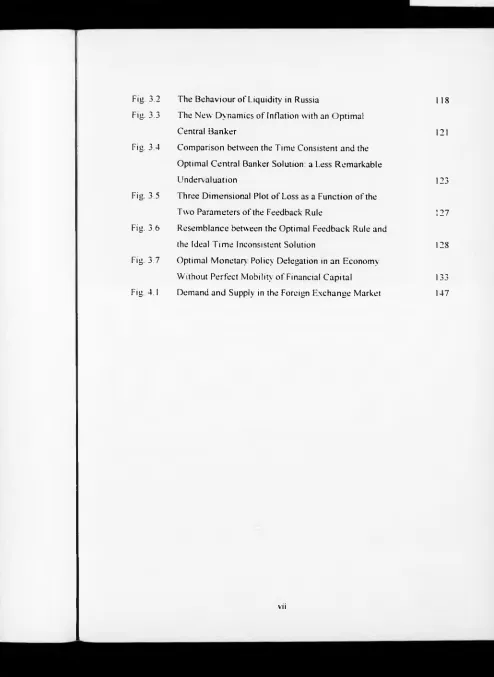
L ist of F igures
Fig. 1.1 Price Liberalisation 11
Fig. 1.2 Auction, Black and Effective Nominal Exchange Rates
before the July 1992 Reforms 19
Fig. 1.3 Dynamic behaviour with Xp> 1 36
Fig. 1.4 Dynamic behaviour with Xp < 1 36
Fig. 1.5 Internal Capital Flight 38
Fig. 1.6 Real Auction and Black Market Exchange Rates 41
Fig. 1.7 Dollar Deposits in Russian Commercial Banks 46
Fig. 1.8 OLS Regression between Competitiveness and Dollar
Deposits 47
Fig. 1.9 The Behaviour of Liquidity and Dollar Deposits 49
Fig. 1.10 The Joint Effect of a Higher Rate of Monetary Expansion
and an Export Tax on Competitiveness and Liquidity 53
Fig. 1.11 The Laffer Curve 58
Fig. 1.12 Short-Run Incentive to a Higher Rate of Monetary
Growth 62
Fig. 1.13 The Consequences of High Seigniorage on Internal
Capital Flight 63
Fig. 2.1 The Consequences of an Expansionary Monetary
Policy 85
Fig. 2.2 Time Inconsistent Paths for Monetary Growth and
Inflation 94
Fig. 2.3 Time Inconsistent Path for the Real Exchange Rate 95
Fig. 2.4 Violation of Belman's Principle of Optimality 96
Fig. 2.5 The Impact and Long Run Effect of a Time Consistent
Monetary Policy 104
Fig. 3.1 OLS Regression between Competitiveness and Liquidity 115
Fig. 3.2 The Behaviour of Liquidity in Russia 118
Fig. 3.3 The New Dynamics of Inflation with an Optimal
Central Banker 121
Fig. 3.4 Comparison between the Time Consistent and the
Optimal Central Banker Solution: a Less Remarkable
Undervaluation 123
Fig. 3.5 Three Dimensional Plot of Loss as a Function of the
Two Parameters of the Feedback Rule ¡27
Fig. 3.6 Resemblance between the Optimal Feedback Rule and
the Ideal Time Inconsistent Solution 128
Fig. 3.7 Optimal Monetary Policy Delegation in an Economy
Without Perfect Mobility of Financial Capital 133
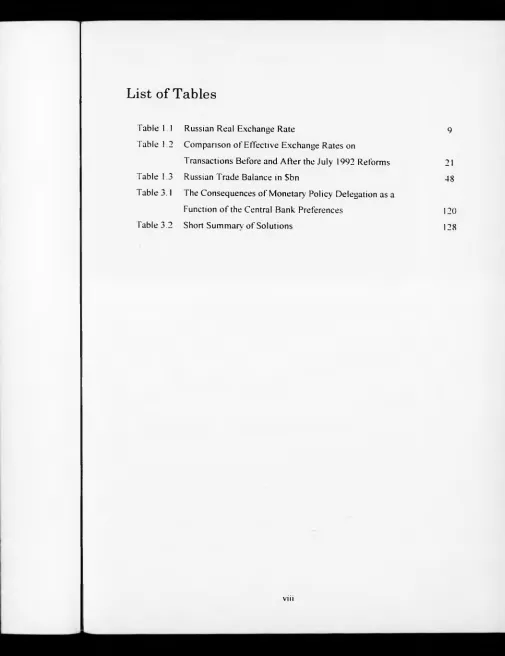
[image:10.546.27.521.12.689.2]L ist of Tables
Table 1.1 Russian Real Exchange Rate 9
Table 1.2 Comparison of Effective Exchange Rates on
Transactions Before and After the July 1992 Reforms 21
Table 1.3 Russian Trade Balance in Sbn 48
Table 3.1 The Consequences of Monetary Policy Delegation as a
Function o f the Central Bank Preferences 120
Table 3.2 Short Summary of Solutions 128
[image:11.550.24.529.19.675.2]A c k n o w le d g e m e n ts
1 would like to thank my supervisor Marcus Miller for his helpful comments,
academic advice and support throughout this work. I am also grateful to Neil Rankin
for insightful comments on chapter 2 of this thesis. Responsibility for all remaining
I n tr o d u c tio n
Horder (1997: 17) argues that "under the socialist system the main instrument for
savings was domestic money". However, long spells of high inflation during the
early 90’s have turned Russia into, what may be described as, a "cashless society",
(The Economist, 1997: 6) relying mainly on barter and foreign exchange This has
resulted in great economic instability giving rise to frequent criticism on how the
Russian authorities handled the economy during that period. It is. therefore, the
primary objective of this thesis to evaluate the early 90's Russian monetary policies
and foreign exchange market reforms, exploring whether this economic instability,
although unavoidable, could have been mitigated, and whether lessons can be drawn
for countries in similar circumstances. In order to discuss this, the thesis will be
organised in five chapters as follows:
In chapter 1, P.xchange Rale Undervaluation in the Absence of Perfect Capital
Mobility: the Russian ( use, we first review the reasons why radical reformers, such
as Yegor Gaidar and Boris Fedorov, were not in a position to halt the large monetary
flow, which the Russian economy was witnessing. At the same time, there is a
description of how, in a relative short time, Russia moved to a system of current
account convertibility, liberalised prices and favourable retention rules, the purpose
being to bring most of the economy back to legal channels.
This was certainly not an easy set of policies to cany out, considering the sudden
breakdown of monetary control in the rouble zone and the extent to which official
prices had been repressed. As pointed out by Bruno (1993: 16), current account
convertibility is a risky option in an economy without inflation hedges, since
"demand for foreign exchange reflects primarily a stock demand”. We maintain that
a currency substitution model is appropriate to describe the Russian economic
environment.
The simple model developed here shows how, even in the absence of perfect capital
mobility, a monetary expansion brings about the overshooting of the exchange rate.
The economic insight of the model is the following: the weakness of the exchange
rate improves the external position of the country, supplying the foreign exchange
needed to satisfy economic agents' portfolio demands. The possession of foreign
exchange as a store o f value is sometimes called internal capital flight' This is a
common alternative to a real capital flight whenever capital account restrictions are
in place. Both internal capital flight, and temporary real exchange rate weakness, are
standard features of unstable economies, which rely on printing money for financing
purposes. The model combines price stickiness and currency substitution, and can be
reduced to a linear system of two differential equations.
In chapter 2, Time Consistency in an Open Economy, a-la-Dornhusch, two different
models are presented:
I ) the first, is the Barro (1983) seigniorage model, which offers an insight to high
inflation, perfectly consistent with the hypothesis of the rationality of economic
commitment of a future tight monetary policy, economic agents understand the
government's great difficulties for financing the budget and hence correctly
foresee the real future monetary policies. Their response is to hold less money, so
lowering the inflation tax. It is a one period model;
2) the second, is the Buiter Miller (1981) model, which emphasises the
significance of the different speed of adjustment between the financial and the
goods market. The time horizon is infinity. A key figure of the whole analysis is
here presented: it is the phase diagram of the system of differential equations,
expressed as a function of the real exchange rate, c and of real balances. / The
stable manifold of the system allows one to examine the overshooting of the
exchange rate in the aftermath of a monetary shock.
The aim of this chapter is to integrate these two models in a common theoretical
framework. The first problem to consider is how to make the time horizon of the two
models compatible This is solved by postulating a policy maker who minimises a
quadratic discounted stream of costs over an infinite time period, subject to the
Buiter Miller model. Thus, it is an optimal control problem
After having calculated the standard optimal control solution, it is important to refer
to the time consistency literature. In fact, the derived solution violates Belman's
principle of optimality. So far this is the time inconsistent solution.
Thus, it becomes necessary to find an alternative wav to calculate the time consistent
solution Our analysis refers to the Cohen and Michel (1988) article, where it is
shown how standard control theory should be modified to obtain time consistent
solutions in a dynamic framework with forward looking variables. The derivation of
the time consistent solution, suggested by the Cohen and Michel technique, requires
the assumption of a predetermined linear relationship between c and / . The
application of this method allows one to reduce the number of state variables to only
one, /.
The time consistent solution to the above problem, can be represented by a phase
diagram entirely analogous to the one characterised by the Buiter Miller model The
crucial difference is that the growth rate of money is here endogenous. The exchange
rate overshooting critically depends on the policy makers' aversion to inflation. The
model therefore predicts that the greater the government's need to finance the deficit
and to subsidise the debts of enterprises by printing money, the greater the real
exchange rate jump As a consequence, the analysis can justify the scale o f the
Russian undervaluation
In chapter 3, Exchange Rale I 'ndervaluaimn and In.slitmional Reform, our objective
is to apply the previous analysis to the Russian undervaluation experience. Firstly,
we maintain that it is important to verify whether the empirical data at our disposal
gives some support to the theoretical analysis. There seems to be some evidence that
the real exchange rate appreciation and fall in real balances had a common trend,
thus giving empirical support to chapter 2.
This begs the question whether institutional reform would have been the appropriate
response to the government’s policy credibility problem. For example, recent
well-known issue of monetary policy delegation. The standard result, that the
optimal central banker should be conservative, holds here.
The really interesting point here is the possibility of extending the key Buiter Miller
figure, to the context of monetary delegation. Our analysis reaches the conclusion
that, if Russia had replaced Gerashchenko, by appointing a suitably conservative
central banker, the adjustment path would have remained similar but less harmful.
Enhanced credibility signifies both a smaller real exchange rate undervaluation, and
a larger tax base for seigniorage.
Finally, we extend the currency substitution model developed in chapter I. Exchange
Rate Undervaluation in the Absence o f Perfect Capital Mobility: the Russian Case,
to the constraint of time consistency. It can be shown that, with monetary policy
delegation, not only the exchange rate weakness is reduced, but so is also the overall
stock of foreign exchange held by the private sector.
In chapter 4. Internal Capital blight in a Black Market Exchange Rate Econoniv we
explore the reasons why black market exchange rates develop and the likely
consequences on the remaining macroeconomic system
Russian radical reformers encouraged exporters to act through legal channels by
easing the foreign exchange surrender rules. Over time, significant steps were made
to ensure current account convertibility, and. in addition, there were no serious
attempts to defend the rouble or to restrict current account convertibility after July
1992. This was certainly courageous
[n similar circumstances policy makers frequently prefer to keep the domestic
currency artificially overvalued. This is the single most important factor originating a
black market exchange rate, as the existing literature confirms.
We develop a stylised black market exchange rate economy. Frustrated demand
spills over into the black market exchange rate. Exporters are compelled by law to
supply dollars into the official market; however if there is a black market premium,
they are ready to under invoice their revenues and divert dollars into the black
market. Thus, even when retention rules are tight, internal capital flights are still
possible, if the black market current account is positive. Net accumulation of foreign
exchange is achieved with illegal means. For this reason it may be referred to as
illegal internal capital flight.
Technically, we combine a currency substitution equation, an equation for the black
market current account and finally, an equation for reserves The model can be
reduced to a non-linear system of differential equations. Subsequently, we solve the
model by applying the technique suggested by Dixit (1980) and Currie (1985) to
determine the free variable as a function of the predetermined variables of the
system. This allows us to examine what the impact effect is of exogenous changes of
both money supply and of the official exchange rate. As regards a monetary
expansion, the analysis arrives at the standard result that a monetary expansion leads
to a rise in the black market premium. Such a rise spurs exporters' willingness to
divert more hard currency into the black market, hence satisfying the greater foreign
As regards an official exchange rate devaluation, we explore Morris’ argument
(1995) that this is likely to be a successful policy, if the country' is a net receiver of
foreign aid. On the other hand, if the country relies on an overvalued exchange rate
as a implicit source ot revenue, a devaluation has a negative fiscal impact, possibly
undermining the stabilisation attempt.
Finally, in chapter 5 we attempt to summarise the main arguments which have been
discussed throughout the thesis and to suggest further developments of this research.
Chapter 1
E x c h a n g e R a te U n d e r v a lu a tio n in th e A b se n c e of
P e rfe c t C a p ita l M o b ility : t h e R u s s ia n C a se
1.1
Russian Economic Background
1.11 An O verview on th e Real E x c h a n g e R ate W e a k n e ss in R u ssia
In the early 90‘s currencies have typically been weak in the former USSR and
Eastern Europe. While economists often recognise the dangers of having overvalued
currencies, in terms of losses of export markets, which may never be recovered
(Dornbusch, 1988: 80-107), they tend to be less concerned with the risks of
undervalued exchange rates. Indeed, when the exchange rate is fixed to a nominal
anchor, it is conventional wisdom to be cautious and initially choose a weak parity
for the exchange rate. However, the extent and scale of the undervaluation
phenomenon in Eastern Europe and Russia in the early 90’s have been so impressive
that their economic causes and consequences cannot be ignored. Bruno, for instance,
rate valued foreign exchange at roughly ten times more that the PPP parity, while in
Russia in 1991-1992 the exchange rate reached the high peaks of 15 or 20 (Bruno,
1993: 16) times such a benchmark value. The large size of the Russian
undervaluation in the early 90's is also broadly confirmed by the statistics gathered
in a recently established journal, Russian Economic Trends (see Table 1.1), which
monitors the progress of the Russian economy.
T a b le 1.1 R u s s ia n R eal E x ch an g e R ate
A ctual/PPP 1991
D ecem ber 33.3
1992
Januarv h i
Februarv 9.1
M arch
r n
April 5.9
Mav 4.3
•lune 3.6
July 3.8
August 4.2
Septem ber 4.8
O ctober 6.7
N ovem ber 6.7
D ecem ber 5.3
1993
Januarv 4.6
February 4.8
M arch 4.6
April 4.6
Mav 4.6
.1 une 4.6
July 3.4
August 3.1
(source: Russian E conom ic T ren d s1. 1993: 25)
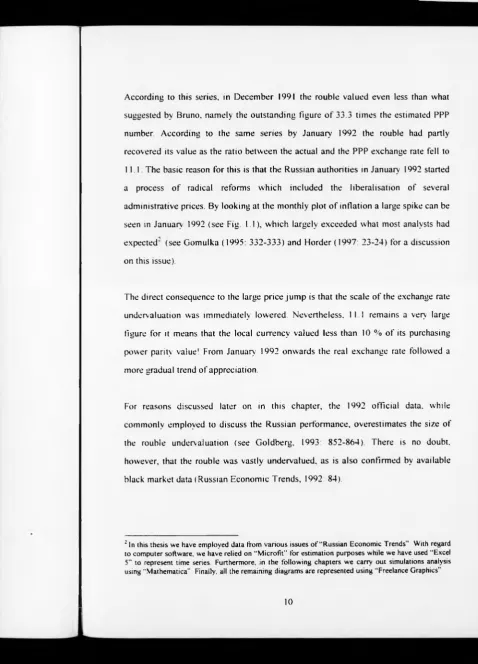
According to this series, in December 199! the rouble valued even less than what
suggested by Bruno, namely the outstanding figure of 33.3 times the estimated PPP
number. According to the same series by January 1992 the rouble had partly
recovered its value as the ratio between the actual and the PPP exchange rate fell to
11.1 The basic reason for this is that the Russian authorities in January 1992 started
a process of radical reforms which included the liberalisation of several
administrative prices. By looking at the monthly plot of inflation a large spike can be
seen in January 1992 (see Fig. 1.1), which largely exceeded what most analysts had
expected' (see Gomulka (1995: 332-333) and Horder (1997: 23-24) for a discussion
on this issue).
The direct consequence to the large price jump is that the scale of the exchange rate
undervaluation was immediately lowered. Nevertheless. Il l remains a very large
figure for it means that the local currency valued less than 10 % of its purchasing
power parity value! From January 1992 onwards the real exchange rate followed a
more gradual trend of appreciation.
For reasons discussed later on in this chapter, the 1992 official data, while
commonly employed to discuss the Russian performance, overestimates the size of
the rouble undervaluation (see Goldberg, 1993: 852-864). There is no doubt,
however, that the rouble was vastly undervalued, as is also confirmed by available
black market data (Russian Economic Trends, 1992: 84).
[image:22.550.25.504.12.677.2]The weakness of the Russian exchange rate did not remain unnoticed by world
economic investors as it provided the opportunity to acquire Russian assets at low
prices. This is shown, for example, by the following extract taken from the
Economist (1994: 94):
To most people the Weimar Republic signifies economic collapse, social turmoil and, eventually, the rise of Hitler Marc Faber, a Hong Kong-based investor, takes a different view, “the Weimar hyperinflation”, he says, “provided the best buying opportunity for German shares this century”. Mr Faber uses Daimler to prove his point. By November 1922, the company's market capitalisation was 980m paper marks. A single Daimlercar then cost 3m paper marks, so it would have been possible to buy the whole company for the price of only 327 of its cars. The opportunity was short-lived, however In 1923 a speculative fury gripped the German stockmarket, which rose 15 times, measured in dollar terms. Mr Faber believes that Russian assets are now almost as undervalued as German ones were in 1922. He is not alone. In the first quarter of this year foreign portfolio investors put an estimated S400m into shares of Russian companies. Longer-term strategic investors have pumped in far more: over the past four years they have committed S 1 1.6 billion
In addition to all the legal opportunities to buy Russian goods and assets cheaply, a
massive exchange rate undervaluation prompted all kinds of illegal activities to
flourish (see Goldman 1996: 1 17). Surrender rules, export licenses and quotas were
supposed to hinder the underselling of national resources to foreigners, but rogue
traders often managed to find ways to elude the existing tax system. As Aslund
(1995: 150) says.
"rogue traders were depriving Russia of its national wealth by selling raw material cheaply abroad. Undervoicing was chronic, often because the exporters did not own the products they exported to their own benefit. The call fo strict export controls was overwhelming.”
To halt the damage caused by these frauds and by the general complexity of the
simplify foreign exchange rate rules and over time to complete all the necessary
steps to attain current account convertibility. Above all. it was vital to carrv out
economic reforms which would encourage exporters to channel hard currencies
through official markets
1.12 T he P ro sp e c ts o f C u rre n t A ccount C o n v e rtib ility b etw een th e F in al
Y e a rs o f th e Soviet U nion a n d th e S t a r t of R adical R eform s
It is well-known that during the years of Communism, currencies had not been
convertible and all trade matters had been settled by the Council of Mutual
Economic Assistance. The countries involved in such a system were:
Czechoslovakia. Hungary, Poland, Bulgaria. Romania and the USSR. Trade was
recorded bewteen the CMEA countries at the International Bank for Economic
Cooperation in Moscow. Payments were carried out in national currencies and the
common unit of accountancy was the Transferable Rouble. In practice exchange
rates were established by political agreement, while to a large extent trade was
bilateral as deficits between any two countries could not persist for long.
In short, the system was plainly biased against trade The rationale for this pattern of
trade was the communist notion that trade is not growth enhancing - through
competition and variety - but essentially is only a necessity required by the different
allocation of resources across countries. With the defeat of Communism, the concept
that trade itself is an engine of growth revived, and convertibility, therefore,
suddenly became an objective for all the CMEA countries.
As it is well known that the IMF regulation (Article 8 Section 2) explicitly requires
current account convertibility with the following objectives:
1) to bring the correct price signals to the market
2) to increase the size of the market, reducing any existing monopoly power
3) to allow a wider consumption choice to consumers
4) to allow a greater choice of inputs to producers
As tar back as November 1989, the Soviet Union had started moving in this direction
by introducing currency auctions. As Goldberg (1992: 6) says “this marked the start
of a period of exchange-rates movements that in principle would be driven by market
forces". In theory. Soviet exporting enterprises could sell hard currency on a
voluntary base In practice, however, in 1989 surrender requirements rules were still
extremely severe, as the fraction of foreign currency earnings which could be freely
allocated in these markets was less than 10 percent. Thus, the early foreign-currency
auctions which took place in the Soviet Union "have been characterized by a
distinctive shortage of exporters willing to voluntary sell foreign exchange"
(Goldberg 1992: 7) As a consequence, not only was it necessary to ration foreign
exchange demand, but, in several circumstances, the Central Bank of Russia (CBR)
had to intervene to defend the rouble by depleting its hard currency reserves.
Moreover, the Soviet Union was characterised by a system o f multiple exchange
rates which survived up until 1992. It was particularly complex: for each currency
transaction a different exchange rate was applied which depended on both the region
and the goods traded. Hence, it is not surprising that the Soviet economy -
liable to all kinds of frauds. In general, exporters were compelled to sell their foreign
exchange at unfavourable prices, whilst some importers were given the opportunitv
to buy hard currency at exceptionally advantageous prices. All unsatisfied demand
for hard currency inexorably spilled over into the black market. As exporters
recognised the existence of this residual demand, they were more than willing to
divert part of their hard gained currency into the parallel market.
Before long the Russian political scene was going to experience major changes
which would step up the process of economic reform. On June 12 1991 Boris Yeltsin
was in fact elected President of Russia and later in the same year, between the 19th
and 21st of August, an abortive Communist coup took place, undermining
Gorbachev's leadership For some time the Soviet Union seemed to be on the brink
of both social and economic collapse (Aslund, 1995: 52):
"The severity o f the acute financial crisis of 1991 can hardly be exaggerated. The Soviet budget deficit had risen to at least 20 percent of GDP. and it had skyrocketed out of control. International financing had been exhausted, and the USSR defaulted on its foreign payments in December 1991. The USSR suffered from a combination of high and rising inflation, and it endured massive shortages and long queues because of a huge monetary overhang."
Until then Russia had managed to prevent the outburst of a fully-fledged
hyperinflationary process by strictly controlling administrative prices. However, it
turned out to be impossible to halt large wage increases, as well as to control credit
and social expenditure Hence the Russian economy was suffering from a large
monetary overhang which soon led the way to a dangerous supply collapse: prices, in
fact, were low to the point that it had become hardly worthwhile for producers to
keep up production or to sell goods in official stores. Furthermore. Russians started
storing goods and, more and more frequently, buying and selling foreign currencies
in black markets.
While credit to enterprises seemed to be boundless, money was becoming
increasingly meaningless as it hardly served the purpose of buying consumption
goods. Large enterprises, especially, were subject to soft budget constraints as "'the
state netted out debts between enterprises at the end of the year and offered cheap
loans to cover those enterprises that had deficits" (Aslund 1995: 178). So they had no
need to economize on real balances and no need to borrow at demanding
"commercial rates'. All balance sheets difficulties could be simply resolved by what
Skidelsky and Halligan (1996: 28) have aptly defined as "phone call financing"
Clearly these policies could not be sustained for long. Two political developments in
fact shook Russia in December 1991 On the 8th of December the USSR was
abolished in accordance to the agreement signed in Belovezhsky by the leaders of
Belarus, Russia and Ukraine In the same month Yegor Gaidar was appointed as
Minister of the Economy and Deputy Prime Minister of Russia and launched a set of
radical reforms Gaidar persuaded Yeltsin that it was absolutely necessary to
eliminate as soon as possible the large monetary overhang by liberalising
administrative prices. This policy needed to be matched by a substantial
improvement in the government budget, reducing at least one of the main causes of
inflationary pressure. Arms procurement, state investments and subsidies were
immediately curbed. Several payments were also delayed: a policy which in the short
run reduced the need to finance the deficit by printing money Social expenditures
were, on the other hand, not immediately targeted with the clear objective to reduce
establish personal taxes, as it was extremely hard for the bureaucratic establishment
to collect them. Taxes needed to be primarily levied on large enterprises, because it
was easier to monitor their payments. In January 1992 VAT was then introduced at a
unified rate of 28 percent with the aim to add revenues to those from the already
existing profit and payroll taxes.
Radical reformers wished to attain currency convertibility by replacing all the
complex surrender requirements regulations, licenses, and multiple exchange rates
with a much simpler system of tariffs (Aslund 1995: 11). However, they decided to
liberalise foreign exchange markets with a gradual strategy as they were anxious of
not being capable of collecting export and import taxes. Moreover, it proved very
difficult to win over all the existing vested interests, which were particularly strong
in the import sector.
1.13 A ccom plishm ent o f C u r r e n t A ccount C o n v ertib ility in R u s s ia
At the beginning of 1992 the Russian government decided to push forward foreign
exchange market reforms with the intention to achieve current account
convertibility As regards the export sector, from January 1992 the system of
multiple currency coefficients was abolished, but the following surrender rules were
established: 40 percent of currency earnings would now be sold to the Hard Currency
Hoard of the CBR at the extremely unfavourable rate of 55 roubles per dollar. An
additional 10 percent would be surrendered to the Central Bank's Stabilisation fund
"at what was supposedly the commercial rate which was fixed at 100 roubles per
dollar" (Aslund 1995: 148) All the remaining hard currency could be either
deposited in Russian bank accounts or built up to buy imports or, as final alternative,
sold in the free market exchange rate, in Moscow through currency auctions which
regularly took place twice a week. The clear objective was to develop an official
currency market while maintaining the revenue for the state from the exporting
sector.
As regards the import side "so-called centralized imports persisted for vital goods,
with a multitude of highly subsidized currency coefficients.” (Aslund 1995: 148).
Residents were entitled to acquire foreign exchange on these official markets as long
as they possessed a regular import certificate (Russian Economic Trends, 1992 1.1:
32).
Although regulations had become more favourable, exporters were still reluctant to
proceed through legal channels As a matter of fact, during the first currency auctions
the foreign exchange market remained, as a rule, very thin' - the whole weekly
turnover on the main market in Moscow did not exceed S 15 million At first sight
this seems odd. considering that during the first half of 1992 in these auction markets
the dollar was sold at exceptionally high prices, well above the corresponding black
market values (see Fig. 1.2). Note, for example, that the auction exchange rate
peaked on the 28th of January 1992 at 230 roubles to the dollar while on the same
day the black market exchange rate was valued at the much smaller rate of 128
roubles to the dollar1
However, if an effective exchange rate series is defined which accounts for the
existing surrender rules', the spread between official and black market prices
becomes much smaller (see Fig. 1.2), thus explaining why exporters were still
reluctant to channel Foreign exchange transactions through legal markets.
Another good explanation For the rouble weakness in these auction markets is that
exporters were not compelled to sell a halF oF their earnings. In view oF the highly
inflationary climate, they generally preferred to deposit Foreign exchange into
Russian bank accounts. For this reason, it was the Central Bank oF Russia which had
in several circumstances to provide the necessary resources to ensure that auction
markets would take place.
The above discussion also clarifies why throughout the first halFoF 1992 the auction
Foreign exchange figures, as published in Russian Economic Trends, overestimate
the undervaluation of the rouble. To put it briefly, exporters were not offered a good
deal such as official numbers seem to suggest. This discussion also help explain why
changes in legislation regarding surrender and retention rules affect the reliability
and quality of official data.
Looking at the spread between the black and effective exchange rate (see Fig. 1.2),
the black market premium was negative in the first few months of 1992 This
suggests that at the outset of reform the Russian authorities were prepared to pay an
implicit subsidy to exporters, with the objective of bringing foreign exchange
transactions back to legal markets.
But soon after there was a return to a more standard situation of a positive black
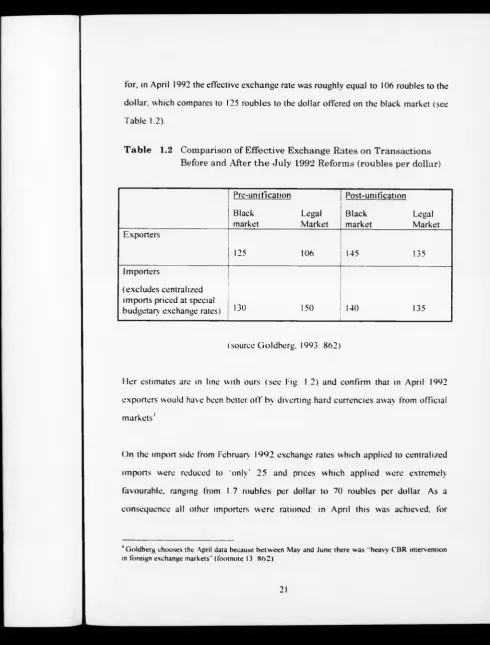
market premium Goldberg (1993) has for example estimated that, if all the existing
for, in April 1992 the effective exchange rate was roughly equal to 106 roubles to the
dollar, which compares to 125 roubles to the dollar offered on the black market (see
Table 1.2).
T a b le 1.2 C om parison of E ffectiv e E xchange R a te s o n T ra n sa c tio n s Before an d A fter t h e J u ly 1992 R eform s (ro u b les p e r dollar)
Pre-unification
Black market
Legal Market
Post-unification
Black market
Legal Market Exporters
125 106 145 135
Importers
(excludes centralized imports priced at special
budgetary exchange rates) 130 150 140 135
(source Goldberg. 1993: 862)
Her estimates are in line with ours (see Fig 1.2) and confirm that in April 1992
exporters would have been better off by diverting hard currencies away from official
markets'
On the import side from February 1992 exchange rates which applied to centralized
imports were reduced to "only" 25 and prices which applied were extremely
favourable, ranging from 1.7 roubles per dollar to 70 roubles per dollar As a
consequence all other importers were rationed: in April this was achieved, for 4
4 Goldberg chooses the April data because between May and June there was "heavy CBR intervention in foreign exchange markets" (footnote 13 HO2)
[image:33.547.21.512.22.668.2]example, by setting the exchange rate at 150 roubles per dollar, which was an even
more expensive price than the 130 roubles required in black markets (see Table 1.2).
Goldberg's conclusion is that before July 1992 there was still an incentive to
exchange currencies on the black market exchange rate for both exporters and
importers.
From July 1992 onwards surrender rules were substantially relaxed. Thereafter 50
percent of all earnings could be retained, while the remaining part had to be sold to
the CBR (30 percent) and to the Russian currency market (20 percent) (Aslund.
1995: 148)5.
These final changes turned out to be sufficient to unify the exchange rate for all
goods traded - with the exception of centralized imports - and to establish current
account convertibility: Goldberg estimated that this was achieved at the approximate
rate o f 135 roubles to the dollar (see Table 1.2). Over time the Moscow Interbank
Foreign Currency Exchange (MICEX) became gradually more important in terms of
weekly turnover, until finally currency auctions became a daily feature.
The basic objective of the above discussion has been to describe how. in a relative
short time. Russia moved to a system of current account convertibility, liberalised
prices and favourable retention rules, the purpose being to bring most of the
economy back to legal channels. As a final remark to this section, it is important to
note that the Russian authorities decided to preserve tight administrative controls
with regard to capital account transactions. Experience with capital flights advised
against even more radical foreign exchange reforms.
1.2
The Origins of Exchange Rate Instability in Russia
1.21 P re lim in a ry R em ark s
As we saw in section 1.1, there is overwhelming evidence that in the early 90’s the
rouble has been undervalued. Such an undervaluation has persisted, possibly even
strengthened, when the Russian authorities decided to relax the existing retention
rules and move to a system of current account convertibility
It is not easy to identify the key aspects of currency weakness and to relate the
Russian and other episodes of exchange rate undervaluation to a standard theoretical
background. The first possible reference at our disposal is the overshooting
literature, which says that, given perfect capital mobility, loose monetary policies are
matched bv undervalued exchange rates. The classic insight of this literature is that
expansionary monetary policies reduce the attractiveness of the local currency , to the
point that agents are no longer willing to hold it unless it becomes sufficiently cheap
to compensate for the low nominal interest rate. Before attempting to develop a more
formal analysis accounting for the Russian financial crisis, we think appropriate to
first review the sources of monetary creation in Russia
1.22 S o u rces o f M o n etary C re a tio n in R u ssia
By all accounts it is certainly the case that Russia could not immediately halt the
enormous growth in the rate of money supply. As Skidelsky and Halligan (1996 15)
have correctly pointed out there was "one source o f money creation but four taps'".
The "four taps' were the following:
a) the government budget deficit;
b) enterprise subsidies;
c) credits to commercial banks;
d) FSU Republics Technical Credits'
a) The Government Budget Deficit
Our discussion starts with the first obvious source of rouble creation: the Russian
government budget deficit. From the very beginning of his mandate Gaidar realised
that it was urgent to reduce the large government budget deficit which had reached,
in 1991, the amazing figure of 30 percent o f GDP It was crucial to bring this figure
down to a sustainable level in order to establish credibility in the government's
policies. Gaidar's attempt was initially successful: during the first quarter of 1992 he
surprisingly managed to attain a budget surplus approximately equal to 0.9 percent of
GDP It must be said that this result needs to be partly qualified inasmuch as it
depended on the deferral of expenditures and commitments which sooner or later
would have to be met Nonetheless, these policies, probably for the first time,
signaled to financial markets the will, if not the strength, to cope with tough
unpopular decisions (Aslund, 1995: 189).
Despite all the good will. Gaidar - even if he had wanted to - could not prevent the
widening of the so-called 'internal deficit' The latter was more significant than the
the Russian state was subject to, derived from the frequent leveling out of enterprise
debts These policies were not, in fact, under the direct control of the government as
it was the CBR which granted enterprise credit.
h) Enterprise Subsidies
A second source of rouble creation derived from the frequent recurrence of policy
makers to enterprise subsidies. According to many commentators, this tendency
started to get worse when Viktor Gerashchenko was appointed as chair of the CBR
on July 17 1992. Gerashchenko believed that it was absolutely essential to present
loss-making enterprises from collapsing. Henceforth his policies were essentially
devised to assist these enterprises overcoming their chronic financial difficulties,
with the intent of keeping the economy alive. However, the actual result was that the
internal deficit' widened in the second quarter of 1992 to 7 8 per cent of GDP and
reached the peak of 14.6 percent in the third quarter (Skidelsky and Halligan. 1996:
15) In the view of Skidelsky and Halligan. far from solving the financial difficulties
of these enterprises, Gerashchenko's policies were quickly leading Russia to
experience hyperinflation - generally defined as inflation greater than 50 percent per
month Skidelsky and Halligan also emphasised how the consequent wiping out of
savings could possibly bring Russia near to a major collapse in demand.
c) ( redils to ( 'ommercial Hanks
Another element of macroeconomic instability depended on the fact that the growth
rate of money supply was much larger than the growth rate of the monetary base. It is
true that the CBR in the attempt to control the money multiplier required
commercial banks to deposit 20 % of their assets, as it is common practice in
Western economies. These banks could in fact borrow credit from the CBR at the
refinance rate which was introduced in Russia for the first time. Nonetheless, as the
real interest rate was extremely negative credit demand was huge and needed to be
rationed. For that reason - at least in the early stage of transition - the money
multiplier was mainly a political choice, influenced more by the strength of financial
lobbies on CBR administrators than by the logic of financial markets (Aslund, 1995:
188). In quantitative terms, the CBR loans to commercial banks grew from R 134 bn
on January I 1992 to R 380 bn on May 1
d) FSU Republics 'Technical ( redits ’
Up to now we have described all the internal reasons why in the early 90's Russia
went through a phase of large monetary expansion. In addition there were also
considerable external factors which further explain the reasons for the loss of
monetary control Williamson (1992: 14) described how this process developed:
When the reform government was appointed it must have been immediately clear to
radical reformers how urgent it was to stop the progressive surge in the growth rate
of money. As a first step Russia decided to establish control over the emission of
rouble cash: thereafter cash would partly be used by the Russian Federation and
partly 'lent' to other republics at a low real interest rate. As Williamson points out
(1992: 15) these republics were therefore implicitly denied the opportunity "to share
seigniorage in rouble creation".
However, the FSU central banks could still give credit to their enterprises which in
tum could be used for buying Russian goods (Goldberg, Ickes and Rvterman. 1994:
302-303). At the beginning of 1992 the Russian federation established a
correspondent account system which permitted the monitoring of but not to halt, this
source of monetary growth. The system functioned as follows (Russian Economic
Trends, 1992 11: 14)
"The Central Bank established a correspondent account for the Central Bank of each former republic of the USSR, starting with an initial balance of zero. All banking transactions between republics were to be conducted through these accounts, thus making it possible for Russia to monitor which republics were running up large deficits based on excessive creation of rouble credits in their own republics".
According to Skidelskv and Halligan (1996: 21), at the time of the 1992 Gaidar
administration, the IMF did not urge the Russian federation to dismantle the rouble
zone, possibly because "it feared that Russia would repudiate the debts of the Former
Soviet Union" While it would have been surely difficult to regain monetary control
straightway, all the further delay meant was that the 'fourth tap' continued to be a
damaging source of macroeconomic instability
1.23 The Model
While the immense growth of money supply is certainly at the root of the Russian
financial crisis, we believe that the story suggested by the overshooting literature is
not entirely satisfactory in the present context. As a rule we do not think that it is
appropriate to assume perfect capital mobility for countries under a process of
economic transition because at the early stages of economic transition, the
convertibility of the capital account is typically limited, the purpose being to impede
the development of large capital flights.
Bruno (1993) and Flemming (1993) have recently suggested a simple alternative
story to account for the existence of widespread and persistent undervaluation in
Eastern Europe and Russia which focuses on the current account rather than on the
capital account. Bruno emphasized that market reforms in Eastern Europe and
Russia were combined with a large degree of current account convertibility, while
controls to capital account transactions were generally maintained
The desire to establish the convertibility of the domestic currency and create a
credible foreign exchange market has strong economic reasons, as we have
previously described. Unsurprisingly, this is the policy which is also commonly
advised by economic analysts with the clear objective to create proper price signals
in the economy. Current account convertibility in Russia coincided with the
abandoning, on the first of July 1992, of the previous chaotic system of multiple
exchange rates, with the unification of the different exchange rates into one single
However, as emphasized by Bruno, current account convertibility may be dangerous
in an economy without inflation hedges, as in this case "demand for foreign
exchange reflects primarily a stock demand” (Bruno,1993: 16). If savers are offered
negative real interest rates, as indeed in Russia, foreign exchange becomes the onlv
credible inflation hedge and its demand easily rockets as residents desperately try to
avoid the cost of inflation. Therefore, if demand for hard currency was to be satisfied
in some way, a large devaluation of the exchange rate was necessary to improve the
competitiveness of exporters, and to attract tourists, thus initiating a sustained inflow
of dollars through the current account.
Flemming (1993: 80-83) similarly indicated how the lack of an inflation hedge
encourages exporters to hold their foreign exchange. In Russia the process was not
discouraged bv the system as the existing retention rules allowed the legal possession
of foreign exchange. We discussed in section 1.13 how these rules conceded that
exporters could hold onto a certain fraction of their hard currency earnings:
furthermore, a certain number of enterprises were exempted from these surrender
requirements. Flemming correctly pointed out that the existing legal inflow of dollars
required a trade surplus and in turn an undervalued real exchange rate. The
possession of foreign exchange as a store of value is called by Flemming "internal
capital flight". This is a common alternative to a real capital flight whenever capital
account restrictions are in place.
We have tried in this paper to formalise the idea of Bruno and Flemming in a simple
theoretical context and to develop a model which captures and describes the huge
changes in the real exchange rate. As mentioned above, for countries in transition the
assumption of capital account convertibility and perfect capital mobility is
unrealistic and hence we prefer to choose the alternative notion of currency
substitution. Following the large literature initiated with the papers by Calvo and
Rodriguez (1977) and Krugman (1979), we relax the assumption o f perfect arbitrage
between domestic and foreign assets. Conversely, we assume that consumers have a
portfolio of domestic and foreign assets, and demand a given proportion between
domestic assets and foreign assets which depend on the difference between their
expected rate of return.
In order to keep the analysis simple, we rule out the existence of a bond market, as in
the currency substitution literature, and assume the existence o f only two assets:
domestic and foreign currency This may be reasonable for a country at an early
phase of stabilisation, such as Russia, because the budget deficit is in great pan
financed by credit from the central bank, and not by bonds It is only more recently
that the Russian government has attempted to finance a fraction o f its deficit through
open market operations.
The classic currency substitution literature, however, is not always perfectly suitable
to analyse countries in transition In Krugman's model (1979), for instance,
purchasing power parity is assumed, although this is not realistic in the context of the
massive undervaluation experienced in Russia. Eastern Europe and Ukraine The
analysis of Calvo and Rodriguez (1977) does not suffer from this drawback, as the
assumption of purchasing power parity is relaxed In their model they postulate
instantaneous price flexibility in the non-tradable sector, while, in this theoretical
model, we prefer to maintain, as in the Dornbusch (1976) type of models, the
We try to combine together two different strands of literature, namely the original
currency substitution literature and the notion of price rigidity of the Dombusch
model. We believe this allows us to analyse, although in a rather simplified
framework, the impact of monetary policy on economies in transition.
The standard currency substitution assumption is that the ratio of money to the value
of dollars depends negatively on the difference in the rate of returns of the two
currencies (e g. Calvo and Rodriguez. 1977: 620, Krugman. 1992: 314, Morris, 1995:
302). Given that in the present context we relax the assumption of purchasing power
parity, the difference in the rate of return between the two types of currencies is not
inflation but the rate of change in the exchange rate
The exchange rate .v is defined as the price of foreign currency, m is the quantity of
money in the economy while x is the quantity of dollars Therefore, we can
formulate this convenient functional form.
ds
1.1) m - s - ,r = -A —
dl
which describes to what extent, if agents anticipate a future devaluation of the
exchange rate, their response is to reduce the proportion between money and dollars
(valued in terms of domestic currency) in their portfolio''.
In this context it is implicitly assumed that desired money holdings are negatively related to the rate of
change in the exchange rate and positively related to wealth -— • = where wealth is
defined as the sum o f real money balances and the real value o f dollars, W —
example, Krugman, 1992 3 14-316 and Morris, 1995 302)
M SX
----
1---/ ' r (see, for
We also assume that prices, p, adjust sluggishly according to a typical Phillips curve
dynamics,
1.2) x = LJE- = p(x- p)+ n
where a devaluation in the real exchange rate stimulates demand and initiates an
inflationary process. Inflation also depends on expectations, proxied by the growth
rate of money, t] (core inflation).
The last necessary step to close the model is to specify a relationship for the supplv
of dollars When the capital account is not convertible, the only source of foreign
exchange is the revenue gained by exporters and the hard currency brought in by
tourists. Hence, we assume, as in Krugman and in Calvo and Rodriguez models, that
a positive rate of accumulation of foreign exchange in the domestic economy
requires a trade balance surplus. "This follows from the assumption that foreign
currency is the only internationally traded asset; if securities were included and
allowed to be traded then the foreign exchange could be instantaneously acquired
through sales of securities abroad" (Calvo and Rodriguez, 1977: 619)
In turn, the trade balance depends positively on the real exchange rate, and therefore.
1.3) —— = fx(s- p ) CU
Equations 1.1), 1.2) and 1.3) complete the model whose structure is hence quite
simple. In the steady state the inflation and devaluation rate match the growth rate of
money and the amount of foreign exchange in the economy is fixed (i.e. the degree
of dollarisation of the economy is constant):
_ </v_
n
Furthermore, it can be seen from equations 1.2) and 1.3) that the real exchange rate,
v - p is the only variable affecting both inflation, n and the rate of accumulation of
, d x
foreign exchange, — . Thus the determinant of the system is zero: this at first mav
dt
seem a complicating feature of the model; on the contrary, it allows a reduction of
the system from three differential equations to two equations hence simplifying the
model without losing its basic insight.
To verify this let us consider that it is possible to formulate the rate of accumulation
of dollars as in the following expression:
1 4 > ~ - = - p p ' ( nLit - *)
Henceforth, integrating equation 1.4) we determine that the amount o f foreign
exchange present in the domestic economy as a linear function of real balances:
1.5)
x = - p p ' ( m - p ) + A
where A is the constant of integration. Assuming for simplicity that the initial values
of x,m ,p are equal to zero:
.v0 = mu = pn = 0
it follows, as a consequence, that the constant of integration is also equal to zero:
A = 0
The next step of the analysis is to define the real exchange rate as:
1.6) c = s - p
which also implies that the rate of change of the real exchange rate is equal to:
1.7) Jl _ els
dl dl
It now becomes straightforward to reduce our model into a system of two differential
1 8)
dx
Hi
lie
Hi
0
r' + rV'V r
1
/y -p Lr 0
- nin terms of the two most relevant variables of the model, namely the stock of foreign
exchange held by the private sector, x and the real exchange rate, c .
The steady state is characterised by the two following expressions:
The first of the two equations suggests that an increase in the rate of growth of
money leads to a steady state increase in foreign exchange. While the second
equation suggests that the real exchange rate eventually returns to its equilibrium
value in the long run
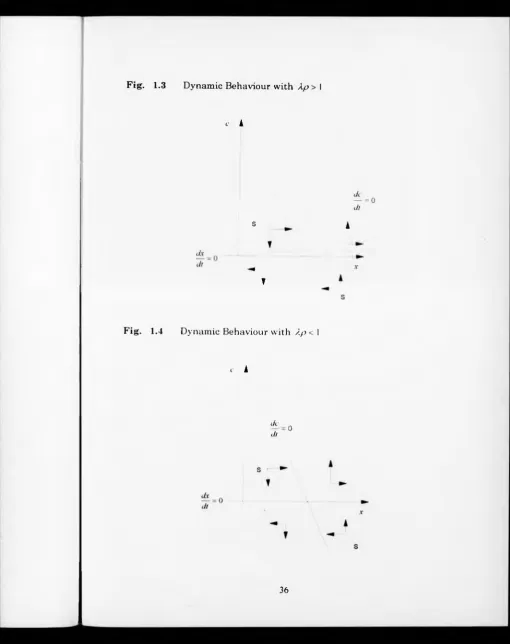
From the technical point of view the system is standard, as it is linear, the
determinant is negative and the solution is unambiguously a saddle point We can
represent the dynamic system in two phase diagrams (see Fig. 1.3 and Fig. 1.4),
which corresponds to the two alternative cases depending on whether the line of
stability, = 0 has positive or negative slope (Calvo and Rodriguez. 1977: 621-19)
1.10)
J t
6 2 2 ).
F i g . 1 .3 D y n a m i c B e h a v i o u r w i t h A p >\
C A
s
T
J c
— = 0
J l
A
F ig . 1.4 D ynam ic B eh av io u r w ith A p < 1
C- A
[image:48.547.23.534.14.658.2]In both cases the motion of x in the plane is obvious as long as we bear in mind that
a net accumulation of foreign assets requires an economy with a positive real
exchange rate, e > 0 (equation 1.3). On the same plane the direction of the arrows
describe the dynamics of the real exchange rate, c .
Although the two pictures are different, they have the helpful common feature that
for both the stable manifold SS is negatively sloped . If we refer to p , as the stable
given by the following expressions:
We can now examine what the effects are of a change in monetary policy and to
verify whether our original insight was correct (see Figure 1.5). If there is a higher
monetary expansion, one expects dollar holdings to increase, which requires the
stable manifold to shift up to the right from SS to TT. But dollar holdings, .r, is a
sluggish variable, so the exchange rate,c, has to jump to guarantee the long run
stability of the system. 7
7 Hence in both cases the motion of the variables rule out the “undershooting” case f i d
1.12)
where the slope of the stable manifold is: 0 = —p
P
F ig . 1 .5 I n t e r n a l C a p it a l F l i g h t
c
A
T
B
A X
T
S
Hence, the initial response of the real exchange rate to an unexpected monetary
expansion is an instantaneous devaluation from point A to point B The dynamics of
the system also suggests that over time the economy will gradually slide from point
B to reach point D, which is the new steady state.
From the above figure we see how this currency substitution story help shed light on
the phenomenon described by Bruno and Flemming as internal capital flight. When
the government decides to expand the growth rate of money, there will be an
increase of inflation and of the rate of devaluation in the exchange rate in the steady
state. As agents attempt to defend themselves from the forthcoming losses, their
demand for foreign exchange increases, requiring a net accumulation of foreign
depreciate to attract tourists and favour exporters, and to remain weak for enough
time to allow the process of dollarisation to continue until agents fully satisfy their
portfolio demand tor foreign exchange. Thus agents are able to to substitute for local
currency into dollars not through capital account but via the current - which is what
meant by saying that the capital flight is internal.