University of Warwick institutional repository: http://go.warwick.ac.uk/wrap
This paper is made available online in accordance with
publisher policies. Please scroll down to view the document
itself. Please refer to the repository record for this item and our
policy information available from the repository home page for
further information.
To see the final version of this paper please visit the publisher’s website.
Access to the published version may require a subscription.
Author(s): Avin Babataheri, Marcus Roper, Marc Fermigier and Olivia
Du Roure
Article Title: Tethered fleximags as artificial cilia
Year of publication: 2011
Link to published article:
http://dx.doi.org/10.1017/S002211201100005X
Publisher statement: Babataheri, A., et al. (2011). Tethered fleximags
as artificial cilia. Journal of Fluid Mechanics, 678, pp. 5-13,
doi:
10.1017/S002211201100005X. Copyright © Cambridge University
Press 2011. To view the published open abstract, go to
doi:10.1017/S002211201100005X
Tethered fleximags as artificial cilia
A V I N B A B A T A H E R I1, M A R C U S R O P E R2,3, M A R C F E R M I G I E R1† A N D O L I V I A D U R O U R E1
1Physique et M´ecanique des Milieux H´et´erogenes, UMR 7636 CNRS/ESPCI ParisTech, Universit´e Pierre et Marie Curie, Universite Paris Diderot, 10, rue Vauquelin, 75005 Paris, France 2Department of Mathematics and Lawrence Berkeley National Laboratory, University of California,
Berkeley, CA 94720, USA
3Mathematics Institute, University of Warwick, Coventry CV4 7AL, UK
(Received27 October 2010; revised 27 October 2010; accepted 23 December 2010;
first published online 15 March 2011)
Flexible superparamagnetic filaments (‘fleximags’) are very slender elastic filaments, which can be driven by distributed magnetic torques to mimic closely the behaviour of biological flagella. Previously, fleximags have been used as a basis for artificial micro-swimmers capable of transporting small cargos Dreyfuset al.(Nature, vol. 437, 2005, p. 862). Here, we demonstrate how these filaments can be anchored to a wall to make carpets of artificial micro-magnetic cilia with tunable densities. We analyse the dynamics of an artificial cilium under both planar and three-dimensional beating patterns. We show that the dynamics are controlled by a single characteristic length scale varying with the inverse square root of the driving frequency, providing a mechanism to break the fore and aft symmetry and to generate net fluxes and forces. However, we show that an effective geometrical reciprocity in the filament dynamics creates intrinsic limitations upon the ability of the artificial flagellum to pump fluid when driven in two dimensions.
Key words: Low-Reynolds-number flows, MEMS/NEMS, swimming/flying
1. Introduction
Assemblies of cilia and isolated flagella are used by microorganisms to propel themselves in liquids, and by multi-celled organisms for internal transport of fluids or materials, including the clearance of mucus from airways and the movement of ova along oviducts (Brennen & Winet 1977). Nodal cilia also play a crucial role in determining the bilateral asymmetry of developing embryos (Nonaka et al. 1998; Cartwright, Piro & Tuval 2004; Buceta et al. 2005). The structure of cilia is highly conserved across many species, including mammals and ciliated protists. Cilia are very flexible, possess a very large aspect ratio and their three-dimensional motion is due to distributed bending torques generated by internal molecular motors (Camalet, J¨ulicher & Prost 1999). The desire to understand in detail the fluid dynamics of assemblies of cilia and to create pumps and mixers for microfluidic devices has prompted the fabrication of artificial cilia-like structures, such as carpets of PDMS pillars loaded with maghemite nanocolloids (Evans et al. 2007). Recent studies have shown the feasibility of fluid transport by rigid superparamagnetic rods if tethered to
6 A. Babataheri, M. Roper, M. Fermigier and O. du Roure
B B
τM (c)
l h
[image:3.493.92.417.58.299.2](b) (a)
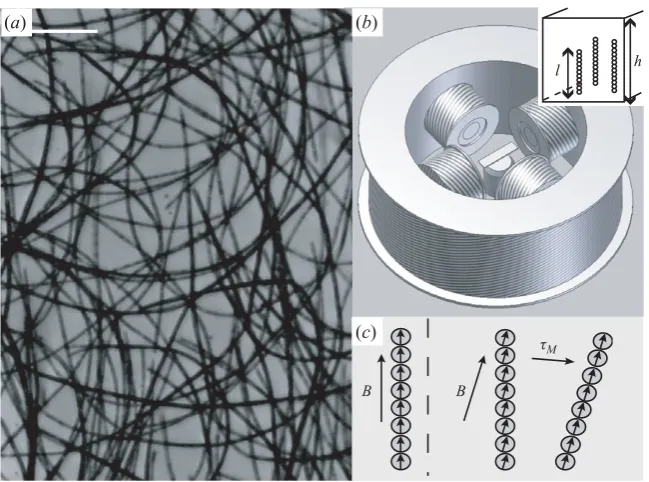
Figure 1.(a) Fleximags. Scale bar: 50µm. (b) Coil set-up around the sample and microscope
objective. Inset: Magnetic filaments within a rectangular capillary tube. (c) Actuation mechanism.
a substrate (Shieldset al. 2010; Vilfan et al.2010) or allowed to walk, fragment and reassemble (Singet al. 2010).
Here, we use the ability of superparamagnetic colloids to self-assemble into long chains, which can be permanently linked by adsorbed polymer to create micro-magnetic filaments (fleximags) (Dreyfus et al.2005; Goubault et al. 2005) and graft these filaments to chemically treated surfaces to make microscopic flexible artificial cilia (figure 1). Our artificial cilia share key common features with real cilia, namely a very large aspect ratio, high flexibility and the ability to follow complex trajectories in three dimensions without being subjected to a net external force.
The key feature in our system is the existence of a characteristic mobile length res-ulting from the balance between magnetic driving and viscous resistive torques which decreases as the inverse square root of the driving frequency. This frequency depend-ence provides the basis for breaking the fore and aft symmetry of the filament motion to generate a net average flux of fluid along the substrate. However, we show that because of a hidden geometric reciprocity of the filament motion, the net force remains small, directly confirming and explaining the very low pumping efficiencies observed in previous simulation-based studies (Kim & Netz 2006; Downton & Stark 2009).
2. Experiments
of cilia by coating the walls of the capillary tube with L-polylysine (Sigma, incubation one night at 0.01 % wt/wt) to promote the adhesion of the magnetic filaments. By aging the wall-coating, we can control the density of cilia. The suspension is held in a constant vertical magnetic field (B≈24 mT) for 30 min. During this incubation time, long filaments, essentially one particle in diameter, are formed. Then, the suspension is washed away by clear fluid and only a few filaments per mm2remain on the tube wall.
Their length,L, can be varied between 50 and 300µm. The bending coefficient of the filamentsκ, measured as described before (Goubaultet al.2003), isκ≈8×10⁻²⁶ J m.
A time-varying magnetic field, created by the magnetic coils, causes the artificial cilia to flex and bend. Just as for a real flagellum, this magnetic actuation produces no net force upon each artificial cilium, but produces internal torques along the length of the filament. The dipole moment m of a single superparamagnetic colloid is parallel to the applied field B. If, however, the local orientation of the filament is not parallel to the field, then, because of the dipole–dipole interaction between colloids, a net torque is developed which tends to realign the filament (figure 1c). This local driving magnetic torque is given by:
τM = πa2B2
6µ0
χe2sin(2α), (2.1)
where α is the angle between the field and the local filament axis, and χe denotes
effective susceptibility (Roperet al. 2006).
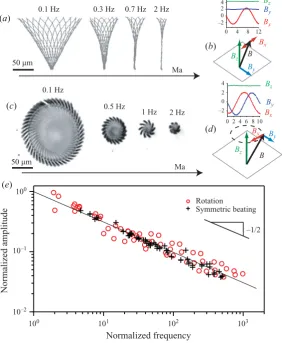
The three field components are generated by independent sets of coils driven by bipolar amplifiers (|B|= 4–10 mT). We investigated planar periodic motions and three-dimensional (3D)-rotations. For planar oscillations, we visualize the entire filament by tilting the plane of oscillation by an angle 25◦ with respect to the optical axis. The zandy field components are constant in time, while thex component oscillates (figure 2b). To generate a symmetric motion, we impose Bx(t) =B0cos(ωt), with a
frequency ranging from 0.1 to 5 Hz. To induce a precession of the filament, the field rotates on a cone around thezaxis:Bzis constant whileBx andBy oscillate in phase
quadrature (figure 2d). The cone angleθ ranges from 10◦ to 40◦.
For both planar and 3D actuation, the amplitude of filament motion decreases as we increase the beating frequency,ω(figure 2) (movies are available as supplementary material at journals.cambridge.org/flm). To reconstruct the shape of the beating filament, we image the filament trajectory at six different z positions. Projecting all images, for a given time, onto a single plane gives a focused image all along the filament. This resulting image is processed to obtain a smooth and differentiable shape. The dependence of amplitude upon frequency can be understood from the torque balance on a flexible magnetic filament of length driven at an angular velocityω: here, the driving torqueΓm= (/2a)τM, and is balanced both by a viscous
torque, Γv, due to the friction of the surrounding fluid and a bending torque, Γb,
due to the elasticity of the linker between particles in the filament. For a slender rod, Γv∼ζ⊥ω3, where ζ⊥ is the drag per unit length of filament, while Γb∼κ/.
Thus, viscous torques can balance the magnetic torque on a magnetoviscous length scale: mv/L∼Ma−1/2 and bending torques can balance the magnetic torque on a
magnetoelastic length scale: mb/L∼Mn−1/2, where Ma and Mn are the Mason and magnetoelastic numbers introduced by Melle et al.(2003), Cebers (2003) and Roper
et al. (2006):
Ma= ζ⊥ωL
2µ 0
a2B2χ2
e
, Mn = a
2χ2
eB2L2 µ0κ
8 A. Babataheri, M. Roper, M. Fermigier and O. du Roure
Bz By
Bx B
0.1 Hz 0.3 Hz 0.7 Hz 2 Hz
4 2 0
0 4 8 12 –2
4 2 0
0 2 4 6 8 10 –2
Ma 50 µm
(a)
(b)
(d)
Bz
By
B Bx
–1/2 Rotation
Symmetric beating
Normalized frequency
Normalized amplitude
Bz
By
Bx
Bz
By Bx 0.1 Hz
100
10–1
10–2
100 101 102 103
0.5 Hz
1 Hz 2 Hz
Ma 50 µm
(c)
[image:5.493.112.395.65.409.2](e)
Figure 2.(Colour online) Tip amplitude and mobilized length decrease as the driving
frequency is increased. (a) Shapes of filaments, reconstructed from top view, for planar oscillations at four different frequencies. (b) Driving magnetic fields for planar motion. (c) Excursion of filament tip (top view) for 3D rotations. (d) Magnetic fields for 3D rotation. (e) Relative filament tip displacement as a function of Mason number for planar beating (䊊, L= 160, 180 and 220 µm) and rotation (+,L= 150→300µm andθ from 10◦ to 40◦).
In our experiments, B∼10 mT and L∼100µm, so Mn∼105 is much larger than
Ma∼1–1000, so the dominant resistance to the magnetic torque comes from viscous drag and the intrinsic elasticity of the filaments can be neglected.
Although filament bending stiffness can be neglected, the interplay of dipole interactions, which tend to straighten the filament, and viscous loading, endows the filament with a dynamically varying characteristic bending scale mv, effectively
making it rigid to slow motions and flexible to fast motions. Because the free end of the filament must track the direction of the time-varying applied field, we expect, from the above scalings, that the amplitude of the free end motionA∼mv∝Ma−1/2L. For
free end traces out a circle. The azimuthal speed of a point on the mobile section depends on its distance from the vertical axis, giving rise to a total viscous torque Γv∼ζ⊥ω3sinθ so that the mobile length of filament∼(Masinθ)−1/2L. The radius
of rotation, R, is the projection of this mobile length onto the horizontal plane, so R∼sinθ∼(Masinθ)−1/2×Lsinθ.
3. Numerical simulations
A mathematical model quantitatively predicts the fleximag shape and the fluxes that it generates, and allows us to explore a wide parameter space of possible field configurations and filament lengths (Cebers 2003; Roper et al. 2006; Keaveny & Maxey 2008; Gauger, Downton & Stark 2009). In the continuum limit, the fleximag is considered as an inextensible filament with centreline r(s, t) varying with time, t, and the distance along the filament, s (Cebers 2003; Roper et al. 2006). The local filament velocity is proportional to the net force: ∂r/∂t=M·∂f/∂s, where f is the stress resultant across a slice of filament, and the mobility tensor M includes the approximate enhancement in drag due to the proximity of the wall, represented by coefficients kx,z:
M= 1 ζss+
1
ζ⊥(1−ss)− kx
z+(exex+eyey)− kz
z+ezez. (3.1)
At the same order of error as already made in the resistive force theory, we may choose 2kx=kz=L/8πη, incorporating only the wall-induced backflow caused by a
single Stokeslet at each reference location. A small displacement is added to keep the mobility tensor positive definite down to z= 0. Our simulations are insensitive to the precise form of the regularization, most likely because the filament is held stationary at the wall. We obtain an equation for the filament dynamics by resolving the stress resultant into a tensile force Λs, and a normal force, which can be related to the magnetic field by torque balance. In dimensionless variables (scalings by L,t by 1/ω,Λ by a2B2
zχe2/µ0,M byζ⊥ and B by Bz), these manipulations give: ∂r
∂t = 1 6MaM·
∂
∂s[−(B·s) (B−(B·s)s) +Λs] (3.2) with the tension, Λ, given implicitly by the inextensibility condition ∂r/∂s|= 1. We discretize this pair of partial differential equations using second-order centred differences for the spatial derivatives, and integrate in time using the Matlab differentio-algebraic equation solver ode15s. The computed shapes agree well with experimental observations, showing that the level of approximation used is completely adequate to describe the dynamics (figure 3).
4. Induced fluxes
To generate a flux of fluid using an artificial cilium, we manipulate the frequency of actuation, and thereby the mobile length of the artificial cilium, within a single stroke. Specifically, we divide the actuation cycle into two parts: a fast right-to-left stroke,Bx(t)∝cos(ωft) followed by a slow left-to-right stroke, Bx(t)∝cos(ωst);
in our experiments, ωf/ωs= 10. Filament shapes for this asymmetric actuation are
shown in figures 3(c), 3(d) and 4(a).
10 A. Babataheri, M. Roper, M. Fermigier and O. du Roure
1.0
0.5
0
(a)
1.0
0.5
0
(b)
1.0
0.5
0
(c)
1.0
0.5
0
0 0.5 1.0 1.5 2.0
[image:7.493.114.390.49.421.2](d)
Figure 3.(Colour online) Experimental filament shapes (dashed lines) accord very closely
with the predictions of a continuum model (solid lines) at (a,c) low (0.1 Hz, Ma≈18) and (b,d) high (1.0 Hz, Ma≈180) frequencies; (a) and (b) show symmetric actuation while (c) and (d) show asymmetric actuation. Circled arrows: orientation of the instantaneous magnetic field.
expected that during the fast leftward part of the motion, the mobile length of filament exerts a force Ff∼ζ⊥ωfmv(ωf)2 upon the fluid, creating a total leftward
flow of fluid Ff∼FfL/ηωf over the fast half-stroke. On applying the same
scalings to the slow half-stroke, we predicted net rightward transport, because
|Fs|/|Ff| ∼mv(ωs)2/mv(ωf)2 1.
Normalized flux
(a)
(c) (d) (e)
(b)
Ma
–10 –5 0 5 10
Torque per unit length (pN)
–6 –4 –2 0 2 4 Force (pN)
0 5.0 7.5 10.0
3 2 1 0 1 2(×10
5)
(×105)
Time (s)
Flux (
µ
m
3 s –1)
Flux (
µ
m
3 s –1) Force (pN) 100 10–1 10–2 10–3
101 102 103
–2 0 2
–5 0 5
*
° °
2.5
[image:8.493.67.415.67.353.2]* °
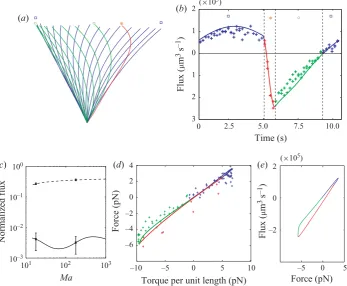
Figure 4. The pumping efficiency of planar beating is very low. (a) Filament shapes during
asymmetric beating: fast-leftward stroke (red, star), slow-rightward stroke (green, open circles, and blue, open squares). (b) Instantaneous fluxes generated by a single filament, computed from the experimental (crosses) and simulated (solid line) filament shapes, as a function of time. Asymmetry of filament shapes leads to different flux rates during leftward and rightward strokes. Here colour coding of stroke phases follows (a). (c) Average dimensionless horizontal flux as a function of frequency for asymmetric actuation, including simulations (curves) and experimental data (points). The solid curve and solid points give the average fluid flux |Ff − Fs|/T and the dashed curve and hollow points give the averaged unsigned flux
|Ff +Fs|/T. Fluxes are scaled byτmL/ζ⊥∼(a2Bz2χe2L/6µ0πζ⊥). (d) Total horizontal force is related in a direct one-to-one manner to the basal torque, so filament dynamics have a single degree of freedom. (e) Force and flux are not proportional because of the designed stroke asymmetry.
during leftward and rightward motions are clearly different (figure 4a). In addition, the fluxes computed from the experimental or simulated filament shapes using the mobility tensor M vary differently during the fast and slow motions (figure 4b). So, the remarkably exact cancellation of leftward and rightward fluxes suggests a deeper underlying symmetry.
12 A. Babataheri, M. Roper, M. Fermigier and O. du Roure
organizes its shape in motion – neither the flux nor the basal torque themselves are time-reversible (figure 4b), and the force is not simply related either to the filament basal angle or to the angle of the magnetic field individually.
Although the net force exerted by the filament is almost zero over a complete cycle of the applied field, the designed asymmetry in filament motion leads to change in the effective height of application of the force during the stroke cycle: ηF/F. Thus, although the net force is almost exactly reversible, the instantaneous flux is not directly proportional to the force (figure 4e) creating small difference in fluxes during leftward and rightward strokes. Nonetheless, the effective reciprocity of motion makes the pumping efficiency very small.
5. Conclusion
Our method for tethering flexible magnetic filaments to rigid surfaces allows the construction of micrometer-scale physical analogues of cilia. We observed large differences in the dynamics of filaments driven at high or low frequencies, but a planar asymmetric actuation, which includes fast and slow half-strokes, produces small net fluxes. We relate this to the direct dependence of the force applied by the filament upon a single dynamical variable, creating a hidden reciprocity in the filament motion. The need to overcome this reciprocity provides a common basis for understanding the efficiency gains associated with two recently proposed modifications of the filament, namely the inclusion of elastic defections along the length of the filament, and actuation of the micro-magnetic filament in two independent directions (Downton & Stark 2009; Gauger et al. 2009). Alternatively, we can contemplate maximizing the anisotropic effect of motions close to and far from the wall to turn a reciprocal force into a non-reciprocal flux. While Shieldset al.(2010) have shown the ability of rather rigid magnetic microrods, actuated on inclined cones, to generate significant fluxes, more flexible cilia allow the realization of more complex and biologically-faithful dynamical behaviours (Coqet al. 2010).
We thank P. Jenffer for technical support. M.R. is supported by a fellowship from the Miller Institute for Basic Research in Sciences. This work is supported by the Ile de France region under the SESAME program. Supplementary movies are available at journals.cambridge.org/flm.
R E F E R E N C E S
Brennen, C. & Winet, H. 1977 Fluid mechanics of propulsion by cilia and flagella. Annu. Rev. Fluid Mech.9, 339–398.
Buceta, J., Ibanes, M., Rasskin-Gutman, D., Okada, Y., Hirokawa, N. & Izpisua-Belmonte,
J. C.2005 Nodal cilia dynamics and the specification of the left/right axis in early vertebrate
embryo development.Biophys. J.89(4), 2199–2209.
Camalet, S., J¨ulicher, F. & Prost, J. 1999 Self-organized beating and swimming of internally
driven filaments.Phys. Rev. Lett.82(7), 1590–1593.
Cartwright, J. H. E., Piro, O. & Tuval, I. 2004 Fluid-dynamical basis of the embryonic
development of left-right asymmetry in vertebrates. Proc. Natl Acad. Sci. USA 101, 7234–
7239.
Cebers, A.2003 Dynamics of a chain of magnetic particles connected with elastic linkers.J. Phys.: Condens. Matter15, S1335–S1344.
Coq, N., Ngo, S., du Roure, O., Fermigier, M. & Bartolo, D.2010 Three-dimensional beating of
Downton, M. & Stark, H.2009 Beating kinematics of magnetically actuated cilia.Eur. Phys. Lett.
85, 44002.
Dreyfus, R., Baudry, J., Roper, M. L., Fermigier, M., Stone, H. A. & Bibette, J.2005 Microscopic
artificial swimmers.Nature 437(7060), 862–865.
Evans, B. A., Shields, A. R., Carroll, R. L., Washburn, S., Falvo, M. R. & Superfine, R.2007
Magnetically actuated nanorod arrays as biomimetic cilia.Nano Lett.7(5), 1428–1434.
Gauger, E. M., Downton, M. T. & Stark, H.2009 Fluid transport at low Reynolds number with
magnetically actuated artificial cilia.Eur. Phys. J.E28(2), 231–242.
Goubault, C., Jop, P., Fermigier, M., Baudry, J., Bertrand, E. & Bibette, J. 2003 Flexible
magnetic filaments as micromechanical sensors.Phys. Rev. Lett.91, 260802.
Goubault, C., Leal-Calderon, F., Viovy, J. L. & Bibette, J. 2005 Self-assembled magnetic
nanowires made irreversible by polymer bridging.Langmuir 21(9), 3725–3729.
Keaveny, E. & Maxey, M. 2008 Spiral swimming of an artificial micro-swimmer.J. Fluid Mech.
593, 293–319.
Kim, Y. & Netz, R.2006 Pumping fluids with periodically beating grafted elastic filaments.Phys. Rev. Lett.96, 158101.
Melle, S., Calder ´on, O. G., Rubio, M. A. & Fuller, G. G. 2003 Microstructure evolution in
magnetorheological suspensions governed by mason number.Phys. Rev.E68, 041503.
Nonaka, S., Tanaka, Y., Okada, Y., Takeda, S., Harada, A., Kanai, Y., Kido, M. & Hirokawa, N.
1998 Randomization of left–right asymmetry due to loss of nodal cilia generating leftward
flow of extraembryonic fluid in mice lacking kif3b motor protein.Cell95(6), 829–837.
Roper, M., Dreyfus, R., Baudry, J., Fermigier, M., Bibette, J. & Stone, H. A. 2006 On the
dynamics of magnetically driven elastic filaments.J. Fluid Mech.554, 167–190.
Shields, A. R., Fiser, B. L., Evans, B. A., Falvo, M. R., Washburn, S. & Superfine, R. 2010
Biomimetic cilia arrays generate simultaneous pumping and mixing regimes.Proc. Natl Acad.
Sci.107(36), 15670–15675.
Sing, C. E., Schmid, L., Schneider, M. F., Franke, T. & Alexander-Katz, A. 2010 Controlled
surface-induced flows from the motion of self-assembled colloidal walkers.Proc. Natl Acad.
Sci. USA107, 535–540.
Vilfan, M., Poto ˇcnik, A., Kav ˇci ˇc, B., Osterman, N., Poberaj, I., Vilfan, A. & Babi ˇc, D. 2010