MASTER THESIS
TOWARDS AN
UNDER-STANDING OF SUCCESS
DIMENSIONS IN DESIGN
THINKING EDUCATION
Tim-Benjamin Lembcke
FACULTY OF BEHAVIORAL, MANAGEMENT AND SOCIAL SCIENCES (BMS) TECHNOLOGY MANAGEMENT AND SUPPLY (TM/S)
EXAMINATION COMMITTEE
Dr. Matthias de Visser Dr. Michel Ehrenhard
EXTERNAL SUPERVISOR
Dr. Claudia Nicolai, HPI School of Design Thinking, University of Potsdam, Germany
Towards an understanding of success dimensions
in Design Thinking education
HPI School of Design Thinking, Hasso Plattner Institute, University of Potsdam, Germany University of Twente, Enschede, The Netherlands
Technical University of Berlin, Germany
Acknowledgements
I would like to take this opportunity to express my sincere appreciation for the guidance and encouragement by my supervisors, Dr. Claudia Nicolai, academic director of the HPI School of Design Thinking, and Dr. Matthias de Visser, assistant professor at the University of Twente in Enschede. Without their long-lasting support and advice this thesis and the richness of results would not have been possible.
I would also like to thank Dr. Michel Ehrenhard for being the second supervisor of this thesis and for his ongoing study coordination during my studies at the University of Twente. The same is true for all staff members, coaches and students that willingly participated in this study to improve the Design Thinking programme.
It has been a great pleasure to study at the University of Twente and the HPI School of Design Thinking. The education format in the Netherlands allowed me to take my time to reflect deeply on a variety of topics. Only the extensive research flexibility and the openness for innovative topics at both organisations allowed me to address the topic of Design Thinking.
Furthermore, I would like to express my gratitude to Hasso Plattner, without whom Design Thinking would not have been able to come of age so rapidly and the d.school in Potsdam would likely not exist today. Receiving the honour to participate in the Design Thinking programme allowed me to reflect upon my mindset and supported me in an important period of life.
Ideation and innovation processes have become a cornerstone for the competitiveness of organ-isations. Design Thinking is one promising way to extend the creative potential of both students and professionals. Interdisciplinary teams solving complex challenges in open innovation spaces are the specialty of Design Thinking. The HPI School of Design Thinking in Potsdam, Germany, offers education programmes for students and professionals to become proficient in the process and methods.
This thesis focuses on the question of how the current student education programme in Potsdam can be evaluated. Previous research in this area mainly focused on professional contexts. As no formal accreditation seems suitable for the student programme, a congeneric literature review suggested 4 success dimensions: motivation and understanding, learning goals, learning experience and facilitation, success perception and personal development. In a qualitative and explorative format, 13 interviewees (applicants, students, coaches and staff members) were invited for in-depth interviews.
Team work is perceived as most relevant for the education programme and is understood as collaborative and innovative problem solving among team members from diverse backgrounds. Students perceive the programme as successful when they learn how to work and manage inter-disciplinary teams (team-level), how to develop their creative confidence (personal-level) and how to apply Design Thinking for future projects (content-level). Several important success elements for each success dimension were derived, providing the base for the development of quantitative or qualitative evaluation measures capturing the overall programme. Extensive descriptions of the rich results provide a current state of the Design Thinking programme and suggest future improvement areas. In making implicit knowledge of the d.school available to the academic soci-ety, researchers and individuals outside this subject area can gain a deeper understanding of the Design Thinking programme.
Quotation formatting
Table of Contents
I Design Thinking introduction and research design 1
1 Design Thinking to meet increasing complexity 2
1.1 The advent of Design Thinking student education . . . 2
1.2 Research context . . . 3
1.2.1 Research problem . . . 3
1.2.2 Research objective . . . 4
1.2.3 Research motivation . . . 4
2 Theoretical background 5 2.1 Design and the Design Thinking discourse . . . 5
2.1.1 Designerly Thinking . . . 6
2.1.2 Design Thinking . . . 8
2.2 Design Thinking student education in Potsdam . . . 11
2.2.1 Implicit knowledge and lead interviews . . . 11
2.2.2 Design Thinking paradigm . . . 11
2.2.3 Design Thinking education programme . . . 12
2.2.3.1 Process . . . 13
2.2.3.2 Programme structure . . . 14
2.2.3.3 Personnel structure . . . 15
2.2.3.4 Participants . . . 16
2.2.3.5 Space . . . 16
2.2.3.6 Team work and collaboration . . . 16
2.3 Success dimensions literature research . . . 17
2.3.1 Effective and innovation teams in professional contexts . . . 17
2.3.2 Problem-based learning and Design Thinking . . . 17
2.3.3 Success dimensions derived from literature review . . . 23
3 Research design 26 3.1 Research question . . . 26
II Research results 30
4 Motivation and understanding 31
4.1 Word-of-mouth recommendation is a strong motivation apply for the d.school . . 31 4.2 Design Thinking understood as innovative problem solving in diverse teams . . . 32
5 Learning goals for the d.school programme 35
5.1 Applicants expect to become confident in the Design Thinking process . . . 35 5.2 Three areas of key learnings: Team experiences, Design Thinking process learnings
and personal development . . . 36 5.3 Basic and Advanced track address affective, normative and ethical dimensions . . 39
6 Learning experience and facilitation 41
6.1 Students wish for an open discourse environment at their universities . . . 41 6.2 Programme managers and coaches experience high personal and emotional demands 43 6.3 Students do not experience their academic team work as team work, some not
even as group work . . . 44 6.4 Teams experience manifold challenges at d.school . . . 45 6.4.1 Working values, leadership styles and motivations influence student teams 46 6.4.2 Knowing more is no problem, but knowing better is . . . 48 6.5 The Design Thinking journey can be facilitated with six ideal coaching attributes 50
7 Success perception and personal development 54
7.1 Students perceive academic group work with joint task commitment, proper group agreements and a supportive environment as successful . . . 54 7.2 Experiencing real team work for the first time is a huge success for d.school students 55 7.3 Coaches and programme managers perceive their job role as successful if they can
support students in growing to their potential . . . 57 7.4 New thinking experience . . . 58
7.4.1 Students are ready to show their own potential and thoughts in university but mostly find an environment not stimulating them . . . 58 7.4.2 Team-first and openness approaches of the d.school as suitable means for
a new thinking experience . . . 61 7.5 Students report to gain creative confidence and can apply learnings to their own
lives . . . 63 7.6 Project partners are either Design Thinking experienced or unexperienced and
latter ones are harder to deal with . . . 66
8 d.school improvement suggestions and Design Thinking vision 69
8.1 Team and programme organisation are important improvement areas for the future 69 8.2 Key visions of staff members are students integrating Design Thinking into their
Table of Contents
III Discussion, implications and conclusion 74
9 Research results synthesis 75
9.1 Motivation and understanding . . . 75
9.2 Learning goals . . . 75
9.3 Learning experience and facilitation . . . 76
9.4 Success perception and personal development . . . 77
9.5 Future development factors . . . 78
10 Discussion 83 10.1 Team work is the most relevant learning, followed by personal development and process understanding . . . 83
10.2 Students perceive the programme as successful if the team-, personal- and content-levels are addressed . . . 84
11 Research contribution and future research directions 86 11.1 The suggested success dimensions were supported . . . 86
11.2 Future research directions . . . 88
12 Implications 89
13 Research design reflection 91
14 Summary and outlook 92
IV Appendix 95
List of Figures 96
List of Tables 97
Bibliography 99
Design Thinking introduction and
1. Design Thinking to meet increasing
complexity
1.1. The advent of Design Thinking student education
Everyone loves an innovation, ’an idea that sells.’ Unfortunately, this is an outcome, not a process for achieving the goal. (Plattner et al., 2010, p. xiii)
The outcomes of innovation processes, i.e. innovations, have become a cornerstone for the competitiveness of organisations, yet many organisations still struggle in staying competitive. Even companies that were known to be well-managed and formerly innovative became suddenly obsolete (e.g. Nokia or Kodak), indicating that not only innovation itself but also the method and process how it is implemented are important (Christensen, 1997). Innovation challenges often seem to be the trial of squaring a circle and an extensive body of research has outlined the importance for education organisations like universities to help students in facilitating their innovative potential to be able to “solve messy, unstructured problems that don’t have easy answers” (Steinbeck, 2011, p. 27). These challenges occur especially in today’s economies characterised by an increasing competitive pressure and globalisation (cf. Thiel and Masters, 2014).
One promising way to extend the innovative potential of students and professionals has been developed at the Design School (in short d.school) at the University of Stanford, USA, and the HPI School of Design Thinking at the University of Potsdam, Germany – namely the Design Thinking education. Acknowledging that technology and business domains are sufficiently considered in corporate problem-solving and innovation processes, the element of user-centeredness, i.e. the human values, was lacking necessary attention (Brown, 2008). With successes like inventing the computer mouse or the design of the Lisa computer, the computer that shall later become the Macintosh, Design Thinking became renowned as a meta-disciplinary and “holistic concept to design cognition and design learning that enables students to work successfully in multi-disciplinary teams and enact positive, design-led change in the world” (Rauth et al., 2010, p. 2).
et al., 2012). As the authors describe, “there should be an emotional distance between the team member and coach, while at the same time sufficient closeness to always know when intervention is needed” (ib., p. 79). The bootcamp bootleg d.school (2011) and Plattner et al. (2010, 2012b,a) outlined that teams usually consist of five to seven members with a diverse background (regarding e.g. study field, nationality, professional backgrounds). These teams get assigned design challenges, i.e. specific research or project questions that are framed in an open and inspiring format. Challenges include a brief description of a current situation and frame the space in which teams are asked to proceed. The goal of the design education is hereby twofold: On the one hand, challenges are assigned to project partners (e.g. companies, research institutes, and social organisations) and teams strive to improve the pain points of their project partners with user-tested as well as iteratively substantiated prototypes and concepts. On the other hand, team members are assisted in their individual and joint learning journey by two coaches that are alternatingly available.
Design Thinking has received an increasing attention in research, in particular through the Hasso Plattner Design Thinking Research Program (HPDTRP), a joint research programme between the University of Stanford and the Hasso Plattner Institute in Potsdam. This research programme focuses on different aspects of Design Thinking. It aims at substantiating the Design Thinking practices on an academic level as well as to connect Design Thinking with the research in con-generic field like general innovation management research. This research programme is also an important source for the regular Design Thinking series published with different foci (Plattner et al., 2010, 2012b,a, 2014, 2016).
1.2. Research context
1.2.1. Research problem
This thesis began with the question of how the current Design Thinking education programme in Potsdam could be evaluated. In order to improve an existing programme or process, one needs an understanding of where one is standing at the moment. This “line in the sand” is necessary to understand how any change that is going to be made affects this initial situation and also which factors are promising or interesting to look at.
1. Design Thinking to meet increasing complexity
period. Thus different evaluation criteria are necessary and it cannot even be assumed that these criteria can be quantitatively assessed at this stage.
In order to improve the Design Thinking student education programme - and to develop qualitative, quantitative or mixed evaluation measures for the Design Thinking education programme - it is thus necessary to first identify and understand success dimensions that are likely to be relevant for the Design Thinking education success. Because there is no previous research available with an indication of probable success dimensions, this study is carried out qualitatively and explorative with in-depth interviews.
1.2.2. Research objective
There is a multitude of studies available on the topic of success factors for team innovation (in professional context) or team effectiveness (again, mostly in professional context). These professional contexts differ substantially from the education context of the d.school in Potsdam. As in professional contexts the main motivation is to generate turnover, ensure the organisations future and to increase shareholder value, the motivation at the d.school lies in educating students to train their creative confidence and develop a higher self-efficacy. With its focus on team process and team experience rather than directing them towards a predetermined knowledge and learning framework, the d.school also differs from classic university contexts that still tend to promote and are characterised by a standardised education format.
Thus success dimensions in professional contexts (and largely also in academic contexts) do not seem to apply for the Design Thinking education programme. To be able to research educational aspects (e.g. the format or the teaching method) of Design Thinking it is necessary to have an understanding of success dimensions for Design Thinking education. These overall success dimensions can function as a „line in the sand“ for future Design Thinking education research. Accordingly, this descriptive, qualitative and explorative research study provides a first under-standing of success dimensions in the Design Thinking education at the HPI School of Design Thinking in Potsdam.
1.2.3. Research motivation
2.1. Design and the Design Thinking discourse
When a new term is becoming viral, especially the academic world needs to become cautious. Design Thinking as a new way to approaching seemingly unsolvable or highly complex multi-dimensional problems has received such a notion during the last 10 years. The danger is that the term itself is getting closer to the thin line between being seen as a panacea by its evangelists and being considered as a buzz-word and a jack of all trades method by its critics (cf. Badke-Schaub et al., 2010).
Design Thinking dates back to the previous century. Based on the foundational work of Simon (1969) on the overall nature of design, this research area has gained an increasing interest. Ever since, the research on Design Thinking has been both theoretically and case-based as well as elaborative. Even longer than this is the discourse on what design means. Krippendorff (2005) summarises the subjective perception of what design is by stating that
“most outsiders see design as an applied art, as having to do with aesthetics, unlike a solid profession unto itself, with technical knowledge, skills, and responsibilities to rely on. Insiders to design, by contrast, talk of innovative ideas, coordinating the concerns of many disciplines, being advocates for users, and trying to balance social, political, cultural, and ecological considerations. The underlying thread in designers’ self-perception is a concern for what people do with artifacts. It differs from the concerns of other professionals by addressing issues of human interfaces with technology, technology understood quite broadly as what humans create – artifacts.” (Krippendorff, 2005, p. 47)
This subjective notion is substantiated by the following design and designerly thinking description. Authors like Buchanan (1992) indicated that the ever-increasing complexity of globalised chal-lenges (will) necessitate new problem-solving approaches. They argued that the way how designers have approached their design problems (i.e. the creation of design objects or artefacts) might render useful insights for solving challenges located and considered as outside of the classic design discipline.
2. Theoretical background DIVERSITY AND UNITY
4
were trained as designers to exert their influence outside the traditional design professions” (Dorst, Stewart, Staudinger, Paton & Dong, 2010, p. 9). However, the question of the limits and applicability of the concept to other target areas is central; which elements of design thinking can be conveyed beyond the core design disciplines, and how?
PERCEPTIONS OF THE ORIGINS AND CENTRAL LITERATURE OF THE TWO DISCOURSES
In the following we discuss how the views of the interviewed academics and practitioners in the field of design coincide with or contrast the depiction of Johansson and Woodilla (2010).
In line with Johansson and Woodilla (2010), the interviewed representatives of the design discourse (i.e. the academics) unanimously described the beginnings of the design thinking paradigm to take place in the early sixties when research embarked on finding out what designing is and how could design as a process and as an activity be improved. The interviewees describe the development of the concept to align with the overall development of design research from the first conferences on design
methods in the early sixties onwards. Within the design research stream, the interviewed academics specifically link design thinking to the analysis of the designers’ thinking processes and regularly mention Simon (1969) and Schön (1983) as keystone works with notions such as; “The concept of design thinking begun to formulate after Schön published the Reflective Practitioner in 1983.”
The perception of design thinking originating at IDEO was supported without exception by the views of the interviewed practitioner experts with statements such as “The roots of design thinking ultimately are in IDEO and their notion of user centered design.“ The d.school of Hasso Plattner Institute of Design at Stanford University was also linked strongly to both IDEO and the birth of the design thinking concept. Also the representatives of the design discourse acknowledged the role of IDEO, and specifically its CEO Tim Brown, in the birth of the recent
managerial discourse. Since in the design research stream, the term design thinking is used
predominantly to refer to the cognitive processes of a designer and in the more recent managerial discussion it refers to a more general approach to innovation, many of the interviewed academics felt that there are two entirely different subjects called
Figure 1 Roots of design thinking: views from the two discourses. References to the key literature mentioned by the respondents. Figure 2.1.1.: Roots of design thinking – Source: Hassi and Laakso (2011, p. 4)
In brief, the two discourses can be summed up as following (see Fig. 2.1.1 and 2.1.2, based on Johansson-Sköldberg et al., 2013, p. 123 ff.): Designerly Thinking and Design Thinking.
2.1.1. Designerly Thinking
The first discourse is called ’designerly thinking’. “This refers to the academic construction of the professional designer’s practice (practical skills and competence) and theoretical reflections around how to interpret and characterize this non-verbal competence of the designers” (Johansson-Sköldberg et al., 2013, p. 123). They argued that this research is rooted in the academic field of design and frames the underlying motifs and practices that led to a designerly thinking and to a design expertise. Within this discourse, the authors identified five streams of design and designerly thinking as
• thecreation of artefacts (Simon, 1969).
Simon argued that historically the task of science disciplines had been to describe what already exists and “teach about natural things: how they are and how they work” (ib., p. 111). In contrast, design is rather focused on devising “courses of action aimed at changing existing situations into preferred ones” (ib.). The intellectual activities of drawing a painting, finding a new remedy and defining a new social welfare plan did not differ fundamentally for him. Accordingly, the assumed differences in the research world between designers’ ways and engineers’ ways of thinking became irrelevant for Simon.
Schön, originating from a pragmatic tradition, argued in The Reflective Practicioner that design is not to be understood rationally (and positivistic) but rather through a prag-matic/hermeneutic point-of-view1. He understood the design process as interplay of
“cre-ation and reflection-upon-the-cre“cre-ation that allows for constantly improved competence and re-creation” (Johansson-Sköldberg et al., 2013, p. 124). The reflection was understood as an integral part of the design practice. Schön described that this understanding can be transferred to a managerial context: “While managers deal with decisions under un-certainty through intuition, they build up an essentially unanalysable capacity for problem solving through long and varied practice rather than through studying theory or techniques” (ib.). He noted that this process is often unconsciously and managers as well as designers do seldom reflect upon their reflection-in-action.
• a problem-solving activity (Buchanan, 1992, based on Rittel and Webber, 1973).
Rittel and Webber introduced in 1973 their Dilemmas in a General Theory of Planning in which they argued that the “search for scientific bases for confronting problems of social policy” (ib., p. 155) is to fail, namely due to the ’wicked’ nature of these social problems – in contrast to the ’tame’ nature of (natural) sciences. Their reasoning was that social problems can hardly be described exactly and definitely. Even worse, in modern sciences there is often a discourse about the most basic terms and definitions of a problem at hand. Thus “there are no ’solutions’ in the sense of definitive and objective answers” (ib.). Rittel and Webber introduced the separation of problem definition and problem solving phase. In the problem definition phase, the problem and its underlying constructs can be clarified leading to a qualification of the problem. Buchanan (1992) built upon this and adapted this line of thinking to the design context. Arguing that designers do not only “decorate messages” (ib., p. 12) but merely should find new “arguments by means of a new synthesis” (ib.) from various sources, he established placements as the “sources of new ideas and possibilities when applied to problems in concrete circumstances” (ib.). “Placements are ‘tools’ for intuitively or deliberately shaping a design situation, identifying the views of all participants, the issues of concern, and the intervention that becomes a working hypothesis for exploration and development, thereby letting the problem formulation and solution go hand in hand rather than as sequential steps” (Johansson-Sköldberg et al., 2013, p. 125). • a way of reasoning/making sense of things (Lawson, 2006; Cross, 2006, 2011).
Lawson and Cross were trained architects and used an abductive reasoning process to both derive a design process model from their practical examples. Lawson aimed at describing a model of designing (2006, pp. 289-303) with the six phases of formulating, representing, moving, bringing problems and solutions together, evaluating, reflecting. Cross identified key aspects of design strategies, namely “(1) taking a broad ’systems approach’ to the problem,
2. Theoretical background
rather than accepting narrow problem criteria; (2) ’framing’ the problem in a distinctive and sometimes rather personal way; and (3) designing from ’first principles”’ (Cross, 2011). This is noteworthy because it fleshes out the differentiation between problem definition (framing) and problem solution introduced by Rittel and Webber (1973). Furthermore, his three design strategies and his model (see Fig. 2.1.3) can serve as a theoretical foundation for the Design Thinking education at the School of Design Thinking in Potsdam.
• creation of meaning (rather than artefacts) (Krippendorff, 2005).
For Simon (1969), the design artefact is at the core of the design process, and the meaning of it is an attribute attached to the artefact. For Krippendorff (2005), however, the meaning is “at the core of the design process and the artefact becomes a medium for communicating these meanings” Johansson-Sköldberg et al. (2013, p. 126). While Cross distincts between the science of design2 and the design science3, Krippendorff (2005) turned the semantic notion to ascience for design. With this he referred to “a systematic collection of accounts of successful design practices, design methods, and their lessons, however abstract, codified, or theorized, whose continuous rearticulation and evaluation within the design community amounts to a self-reflective reproduction of the design profession” (Krippendorff, 2005, p. 209).
2.1.2. Design Thinking
The second discourse is ’design thinking’, a term that is related to a management discourse. This means a “discourse where design practice and competence are used beyond the design context (including art and architecture), for and with people without a scholarly background in design, particularly in management” (Johansson-Sköldberg et al., 2013, p. 123). People with no former education in design theory aim to learn and internalise designerly thinking. Usually they are not going to study or do not want or have the time to study the academic field of design first, thus design thinking becomes a discourse about how to transfer the designerly thinking theory to non-designerly backgrounds and fields (e.g. through design management studies). One criticism, especially regarding the management discourse, is that the majority of recent publications rather focuses on hands-on advices and checklists and less on theory building and it is thus less theoretically-robust (cf. ib., p. 127). Johansson-Sköldberg et al. summarise the Design Thinking discourse into three streams: Design Thinking as
• design company IDEO’s way of working with design and innovation (Kelley and Littman, 2001, 2006; Brown, 2008, 2009).
Tom Kelley is one of the brothers that founded IDEO, which claims to be the worlds largest design company. In his books, Kelley laid out numerous success stories of the IDEO way of
2“Science of design, [...] that body of work which attempts to improve our understanding of design through ’scientific’ (i.e., systematic, reliable) methods of investigation.” (Cross, 2006, p. 209)
designing solutions to given challenges. Albeit critics note that the IDEO approach lacks a theoretical foundation, the proposed framework of interlinked steps to design and find new ways of problem solving quickly became famous. For practitioners of Design Thinking in the notion of IDEO it is usually more important that the process can support teams and individuals in reclaiming their creative confidence than not spreading the word because of a suggested or perceived lack of theoretical foundation. By their hands-on attitude stating that ’everybody could do it’, Brown and Kelley invite everyone to try out their process, preferably in a team setting. Although no formal link exists between IDEO and the Design Management Institute, their understanding of Design Thinking tends in the same direction (Bohemia et al., 2012; Lockwood, 2010)
• a way to approach indeterminate organizational problems, and anecessary skill for practising managers (Dunne and Martin, 2006; Martin, 2009).
Martin worked with IDEO and used their Design Thinking approach to revise his former knowledge funnel model (Martin, 2009) and to improve his management education at the University of Toronto (Dunne and Martin, 2006). The knowledge-funnel is a stage-gate model with three stages: The mystery stage (infinite variety of forms for ideas and solutions), heuristic stage (narrowing down the field of inquiry, e.g. by testing) and the algorithm stage (reaching a generalisable formula). Martin understands Design Thinking as “the form of thought that enables movement along the knowledge funnel, and the firms that master it will gain a nearly inexhaustible, long-term business advantage” (Martin, 2009, p. 23). Contrary to Kelley and Brown, Martin solely focused on the knowledge funnel model to operationalise his understanding of Design Thinking to a management and business school environment. He diminished the notions of Schön on the design nature of Design Thinking and rather focused on a linear process instead of the iterative (and reflective) design approach. Accordingly, the education streams of Dunne and Martin (2006) on the one hand and Kelley and Littman (2001, 2006); Brown (2008); Plattner et al. (2010, 2012b,a, 2014) differ substantially. Although Martin’s framework is less complex to understand and does not necessitate an demanding engagement with a design-oriented way of thinking, Liedtka and Ogilvie (2012) admit that for reaching the best results, the lead from a designer is inalienable. Thus a certain dive into the way of designerly thinking seems to be necessary for accessing the whole design potential for an organisation.
• part of management theory (Boland and Collopy, 2004).
2. Theoretical background
134
12 annex
ANNEX TABLES
AND FIGURES
The different design thinking discourses according to Johansson-Sköldberg et al. (2013)
Table 5: The streams of ‘designerly’ and ‘managerial’ design thinking discourses (adapted from Johansson-Sköldberg et al., 2013, p. 130) Discourse
streams Originator Discourse Character & Academic Perspective Relation to Practice /Epistemology Core Concept Audience
Management discourses
IDEO & other industry leaders
Showcase success
cases →experiences, some connections to innovation research
How we do design thinking
(Kelley & Littman, 2001, 2005)
and how anyone can use it (Brown,
2008, 2009; Kelley & Kelley, 2013).
Company managers (potential
customers)
Roger Martin
(2006, 2009a, 2009b)
Use success cases to illustrate theory
development →cognitive/ management science/ planning theories
How successful production companies use design thinking and how ‘any’ organization can do it.
Company managers & educators (academics,
consultants)
boland & Collopy
(2004)
Scholars apply their theoretical perspectives to the design area
→different perspectives
Design thinking as analogy
and alternative. Academic researchers & educators
Design discourses of designerly thinking
Simon
(1996 [1969]) Economic & Political science Rationalism:The science of the artificial
Academic researchers & educators in the design
field
Schön(1983) Philosophy & Music Pragmatism: Reflection in action
buchanan (1992, based on Rittel & Webber, 1973)
Art history Postmodernism: Wicked problems
Lawson(2006 [1980]); Cross
(2006, 2001)
Design & Architecture Practice perspective:
Designerly ways of knowing
krippendorf
(2006) Philosophy & Semantics Hermeneutics: Creating meaning
12.2
Figure 2.1.2.: Different major Design Thinking discourse streams – Source: Schmiedgen et al. (2016, p.
134), based on Johansson-Sköldberg et al. (2013)
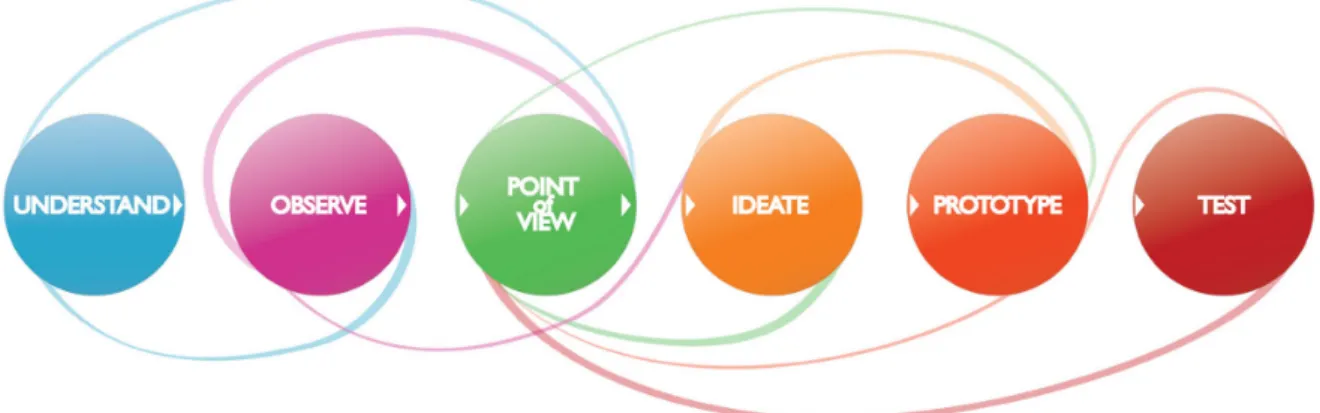
Figure 2.2.1.: Design Thinking process at the School of Design Thinking in Potsdam
– Source: School of Design Thinking
Johansson-Sköldberg et al. (2013) closed with “we do not believe that there is a unique meaning of ’design thinking’, and accordingly we should not look for one” (p. 132). Following this notion, the Design Thinking understanding for the scope of this thesis is outlined in the next section.
2.2. Design Thinking student education in Potsdam
2.2.1. Implicit knowledge and lead interviews
Johansson-Sköldberg et al. (2013) already mentioned that especially the management-oriented Design Thinking discourse is rooted in hands-on practices rather than an extensive theoretical body. Thus the Design Thinking education evolved through a continuous testing out and improv-ing cycle, similar to the reflection-in-action practice introduced by Schön (1983). Furthermore, the School of Design Thinking in Potsdam as well as the d.school in Stanford carry a tremendous stock of knowledge that is only implicitly available to the stakeholders currently involved at both places.
To make certain aspects that are relevant to the understanding of Design Thinking as practiced in Potsdam available to the reader in this introduction, the author carried out lead interviews. Elements of these interviews are integrated in this introduction to ease the understanding of the Design Thinking student education programme and its underlying reasoning.
2.2.2. Design Thinking paradigm
2. Theoretical background
renowned IDEO design consultancy, had been teaching design classes in Stanford since the late seventies of the previous century. In 2004, he was a professor for mechanical engineering at Stanford and met up with George Kembel to found the d.school. Closely after this foundation, Hasso Plattner got to know about this new ’design school’ and generously supported the building of the Hasso Plattner Institute of Design (d.school) at the University of Stanford. As both Kembel and Kelley had a broad industry experience, they thought of this school as an intersection between the educational / academic world and the professional world. From the very beginning the whole paradigm at the d.school was very pragmatic and hands-on (the famous ’show don’t tell’ quote stems from this). The School of Design Thinking in Potsdam at the Hasso Plattner Institute in Potsdam became the sister institute in 2007 and has been following the same paradigm.
Tim Brown, CEO of IDEO, explains what the IDEO understanding of Design Thinking is - and this is relevant for the d.schools as well since they have been built upon the experiences previously gained at IDEO. This paradigm is outlined Brown’s renowned HBR article (Brown, 2008): Design Thinking as a “a methodology that imbues the full spectrum of innovation activities with a human-centered design ethos” (ib. p. 86). Design Thinking thus focuses on the early phases in the innovation process - identifying user needs, defining promising inventions and preparing the innovation process leading to a new product or service offering. Continuous feedback loops lead to an iterative approach in which the practitioners of Design Thinking need to be ready to completely kill their initial ideas and head for a new direction (Brown, 2009; Kelley and Littman, 2001, 2006; Kelley and Kelley, 2012).
2.2.3. Design Thinking education programme
The School of Design Thinking in Potsdam was established in 2007 and is located under the roof of the Hasso Plattner Institute in Potsdam, which in turn is academically subordinated to the University of Potsdam.
The Design Thinking education overall aims at enabling scholars to be prepared to participate in Design Thinking projects in the future. Furthermore, scholars shall be able to stimulate a design-fostering environment in which new ways of problem-solving and solutions can flourish. In this way, scholars are educated to become Design Thinkers that are able to “match people’s needs with what is technologically feasible and what a viable business strategy can convert into customer value and market opportunity” (Brown, 2008). A foundation for this is an ability that the Kelley brothers call creative-confidence - “the natural ability to come up with new ideas and the courage to try them out” (Kelley and Kelley, 2013, p. 115). When participants manage to learn this through Design Thinking education and are less influenced by their fear of failure, scholars can start to “see every experience as an opportunity they can learn from” (ib., p. 38). So what is the Design Thinking education about? To understand the way how the School of Design Thinking in Potsdam operates, several aspects are important to know:
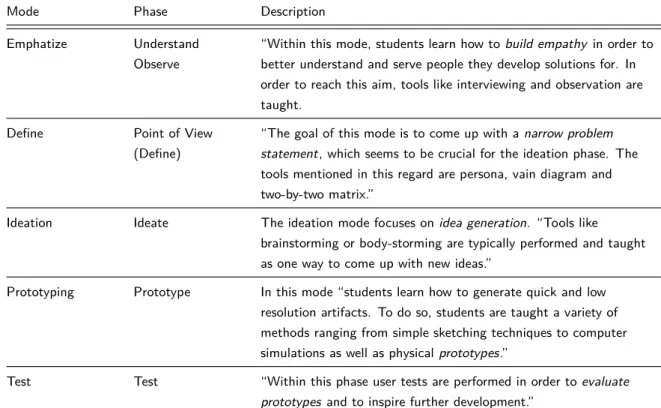
Mode Phase Description
Emphatize Understand
Observe
“Within this mode, students learn how tobuild empathy in order to better understand and serve people they develop solutions for. In order to reach this aim, tools like interviewing and observation are
taught.
Define Point of View
(Define)
“The goal of this mode is to come up with anarrow problem statement, which seems to be crucial for the ideation phase. The
tools mentioned in this regard are persona, vain diagram and two-by-two matrix.”
Ideation Ideate The ideation mode focuses onidea generation. “Tools like brainstorming or body-storming are typically performed and taught as one way to come up with new ideas.”
Prototyping Prototype In this mode “students learn how to generate quick and low resolution artifacts. To do so, students are taught a variety of
methods ranging from simple sketching techniques to computer simulations as well as physicalprototypes.”
Test Test “Within this phase user tests are performed in order toevaluate
prototypesand to inspire further development.”
Table 2.1.: Design Thinking phase descriptions – Source: Based on Rauth et al. (2010, p. 5)
2. The programme structure - the programme in Potsdam is structured into a Basic and Advanced track
3. The personnel structure - the different stakeholders involved in the Design Thinking edu-cation
4. Theparticipants - students from all over the world apply for the programme and make the School of Design Thinking a highly interdisciplinary and international place.
5. Thespace - the School of Design Thinking does not look like a traditional university setting. The space is optimised for team work and collaboration.
6. The team work and collaboration - Design Thinking in the philosophy of the d.school in Potsdam assumes that multiple students from different academic, professional and interna-tional backgrounds spark new insights and ideas. Thus the programme is pure team work in groups of 5-6 students, accompanied by a coach.
2.2.3.1. Process
2. Theoretical background
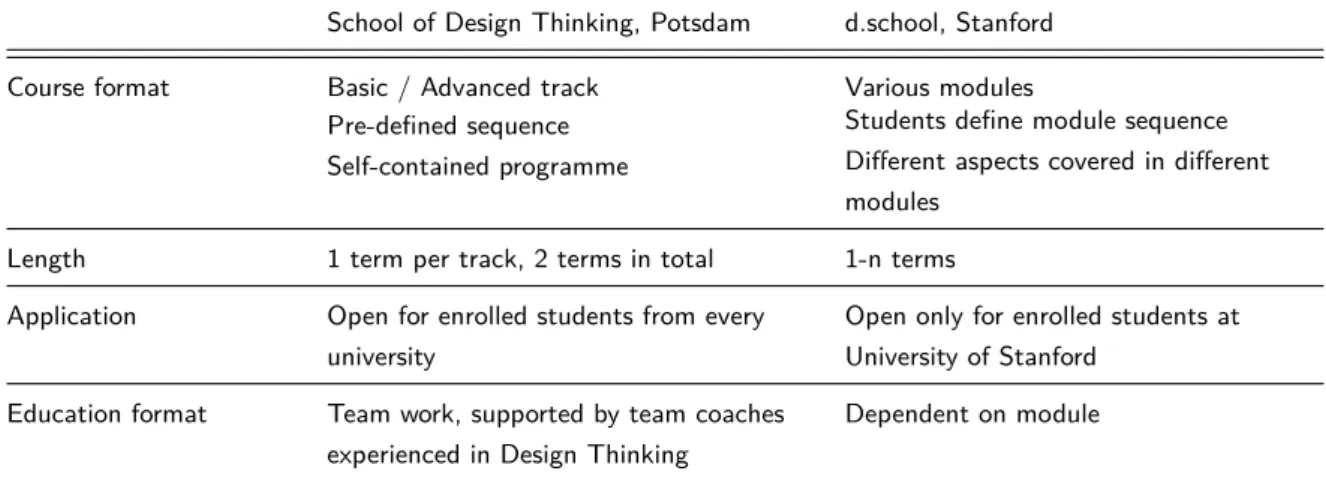
School of Design Thinking, Potsdam d.school, Stanford
Course format Basic / Advanced track Pre-defined sequence Self-contained programme
Various modules
Students define module sequence Different aspects covered in different
modules
Length 1 term per track, 2 terms in total 1-n terms
Application Open for enrolled students from every university
Open only for enrolled students at University of Stanford
Education format Team work, supported by team coaches experienced in Design Thinking
Dependent on module
Table 2.2.:Key student education programme differences – Source: Own depiction
2.2.3.2. Programme structure
The programme structure in Potsdam differs from the one in Stanford. Table 2.2 highlights the key differences. Contrary to Stanford, the education programme in Potsdam is not modularised in terms of process phases but consists of two tracks, each lasting one term. The Potsdam programme leads through all Design Thinking phases (Fig. 2.2.1) and provides all participating students with a holistic view of Design Thinking. Today, the Potsdam programme is structured in the following way:
1. The Design Thinking week (a one-week programme) as a primer for interested students. The participation is not mandatory to apply for the Basic track.
2. The Basic track
a) Motivation: First understanding of Design Thinking, guided on-boarding into the team process and team experience (EW, 47 f.)
b) Duration: One term, ca. 12 weeks, parallel to University of Potsdam lecture schedule c) Frequency: Two days full-time presence team work in Potsdam per week
d) Application: Written application with T-Profile, followed by a two-day Design Thinking bootcamp as assessment centre ahead of the term
e) Size: 80 students per term, 16 teams f) Sequence:
i. One-week project: Introduction to Design Thinking, internal challenge
ii. Three-week project: Deepening the understanding, more complex challenge, still internal
3. The Advanced track
a) Motivation: Experiencing your role in a team working together on a challenge no team member is experienced in (WZ, 31 f.)
b) Duration: One term, ca. 12 weeks, parallel to University of Potsdam lecture schedule c) Frequency: Two days full-time presence team work in Potsdam per week
d) Application: Written application with T-Profile, only Basic Track alumni accepted e) Size: 40 students per term, 8 teams
f) Sequence
i. Twelve-week project: Teams apply their Design Thinking knowledge and expertise independently, project challenge together with an external project partner (com-pany, organisation, NGO)
2.2.3.3. Personnel structure
Throughout this thesis, role descriptions are used that are introduced in this section:
• Staff members: Everyone who is associated with providing the Design Thinking education, especially
– Academic director: This is the academic lead of the whole Design Thinking programme
in Potsdam
– Track manager: They supervise either the Basic or the Advanced track. Their role is
to manage their respective tracks, coordinate the coaches for the teams in their tracks, set up the schedule and provide necessary resources. Each track consists of 8 teams, hence two Basic track “subtracks” exist with one track manager each.
– Coaches: Mostly alumni from the Design Thinking programme, coaches bring in an
external perspective and support student teams in becoming proficient in Design Think-ing
• Students: Everyone who is or was taking part of the Design Thinking student programme as a student to learn Design Thinking
– Current Basic / Advanced track students
– Alumni
2. Theoretical background
2.2.3.4. Participants
Each term around 200 to 350 students apply in Potsdam to become one of the 80 accepted Basic track students (EW, 56). Contrary to the Stanford d.school, in Potsdam every student from every nationality can apply. There is no necessity to enrol for a university course or programme at the University of Potsdam. During the selection process, attention is paid that the selected Basic track students result in a heterogeneous group from diverse backgrounds and different experience levels (EW, 60). Students that are typically accepted “have been trying to gain or have already gained [...] experiences outside their curriculum in terms of their study curriculum” (ib.). They are interested in working together, are eager to apply (not only learn about) Design Thinking, are rather ’we’ than ’I’ focused, have often “untypical biographies” - so that “they’ve been maybe also changing their course of studies and can explain why” (ib.) and that sometimes have already demonstrated entrepreneurial activities.
From the 80 Basic track students, 40 are able to continue with the Advanced track.
2.2.3.5. Space
The space at the School of Design Thinking is noticeably different from a classic university setting. First of all, neither a formal lecture hall exists nor a room with a pre-defined table-and-chair-order like in university seminar rooms. Space is dominated by chairs, tables and whiteboards that can be easily moved and rearranged. Hereby students are encouraged to fit the space to their needs - and these may not change between the track days but also and even within one day. As an example, when in ideation setting one might need more space and room to come up with new thoughts. However, during the define phase doing idea synthesis multiple whiteboards might be helpful to structure the thoughts using post it notes.
Noteworthy d.school facilities are:
• A make space with tools to create small prototype, design applications and print 3D objects • A workshop room for larger prototype manufacturing
• A library with design, creativity and innovation literature
• A costume and green room to dress oneself up or capture video sequences • A large garden area for recreation or team meetings in nature
2.2.3.6. Team work and collaboration
Thinking process is designed to be experienced as a team and working-on-your-own settings are very seldom. Coaches accompany teams and provide them with stimuli in case they might have got stuck.
2.3. Success dimensions literature research
2.3.1. Effective and innovation teams in professional contexts
As a foundation for the qualitative interview guidelines, a thorough literature research was conduc-ted. In section 1.2.2, it was already noted that the professional and academic success dimension context does not directly apply to the format of the Design Thinking education programme in Potsdam. For the research objective, it is not of primary interest to understand detailed success dimensions in specific industries, how they might differ from industry to industry and which ex-act perfomance measures were (successfully) ascertained. Research papers were selected upon providing insights into the overall dimensions that are important to shed light on – and not the specific and detailed findings. Meta-studies provided a helpful and focused starting point for this and the most cited and relevant studies were selected.
Table 2.7 summarises this structure: For example, Hülsheger et al. (2009) stated the importance of team work, sufficient resources and support for team innovation performance dimensions. This led, among similar findings of other researchers, to the introduction of the team work / challenges and team facilitation aspects in the interview guidelines.
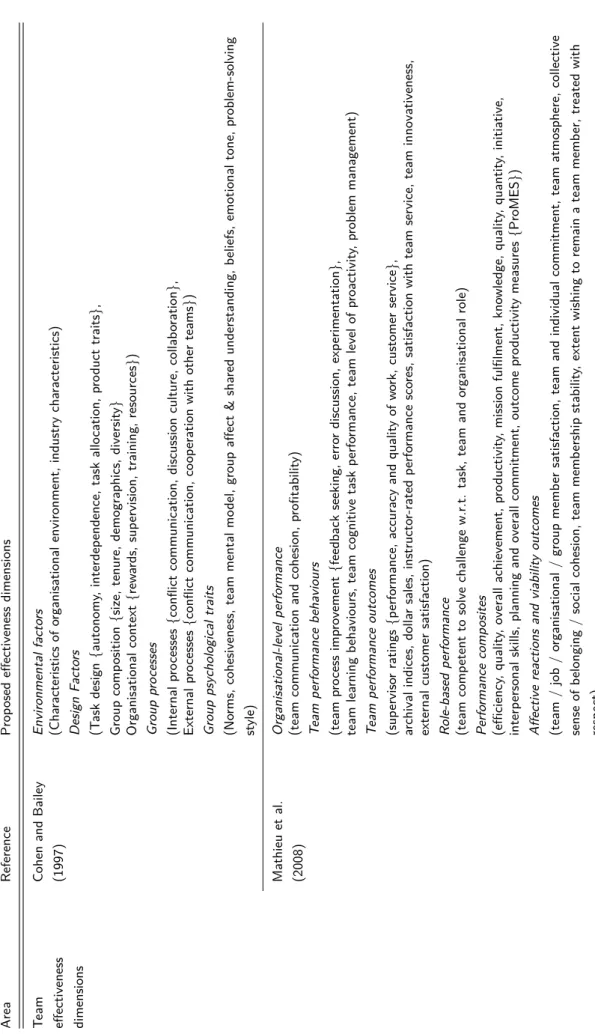
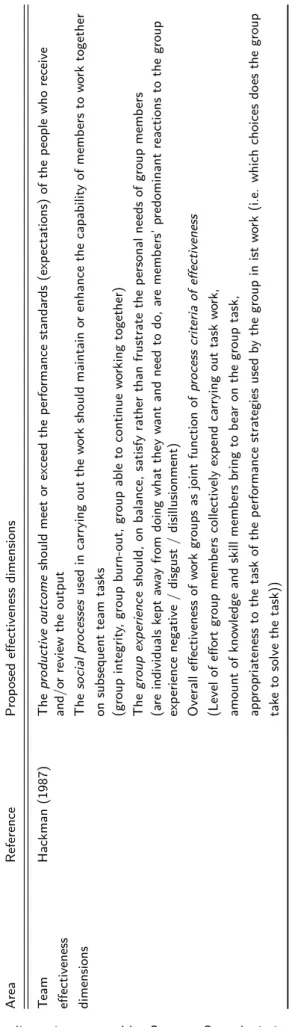
Especially in the field of professional work teams meta-studies existed that highlighted key effect-iveness and innovation success dimensions. Meta-studies of Cohen and Bailey (1997); Mathieu et al. (2008) spanned the team research literature from 1990-1996 and 1997-2007. Both are look-ing at overall team effectiveness dimensions in professional settlook-ings and their relevant findlook-ings are summarised in Table 2.3. Hackman (1987) provided further guidelines on what team effectiveness dimensions shall capture in general. Table 2.4 highlights these results.
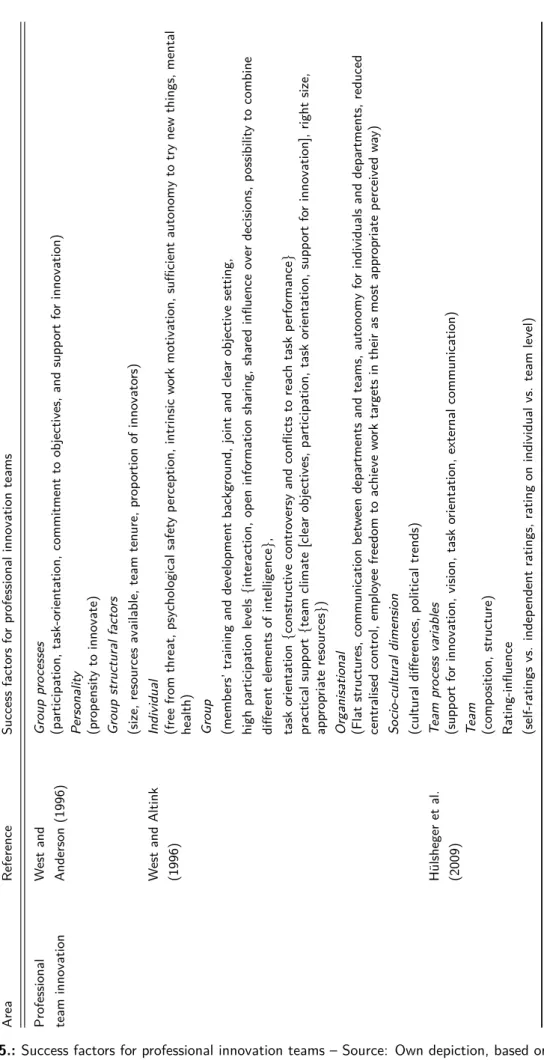
In the field of team innovation in a professional context, West and Anderson (1996); West and Altink (1996); Hülsheger et al. (2009) focused on dimensions that foster and enable innovative capabilities and outcomes in professional teams. Table 2.5 summarises their results.
2.3.2. Problem-based learning and Design Thinking
2. Theoretical background Area Reference Prop o sed effectiveness dimensions T eam effectiveness dimensions Cohen and B ail ey (1997 ) Environmental facto rs (Cha ra c te ristics of o rganisational environment, indu stry cha racteristics) Design F acto rs (T ask design {autonomy , interdep endence, task allo cation, p ro duct tr a it s}, Group comp osition {size, tenu re, demographics, diversit y} Organisational context {rew a rds, sup ervision, training, resources} ) Group p ro cesses (Internal p ro cesses {conflict communication, discussion culture, collab o ration}, External p ro cesses {conflict communication, co op eration with other teams}) Group psychological traits (No rms, cohesiveness, team mental mo del , group affect & sha red understanding, b eliefs, emotional tone, p roblem-solving st yl e) Mathieu et al. (2008 ) Organisational-level p erfo rmance (team communication and cohesion, p rofitabilit y) T eam p erfo rmance b ehaviours (team p ro cess imp rovement {feedback seeking, erro r discussion, exp erimentation}, team lea rning b ehaviours, team cognitive task p erfo rmance, team level of p roactivit y, p rob lem management) T eam p erfo rmance outcomes (sup erviso r ratings {p erfo rmance, accuracy and qualit y of w o rk, customer service}, a rc h iva l indices, dolla r sales, instructo r-rated p erfo rmance sco res, satisfaction with team service, team innovativeness, external customer satisfaction) Role-based p erfo rmance (team comp etent to solv e challenge w.r.t. task, team and o rganisational rol e) P erfo rmance co m p osites (efficiency , qualit y, overall achievement, p ro d uctivi ty , mission fulfilment, kno wledge, qualit y, quantit y, initiative, interp ersonal skills, planning a nd overall commitment, outcome p ro ductivit y measures {ProMES}) Affective react ion s and viabilit y outcomes (team / job / o rganisational / group memb er satisfaction, team and individual commitment, team atmosphere, collective sense of b elonging / so c ial cohesion, team memb ership stabilit y, extent wishing to remain a team memb er, treated wi th resp ect)
Table 2.3.:Team effectiveness dimensions – Source: Own depiction, based on Cohen and Bailey (1997);
Area Reference Prop o sed effectiveness dimensions T eam effectiveness dimensions Hackman (1987 ) The p ro ductive outcome should meet o r exceed the p erfo rma nce standa rds (exp ectations) of the p eople who receive and/o r review the output The so cial p ro cesses used in ca rrying out the w o rk should maintain o r en hance the capabilit y of memb ers to w o rk together on subsequent te a m tasks (group integrit y, group burn-out, group able to continue w o rking together) The group exp erienc e should, on balance, satisfy rather than frustrate the p e rsona l needs of group memb ers (a re individuals k ept a w a y from doing what they w ant an d need to do, a re memb ers’ p redominant reactions to the group exp erie n ce negative / disgust / disi llusionm e n t) Overall eff ectiveness of w o rk groups as joint function of p ro cess criteri a of effectiveness (Level of effo rt group memb ers collectively exp end ca rrying out task w o rk, amount of kn o wledge an d skill memb ers b ring to b ea r on the group task, app rop riateness to the task of the p erfo rmance strategies used b y th e group in ist w o rk (i.e. which choices do es the group tak e to solve the task))
2. Theoretical background
Area Reference Success facto rs fo r p rofessional innovation teams Professional team innovation W est and Anderson (1996 ) Group p ro cesses (pa rtic ip ation, task-o rientation, commitment to objectives, and supp o rt fo r innovation) P ersona lit y (p rop ensit y to innovate) Group structural facto rs (size, resources available, team tenure, p rop o rtion of innovato rs) W est and Altink (1996 ) Individual (free from threat, psychological safet y p erception, intrinsic w o rk motivation, sufficient autonomy to try new things, mental
health) Group (memb
ers’ training and devel op ment background, joint and clea r objective setting, high pa rticipation levels {interaction, op e n info rmation sha ring, sha red in fluence over decisions, p ossibilit y to combine different elements of intelligence}, task o rientation {constructive controversy and conflicts to reach ta sk p erfo rmance} p ractical supp o rt {team climate [clea r objectives, pa rticipation, task o rientation, supp o rt fo r innovation], right size, app rop riate resources}) Organisational (Flat structures, communication b et w e en depa rtments and teams, autonomy fo r in divi d uals and depa rtment s, reduced centralised control, emplo y ee freedom to achieve w o rk ta rgets in their as most app rop riate p ercei ved w a y) So cio-c u lt ural dimension (cultural differences, p olitical trends) Hülsheger et al. (2009 ) T eam p ro cess va riables (supp o rt fo r innovation, vision, task o rientation, external commun icat ion ) T eam (comp osition, structure) Rating-influence (self-ratings vs. indep endent ratings, rating on individual vs. team level)
Table 2.5.:Success factors for professional innovation teams – Source: Own depiction, based on West
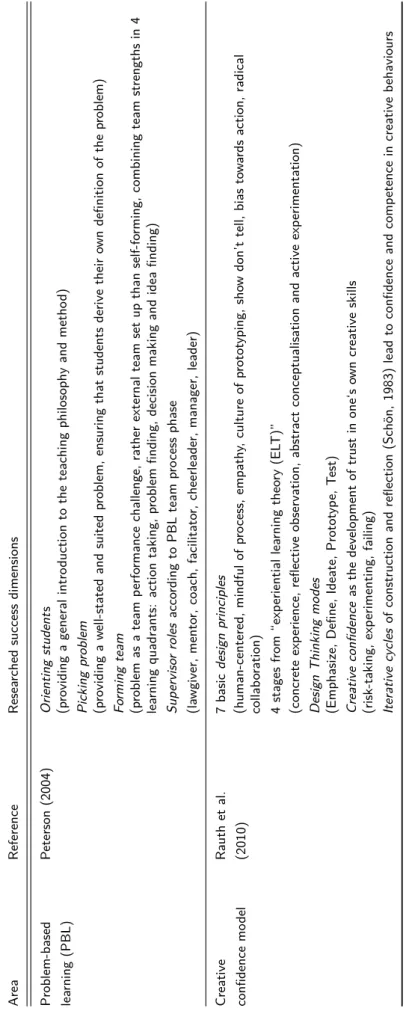
2. Theoretical background Area Reference Resea rched success dimensions Problem-based lea rning (PBL) P eterson (2004 ) Orienting student s (p roviding a general intro duction to the teaching ph ilosoph y and metho d) Picking p roblem (p roviding a w ell-stated and suited p roblem, ensuring that students derive their o wn d efinition of the p roblem) F o rming team (p rob lem as a team p erfo rmance challenge, rather external team set up than self-fo rming, combining team strengt hs in 4 lea rnin g quadrants: action taking, p roblem finding, decision making a nd idea finding) Sup erviso r role s acco rding to PBL team p ro cess ph ase (la wgiver, mento r, coach, facilitato r, cheerleader, manager, leader) Creative confidence mo del Rauth et al. (2010 ) 7 basic design p rinciples (human-centered, mindful of p ro cess, empathy , culture of p rot ot yping, sho w don’t tell, bias to w a rds action, radical collab o ration) 4 stages from “exp eriential lea rning theo ry (EL T)” (concrete exp erience, reflec tiv e observation, abstract conceptua lisat ion and active exp erimentation) Design Thinking mo des (Emphasize, Define, Ideate, Protot yp e, T est) Creative confidence as the development of trust in one‘s o wn creative skills (risk-taking, exp erimenting, failing) Iterative cycles of construction and reflection (Schön , 1983 ) lead to confidence and comp etence in creative b ehaviours
Table 2.6.:Problem-based learning and creative confidence success dimensions – Source: Own depiction,
2.3.3. Success dimensions derived from literature review
As a result of the literature research, certain dimensions arose. Due to their innovative context, these dimensions are assumed to be also relevant for the Design Thinking student education. As the motivation e.g. in a professional context is different than in an educational one, the success factors itself where not transferred but only the meta-level dimensions. These meta-dimensions served as the skeleton for the interview questionnaire. For an overview of discussed aspects and how these are aligned with the research interview questionnnaire sections, refer to Table 2.7:
• Motivation and understanding (Code: MU)
– West and Altink (1996) indicated that the individual perception and motivation is a
relevant factor for innovation teams. Extended with the notion of Rauth et al. (2010), the motivation as well as the individual’s understanding of Design Thinking and his or her general wishes for and expectations of the programme are enquired.
• Learning goals (Code: LG)
– Following the nature of the education programme, key learnings of the programme
are asked. These are extended by the classification of Kraiger et al. (1993) into skill-based, cognitive and affective learning goal dimensions and follow the same notion as a current Hasso Plattner Design Thinking Research (HPDTR) project currently uses to bring Design Thinking education to an open online course environment.
• Learning experience (Code: LE)
– In order to learn something and reach the learning goals, students undergo a learning
journey in Potsdam and this aspect concentrates on their experiences on this journey (in case of interested students not currently taking part, experiences throughout their university learning journey are questioned). One important topic noted by the majority of researchers is the team work and team setting. This aspect is on the hand considered by the team work experience itself as well as by asking for individuals’ most challenging moments (following the critical incident technique). As Hackman (1987) stressed, the team work should “enhance the capability of members to work together on subsequent tasks”. Carried over to the Design Thinking context, this means that team members learn to work together productively in an interdisciplinary team setting. This is an element in the personal development section of the interview.
• Success perception and personal development (Code: SP)
– As expected, the professional research of Cohen and Bailey (1997); Mathieu et al.
2. Theoretical background
Motivationand understanding Motivation Understandingof DesignThinking Learning goals Keyl earnings Learning goaldimensions Learning experience Individualchallenges Team wo rk/ challenges Team facilitation Successp erceptionand personal development Individual Personal development External Co d e MU1 MU2 LG1 L G2 LE1 LE2 LE3 SP1 SP2 SP3 Cohen and Bailey (1997 ) X X X X X Mathieu et al. (2008 ) X X X X X Hackman (1987 ) X X X X W est and Anderson (1996 ) X X X W est and Altink (1996 ) X X X X Hülsheger et al. (2009 ) X X X X P eterson (2004 ) X X X X Rauth et al. (2010 ) X X X X X X X Kraiger et al. (1993 ) X Hassi and Laakso (2011 ) X X X
3. Research design
3.1. Research question
Design Thinking student education evaluation measure
Motivation and understanding
Why do students want to learn about Design Thinking?
Learning goals
What do students expect to learn and staff members consider as important learnings?
Learning experience and facilitation
How do students perceive and think about their learning environment and learning experience at the d.school?
Sub
-
Qu
es
tio
ns
Re
se
arch
con
te
xt
Identification of success measures Quantitative validation Quantitative survey
Re
se
arch
go
al
Focus of the Master thesis:
1. Providing a first understanding of which learning dimensions stakeholders of the Design Thinking student education programme in Potsdam consider as important.
2. Providing insights when and why stakeholders consider their role and participation in the Design Thinking student education programme as successful.
• Motivation
• Understanding of Design Thinking
• Wishes / Expectations
• Key learnings
• Programme expectations
• Team work and team facilitation
• Individual / team challenges
In
te
rvie
w
as
pe
ct
s
Success perception and personal development
When and why do stakeholders consider their role and participation in the Design Thinking student education as successful?
• Success perception
• Personal development areas
Sub
-
Qu
es
tio
ns
In
te
rvie
w
as
pe
ct
s
Figure 3.1.1.: Research design – Source: Own depiction
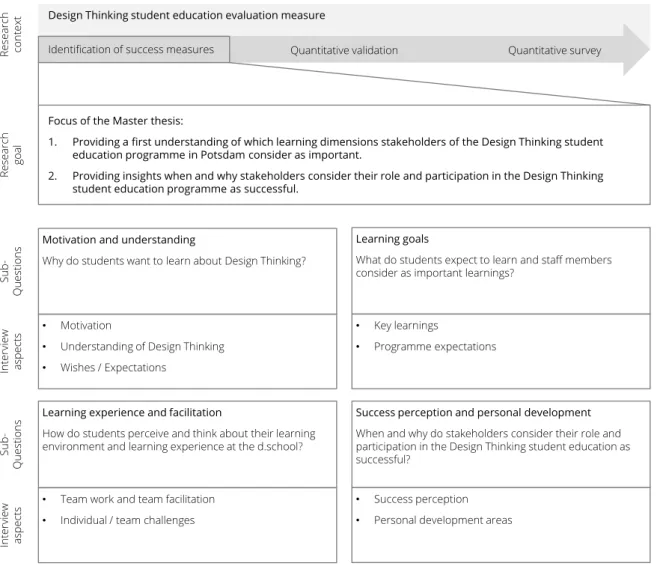
The overall research context of this thesis is to define measures to evaluate the Design Thinking student education programme. To derive this measure, the first step is to identify success meas-ures, followed by a quantitative validation and a large-scale quantitative survey (see Figure 3.1.1). Within this context, as the first step, this thesis focuses on laying the foundation by identifying success measures of the Design Thinking student education programme.
1. Providing a first understanding of which learning dimensions stakeholders of the Design Thinking student education programme in Potsdam consider as important.
2. Providing insights when and why stakeholders consider their role and participation in the Design Thinking student education programme as successful.
Stakeholders consist of multiple parties and can be classified into the provider of the programme and the recipients: In the first category, track and programme managers as well as coaches represent the providers of the Design Thinking student education programme. In the second category, current and former participants of the programme as well as students interested to apply form the group of recipients (refer also to sec. 2.2.3.4 on page 16).
These aspects lead to the following sub-questions as guiding principles for the qualitative research design:
• Why do students want to learn about Design Thinking?
– This question focuses on the motivational aspect why people care at all about the
Design Thinking programme and consider applying for it.
• What do students expect to learn and staff members consider as important learnings?
– This question is directed at understanding what the expectations and wishes towards
the programme are. This leads to a set of key learning goals that students, interested applicants and staff members consider as important for the Design Thinking education programme and its success.
• How do students perceive and think about their learning environment and learning experi-ence at the School of Design Thinking?
– This question tackles the perception of the current programme format. It aims at
understanding how the learning environment influences the team work, how individuals’ experiences influence their success perception of the programme and what students overall feel about the programme.
A guiding principle for the outlook is to connect these findings to the literature review and show commonalities and differences:
• How do the findings connect to the literature and what are potential improvement areas for the Design Thinking student education programme?
3.2. Research paradigm and format
3. Research design
Research paradigms
Philosophical assumptions
Positivism Critical theory Constructivism Realism
Ontology Reality exists driven
by natural mechanisms. Discrete variables
can be measured
Reality is shaped by
social, ethnic, economic, political and other forces
over time
Reality is
constructed by people based on beliefs, feelings and
experiences
Reality is
imperfectly understood because of human mental
limitations
Epistemology Researcher is
remote from reality
Researcher is
involved with those being researched
Researcher is a
passionate participant
Mutual interaction
between researcher and interviewee
Methodology Experiments and
surveys. Mainly quantitative methods
Action research.
Researcher is transformative, changing the
participant’s social world
In-depth interviews.
Individual beliefs, feelings and views sought
Case studies.
Convergent interviewing. Interpretation by
qualitative and/or quantitative methods
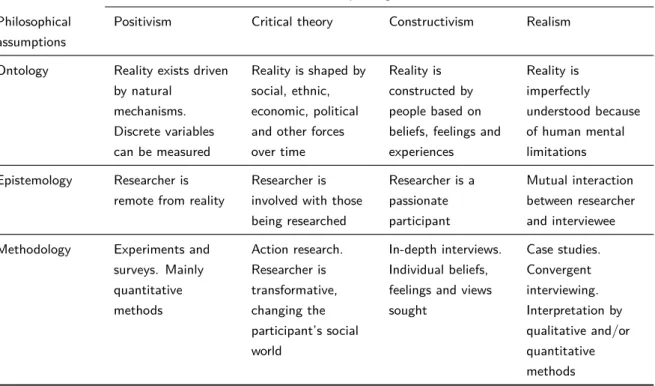
Table 3.1.: Philosophies underpinning research paradigms – Source: Hine and Carson (2007, p. 4)
understood, e.g. due to individual perceptions, contexts, and human limitations). The explorative and in-depth interviews partly overlap with constructivism but the author did not engage with the interviewees in their daily experiences. However, the author has a profound pre-knowledge and is very experienced in Design Thinking and could hence interpret certain answers of interviewees against the background of his previous experiences.
Dresch et al. (2015) and van Aken et al. (2012) argue to differentiate “three processes for know-ledge generation: theory development, theory testing, and reflective design” (Dresch et al., 2015, p. 81). The first one is about relationship-building between different dependent and independent variables. The second, theory testing, is about propositions of relationships that are tested. The third one, also known as academic problem solving, is based on the problem-solving cycle (see Figure 3.2.1). This process is suitable to address the research question at hand (although not a business context, the process can be adapted to an education context as business in the notion of van Aken et al. (2012) is rather a description for an external entity or organisation).
3. Research design
van Aken et al. (
2012
) also differentiate three processes for knowledge
genera-tion: theory development, theory testing, and reflective design. In theory
develop-ment, the research method serves as the case study (van Aken et al.
2012
). The
process of theory development begins with the observation of a phenomenon
that has not been adequately explored in the academic literature (van Aken et al.
2012
). According to van Aken et al. (
2012
), researchers observe the
phenom-enon, develop explanations, and compare these explanations with existing
theo-ries. Propositions that modify the existing theory are formulated to generate new
knowledge (van Aken et al.
2012
).
Once the theory is developed, another knowledge generation process may
begin: theory testing. This process assists in the conclusion and validation of the
results obtained during theory development (van Aken et al.
2012
). The first step
of the process is to identify explanations in the academic literature that are not
conclusive about a specific phenomenon (van Aken et al.
2012
). van Aken et al.
(2012)
suggest that the researcher can generate a conceptual model and
hypoth-eses that can be tested. Hypothhypoth-eses should be examined and the researcher can
deduce conclusions about the phenomenon to confirm the previously developed
theory (van Aken et al.
2012
).
The third process of knowledge generation is significantly related to the concepts
of design science and this study. According to van Aken et al. (
2012
), the reflective
design
is based on the problem-solving cycle (see Fig.
4.12
). Note that the goal of the
reflective design is not problem solving in a single and particular context but generic
solutions that can be applied in various contexts (van Aken et al.
2012
).
Once the problem is defined, the researcher can apply the problem-solving
cycle. However, in the case of reflective design, which was proposed by van Aken
et al. (
2012
), the researcher should reflect to analyze the problem and the
pro-posed solution in an aggregated form after application of the cycle to generalize
the knowledge gained in the research. The researcher must disregard particular
details of the company and define general requirements—design propositions—for
a given class of problems.
Business Phenomenon (type of business
problem) Solutions not adequately addressed in academic literature Selection of company’s problem and linkage to business performance expected for the
situation Analysis and diagnosis Data collection and analysis Academic literature Solution Design
If possible, pilot
Implementation Evaluation Academic reflection Formulation of design proposition (technological rule) Future research
Problem solving cycle
Fig. 4.12 Reflective design. Source van Aken et al. (Figure 3.2.1.:Problem solving cycle – Source: Dresch et al. (2015, p. 81),2012)
based on van Aken et al. (2012)
success research) are intersecting and, if applicable, extended by insights from other areas. Regarding the data collection, a method is needed fulfilling the following demands:
• As the study is explorative and there are only analogous assumptions of relevant success measures, interviews need to be carried out in a non-biasing format (i.e. in the invitation and at the beginning of the interviews, no direction of thought shall be induced)
• The interview process needs to be self-improving, meaning that throughout a series of interviews patterns can emerge and can be adapted if necessary
• The interview method needs to be suitable for interviewees to tell their personal experiences and perceptions of interactions and relationships
Assessing these demands, case-based in-depth interviews are chosen. A qualitative and interpretive paradigm is applied to qualitatively understand success dimensions in Design Thinking student education.
Between November 2015 and February 2016, 13 persons were interviewed in total: • 4 program / track manager, 2 coaches on the institutional side
• 5 current and 2 prospective students on the participant side