Effect of Drying Processes on the Texture of Silica Gels
Hamid Satha1*, Kamel Atamnia1, Florence Despetis2
1Laboratoire AIGM, Groupe Matériaux, Université 8 mai 1945, Guelma, Algérie; 2GES, UMR CNRS 5650, Université de Mont- pellier II, Montpellier, France.
Email: *[email protected]
Received September 14th, 2012; revised October 20th, 2012; accepted November 7th, 2012
ABSTRACT
Peculiar xerogels and aerogels constituted by a silica network, made of spherical fully dense silica particles having the same size, are investigated by adsorption of nitrogen at 77.4 K. Comparison of sorption data between materials dried via different methods, gentle drying at room temperature, alcohol supercritical drying and CO2 supercritical drying, shows
that the specific surface area is associated to the particle sizes and necks established between them during drying and not to the sample density. The dissolution-redeposition of silica, which occurs in the alcohol supercritical drying pro- cess, induces a decrease of specific surface area and consequently an increase in the mechanical properties compara- tively to CO2 supercritical drying. Investigating pore volume measurements as a function of dwell time, which is the
interval of time allowing a pressure change of 0.01%, we corroborate that for compliant materials the full volume can not be detected because of capillary stresses. So the time required to perform correct measurements of the pore volume decreases with sample bulk density increase and elastic properties increase. All these experiments qualitatively cor- roborate the theory proposed previously.
Keywords: Nitrogen Sorption; Pore Volume; Aerogel; Alcohol Supercritical Drying; CO2 Supercritical Drying
1. Introduction
Silica xerogels and aerogels are materials exhibiting a high porous volume. They are characterized by pores having a size smaller than 100 nm. Moreover they are brittle and the mechanical properties values of some pe- culiar light aerogels can be considered as the lowest among the family of inorganic materials.
According to the small pore sizes, gas condensation easily occurs and induces capillary stresses. These capil- lary stresses do not have any effect on porous materials with acceptable mechanical properties. Conversely they induce significant strain in the case of aerogels whose elastic modulus is in the range of a few MPa. This strain is easily evidenced with lightweight aerogels having a porosity higher than 0.9. During a nitrogen adsorption- desorption isotherm experiment a length variation results from the compression of the sample which occurs as ni- trogen molecules condense within the pores. This length change has been followed using an optical device [1] and more recently has been quantified using a linear variable differential transducer [2]. Thus the porous volume measured using adsorption technique is far smaller than the true porous volume of aerogel.
Previously other causes have been evoked to explain
the discrepancy between the true and measured porous volume. The first one concerns the range of pore size investigated using nitrogen adsorption technique. If the dried gel contains pores the size of which is higher than 50 nm, they will not be taken into account in the mea- surement. This possibility does not agree with permeabil- ity measurements which indicate that silica gels are mainly constituted by pores of very small size.
Another possible reason for such a discrepancy comes from the mean curvature of liquid nitrogen adsorbed on the material surface [3]. Condensation stops if the cur- vature reaches a value close to zero and consequently the true porous volume is not measured [4,5].
In this paper, we investigate the effect of capillary forces on the porous volume of peculiar gels constituted by a silica network made of spherical fully dense silica particles having the same size.
2. Experimental
2.1. Sample Preparation
Silica gels are obtained from a commercial colloidal sil-ica solution called Ludox LS (Trade mark) consisting of spherical particles of about 14 nm size. Stabilization at pH equal to 8.2 is due to Na+ ions which are located at
the surface of dense silica particles. The calculated spe-
cific surface area of powder is 195 m2·g−1. Gelation is
performed by adding hydrochloric acid aqueous solution. Different dilutions permit to synthesize two series of gels at controlled pH. The samples are labeled NX or AX (N for pH 7 and A for pH 5). X is related to the dilution and increases when the dilution of the starting gelling solu- tion increases.
After gelation all the gels are soaked with ethanol. Three solvent exchanges are performed. The total solvent exchange requires one month to obtain a gel with pores mainly filled by ethanol. Traces of water are about 1% as measured with Karl Fischer method.
Gels are dried using three different processes. The first one consists in a gentle drying at room temperature. The resulting material is a conventional xerogel. The second one is dried in an autoclave by rising the temperature at a rate of 100˚C/h up to 300˚C. So the pressure increases up to 15 MPa. The duration of the depressurization step is four hours. Materials are called alcohol supercritically dried (SCD) aerogels. The last series of gels is dried us- ing CO2 instead of alcohol in supercritical drying. This
treatment consists to exchange alcohol with liquid CO2 at
10˚C and 6 MPa for 2 h 30 min then increasing the auto-clave temperature up to 50˚C and the pressure up to 10 MPa. The time of depressurization is six hours.
2.2. Nitrogen Adsorption-Desorption Measurements
The bulk densities of samples a are evaluated from
weight and linear dimensions. Due to the large shrinkage, the bulk density of xerogels is less accurate than that of aerogels. The theoretical total porous volume VPth is
cal-culated from the relation:
Pth
a s
1 1
V
where s is the skeletal density of silica which is 2.2
g·cm−3 [6]. The porosity of this material is totally open.
The specific surface area is obtained from nitrogen ad- sorption-desorption isotherm at 77 K using BET theory [7]. The accuracy is about 4%. Normally for rigid porous materials, when the nitrogen relative pressure P/Po ap-
proaches 0.99, the volume of adsorbed nitrogen must correspond to the porous volume. We have chosen to estimate the mean pore size using BJH theory applied to desorption step [8]. Taking the same sample, different runs are performed by changing the dwell time. The equilibrium time which is imposed by the investigator, is the interval of time allowing a pressure change of 0.01%. It has been varied from 5 to 240 seconds.
According to previous reported recommendations [9] adsorption nitrogen experiments are performed on small pieces of monolithic samples. The sample weight varies between 0.12 to 0.24 g, the lowest weight corresponding
to the lowest density in order to characterize the same samples volumes. Samples are cut with a razor blade from a monolithic one to avoid crushing which can result in a partial densification of lightweight aerogels.
2.3. Young Modulus Measurements
The mechanical behaviors of samples are investigated by the nanoindentation technique. Indentation experiments are carried out on samples monoliths exhibiting flat sur- faces using a home made instrumented microindentor [10]. Typical force versus penetration depth curves are obtained. The standard way to determine the elastic modulus is by using the initial slope of the unloading curve [11]. Because of the aerogels brittleness difficulties are encountered to obtain an adjusted surface for inden- tation, so only a few samples have been characterized. The bulk modulus K is then calculated making use of the relation K = E/3(1−2) with the Poisson’s ratio taken to be 0.2 [12].
3. Results
The density of samples dried under conventional condi- tions (xerogels) varies from 1.15 to 1.3. The bulk density of aerogels is within the range 0.19 - 0.48 g/cm3 depend-
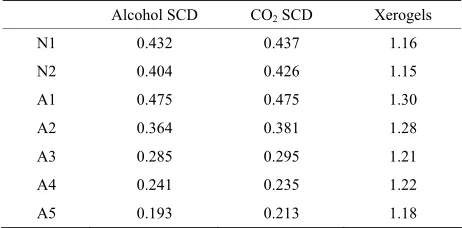
ing on the dilution in aqueous solution of the starting silica sol and on the supercritical drying technique. The shrinkage of xerogels is of great extent even though the gels analysed here are constituted by an assembly of sil- ica spherical particles with size and shape not modified during the drying step. Moreover, since both supercritical drying procedures are performed on the same gel sam- ples, it is possible to compare the densities of obtained aerogels (Table 1). Aerogels obtained from alcohol su-
percritical drying show a slightly lower density than those issued from CO2 supercritical drying whatever the
dilution of the starting solution allowing to prepare the gel. This feature is not presently well understood since CO2 is relatively inert and is expected unreactive versus
[image:2.595.307.538.621.735.2]silica. We hypothesis that largest pores shrink during the
Table 1. Bulk density in g/cm3 for xerogels and alcohol or CO2 SCD aerogels. Density values are depending on dilu-
tion and pH of the gelling solution (accuracy on the density 1%).
Alcohol SCD CO2 SCD Xerogels N1 0.432 0.437 1.16 N2 0.404 0.426 1.15 A1 0.475 0.475 1.30
A2 0.364 0.381 1.28 A3 0.285 0.295 1.21 A4 0.241 0.235 1.22
stage of depressurisation because of the previous solvent exchange stage, between liquid alcohol and liquid CO2,
which is not complete.
[image:3.595.311.537.353.674.2]The specific surface area of xerogels is nearly constant (180 m2·g−1) as a function of bulk density (
Figure 1).
This value, smaller than that of isolated particles (195 m2·g−1), obviously corresponds to the formation of the
network which is constituted by linked particles. Con- cerning aerogels, the evolution of specific surface area with bulk density exhibits two families (Figure 2). Sur-
face area values of aerogels obtained from CO2 super-
critical drying are close to those obtained for xerogels. Contrarily aerogels issued from an alcoholic supercritical drying show a smaller specific surface area (145 m2·g−1).
The surface area lost associated to this last supercritical drying process is about 40 m2·g−1. It is worth noting that
for all the investigated series of samples the specific sur- face area does not depend on the density. This feature also indicates that the surface is related to the size of par- ticles while the density mainly acts on the porous vol- ume.
The pore size distribution of silica gel spans over the entire range of pores measured using nitrogen adsorption measurements. So the pore volume corresponds to pores sizes smaller than 50 nm (mesoporosity) and its
mea-160 170 180 190 200
1.1 1.2 1.3 1.4
Sp ec if ic su rf ace a rea ( m 2 .g -1 ) Xerogels (m 2·g -1)
ρa (g·cm−3)
Figure 1. Xerogels specific surface area as a function of bulk density.
100 140 180 220
0.1 0.2 0.3 0.4 0.5 0.6
Sp ecif ic su rf ace ar ea (m 2.g -1) Alcohol SCD CO2 SCD CO2SCD
(m
2·g -1)
[image:3.595.68.282.404.520.2]ρa (g·cm−3)
Figure 2. Aerogels specific surface area as a function of bulk density: effect of drying process.
[image:3.595.61.286.560.708.2]surement needs to choose adjusted adsorption-desorption parameters.
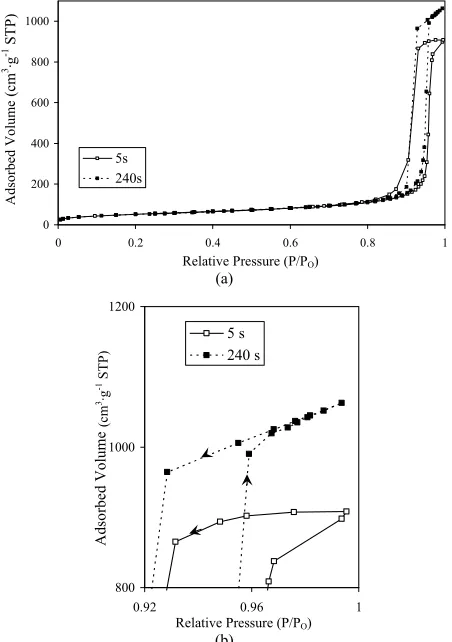
Figure 3 exhibits the difference between two runs per-
formed on a same sample by changing the dwell time (5 s and 240 s) between a pressure change of 10−4. The two
curves superimpose up to a relative pressure of 0.95. Beyond this P/Po value, the curve characterized by a
dwell time of 240 s, give higher adsorbed volumes and the hysteresis have different shape close to saturation. Whereas the adsorbed volumes are different between adsorption and desorption for the 5 s dwell time, for the 240 s dwell time, volumes are slightly identical (Figure
3(b)).
Two kinds of aerogels have been investigated chang- ing dwell time (Figure 4). The value of the ratio Vpm/VPth
(where Vpm is the measured porous volume) becomes
constant for alcohol 0.43 sample and for a dwell time of 30 seconds. For CO2 0.44 sample the ratio increases con-
tinuously as a function of dwell time. It seems possible to assert that equilibrium can be reached with a dwell time about 120 s.
0 200 400 600 800 1000
0 0.2 0.4 0.6 0.8 1
A ds orbe d Volume (c m 3.g -1 ST
P) 5s 240s (c m 3·g -1 ST
P
)
Relative Pressure (P/PO)
(a)
800 1000 1200
0.92 0.96 1
Ad sor bed Vo lu me ( cm 3 .g -1 STP) 5 s 240 s (c m 3·g -1 STP
)
Relative Pressure (P/PO)
(b)
Figure 3. Nitrogen adsorption-desorption isotherm of a SCD CO2 aerogel. (a) Complete isotherm; (b) Enlargement
40 60 80 100
0 50 100 150 200 250
Equilibrium time (s)
Vpm/V
pth (%
)
[image:4.595.61.287.84.222.2]0.44 CO2 SCD 0.43 Alcohol SCD 0.44 CO2SCD
Figure 4. Relaxation effects versus bulk density (dwell time 120 s). Empty symbols for CO2 SCD-Full symbols for al-
cohol SCD.
In Figure 5, Vpm/VPth is plotted as a function of bulk
density for aerogels issued from the two kinds of super- critical drying and for a dwell time of 120 s. This figure displays that these measurements are valid only for highest densities and express a relaxation phenomenon which takes place as a function of time. In order to cor- roborate this effect, Table 2 gives bulk modulus meas-
ured for the two kinds of aerogels. We note that, for a given density, CO2 SCD samples are less stiff.
4. Discussion
The xerogels dried at room temperature and under air atmosphere are obtained in the shape of lumps. The spe- cificsurface area is about constant (180 m2·g−1). It does
not depend on the pH (5 or 7) at which the gelation is carried out. CO2 aerogels issued from the same gels dis-
play a surface value in the same order of magnitude. This fact indicates that the CO2 supercritical drying does not
induce a deep change in surface area. Consequently the surface can be mainly associated to the size of the parti- cle keeping in mind that an area is lost between particles at the location of necks. Moreover nitrogen molecules cannot reach the entire surface located between linked particles [6]. This value crudely corresponds to that esti- mated from simple geometrical arguments [13]. Thus we can say that the specific surface area of these silica xe- rogels and CO2 SCD aerogels is mainly associated to the
particle size.
The surface area of alcohol SCD is about 146 m2/g.
The comparison with xerogels or CO2 SCD aerogels in-
[image:4.595.309.537.85.215.2]dicates that a surface is lost during the alcohol super- critical stage. The surface decrease is related to the solu- bility of silica at high temperature (300˚C) and high pressure (20 MPa) [14]. The dissolution-redeposition of silica induces a redeposition of silica at the necks be- tween particles and consequently an increase in the me- chanical properties as shown in our mechanical results. Moreover it was previously demonstrated [12] that the
Figure 5. Relaxation effects versus dwell time for two kinds of aerogels with same bulk density. Empty symbols for CO2
SCD-Full symbols for alcohol SCD.
Table 2. Properties of silica aerogels.
Bulk density
(g·cm−3) E (MPa) K (MPa) A1: Alcohol SCD 0.475 233 5 129 3
A3: Alcohol SCD 0.285 22 1 12.2 0.5 A5: Alcohol SCD 0.193 19 1 10.6 0.5 A1: CO2 SCD 0.475 74 4 41 2 A2: CO2 SCD 0.381 33 2 18 1
microporosity, i.e. porosity due to pores having size
smaller than 2 nm, disappears
The effect of capillary forces arising during the last in- stants of nitrogen adsorption measurements are now bet- ter understood [9]. The whole porous volume measured at a relative pressure P/Po close to 1 should theoretically
correspond to real one. However due to capillary forces associated to nitrogen condensation inside the pores, the gel shrinks at the beginning of condensation [8]. Addi- tionally Reichenauer and Scherer have demonstrated that when the relative partial pressure approaches 1 an expan- sion can be observed. It corresponds to the fact that the capillary stresses become of a smaller extent as the cur- vature radius of the interface liquid-vapour increases. If the experiment is performed under usual conditions, the expansion of gel cannot establish and consequently the measured pore volume Vpm is much smaller than theo-
retical pore volume VPth calculated from relation (1).
The difference between the measured porous volume Vpm and the theoretical porous volume VPth depends on
the aerogel geometrical dimensions, on its elastic modu- lus and on the selected time for experiment. This differ- ence, which is unequivocally related to a macroscopic shrinkage of the aerogels, is for a given data acquisition time obviously higher for aerogels having low density and consequently displaying the lowest elastic properties. We observe that for a given equilibrium time the Vpm/VPth ratio is lower for aerogels issued from CO2 than
[image:4.595.309.538.283.377.2]capillary condensation is higher for CO2 aerogels for
which the network is more connected. Reichenauer and Scherer have demonstrated that the capillary stresses operated on the silica backbone can reach 0.1 to 0.8 MPa. This value is high enough, comparatively to the bulk modulus of some samples, to induce contraction upon sorption in mesopores. However, our experiments can not allow correcting the isotherm according to the uni- form contraction model.
In all cases, equilibrium times must be sufficiently long to assume that the samples are enough equilibrated. So, the time required to perform correct measurements of the pore volume decreases with sample bulk density in- crease and elastic properties increase. All these experi- ments qualitatively corroborate the theory proposed pre- viously [9].
5. Conclusions
The gel shrinkage associated to the drying steps is dem- onstrated dependant on the kind of drying and on chemi- cal reaction occurring during syneresis and dissolution- redeposition of silica. The specific surface area is mainly constant and does not depend on the bulk density of gels. It is associated to the particle sizes and necks establishing between them.
We corroborate that the pore volume can not be easily obtained by nitrogen adsorption-desorption. Because of capillary stresses induced during measurement, a diver- gence between the measured porous volume and the ex- pected one is observed. This divergence is linked to the mechanical properties of material and on the selected time to estimate the adsorbed volume.
REFERENCES
[1] R. K. Iler, “The Chemistry of Silica: Solubility, Polym- erization, Colloid and Surface Properties, and Biochemis- try,” Wiley, New York, 1979.
[2] C. J. Brinker and G. W. Scherer, “Sol-Gel Science: The Physics and Chemistry of Sol-Gel Processing,” Academic Press, Inc, 1990.
[3] J. Fricke, “SiO2-Aerogels: Modifications and Applica- tions,” Journal of Non-Crystalline Solids, Vol. 121, No. 1-3, 1990, pp. 188-192.
doi:10.1016/0022-3093(90)90129-A
[4] G. W. Scherer, “Recent Progress in Drying of Gels,” Journal of Non-Crystalline Solids, Vol. 147-148, 1992, pp. 363-374.
[5] G. W. Scherer, S. Calas and R. Sempere, “Sintering Aero- gels,” Journal of Sol-Gel Science and Technology, Vol. 13, No. 1-3, 1998, pp. 937-943.
doi:10.1023/A:1008687610326
[6] H. Satha, A. Haddad and J. Phalippou, “Silica Glass from Aerosil by Sol-Gel Process: Densification and Textural Properties,” International Journal of Thermophysics, Vol. 24, No. 3, 2003, pp. 885-893.
doi:10.1023/A:1024013005413
[7] S. Brunauer, P. H. Emmet and E. Teller, “Adsorption of Gases in Multimolecular Layers,” Journal of the Ameri- can Ceramic Society, Vol. 60, No. 2, 1938, pp. 309-319. [8] E. P. Barret, L. G. Joyner and P. P. Halenda, “The Deter-
mination of Pore Volume and Area Distributions in Po- rous Substances,” Journal of the American Ceramic Soci-ety, Vol. 73, 1951, pp. 373-380.
[9] G. Reichenauer and G. W. Scherer, “Nitrogen Sorption in Aerogels,”Journal of Non-Crystalline Solids, Vol. 285, No. 1-3, 2001, pp. 167-174.
doi:10.1016/S0022-3093(01)00449-5
[10] M. Foret, J. Pelous and R. Vacher, “An Investigation of the Structure of Colloidal Aerogels,” Journal of Non- Crystalline Solids, Vol. 147-148, 1992, pp. 382-385. [11] J. Zarzycki, “Structure of Dense Gels,” Journal of Non-
Crystalline Solids, Vol. 147-148, 1992, pp. 176-182. [12] M. Pauthe, “Gels de Silice Issus de Composés Orga-
nométalliques Modifiés. Leur Applications aux Verres d’Oxynitrure de Silicium,” Ph.D. Thesis, Montpellier University, Montpellier, 1989.
[13] T. Woignier, J. Phalippou, J. F. Quinson, M. Pauthe and F. Laveissiere, “Physicochemical Transformation of Silica Gels During Hypercritical Drying,”Journal of Non-Cry- stalline Solids, Vol. 145, 1992, pp. 25-32.
doi:10.1016/S0022-3093(05)80424-7