Semantic Role Labeling Improves Incremental Parsing
Ioannis Konstas and Frank Keller
Institute for Language, Cognition and Computation School of Informatics, University of Edinburgh
{ikonstas,keller}@inf.ed.ac.uk
Abstract
Incremental parsing is the task of assign-ing a syntactic structure to an input sen-tence as it unfolds word by word. Incre-mental parsing is more difficult than full-sentence parsing, as incomplete input in-creases ambiguity. Intuitively, an incre-mental parser that has access to seman-tic information should be able to reduce ambiguity by ruling out semantically im-plausible analyses, even for incomplete in-put. In this paper, we test this hypothesis by combining an incremental TAG parser with an incremental semantic role labeler in a discriminative framework. We show a substantial improvement in parsing per-formance compared to the baseline parser, both in full-sentence F-score and in incre-mental F-score.
1 Introduction
When humans listen to speech, the input becomes available gradually as the speech signal unfolds. Reading happens in a similarly gradual manner when the eyes scan a text. There is good evidence that the human language processor is adapted to this and works incrementally, i.e., computes an in-terpretation for an incoming sentence on a word-by-word basis (Tanenhaus et al., 1995; Altmann and Kamide, 1999). Also language processing systems often deal with speech as it is spoken, or text as it is typed. A dialogue system should start interpreting a sentence while it is spoken, and an information retrieval system should start retrieving results while the user is typing.
Incremental processing is therefore essential both for realistic models of human language pro-cessing and for NLP applications that react to user input in real time. In response to this, a number of incremental parsers have been devel-oped, which use context-free grammar (Roark,
2001; Schuler et al., 2010), dependency grammar (Chelba and Jelinek, 2000; Nivre, 2007; Huang and Sagae, 2010), or tree-substitution grammars (Sangati and Keller, 2013). Typical applications of incremental parsers include speech recognition (Chelba and Jelinek, 2000; Roark, 2001; Xu et al., 2002), machine translation (Schwartz et al., 2011; Tan et al., 2011), reading time modeling (Demberg and Keller, 2008), or dialogue systems (Stoness et al., 2004).
Incremental parsing, however, is considerably harder than full-sentence parsing: when process-ing then-th word in a sentence,an, the parser only
has access to the left context (wordsa1...an−1);
the right context (wordsan+1...aN) is not known
yet. This can lead to local ambiguity, i.e., pro-duce additional syntactic analyses that are valid for the sentence prefix, but become invalid as the right context is processed. As an example consider the sentence prefix in (1):
(1) The athlete realized her goals . . . a. at the competition
b. were out of reach
The prefix could continue as in (1-a), i.e., as a main clause structure. Or the next words could be as in (1-b), in which caseher goalsis part of a subordinate clause.
Intuitively, an incremental parser that has access to semantic information would be able to decide which of these two analyses is likely to be correct, even without knowing the rest of the sentence. If the NPher goalsis a likelyARG1 ofrealizedthe
parser should prefer the main clause structure. On the other hand, if the NP is a likelyARG0 of an (as
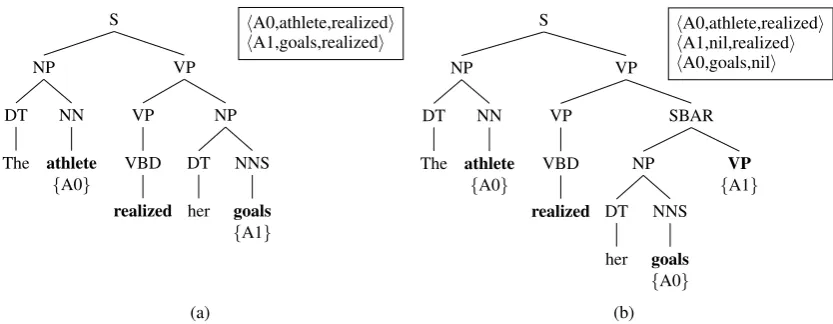
yet unseen) embedded verb, then the parser should go for the subordinate clause structure. This is il-lustrated in Figure 2. Note that the preference can easily be reversed: if the prefix wasthe athlete re-alized her shoes, then her shoesis very likely to be anARG0 rather than anARG1.
The basis of this paper is the hypothesis that semantic information can aid incremental parsing. To test this hypothesis, we combine an incremen-tal TAG parser with anincremental semantic role labeling (iSRL) system. The iSRL system takes prefix trees and computes their most likely seman-tic role assignments. We show that these role as-signments can be used to re-rank the output of the incremental parser, leading to substantial im-provements in parsing performance compared to the baseline parser, both in full-sentence F-score and in incremental F-score.
2 Incremental Semantic Role Labeling
The current work builds on an existing incremen-tal parser, the Psycholinguistically Motivated Tree Adjoining Grammar (PLTAG) parser of Demberg et al. (2013). The distinguishing feature of this parser is that it builds fully connected structures (no words are left unattached during incremental parsing); this requires it to make predictions about the right context, which are verified as more of the input becomes available. Konstas et al. (2014) show that semantic information can be attached to PLTAG structures, making it possible to assign se-mantic roles incrementally. In the present paper, we use these semantic roles to re-rank the output of the PLTAG parser.
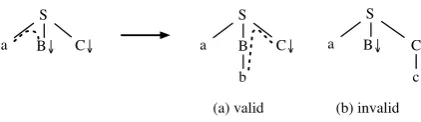
2.1 Psycholinguistically Motivated TAG PLTAG extends standard TAG (Joshi and Sch-abes, 1992) in order to enable incremental parsing. Standard TAG assumes a lexicon of elementary trees, each of which contains at least one lexical item as an anchor and at most one leaf node as a foot node, marked with A∗. All other leaves are marked with A↓ and are called substitution nodes. To derive a TAG parse for a sentence, we start with the elementary tree of the head of the sentence and integrate the elementary trees of the other lexical items of the sentence using two oper-ations:adjunctionat an internal node and substi-tutionat a substitution node (the node at which the operation applies is theintegration point). Stan-dard TAG derivations are not guaranteed to be in-cremental, as adjunction can happen anywhere in a sentence, possibly violating left-to-right process-ing order. PLTAG addresses this limitation by in-troducingprediction trees,elementary trees with-out a lexical anchor. These are used to predict syntactic structure anchored by words that appears later in an incremental derivation. This ensures
a S
B↓ C↓ a
S
B C↓
b
a S
B↓ C
c
[image:2.595.311.522.67.128.2](a) valid (b) invalid
Figure 1: The current fringe (dashed line) indi-cates where valid substitutions can occur. Other substitutions result in an invalid prefix tree.
that fully connected prefix trees can be built for every prefix of the input.
In order to efficiently parse PLTAG, Demberg et al. (2013) introduce the concept of fringes. Fringes capture the fact that in an incremental derivation, a prefix tree can only be combined with an elementary tree at a limited set of nodes. For instance, the prefix tree in Figure 1 has two substi-tution nodes, forBandC. However, only substi-tution intoBleads to a valid new prefix tree; if we substitute intoC, we obtain the tree in Figure 1b, which is not a valid prefix tree (i.e., it represents a non-incremental derivation).
2.2 Incremental Role Propagation
The output of a semantic role labeler is a set of semantic dependency tripleshl,r,pi, wherel is a semantic role label (e.g., ARG0, ARG1,ARGM in
Propbank), andr and p are the words (argument and predicate) to which the role applies. An incre-mentalsemantic role labeler assigns semantic de-pendency triples to a prefix of the input sentence. Note that not every word is an argument to a pred-icate, therefore the set of triples will not necessar-ily change at every input word. Also, triples can be incomplete, as either the predicate or the argument may not have been observed yet.
S
VP
NP
NNS
goals {A1}
DT
her VP
VBD
realized
NP
NN
athlete {A0}
DT
The
hA0,athlete,realizedi hA1,goals,realizedi
(a)
S
VP
SBAR
VP {A1}
NP
NNS
goals {A0}
DT
her VP
VBD
realized
NP
NN
athlete {A0}
DT
The
hA0,athlete,realizedi hA1,nil,realizedi hA0,goals,nili
[image:3.595.91.508.75.237.2](b)
Figure 2: Incremental Role Propagation Algorithm application for two different prefix trees of the sen-tence prefixthe athlete realized her goals. In (a) the parser builds a main clause, so IRPA assigns an A1 togoalswithrealized as predicate. In (b) the parser predicts an embedded clause, so IRPA delays the assignment of the A1 torealized, and instead introduces two incomplete triples: the first one is predicate-incomplete, with the argumentgoalsassigned an A0, waiting to be attached to a predicate. The second one is argument-incomplete with predicaterealizedassigned an A1, waiting for an argument to follow.
(see Section 1). Note the use of incomplete seman-tic role triples in Figure 2b.
3 Model
We use a discriminative model in order to re-rank the output of the baseline PLTAG parser based on semantic roles assigned by the iSRL system. 3.1 Problem Formulation
Our overall approach is closely related to the discriminative incremental parsing framework of Collins and Roark (2004). The goal is to learn a mapping from input sentences x∈
X
to parse trees y∈Y
. For a given set of training pairs of sentences and gold-standard parse trees (x,y) ∈X
×Y
, the output ˆycan be defined as: ˆy= argmax
y∈GEN(x)Φ(x,y)·w¯ (1)
whereGEN(x)is a function that enumerates can-didate parse trees for a given inputx, Φis a rep-resentation that maps each training example(x,y) to a feature vectorΦ(x,y)∈Rd, and ¯w∈Rd is a
vector of feature weights.
During training, the task is to estimate ¯wgiven the training examples. In terms of efficiency, a crucial part of Equation (1) is the search strategy over parses produced by GEN and, to a smaller degree, the dimensionality of ¯w. One common de-coding technique is to implement a dynamic pro-gram, thus avoiding the explicit enumeration of
all analyses for a given timestamp (Huang, 2008). However, central to the discriminative approach is the exploration of features that cannot be straight-forwardly embedded into the parser using a dy-namic program. These include arbitrarily long-range dependencies contained in a parse tree, and more importantly non-isomorphic representations of the input sentence such as its semantic frame, i.e., the set of all semantic roles tripes that pertain to the same predicate. In order to accommodate these, we decode via beam search over candidate parses. We keep a list of thek-best analyses and prune those whose scorescr(x) =Φ(x,y)·w¯ falls below a threshold.
3.2 Incrementalk-best Parsing
What we described in the previous section could equally apply tok-best re-ranking for full-sentence parsing (e.g., Charniak and Johnson, 2005). For incremental parsing, in addition to outputting ˆyfor the full sentence, we need to output prefix trees
ˆ
yn for every prefix of lengthn∈ {1...N}of
sen-tencex=a1...aN with lengthN. Let hxn,yˆn,ni,
be the state of our model after we have parsed the firstnwords of sentencex, resulting in analysis ˆyn.
an+1by combining the prefix tree ˆynwithan+1:
ADV hxn,yˆn,ni=hxn,yˆn,ni ⊗an+1 ={hxn+1,yˆn+1,n+1i} Next, we define the set of states representing prefix trees as π, with π0 = {hx0,/0,0i}, and
πn = ∪π0∈πn−1ADV(π0). We can now redefine
GEN(xn) =πn, for any prefix of lengthn.
We enumerate prefix trees (functionGEN) with the incremental parser of Demberg et al. (2013). The states of the model are stored in a chart; each cell holds the top-k prefix trees. The transition to the next state (function ADV) is performed by combining each prefix tree with a set of candidate of elementary (and prediction) trees via adjunc-tion and substituadjunc-tion, subject to restricadjunc-tions im-posed by incrementallity (see Figure 2). In or-der to efficiently compute all combinations, the PLTAG parser computes only the fringes (see Sec-tion 2) of the prefix tree, and the candidate ele-mentary trees and matches these two; this avoids the computation of the prefix tree entirely.1
Each prefix tree is weighted using a probabil-ity model estimated over PLTAG operations and the lexicon. This probability is used as a feature in Φ. In addition, we define a set of features of increasing sophistication, which include features specific to PLTAG, standard tree-based features, and, crucially, features extracted from the seman-tic role triples produced incrementally by the iSRL system of Konstas et al. (2014). The features are computed for each prefix treeyn, soΦcan be
re-written asΦ(xn,yn), and therefore Equation (1)
be-comes: ˆ
yn=argmax yn∈πn
Φ(xn,yn)·w¯ (2)
Our goal now becomes to learn mappings between sentenceprefixes xnandprefixtrees ˆyn. In contrast
to models that estimate features weights on full sentence parses (Collins and Roark, 2004; Char-niak and Johnson, 2005), we do not observe gold-standard prefix trees during training. However, we can use gold-standard lexicon entries when pars-ing the trainpars-ing data with the PLTAG parser, which gives an approximation of gold-standard prefix treesy+
n. Finally, during testing, given an unseen
sentencexand a trained set of feature weights ¯w, our model generates prefix treesyn for every
sen-tence prefix of sizen.
1As in a chart parser, the prefix tree can be re-constructed
by following backpointers in the chart. This is done only for evaluation at the end of the sentence or incrementally on demand.
4 Reranking Features
This section describes the features used for rerank-ing the prefix trees generated by the incremental parser. We include three different classes of fea-tures, based on local information from PLTAG el-ementary trees, based on global and structural in-formation from prefix trees, and based on seman-tic information provided by iSRL triples. In con-trast to work on discriminative full-sentence pars-ing (e.g., Charniak and Johnson, 2005; Collins and Koo, 2005), we can only use features extracted from the prefix trees being constructed incremen-tally as the sentence is parsed. The right context of the current word cannot be used, as this would vio-late incrementality. Every feature combination we try also includes the following baseline features: Prefix Tree Probability is the log probability of the prefix tree as scored by the probability model of the baseline parser. The score is normalized by prefix length, to avoid getting larger negative log probability scores for longer prefixes.
Elementary Tree Probability is the log proba-bility of the elementary tree corresponding to the word just added to the prefix tree according to the probability model of the baseline parser.
4.1 PLTAG Features
The baseline generative model of the PLTAG parser employs features based on parsing actions, the elementary trees used at each timestamp, and the previous word and PoS tag. In the discrimi-native model, we extend the locality of these fea-tures, as well as addressing sparsity issues arising from rare elementary trees. In all cases, both lex-icalized and unlexlex-icalized versions of the elemen-tary trees are used.
Unigram Trees is a family of binary features that record the local elementary trees chosen by the parser for then-th word, i.e., current word for
n=1 and previous word forn=2.
and captures pairs of elementary trees that are fre-quently chosen together, e.g., a verb-headed tree with a PP foot node, followed by an NP-headed prepositional tree.
4.2 Tree Features
The following features are inspired by Charniak and Johnson (2005) and attempt to encode proper-ties of the prefix tree, as well as capture regulari-ties for specific syntactic construction such as co-ordination. Even though the PLTAG parser builds fully connected structures and predicts upcoming context, some constituents in a given prefix tree may be incomplete. We therefore compute the fea-tures in this group only for those constituents that have been completed in the current prefix tree (i.e., constituents that are complete at wordan, but were
incomplete at word an−1). This ensures each of the features is only counted once per constituent. For example, the coordination parallelism feature (see below) should be computed only after all the words in the yield of the CC non-terminal have been observed.
Right Branch encodes the number of nodes on the longest path from the root of the prefix tree to the rightmost pre-terminal. We also include the symmetrical feature which records the number of the remaining nodes in the prefix tree. This feature allows the parser to prefer right-branching trees, commonly found in English syntax.
Coordination Parallelism records whether the two sibling subtrees of a coordination node are identical in terms of structure and node categories up to depth l. We encode identity in a bit mask, and setl=4 (e.g., 1100 means the subtrees have identical children and grandchildren).
Coordination Parallelism Length indicates the binned difference in size between the yields of each sibling subtree under a coordination node. It also stores whether the second subtree is at the end of the sentence.
Heavy stores the category of each node in a completed constituent, along with the binned length of its yield and whether it is at the end of the sentence. This feature captures the tendency of larger constituents to occur towards the end of the sentence.
Neighbors encodes the category of each node in the completed constituent, the binned yield size,
and the PoS tags of thel preceding words, were
l=1 or 2.
Word stores the current word along with the cat-egories of itslimmediate ancestor nodes (exclud-ing pre-terminals);l=2 or 3.
4.3 SRL Features
The features in this group are extracted from the output of iSRL system of Konstas et al. (2014), which annotates prefix trees with semantic roles. The setup proposed in the current paper makes it possible to feed the semantic information back to the PLTAG parser by using it to re-rank thek -best prefix trees generated by the parser. (The re-ranked prefix trees could then also result in better iSRL performance, an issue we will return to in Section 6.3.)
Recall that the SRL information comes in the form of tripleshl,r,pi, wherel is a semantic role label andr and pare the words to which the role applies (see Figure 2 for examples). For each fea-ture, we also compute an unlexicalized version by replacing the argument and predicates in the triples with their PoS tags.
Complete SRL Triples stores the complete triples (if any) generated by the current word. The word can be the predicate or the argument in one or more dependency relations involving previous words.
Semantic Frame records all the arguments of a predicate (if present) for frequent semantic la-bels, i.e., A0, A1 and A2, as well as the presence of a modifier (e.g., AM-TMP, AM-LOC, etc.). This feature usually fires when a verb is added to the prefix tree and generates several complete SRL triples. The feature captures the semantic frame of a verb as a whole (while the previous feature just records it as a collection of triples).
Back-off SRL Triples are generated by remov-ing either the argument, or the predicate, or the role label, from a complete triple. This provides a way of generalizing between triples that share some information without being completely iden-tical.
5 Feature Weight Estimation
We estimate the vector of feature weights ¯w in Equation (2) using the averaged structured percep-tron algorithm of Collins (2002); we give the pseu-docode in Algorithm 1. The perceptron makes
T passes over L training examples. In each it-eration, for each sentence prefix/prefix tree pair (xn,yn), it computes the best scoring prefix tree ˆyn
among the candidate prefix trees, given the cur-rent feature weights ¯w. In line 7, the algorithm updates ¯wwith the difference (if any) between the feature representations of the best scoring prefix tree ˆyn and the approximate gold-standard prefix
treey+
n (see Section 3.2). Note that since we use
a constant beam during decoding with the PLTAG parser in order to enumerate the set of prefix trees
πn, there is no guarantee that the argmax in line 5
will find the highest scoring (in terms of F-score) prefix treey∗
n6=yˆn. Search errors due to the best
analysis falling out of the beam at a given pre-fix length will create errors both when decoding unseen sentences at test time, and when learning the feature weights with the perceptron algorithm. The final weight vector ¯w is the average of the weight vectors overT iterations, Lexamples and
N words. The averaging avoids overfitting and produces more stable results (Collins, 2002).
Note that features are computed for every prefix of the input sentence. Recall that the parser avoids the explicit computation of the prefix trees in πn
through the use of the fringes (see Sections 2.1 and 3.2). This is sufficient for the computation of PLTAG and SRL features, but we need to explic-itly calculate every prefix treeynfor the
computa-tion of the tree features (see Seccomputa-tion 4.2). This is an expensive operation if we are parsing the whole training corpus. To overcome this time bottleneck, we compute features only for those analyses of every input sentence prefix that belongs to thek -best analyses at the end of the sentence. In other words,πnis the set of only those prefix trees that
are used by thek-best analyses at the end of the sentence. This results in a much smaller number of prefix trees that need to be computed for each word. However, during testing, given the trained
¯
wand an unseen sentence, we compute all features for each prefix length of the sentence, hence calcu-late all prefix trees inπnand incrementally re-rank
the chart entries of the parser on the fly.
Algorithm 1:Averaged Structured Perceptron Input: Training Examples:(x,y)L
i=1,xi=a1...aN
1 w¯←0
2 fort←1...T do
3 fori←1...Ldo
4 forn←1...Ndo
5 yˆn=argmaxyn∈πnΦ(xn,yn)·w¯
6 ify+n 6=yˆnthen
7 w¯←w¯+Φ(xn,y+n)−Φ(xn,yn)
8 returnT1∑Tt=11L∑Li=1∑Nn=1N1wt,i,n
6 Experiments
6.1 Setup
We use the PLTAG parser of Demberg et al. (2013) to enumerate prefix trees yn and to compute the
prefix tree and word probability scores which we use as features. We also use the iSRL system of Konstas et al. (2014) to generate incremental SRL triples. Their system includes a semantically-enriched lexicon extracted from the Wall Street Journal (WSJ) part of the Penn Treebank corpus (Marcus et al., 1993), converted to PLTAG for-mat. Semantic role annotation is sourced from Propbank. We trained the probability model of the parser and the identification and labeling clas-sifiers of the iSRL system using the intersection of Sections 2–21 of WSJ and the English portion of the CoNLL 2009 Shared Task (Hajiˇc et al., 2009). We learn the weight vector ¯wby training the per-ceptron algorithm also on Sections 2–21 of WSJ (see Section 5 for details). We use the PoS tags predicted by the parser, rather than gold standard PoS tags. Testing is performed on section 23 of WSJ, for sentences up to 40 words.
6.2 Evaluation
In addition to standard full-sentence labeled bracket score, we evaluate our model incremen-tally, by scoring the prefix trees generated for each sentence prefix (Sangati and Keller, 2013). For each prefix of the input sentence (two words or more), we compute the labeled bracket score for the minimal structure spanning that prefix. The minimal structure is defined as the subtree rooted in the lowest common ancestor of the prefix nodes, while removing any leftover intermediate nodes on the right edge of the subtree that do not have a word in the prefix as their yield.
syn-System Prec Rec F AUC SRL BASELINE 75.51 76.93 76.21 71.49 69.43
TREE 75.99 77.52 76.75 73.02 68.80
SRL 75.99 77.65 76.81 73.97 69.96
TREE+PLTAG 76.67 78.27 77.47 72.27 70.27
TREE+PLTAG
+SRL
[image:7.595.308.537.70.265.2]77.00 78.57 77.77 74.97 70.00
Table 1: Full-sentence parsing results2, area under the curve (AUC) for the incremental parsing re-sults of Figure 3, and combined SRL score across different groups of features.
tactic parses output by our re-ranker. (In contrast, Konstas et al. (2014) work with gold-standard syn-tactic parses.)
We evaluate four variants of our model (see Sec-tion 4 for an explanaSec-tion of the different groups of features):
TREE is the model that uses tree features
only; this essentially simulates standard parse re-ranking approaches such as the one of Charniak and Johnson (2005).
SRLuses only features based on iSRL triples;
it provides a proof-of-concept, demonstrating that the semantic information encoded in SRL triples can help the parser building better syntactic trees.
TREE+PLTAG adds PLTAG Features to the
TREE model, taking advantage of local
infor-mation specific to elementary PLTAG trees; TREE+PLTAG essentially provides a strong
syntax-only baseline.
TREE+PLTAG+SRL combines SRL features
and syntactic features.
Finally, our baseline is the PLTAG parser of Demberg et al. (2013), using the original proba-bility model without any re-ranking. A compari-son with other incremental parsers would be de-sirable, but is not trivial to achieve. This is be-cause the PLTAG parser is trained and evaluated on a version of the Penn Treebank that was con-verted to PLTAG format. This renders our results not directly comparable to parsers that reproduce the Penn Treebank bracketing. For example, the PLTAG parser produces deeper tree structures in-formed by Propbank and the noun phrase annota-tion of Vadas and Curran (2007).
10 20 30 40
0.65 0.7 0.75 0.8 0.85 0.9
Prefix Length
F-score
BASELINE
TREE
SRL
TREE+PLTAG
TREE+PLTAG+SRL
Figure 3: Incremental parsing F-score for increas-ing sentence prefixes, up to 40 words.
6.3 Results
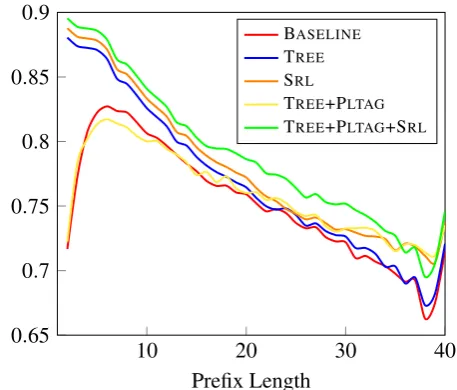
Figure 3 gives the results of evaluating incre-mental parsing performance. The x-axis shows prefix length, and the y-axis shows incremental F-score computed as suggested by Sangati and Keller (2013). Each point is averaged over all pre-fixes of a given length in the test set. To quantify the trends shown in this figure, we also compute the area under the curve (AUC) for each feature combination; this is given in Table 1.
We find that TREE performs consistently
bet-ter than the baseline for short prefixes (up to the first 20 words), and then is very close to the base-line. This is expected given that tree features add structure-specific information (e.g., about coordi-nation) to the baseline model, and is consistent with results obtained using similar features in the literature (Charniak and Johnson, 2005). Adding PLTAG features (TREE+PLTAG) hurts
incremen-tal performance for short prefixes (up to about 20 words), but then performance gradually increases over the baseline and over TREE alone. It seems
that the PLTAG features, which are specific to the grammar formalism used, are able to help with longer and more complex prefixes, but introduce noise in smaller prefixes.
The SRL feature set, on the other hand, results in a consistent increase in performance compared 2Note that the baseline score is lower than the published
to the baseline, across all prefix lengths. SRL
pro-vides semantic knowledge, while TREE provides
syntactic knowledge, but the performance of both feature sets is very close to each other, up to a prefix length of about 30 words, after which SRL
has a clear advantage. SRL features seem to fil-ter out local ambiguity caused by creating pre-fix trees incrementally and result in correct parses closer to the end of sentence, even without the use of the syntactic information contained in the TREE+PLTAGfeature set. Recall that SRLuses
in-formation provided by the semantic frame, some-thing that a syntax-only model does not have ac-cess to. It seems that this makes it possible for SRL
to (partially) compensate for mistakes made by the parser. The AUC of SRLis higher by 0.95 and 1.7
points compared to TREE and TREE+PLTAG,
re-spectively.
We observe an additional boost in perfor-mance when using all features together in the TREE+PLTAG+SRL configuration, which
outper-forms SRLalone by 1.0 points in AUC. Recall that
SRL features do not apply to every word; they fire only when semantic information is introduced to the parser via the semantically-enriched lexicon. Hence by adding tree and PLTAG features, which normally apply for every new word, we are able to perform effective re-ranking for all sentence pre-fixes, which explains the boost in performance. Note that for all variants of our model we observe a dip in performance at around 38 words. This is probably due to noise, caused by the small number of sentences of this length. The upward trend seen around word 40 is probably the effect of observ-ing the end of the sentence, which boosts parsobserv-ing accuracy.
Turning to full sentence evaluation (Table 1), we observe a similar trend. Both TREE and
SRL beat the baseline by about 0.55 points in
F-score. Progressively adding features increases per-formance, with the greatest gain of 1.56 points attained by the combination of all features in TREE+PLTAG+SRL.
We also report combined SRL F-score com-puted on the re-ranked syntactic trees (rightmost column of Table 1). We find that compared to the baseline, only a small improvement of 0.55 points is achieved by TREE+PLTAG+SRL, while
TREE+PLTAG improves by 0.84 points. The
syntax-only variant therefore outperforms the full model, but only by a small margin.
7 Related Work
The most similar approach in the literature is Collins and Roark’s (2004) re-ranking model for incremental parsing. They learn the syntactic fea-tures of Roark (2001) using the perceptron model of Collins (2002). Similar to us, they use the in-cremental parser to search over candidate parses. However, they limited themselves to local deriva-tion features (akin to our PLTAG features), and do not explore global syntactic feature (tree features) or SRL features. Even though they re-rank the output of an incremental parser, they only evalu-ate full sentence parsing performance. Other re-ranking approaches to syntactic parsing make use of an extensive set of global features, but apply it on thek-best list of full sentence parses (Charniak and Johnson, 2005; Collins and Koo, 2005) or the
k-best list of derivations of a packed forest (Huang, 2008), i.e., these approaches are not incremental.
8 Conclusions
We started from the observation that human pars-ing uses semantic knowledge to rule out parses that lead to implausible interpretations. Based on this, we hypothesized that also in NLP, an incre-mental syntactic parser should benefit from se-mantic information. To test this hypothesis, we combined an incremental TAG parser with an in-cremental semantic role labeler. We used the out-put of the iSRL system to derive features that can be used to re-rank the prefix trees generated by the incremental parser. We found that SRL features, both in isolation and together with standard syn-tactic features, improve parsing performance, both when measured using full-sentence F-score, and in terms of incremental F-score.
In future work, we plan to combine our incre-mental parsing/role labeling approach with a com-positional model of semantics, which would have to be modified to take semantic role triples as in-put (rather than words or word pairs). The re-sulting plausibility estimates could then be used as another source of semantic information for the parser, or employed in down-stream tasks.
Acknowledgments
EPSRC support through grant EP/I032916/1 “An integrated model of syntactic and semantic pre-diction in human language processing” to Frank Keller and Mirella Lapata is gratefully acknowl-edged.
References
Altmann, Gerry T. M. and Yuki Kamide. 1999. Incremental interpretation at verbs: Restricting the domain of subsequent reference. Cognition
73:247–264.
Charniak, Eugene and Mark Johnson. 2005. Coarse-to-fine n-best parsing and maxent dis-criminative reranking. In Proceedings of the 43rd Annual Meeting of the Association for Computational Linguistics. Ann Arbor, Michi-gan, pages 173–180.
Chelba, Ciprian and Frederick Jelinek. 2000. Structured language modeling. Computer Speech and Language14:283–332.
Collins, Michael. 2002. Discriminative training methods for hidden markov models: Theory and experiments with perceptron algorithms. In
Proceedings of the 2002 Conference on Empir-ical Methods in Natural Language Processing. pages 1–8.
Collins, Michael and Terry Koo. 2005. Discrim-inative reranking for natural language parsing.
Computational Linguistics31(1):25–70. Collins, Michael and Brian Roark. 2004.
Incre-mental parsing with the perceptron algorithm. InProceedings of the 42nd Meeting of the As-sociation for Computational Linguistics, Main Volume. Barcelona, Spain, pages 111–118. Demberg, Vera and Frank Keller. 2008. Data from
eye-tracking corpora as evidence for theories of syntactic processing complexity. Cognition
101(2):193–210.
Demberg, Vera, Frank Keller, and Alexander Koller. 2013. Incremental, predictive pars-ing with psycholpars-inguistically motivated tree-adjoining grammar. Computational Linguistics
39(4):1025–1066.
Gesmundo, Andrea, James Henderson, Paola Merlo, and Ivan Titov. 2009. A latent vari-able model of synchronous syntactic-semantic parsing for multiple languages. In Proceed-ings of the Thirteenth Conference on Compu-tational Natural Language Learning: Shared Task. pages 37–42.
Syntactic and semantic dependencies in multi-ple languages. InProceedings of the 13th Con-ference on Computational Natural Language Learning. Boulder, Colorado, USA.
Huang, Liang. 2008. Forest reranking: Dis-criminative parsing with non-local features. In
Proceedings of the 46th Annual Meeting of the Association for Computational Linguistics. Columbus, Ohio, pages 586–594.
Huang, Liang and Kenji Sagae. 2010. Dynamic programming for linear-time incremental pars-ing. InProceedings of the 48th Annual Meeting of the Association for Computational Linguis-tics. Uppsala, pages 1077–1086.
Joshi, Aravind K. and Yves Schabes. 1992. Tree adjoining grammars and lexicalized grammars. In Maurice Nivat and Andreas Podelski, editors,
Tree Automata and Languages, North-Holland, Amsterdam, pages 409–432.
Konstas, Ioannis, Frank Keller, Vera Demberg, and Mirella Lapata. 2014. Incremental seman-tic role labeling with tree adjoining grammar. In
Proceedings of the 2014 Conference on Empir-ical Methods in Natural Language Processing. Doha, Qatar, pages 301–312.
Li, Junhui, Guodong Zhou, and Tou Hwee Ng. 2010. Joint syntactic and semantic parsing of chinese. In Proceedings of the 48th Annual Meeting of the Association for Computational Linguistics. Association for Computational Lin-guistics, pages 1108–1117.
Marcus, Mitchell P., Mary Ann Marcinkiewicz, and Beatrice Santorini. 1993. Building a large annotated corpus of english: The Penn tree-bank. Computational Linguistics 19(2):313– 330.
Nivre, Joakim. 2007. Incremental non-projective dependency parsing. InHuman Language Tech-nologies: The Conference of the North Amer-ican Chapter of the Association for Compu-tational Linguistics; Proceedings of the Main Conference. Rochester, New York, pages 396– 403.
Roark, Brian. 2001. Probabilistic top-down pars-ing and language modelpars-ing. Computational Linguististics27:249–276.
Sangati, Federico and Frank Keller. 2013. In-cremental tree substitution grammar for pars-ing and word prediction. Transactions of the Association for Computational Linguistics
1(May):111–124.
Schuler, William, Samir AbdelRahman, Tim Miller, and Lane Schwartz. 2010. Broad-coverage parsing using human-like memory constraints. Computational Linguististics
36(1):1–30.
Schwartz, Lane, Chris Callison-Burch, William Schuler, and Stephen Wu. 2011. Incremen-tal syntactic language models for phrase-based translation. In Proceedings of the 49th An-nual Meeting of the Association for Computa-tional Linguistics: Human Language Technolo-gies, Volume 1. Portland, OR, pages 620–631. Stoness, Scott C., Joel Tetreault, and James Allen.
2004. Incremental parsing with reference inter-action. In Frank Keller, Stephen Clark, Matthew Crocker, and Mark Steedman, editors, Proceed-ings of the ACL Workshop Incremental Parsing: Bringing Engineering and Cognition Together. Barcelona, pages 18–25.
Sutton, Charles and Andrew McCallum. 2005. Joint parsing and semantic role labeling. In Pro-ceedings of the Ninth Conference on Computa-tional Natural Language Learning. Ann Arbor, Michigan, pages 225–228.
Tan, Ming, Wenli Zhou, Lei Zheng, and Shaojun Wang. 2011. A large scale distributed syntactic, semantic and lexical language model for ma-chine translation. In Proceedings of the 49th Annual Meeting of the Association for Compu-tational Linguistics: Human Language Tech-nologies, Volume 1. Portland, OR, pages 201– 210.
Tanenhaus, Michael K., Michael J. Spivey-Knowlton, Kathleen M. Eberhard, and Julie C. Sedivy. 1995. Integration of visual and linguis-tic information in spoken language comprehen-sion. Science268:1632–1634.
Titov, Ivan, James Henderson, Paola Merlo, and Gabriele Musillo. 2009. Online graph planari-sation for synchronous parsing of semantic and syntactic dependencies. In Proceedings of the 21st International Jont Conference on Artifi-cal Intelligence. Morgan Kaufmann Publishers Inc., San Francisco, CA, USA, pages 1562– 1567.
Vadas, David and James Curran. 2007. Adding noun phrase structure to the penn treebank. In Proceedings of the 45th Annual Meeting of the Association of Computational Linguis-tics. Association for Computational Linguistics, Prague, Czech Republic, pages 240–247. Volokh, Alexander and G¨unter Neumann. 2008.
Proceedings of the Twelfth Conference on Com-putational Natural Language Learning, Coling 2008 Organizing Committee, chapter A Puris-tic Approach for Joint Dependency Parsing and Semantic Role Labeling, pages 213–217. Xu, Peng, Ciprian Chelba, and Frederick Jelinek.