Latent Predictor Networks for Code Generation
Wang Ling♦Edward Grefenstette♦Karl Moritz Hermann♦ Tom´aˇs Koˇcisk´y♦♣Andrew Senior♦Fumin Wang♦Phil Blunsom♦♣
♦Google DeepMind♣University of Oxford
{lingwang,etg,kmh,tkocisky,andrewsenior,awaw,pblunsom}@google.com
Abstract
Many language generation tasks require the production of text conditioned on both structured and unstructured inputs. We present a novel neural network architec-ture which generates an output sequence conditioned on an arbitrary number of in-put functions. Crucially, our approach allows both the choice of conditioning context and the granularity of generation, for example characters or tokens, to be marginalised, thus permitting scalable and effective training. Using this framework, we address the problem of generating pro-gramming code from a mixed natural lan-guage and structured specification. We create two new data sets for this paradigm derived from the collectible trading card games Magic the Gathering and Hearth-stone. On these, and a third preexisting corpus, we demonstrate that marginalis-ing multiple predictors allows our model to outperform strong benchmarks.
1 Introduction
The generation of both natural and formal lan-guages often requires models conditioned on di-verse predictors (Koehn et al., 2007; Wong and Mooney, 2006). Most models take the restrictive approach of employing a single predictor, such as a word softmax, to predict all tokens of the output sequence. To illustrate its limitation, suppose we wish to generate the answer to the question “Who wrote The Foundation?” as “The Foundation was written by Isaac Asimov”. The generation of the words “Issac Asimov” and “The Foundation” from a word softmax trained on annotated data is un-likely to succeed as these words are sparse. A ro-bust model might, for example, employ one
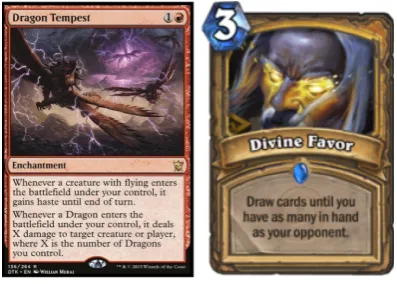
pre-Figure 1: Example MTG and HS cards.
dictor to copy “The Foundation” from the input, and a another one to find the answer “Issac Asi-mov” by searching through a database. However, training multiple predictors is in itself a challeng-ing task, as no annotation exists regardchalleng-ing the pre-dictor used to generate each output token. Fur-thermore, predictors generate segments of differ-ent granularity, as database queries can generate multiple tokens while a word softmax generates a single token. In this work we introduceLatent Predictor Networks (LPNs), a novel neural archi-tecture that fulfills these desiderata: at the core of the architecture is the exact computation of the marginal likelihood over latent predictors and gen-erated segments allowing for scalable training.
We introduce a new corpus for the automatic generation of code for cards in Trading Card Games (TCGs), on which we validate our model1.
TCGs, such as Magic the Gathering (MTG) and Hearthstone (HS), are games played between two players that build decks from an ever expanding pool of cards. Examples of such cards are shown in Figure 1. Each card is identified by its attributes
1Dataset available at https://deepmind.com/publications.html
[image:1.595.317.516.222.364.2](e.g., name and cost) and has an effect that is de-scribed in a text box. Digital implementations of these games implement the game logic, which in-cludes the card effects. This is attractive from a data extraction perspective as not only are the data annotations naturally generated, but we can also view the card as a specification communi-cated from a designer to a software engineer.
This dataset presents additional challenges to prior work in code generation (Wong and Mooney, 2006; Jones et al., 2012; Lei et al., 2013; Artzi et al., 2015; Quirk et al., 2015), including the handling of structured input—i.e. cards are com-posed by multiple sequences (e.g., name and description)—and attributes (e.g., attack and cost), and the length of the generated sequences. Thus, we propose an extension to attention-based neu-ral models (Bahdanau et al., 2014) to attend over structured inputs. Finally, we propose a code com-pression method to reduce the size of the code without impacting the quality of the predictions.
Experiments performed on our new datasets, and a further pre-existing one, suggest that our ex-tensions outperform strong benchmarks.
The paper is structured as follows: We first describe the data collection process (Section 2) and formally define our problem and our base-line method (Section 3). Then, we propose our extensions, namely, the structured attention mech-anism (Section 4) and the LPN architecture (Sec-tion 5). We follow with the descrip(Sec-tion of our code compression algorithm (Section 6). Our model is validated by comparing with multiple bench-marks (Section 7). Finally, we contextualize our findings with related work (Section 8) and present the conclusions of this work (Section 9).
2 Dataset Extraction
We obtain data from open source implementations of two different TCGs, MTG in Java2 and HS in
Python.3 The statistics of the corpora are
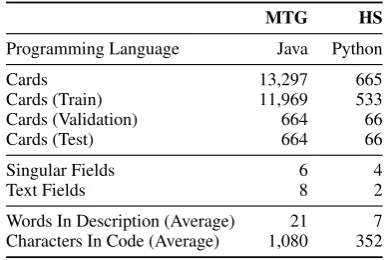
illus-trated in Table 1. In both corpora, each card is im-plemented in a separate class file, which we strip of imports and comments. We categorize the con-tent of each card into two different groups: sin-gular fieldsthat contain only one value; and text fields, which contain multiple words representing different units of meaning. In MTG, there are six singular fields (attack, defense, rarity, set, id, and
2github.com/magefree/mage/
3github.com/danielyule/hearthbreaker/
MTG HS
Programming Language Java Python
Cards 13,297 665
Cards (Train) 11,969 533
Cards (Validation) 664 66
Cards (Test) 664 66
Singular Fields 6 4
Text Fields 8 2
[image:2.595.319.513.62.192.2]Words In Description (Average) 21 7 Characters In Code (Average) 1,080 352
Table 1: Statistics of the two TCG datasets.
health) and four text fields (cost, type, name, and description), whereas HS cards have eight singu-lar fields (attack, health, cost and durability, rar-ity, type, race and class) and two text fields (name and description). Text fields are tokenized by splitting on whitespace and punctuation, with ex-ceptions accounting for domain specific artifacts (e.g., Green mana is described as “{G}” in MTG). Empty fields are replaced with a “NIL” token.
The code for the HS card in Figure 1 is shown in Figure 2. The effect of “drawing cards until the player has as many cards as the opponent” is im-plemented by computing the difference between the players’ hands and invoking the draw method that number of times. This illustrates that the map-ping between the description and the code is non-linear, as no information is given in the text regard-ing the specifics of the implementation.
classDivineFavor(SpellCard): def __init__(self):
super().__init__("Divine Favor", 3, CHARACTER_CLASS.PALADIN, CARD_RARITY.RARE)
def use(self, player, game): super().use(player, game)
difference =len(game.other_player.hand) -len(player.hand)
fori in range(0, difference): player.draw()
Figure 2: Code for the HS card “Divine Favor”.
3 Problem Definition
Given the description of a card x, our decoding problem is to find the codeyˆso that:
ˆ
y= argmax
y logP(y|x) (1)
number of input fields.|xk|denotes the number of
tokens inxkandxkiselects thei-th token.
4 Structured Attention
Background When |x| = 1, the
atten-tion model of Bahdanau et al. (2014) ap-plies. Following the chain rule, logP(y|x) =
P
t=1..|y|logP(yt|y1..yt−1, x), each token yt is
predicted conditioned on the previously gener-ated sequencey1..yt−1 and input sequence x1 =
x11..x1|x1|. Probability are estimated with a
soft-max over the vocabularyY:
p(yt|y1..yt−1, x1) = softmax
yt∈Y (ht) (2)
wherehtis the Recurrent Neural Network (RNN)
state at time stamp t, which is modeled as
g(yt−1,ht−1,zt). g(·)is a recurrent update
func-tion for generating the new state ht based on
the previous tokenyt−1, the previous stateht−1,
and the input text representation zt. We
imple-mentgusing a Long Short-Term Memory (LSTM) RNNs (Hochreiter and Schmidhuber, 1997).
The attention mechanism generates the repre-sentation of the input sequence x = x11..x1|x1|,
and zt is computed as the weighted sum zt =
P
i=1..|x1|aih(x1i), where ai is the attention
co-efficient obtained for token x1i and h is a
func-tion that maps eachx1i to a continuous vector. In
general,his a function that projectsx1iby
learn-ing a lookup table, and then embeddlearn-ing contex-tual words by defining an RNN. Coefficients ai
are computed with a softmax over input tokens
x11..x1|x1|:
ai = softmaxx
1i∈x (v(h(x1i),ht−1)) (3)
Functionvcomputes the affinity of each tokenx1i
and the current output contextht−1. A common
implementation ofvis to apply a linear projection fromh(x1i) : ht−1 (where:is the concatenation
operation) into a fixed size vector, followed by a
tanhand another linear projection.
Our Approach We extend the computation of
ztfor cases whenxcorresponds to multiple fields.
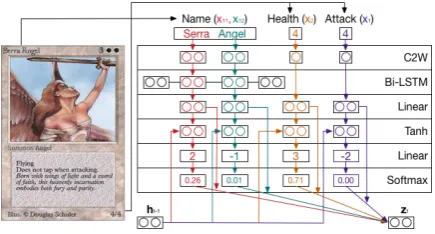
Figure 3 illustrates how the MTG card “Serra An-gel” is encoded, assuming that there are two singu-lar fields and one text field. We first encode each tokenxkiusing the C2W model described in Ling
[image:3.595.308.526.66.183.2]et al. (2015), which is a replacement for lookup ta-bles where word representations are learned at the
Figure 3: Illustration of the structured attention mechanism operating on a single time stampt.
character level (cf. C2W row). A context-aware representation is built for words in the text fields using a bidirectional LSTM (cf. Bi-LSTM row). Computing attention over multiple input fields is problematic as each input field’s vectors have dif-ferent sizes and value ranges. Thus, we learn a linear projection mapping each input tokenxki to
a vector with a common dimensionality and value range (cf. Linearrow). Denoting this process as
f(xki), we extend Equation 3 as:
aki = softmaxx
ki∈x (v(f(xki),ht−1)) (4)
Here a scalar coefficientakiis computed for each
input tokenxki (cf. “Tanh”, “Linear”, and
“Soft-max” rows). Thus, the overall input representation
ztis computed as:
zt=
X
k=1..|x|,i=1..|xk|
aijf(xki) (5)
5 Latent Predictor Networks
Background In order to decode from x to y,
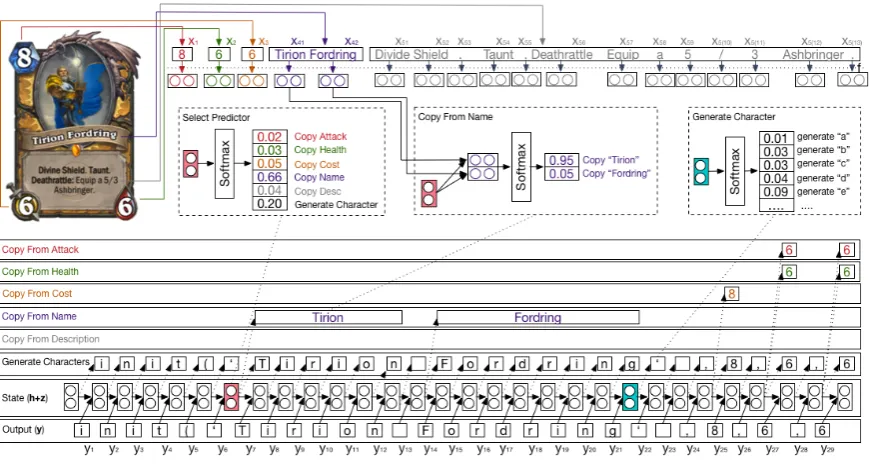
Figure 4: Generation process for the codeinit(‘Tirion Fordring’,8,6,6)using LPNs.
which are typically copied from one language to the other. Pointer networks (Vinyals et al., 2015) address this by defining a probability distribution over a set of units that can be copiedc = c1..c|c|. The probability of copying a unitciis modeled as:
p(ci) = softmaxc
i∈c (v(h(ci),q)) (6)
As in the attention model (Equation 3),vis a func-tion that computes the affinity between an embed-ded copyable unith(ci)and an arbitrary vectorq.
Our Approach Combining pointer networks
with a character-based softmax is in itself difficult as these generate segments of different granularity and there is no ground truth of which predictor to use at each time stamp. We now describe Latent Predictor Networks, which model the conditional probabilitylogP(y|x)over the latent sequence of predictors used to generatey.
We assume that our model uses multiple pre-dictors r ∈ R, where each r can generate multiple segments st = yt..yt+|st|−1 with
ar-bitrary length |st| at time stamp t. An
ex-ample is illustrated in Figure 4, where we ob-serve that to generate the code init(‘Tirion Fordring’,8,6,6), a pointer network can be used to generate the sequences y13
7 =Tirion
and y22
14=Fordring (cf. “Copy From Name”
row). These sequences can also be generated us-ing a character softmax (cf. “Generate Characters”
row). The same applies to the generation of the attack, health and cost values as each of these pre-dictors is an element inR. Thus, we define our ob-jective function as a marginal log likelihood func-tion over a latent variableω:
logP(y|x) = logX
ω∈ω¯
P(y, ω |x) (7)
Formally,ωis a sequence of pairsrt, st, where
rt ∈R denotes the predictor that is used at
time-stamp tand st the generated string. We
decom-poseP(y, ω |x)as the product of the probabilities of segmentsstand predictorsrt:
P(y, ω|x) = Y
rt,st∈ω
P(st, rt|y1..yt−1, x) = Y
rt,st∈ω
P(st|y1..yt−1, x, rt)P(rt|y1..yt−1, x)
where the generation of each segment is per-formed in two steps: select the predictor rt with
probability P(rt | y1..yt−1, x) and then
gener-ate st conditioned on predictor rt with
probabil-itylogP(st | y1..yt−1, x, rt). The probability of
each predictor is computed using a softmax over all predictors in R conditioned on the previous stateht−1and the input representationzt(cf.
“Se-lect Predictor” box). Then, the probability of gen-erating the segment st depends on the predictor
Character Generation Generate a single char-acter from observed charchar-acters from the training data. Only one character is generated at each time stamp with probability given by Equation 2.
Copy Singular Field For singular fields only
the field itself can be copied, for instance, the value of the attack and cost attributes or the type of card. The size of the generated segment is the number of characters in the copied field and the segment is generated with probability1.
Copy Text Field For text fields, we allow each
of the words xki within the field to be copied.
The probability of copying a word is learned with a pointer network (cf. “Copy From Name” box), whereh(ci)is set to the representation of the word
f(xki)andqis the concatenationht−1 :ztof the
state and input vectors. This predictor generates a segment with the size of the copied word.
It is important to note that the state vectorht−1
is generated by building an RNN over the se-quence of characters up until the time stampt−1, i.e. the previous context yt−1 is encoded at the
character level. This allows the number of pos-sible states to remain tractable at training time.
5.1 Inference
At training time we use back-propagation to max-imize the probability of observed code, according to Equation 7. Gradient computation must be per-formed with respect to each computed probabil-ityP(rt |y1..yt−1, x)andP(st |y1..yt−1, x, rt).
The derivative∂P∂(rlogt|y1P..y(yt|−x1),x) yields:
∂αtP(rt|y1..yt−1, x)βt,rt+ξrt P(y|x)∂P(rt|y1..yt−1, x) =
αtβt,rt α|y|+1
Hereαt denotes the cumulative probability of all
values ofωup until time stamptandα|y|+1yields
the marginal probabilityP(y |x). βt,rt =P(st | y1..yt−1)βt+|st|−1 denotes the cumulative
proba-bility starting from predictorrtat time stampt,
ex-clusive. This includes the probability of the gener-ated segmentP(st|y1..yt−1, x, rt)and the
proba-bility of all values ofωstarting from timestampt+
|st|−1, that is, all possible sequences that generate
segmentyafter segmentstis produced. For
com-pleteness,ξrdenotes the cumulative probabilities
of all ω that do not include rt. To illustrate this,
we refer to Figure 4 and consider the timestamp
t = 14, where the segments14 =Fordringis
generated. In this case, the cumulative probability
α14 is the sum of the path that generates the
se-quenceinit(‘Tirion with characters alone, and the path that generates the wordTirionby copying from the input. β21 includes the
prob-ability of all paths that follow the generation of Fordring, which include2×3×3different paths due to the three decision points that follow (e.g. generating 8 using a character softmax vs. copy-ing from the cost). Finally, ξr refers to the path
that generatesFordringcharacter by character. While the number of possible paths grows ex-ponentially,α andβ can be computed efficiently using the forward-backward algorithm for Semi-Markov models (Sarawagi and Cohen, 2005), where we associate P(rt | y1..yt−1, x) to edges
andP(st|y1..yt−1, x, rt)to nodes in the Markov
chain.
The derivative ∂P(s∂tlog|y1..yP(ty−|1x,x,r) t) can be com-puted using the same logic:
∂αt,stP(st|y1..yt−1, x, rt)βt+|st|−1+ξrt P(y |x)∂P(st|y1..yt−1, x, rt) =
αt,rtβt+|st|−1 α|y|+1
Once again, we denote αt,rt = αtP(rt | y1..yt−1, x) as the cumulative probability of all
values ofωthat lead tost, exclusive.
An intuitive interpretation of the derivatives is that gradient updates will be stronger on prob-ability chains that are more likely to generate the output sequence. For instance, if the model learns a good predictor to copy names, such as Fordring, other predictors that can also gener-ate the same sequences, such as the character soft-max will allocate less capacity to the generation of names, and focus on elements that they excel at (e.g. generation of keywords).
5.2 Decoding
Decoding is performed using a stack-based de-coder with beam search. Each state S corre-sponds to a choice of predictorrtand segmentst
at a given time stamp t. This state is scored as
V(S) = logP(st | y1..yt−1, x, rt) + logP(rt |
y1..yt−1, x) + V(prev(S)), where prev(S)
de-notes the predecessor state of S. At each time stamp, the n states with the highest scores V
are expanded, where n is the size of the beam. For each predictorrt, each output st generates a
which produce the same output up to that point are merged by summing their probabilities.
6 Code Compression
As the attention-based model traverses all input units at each generation step, generation becomes quite expensive for datasets such as MTG where the average card code contains 1,080 characters. While this is not the essential contribution in our paper, we propose a simple method to compress the code while maintaining the structure of the code, allowing us to train on datasets with longer code (e.g., MTG).
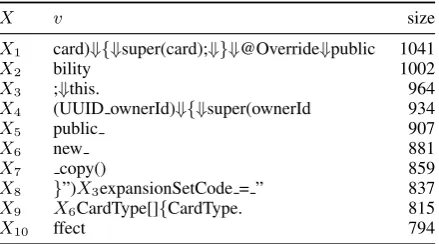
The idea behind that method is that many keywords in the programming language (e.g., publicandreturn) as well as frequently used functions and classes (e.g.,Card) can be learned without character level information. We exploit this by mapping such strings onto additional sym-bols Xi (e.g., public class copy() →
“X1 X2 X3()”). Formally, we seek the string vˆ
among all stringsV(max)up to lengthmaxthat maximally reduces the size of the corpus:
ˆ
v= argmax
v∈V(max)(len(v)−1)C(v) (8)
where C(v) is the number of occurrences of
v in the training corpus and len(v) its length.
(len(v)−1)C(v) can be seen as the number of characters reduced by replacing v with a non-terminal symbol. To findq(v)efficiently, we lever-age the fact thatC(v)≤C(v0)ifvcontainsv0. It follows that(max−1)C(v)≤(max−1)C(v0), which means that the maximum compression ob-tainable for v at size max is always lower than that of v0. Thus, if we can find a ¯v such that
(len(¯v)−1)C(¯v) > (max−1)C(v0), that is v¯ at the current size achieves a better compression rate than v0 at the maximum length, then it fol-lows that all sequences that containv can be dis-carded as candidates. Based on this idea, our itera-tive search starts by obtaining the countsC(v)for all segments of sizes= 2, and computing the best scoring segment¯v. Then, we build a listL(s) of all segments that achieve a better compression rate than¯vat their maximum size. At sizes+ 1, only segments that contain a element inL(s−1)need to be considered, making the number of substrings to be tested to be tractable assincreases. The al-gorithm stops once sreaches max or the newly generated listL(s)contains no elements.
X v size
X1 card)⇓{⇓super(card);⇓}⇓@Override⇓public 1041
X2 bility 1002
X3 ;⇓this. 964
X4 (UUID ownerId)⇓{⇓super(ownerId 934
X5 public 907
X6 new 881
X7 copy() 859
X8 }”)X3expansionSetCode = ” 837
X9 X6CardType[]{CardType. 815
[image:6.595.308.528.62.184.2]X10 ffect 794
Table 2: First 10 compressed units in MTG. We replaced newlines with⇓and spaces with .
Oncevˆis obtained, we replace all occurrences ofvˆwith a new non-terminal symbol. This pro-cess is repeated until a desired average size for the code is reached. While training is performed on the compressed code, the decoding will undergo an additional step, where the compressed code is restored by expanding the allXi. Table 2 shows
the first 10 replacements from the MTG dataset, reducing its average size from 1080 to 794.
7 Experiments
Datasets Tests are performed on the two
datasets provided in this paper, described in Ta-ble 1. Additionally, to test the model’s ability of generalize to other domains, we report results in the Django dataset (Oda et al., 2015), comprising of 16000 training, 1000 development and 1805 test annotations. Each data point consists of a line of Python code together with a manually created nat-ural language description.
Neural Benchmarks We implement two
stan-dard neural networks, namely a sequence-to-sequence model (Sutskever et al., 2014) and an attention-based model (Bahdanau et al., 2014). The former is adapted to work with multiple in-put fields by concatenating them, while the latter uses our proposed attention model. These models are denoted as “Sequence” and “Attention”.
Machine Translation Baselines Our problem
evidence that using machine translation systems without committing to such assumptions can lead to results competitive with the systems described above. We follow the same approach and create a phrase-based (Koehn et al., 2007) model and a hierarchical model (or PCFG) (Chiang, 2007) as benchmarks for the work presented here. As these models are optimized to generate words, not char-acters, we implement a tokenizer that splits on all punctuation characters, except for the “ ” charac-ter. We also facilitate the task by splitting Camel-Case words (e.g., class TirionFordring →class Tirion Fordring). Otherwise all class names would not be generated correctly by these methods. We used the models implemented in Moses to generate these baselines using stan-dard parameters, using IBM Alignment Model 4 for word alignments (Och and Ney, 2003), MERT for tuning (Sokolov and Yvon, 2011) and a 4-gram Kneser-Ney Smoothed language model (Heafield et al., 2013). These models will be denoted as “Phrase” and “Hierarchical”, respectively.
Retrieval Baseline It was reported in (Quirk et
al., 2015) that a simple retrieval method that out-puts the most similar input for each sample, mea-sured using Levenshtein Distance, leads to good results. We implement this baseline by computing the average Levenshtein Distance for each input field. This baseline is denoted “Retrieval”.
Evaluation A typical metric is to compute the
accuracy of whether the generated code exactly matches the reference code. This is informative as it gives an intuition of how many samples can be used without further human post-editing. How-ever, it does not provide an illustration on the de-gree of closeness to achieving the correct code. Thus, we also test using BLEU-4 (Papineni et al., 2002) at the token level. There are clearly problems with these metrics. For instance, source code can be correct without matching the refer-ence. The code in Figure 2, could have also been implemented by calling the draw function in an cycle that exists once both players have the same number of cards in their hands. Some tasks, such as the generation of queries (Zelle and Mooney, 1996), have overcome this problem by executing the query and checking if the result is the same as the annotation. However, we shall leave the study of these methologies for future work, as adapting these methods for our tasks is not
triv-ial. For instance, the correctness cards with con-ditional (e.g. if player has no cards, then draw a card) or non-deterministc (e.g. put a random card in your hand) ef-fects cannot be simply validated by running the code.
Setup The multiple input types (Figure 3) are
hyper-parametrized as follows: The C2W model (cf. “C2W” row) used to obtain continuous vec-tors for word types uses character embeddings of size 100 and LSTM states of size 300, and gener-ates vectors of size 300. We also report on results using word lookup tables of size 300, where we replace singletons with a special unknown token with probability0.5during training, which is then used for out-of-vocabulary words. For text fields, the context (cf. “Bi-LSTM” row) is encoded with a Bi-LSTM of size 300 for the forward and back-ward states. Finally, a linear layer maps the differ-ent input tokens into a common space with of size 300 (cf. “Linear” row). As for the attention model, we used an hidden layer of size 200 before ap-plying the non-linearity (row “Tanh”). As for the decoder (Figure 4), we encode output characters with size 100 (cf. “output (y)” row), and an LSTM state of size 300 and an input representation of size 300 (cf. “State(h+z)” row). For each pointer network (e.g., “Copy From Name” box), the inter-section between the input units and the state units are performed with a vector of size 200. Train-ing is performed usTrain-ing mini-batches of 20 sam-ples using AdaDelta (Zeiler, 2012) and we report results using the iteration with the highest BLEU score on the validation set (tested at intervals of 5000 mini-batches). Decoding is performed with a beam of 1000. As for compression, we performed a grid search over compressing the code from 0% to 80% of the original average length over inter-vals of 20% for the HS and Django datasets. On the MTG dataset, we are forced to compress the code up to 80% due to performance issues when training with extremely long sequences.
7.1 Results
Baseline Comparison Results are reported in
MTG HS Django
[image:8.595.78.285.281.362.2]BLEU Acc BLEU Acc BLEU Acc Retrieval 54.9 0.0 62.5 0.0 18.6 14.7 Phrase 49.5 0.0 34.1 0.0 47.6 31.5 Hierarchical 50.6 0.0 43.2 0.0 35.9 9.5 Sequence 33.8 0.0 28.5 0.0 44.1 33.2 Attention 50.1 0.0 43.9 0.0 58.9 38.8 Our System 61.4 4.8 65.6 4.5 77.6 62.3 – C2W 60.9 4.4 67.1 4.5 75.9 60.9 – Compress - - 59.7 6.1 76.3 61.3 – LPN 52.4 0.0 42.0 0.0 63.3 40.8 – Attention 39.1 0.5 49.9 3.0 48.8 34.5
Table 3: BLEU and Accuracy scores for the pro-posed task on two in-domain datasets (HS and MTG) and an out-of-domain dataset (Django).
Compression 0% 20% 40% 60% 80%
Seconds Per Card
Softmax 2.81 2.36 1.88 1.42 0.94
LPN 3.29 2.65 2.35 1.93 1.41
BLEU Scores
Softmax 44.2 46.9 47.2 51.4 52.7
LPN 59.7 62.8 61.1 66.4 67.1
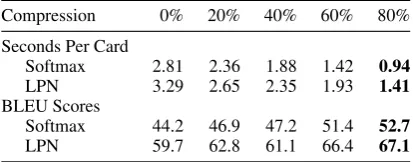
Table 4: Results with increasing compression rates with a regular softmax (cf. “Softmax”) and a LPN (cf. “LPN”). Performance values (cf. “Seconds Per Card” block) are computed using one CPU.
syntactic errors such as producing a non-existent function call or generating incomplete code. As BLEU penalizes length mismatches, generating code that matches the length of the reference pro-vides a large boost. The phrase-based transla-tion model (cf. “Phrase” row) performs well in the Django (cf. “Django” column), where map-ping from the input to the output is mostly mono-tonic, while the hierarchical model (cf. “Hierar-chical” row) yields better performance on the card datasets as the concatenation of the input fields needs to be reordered extensively into the out-put sequence. Finally, the sequence-to-sequence model (cf. “Sequence” row) yields extremely low results, mainly due to the lack of capacity needed to memorize whole input and output sequences, while the attention based model (cf. “Attention” row) produces results on par with phrase-based systems. Finally, we observe that by including all the proposed components (cf. “Our System” row), we obtain significant improvements over all base-lines in the three datasets and is the only one that obtains non-zero accuracies in the card datasets.
Component Comparison We present ablation
results in order to analyze the contribution of each of our modifications. Removing the C2W model (cf. “– C2W” row) yields a small deterioration, as word lookup tables are more susceptible to spar-sity. The only exception is in the HS dataset, where lookup tables perform better. We believe that this is because the small size of the training set does not provide enough evidence for the char-acter model to scale to unknown words. Surpris-ingly, running our model compression code (cf. “– Compress” row) actually yields better results. Ta-ble 4 provides an illustration of the results for dif-ferent compression rates. We obtain the best re-sults with an 80% compression rate (cf. “BLEU Scores” block), while maximising the time each card is processed (cf. “Seconds Per Card” block). While the reason for this is uncertain, it is simi-lar to the finding that language models that output characters tend to under-perform those that output words (J´ozefowicz et al., 2016). This applies when using the regular optimization process with a char-acter softmax (cf. “Softmax” rows), but also when using the LPN (cf. “LPN” rows). We also note that the training speed of LPNs is not significantly lower as marginalization is performed with a dy-namic program. Finally, a significant decrease is observed if we remove the pointer networks (cf. “– LPN” row). These improvements also generalize to sequence-to-sequence models (cf. “– Attention” row), as the scores are superior to the sequence-to-sequence benchmark (cf. “Sequence” row).
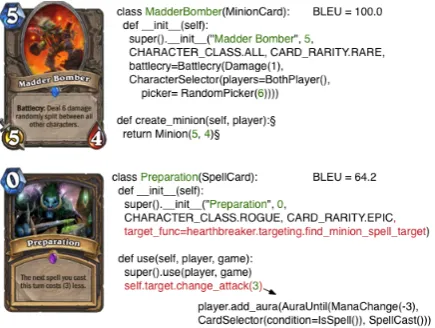
Result Analysis Examples of the code
this difference. However, in many cases, effects that radically differ from seen ones tend to be gen-erated incorrectly. In the card “Preparation”, we observe that while the properties of the card are generated correctly, the effect implements a unre-lated one, with the exception of the value 3, which is correctly copied. Yet, interestingly, it still gener-ates a valid effect, which sets a minion’s attack to 3. Investigating better methods to accurately gen-erate these effects will be object of further studies.
Figure 5: Examples of decoded cards from HS. Copied segments are marked in green and incor-rect segments are marked in red.
8 Related Work
While we target widely used programming lan-guages, namely, Java and Python, our work is related to studies on the generation of any ex-ecutable code. These include generating regu-lar expressions (Kushman and Barzilay, 2013), and the code for parsing input documents (Lei et al., 2013). Much research has also been in-vested in generating formal languages, such as database queries (Zelle and Mooney, 1996; Be-rant et al., 2013), agent specific language (Kate et al., 2005) or smart phone instructions (Le et al., 2013). Finally, mapping natural language into a sequence of actions for the generation of executable code (Branavan et al., 2009). Fi-nally, a considerable effort in this task has fo-cused on semantic parsing (Wong and Mooney, 2006; Jones et al., 2012; Lei et al., 2013; Artzi et al., 2015; Quirk et al., 2015). Recently pro-posed models focus on Combinatory Categorical Grammars (Kushman and Barzilay, 2013; Artzi
et al., 2015), Bayesian Tree Transducers (Jones et al., 2012; Lei et al., 2013) and Probabilistic Con-text Free Grammars (Andreas et al., 2013). The work in natural language programming (Vadas and Curran, 2005; Manshadi et al., 2013), where users write lines of code from natural language, is also related to our work. Finally, the reverse map-ping from code into natural language is explored in (Oda et al., 2015).
Character-based sequence-to-sequence models have previously been used to generate code from natural language in (Mou et al., 2015). Inspired by these works, LPNs provide a richer framework by employing attention models (Bahdanau et al., 2014), pointer networks (Vinyals et al., 2015) and character-based embeddings (Ling et al., 2015). Our formulation can also be seen as a generaliza-tion of Allamanis et al. (2016), who implement a special case where two predictors have the same granularity (a sub-token softmax and a pointer net-work). Finally, HMMs have been employed in neural models to marginalize over label sequences in (Collobert et al., 2011; Lample et al., 2016) by modeling transitions between labels.
9 Conclusion
We introduced a neural network architecture named Latent Prediction Network, which allows efficient marginalization over multiple predictors. Under this architecture, we propose a generative model for code generation that combines a char-acter level softmax to generate language-specific tokens and multiple pointer networks to copy key-words from the input. Along with other exten-sions, namely structured attention and code com-pression, our model is applied on on both exist-ing datasets and also on a newly created one with implementations of TCG game cards. Our experi-ments show that our model out-performs multiple benchmarks, which demonstrate the importance of combining different types of predictors.
References
M. Allamanis, H. Peng, and C. Sutton. 2016. A Con-volutional Attention Network for Extreme Summa-rization of Source Code. ArXiv e-prints, February. Jacob Andreas, Andreas Vlachos, and Stephen Clark.
2013. Semantic parsing as machine translation. In
Yoav Artzi, Kenton Lee, and Luke Zettlemoyer. 2015. Broad-coverage ccg semantic parsing with amr. In
Proceedings of the 2015 Conference on Empirical Methods in Natural Language Processing, pages 1699–1710, September.
Dzmitry Bahdanau, Kyunghyun Cho, and Yoshua Bengio. 2014. Neural machine translation by jointly learning to align and translate. CoRR, abs/1409.0473.
Jonathan Berant, Andrew Chou, Roy Frostig, and Percy Liang. 2013. Semantic parsing on freebase from question-answer pairs. In Proceedings of the 2013 Conference on Empirical Methods in Natural Lan-guage Processing, pages 1533–1544.
S. R. K. Branavan, Harr Chen, Luke S. Zettlemoyer, and Regina Barzilay. 2009. Reinforcement learn-ing for mapplearn-ing instructions to actions. In Pro-ceedings of the Joint Conference of the 47th Annual Meeting of the ACL and the 4th International Joint Conference on Natural Language Processing of the AFNLP, pages 82–90.
David Chiang. 2007. Hierarchical phrase-based trans-lation. Comput. Linguist., 33(2):201–228, June. Ronan Collobert, Jason Weston, L´eon Bottou, Michael
Karlen, Koray Kavukcuoglu, and Pavel Kuksa. 2011. Natural language processing (almost) from scratch. J. Mach. Learn. Res., 12:2493–2537, November.
Kenneth Heafield, Ivan Pouzyrevsky, Jonathan H. Clark, and Philipp Koehn. 2013. Scalable modi-fied Kneser-Ney language model estimation. In Pro-ceedings of the 51th Annual Meeting on Association for Computational Linguistics, pages 690–696. Sepp Hochreiter and J¨urgen Schmidhuber. 1997. Long
short-term memory. Neural Comput., 9(8):1735– 1780, November.
Bevan Keeley Jones, Mark Johnson, and Sharon Gold-water. 2012. Semantic parsing with bayesian tree transducers. In Proceedings of the 50th Annual Meeting of the Association for Computational Lin-guistics, pages 488–496.
Rafal J´ozefowicz, Oriol Vinyals, Mike Schuster, Noam Shazeer, and Yonghui Wu. 2016. Exploring the lim-its of language modeling. CoRR, abs/1602.02410. Rohit J. Kate, Yuk Wah Wong, and Raymond J.
Mooney. 2005. Learning to transform natural to for-mal languages. InProceedings of the Twentieth Na-tional Conference on Artificial Intelligence (AAAI-05), pages 1062–1068, Pittsburgh, PA, July. Philipp Koehn, Hieu Hoang, Alexandra Birch, Chris
Callison-Burch, Marcello Federico, Nicola Bertoldi, Brooke Cowan, Wade Shen, Christine Moran, Richard Zens, Chris Dyer, Ondˇrej Bojar, Alexandra Constantin, and Evan Herbst. 2007. Moses: Open source toolkit for statistical machine translation. In
Proceedings of the 45th Annual Meeting of the ACL on Interactive Poster and Demonstration Sessions, pages 177–180.
Nate Kushman and Regina Barzilay. 2013. Using se-mantic unification to generate regular expressions from natural language. InProceedings of the 2013 Conference of the North American Chapter of the Association for Computational Linguistics: Human Language Technologies, pages 826–836, Atlanta, Georgia, June.
Tom Kwiatkowski, Luke Zettlemoyer, Sharon Goldwa-ter, and Mark Steedman. 2010. Inducing proba-bilistic ccg grammars from logical form with higher-order unification. InProceedings of the 2010 Con-ference on Empirical Methods in Natural Language Processing, pages 1223–1233.
G. Lample, M. Ballesteros, S. Subramanian, K. Kawakami, and C. Dyer. 2016. Neural Architectures for Named Entity Recognition. ArXiv e-prints, March.
Vu Le, Sumit Gulwani, and Zhendong Su. 2013. Smartsynth: Synthesizing smartphone automation scripts from natural language. In Proceeding of the 11th Annual International Conference on Mo-bile Systems, Applications, and Services, pages 193– 206.
Tao Lei, Fan Long, Regina Barzilay, and Martin Ri-nard. 2013. From natural language specifications to program input parsers. In Proceedings of the 51st Annual Meeting of the Association for Compu-tational Linguistics (Volume 1: Long Papers), pages 1294–1303, Sofia, Bulgaria, August.
Wang Ling, Tiago Lu´ıs, Lu´ıs Marujo, R´amon Fernan-dez Astudillo, Silvio Amir, Chris Dyer, Alan W Black, and Isabel Trancoso. 2015. Finding function in form: Compositional character models for open vocabulary word representation. InProceedings of the 2015 Conference on Empirical Methods in Nat-ural Language Processing.
Wei Lu, Hwee Tou Ng, Wee Sun Lee, and Luke S. Zettlemoyer. 2008. A generative model for pars-ing natural language to meanpars-ing representations. In
Proceedings of the 2008 Conference on Empirical Methods in Natural Language Processing, EMNLP ’08, pages 783–792, Stroudsburg, PA, USA. Associ-ation for ComputAssoci-ational Linguistics.
Mehdi Hafezi Manshadi, Daniel Gildea, and James F. Allen. 2013. Integrating programming by exam-ple and natural language programming. In Marie desJardins and Michael L. Littman, editors, AAAI. AAAI Press.
Franz Josef Och and Hermann Ney. 2003. A sys-tematic comparison of various statistical alignment models. Comput. Linguist., 29(1):19–51, March.
Yusuke Oda, Hiroyuki Fudaba, Graham Neubig, Hideaki Hata, Sakriani Sakti, Tomoki Toda, and Satoshi Nakamura. 2015. Learning to gener-ate pseudo-code from source code using statistical machine translation. In 30th IEEE/ACM Interna-tional Conference on Automated Software Engineer-ing (ASE), Lincoln, Nebraska, USA, November.
Kishore Papineni, Salim Roukos, Todd Ward, and Wei-Jing Zhu. 2002. Bleu: A method for automatic eval-uation of machine translation. InProceedings of the 40th Annual Meeting on Association for Computa-tional Linguistics, pages 311–318.
Chris Quirk, Raymond Mooney, and Michel Galley. 2015. Language to code: Learning semantic parsers for if-this-then-that recipes. In Proceedings of the 53rd Annual Meeting of the Association for Compu-tational Linguistics, pages 878–888, Beijing, China, July.
Sunita Sarawagi and William W. Cohen. 2005. Semi-markov conditional random fields for information extraction. In L. K. Saul, Y. Weiss, and L. Bottou, editors,Advances in Neural Information Processing Systems 17, pages 1185–1192. MIT Press.
Artem Sokolov and Franc¸ois Yvon. 2011. Mini-mum Error Rate Semi-Ring. In Mikel Forcada and Heidi Depraetere, editors, Proceedings of the Eu-ropean Conference on Machine Translation, pages 241–248, Leuven, Belgium.
Ilya Sutskever, Oriol Vinyals, and Quoc V. Le. 2014. Sequence to sequence learning with neural net-works. CoRR, abs/1409.3215.
David Vadas and James R. Curran. 2005. Program-ming with unrestricted natural language. In Pro-ceedings of the Australasian Language Technology Workshop 2005, pages 191–199, Sydney, Australia, December.
Oriol Vinyals, Meire Fortunato, and Navdeep Jaitly. 2015. Pointer networks. In C. Cortes, N.D. Lawrence, D.D. Lee, M. Sugiyama, and R. Garnett, editors,Advances in Neural Information Processing Systems 28, pages 2674–2682. Curran Associates, Inc.
Yuk Wah Wong and Raymond J. Mooney. 2006. Learning for semantic parsing with statistical ma-chine translation. InProceedings of the Main Con-ference on Human Language Technology Confer-ence of the North American Chapter of the Associa-tion of ComputaAssocia-tional Linguistics, pages 439–446.
Matthew D. Zeiler. 2012. ADADELTA: an adaptive learning rate method. CoRR, abs/1212.5701.