Factorization threshold models
for scale‑free networks generation
Akmal Artikov
1,3*, Aleksandr Dorodnykh
1, Yana Kashinskaya
1,2and Egor Samosvat
3Background
Most social, biological, topological and technological networks display distinct nontriv-ial topological features demonstrating that connections between the nodes are neither regular nor random at the same time [1]. Such systems are called complex networks. On of the well-known and well-studied classes of complex networks is scale-free networks
whose degree distribution P(k) follows a power law P(k)∼k−α, where α is a parameter whose value is typically in the range 2< α <3. Many real networks have been reported to be scale-free [2].
Generating scale-free networks is an important problem because they usually have useful properties, such as high clustering [3], robustness to random attacks [4] and easy achievable synchronization [5]. Several models for producing scale-free networks have been suggested; most of them are based on the preferential attachment approach [1]. This approach forces existing nodes of higher degrees to gain edges added to the net-work more rapidly in a “rich-get-richer” manner. This paper offers a model with another explanation of scale-free property.
Our approach is inspired by matrix factorization, a machine learning method being successfully used for link prediction [6]. The main idea is to approximate a network
Abstract
Background: Several models for producing scale-free networks have been suggested; most of them are based on the preferential attachment approach. In this article, we suggest a new approach for generating scale-free networks with an alternative source of the power-law degree distribution.
Methods: The model derives from matrix factorization methods and geographical threshold models that were recently proven to show good results in generating scale-free networks. We associate each node with a vector having latent features distributed over a unit sphere and with a weight variable sampled from a Pareto distribution. We join two nodes by an edge if they are spatially close and/or have large weights.
Results and conclusion: The network produced by this approach is scale free and has a power-law degree distribution with an exponent of 2. In addition, we propose an extension of the model that allows us to generate directed networks with tunable power-law exponents.
Keywords: Scale-free networks, Matrix factorization, Threshold models
Open Access
© 2016 The Author(s). This article is distributed under the terms of the Creative Commons Attribution 4.0 International License (http://creativecommons.org/licenses/by/4.0/), which permits unrestricted use, distribution, and reproduction in any medium, provided you give appropriate credit to the original author(s) and the source, provide a link to the Creative Commons license, and indicate if changes were made.
RESEARCH
*Correspondence: artikov.akmalzhon@phystech. edu
1 Moscow Institute of Physics
and Technology (SU), Moscow, Russia
adjacency matrix by a product of matrices V and VT, where V is the matrix of nodes’
latent features vectors. To create a generative model of scale-free networks, we sample latent features V from some probabilistic distribution and try to generate a network adjacency matrix. Two nodes are connected by an edge if the dot product of their latent features exceeds some threshold. This threshold condition is influenced by the geograph-ical threshold models that are applied to scale-free network generation [7]. Because of the methods used (adjacency matrix factorization and threshold condition), we call our model the factorization threshold model.
A network produced in such a way is scale-free and follows power-law degree distribu-tion with an exponent of 2, which differs from the results for basic preferential attach-ment models [8–10] where the exponent equals 3. We also suggest an extension of our model that allows us to generate directed networks with a tunable power-law exponent.
This paper is organized as follows. “Related work” section provides information about related works that inspired us. The formal description of our model in the case of an undirected fixed size network is presented in “Model description” section, which is fol-lowed by a discussion of how to generate growing networks. In “Generating sparse net-works” section, the problem of making resulting networks sparse is considered. “Degree distribution” section shows that our model indeed produces scale-free networks. Exten-sions of our model, which allows to generate directed networks with a tunable power-law exponents and some other interesting properties, will be discussed in “Model modifica-tions” section. “Conclusion” section concludes the paper.
Related work
In this section, we consider related works that encouraged us to create a new model for complex networks generation.
Matrix factorization
Matrix factorization is a group of algorithms where a given matrix R is factorized into two smaller matrices Q and P such that: R≈QTP [11].
There is a popular approach in recommendation systems which is based on matrix fac-torization [12]. Assume that users express their preferences by rating some items, this can be viewed as an approximate representation of their interests. Combining known ratings, we get partially filled matrix R, the idea is to approximate unknown ratings using matrix factorization R≈QTP. A geometrical interpretation is the following. The rows
of matrices Q and P can be seen as latent features vectors qi and pu of items and users, respectively. The dot product (qi,pu) captures an interaction between an user u and an item i, and it should approximate the rating of the item i by the user u: Rui≈(�qi,p�u). Mapping of each user and item to latent features is considered as an optimization prob-lem of minimizing distance between R and QTP that is usually solved using stochastic gradient descent (SGD) or alternating least squares (ALS) methods.
Furthermore, matrix factorization was suggested to be used for link prediction in net-works [6]. Link prediction refers to the problem of finding missing or hidden links which probably exist in a network [13]. In [6] it is solved via matrix factorization: a network adjacency matrix A is approximated by a product of the matrices V and VT, where V is
Geographical threshold models
Geographical threshold models were recently proven to have good results in scale-free net-works generation [7]. We are going to briefly summarize one variation of these models [14]. Suppose the number of nodes to be fixed. Each node carries a randomly and indepen-dently distributed weight variable wi∈R. Also, the nodes are uniformly and indepen-dently distributed with specified density in a Rd. A pair of nodes with weights w,w′ and Euclidean distance r are connected if and only if:
where θ is the model threshold parameter and h(r) is the distance function that is
assumed to decrease in r. For example, we can take h(r)=r−β, where β >0.
First, exponential distribution of weights with the inverse scale parameter has been studied. This distribution of weights leads to scale-free networks with a power-law expo-nent of 2: P(k)∝k−2. It is interesting that the exponent of a power law does not depend
on the , d and β in this case. Second, Pareto weight distribution with scale parameter w0 and shape parameter a has been considered. In this case, a tunable power-law degree distribution has been achieved: P(k)∝k−1−aβd.
There are other variations of this approach: uniform distribution of coordinates in the d-dimensional unit cube [15], lattice-based models [16, 17] and even networks embed-ded in fractal space [18].
Model description
We studied theoretically matrix factorization by turning it from a trainable supervised model into a generative probabilistic model. When matrix factorization is used in machine learning, the adjacency matrix A is given and the goal is to train the model by tuning the matrix of latent features V in such way that A≈VTV. In our model, we make the reverse: latent features V are sampled from some probabilistic distribution and we generate a network adjacency matrix A based on VTV.
Formally our model is described in the following way:
• Network has n nodes and each node is associated with a d-dimensional latent fea-tures vector vi.
• Each latent features vector vi is a product of weight wi and direction xi.
• Directions xi are i.i.d. random vectors uniformly distributed over the surface of
(d−1)-sphere.
• Weights are i.i.d. random variables distributed according to Pareto distribution with the following density function f(w):
(1)
(w+w′)·h(r)≥θ,
Aij=I�(v�i,v�j)≥θ� �
vi=wix�i∈Rd
wi∼Pareto(a,w0), x�i∼Uniform(Sd−1)
i=1. . .n, j=1. . .n
(2) f(w)= a
w0
w0
w
a+1
• Edges between nodes i and j appear if a dot product of their latent features vectors
(vi,vj) exceeds a threshold parameter θ.
Therefore, we take into consideration both node’s importance wi and its location xi on the surface of a (d−1)-sphere (that can be interpreted as the earth in the case of xi� ∈S2⊂R3 ). Thus, inspired by the matrix factorization approach we achieved the following model behavior: the edges in our model are assumed to be formed when a pair of nodes is spatially close and/or has large weights. Actually, compared with the geographical threshold models, we use dot product to measure proximity of nodes instead of Euclidean distance.
We have defined our model for fixed size networks, but in principle, our model can be generalized for the case of growing networks. The problem is that a fixed threshold
θ when the size of a network tends to infinity with high probability leads to a complete
graph. But real networks are usually sparse.
Therefore, to introduce growing factorization threshold models we use a threshold function θ :=θ (n) which depends on the number of nodes n in the network. Then for every value of network size n we have the same parameters except of threshold θ. This
means that at every step, when a new node will be added to the graph, some of the exist-ing edges will be removed. In the next section, we will try to find threshold functions which lead to sparse networks.
To preserve readability of the proofs, we consider only the case d=3 because proofs
for higher dimensions can be derived in a similar way. However, we will give not only mean-field approximations but also strict probabilistic proofs, which to the best of our knowledge have not been done for geographical threshold models yet and can be likely applied in the other works too.
Generating sparse networks
The aim of this section is to model sparse growing networks. To do this, we need to find a proper threshold function.
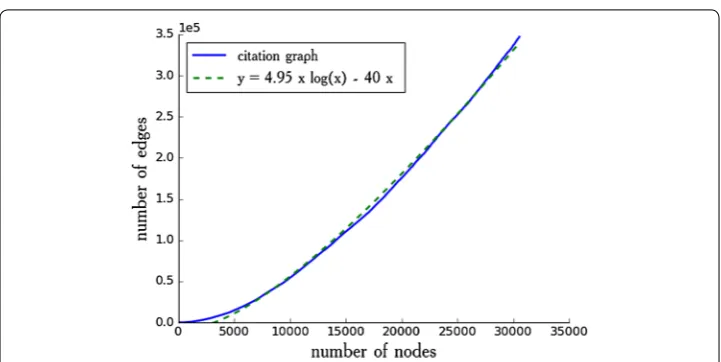
First, we have studied the growth of the real networks. For example, Fig. 1 shows the growth of a citation graph. The data was obtained from the SNAP1 database. It can be seen that the function y(x)=4.95xlogx−40x is a good estimation of the growth rate of this network. That is why we decided to focus on the linearithmic or sub-linearithmic growth rate of the model (here and subsequently, by the growth of the model we mean the growth of the number of edges).
Analysis of the expected number of edges
Let M(n) denote the number of edges in the network of size n. To find its expectation, we need the two following lemmas.
Lemma 1 The probability for a node with weight w to be connected to a random node is
1 https://snap.stanford.edu/data/.
(3)
Pe(w)=
1 2
�
1− aθ
w(a+1)w0
�
, w> wθ 0, 1
2
wa 0
Lemma 2 The edge probability in the network is
To improve readability, we moved the proofs of Lemmas 1 and 2 to Appendix.
The next theorem shows that our model can have any growth which is less than quadratic.
Theorem 1 Denote as R(n) such function that R(n)=o(n2) and R(n)>0. Then there
exists such threshold function θ (n) that the growth of the model isR(n):
Proof It easy to check that Pe is a continuous function of θ. The intermediate value
theo-rem states that Pe(θ ) takes any value between Pe(θ =0)=1/2 and Pe(θ= ∞)=0 at
some point within the interval.
Since R(n)=o(n2) and positive, there exists N such that for all n≥N, 0<R(n) <12×n(n2−1).
It means that the equation EM(n)=R(n) is feasible for all n≥N.
Taking into account Theorem 1, we obtain parameters for the linearithmic and linear growths of the expected number of edges.
Theorem 2 Suppose the following threshold function: θ (n)=Dn1awhere D is a
con-stant. Then the growth of the model is linearithmic:
whereA is a constant depending on the Pareto distribution parameters.
(4) Pe=
1 2−12 a
2
(a+1)2wθ2 0
, θ <w20,
w20a 2θa
�
a(lnθ−2 lnw0)
a+1 − a
2
(a+1)2 +1
�
, θ ≥w02.
∃N EM(n)=R(n) (n≥N).
EM(n)=Anlnn(1+o(1))
n≥ w
2a
0 Da
,
Proof We can rewrite inequality n≥ w20a
Da as Dn
1 a ≥w2
0 and apply Lemma 2 in the case
θ (n)=Dn1a ≥w2
0
If we replace θ by Dn1a, we obtain
Theorem 3 Suppose that the growth of the model is sub-linearithmic:EM(n)
nlnn =o(1), then n1a
θ (n) =o(1).
Proof Let us consider another model with a threshold function θ′(n)=Dn1a and the expected number of edges EM′(n). According to Theorem 2 and the condition EM(n)
nlnn =o(1) there exists a natural number ND such that
This also means that for all n≥ND we have θ (n)≥θ′(n). Therefore
By the arbitrariness of the choice of D, we have n1a
θ (n) =o(1).
Concentration theorem
In this section, we will find the variance of the number of the edges and prove the con-centration theorem
Proofs of the following lemmas can be found in the Appendix.
Lemma 3 Suppose thatx, y and z are random nodes. Let P< be the probability for the
nodex to be connected to both nodesy andz. Then the variance of the number of edgesM is
Lemma 4 Suppose thatx, y andz are random nodes. LetP< be the probability for the
nodex to be connected to both nodesy andz. Then
Combining these results, we get the following theorem that will be needed to prove the concentration theorem
(5)
EM= n(n−1)
2 w02a 2θa
a(lnθ−2 lnw0)
a+1 −
a2
(a+1)2 +1
.
EM(n)= n(n−1)w 2a
0
4(Dn1a)a
a(ln(Dn1a)−2 lnw0)
a+1 −
a2 (a+1)2+1
= (n−1)w 2a
0
4Da
lnn a+1−
a2
(a+1)2+1+
a(lnD−2 lnw0) a+1
=Anlnn(1+o(1)).
∀n≥ND EM′(n)=Anlnn(1+o(1))≥EM(n).
∀n≥ND n1a
θ (n) ≤ n1a
θ′(n) = 1 D.
Var(M)= n(n−1)
2 Pe(1−Pe)+n
(n−1)(n−2)
2 (P<−P
2
e),
P<=
1 4
w2a
0
θ2a(a+1)2[θa−w02a] +14 w2a
0
θa
�
1−2 a2
(a+1)2 + a
3
(a+1)2(a+2) �
, θ ≥w20, 1
4−12 a
2θ
(a+1)2w12 0 +
1 4 a
3θ2
(a+1)2(a+2)w14 0
Theorem 4 Ifθ ≥w20, the variance is
whereAandBare constants which depend on the Pareto distribution parameters.
Proof According to Lemmas 3 and 4 in case of θ ≥w20, the variance is
According to Lemma 2, the expected number of edges is
Combining (8) and (6), we obtain
Therefore,
where C1, C2, C3, A and B are constants depending on the Pareto distribution parameters.
Finally, we obtain
Theorem 5 Concentration theorem Ifθ (n)andEM(n)tends to infinity asn→ ∞and
n3
(EM(n))2θ (n)a =o(1), then
whereM is the number of edges in the graph.
Proof According to Chebyshev’s inequality, we have Var(M)=EM+n(n−1)(n−2)
2
A1
θa+B 1 θ2a
− 2(n−2)
n(n−1)(EM) 2,
(6)
Var(M)= n(n−1)
2 Pe(1−Pe)+n
(n−1)(n−2)
2 (P<−P
2
e).
(7)
P<=
1 4
w02a θ2a(a+1)2[θ
a−w2a 0 ] +
1 4
w20a θa
1−2 a 2
(a+1)2 +
a3 (a+1)2(a+2)
(8)
EM= n(n−1) 2 Pe.
Var(M)=EM(1−Pe)+n
(n−1)(n−2)
2 P<−EM(n−2)Pe
=EM+n(n−1)(n−2)
2 P<−
2(n−2)
n(n−1)(EM)
2.
P<= 1
4
w02a
θ2a(a+1)2[θ
a
−w02a] +1
4
w2a0
θa
1−2 a 2
(a+1)2+
a3
(a+1)2(a+2)
= 1
θaC1− 1
θ2aC2+ 1
θaC3=A 1
θa +B 1
θ2a,
Var(M)=EM+n(n−1)(n−2) 2
A1
θa+B 1
θ2a
− 2(n−2)
n(n−1)(EM) 2.
∀ε >0 P(|M−EM| ≥ε·EM)−−−→n→∞ 0,
(9) P(|M−EM| ≥ε·EM)≤ Var(M)M
Let us estimate the right part of the inequality. Using Theorem 4, we get
Using the conditions of the theorem, we obtain
Combining Theorems 2, 3 and 5, we obtain the following corollary.
Corollary 1 Suppose that one of the following conditions holds:
• The threshold function θ (n) equals Dn1a
• n
EM(n) =O(1) and EM(n)
nlnn =o(1)
Then
whereM is the number of edges in the graph.
In this way, we have proved that the number of edges in the graph does not deviate much from its expected value. It means that having the linearithmic or the sub-linearith-mic growth of the expected number of edges we also have the same growth for the actual number of edges.
Degree distribution
In this section, we show that our model follows power-law degree distribution with an exponent of 2 and give two proofs. The first is a mean-field approximation. It is usually applied for a fast checking of hypotheses. The second one is a strict probabilistic proof. To the best of our knowledge it has not been considered in the context of the geographic threshold models yet.
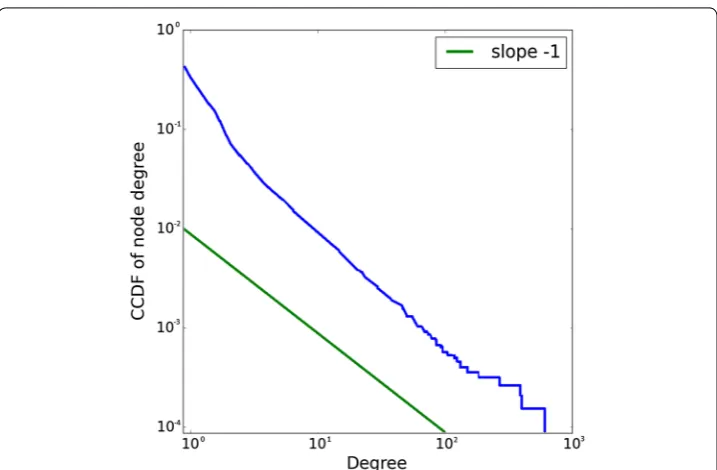
To confirm our proofs, we carried out a computer simulation and plotted complemen-tary cumulative distribution of node degree which is shown on Fig. 2. We also used a discrete power-law fitting method, which is described in [2] and implemented in the net-work analysis package igraph.2 We obtained α=2.16, x
min=4 and a quite large p-value
of 0.9984 for the Kolmogorov–Smirnov goodness of fit test.
Theorem 6 LetP(k) be the probability of a random node to have a degreek. If n1a
θ (n) =o(1) , then there exist such constantsC0andN0such that∀k(n): ∀n > N0k(n) < C0nwe have
Var(M)
ε2
·(EM)2 =
1
ε2EM +
O(n3)
(EM)2
A1
θa+B
1
θ2a
+O 1
n
=
1
ε2EM +
O(n3)
(EM)2
1
θa
1+
B Aθ2a
+O
1
n
Var(M)
ε2·(EM)2 →0 asn→ ∞.
∀ε >0 P(|M−EM| ≥ε·EM)−−−→n
→∞ 0,
2 http://igraph.org/.
Mean‑field approximation
This approximation gives power law only for nodes with weights w≤ θ
w0. But the expected number of nodes with weights not satisfying this inequality Em is extremely small
As it was shown in Lemma 1, the probability of the node v�i=wix�i with weight wi=w≤ w0θ to have an edge to another random node is
Let ki(w) be the degree of the node vi. Then
where I stands for the indicator function. As all nodes are independent, we get
In the mean-field approximation, we assume that ki(w) is really close to its expectation and we can substitute it by (n−1)Pe(w) in the following expression for the degree distri-bution P(k)=f(w)ddwk, where f(w) is a density of weights. Thus,
(10)
Em=nP
w> θ w0
=n
w20 θ
a
=o(1).
Pe(w)=
wa0 2θa(a+1)w
a.
ki(w)=
i�=j
I[viis connected tovj],
Eki(w)=(n−1)Pe(w).
Fig. 2 Complementary cumulative distribution of node degree n=3·105, x�i∈R3, wi∼Pareto(3, 1),
Note that we have not used conditions on k(n) and θ (n) yet, they are needed to esti-mate residual terms in the following rigorous proof.
Proof Degree ki of the node vi is a binomial random variable. Using the probability Pe(w) of the node vi with weight wi =w to have an edge to another random node, we can get the probability that ki equals k:
To get the total probability, we need to integrate this expression with respect to w
Because of Pe(w) is a composite function, the integral breaks up into two parts.
Thus,
For estimating I1 we can use the formula Pe(w)= 12 w
a
0
θa(a+1)wa from Lemma 1. After mak-ing the substitution to integrate with respect to Pe(w) and using the incomplete
beta-function, we get
For I2 we can derive an upper bound. Note that for w≥θ/w0 we have
Therefore, we obtain the following upper estimate
P(k)= 2aw
a
0θa(a+1) (n−1)w2a ∝k−2
P(ki=k|wi=w)=
n−1
k
(Pe(w))k(1−Pe(w))n−k−1.
P(ki=k)=
n−1 k
∞
w0
(Pe(w))k(1−Pe(w))n−k−1 aw0a wa+1dw.
I1= θ/w0
w0
(Pe(w))k(1−Pe(w))n−k−1 awa0 wa+1dw,
I2=
∞
θ/w0
(Pe(w))k(1−Pe(w))n−k−1 awa0 wa+1dw.
P(ki=k)=
n−1
k
(I1+I2).
I1=
w02a
2θaa(a+1) ·
B
1
2(a+1);k−1,n−k
−B
w20a
2θa(a+1);k−1,n−k
.
Pe(w)= 1 2
1− aθ
w(a+1)w0
< 1
2
1−Pe(w)≤1−Pe(θ/w0)= 1 2
1+ a
a+1
We now combine estimates for I1, I2 and the following estimates for the incomplete
beta-function:
This gives us
Let us introduce the following notations:
Using n
θa(n) =o(1), for k(n) <C0n we get I2=O
(ε0)n−k−1 2k
∞ �
θ/w0 awa0 wa+1dw
=O
�
(ε0)n−k−1
θa2k �
B(x;a,b)=Ox
a
a
,
B(x;a,b)=B(a,b)+O(1−x)
b
b
,
1
B(d−1,n−d) =
Ŵ(n−1)
Ŵ(d−1)Ŵ(n−d) =O
nd−1
Ŵ(d−1)
.
P(ki=k)= �
n−1
k
� w2a
0 2θaa(a
+1)
B(k−1,n−k)+O
�
1−2 1
(a+1) �n−k
n−k −O � w02a
2θa (a+1)
�k−1
k−1
+O �
(ε0)n−k−1
θa2k � = �n −1 k
� w2a
0
2θaa(a+1)B(k−1,n−k)
1+O �
(ε1)n−knk−1
(n−k)Ŵ(k−1)
� + O � w2a
0 2θa
(a+1) �k−1
nk−1
(k−1)Ŵ(k−1)
+O �
(ε0)n−k−1
θa2k
nk−1
Ŵ(k−1)
��
.
A=O
�
(ε1)n−knk−1
(n−k)Ŵ(k−1) �
, whereε1=1− 1 2(a+1),
B=O
�
w2a
0 2θa(a+1)
�k−1
nk−1
(k−1)Ŵ(k−1) ,
C=O
�
(ε0)n−k−1
θa2k
nk−1
Ŵ(k−1) �
, whereε0= 1 2
�
1+ a
a+1
�
.
B=O �
w2a
0
2(a+1) �k−1
(θna)k−1
Ŵ(k)
If k(n) is a bounded function, then since ε0<1 and ε1<1 we have
If k(n)→ ∞ as n→ ∞, using Stirling’s approximation Ŵ(k−1)∼√2π(k−2)k−e2k−2 we get
Since εxx→0 for ε <1 as x→ ∞ there exist constants C0 and N0 such that for n>N0 and k(n) <C0n we have (ε1)
n−k k−1 n
k−2 <1 and (ε0)
n−k−1
k−1 n
k−2 <1. This implies that
A=o(1) and C=o(1).
Thus, we obtain
Note that regardless of the shape parameter of the Pareto distribution of weights we always generate networks with a degree distribution following a power law with an expo-nent equals 2. In the next section, we modify our model to change the expoexpo-nent of the degree destribution and some other properties of the resulting networks.
Model modifications
In this section, we will show how to modify our model to get new properties and how these modifications will affect the degree distribution.
Directed network
Many real networks are directed. To model them and obtain an exponent of the power law that differs from 2, we changed the condition for the existence of an edge. There will be a directed edge (vi,vj), if and only if
As it follows from the next theorem this modification allows us to tune an exponent of the power law.
Theorem 7 Let Pout(k) be the probability of an random node to have out-degree k,
Pin(k) in-degreek. Ifnmax{α,β}/a/θ (n)=o(1), then there exist constantsC0 andN0 such
that∀k(n): ∀n>N0k(n) <C0n we have
A=O(ε1)
n−k k−1nk−1
=o(1),
C=O(ε0)n−knk−1
=o(1).
A=O
k−2 (n−k)√k−2
(ε1) n−k
k−1 n
k−2
k−1
,
C=O
√
k−2 θa
(ε0) n−k−1
k−1 n
k−2
k−1
.
(11) P(ki=k)=(1+o(1))
n−1
k
B(k−1,n−k)=(1+o(1))k−2.
Proof Here is a proof for the out-degree distribution. The case of the in-degree distribu-tion is similar.
First, let us compute Pe(w)—the probability of the node v�i=wix�i with weight wi=w to have an edge to another random node.
Similar to Lemma 1 we get
Thus, we obtain
Like in Theorem 6, we have
The rest of the proof is similar to the corresponding steps of Theorem 6, so we omit
details here.
With α=β this model turns into an undirected case with the power-law exponent
equals 2 that agrees with Theorem 6.
Functions of dot product
In our model because of the condition wiwj(x�i,x�j)≥θ ≥0 node vi can only be
con-nected to the node vj if an angle between xi and xj is less than π/2. This is a constraint on
the possible neighbors of a node that restricts the scope of our model.
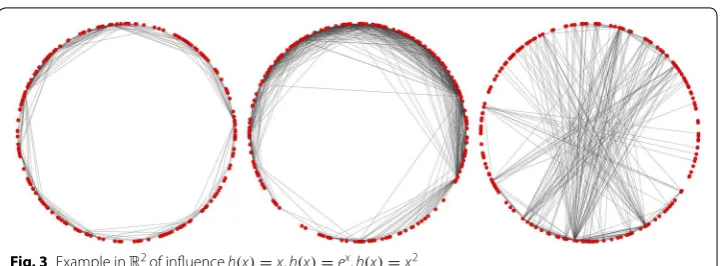
We can solve this issue by changing the condition for the existence of an edge:
where h: [−1, 1] →R. On Fig. 3 is an example of how it works in R2.
Theorem 8 Let Pout(k) be the probability of an random node to have out-degree k,
Pin(k)—in-degree k. If nmax{α,β}/a/θ (n)=o(1) and h: [−1, 1] →R-continuous, strictly Pout(k)=(1+o(1))k−1−α/β,Pin(k)=(1+o(1))k−1−β/α.
(12)
Pe(w)=
∞
w0 f(w′)
x′∈S(0, 1) (wαx,(w′)βx′)≥θ
1 4πdx
′dw′.
(13)
Pe(w)=
∞
max{w0,θ1/β/wα/β} awa0 (w′)a+1
1 2
1− θ
wα(w′)β
dw′.
(14)
Pe(w)=
1 2
�
1− aθ
wα(a+β)wβ
0
�
, w>�wθα
0
�1/β
,
waα/βwa 0 2θa/β
�
1
a− β+1a
�
, w≤�θ
wα
0
�1/β
.
P(ki=k)=
n−1 k
∞
w0
(Pe(w))k(1−Pe(w))n−k−1 aw0a wa+1dw.
increasing function, positive at least in one point from (−1, 1), then there exist constants C0 and N0 such that ∀k(n): ∀n>N0k(n) <C0n we have
Short scheme of proof
Here is the scheme of proof for the out-degree distribution. The case of the in-degree is similar.
Restrictions on the function h allow us to modify the proof of the directed case. The main difference is a value of the probability Pe(w) of a node v�i =wix�i with the weight wi=w to have an edge to another random node.
We will denote by I the inner integral:
We can rewrite inequality (15) as h((x,x′))≥ θ
wα(w′)β and notice that wα(θw′)β ∈(0,+∞) . Let us consider h([−1, 1])= [r,q], on this interval function h is invertable. We examine the mutual position of [r, q] and (0,+∞). The definition of h implies that [r,q] ∩(0,+∞)�= ∅. This gives us the next two cases.
A. The first case is [r,q] ⊂(0,+∞). If wα(θw′)β ∈ [r,q], then we may invert h and the inner integral I is equal to 2π1−h−1wα(θw′)β
. If θ
wα(w′)β >q, then the
inequal-ity (15) is not satisfied and I =0. If 0< wα(θw′)β <r, then the inequality (15) is
satis-fied for any pair of x and x′, I=4π, the surface area of S2. Pout(k)=k−1−α/β(1+o(1)),Pin(k)=k−1−β/α(1+o(1)).
(16)
Pe(w)=
∞
w0
awa0 (w′)a+1
x′∈S2 wα(w′)βh((x,x′))≥θ
1 4πdx
′dw′.
(17)
x′∈S2 wα(w′)βh((x,x′))≥θ
1 4πdx
′dw′.
To deal with Pe(w), we need to compare w0 with boundaries for each range of
θ
wα(w′)β
1. If w0< θ 1/β
wα/βq1/β, then
2. If θ1/β
wα/βq1/β ≤w0< θ
1/β
wα/βr1/β, then
3. Last case is w0≥ θ 1/β
wα/βr1/β. But θ (n) grows with n, and for big enough n this
ine-quality will not be satisfied.
B. The second case is [r,q] �⊂(0,+∞), which implies r≤0. If wα(θw′)β ∈(0,q], then
I=2π1−h−1wα(θw′)β
. If θ
wα(w′)β >q, then I=0. This gives
It remains only to show that Pout(k)=k−2(1+o(1)). But now it is easy to see that
the influence of every kind of the principal parts of the integral for Pe(w) has been
already examined in previous theorems for degree distributions. For example,
what is proportional to the one we got in Theorem 7. Therefore, we are not giving
here additional details.
For example, described class of functions contains functions like ex and x2m+1+c,
m∈N, for a proper constant c.
Of course, not only this small class of functions h(x) has no influence on the degree distribution. For example, it is easy to show that h(x)=x2m,m∈N also has this
prop-erty. In this way, a proof will be different only in the computation of Pe(w).
Pe(w)=
θ1/β
wα/βq1/β
w0
0dw′+
θ1/β
wα/βr1/β
θ1/β
wα/βq1/β
awa0
(w′)a+1
1 2
1−h−1
θ
wα(w′)β
dw′
+
∞
θ1/β
wα/βr1/β
4π aw
a
0 (w′)a+1dw′.
Pe(w)=
θ1/β
wα/βr1/β
w0
awa0 (w′)a+1
1 2
1−h−1
θ
wα(w′)β
dw′+
∞
θ1/β
wα/βr1/β
4π aw a 0 (w′)a+1dw
′.
Pe(w)=
∞
max(w0, θ1/β
wα/βq1/β)
aw0a
(w′)a+1
1 2
1−h−1
θ
wα(w′)β
dw′
θ1/β wα/βr1/β
θ1/β wα/βq1/β
awa0
(w′)a+1
1 2
1−h−1
θ
wα(w′)β
dw′= w
a
0w2aα/β βθa/β
q
r
Conclusion
In our work, we suggest a new model for scale-free networks generation, which is based on the matrix factorization and has a geographical interpretation. We formalize it for fixed size and growing networks. We proof and validate empirically that degree distribu-tion of resulting networks obeys power law with an exponent of 2.
We also consider several extensions of the model. First, we research the case of the directed network and obtain power-law degree distribution with a tunable exponent. Then, we apply different functions to the dot product of latent features vectors, which give us modifications with interesting properties.
Further research could focus on the deep study of latent features vectors distribution. It seems that not only a uniform distribution over the surface of the sphere should be considered because, for example, cities are not uniformly distributed over the surface of Earth. Besides, we want to try other distributions of weights.
Authors’ contributions
This work is the result of a close joint effort in which all authors contributed almost equally to defining and shaping the problem definition, proofs, algorithms, and manuscript. The research would not have been conducted without the participation of any of the authors. All authors read and approved the final manuscript.
Author details
1 Moscow Institute of Physics and Technology (SU), Moscow, Russia. 2 Skolkovo Institute of Science and Technology,
Moscow, Russia. 3 Yandex, Moscow, Russia.
Competing interests
The authors declare that they have no competing interests.
Appendix Proof of Lemma 1
For a node x with the weight w, the probability to be connected to a random node is rep-resented by
We can rewrite inequality ww′(x,x′)≥θ as (x,x′)≥ θ
ww′. If wwθ′ ∈ [0, 1], this inequality
defines the spherical cap of the area 2π(1− θ
ww′). Therefore, we have
If we substitute f(w′) from (2), we obtain
(18)
Pe(w)= ∞
w0
f(w′)
x′∈S2
ww′(x,x′)≥θ
1 4πdx
′dw′.
(19) Pe(w)=
∞
max{w0,θ/w}
f(w′)2π
1− θ
ww′
1 4πdw
′.
(20)
Pe(w)= ∞
max{w0,θ/w} a w0
w0 w′
a+11
2
1− θ ww′
If w≤θ/w0, then
If w> θ/w0, then
Proof of Lemma 2
The edge probability is represented by
Using (18), we obtain
If θ <w02, then for all w∈ [w0,∞)Pe(w) equals to 12
1− aθ w(a+1)w0
. Using it, we get
Pe(w)=
∞ θ/w a 2w0 w0 w′
a+1
1− θ
ww′
dw′=
∞ θ/w a 2w0 w0 w′
a+1
dw′−
∞ θ/w a 2w0 w0 w′
a+1 θ ww′dw′
=aw
a 0 2
1
a(θ/w)a−
awa0θ
2w
1
(a+1)(θ/w)a+1= 1
2 wa0
θa(a+1)w a.
Pe(w)=
∞ w0 a w0 w0 w′
a+1 2π
1− θ
ww′
1
4πdw
′= aw
a 0 2 ∞ w0 1
w′a+1dw′−
awa0θ
2w
∞
w0
1
w′a+2dw′
= aw a 0 2 1 awa 0 −aw a 0θ 2w 1
(a+1)wa0+1 =
1
2
1− aθ
w(a+1)w0
.
(21)
Pe=
∞ w0 S2 ∞ w0
x′∈S2
ww′(x,x′)≥θ
f(w)f(w′) 1
16π2dx
′dw′dxdw.
(22)
Pe=
∞
w0
S(0,1)
1
4πf(w)Pe(w)dxdw=
∞
w0
f(w)Pe(w)dw.
Pe=
∞ w0 1 2
1− aθ
w(a+1)w0
a w
a
0
wa+1dw
= 1 2 − ∞ w0 1 2 aθ w(a+1)w0
a w
a
0
wa+1dw
= 1
2 − 1 2a
2θwa0−1
a+1
∞
w0 1 wa+2dw
= 1
2 − 1 2a
2θwa0−1
a+1
1
a+1
1 wa0+1
= 1
2 − 1 2
a2
If θ ≥w20, then
Proof of Lemma 3
Let us enumerate pairs of nodes. Each pair of nodes i has an edge indicator Iei. By definition, we have
Ie1, . . ., Ien(n−1)/2 is the sequence of identically distributed random variables, so their expected value is the same and equals to Pe.
Since EIe2
i=EIei =Pe, it follows that
If edges ei and ej do not have mutual nodes, then Iei and Iej are independent variables.
Therefore, E(IeiIej)=E(Iei)E(Iej)=P2e. We get
EIe(v,w)Ie(v,z) is exactly equal to P<.
Proof of Lemma 4 It can be easily seen that
Pe=
θ/w0
w0
1 2
w0a θa(a+1)w
aa wa0
wa+1dw+
∞
θ/w0
1 2
1− aθ
w(a+1)w0
a w
a
0
wa+1dw
= 1
2
wa0 θa(a+1)aw
a
0
θ/w0
w0
1
wdw+
1 2aw a 0 ∞
θ/w0
1
wa+1 −
a2wa−0 1θ
2(a+1)
∞
θ/w0
1
wa+2dw
= 1
2
w02aa
θa(a+1)(lnθ−2 lnw0)+
w20a
2θa −
a2
2(a+1)2
w20a θa .
Var(M)=E(M2)−E(M)2=E(Ie1+ · · · +Ien(n−1)/2)
2−(EI
e1+ · · · +EIen(n−1)/2)
2
=
i
EI2
ei+2
i�=j
EIe
iIej −
i
(EIe
i)
2−2
i�=j
EIe
iEIej.
EIeiIej−
n(n−1)
2 (Pe)
2 −2
i�=j
EIeiEIej=
n(n−1)
2 Pe(1−Pe)+2
i�=j
EIeiIej−2
i�=j EIeiEIej.
Var(M)= n(n−1)
2 Pe(1−Pe)+ n
v=1 n
w=1
w�=v
n
z=w+1
z�=v
(EIe(v,w)Ie(v,z)−EIe(v,w)EIe(v,z))
= n(n2−1)Pe(1−Pe)+ n
v=1 n
w=1
w�=v
n
z=w+1
z�=v
(EIe(v,w)Ie(v,z)−P
2 e) P<= ∞ w0
If θ <w02 we have
If θ ≥w20, then
Computing the first integral, we get
And for the second one, we have
This gives us P< in the case of θ ≥w02: P<=
∞ w0 1 4
1− aθ
w(a+1)w0
2 a w
a
0
wa+1dw
= 1 4aw a 0 ∞ w0 1
wa+1dw−
1 2
a2θwa−1 0
a+1
∞
w0
1
wa+2dw+
1 4
a3θ2wa−2 0
(a+1)2 ∞
w0
1
wa+3dw
= 1
4 − 1 2
a2θ (a+1)2
1
w02+
1 4
a3θ2 (a+1)2(a+2)
1
w04.
P<= θ/w0
w0 1 4
w20a
θ2a(a+1)2w
2aa wa0
wa+1dw+ ∞
θ/w0 1 4
1− aθ w(a+1)w0
2 a w
a
0
wa+1dw.
θ/w0
w0 1
4 w02a
θ2a(a+1)2w 2a
a w
a 0 wa+1dw=
1
4 w02a
θ2a(a+1)2aw a 0
θ/w0
w0
wa−1dw
= 14 w
2a 0 θ2a(a+1)2[θ
a −w2a0 ].
∞
θ/w0 1
4
1− aθ
w(a+1)w0 2
a wa0
wa+1dw= ∞
θ/w0 1
4a wa0
wa+1dw− ∞
θ/w0 1
2 aθ
w(a+1)w0 a
wa0
wa+1dw
+ ∞
θ/w0 1
4 a2
θ2 w2
(a+1)2w2 0
a w a 0 wa+1dw
= 14awa0 ∞
θ/w0 1
wa+1dw− 1
2 a2
θw0a−1 a+1
∞
θ/w0 1
wa+2dw
+14a 3
θ2wa−2 0 (a+1)2
∞
θ/w0 1
wa+3dw
= 14wa0 wa0
θa − 1
2 a2
θwa0−1 (a+1)2
wa0+1
θa+1 + 1
4 a3
θ2wa0−2 (a+1)2
(a+2) w0a+2
θa+2
= 14w 2a 0 θa −
1
2 a2
(a+1)2 w20a
θa + 1
4
a3
(a+1)2 (a+2)
w02a
θa .
P(<)= 1 4
w2a0 θ2a(a+1)2[θ
a−w2a 0 ] +
1 4
w2a0 θa
1−2 a
2
(a+1)2+
a3 (a+1)2(a+2)
Received: 21 February 2016 Accepted: 4 August 2016
References
1. Albert R, Barabási A-L. Statistical mechanics of complex networks. Rev Mod Phys. 2002;74(1):47.
2. Clauset A, Shalizi CR, Newman ME. Power-law distributions in empirical data. SIAM Rev. 2009;51(4):661–703. 3. Colomer-de-Simon P, Boguná M. Clustering of random scale-free networks. Phys Rev E Stat Nonlin Soft Matter Phys.
2012;86:026120 (preprint arXiv:1205.2877).
4. Callaway DS, Newman ME, Strogatz SH, Watts DJ. Network robustness and fragility: percolation on random graphs. Phys Rev Lett. 2000;85(25):5468.
5. Moreno Y, Pacheco AF. Synchronization of kuramoto oscillators in scale-free networks. EPL (Europhys Lett). 2004;68(4):603.
6. Menon AK, Elkan C. Link prediction via matrix factorization. In: Gunopulos D, Hofmann T, Malerba D, Vazirgiannis M, editors. Machine learning and knowledge discovery in databases: European conference, ECML PKDD 2011, Athens, September 5–9, 2011, Proceedings, Part II. Berlin: Springer; 2011. p. 437–52.
7. Hayashi Y. A review of recent studies of geographical scale-free networks. arXiv preprint physics/0512011; 2005. 8. Barabási A-L, Albert R. Emergence of scaling in random networks. Science. 1999;286(5439):509–12.
9. Bollobás B, Riordan O, Spencer J, Tusnády G, et al. The degree sequence of a scale-free random graph process. Random Struct Algorithms. 2001;18(3):279–90.
10. Holme P, Kim BJ. Growing scale-free networks with tunable clustering. Phys Rev E. 2002;65(2):026107.
11. Lee DD, Seung HS. Algorithms for non-negative matrix factorization. In: Advances in neural information processing systems; 2001. p. 556–562.
12. Koren Y, Bell R, Volinsky C. Matrix factorization techniques for recommender systems. Computer. 2009;8:30–7. 13. Liben-Nowell D, Kleinberg J. The link-prediction problem for social networks. J Am Soc Inf Sci Technol.
2007;58(7):1019–31.
14. Masuda N, Miwa H, Konno N. Geographical threshold graphs with small-world and scale-free properties. Phys Rev E. 2005;71(3):036108.
15. Morita S. Crossovers in scale-free networks on geographical space. Phys Rev E. 2006;73(3):035104.