ISSN Online: 2153-120X ISSN Print: 2153-1196
DOI: 10.4236/jmp.2017.812123 Nov. 28, 2017 2034 Journal of Modern Physics
Matter-Antimatter Coexistence Method for
Finite Density QCD toward a Solution of the
Sign Problem
Hideo Suganuma
Department of Physics, Graduate School of Science, Kyoto University, Kyoto, Japan
Abstract
Toward the lattice QCD calculation at finite density, we propose “matter-antimatter coexistence method”, where matter and anti-matter systems are prepared on two parallel R4-sheets in five-dimensional Euclidean
space-time. We put a matter system M with a chemical potential µ ∈C on a
R4-sheet, and also put an anti-matter system M with −
µ
*on the other R4-sheet shifted in the fifth direction. Between the gauge variables
eiagA
Uν ≡ ν in M and Uν ≡eiagAν in M, we introduce a correlation term
( ) ( )
{
†}
2{
( )
( )
}
2,
1 2 Re tr
2
a a
c
x x
Sλ ≡
∑
ν λ N − Uν x Uν x ∑
λa Aν x −Aν x with areal parameter
λ
. In one limit of λ → ∞ , a strong constraint( )
( )
Uν x =Uν x is realized, and therefore the total fermionic determinant
becomes real and non-negative, due to the cancellation of the phase factors in
M and M, although this system resembles QCD with an isospin chemical
potential. In another limit of λ →0, this system goes to two separated
ordinary QCD systems with the chemical potential of µ and −
µ
*. For agiven finite-volume lattice, if one takes an enough large value of
λ
,( )
( )
Uν x Uν x is realized and phase cancellation approximately occurs
between two fermionic determinants in M and M, which suppresses the sign
problem and is expected to make the lattice calculation possible. For the obtained gauge configurations of the coexistence system, matter-side quantities are evaluated through their measurement only for the matter part
M. The physical quantities in finite density QCD are expected to be estimated by the calculations with gradually decreasing
λ
and the extrapolation to0
λ
= . We also consider more sophisticated improvement of this method using an irrelevant-type correlation.How to cite this paper: Suganuma, H. (2017) Matter-Antimatter Coexistence Method for Finite Density QCD toward a Solution of the Sign Problem. Journal of Modern Physics, 8, 2034-2041.
https://doi.org/10.4236/jmp.2017.812123
Received: October 27, 2017 Accepted: November 25, 2017 Published: November 28, 2017
Copyright © 2017 by author and Scientific Research Publishing Inc. This work is licensed under the Creative Commons Attribution International License (CC BY 4.0).
http://creativecommons.org/licenses/by/4.0/
DOI: 10.4236/jmp.2017.812123 2035 Journal of Modern Physics
Keywords
Lattice QCD, Finite Density, Sign Problem, QCD Phase Diagram
1. Introduction
Nowadays, quantum chromodynamics (QCD) has been established as the fun-damental theory of strong interaction. Together with the success of perturbative QCD for high-energy processes of hadron reactions, the lattice QCD Monte Carlo simulation has been a powerful tool to analyze nonperturbative aspects of QCD, after the formulation of lattice QCD and its numerical success [1]. Indeed, lots of studies of the QCD vacuum, hadrons and the quark-gluon plasma have been done for both zero-temperature and finite-temperature in lattice QCD.
Finite density QCD is also important to understand the QCD diagram, nuc-lear systems and neutron stars, and it is desired to perform the lattice QCD analysis as the first-principle calculation of the strong interaction. However, there appears a serious problem called the “sign problem” [2][3] in the practical lattice QCD calculation at finite density. This problem originates from the com-plex value including minus sign of the QCD action and the fermionic determi-nant at finite density even in the Euclidean metric [4].
At finite density with the chemical potential µ, the Euclidean QCD action
[
, , ;]
S A
ψ ψ µ
is generally complex,[
]
[ ]
4{
(
)
}
4
, , ; G d ,
S A
ψ ψ µ
=S A +∫
xψ
D/ + +mµγ ψ
∈C (1)with the gauge action SG
[ ]
A ∈R and covariant derivative D igA ν ≡ ∂ +ν ν. (In this paper, we use hermite γ-matrices of †µ µ
γ =γ in the Euclidean metric.)
Therefore, one cannot identify the action factor as a probability density in the QCD generating functional, unlike ordinary lattice QCD calculations. Also, the fermionic determinant at finite density generally takes a complex value [4], and its phase factor is drastically changed depending on the gauge configuration in a large-volume lattice, so that the Monte Carlo importance sampling loses its efficiency, which makes the numerical analysis highly difficult for the evaluation of the integral. This is the sign problem.
The sign problem has been a longstanding difficult problem in computational physics, and widely appears in various region of statistical physics, condensed matter physics and QCD physics at finite density. Then, it is desired to develop some methods to suppress the sign problem in many fields in theoretical physics.
DOI: 10.4236/jmp.2017.812123 2036 Journal of Modern Physics
propose a new theoretical method of “matter-antimatter coexistence method” in Euclidean QCD at finite density, and show its actual procedure for the lattice calculation. Section 3 will be devoted to the summary and the conclusion.
2. Matter-Antimatter Coexistence Method
In this section, we introduce the matter-antimatter coexistence method for general complex chemical potential µ ∈C. In this method, we use phase
cancellation of the fermionic determinants between a matter system with µ
and an anti-matter system with −
µ
*, which generally holds in QCD at finitedensity.
2.1. General Property of QCD at Finite Density
To begin with, we start from the general property of finite-density QCD [4],
[
]
* *, , ; , , ; ,
S Aψ ψ µ =S A ψ ψ µ− (2)
for the Euclidean QCD action S A
[
, , ;ψ ψ µ
]
in the presence of the chemicalpotential µ ∈C.
For instance, in continuum QCD, one finds
(
)
*(
*)
4 4 ,
D m D m
ψ / + +µγ ψ =ψ / + −µ γ ψ
(3)
which leads to Equation (2) and
(
)
*(
*)
4 4
Det D/ + +m µγ =Det D/ + −m µ γ . (4)
Also in lattice QCD, the fermionic kernel DF corresponding to D/ +m generally satisfies †
5 5
F F
D =
γ
Dγ
[6], and therefore one finds(
)
*(
*)
4 4 ,
F F
D D
ψ +µγ ψ =ψ −µ γ ψ
(5)
which leads to Equation (2) and
(
)
*(
*)
4 4
Det DF+µγ =Det DF−µ γ . (6)
Then, as an exceptional case, the QCD action with the pure imaginary chemical potential µ ∈iR is manifestly real, and hence its lattice calculation is
free from the sign problem. However, the QCD action is generally complex at finite density.
2.2. Definition and Setup of Matter-Antimatter Coexistence
Method
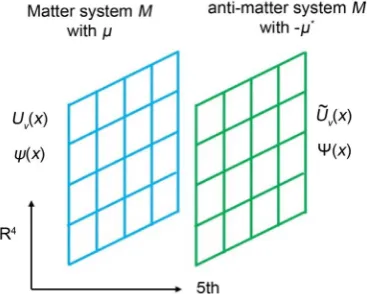
Now, we show the definition and setup of our approach, the “matter-antimatter coexistence method” [5]. In this method, we consider matter and anti-matter systems on two parallel R4-sheets in five-dimensional Euclidean space-time. For
the matter system M with a chemical potential µ ∈C on a R4-sheet, we also
prepare the anti-matter system M with −
µ
* on the other R4-sheet shifted inthe fifth direction, as shown in Figure 1.
We put an ordinary fermion field
ψ
( )
x with the mass m and the gaugevariable Uν
( )
x ≡eiagA xν( ) at 4DOI: 10.4236/jmp.2017.812123 2037 Journal of Modern Physics
Figure 1. The matter-antimatter coexistence system
in five-dimensional Euclidean space-time. We put the matter system M with µ, Uν
( )
x and ψ( )
xon a R4-sheet, and the anti-matter system M with *
µ
− , Uν
( )
x =Uν( )
x+ˆ5 and Ψ( )
x =ψ( )
x+ˆ5 on the other R4-sheet shifted in the fifth direction.fermion field Ψ
( )
x ≡ψ(
x+ˆ5)
with the same mass m and the gauge variable( )
( )(
ˆ)
eiagA x 5
Uν x ≡ ν ≡Uν x+
on the anti-matter system M. Here, ˆ5 denotes
the fifth direction vector with an arbitrary length a5, which is independent of
four-dimensional lattice spacing a.
Between the gauge variables Uν
( )
x in M and Uν( )
x in M, we introducea correlation term such as
( ) ( )
{
†}
,
2 c Re tr
x
Sλ N Uν x Uν x
ν
λ
≡
∑
− (7)with a real parameter
λ
(≥0) in the lattice formalism. This correlation acts on( )
Uν x and Uν
( )
x at the same four-dimensional coordinate x∈R4, andconnects two different situations: Uν
( )
x =Uν( )
x in λ → ∞ and two separatedQCD systems in λ →0.
In fact, the total lattice action in this method is expressed as
[ ]
(
[ ]
)
(
)
{
( ) ( )
}
4 * 4 ,2 Re tr
G F G
x
F c
x x
S S U D U S U
D U N Uν x Uν x
ν
ψ
µγ ψ
µ γ
λ
= + + +
+ Ψ − Ψ + −
∑
∑
∑
† (8)
with the gauge action SG
[ ]
U ∈R and the fermionic kernel D UF[ ]
in lattice QCD. After integrating out the fermion fields ψ and Ψ, the generatingfunctional of this theory reads
[ ]
(
[ ]
)
(
)
( ) ( ){
}
[ ](
)
{
(
[ ]
)
(
)
}
( ) ( ){
}
† , † , * 4 42 Re tr
*
4 4
2 Re tr
e Det e Det
e e Det e . G G c x G G c x S U S U F F
N U x U x
S U S U
F F
N U x U x
Z DU D U DU D U
DU DU D U D U
ν ν ν ν ν ν λ λ
µγ µ γ
µγ µ γ
− − − − − + − − ∑ ∑ = + − × = + − ×
∫
∫
∫ ∫
DOI: 10.4236/jmp.2017.812123 2038 Journal of Modern Physics
Here, the total fermionic determinant
[ ]
(
)
(
)
{
*}
4 4
, Det F F
U U D U
µγ
D Uµ γ
∆ ≡ + − (10)
is generally complex, and all other factors are real and non-negative in Z.
2.3. Four-Dimensional Continuum Limit
Near the four-dimensional continuum limit of a0, this additional term
becomes
( )
( )
{
}
2{
( )
( )
}
22 4
phys
1 1
d
2 2
a a a a
x
Sλ
∑
λa Aν x −Aν x ∫
x λ Aν x −Aν x (11)with 2
phys a
λ ≡λ − , and the generating functional goes to
[ ]
(
)
{
(
)
(
)
}
4{
( ) ( )}
2phys
1 d
* 2
cont e Det 4 4 e
a a
G G x A x A x
S A S A
Z =
∫ ∫
DA DA − + D/ + +m µγ D/ + −m µ γ −∫ λ ν −ν (12)with the continuum gauge action SG
[ ]
A ∈R and D igA ν ≡ ∂ +ν ν .
2.4. Lattice Calculation Procedure
Next, we show the actual procedure of this method for the lattice QCD calculation at finite density. In the practical lattice calculation with the Monte Carlo method, the fermionic determinant in Z is factorized into its amplitude and phase factor as
[ ] ( )
{
(
[ ]
)
(
)
}
( ) ( ){
†}
, * 4 42 Re tr
phase
e Det
e , ,
G G
c x
S U S U
F F
N U x U x
Z DU DU D U D U
O U U
ν ν ν λ
µγ µ γ
− + −∑ − = + − ×
∫
∫
(13)and the phase factor of the total fermionic determinant
[ ]
( )
(
)
{
*}
4 4
arg Det
phase , e
F F
i D U D U
O U U µγ µ γ
+ − ≡
(14)
is treated as an “operator” instead of a probability factor in a similar way to the phase quenched reweighting method [3], while all other real non-negative factors in Z can be treated as the probability density.
The additional term Sλ connects the following two different situations as the
two limits of the parameter
λ
:1) In one limit of
λ
→ ∞, a strong constraint Uν( )
x =Uν( )
x is realized,and the phase factors of two fermionic determinants Det
(
D UF[ ]
+µγ
4)
and(
*)
4
Det DF − U µ γ are completely cancelled, owing to Equation (6). Therefore,
the total fermionic determinant is real and non-negative,
[ ]
(
)
(
)
{
*}
4 4
Det D UF +
µγ
DFU=U−µ γ
≥0, (15)that is, OphaseU U, = 1, and the numerical calculation becomes possible
without the sign problem. Note however that this system resembles QCD with an isospin chemical potential [7], which is different from finite density QCD.
2) In another limit of λ →0, this system goes to “two separated ordinary
QCD systems” with the chemical potential of µ and −
µ
*DOI: 10.4236/jmp.2017.812123 2039 Journal of Modern Physics
cancellation of the phase factors cannot be expected between the two fermionic determinants Det
(
D UF[ ]
+µγ
4)
and Det(
DF − U µ γ* 4)
for significantlydifferent Uν
( )
x and Uν( )
x , which are independently generated in the MonteCarlo simulation.
In fact, in other words, this approach links QCD with a chemical potential and QCD with an isospin-chemical potential.
For a given four-dimensional finite-volume lattice, if one takes an enough large value of
λ
, Uν( )
x Uν( )
x is realized, and approximate phase cancellationoccurs between the two fermionic determinants Det
(
D UF[ ]
+µγ
4)
and(
*)
4
Det DF − U µ γ in M and M. Then, we expect a modest behavior of the
phase factor OphaseU U, in Equation (14), which leads to feasibility of the
numerical lattice calculation with suppression of the sign problem.
Once the lattice gauge configurations of the coexistence system are obtained with the most importance sampling in the Monte Carlo simulation, matter-side quantities can be evaluated through their measurement only for the matter part
M with µ.
By performing the lattice calculations with gradually decreasing
λ
and their extrapolation to λ =0, we expect to estimate the physical quantities in finitedensity QCD with the chemical potential µ. (This procedure may resemble the chiral extrapolation, where the current quark mass m is gradually reduced and
the lattice data is extrapolated to m=0.)
Here, we summarize the lattice QCD procedure of the matter-antimatter coexistence method for finite density QCD:
1) For the matter system M with µ on a finite-volume lattice, prepare also the anti-matter system M with −
µ
* on a fifth-dimensional parallel lattice.2) For the coexistence system M+M, introduce the correlation Sλ between M and M.
3) For the finite four-dimensional volume V, take an enough large value of
λ
so as to realize approximate phase cancellation in the total fermionic determinant
, U U
∆ , and generate the gauge configurations using the Monte Carlo
calculation, with treating the phase factor OphaseU U, as an operator.
4) For the obtained gauge configurations of the coexistence system, perform the lattice QCD measurement only for the matter part M with µ.
5) Reduce the value of the correlation parameter
λ
gradually, and extrapolate the lattice data toλ
=0.As a caution, even with this method, it is rather difficult to deal with the large volume case, because the phase factor OphaseU U, largely changes depending
on the gauge configuration in the large volume, when
λ
is reduced. For the finite volume, however, this method is expected to suppress the sign problem and to enlarge the calculable region at finite density and temperature.2.5. More Sophisticated Correlation between Matter and
Antimatter Systems
DOI: 10.4236/jmp.2017.812123 2040 Journal of Modern Physics M and the anti-matter M. Although the system goes to ordinary QCD in the
limit of λ →0, it is desired to reduce some effect from the additional
correlation at finite values of
λ
. On this point, we here consider a possibleimprovement in this framework.
So far, we have demonstrated this method by taking the simplest correlation of Sλ in Equation (7). In this method, however, there is some variety on the
choice of the correlation between Uν
( )
x in M and Uν( )
x in M. In fact, the validity of the data extrapolation can be checked by various extrapolations with different type of the additional correlation.In particular, it is interesting to consider more sophisticated correlation such as
( ) ( )
{
†}
3 4 1 2{
( )
( )
}
2 38 Retr d
8
a a
c x
Sξ N Uν x Uν x x a Aν x Aν x
ν
ξ ξ
≡ − −
∑
∑
∫
(16)with a dimensionless non-negative real parameter
ξ
. At the classical level, this correlation is an irrelevant interaction and it gives vanishing contributions in the continuum limit a→0, like the Wilson term 1 22ar Dψ ψ
− [6]. By the use of
this irrelevant-type correlation, the effect from the additional term is expected to be reduced in the actual lattice calculation.
3. Summary and Conclusion
We have proposed the “matter-antimatter coexistence method” toward the lattice calculation of finite density QCD. In this method, we have prepared matter M with µ and anti-matter M with −
µ
* on two parallel R4-sheets infive-dimensional Euclidean space-time, and have introduced a correlation term
( ) ( )
{
†}
2{
( )
( )
}
2,
1
2 Retr
2
a a
c
x x
Sλ ≡
∑
ν λ N − Uν x Uν x ∑
λa Aν x −Aν x betweenthe gauge variables Uν =eiagAν in M and Uν =eiagAν in M. In one limit of
∞
→
λ
, owing to Uν( )
x =Uν( )
x , the total fermionic determinant is real andnon-negative, and the sign problem is absent. In another limit of λ →0, this
system goes to two separated ordinary QCD systems with the chemical potential of µ and −
µ
*.For a given finite-volume lattice, if one takes an enough large value of
λ
,( )
( )
Uν x Uν x is realized and phase cancellation approximately occurs
between two fermionic determinants in M and M , which is expected to
suppress the sign problem and to make the lattice calculation possible. For the obtained gauge configurations of the coexistence system, matter-side quantities can be evaluated by their measurement only for the matter part M. By gradually reducing
λ
and the extrapolation toλ
=0, it is expected to obtain estimationof the physical quantities in finite density QCD with µ.
DOI: 10.4236/jmp.2017.812123 2041 Journal of Modern Physics
Langevin method [2] and the reweighting technique [3]. For example, if the hopping parameter expansion is utilized, huge calculations of the fermionic determinant can be avoided, and a low-cost analysis with the quenched gauge configuration becomes possible, since the additional term Sλ only includes gauge variables. In addition to the actual lattice calculation, the effect from the additional term is to be investigated carefully.
Efficiency of this method would strongly depend on the system parameters, such as the space-time volume V, the quark mass m, the temperature T and the
chemical potential µ. For instance, near the chiral limit m=0 in large V, the
fermionic determinant tends to possess quasi-zero-eigenvalues, which permits a drastic change of the phase in the fermionic determinant, although the zero fermionic-determinant case would give no significant contribution in the QCD generating functional. In any case, this method is expected to enlarge calculable area of the QCD phase diagram on
(
T, , ,µ
m V)
.Acknowledgements
The author is supported in part by the Grants-in-Aid for Scientific Research (Grant No. 15K05076) from Japan Society for the Promotion of Science.
References
[1] Creutz, M. (1980) Physical Review D, 21, 2308-2315. https://doi.org/10.1103/PhysRevD.21.2308
[2] Parisi, G. (1983) Physics LettersB, 131, 393-395. https://doi.org/10.1016/0370-2693(83)90525-7
[3] Fodor, Z. and Katz, S.D. (2002) Physics LettersB, 534, 87-92. https://doi.org/10.1016/S0370-2693(02)01583-6
[4] Hasenfratz, P. and Karsch, F. (1984) Physics Report, 103, 219-223. https://doi.org/10.1016/0370-1573(84)90083-8
[5] Suganuma, H. (2017) Matter-Antimatter Coexistence Method for Finite Density QCD. Proceedings of the International Workshop on Excited QCD 2017, Sintra, 7-13 May 2017, arXiv: 1707.05996 [hep-lat], to appear in Acta Physica Polonica B Proceedings Supplement.
[6] Rothe, H.J. (2012) Lattice Gauge Theories. World Scientific, Singapore. https://doi.org/10.1142/8229
[7] Son, D.T. and Stephanov, M.A. (2001) Physical Review Letters, 86, 592-595. https://doi.org/10.1103/PhysRevLett.86.592