Proceedings of the 55th Annual Meeting of the Association for Computational Linguistics, pages 1342–1352 Vancouver, Canada, July 30 - August 4, 2017. c2017 Association for Computational Linguistics Proceedings of the 55th Annual Meeting of the Association for Computational Linguistics, pages 1342–1352
Vancouver, Canada, July 30 - August 4, 2017. c2017 Association for Computational Linguistics
Learning to Ask: Neural Question Generation for
Reading Comprehension
Xinya Du1 Junru Shao2 Claire Cardie1 1Department of Computer Science, Cornell University
2Zhiyuan College, Shanghai Jiao Tong University
{xdu, cardie}@cs.cornell.edu [email protected]
Abstract
We study automatic question generation for sentences from text passages in read-ing comprehension. We introduce an attention-based sequence learning model for the task and investigate the effect of en-coding sentence- vs. paragraph-level infor-mation. In contrast to all previous work, our model does not rely on hand-crafted rules or a sophisticated NLP pipeline; it is instead trainable end-to-end via sequence-to-sequence learning. Automatic evalu-ation results show that our system sig-nificantly outperforms the state-of-the-art rule-based system. In human evaluations, questions generated by our system are also rated as being more natural (i.e., grammat-icality, fluency) and as more difficult to an-swer (in terms of syntactic and lexical di-vergence from the original text and reason-ing needed to answer).
1 Introduction
Question generation (QG) aims to create natu-ral questions from a given a sentence or para-graph. One key application of question generation is in the area of education — to generate ques-tions for reading comprehension materials (Heil-man and Smith, 2010). Figure 1, for example, shows three manually generated questions that test a user’s understanding of the associated text pas-sage. Question generation systems can also be de-ployed as chatbot components (e.g., asking ques-tions to start a conversation or to request feed-back (Mostafazadeh et al.,2016)) or, arguably, as a clinical tool for evaluating or improving mental health (Weizenbaum,1966;Colby et al.,1971).
In addition to the above applications, question generation systems can aid in the development of
Sentence:
Oxygen is used in cellular respiration and re-leased byphotosynthesis, which uses the en-ergy ofsunlightto produce oxygen fromwater.
Questions:
– What life process produces oxygen in the presence of light?
photosynthesis
– Photosynthesis uses which energy to form oxygen from water?
sunlight
– From what does photosynthesis get oxygen? water
Figure 1: Sample sentence from the second para-graph of the articleOxygen, along with the natural questions and their answers.
annotated data sets for natural language process-ing (NLP) research in readprocess-ing comprehension and question answering. Indeed the creation of such datasets,e.g., SQuAD (Rajpurkar et al.,2016) and MS MARCO (Nguyen et al., 2016), has spurred research in these areas.
For the most part, question generation has been tackled in the past via rule-based approaches (e.g., Mitkov and Ha (2003); Rus et al. (2010). The success of these approaches hinges criti-cally on the existence of well-designed rules for declarative-to-interrogative sentence transforma-tion, typically based on deep linguistic knowledge. To improve over a purely rule-based sys-tem, Heilman and Smith (2010) introduced an overgenerate-and-rank approach that generates multiple questions from an input sentence using a rule-based approach and then ranks them us-ing a supervised learnus-ing-based ranker. Although the ranking algorithm helps to produce more
ceptable questions, it relies heavily on a manually crafted feature set, and the questions generated of-ten overlap word for word with the tokens in the input sentence, making them very easy to answer. Vanderwende (2008) point out that learning to ask good questions is an important task in NLP research in its own right, and should consist of more than the syntactic transformation of a declar-ative sentence. In particular, a natural sounding question often compresses the sentence on which it is based (e.g., question 3 in Figure1), uses syn-onyms for terms in the passage (e.g., “form” for “produce” in question 2 and “get” for “produce” in question 3), or refers to entities from preced-ing sentences or clauses (e.g., the use of “pho-tosynthesis” in question 2). Othertimes, world knowledge is employed to produce a good ques-tion (e.g., identifying “photosynthesis” as a “life process” in question 1). In short, constructing nat-ural questions of reasonable difficulty would seem to require an abstractive approach that can pro-duce fluent phrasings that do not exactly match the text from which they were drawn.
As a result, and in contrast to all previous work, we propose here to frame the task of question gen-eration as a sequence-to-sequence learning prob-lem that directly maps a sentence from a text pas-sage to a question. Importantly, our approach is fully data-driven in that it requires no manually generated rules.
More specifically, inspired by the recent suc-cess in neural machine translation (Sutskever et al., 2014; Bahdanau et al., 2015), summariza-tion (Rush et al.,2015;Iyer et al.,2016), and im-age caption generation (Xu et al.,2015), we tackle question generation using a conditional neural language model with a global attention mecha-nism (Luong et al.,2015a). We investigate several variations of this model, including one that takes into account paragraph- rather than sentence-level information from the reading passage as well as other variations that determine the importance of pre-trained vs. learned word embeddings.
In evaluations on the SQuAD dataset (Ra-jpurkar et al., 2016) using three automatic eval-uation metrics, we find that our system signif-icantly outperforms a collection of strong base-lines, including an information retrieval-based system (Robertson and Walker,1994), a statistical machine translation approach (Koehn et al.,2007), and the overgenerate-and-rank approach of
Heil-man and Smith (2010). Human evaluations also rated our generated questions as more grammati-cal, fluent, and challenging (in terms of syntactic divergence from the original reading passage and reasoning needed to answer) than the state-of-the-art Heilman and Smith(2010) system.
In the sections below we discuss related work (Section2), specify the task definition (Section3) and describe our neural sequence learning based models (Section4). We explain the experimental setup in Section5. Lastly, we present the evalua-tion results as well as a detailed analysis.
2 Related Work
Reading Comprehension is a challenging task for machines, requiring both understanding of nat-ural language and knowledge of the world (Ra-jpurkar et al.,2016). Recently many new datasets have been released and in most of these datasets, the questions are generated in a synthetic way. For example, bAbI (Weston et al.,2016) is a fully synthetic dataset featuring 20 different tasks. Her-mann et al. (2015) released a corpus of cloze style questions by replacing entities with place-holders in abstractive summaries of CNN/Daily Mail news articles.Chen et al.(2016) claim that the CNN/Daily Mail dataset is easier than previ-ously thought, and their system almost reaches the ceiling performance.Richardson et al.(2013) cu-rated MCTest, in which crowdworker questions are paired with four answer choices. Although MCTest contains challenging natural questions, it is too small for training data-demanding question answering models.
Recently, Rajpurkar et al. (2016) released the Stanford Question Answering Dataset1(SQuAD),
which overcomes the aforementioned small size and (semi-)synthetic issues. The questions are posed by crowd workers and are of relatively high quality. We use SQuAD in our work, and simi-larly, we focus on the generation of natural ques-tions for reading comprehension materials, albeit via automatic means.
Question Generation has attracted the atten-tion of the natural language generaatten-tion (NLG) community in recent years, since the work ofRus et al.(2010).
Most work tackles the task with a rule-based ap-proach. Generally, they first transform the input sentence into its syntactic representation, which
they then use to generate an interrogative sentence. A lot of research has focused on first manually constructing question templates, and then apply-ing them to generate questions (Mostow and Chen, 2009;Lindberg et al.,2013;Mazidi and Nielsen, 2014).Labutov et al.(2015) use crowdsourcing to collect a set of templates and then rank the rel-evant templates for the text of another domain. Generally, the rule-based approaches make use of the syntactic roles of words, but not their semantic roles.
Heilman and Smith (2010) introduce an overgenerate-and-rank approach: their system first overgenerates questions and then ranks them. Although they incorporate learning to rank, their system’s performance still depends critically on the manually constructed generating rules.Mostafazadeh et al.(2016) introduce visual question generation task, to explore the deep con-nection between language and vision.Serban et al. (2016) propose generating simple factoid ques-tions from logic triple (subject, relation, object). Their task tackles mapping from structured repre-sentation to natural language text, and their gen-erated questions are consistent in terms of format and diverge much less than ours.
To our knowledge, none of the previous works has framed QG for reading comprehension in an end-to-end fashion, and nor have them used deep sequence-to-sequence learning approach to gener-ate questions.
3 Task Definition
In this section, we define the question generation task. Given an input sentencex, our goal is to gen-erate a natural questionyrelated to information in the sentence,ycan be a sequence of an arbitrary length: [y1, ..., y|y|]. Suppose the length of the in-put sentence isM,xcould then be represented as a sequence of tokens[x1, ..., xM]. The QG task is defined as findingy, such that:
y= arg max
y
P(y|x) (1)
whereP(y|x)is the conditional log-likelihood of
the predicted question sequencey, given the input
x. In section4.1, we will elaborate on the global
attention mechanism for modelingP(y|x).
4 Model
Our model is partially inspired by the way in which a human would solve the task. To ask a natural question, people usually pay attention to certain parts of the input sentence, as well as associating context information from the para-graph. We model the conditional probability us-ing RNN encoder-decoder architecture (Bahdanau et al.,2015;Cho et al.,2014), and adopt the global attention mechanism (Luong et al.,2015a) to make the model focus on certain elements of the input when generating each word during decoding.
Here, we investigate two variations of our mod-els: one that only encodes the sentence and an-other that encodes both sentence and paragraph-level information.
4.1 Decoder
Similar toSutskever et al.(2014) andChopra et al. (2016), we factorize the the conditional in equa-tion1into a product of word-level predictions:
P(y|x) = |y| Y
t=1
P(yt|x, y<t)
where probability of eachytis predicted based on all the words that are generated previously (i.e.,
y<t), and input sentencex. More specifically,
P(yt|x, y<t) =softmax(Wstanh(Wt[ht;ct])) (2) withhtbeing the recurrent neural networks state variable at time stept, andctbeing the attention-based encoding ofxat decoding time stept
(Sec-tion 4.2). Ws and Wt are parameters to be learned.
ht=LSTM1(yt−1,ht−1) (3)
here, LSTM is the Long Short-Term Memory (LSTM) network (Hochreiter and Schmidhuber, 1997). It generates the new state ht, given the representation of previously generated wordyt−1 (obtained from a word look-up table), and the pre-vious stateht−1.
The initialization of the decoder’s hidden state differentiates our basic model and the model that incorporates paragraph-level information.
encoder’s output s and the paragraph encoder’s output s0 is used as the initialization of decoder hidden state. To be more specific, the architec-ture of our paragraph-level model is like a “Y”-shaped network which encodes both sentence-and paragraph-level information via two RNN branches and uses the concatenated representation for decoding the questions.
4.2 Encoder
The attention-based sentence encoder is used in both of our models, while the paragraph en-coder is only used in the model that incorporates paragraph-level information.
Attention-based sentence encoder:
We use a bidirectional LSTM to encode the sen-tence,
− →
bt=−−−−→LSTM2
xt,−−→bt−1
←−
bt=←−−−−LSTM2
xt,←−−bt+1
where−→btis the hidden state at time steptfor the forward pass LSTM,←b−tfor the backward pass.
To getattention-basedencoding ofxat decod-ing time stept, namely,ct, we first get the context dependent token representation bybt = [−→bt;←b−t], then we take the weighted average over bt (t =
1, ...,|x|),
ct=
X
i=1,..,|x|
ai,tbi (4)
The attention weight are calculated by the bi-linear scoring function and softmax normalization,
ai,t=
exp hT
tWbbi
P
jexp hTtWbbj
(5)
To get the sentence encoder’s output for initial-ization of decoder hidden state, we concatenate last hidden state of the forward and backward pass, namely,s= [−−→b|x|;←b−1].
Paragraph encoder:
Given sentencex, we want to encode the para-graph containing x. Since in practice the para-graph is very long, we set a length thresholdL, and
truncate the paragraph at theLthtoken. We call the
truncated paragraph “paragraph” henceforth.
Denoting the paragraph as z, we use another bidirectional LSTM to encodez,
− →
dt=−−−−→LSTM3
zt,−−→dt−1
←−
dt=←−−−−LSTM3
zt,←−−dt+1
With the last hidden state of the forward and backward pass, we use the concatenation[−→d|z|;←d−1] as the paragraph encoder’s outputs0.
4.3 Training and Inference
Giving a training corpus of sentence-question pairs: S = x(i),y(i) Si=1, our models’ train-ing objective is to minimize the negative log-likelihood of the training data with respect to all the parameters, as denoted byθ,
L=−
S
X
i=1
logPy(i)|x(i);θ
=−
S
X
i=1 |y(i)|
X
j=1
logPyj(i)|x(i), y(<ji);θ
Once the model is trained, we do inference us-ing beam search. The beam search is parametrized by the possible paths numberk.
As there could be many rare words in the input sentence that are not in the target side dictionary, during decoding many UNK tokens will be out-put. Thus, post-processing with the replacement ofUNKis necessary. UnlikeLuong et al.(2015b), we use a simpler replacing strategy for our task. For the decodedUNKtoken at time step t, we
re-place it with the token in the input sentence with the highest attention score, the index of which is
arg maxiai,t.
5 Experimental Setup
We experiment with our neural question genera-tion model on the processed SQuAD dataset. In this section, we firstly describe the corpus of the task. We then give implementation details of our neural generation model, the baselines to compare, and their experimental settings. Lastly, we intro-duce the evaluation methods by automatic metrics and human raters.
5.1 Dataset
ques-0 2000 4000 6000 8000 10000 12000 14000 16000 # sentence-question pairs
< 10 (10, 20] (20, 30] (30, 40] (40, 50] (50, 60] (60, 70] (70, 80] (80, 90] (90, 100]
non-stop-words overlap (%)
Figure 2: Overlap percentage of sentence-question pairs in training set. y-axis is # non-stop-words
overlap with respect to the total # tokens in the question (a percentage); x-axis is # sentence-question pairs for a given overlap percentage range.
tions. We train our models with the sentence-question pairs. The dataset contains 536 articles with over 100k questions posed about the articles. The authors employ Amazon Mechanical Turks crowd-workers to create questions based on the Wikipedia articles. Workers are encouraged to use their own words without any copying phrases from the paragraph. Later, other crowd-workers are em-ployed to provide answers to the questions. The answers are spans of tokens in the passage.
Since there is a hidden part of the original SQuAD that we do not have access to, we treat the accessible parts (∼90%) as the entire dataset henceforth.
We first run Stanford CoreNLP (Manning et al., 2014) for pre-processing: tokenization and sen-tence splitting. We then lower-case the entire dataset. With the offset of the answer to each ques-tion, we locate the sentence containing the answer and use it as the input sentence. In some cases (< 0.17% in training set), the answer spans two or more sentences, and we then use the concatenation of the sentences as the input “sentence”.
Figure 2 shows the distribution of the token overlap percentage of the sentence-question pairs. Although most of the pairs have over 50% over-lap rate, about 6.67% of the pairs have no non-stop-words in common, and this is mostly because of the answer offset error introduced during an-notation. Therefore, we prune the training set based on the constraint: the sentence-question pair must have at least one non-stop-word in common. Lastly we add<SOS>to the beginning of the
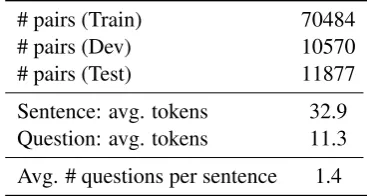
sen-# pairs (Train) 70484
# pairs (Dev) 10570
# pairs (Test) 11877
[image:5.595.323.507.63.161.2]Sentence: avg. tokens 32.9 Question: avg. tokens 11.3 Avg. # questions per sentence 1.4
Table 1: Dataset (processed) statistics. Sentence average # tokens, question average # tokens, and average # questions per sentence statistics are from training set. These averages are close to the statistics on development set and test set.
tences, and<EOS>to the end of them.
We randomly divide the dataset at the article-level into a training set (80%), a development set (10%), and a test set (10%). We report results on the 10% test set.
Table 1 provides some statistics on the pro-cessed dataset: there are around 70k training sam-ples, the sentences are around 30 tokens, and the questions are around 10 tokens on average. For each sentence, there might be multiple corre-sponding questions, and, on average, there are 1.4 questions for each sentence.
5.2 Implementation Details
We implement our models2in Torch73on top of
the newly released OpenNMT system (Klein et al., 2017).
For the source side vocabularyV, we only keep the 45k most frequent tokens (including<SOS>, <EOS>and placeholders). For the target side vo-cabularyU, similarly, we keep the 28k most fre-quent tokens. All other tokens outside the vocab-ulary list are replaced by the UNK symbol. We choose word embedding of 300 dimensions and use theglove.840B.300dpre-trained embed-dings (Pennington et al., 2014) for initialization. We fix the word representations during training.
We set the LSTM hidden unit size to 600 and set the number of layers of LSTMs to 2 in both the en-coder and the deen-coder. Optimization is performed using stochastic gradient descent (SGD), with an initial learning rate of 1.0. We start halving the learning rate at epoch 8. The mini-batch size for the update is set at 64. Dropout with probability
2The code is available at https://github.com/
xinyadu/nqg.
[image:5.595.76.291.64.197.2]Model BLEU 1 BLEU 2 BLEU 3 BLEU 4 METEOR ROUGEL
IRBM25 5.18 0.91 0.28 0.12 4.57 9.16
IREdit Distance 18.28 5.48 2.26 1.06 7.73 20.77
MOSES+ 15.61 3.64 1.00 0.30 10.47 17.82
DirectIn 31.71 21.18 15.11 11.20 14.95 22.47
H&S 38.50 22.80 15.52 11.18 15.95 30.98
Vanilla seq2seq 31.34 13.79 7.36 4.26 9.88 29.75
Our model (no pre-trained) 41.00 23.78 15.71 10.80 15.17 37.95
Our model (w/ pre-trained) 43.09 25.96 17.50 12.28 16.62 39.75
+ paragraph 42.54 25.33 16.98 11.86 16.28 39.37
Table 2: Automatic evaluation results of different systems by BLEU 1–4, METEOR and ROUGEL. For
a detailed explanation of the baseline systems, please refer to Section5.3. The best performing system for each column is highlighted in boldface. Our system which encodes only sentence with pre-trained word embeddings achieves the best performance across all the metrics.
0.3 is applied between vertical LSTM stacks. We clip the gradient when the its norm exceeds 5.
All our models are trained on a single GPU. We run the training for up to 15 epochs, which takes approximately 2 hours. We select the model that achieves the lowest perplexity on the dev set.
During decoding, we do beam search with a beam size of 3. Decoding stops when every beam in the stack generates the<EOS>token.
All hyperparameters of our model are tuned us-ing the development set. The results are reported on the test set.
5.3 Baselines
To prove the effectiveness of our system, we com-pare it to several competitive systems. Next, we briefly introduce their approaches and the experi-mental setting to run them for our problem. Their results are shown in Table2.
IR stands for our information retrieval baselines. Similar to Rush et al.(2015), we implement the IR baselines to control memorizing questions from the training set. We use two metrics to calculate the distance between a question and the input sen-tence,i.e., BM-25 (Robertson and Walker,1994) and edit distance (Levenshtein,1966). According to the metric, the system retrieves the training set to find the question with the highest score.
MOSES+ (Koehn et al., 2007) is a widely used phrase-based statistical machine translation sys-tem. Here, we treat sentences as source language text, we treat questions as target language text, and we perform the translation from sentences to
ques-tions. We train a tri-gram language model on tar-get side texts with KenLM (Heafield et al.,2013), and tune the system with MERT on dev set. Per-formance results are reported on the test set.
DirectInis an intuitive yet meaningful baseline in which the longest sub-sentence of the sentence is
directlytaken as the predicted question.4 To split
the sentence into sub-sentences, we use a set of splitters,i.e., {“?”, “!”, “,”, “.”, “;”}.
H&Sis the rule-based overgenerate-and-rank sys-tem that was mentioned in Section2. When run-ning the system, we set the parameter just-wh true (to restrict the output of the system to being only wh-questions) and set max-length equal to the longest sentence in the training set. We also setdownweight-protrue, to down weight questions with unresolved pronouns so that they appear towards the end of the ranked list. For com-parison with our systems, we take the top question in the ranked list.
Seq2seq (Sutskever et al., 2014) is a basic encoder-decoder sequence learning system for machine translation. We implement their model in Tensorflow. The input sequence is reversed be-fore training or translating. Hyperparameters are tuned with dev set. We select the model with the lowest perplexity on the dev set.
Naturalness Difficulty Best % Avg. rank
H&S 2.95 1.94 20.20 2.29
Ours 3.36 3.03* 38.38* 1.94**
Human 3.91 2.63 66.42 1.46
Table 3: Human evaluation results for question generation. Naturalness and difficulty are rated on a 1–5 scale (5 for the best). Two-tailed t-test results are shown for our method compared to H&S (statistical significance is indicated with∗(p < 0.005),∗∗(p< 0.001)).
5.4 Automatic Evaluation
We use the evaluation package released by Chen et al. (2015), which was originally used to score image captions. The package includes BLEU 1, BLEU 2, BLEU 3, BLEU 4 (Papineni et al.,2002), METEOR (Denkowski and Lavie, 2014) and ROUGEL (Lin, 2004) evaluation scripts. BLEU
measures the average n-gram precision on a set
of reference sentences, with a penalty for overly short sentences. BLEU-nis BLEU score that uses
up ton-grams for counting co-occurrences.
ME-TEOR is a recall-oriented metric, which calculates the similarity between generations and references by considering synonyms, stemming and para-phrases. ROUGE is commonly employed to eval-uate n-grams recall of the summaries with
gold-standard sentences as references. ROUGEL
(mea-sured based on longest common subsequence) re-sults are reported.
5.5 Human Evaluation
We also perform human evaluation studies to mea-sure the quality of questions generated by our sys-tem and the H&S syssys-tem. We consider two modal-ities: naturalness, which indicates the grammati-cality and fluency; anddifficulty, which measures the sentence-question syntactic divergence and the reasoning needed to answer the question. We ran-domly sampled 100 sentence-question pairs. We ask four professional English speakers to rate the pairs in terms of the modalities above on a 1–5 scale (5 for the best). We then ask the human raters to give a ranking of the questions according to the overall quality, with ties allowed.
6 Results and Analysis
Table2shows automatic metric evaluation results for our models and baselines. Our model which only encodes sentence-level information achieves
Sentence 1: the largest of these is the eldon square shop-ping centre , one of the largest city centre shopshop-ping com-plexes in the uk .
Human: what is one of the largest city center shopping complexes in the uk ?
H&S: what is the eldon square shopping centre one of ? Ours: what is one of the largest city centers in the uk ? Sentence 2: free oxygen first appeared in significant quantities during the paleoproterozoic eon -lrb- between 3.0 and 2.3 billion years ago -rrb- .
Human: during which eon did free oxygen begin ap-pearing in quantity ?
H&S: what first appeared in significant quantities dur-ing the paleoproterozoic eon ?
Ours: how long ago did the paleoproterozoic exhibit ? Sentence 3: inflammation is one of the first responses of the immune system to infection .
Human: what is one of the first responses the immune system has to infection ?
H&S: what is inflammation one of ?
Ours: what is one of the first objections of the immune system to infection ?
Sentence 4: tea , coffee , sisal , pyrethrum , corn , and wheat are grown in the fertile highlands , one of the most successful agricultural production regions in Africa. Human: (1) where is the most successful agricultural prodcution regions ? (2) what is grown in the fertile highlands ?
H&S: what are grown in the fertile highlands in africa ? Ours: what are the most successful agricultural produc-tion regions in africa ?
Sentence 5: as an example , income inequality did fall in the united states during its high school movement from 1910 to 1940 and thereafter .
Human: during what time period did income inequality decrease in the united states ?
H&S: where did income inequality do fall during its high school movement from 1910 to 1940 and thereafter as an example ?
Ours: when did income inequality fall in the us ? Sentence 6: however , the rainforest still managed to thrive during these glacial periods , allowing for the sur-vival and evolution of a broad diversity of species . Human: did the rainforest managed to thrive during the glacial periods ?
H&S: what are treaties establishing european union ? Ours: why do the birds still grow during glacial periods ?
Sentence 7: maududi founded the jamaat-e-islami party in 1941 and remained its leader until 1972.
Human: when did maududi found the jamaat-e-islami party ?
H&S: who did maududi remain until 1972 ? Ours: when was the jamaat-e-islami party founded ?
Category (%) H&S Ours Ours + paragraph
BLEU-3 BLEU-4 METEOR BLEU-3 BLEU-4 METEOR BLEU-3 BLEU-4 METEOR
[image:8.595.309.517.229.385.2]w/ sentence 70.23 (243) 20.64 15.81 16.76 24.45 17.63 17.82 24.01 16.39 19.19 w/ paragraph 19.65 (68) 6.34 < 0.01 10.74 3.76 < 0.01 11.59 7.23 4.13 12.13 All* 100 (346) 19.97 14.95 16.68 23.63 16.85 17.62 24.68 16.33 19.61 Table 4: An estimate of categories of questions of the processed dataset and per-category performance comparison of the systems. The estimate is based on our analysis of the 346 pairs from the dev set. Categories are decided by the information needed to generate the question. Bold numbers represent the best performing method for a given metric. ∗Here, we leave out performance results for “w/ article” category (2 samples, 0.58%) and “not askable” category (33 samples, 9.54%).
the best performance across all metrics. We note that IR performs poorly, indicating that memoriz-ing the trainmemoriz-ing set is not enough for the task. The baseline DirectIn performs pretty well on BLEU and METEOR, which is reasonable given the over-lap statistics between the sentences and the ques-tions (Figure2). H&S system’s performance is on a par with DirectIn’s, as it basically performs syn-tactic change without paraphrasing, and the over-lap rate is also high.
Looking at the performance of our three mod-els, it’s clear that adding the pre-trained embed-dings generally helps. While encoding the para-graph causes the performance to drop a little, this makes sense because, apart from useful informa-tion, the paragraph also contains much noise.
Table3shows the results of the human evalua-tion. We see that our system outperforms H&S in all modalities. Our system is ranked best in 38.4% of the evaluations, with an average ranking of 1.94. An inter-rater agreement of Krippendorff’s Alpha of 0.236 is achieved for the overall rank-ing. The results imply that our model can generate questions of better quality than the H&S system.
For our qualitative analysis, we examine the sample outputs and the visualization of the align-ment between the input and the output. In Fig-ure 3, we present sample questions generated by H&S and our best model. We see a large gap be-tween our results and H&S’s. For example, in the first sample, in which the focus should be put on “the largest.” Our model successfully captures this information, while H&S only performs some syntactic transformation over the input without paraphrasing. However, outputs from our system are not always “perfect”, for example, in pair 6, our system generates a question about the reason why birds still grow, but themost relatedquestion would be why many species still grow. But from
when was the first teletext serviceintroduced ? <EOS>
. 1974in starting, service teletextfirst the, ceefax introducedalso bbcthe
0.2 0.4 0.6 0.8
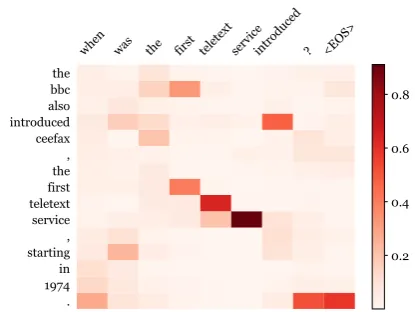
Figure 4: Heatmap of the attention weight matrix, which shows the soft alignment between the sen-tence (left) and the generated question (top).
a different perspective, our question is more chal-lenging (readers need to understand that birds are one kind of species), which supports our system’s performance listed in human evaluations (See Ta-ble3). It would be interesting to further investigate how to interpret why certain irrelavant words are generated in the question. Figure4 shows the at-tention weights (αi,t) for the input sentence when generating each token in the question. We see that the key words in the output (“introduced”, “tele-text”, etc.) aligns well with those in the input sen-tence.
Finally, we do a dataset analysis and fine-grained system performance analysis. We ran-domly sampled 346 sentence-question pairs from the dev set and label each pair with a category. 5
The four categories are determined byhow much
information is needed to ask the question. To be specific, “w/ sentence” means it only requires
the sentence to ask the question; “w/ paragraph” means it takes other information in the paragraph to ask the question; “w/ article” is similar to “w/ paragraph”; and “not askable” means that world knowledge is needed to ask the question or there is mismatch of sentence and question caused by an-notation error.
Table4shows the per-category performance of the systems. Our model which encodes paragraph information achieves the best performance on the questions of “w/ paragraph” category. This veri-fies the effectiveness of our paragraph-level model on the questions concerning information outside the sentence.
7 Conclusion and Future Work
We have presented a fully data-driven neural net-works approach to automatic question generation for reading comprehension. We use an attention-based neural networks approach for the task and investigate the effect of encoding sentence- vs. paragraph-level information. Our best model achieves state-of-the-art performance in both au-tomatic evaluations and human evaluations.
Here we point out several interesting future re-search directions. Currently, our paragraph-level model does not achieve best performance across all categories of questions. We would like to ex-plore how to better use the paragraph-level infor-mation to improve the performance of QG system regarding questions of all categories. Besides this, it would also be interesting to consider to incor-porate mechanisms for other language generation tasks (e.g., copy mechanism for dialogue genera-tion) in our model to further improve the quality of generated questions.
Acknowledgments
We thank the anonymous ACL reviewers, Kai Sun and Yao Cheng for their helpful suggestions. We thank Victoria Litvinova for her careful proofread-ing. We also thank Xanda Schofield, Wil Thoma-son, Hubert Lin and Junxian He for doing the hu-man evaluations.
References
Dzmitry Bahdanau, Kyunghyun Cho, and Yoshua Ben-gio. 2015. Neural machine translation by jointly
learning to align and translate. In International
Conference on Learning Representations Workshop (ICLR).
Danqi Chen, Jason Bolton, and Christopher D.
Man-ning. 2016. A thorough examination of the
cnn/daily mail reading comprehension task. In Pro-ceedings of the 54th Annual Meeting of the As-sociation for Computational Linguistics (Volume 1: Long Papers). Association for Computational Linguistics, Berlin, Germany, pages 2358–2367.
http://www.aclweb.org/anthology/P16-1223. Xinlei Chen, Hao Fang, Tsung-Yi Lin,
Ramakr-ishna Vedantam, Saurabh Gupta, Piotr Dollár, and C Lawrence Zitnick. 2015. Microsoft coco captions: Data collection and evaluation server. arXiv preprint
arXiv:1504.00325.
Kyunghyun Cho, Bart van Merrienboer, Caglar Gul-cehre, Dzmitry Bahdanau, Fethi Bougares,
Hol-ger Schwenk, and Yoshua Bengio. 2014. Learning
phrase representations using rnn encoder–decoder for statistical machine translation. InProceedings of the 2014 Conference on Empirical Methods in Nat-ural Language Processing (EMNLP). Association for Computational Linguistics, Doha, Qatar, pages
1724–1734.
http://www.aclweb.org/anthology/D14-1179.
Sumit Chopra, Michael Auli, and Alexander M.
Rush. 2016. Abstractive sentence
summariza-tion with attentive recurrent neural networks.
In Proceedings of the 2016 Conference of the
North American Chapter of the Association for
Computational Linguistics: Human Language
Technologies. Association for Computational Lin-guistics, San Diego, California, pages 93–98.
http://www.aclweb.org/anthology/N16-1012. Kenneth Mark Colby, Sylvia Weber, and Franklin
Den-nis Hilf. 1971. Artificial paranoia. Artificial In-telligence2(1):1–25. https://doi.org/10.1016/0004-3702(71)90002-6.
Michael Denkowski and Alon Lavie. 2014.
Me-teor universal: Language specific translation eval-uation for any target language. In Proceed-ings of the Ninth Workshop on Statistical Machine Translation. Association for Computational Lin-guistics, Baltimore, Maryland, USA, pages 376– 380. http://www.aclweb.org/anthology/W14-3348. Kenneth Heafield, Ivan Pouzyrevsky, Jonathan H.
Clark, and Philipp Koehn. 2013. Scalable
mod-ified kneser-ney language model estimation. In Proceedings of the 51st Annual Meeting of the Association for Computational Linguistics (Vol-ume 2: Short Papers). Association for Computa-tional Linguistics, Sofia, Bulgaria, pages 690–696.
http://www.aclweb.org/anthology/P13-2121.
Michael Heilman and Noah A. Smith. 2010. Good
question! statistical ranking for question gener-ation. In Human Language Technologies: The 2010 Annual Conference of the North American Chapter of the Association for Computational Lin-guistics. Association for Computational Linguis-tics, Los Angeles, California, pages 609–617.
Karl Moritz Hermann, Tomas Kocisky, Edward Grefenstette, Lasse Espeholt, Will Kay, Mustafa Su-leyman, and Phil Blunsom. 2015. Teaching
ma-chines to read and comprehend. InAdvances in
Neu-ral Information Processing Systems (NIPS). pages 1693–1701.
Sepp Hochreiter and Jürgen Schmidhuber. 1997.
Long short-term memory. Neural computation
9(8):1735–1780.
Srinivasan Iyer, Ioannis Konstas, Alvin Cheung, and
Luke Zettlemoyer. 2016. Summarizing source
code using a neural attention model. In Pro-ceedings of the 54th Annual Meeting of the As-sociation for Computational Linguistics (Volume 1: Long Papers). Association for Computational Linguistics, Berlin, Germany, pages 2073–2083.
http://www.aclweb.org/anthology/P16-1195.
Guillaume Klein, Yoon Kim, Yuntian Deng, Jean Senellart, and Alexander M. Rush. 2017. Opennmt: Open-source toolkit for neural machine translation. ArXiv e-prints.
Philipp Koehn, Hieu Hoang, Alexandra Birch, Chris Callison-Burch, Marcello Federico, Nicola Bertoldi, Brooke Cowan, Wade Shen, Christine Moran, Richard Zens, Chris Dyer, Ondˇrej Bojar,
Alexan-dra Constantin, and Evan Herbst. 2007. Moses:
Open source toolkit for statistical machine
transla-tion. In Proceedings of the 45th Annual Meeting
of the ACL on Interactive Poster and Demonstra-tion Sessions. AssociaDemonstra-tion for ComputaDemonstra-tional Lin-guistics, Stroudsburg, PA, USA, pages 177–180.
http://dl.acm.org/citation.cfm?id=1557769.1557821.
Igor Labutov, Sumit Basu, and Lucy Vanderwende.
2015. Deep questions without deep
understand-ing. In Proceedings of the 53rd Annual
Meet-ing of the Association for Computational Lin-guistics and the 7th International Joint Con-ference on Natural Language Processing (Vol-ume 1: Long Papers). Association for Computa-tional Linguistics, Beijing, China, pages 889–898.
http://www.aclweb.org/anthology/P15-1086.
Vladimir I Levenshtein. 1966. Binary codes capable of correcting deletions, insertions and reversals. In Soviet physics doklady. volume 10, page 707.
Chin-Yew Lin. 2004. Rouge: A package for
au-tomatic evaluation of summaries. In Stan
Sz-pakowicz Marie-Francine Moens, editor, Text
Summarization Branches Out: Proceedings of
the ACL-04 Workshop. Association for Com-putational Linguistics, Barcelona, Spain, pages
74–81.
http://aclweb.org/anthology/W/W04/W04-1013.pdf.
David Lindberg, Fred Popowich, John Nesbit, and
Phil Winne. 2013. Generating natural language
questions to support learning on-line. In Proceed-ings of the 14th European Workshop on Natural
Language Generation. Association for Computa-tional Linguistics, Sofia, Bulgaria, pages 105–114.
http://www.aclweb.org/anthology/W13-2114.
Thang Luong, Hieu Pham, and Christopher D.
Man-ning. 2015a. Effective approaches to
attention-based neural machine translation. InProceedings of the 2015 Conference on Empirical Methods in Nat-ural Language Processing. Association for Compu-tational Linguistics, Lisbon, Portugal, pages 1412–
1421.http://aclweb.org/anthology/D15-1166.
Thang Luong, Ilya Sutskever, Quoc Le, Oriol
Vinyals, and Wojciech Zaremba. 2015b.
Ad-dressing the rare word problem in neural ma-chine translation. In Proceedings of the 53rd Annual Meeting of the Association for Computa-tional Linguistics and the 7th InternaComputa-tional Joint Conference on Natural Language Processing (Vol-ume 1: Long Papers). Association for Computa-tional Linguistics, Beijing, China, pages 11–19.
http://www.aclweb.org/anthology/P15-1002.
Christopher Manning, Mihai Surdeanu, John Bauer,
Jenny F., Steven B., and David M. 2014. The
stanford corenlp natural language processing toolkit.
In Proceedings of 52nd Annual Meeting of the
Association for Computational Linguistics: Sys-tem Demonstrations. Association for Computational Linguistics, Baltimore, Maryland, pages 55–60.
http://www.aclweb.org/anthology/P14-5010.
Karen Mazidi and Rodney D. Nielsen. 2014.
Linguis-tic considerations in automaLinguis-tic question generation.
In Proceedings of the 52nd Annual Meeting of the
Association for Computational Linguistics (Volume 2: Short Papers). Association for Computational Linguistics, Baltimore, Maryland, pages 321–326.
http://www.aclweb.org/anthology/P14-2053.
Ruslan Mitkov and Le An Ha. 2003.
Computer-aided generation of multiple-choice tests. In Jill Burstein and Claudia Leacock, editors, Proceedings of the HLT-NAACL 03 Workshop on Building Educational Applications Using Natural Language Processing. pages 17–22.
http://www.aclweb.org/anthology/W03-0203.pdf.
Nasrin Mostafazadeh, Ishan Misra, Jacob Devlin, Mar-garet Mitchell, Xiaodong He, and Lucy
Vander-wende. 2016. Generating natural questions about
an image. InProceedings of the 54th Annual Meet-ing of the Association for Computational LMeet-inguistics (Volume 1: Long Papers). Association for Compu-tational Linguistics, Berlin, Germany, pages 1802–
1813.http://www.aclweb.org/anthology/P16-1170.
Jack Mostow and Wei Chen. 2009. Generating instruc-tion automatically for the reading strategy of
self-questioning. InProceedings of the 2nd Workshop on
Question Generation (AIED 2009). pages 465–472.
reading comprehension dataset. arXiv preprint
arXiv:1611.09268.
Kishore Papineni, Salim Roukos, Todd Ward, and
Wei-Jing Zhu. 2002. Bleu: a method for
auto-matic evaluation of machine translation. In Pro-ceedings of 40th Annual Meeting of the Asso-ciation for Computational Linguistics. Associ-ation for ComputAssoci-ational Linguistics,
Philadel-phia, Pennsylvania, USA, pages 311–318.
https://doi.org/10.3115/1073083.1073135.
Jeffrey Pennington, Richard Socher, and Christopher
Manning. 2014. Glove: Global vectors for word
representation. In Proceedings of the 2014 Con-ference on Empirical Methods in Natural Language Processing (EMNLP). Association for Computa-tional Linguistics, Doha, Qatar, pages 1532–1543.
http://www.aclweb.org/anthology/D14-1162.
Pranav Rajpurkar, Jian Zhang, Konstantin Lopyrev, and
Percy Liang. 2016. Squad: 100,000+ questions for
machine comprehension of text. InProceedings of the 2016 Conference on Empirical Methods in Nat-ural Language Processing (EMNLP). Association for Computational Linguistics, Austin, Texas, pages
2383–2392.
https://aclweb.org/anthology/D16-1264.
Matthew Richardson, Christopher J.C. Burges, and
Erin Renshaw. 2013. MCTest: A challenge
dataset for the open-domain machine comprehen-sion of text. In Proceedings of the 2013 Confer-ence on Empirical Methods in Natural Language Processing. Association for Computational Linguis-tics, Seattle, Washington, USA, pages 193–203.
http://www.aclweb.org/anthology/D13-1020.
Stephen E. Robertson and Steve Walker. 1994.
Some simple effective approximations to the 2-poisson model for probabilistic weighted re-trieval. In Proceedings of the 17th Annual International ACM SIGIR Conference on search and Development in Information Re-trieval. Springer-Verlag New York, Inc., New York, NY, USA, SIGIR ’94, pages 232–241.
http://dl.acm.org/citation.cfm?id=188490.188561.
Vasile Rus, Brendan Wyse, Paul Piwek, Mihai Lin-tean, Svetlana Stoyanchev, and Cristian Moldovan.
2010. The first question generation shared task
evaluation challenge. In Proceedings of the 6th International Natural Language Generation Conference. Association for Computational Lin-guistics, Stroudsburg, PA, USA, pages 251–257.
http://dl.acm.org/citation.cfm?id=1873738.1873777.
Alexander M. Rush, Sumit Chopra, and Jason
We-ston. 2015. A neural attention model for
abstrac-tive sentence summarization. InProceedings of the 2015 Conference on Empirical Methods in Natu-ral Language Processing. Association for Computa-tional Linguistics, Lisbon, Portugal, pages 379–389.
http://aclweb.org/anthology/D15-1044.
Iulian Vlad Serban, Alberto García-Durán, Caglar Gulcehre, Sungjin Ahn, Sarath Chandar, Aaron
Courville, and Yoshua Bengio. 2016.
Generat-ing factoid questions with recurrent neural net-works: The 30m factoid question-answer corpus.
In Proceedings of the 54th Annual Meeting of
the Association for Computational Linguistics (Vol-ume 1: Long Papers). Association for Computa-tional Linguistics, Berlin, Germany, pages 588–598.
http://www.aclweb.org/anthology/P16-1056.
Ilya Sutskever, Oriol Vinyals, and Quoc V Le. 2014. Sequence to sequence learning with neural
net-works. InAdvances in neural information
process-ing systems (NIPS). pages 3104–3112.
Lucy Vanderwende. 2008. The importance of being
important: Question generation. In Proceedings
of the 1st Workshop on the Question Generation Shared Task Evaluation Challenge, Arlington, VA.
Joseph Weizenbaum. 1966. Eliza—a
computer program for the study of
natu-ral language communication between man
and machine. Commun. ACM 9(1):36–45.
https://doi.org/10.1145/365153.365168.
Jason Weston, Antoine Bordes, Sumit Chopra, Alexan-der M Rush, Bart van Merriënboer, Armand Joulin, and Tomas Mikolov. 2016. Towards ai-complete question answering: A set of prerequisite toy tasks.
InInternational Conference on Learning
Represen-tations Workshop (ICLR).
Kelvin Xu, Jimmy Ba, Ryan Kiros, Kyunghyun Cho, Aaron C Courville, Ruslan Salakhutdinov, Richard S Zemel, and Yoshua Bengio. 2015. Show, attend and tell: Neural image caption generation with visual