International Migration Diversity in
Hungary in the 2011 Population Census
Data
Kincses, Áron
Hungarian Central Statistical Office
February 2016
Online at
https://mpra.ub.uni-muenchen.de/73941/
International Migration Diversity in Hungary
in the 2011 Population Census Data
Áron Kincses
Hungarian Central Statistical Office E-mail: [email protected]
Keywords:
international migration, census, dual citizenship
Foreign nationals have had a significantly positive influence on the regional socioeconomic developments of Hungary. Two realignments took place between the last two censuses: at first, the composition of citizenship changed; then, the local redistribution changed partly because of the different structure of citizenship.
Fields of interests and research: Regional science, regional geography, regional and urban development, regional analysing methods, social- and economic geography network-analysis, applied mathematics and the application of physical science models in geography.
Introduction
Migration is an interdisciplinary topic that mainly interests the fields of demography, statistics, geography, law, economic science, history, work science, psychology, and political science. Consequently, its definition and interpretation emphasise numerous forecasted projections. The Demographic Yearbook published by the Hungarian Central Statistical Office (HCSO 2008) defines international migration as the permanent abandonment of the original (usual) country of residence with the goal of settling down, residing, or obtaining gainful employment in another country.
Because motivations to migrate are continually evolving, definitions of settlement
or performing gainful activity have expanded to include the ideas of educational purposes
(Rédei 2007) and elderlymigration (i.e. the motivation to improve the purchasing power of pensions, increase recreational opportunities, or obtain a relatively more favourable climate) (Illés 2008). The motivation to achieve family reunion also is emphasised as a major factor in international migration.
This migration determines migrants’ lives because this unique, unidirectional event is linked to the symbolic moment of crossing a border (Kovács–Melegh 2000).
However, the effects of migration on migrants depend on the socioeconomic contexts at the points of origin and destination where it occurs; moreover, they inevitably bear the characteristic features of their historical contexts. In the present era of globalization, income gaps among countries are increasing at an accelerated rate, and development is uneven (Kofman–Youngs 2003). The widening differences in the quality of life between poor and rich countries are encouraging human migrations. Simultaneously, migrants’ financial assets continue to increase, and spatial access is improving. Furthermore, some areas of the world are converging such that the cost of long distance migration relative to household income has become so low that growing numbers of people in peripheral countries are finding it feasible to migrate (Hatton–Williamson 2005). In this context, the advent of omnipresent information and transportation technologies and increased border penetrability has meant easier border crossings. The phenomena of circular migration and transnational migration also have appeared on the international scene. Cross-border migrations decreasingly determine the intention to finally settle down (Hatton–Williamson 2005), but rather can be considered as a station within lifetime.
The purpose of this study is to challenge historical interpretations of migration behaviours using 2011 population census data and to describe the immigration groups in Hungary. The study describes the geographic locations of Hungarian migrants as well as their demographic, labour market, and educational attainment differences from the Hungarian native population, and it discusses possible causes for their residential choices. Understanding the full complexity of the topic demands a sophisticated analysis that is beyond the scope of this study. Therefore, although not exhaustive, this study focuses on some key aspects of the Hungarian immigration situation.
Content of analysis, main migration groups
For conceptual and practical reasons, the terms voluntary and legal migration refer to international migration in which migrants change their places of residence (at their volition) from another country and their choices depend on their self-evaluated internal factors, external factors, and attractive and repulsive effects. Most studies on migration consider only foreign citizens or citizens born abroad, although international migration is much broader. To address this weakness and take advantage of the full scope of the population census data, which covers total population of a given area (country) and relates to a predetermined point of time, the paper distinguishes among four migrant groups: foreign citizens, citizens born abroad, dual citizens
Foreign citizens and citizens born abroad
Citizenship laws throughout the world bind citizenship to the principles of ius sanguinis
(privity) or ius soli (country of birth). In the first case, parental citizenship is decisive to determine citizenship, whereas, in the second case, country of birth is the determining factor. However, variation among national laws means that if a citizen of a country of origin under ius sanguinis bears a child in a country that relies on ius soli, that child obtains dual citizenship at birth. On the other hand, if a child is born in a country under the principle of ius sanguinis and the parents are from a country relying on ius soli, neither country would recognize that child as a citizen. Hungary is similar to most European countries in that it confers citizenship under ius sanguinis. According to Act LV of 1993 on Hungarian Citizenship (with amendments), only children whose parents are Hungarian citizens are Hungarian citizen at birth. Hungarian citizenship also can be acquired through the process of naturalization (for individuals who are not born as Hungarian citizens) or re-naturalization (for individuals whose previous Hungarian citizenship has ceased).
In 2011, Hungary’s foreign citizens were included in the population census if they had been living in the country for at least 12 months at the reference date or if they intended to live in Hungary for at least one year, and if, besides their foreign citizenship, they were not Hungarian citizens. Members of the foreign diplomatic corps and their families, members of foreign armed forces stationed in the country by governmental or National Assembly decisions, and persons in Hungary as tourist visitors, for medical reasons, on business, and so on were not enumerated.11
In this study, individuals born outside Hungarian borders and habitually residing inside Hungary are considered foreign-born citizens. This group might include foreign-born foreigners, Hungarians born abroad, those born as Hungarian citizens, foreign-born naturalized Hungarians, and foreign-born repatriated Hungarian citizens.
Dual citizens
Early in the twentieth century, migrants only sporadically travelled home or transferred money home to the country of origin (Rédei 2007). Over time, these became monthly, weekly, or daily practices. The possibilities of maintaining personal contact without spatial mobility changed from being monthly to immediate events (from letters to telegraph to telephone to e-mail, and, recently, to Skype). Thereby, the economic, social, cultural, and political activities of the host and origin countries were increasingly interconnected (Viszt et al. 2001, Portes–DeWind2004, Walton–
Roberts2004, Rédei 2005, Williams–Balaz 2008). Consequently, the characteristics of migration changed.
In the era of globalization, numerous plural phenomena are observed, such as multiple:
– residences, – citizenships,
– real estate ownerships, – employments,
– identities,
– loyalties (Waldinger 2008).
In many countries, exclusive national citizenship has been degraded by the elimination of compulsory military service, treaties that end double taxation, and supranational rules of economic integration, even before the recognition of dual citizenship. Transnationalism reached a higher quality level because of the globalization processes of burgeoning travel and communication technologies (Bernek 2002).
An early understanding of migration held that the process of international migration involves at least two independent political states in which a migrant secedes from the releasing state and accedes to the host country. In the concept of transnational migration, dual citizens (in the within analysis these are persons with foreign citizenship plus Hungarian citizenship) are connected to both countries through their work, residences, and other activities, (Waldinger 2008), and they have the language skills and local knowledge of both regions.
Hungarian citizens returning home
A fundamental approach of historical studies to migration is that migration is a unique event in a person’s lifetime and it, therefore, has an extraordinary character. Knowledge of new types of migration (as discussed above) challenges the notion that migration is a unique event, such as losing citizenship of the country of origin and acquiring citizenship of a host country (Bonancich 1972). In this process, cross-border migrations decreasingly mean the intention to finally settle down, but rather they can be found as a station of lifetime.
Australia in the Pacific Ocean. To characterize separate space-asynchronous migration systems, a minimum of two attractive centres is necessary, between which the simplest migration system comprises two interconnected processes: migration to somewhere and remigration. When a starting point has no posterior attraction for the migrant, neither does the place of migration meet his expectations, and a third location could advance to the second place of attraction (Illés–Kincses 2009).
Figure 1
Citizens born abroad, foreign citizens and dual (Hungarian and other) citizens
Some Hungarian citizens who leave Hungary do not leave their home country forever; Ravenstein (1885) suggests that each significant migration flow creates a reflection, which is its counterflow, at a temporal phase shift, and migrants return after a time lag, by separate-space-asynchronous migration. In this study, Hungarian citizens returning home (returnees) are those Hungarians who had been living at least one year during their lifetimes permanently outside the territory of present-day Hungary, were not born abroad, and had habitually settled in Hungary.
Migrant groups in Hungary
Foreign-born citizens include individuals who have only foreign citizenship and those with dual citizenship (see Figure 1, 3, 4). Independent examination of this group is justified because the Act on Hungarian Citizenship (ius sanguinis) categorizes as dual citizens 25,554 of those born abroad. Of those who have only foreign citizenship, 7254 were born in Hungary. Compared to the more than 200,000 persons enumerated in the
Citizens born abroad
Foreign citizens
previous census, the 2011 population census counted fewer foreign citizens. A possible reason for this change is that the earlier count included foreign citizens and dual citizens. At the theoretical time of zero hour on 1 October 2011, Hungary had 143,197 foreign citizens (excluding dual citizens) and 383,236 foreign-born citizens. For both groups, most people migrated from neighbouring countries or from Germany. Europe plays an outstanding part in Hungarian migration, particularly regarding foreign-born migrants. About 90% of the migrants in 2011 originated from Europe.
The significant number from neighbouring countries relates to cross-border linguistic and cultural connections. This fact suggests that the effects of peace treaties formed at the ends of World Wars I and II strongly influence migration processes in the Carpathian Basin (Tóth 2005). Political changes during the 1990s relate to ethnic Hungarians’ mass migrations into and out of Hungary. In the first year of the regime change resulting in Romania’s anti-minority policy and the incidents in Timisoara, Hungary faced strong migration pressures, which were repeated during the Yugoslav wars. Forced migration transformed into voluntary migration for business or educational purposes.
Interestingly, the number of people born in Romania and living in Hungary is greater than the population of Szeged. Hungary is a primary destination for Europeans, and relatively short distance international migrations are typical. However, the number of Asian and African American migrants is significant because foreigners living in Hungary comprise 161 different nationalities born in 195 different countries (including associated countries and external territories).
Dual citizens and Hungarian citizens returning to Hungary are automatically considered Hungarian citizens by most sources. The reason for this is lack of data, and the only reliable source of information is the population census. According to the census, 88,906 persons of Hungarian citizenship had an additional citizenship in 2011. The distribution of this group resembles the distribution of foreign citizens, in which European origins are clearly observed. This phenomenon indicates that an area-independent interconnectivity of economic, social, cultural, and political factors between sending and host states is limited. Regarding the origins of the dual citizens, Asians and Africans are underrepresented and Australia and the Americas are over-represented compared to the distribution of foreign nationals’ origins. In Hungary, the numbers of American–, Canadian–, or Australian–Hungarian citizens are higher than those of the American, Canadian, or Australian foreign citizens, respectively, suggesting that most of the migrants from those places have Hungarian roots.
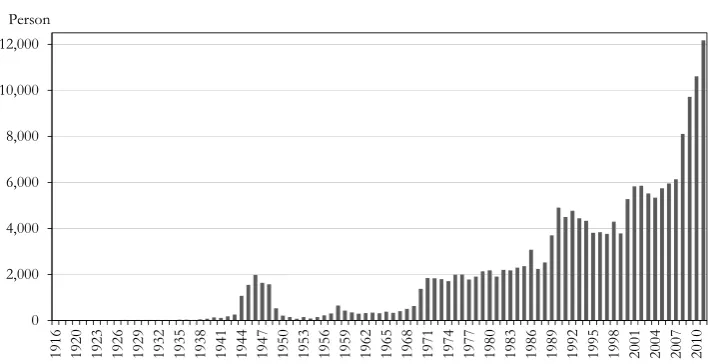
2010, Kapitány–Rohr-2013). These studies estimate the number of Hungarians living abroad not in the millions, but in the hundreds of thousands. Without precise knowledge on emigration, it is important to emphasise the census results, according to which a significant portion of the emigrants does not necessarily cause a demographic loss for Hungary because 190,204 persons were registered in Hungary who had been living abroad for at least a year but had returned home and settled in Hungary (see fig. 1.).
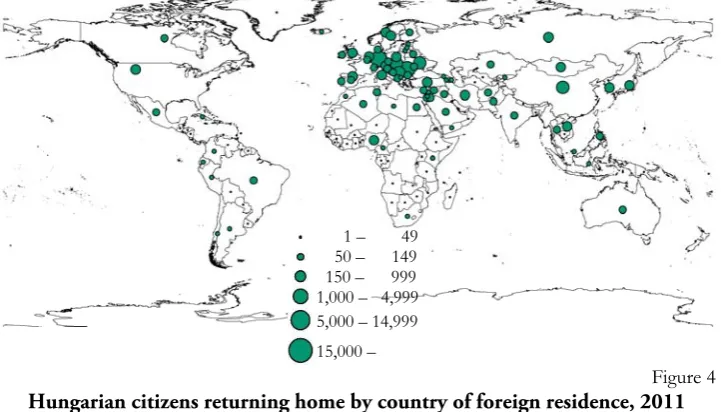
[image:8.595.120.476.369.551.2]Hungarians returning home are not just a demographic surplus for Hungary because language skills and foreign experience suggest an important advantage in the labour market (Rédei 2007). This is where new types of migration might be captured, i.e., the separate space-asynchronous migration systems in which Hungary is defined by migrants as an attractive remigration centre. An examination of Hungarian citizens returning to Hungary does not indicate precisely where and when these Hungarians emigrated nor does it inform us of the main foreign centres at that time. However, the data do show the countries to and from which these Hungarians migrated.
Figure 2
Hungarian citizens returning home by year of return
Until the end of World War II, returnees were mostly from neighbouring countries because of the homeland role. Between 1945 and 1980, because of the establishment of socialist state apparatuses, the largest numbers of returnees to Hungary were from Russia, Iran, Mongolia, Egypt, Germany (GDR), and Austria. From 1981 until the regime change, returnees arrived mostly from Germany, Russia, Algeria, Austria, Iraq, and Libya. After 1990, because of the regime change, the countries from which Hungarians were returning changed. The US and Canada joined Austria and Germany (mostly emigrants from 1956), followed by the UK in 2004 (emigrants returning after 1990 is the most probable case). Accession to the EU and the labour market
expansion are assumed to have caused the growth in the number of migrants; with a time lag, the number of returnees also is significantly increasing, which process was influenced by the economic crisis and associated decline in employment in Western Europe (see Table 1).
Table 1
Migrants living in Hungary by group and by country of former residence, 2011
Country of citizenship/birth of migrant/country of former residence before
returning to Hungary
Dual citizens (Hungarian and
other)
Foreign
citizens abroad Born
Hungarian citizens who lived abroad one year or less before returning
to Hungary
Romania 39,270 38,574 176,550 4,478
Germany 6,412 16,987 22,605 51,911
Slovakia 1,679 8,246 33,155 2,835
Austria 1,467 3,936 6,160 11,376
United Kingdom 1,627 2,602 3,597 20,949
France 1,298 2,201 3,233 5,214
Netherlands 762 2,058 2,438 3,712
EU-28 59,644 85,414 266,701 123,181
Ukraine 2,383 11,820 35,354 3,133
Serbia 9,394 7,752 29,144 1,529
Europe (other) 3,434 7,536 13,608 23,153
Europe total 74,855 112,522 344,807 150,996
China 952 8,852 8,767 603
Vietnam 783 2,358 2,668 181
Iran 146 1,523 1,713 232
Asia (other) 2,240 9,571 12,358 8,944
Asia total 4,121 22,304 25,506 9,960
United States 4,978 3,022 4,684 15,970
Canada 2,149 484 1,198 4,433
Americas (other) 741 1,237 2,416 1,621
Americas total 7,868 4,743 8,298 22,024
Nigeria 128 1,015 1,101 507
Egypt 168 472 632 778
Africa (other) 679 1,366 2,256 3,920
Africa total 975 2,853 3,989 5,205
Other and unknown 1,087 775 636 2,019
Total 88,906 143,197 383,236 190,204
Figure 3
Foreign born persons living in Hungary by country of birth, 2011
Figure 4
Hungarian citizens returning home by country of foreign residence, 2011
Demographic and labour market characteristics of migrant
groups
Most previous studies highlight that migrants are relatively young (Gödri 2012) compared to the resident population in Hungary, and migration has, therefore, rejuvenated Hungary. The average ages of male and female foreign nationals living in
1 – 49 50 – 149 150 – 999 1,000 – 4,999 5,000 – 14,999 15,000 –
[image:10.595.114.481.361.592.2]Hungary are 38.0 and 39.6 years, respectively; in the overall population, males and females are 39.3 and 43.5 years, respectively. For dual citizens, the difference is slightly less pronounced (average age is 39.2 years), whereas citizens born abroad are 47.4 years on average, and Hungarian citizens returning home are 47.6 years on average. The two latter groups are older than the average resident population. More than one-quarter of Hungarian citizens born abroad is older than 65 years of age. The majority of working-age adults who migrated to Hungary in large numbers in the 1990s belongs to this age group. For Hungarian returnees, the average age is relatively old because few of them are under the age of 24, suggesting that most of the migrants leave Hungary for employment (see Figure 5).
Figure 5
Migrants by age groups, 2011
Population census data confirm the results of previous studies regarding migrants’ characteristics. Migrants are, on average, better educated and more economically active than the Hungarian population (non-migrant resident population), providing a human and economic surplus for Hungary (Kincses 2012). Nearly one-third of the foreign and foreign-born populations over age 24, more than 40% of persons with dual citizenship, and almost one-half of Hungarian returnees have higher educational attainment than non-migrant Hungarian nationals (see Figure 6).
Migrant groups’ relatively higher educational attainments and higher proportions of working-age people relate to their relatively higher employment rates compared to the Hungarian resident population. The unemployment rate is lowest for foreign citizens and highest for Hungarian returnees, which is similar to the rate of the resident population. In Hungary, only about 0.4% of inactive earners live on their
0 10 20 30 40 50 60 70 80 90 100
Male Female Male Female Male Female Male Female Male Female
dual citizen foreign citizen born abroad lived abroad min.
1 year Hungarianresident population %
assets (see Table 2). The same rate for Hungarian returnees is 1.3%; it is 1.8% for those born abroad, 3.1% for dual citizens, and 3.3% for foreigners. Within the dependents of the resident population aged 25–64 years, 10% are full-time students, whereas, for the surveyed migrant groups, the rate is between 14% and 23%.
Figure 6
Migrant groups (aged over 25 years) by educational attainment, 2011
Table 2
Distribution of migrants aged 25–64 years and of resident population by economic activity
Economic activity citizens Dual Foreign citizens abroad Born
Hungarian citizens who lived abroad one year or less before returning to
Hungary
Hungarian resident population
Employed 72.6 70.2 72.2 68.4 64.4
Unemployed 7.4 4.6 6.6 9.0 8.7
Economically active population
total 80.0 74.8 78.8 77.4 73.1
Inactive earner 14.3 15.7 15.7 17.4 23.1
Dependent 5.7 9.5 5.5 5.2 3.8
Economically inactive
population total 20.0 25.2 21.2 22.6 26.9
Grand total 100.0 100.0 100.0 100.0 100.0
0 20 40 60 80 100
Hungarian resident population Foreign citizen
Born abroad Dual citizen Live abroad min. 1
year
%
Less than 8 grades of elementary school 8 grades of elementary school
Secondary school without maturity examination, with professional certificate Secondary school with maturity examination
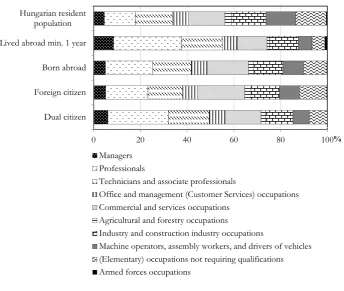
[image:12.595.116.478.453.706.2]A comparison of current and most recent occupations shows that all of the migrant groups are proportionally dominant over the resident population in the more
[image:13.595.132.477.287.578.2]prestigious business, senior governmental, legislative, and professional occupationsrequiring third level educational attainment. The reverse situation is observed for elementary occupations, plant and machine operators, assemblers, vehicle drivers, agricultural workers, and forestry occupations, which represent lower value added (see Figure 7).
Figure 7
Distribution of migrants aged 25–64 years in resident population by main occupational groups, 2011
Spatial overview
Because the spatial distributions of migrant groups differ from that of the Hungarian resident population, the influences of migrants on the country might be less than they are in the specific areas where migrants tend to cluster. Social groups with relatively high prestige and better skills in higher paid occupations tend to concentrate in areas with relatively strong economic indicators and more favourable social images, thereby reinforcing the significant differences in spatial social structure typical of Hungary, in
0 20 40 60 80 100
Dual citizen Foreign citizen Born abroad Lived abroad min. 1 year Hungarian resident
population
%
Managers Professionals
Technicians and associate professionals
Office and management (Customer Services) occupations Commercial and services occupations
Agricultural and forestry occupations
Industry and construction industry occupations
which there is segregation and concentration of socioeconomic groups by prestige (Németh 2011). Three Hungarian regions are of particular interest from the migration perspective, which are generally and persistently typical of Hungary’s migrant groups: central Hungary, border districts, and the Lake Balaton region.
Budapest and Pest County (Central Hungary) attract foreigners from far away, and the residents of this area are mostly non-European migrants. There are many employed persons, the average age is relatively young, and educational attainment is relatively high. In this area, the residents are mostly highly qualified, economically active foreign citizens. During the past ten years, Budapest has become a global migration target area.
In Hungary, most foreign citizens migrate from neighbouring countries, and the location of target areas plays a decisive part in the regional distribution of migrants.
Border district areas play an important part in addition to the economic centres with respect to the selection of a place to live. These settlements are not particularly diverse in the composition of citizenship types, and the population mostly comprises people migrating from across the border.
[image:14.595.126.471.487.655.2]The Lake Balaton region is mainly attractive to German, Austrian, Dutch, Swiss pensioners, and elders seeking new locations to improve their pensions’ purchasing power, increase recreation, and enhance natural value. In addition, foreigners tend to find it easier to integrate into village than city life. The number of elderly migrants significantly increased between the two censuses (see Figure 8–12).
Figure 8
Distribution of migrant and resident population by the present legal status of residence, 2011
0
10 20 30 40 50 60 70 80 90 100
Foreign citizen Hungarian citizen lived abroad min.
1 year
Dual citizen (Hungarian and
other)
Born abroad Resident
population
%
Figure 9
[image:15.595.121.478.180.413.2]Proportion of foreigners per 100 population, 2011
Figure 10
Proportion of dual citizens per 100 population, 2011
0.00 – 0.49 0.50 – 0.99 1.00 – 1.49 1.50 – 1.99 2.00 –
Figure 11
[image:16.595.125.474.394.682.2]Proportion of citizens born abroad per 100 population, 2011
Figure 12
Proportion of Hungarian returnees per 100 population, 2011 0.00 – 0.49 0.50 – 0.99 1.00 – 1.49 1.50 – 1.99 2.00 –
It is typical of the spatial distribution of Hungarian returnees that about 30.7% of them returned to the locations of their previous Hungarian residences. Hungarian returnees clearly demonstrate migrant attitudes when choosing a place to live. Underlying this phenomenon is an important factor: The Hungarian non-migrant population is less flexible in choosing a place of residence than the migrant population because it is more place-bound by family and cultural ties, and local patriotism can impede the frequency, distance, and direction of relocations. In the case of returnees, however, the image of local settlement stock can be an important explanatory factor.
Summary
In Hungary, the number and proportion of migrants in the population are continually increasing. There are two fundamental reasons. On the one hand, the size of the resident Hungarian population is decreasing, which increases the migrants’ proportional representation. On the other hand, the number of foreign-origin migrants is increasing. Foreign citizens began entering Hungary in significant numbers after the regime change. In the initial period, migrants were mostly ethnic groups of Hungarian nationality. Following accession to the European Union, globalisation influenced Hungarian migration networks such that the number of Hungary’s migration sources expanded, and technological changes attracted foreign citizens from farther away. Foreigners living in Hungary comprise about 161 different citizenships born in 195 different countries (including associated countries and external territories).
Currently, the homeland role of the Carpathian Basin, the minority policies of neighbouring countries, transnationalism, multiple identities and multiple citizenships, new types of migration, and circular migration are simultaneously present and active in Hungary. Consequently, international migration cannot be understood as one-dimensional. In this study, Hungary’s migrant population was categorised into four large groups (dual citizens, foreign citizens, foreign-born citizens, and Hungarian citizen returnees). It also is important to note Hungary’s position as a central area of remigration. In 2011, 190,204 persons in Hungary had lived abroad for at least one year, but had returned to Hungary and settled there.
Acknowledgement
REFERENCES
BERNEK,Á. (2002): A globális világ politikai földrajza Nemzeti Tankönyvkiadó, Budapest.
BONACICH,E. (1972): A Theory of Ethnic Antagonism: The Split Labor Market. American Sociological Reveiw 37 (5): 547–559.
GÖDRI,I. (2010): A vándorlási veszteség Magyarországon az elmúlt évtizedben – avagy hányan
is vagyunk valójában? Korfa 10 (3): 3.
GÖDRI,I. (2012): Nemzetközi vándorlás In.: KSH NKI (2012): Demográfiai portré – jelentés a
magyar népesség helyzetéről pp. 137–154, Budapest.
HATTON,T.J.–WILLIAMSON,J.G. (2005): Global Migration and the World Economy: Two Centuries of Policy and Performance Mass.: MIT Press, Cambridge.
ILLÉS,S. (2008): Indirect estimation on the types of internatoinal elderly migration in Hungary
Romanian Review on political Geography 8 (1): 55–63.
ILLÉS,S.–KINCSES, Á. (2009): Cirkuláció és migráció Magyarország nemzetközi
vándor-mozgalmában Statisztikai Szemle 87 (7–8. szám): 729–747.
KAPITÁNY,B.–ROHR,A. (2013): A Magyarországon állandó lakcímmel rendelkező 18–49 éves magyar állampolgárok mintegy 7,4 százaléka tartózkodik jelenleg tartósan
külföldön Korfa 13 (3): 3.
KINCSES,Á. (2012): A Kárpát-medence ezredforduló utáni migrációs hálózatának vizsgálata KSH,
Budapest.
KOFMAN,E.–YOUNGS,G.(2003): Globalization: Theory and Practice Continuum, New York.
KOVÁCS,É.–MELEGH,A. (2000): „Lehetett volna rosszabb is, mehettünk volna Amerikába is”: Vándorlástörténetek Erdély, Magyarország és Ausztria háromszögében. In: Sik
Endre–Tóth Judit (szerk.): Diskurzusok a vándorlásról pp. 93–152. Az MTA Politikai
Tudományok Intézete Nemzetközi Migráció Kutatócsoport évkönyve, Budapest.
L.RÉDEI,M. (2009): A tanulmányi célú mozgás REG-INFO KFT. Budapest.
NEMES NAGY,J. (2009): Terek, helyek, régiók Akadémiai Kiadó. Budapest.
NÉMETH,ZS. (2011): Az urbanizáció és a térbeli társadalomszerkezet változása Magyarországon 1990 és 2001 között NKI, Budapest.
PORTES,A.–DEWIND,J. (2004): A Cross-Atlantic Dialogue: The Progress of Research and
Theory in the Study of International Migration International Migration Review 38 (4):
828–851.
RAVENSTEIN,E.G. (1885): The Laws of Migration Journal of the Royal Statistical Society 48 (2):
167–235.
RÉDEI,M. (2005): A nemzetközi vándorlás folyamatának irányítása Statisztikai Szemle 83 (7):
662–680.
RÉDEI,M. (2007): Mozgásban a világ, a nemzetközi migráció földrajza Eötvös Kiadó, Budapest.
TÓTH,P.P. (2005): A szomszédos országokból bevándorlók lakóhelyi és kulturális jellemzői
Korfa 5 (2-3): 3–7.
VISZT,E.–PLANK,ZS.–BORSI,B. (2001): Mobility of Human Resources in Hungary: An
Analysis and Proposal for Regular Collection of Statistics Hungarian Statistical
Review 79 (6): 79–91.
WALDINGER,R. (2008): Between “here” and “there”: Immigrant cross-border activities and
loyalties International Migration Review 42 (1): 3–29.
WALTON-ROBERTS,M. (2004): Transnational Migration Theory in Population Geography:
Gendered Practices in NetworksLinking Canada and India Population, Space and
Place 10 (3): 361–373.