Munich Personal RePEc Archive
Investigating the effect of efficiency and
technical changes on productivity
Halkos, George and Bampatsou, Christina
Department of Economics, University of Thessaly, Public Power
Corporation S.A.
December 2016
Online at
https://mpra.ub.uni-muenchen.de/76287/
1
Investigating the effect of efficiency and technical
changes on productivity
Christina Bampatsou
1& George Halkos
21 Public Power Corporation S.A. Greece
2 Laboratory of Operations Research,
Department of Economics, University of Thessaly
[email protected], [email protected]
Abstract
Better management of natural capital, an efficient allocation of resources and technological progress can contribute to productivity change. The present study uses Data Envelopment Analysis to determine the Total Factor Productivity Index, in the case of the EU15 countries, using panel data on energy consumption for a period spanning from 1995 to 2011. The aim is not only to determine the index of total factor productivity change but also to record its driving forces for the decision making units under consideration, showing whether the productivity gains come mainly from an improvement in efficiency or derive merely as a result of technological progress. In terms of eco-efficiency, the paper contributes in showing whether the overall development is more driven by input-saving or environmental-saving processes. The detailed decomposition offers policy makers additional insights into more valuable reference material representing the driving forces of productivity gains or losses.
Keywords: Energy; Energy Consumption; Environmental Economics; Carbon emissions; Eco-Efficiency; Data envelopment analysis; Total factor productivity index.
2 1. Introduction
As reported by Bampatsou et al. (2013) the higher share of renewable energy
varieties in an energy mix of a country is a necessary but not a sufficient condition for its
economic system’s sustainability. This is justified by the higher energy demand that
cannot be met by relying only on renewable sources. However, the continuation of high
energy productivity levels is necessary to guarantee the fulfilment of the energy needs of
a country (see Bampatsou et al., 2013). In this study we focus on the trend of energy
consumption in order to develop a more thoughtful measure of the aspects influencing
production efficiency under specific output conditions. Furthermore, bringing together
economic and environmental issues, the concept of economic and ecological efficiency,
known as eco-(in)efficiency, is utilized.
As indicated by Mahlberg et al. (2011) the concept of eco-efficiency claims that it
is possible to produce higher levels of goods and services causing less environmental
degradation and less consumption of natural resources. As we demonstrate further in this
study it is possible for Decision Making Units (henceforth DMUs) to be more efficient or
to increase the efficiency and maintain a certain level of environmental performance or to
improve both targets simultaneously.
The index of eco inefficiency is a quantity measure in the case of carbon dioxide,
which is not priced in most markets. The index incorporates carbon dioxide emissions as
undesirable output. Therefore, is not limited to the measurement of productive efficiency
for operations involving environmental negative externalities produced by the fossil fuel
energy production process (see among others, Chen and Delmas, 2012; Halkos and
3
The contribution of the paper is twofold: First, by adopting this approach, we are
able to identify whether the productivity increase over multiple time periods is a result of
an improvement in technical efficiency or a result of technological progress. In this
regard, we manage to highlight whether productivity change is more driven by
input-saving, environmental-saving or both. Thus, we obtain a useful insight into the way of
transforming inputs into outputs. Moreover, the productivity change that may arise from
the different composition of the total energy mixture by time is an important topic to be
considered.
Second, we apply the Data Envelopment Analysis (DEA) method at a
macroeconomic level. This allows us to investigate the performance of the economic
systems of the EU15 countries using panel data on energy consumption during
1995-2011. Under these conditions, and following the spirit of the dynamic Malmquist Total
Factor Productivity Change (TFPCH) index in the presence of undesirable output, the
productivity of energy consumption is measured in order to decompose the TFPCH into
two components representing the changes of eco-technical and eco-efficiency
respectively.
After a very brief review of the Malmquist productivity index in section 2, the
remaining of this paper is organized as follows. Section 3 presents the data set and the
empirical methodology. Section 4 contains the empirical results and section 5 discusses
the empirical findings in order to have a better understanding of the content of the
productivity change from cross-country comparisons. Finally, section 6 concludes with
4 2. The Malmquist productivity index: A brief history review
Total Factor Productivity (TFP) is a measure of production efficiency and is
defined as the index of all outputs divided by all inputs (see, among others Fischer et al.,
2009; Kitcher et al., 2013). The concept of the Total Factor Productivity index was
suggested by Malmquist (1953) and its development can be calculated using the
Malmquist index. The Malmquist index of TFP growth was developed through a general
production function framework by Caves et al. (1982).
Malmquist’s TFP index can be used to measure the TFPCH of DMUs between
two data points by estimating the ratio of distances of each data point in relation to a
common technology. The productivity change is determined by the contribution of i)
technology innovation (see Sarkis and Weinrach, 2001), ii) productivity improvement
(see Bevilacqua and Braglia, 2002), and iii) optimal allocation of resources (see Kuo et
al., 2010; Fukuyama et al., 2013).
The calculation of the TFP index can be obtained using both parametric and
non-parametric approaches (see Fried et al., 2008). In parametric approaches, the distance
functions are determined by parametric methods and, for this reason, the production
frontier is a stochastic frontier. In non-parametric approaches, like the one utilized in the
present study, the Malmquist Index can be obtained through DEA. The most popular
non-parametric approaches used for calculating the distance functions are the linear
programming models developed by Färe et al., (1994b).
The relevant literature has used the DEA based Malmquist Productivity Index to
calculate the performance of different DMUs over time, in the presence of undesirable
5
2015; Long et al., 2015). More recently, Makridou et al. (2015) suggest an overall energy
efficiency and composite performance indicator combining DEA and Multiple Criteria
Decision Aiding Methodology (MCDA). Wang and Wei (2016) utilize the Luenberger
productivity index, which is also used to calculate productivity change and its
components, to analyze energy input-specific and environmental productivity change in
China.
As indicated by Murillo-Zamorano (2005) the consideration of technical
efficiency contributes to a better understanding of both the temporal evolution and
cross-country variability of aggregated productivity growth. However, the research on the
driving forces of productivity gains or losses in energy sector and in terms of energy
efficiency and CO2 emission performance appears very limited at microeconomic level
with more representative contribution from Martínez (2013). To the best of our
knowledge there is no research addressing the issue at macroeconomic level using the
input-specific Malmquist productivity index. Therefore, the present paper aims to fill in
this gap in order to help DMUs to evaluate economic policies more effectively.
Moreover, the current research aims to assist policymakers in improving the
eco-efficiency of economic growth with less resource consumption and lower pollution
through new technologies and more effective management of energy resources.
3. Data and methodology
DEA is used here to determine the TFP (Malmquist) Index. For this purpose panel
data on energy consumption of the EU151 countries are utilized. The time period spans
from 1995 to 2011 (i.e. T=15; N=17). To determine the Malmquist index, the entire
EU15 is considered as a separate entity and each of the individual EU15 countries is
6
taken as different DMU. Estimates are based on an input oriented DEA model.The index
of the Total Primary Energy Consumption per capita is used as input2, while GDP per
capita and CO2 emissions per capita from the consumption of energy are used as
desirable and undesirable outputs respectively.
A necessary point concerning the choice of inputs and outputs is that they are not
specified following the restrictions of the traditional DEA (Halkos and Salamouris,
2004). In the context of the current application, GDP and CO2 emissions3 are not the
outputs solely due to fossil and non-fossil energy consumption but the representative
outputs and inputs relevant to the calculation of the DEA-based Malmquist productivity
index. Compared to other methods and as noted by Fagerberg (1994), TFP evaluates the
contribution of technology progress and economies of scale to economic growth without
the effect of land, capital, labor and other traditional elements. An analogous
macroeconomic context of DEA applications (cross section/panel data analysis) has been
described in the literature (see, among others, Golany and Thore, 1997; Ramanathan,
2006; Bampatsou and Hadjiconstantinou, 2009; Bampatsou et al., 2013; Xishuang et al.,
2014; Sheng et al., 2015). More recently, Sueyoshi, and Yuan, (2016), suggest a new
approach on energy and sustainability as they measure the degree on Marginal Rate of
Transformation and Marginal Rate of Substitution through DEA environmental
assessment.
2 Although a production function requires the use of L and K our intention is to see the direct effect of
energy on both desirable and undesirable outputs.
3 For more information on CO
2 and in general GHG emissions and the associated problems see among
7
3.1. Data sources and Definitions
For each country, the total primary energy consumption indicates the energy that
has not been subjected to any conversion or transformation process. Total primary energy
consumption includes the consumption of petroleum, dry natural gas, coal, and net
nuclear, hydroelectric and non-hydroelectric renewable electricity. It also includes net
electricity imports (imports minus exports).
CO2 emissions from the consumption of energy include emissions due to the
consumption of petroleum, natural gas, and coal, and also from natural gas flaring. Our
study focuses on CO2 because is by far the largest contributor to the greenhouse effect.
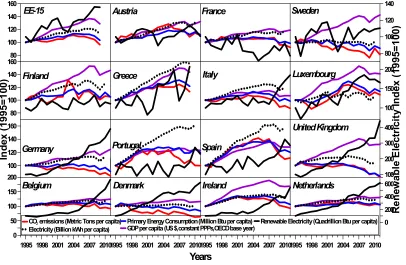
The data set is presented in a summarized form in Figure 1. All energy data comes
from EIA (2013) while all GDP data comes from OECD (2013). The left-hand side
vertical axis represents CO2 emissions, Total Primary Energy Consumption, GDP and
Electricity Net Consumption while the right-hand side vertical axis represents Renewable
Electricity Net Consumption (all expressed per capita).
As input we use the total energy consumption, composed of renewable and
exhaustible energy resources. The input is in this case responsible for the simultaneous
production of both desirable product (GDP), which typically has a positive price, and non
marketed undesirable byproduct (CO2 emissions). The fact that desirable and undesirable
outputs are jointly produced or null-jointly produced indicates, in the terminology of
Shephard and Färe (1974), that the production of desirable outputs is not possible without
8 Figure 1: Development trends of inputs and outputs for the entire EU15 and for each of
the individual EU15 countries (EIA, 2013; OECD, 2013)
1995 1998 2001 2004 2007 2010
Years 0 50 100 150 200 In de x (1 99 5= 10 0) 100 120 140 160 80 100 120 140 160
1995 1998 2001 2004 2007 20101995 1998 2001 2004 2007 20101995 1998 2001 2004 2007 2010 80 100 120 140 160 80 100 120 140 100 150 200 100 200 300 400 0 200 400 600 R en ew ab le E le ct ric ity In de x (1 99 5= 10 0)
CO2 emissions (Metric Tons percapita)
Electricity(Billion kWh percapita) Primary EnergyConsumption(Million Btu per capita)GDPpercapita(US$,constantPPPs,OECDbaseyear) RenewableElectricity (Quadrillion Btu per capita)
EE-15 Austria France Sweden
Finland Greece Italy Luxembourg
Germany Portugal Spain
United Kingdom
Belgium Denmark Ireland Netherlands
The use of the Malmquist input-oriented productivity index (TFPCH) makes
possible to decompose the productivity changes into technical change index (TECHCH)
and technical efficiency change index (EFFCH). These two indexes indicate which
factors drive the change of energy efficiency and the magnitude of this change.
3.2 The model
Following Färe et al. (1994a), the input oriented Malmquist productivity change
index may be formulated as shown in [1] for an assessment involving inputs and outputs:
2 / 1 1 1 1 1 1 1 1 1 1 ) , ( ) , ( ) , ( ) , ( ) , , , ( t t t I t t t I t t t I t t t I t t t t t
I y x y x DDyy xx DD yy xx
9
where I indicates an input-orientation, y denotes output, x denotes input, M is the
productivity of the most recent production point relative to the earlier production point,
and D denotes the input distance function.
The first ratio inside the brackets stands for the Malmquist index for period t. It
shows the previous production point (xt, yt), using period t technology. It calculates
productivity change from period t to period t+1 using the technology level at period t as a
benchmark. With the input Malmquist Productivity Index relying on technology of period
t we have:
) , (
) ,
( 1 1
t t t I t t t I t
I DDyy xx
M (2)
Similarly, the second ratio inside the brackets corresponds to the Malmquist index
for period t+1. It specifies the most recent production point (xt+1, yt+1) using period t+1
technology. It computes the change in productivity from period t to period t+1 using the
technology level at period t+1 as a benchmark. With input Malmquist Productivity Index
being based on the technology of period t+1 we have:
) , ( ) , ( 1 1 1 1 1 t t t I t t t I t
I DD yy xx
M (3)
We may also present the Malmquist Productivity Index in a similar form as shown in [4].
2 / 1 1 1 1 1 1 1 1 1 1 1 1 1 ) , ( ) , ( ) , ( ) , ( ) , ( ) , ( ) , , , ( t t t I t t t I t t t I t t t I t t t I t t t I t t t t t
I y x y x DD yy xx DD yy xx DD yy xx
M (4) or 2 / 1 1 1 1 1 1 1 1 1 1 1 1 1 ) , ( ) , ( ) , ( ) , ( ) , ( ) , ( ) , , , ( t t t I t t t I t t t I t t t I t t t I t t t I t t t t t
I y x y x DD yy xx DD yy xx DD yy xx
M (5)
10
The ratio outside the brackets in equation [5] is defined as the technical efficiency
change index (EFFCH) and the ratios inside the brackets as the technical change index
(TECHCH). Therefore, the Malmquist total factor productivity index is the product of an
efficiency change over the same period and a measure of technical progress as calculated
by shifts in the frontier measured at periods t + 1 and t.
The Malmquist Index values and its components may be greater, equal or
smaller than 1. Hence, it is easy to understand that we have the following three cases:
(i) If Malmqusit Productivity Index between time periods t and t+1 is greater
than 1, then there is an improvement in energy consumption performance
(ii) If Malmquist Productivity Index is equal to 1, then energy consumption
performance remains unchanged, and
(iii) If Malmquist Productivity Index is smaller than 1, then energy
consumption performance declines.
The decomposition of Malmquist Productivity Index into two components (EFFCH and
TECHCH) helps to identify the reasons for the change of the energy consumption
performance.
Changes in efficiency (EFFCH) between time periods t and t+1 are usually
interpreted as technological catch-up, as they measure the change of the energy
consumption performance in the reference periods and therefore how much a country
approaches the production frontier. On the other hand, changes in technology (TECHCH)
are viewed as the result of innovation efforts as noted by Färe et al. (1994b), or
11
Corrado et al. (2005), argue that intangible assets can be described as resources
utilized in soft investments, related to the creation and control of knowledge and further
innovations in energy conservation. Intangible assets have three categories (namely
computerized information, innovative property and economic competencies) and ten
detailed types of assets (namely software, database, R&D, mineral exploration, copyright
and licenses, product development in the financial industry, new architectural and
engineering design, brand equity, firm-specific human capital and organizational capital).
The second component (TECHCH) measures the shift of the empirical production
frontier between time period t and t+1, which indicates the shift in production technology
of an economic system based on energy consumption.
As noted by Ramli and Munisamy (2013), the disregard of undesirable outputs in
efficiency analysis may produce misleading results. Therefore, it is necessary to examine
the effects of undesirable outputs on productivity change over time. In order to measure
productivity when both desirable and undesirable outputs are produced, their joint
production should be examined, as the production of desirable outputs is possible, only
when is accompanied by the simultaneous production of undesirable outputs. Fixler and
Ziechang (1992) developed an emission-incorporated Malmquist TFP index and defined
their input-oriented productivity index as shown in equation [6], which is an extended
form of equation [5] that includes the attribute vector a:
2 / 1 1 1 1 1 1 1 1 1 1 1 1 ) , , ( ) , , ( ) , , ( ) , , ( ) , , , , , ( t t t t t t t t t t t t t t t t t t t t t t Fixler y x D y x D y x D y x D y x y x
M (6)
The definition of Färe et al. (1995) is actually a reciprocal of the Fixler and
12
the non-marketable attributes of production. The aim of using this approach is to
calculate the energy consumption efficiency and the degree of input reduction to reach
the empirical production frontier. The following model can be used to measure the
performance in a time period and the distance function can also be calculated,
incorporating undesirable output.
2 / 1 1 1 1 1 1 1 1 1 1 1 1 ) , , ( ) , , ( ) , , ( ) , , ( ) , , , , , ( t t t t t t t t t t t t t t t t t t t t t t Fare y x D y x D y x D y x D y x y x
M (7)
Based on the same logic as in equation [5], equation [7] can be decomposed into
two factors. These are:
2 / 1 1 1 1 1 1 1 1 1 1 1 1 1 ) , , ( ) , , ( ) , , ( ) , , ( ) , , ( ) , , ( t t t t t t t t t t t t t t t t t t t t t t t t Fare y x D y x D y x D y x D y x D y x D
M (8)
As noted by Charnes et al. (1993), the productivity gains are mainly the result of
an improvement in efficiency if EFFCH>TECHCH and mainly the result of technological
progress if EFFCH<TECHCH
As formalized by Färe and Lovell (1978), the input-oriented efficiency measure of
Farrell (1957) is the same as the inverse of Shephard’s (1970) input distance function,
which provides the theoretical basis of the current study for the calculation of the
Malmquist production index by considering energy consumption. Therefore, values
greater than one of the input oriented version of the Malmquist index indicate an
improvement.
13 4. Empirical results
First, we obtain the production possibility frontier (PPF), presented in Figure 2.
The PPF indicates the points with the maximum possible desirable output and the
minimum amount of emissions that can be produced from a DMU, using the available
technology. The horizontal axis represents the undesirable byproduct (CO2 emissions)
and the vertical axis represents the desirable output (GDP). The output quantity of each
DMU is divided by its input quantity in order to evaluate the DMUs’ eco-inefficiency
based on GDP and CO2 emissions. In this case, the PPF is the locus of all potentially
technically efficient input-output combinations. Therefore, here, technical efficiency
refers to the ability to use a minimal amount of input to produce a given level of total
output. This is displayed in the forms of desirable GDP and undesirable CO2 emissions.
Figure 2: Input-saving productivity change from 2000 to 2009. FR: France, DE: Germany, IE: Ireland, LU: Luxembourg, NL: Netherlands, SE: Sweden, UK: United Kingdom, AT: Austria, BE: Belgium, DK: Denmark, FI: Finland, EL: Greece, IT: Italy, PT: Portugal, ES: Spain.
0.03 0.04 0.05 0.06 0.07 0.08
CO2/Energy
100 150 200 250
G
D
P/
En
er
gy
t:2000
t:2009
FR IE
DE LU
NL
SE UK AT
BE
DK
FI EL
PT IT
ES
IT IE
DK
EL
NL PT UK
AT
SE FR DE
EU-15 LU
[image:14.595.178.406.467.686.2]14
As a next step to our analysis, we obtain Figure 3, which shows the relationship
between GDP production per capita and CO2 emissions per capita for the EU15 countries
under examination. From this figure the efficiency frontiers are obtained by connecting
the origin with the furthest point to the left. Under the assumption of constant returns to
scale and as noted by Chames et al. (1978), the efficiency frontier is defined by a straight
line starting from the beginning of the axes (which determine the production function)
and passing through the point of the unit with the highest ratio of outputs to inputs.
Figure 3: Environmental saving-productivity change from 2000 to 2009. The country names are defined as in Figure.2.
5 10 15 20
C O
2per capita
20000 30000 40000 50000 60000
G
D
P
pe
rc
ap
ita
FR
IE DE
L U
NL S E UKAT BE
D K
FI EL P T
IT ES
IT IE
DK
E L
NL
P T UK AT SE
FR DE
LU
BE F I
E S
t=2000
t=2009
E U-15 E U-15
The distance function now measures the maximal proportional change in outputs
required to make the production point at t+1 (xt+1, yt+1, αt+1) feasible in relation to the
technology at t (Figure 3). From Figure 3 it can be seen that production point at t+1 (xt+1,
yt+1, αt+1) occurs outside the set of feasible production in period t indicating the
occurrence of technological progress (see for example the observation for France –
[image:15.595.147.444.332.561.2]15
the maximal proportional change to output required to make the production point at t (xt,
yt, αt) feasible in relation to the technology at t+1.
Combining the results of production possibility frontiersdepicted in Figure 2 and
Figure 3, one can see whether the overall development is driven by environmental-saving
or input-saving factors.
If inefficiency is ignored, it is impossible to explain further the relative movement
of any given DMU over time. Therefore, productivity growth over time will be unable to
distinguish between improvements deriving from a DMU ‘catching up’ to its own
frontier, or those resulting from the overtime shifting up of the frontier itself. This
indicates that in the absence of inefficiency, there is no way of distinguishing the position
of the DMU relative to the corresponding frontier (eco-efficiency regress) and the
position of the frontier itself (technical progress).
On the other hand, when inefficiency is assumed to exist, the relative movement
of any given DMU over time will depend on both its position relative to the
corresponding frontier (technical efficiency) (Figure 2) and the position of the frontier
itself (technical change) (Figure 3).
However, from Figures 2 and 3 still remains unclear which one of these
phenomena (eco-technical progress or eco-efficiency regress) is predominant, and,
therefore, whether total factor productivity increases or decreases. In order to answer this
question, the Malmquist index (TFPCH) needs to be calculated and decomposed into
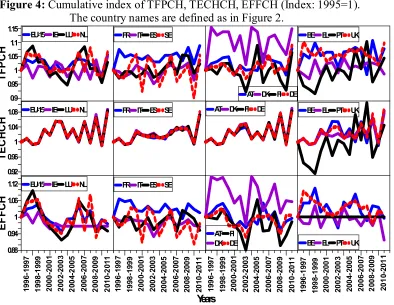
efficiency change (EFFCH) and technical change (TECHCH). This is presented
16 Figure 4: Cumulative index of TFPCH, TECHCH, EFFCH (Index: 1995=1).
The country names are defined as in Figure 2.
0.88 0.94 1 1.06 1.12 EF FC H 0.92 0.96 1 1.04 1.08 TE C HC H 0.9 0.95 1 1.05 1.1 1.15 TF PC H Years
EU-15 IE LU NL
19 96 -1 99 7 19 98 -1 99 9 20 00 -2 00 1 20 02 -2 00 3 20 04 -2 00 5 20 06 -2 00 7 20 08 -2 00 9 20 10 -2 01 1 19 96 -1 99 7 19 98 -1 99 9 20 00 -2 00 1 20 02 -2 00 3 20 04 -2 00 5 20 06 -2 00 7 20 08 -2 00 9 20 10 -2 01 1 19 96 -1 99 7 19 98 -1 99 9 20 00 -2 00 1 20 02 -2 00 3 20 04 -2 00 5 20 06 -2 00 7 20 08 -2 00 9 20 10 -2 01 1 19 96 -1 99 7 19 98 -1 99 9 20 00 -2 00 1 20 02 -2 00 3 20 04 -2 00 5 20 06 -2 00 7 20 08 -2 00 9 20 10 -2 01 1
FR IT ES SE
AT DK FI DE
BE EL PT UK
EU-15 IE LU NL FR IT ES SE AT DK FI DE BE EL PT UK
EU-15 IE LU NL FR IT ES SE
AT
DK FIDE BE EL PT UK
Detailed observations of Figure 4 are included in Table 1. Table 1 reports for each
country and each year, when productivity gains are a result of an improvement in
efficiency or not; and also, when there is a technological progress/loss and a productivity
progress/loss. Table 1 is constructed through a step-by-step procedure until the final
results are obtained. The procedure is as follows:
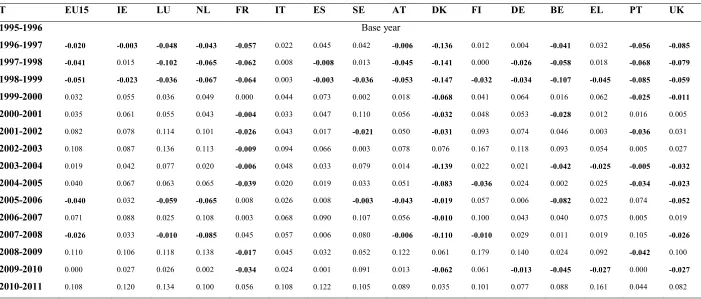
The first step is to determine the difference between the two indexes of TECHCH
and EFFCH. As it was mentioned before, productivity change is mainly derived from an
improvement in efficiency (EFF) (this occurs when TECHCH-EFFCH<0). Also,
productivity change is mainly the result of technological progress (TECH) (when
TECHCH-EFFCH>0). If there is no difference between TECHCH and EFFCH, the
17
During the period under consideration, the difference between the two indexes of
TECHCH and EFFCH for the entire EU15 and for each of the individual EU15 countries
can be negative, positive or zero (see Table A1 in the Appendix).
From the obtained results we observe that the frequency of occurrence of negative
value (TECHCH-EFFCH<0) is: twelve times in the case of Denmark, ten times in the
case of France, nine times in the case of the United Kingdom, eight times in the case of
Portugal, seven times in the case of Belgium, five times in the cases of the entire EU15,
Luxembourg, Netherlands and Austria, three times in the cases of Sweden, Finland,
Germany and Greece, two times in the cases of Ireland and Spain and zero times in the
case of Italy.
In this case (negative difference between the two indexes of TECHCH and
EFFCH) the productivity change is mainly derived from an improvement in efficiency
(EFF).
DMUs with an incidence of at least 7 times negative value
(TECHCH-EFFCH<0), show a negative average (France: -0.014, Denmark: -0.054, Belgium: -0.006,
Portugal: -0.007, United Kingdom:-0.009). Therefore, these countries have mainly
invested in methods to improve efficiency, through appropriate energy policies and
regulations.
The frequency of occurrence of positive value (TECHCH-EFFCH>0) is: fifteen
times in the case of Italy, thirteen times in the cases of Ireland and Spain, twelve times in
the cases of Sweden, Germany and Greece, eleven times in the case of Finland, ten times
18
nine times in the case of the entire EU15, six times in the cases of Portugal and the United
Kingdom, four times in the case of France and three times in the case of Denmark
In this case (positive difference between the two indexes of TECHCH and
EFFCH) the productivity change is mainly the result of technological progress (TECH).
DMUs with an incidence of at least 9 times positive value (TECHCH-EFFCH>0),
show a positive average(the entire EU-15: 0.0285, Ireland: 0.0523, Luxembourg: 0.0353,
Netherlands: 0.0276, Italy: 0.0429, Spain: 0.0365, Sweden: 0.0438, Austria: 0.0263,
Finland: 0.0535, Germany: 0.0387, Greece: 0.0319). Therefore, these countries have
mainly invested in methods to improve technology, through appropriate energy policies
and regulations.
The frequency of occurrence of zero value (TECHCH=EFFCH) is: one time in the
cases of the entire EU15, France, Finland and Portugal. In this case (no difference
between the two indexes of TECHCH and EFFCH) the productivity change is the result
of both technological progress (TECH) and efficiency improvement (EFF).
At this point it should be noted that, for all EU-15 countries except Italy, the
values (TECHCH-EFFCH) in different spans of time are alternating between positive and
negative ones. When the time span with a homogenous pattern (numbers with the same
sign) is long, then there is a short-term effort for energy policy stabilization in one
direction, geared towards an improvement in efficiency (EFF) or towards a technological
progress (TECH). In that respect, alternation exists when a policy is not performing as
expected. When the time span with a homogenous pattern (numbers with the same sign)
is short (one or two years), then there is a mild policy without clear orientation towards
19
The main objective of the energy strategy and policy is to provide a short-term
plan for rehabilitation of the energy sector. Furthermore, it gives the directions for the
medium to long-term reconstruction of the energy sector. The energy strategy shows how
DMUs can use their energy resources to achieve economic and social benefits in an
environmentally responsible manner. It gives the directions and the objectives of
comprehensive and inclusive policy geared towards an improvement in efficiency (EFF)
or towards a technological progress (TECH) or towards a combination of the two.
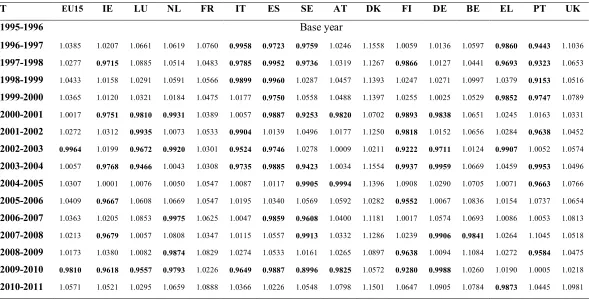
The second step of our analysis is to see if the Malmquist Productivity Index
between two periods t and t+1 is greater than 1, smaller than 1 or remains unchanged in
the case of the entire EU15 and for each individual EU15 country (see Table A2 in the
Appendix).
In terms of productivity change from one year to the next and under constant
returns to scale, an improvement of productivity can be the result of a single factor, or a
combination of two factors known as technical change (technological progress) and
efficiency change (improvement in efficiency). For example, one DMU may increase its
productivity solely by technical change and with no change of the distance to the
respective frontier. In other cases, the productivity change is a combination of technical
change and technical efficiency change. To summarize, productivity change can be a
result of technical change, technical efficiency change or a combination of the two.
During the period under consideration, the total factor productivity index (see
Table A2 in the Appendix) for the entire EU15 and for each of the individual EU15
countries can be greater or smaller than one. The frequency of occurrence of total factor
20
in the case of entire EU15, TFPCH index is 13 (2) times greater (smaller) than one
in the case of Ireland, TFPCH index is 9 (6) times greater (smaller) than one
in the cases of Luxembourg, Netherlands, Germany and Greece, TFPCH index is 10
(5) times greater (smaller) than one
in the cases of France, Denmark and the United Kingdom, TFPCH index is 15 times
greater than one (the whole sample period)
in the case of Italy, index of TFPCH is 8 (7) times greater (smaller) than one
in the case of Spain, the index of TFPCH is 6 (9) times greater (smaller) than one
in the cases of Sweden , Finland and Portugal, the index of TFPCH is 7 (8) times
greater (smaller) than one
in the case of Austria, the index of TFPCH is 12 (3) times greater (smaller) than one
in the case of Belgium, the index of TFPCH is 14 (1) times greater (smaller) than one
It should be mentioned that in the case where the total factor productivity index
between time periods t and t+1 is greater than 1, the energy consumption performance
improves (productivity gains). On the other hand, when the total factor productivity index
between two time periods t and t-+1 is smaller than 1, then the energy consumption
performance declines (productivity loss).
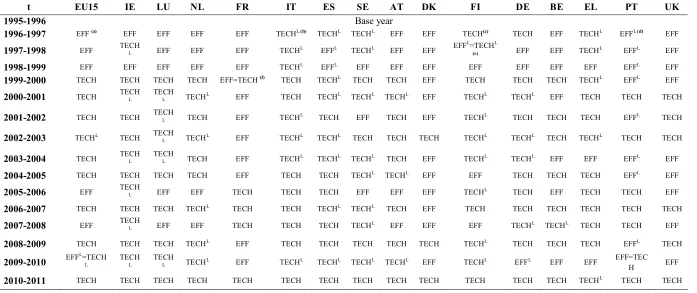
Combining the above two steps, the final results of Table 1 are obtained. Τhis
table shows for each country and each year: i) the productivity gains (TFPCH>1) as a
result of improvements in efficiency (TECHCH-EFFCH<0) and technological progress
21 Table 1: Productivity gains as a result of improvements in efficiency and technological progress and productivity loss. Country names
are defined in Figure 2
t EU15 IE LU NL FR IT ES SE AT DK FI DE BE EL PT UK
1995-1996 Base year
1996-1997 EFF (a) EFF EFF EFF EFF TECHL (b) TECHL TECHL EFF EFF TECH(c) TECH EFF TECHL EFFL (d) EFF
1997-1998 EFF TECHL EFF EFF EFF TECHL EFFL TECHL EFF EFF EFF L=TECHL
(e) EFF EFF TECHL EFFL EFF
1998-1999 EFF EFF EFF EFF EFF TECHL EFFL EFF EFF EFF EFF EFF EFF EFF EFFL EFF
1999-2000 TECH TECH TECH TECH EFF=TECH (f) TECH TECHL TECH TECH EFF TECH TECH TECH TECHL EFFL EFF
2000-2001 TECH TECHL TECHL TECHL EFF TECH TECHL TECHL TECHL EFF TECHL TECHL EFF TECH TECH TECH
2001-2002 TECH TECH TECHL TECH EFF TECHL TECH EFF TECH EFF TECHL TECH TECH TECH EFFL TECH
2002-2003 TECHL TECH TECH
L TECHL EFF TECHL TECHL TECH TECH TECH TECHL TECHL TECH TECHL TECH TECH
2003-2004 TECH TECHL TECHL TECH EFF TECHL TECHL TECHL TECH EFF TECHL TECHL EFF EFF EFFL EFF
2004-2005 TECH TECH TECH TECH EFF TECH TECH TECHL TECHL EFF EFF TECH TECH TECH EFFL EFF
2005-2006 EFF TECHL EFF EFF TECH TECH TECH EFF EFF EFF TECHL TECH EFF TECH TECH EFF
2006-2007 TECH TECH TECH TECHL TECH TECH TECHL TECHL TECH EFF TECH TECH TECH TECH TECH TECH
2007-2008 EFF TECHL EFF EFF TECH TECH TECH TECHL EFF EFF EFF TECHL TECHL TECH TECH EFF
2008-2009 TECH TECH TECH TECHL EFF TECH TECH TECH TECH TECH TECHL TECH TECH TECH EFFL TECH
2009-2010 EFFL=TECHL TECHL TECHL TECHL EFF TECHL TECHL TECHL TECHL EFF TECHL EFFL EFF EFF EFF=TECH EFF
2010-2011 TECH TECH TECH TECH TECH TECH TECH TECH TECH TECH TECH TECH TECH TECHL TECH TECH
aEFF: Productivity gains as a result of improvements in Efficiency, bTECHL: Technological Progress but productivity losses, cTECH: Productivity gains as a
result of Technological Progress, dEFFL: Improvements in Efficiency but productivity losses, eEFFL=TECHL: Efficiency change is equal to technological
22 5. Discussion
The next step of our analysis aims to provide an extra insight into assessing
relative productivity. Taking into account the empirical results obtained in the previous
section, we have a deeper understanding of the content of productivity changes among
cross-country comparisons. This provides policy makers with more valuable reference
material related to drawing up policies that aim to increase national productivity.
Therefore, based on Figure 2, the eco-inefficiency score indicates the evaluated
DMU’s distance from the best practice DMUs with different production mixes to the
efficient frontier. The best practice DMUs (Ireland 2000, Italy 2000, Austria 2000,
France 2000, Ireland 2009 and Sweden 2009) appear equally attractive for inefficient
DMU, which has the flexibility to choose an improvement direction that maximizes its
efficiency. The DMUs with a high eco-efficiency are those situated in the upper right
corner of the two frontiers of Figure 2, where they produce higher desirable outputs with
the lowest undesirable outputs. These countries are France 2000 and Sweden 2009. The
DMUs located on the frontier are considered eco-efficient, because no other DMUs can
produce more desirable outputs and fewer undesirable outputs.
If a DMU fails to achieve an output combination on its production possibility
frontier and falls beneath this frontier, then it is said to be technically inefficient, as it gets
further away from the more efficient countries (e.g. Belgium 2000/2009, Greece
2000/2009, Netherlands 2000/2009).
In Figure 2, technological progress shifts upwards the production possibility
frontier, as more outputs are obtainable using the same level of inputs. It can be seen
23
progress from 2000 to 2009, as in the case of Sweden. In the absence of technological
progress or improvement, an economy (e.g. Greece, Belgium, Netherlands) is found more
and more far from the best practice countries, or driven to the simultaneous increase
(Luxembourg, Finland) or decrease (Italy) of both GDP production and CO2 emissions
(Figure 3).
The simultaneous increase of GDP production (desirable output) and decrease of
CO2 emissions (undesirable output) can only be achieved through technical progress that
affect the ability to optimally combine inputs and outputs.
Combining the results depicted in Figure 2 and Figure 3, one can see whether the
use of input (total energy consumption) or CO2 emissions is the driving force of
productivity growth. Therefore, an overall conclusion can be drawn regarding whether
the overall development is driven by input-saving or by environmental-saving factors.
As shown in Figure 4 and Table 1, the detailed decomposition of total factor
productivity change offers additional insights for policy implications, representing the
driving forces of productivity gains or losses for the entire EU15 and for each of the
individual EU15 countries. Therefore, it illustrates the nature of the overall productivity
change that shapes up the Malmquist index.
More specifically, from this analysis one can see when the possible effect is
characterized as EFF (productivity gains as a result of improvement in efficiency), TECH
(productivity gains as a result of technological progress), EFFL (improvement in
efficiency but productivity losses), TECHL (technological progress but productivity
24
productivity gains), and EFFL=TECHL (efficiency change is equal to technological
change in the case of productivity losses) (see Table 1).
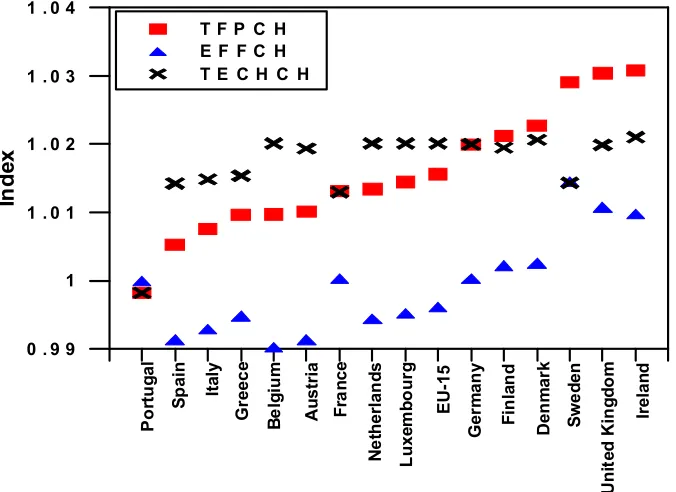
Figure 5 reports the average values of the Malmquist (TFPCH) index and its
components (EFFCH, TECHCH) for the EU15 countries. The greatest increases of the
TFPCH index are observed in Ireland, UK and Sweden, whereas the lowest ones in
[image:25.595.135.473.322.568.2]Portugal, Spain and Italy.
Figure 5: Annual means of Malmquist index and its components. Countries are sorted in
ascending order by the TFPCH index.
0 . 9 9 1 1 . 0 1 1 . 0 2 1 . 0 3 1 . 0 4
In
de
x
T F P C H E F F C H T E C H C H
Ire la nd Po rtu ga l Sp ai n Ita ly G re ec e Be lg iu m A us tr ia Fr an ce Ne th er la nd s Lu xe m bo ur g EU -1 5 G er m an y Fi nl an d D en m ar k U ni te d K in gd om Sw ed en
The analysis of efficiency changes (EFFCH) shows that, the average
eco-efficiency change is positive (higher than one) for 7 of 16 DMUs. These are Sweden, UK,
Ireland, Denmark, Finland, Germany and France, indicating that these DMUs have
caught up the eco-efficiency benchmarks.
From the above countries, Sweden, UK, Ireland and Denmark, have the highest
25
energy, through gradual substitution procedures between fossil and non fossil fuels. The
more a DMU abstains from the consumption of fossil fuels, the greater the divergence
between the desirable (GDP) and the undesirable output (CO2) (see also Figure 1). This
happens because the maximization of the desirable output (GDP) comes with the
temporal stabilization or decrease of the undesirable byproduct. This procedure is related
to how effective is the energy mix and, therefore, how effectively the inputs are
transformed into outputs using the available technology.
However, it is the average technical change that contributes most to productivity
gains (TFPCH) (Figure 5), as it describes the change of the frontier (Figure 3) and,
therefore, the best performers of the sample and not the development of the DMUs under
the frontier (Figure 2). Our results are similar to those reported in the study conducted by
Makridou et al. (2016), who concluded that technology change is primarily responsible
for the improvements achieved in most sectors.
The results of the model show that the average TECHCH index is positive
(higher than one) and greater than the average EFFCH index in all countries, except
Portugal where there is an average decrease of 0.18% in the sample period.
The results on Figure 5 suggest that if the annual average growth of EFFCH is
higher than one and lower than the annual average growth of TECHCH, then productivity
gain (TFPCH), which is primarily the result of technological progress, have the highest
value. Thus, the best DMUs of the sample, with the highest values of TFPCH index, are
identified in the case of Ireland, United Kingdom, Sweden, Denmark, Finland and
Germany. In the case of Sweden, the annual average growth of EFFCH (1.45%) is almost
26
On the other hand, if the annual average growth of EFFCH is lower than one and
lower than the annual average growth of TECHCH, which is higher than one, then
productivity gain (TFPCH), which is primarily the result of technological progress, have
the lowest value. Thus, the worst DMUs of the sample with the lowest values of TFPCH
index are identified in the case of EU15, Luxembourg, Netherlands, France, Austria,
Belgium, Greece, Italy and Spain. In the case of France, the annual average growth of
EFFCH is positive (higher than one) with an average increase of 0.03% (Figure 5).
6. Conclusions and policy implications
This study develops an input oriented DEA model, aggregating both energy
productivity and environmental degradation into a comprehensive index of Total Factor
Productivity (Malmquist), in order to evaluate a DMU’s total factor productivity.
The results suggest that technical progress affecting the ability to optimally
combine inputs and outputs is the main factor for the simultaneous increase of desirable
output and decrease of undesirable byproduct for most DMUs for the sample period
under examination. In the absence of technical progress, a DMU is either far from the
best practice DMUs (e.g. Greece, Belgium, Netherlands), or driven to the simultaneous
increase (Luxembourg, Finland) or decrease (Italy) of both GDP production and CO2
emissions.
An assessment of each DMU’s productivity for the sample period is summarized
in the following cases:
i) Productivity gains are due to an improvement in efficiency,
27
iii) There is an improvement in efficiency, but the productivity decreases,
iv) There is technological progress, but the productivity decreases,
v) There are productivity gains when efficiency change is equal to technological change,
vi) There is productivity loss when efficiency change is equal to technological change.
As shown from the analysis, the highest values of productivity gains (TFPCH) can
be achieved in the case where the annual average growth of EFFCH is higher than one
and lower than the annual average growth of TECHCH (Ireland, United Kingdom,
Sweden, Denmark, Finland, Germany). On the other hand, the lowest values of
productivity gains (TFPCH) appears when the annual average growth of EFFCH is lower
than one and lower than the annual average growth of TECHCH (EU15, Luxembourg,
Netherlands, France, Austria, Belgium, Greece, Italy and Spain).
The methodology utilized here and the results obtained capture the different
causes of losses or gains in DMU’s productivity from year to year. This work quantifies
the inefficiency of the DMUs under the frontier, through the indicators of EFFCH,
TECHCH and TFPCH. Such an approach is of particular importance in encouraging
inefficient DMUs to always compare themselves with efficient DMUs in their range, and
thus to make progress and improvements.
The obtained results have important implications for the policy makers to promote
productivity performance of the energy sector in EU-15 countries. The detailed
decomposition of productivity change into efficiency change, technology change,
innovation efficiency and technology catch-up effect offers a better understanding of the
content of the productivity change through the cross-country comparisons. That
28
EU15 and for each of the individual EU15 countries and thus offers additional insights
for policy implications. For instance, policy actions intended to improve productivity
gains (decrease productivity losses) might be misdirected if they focus (if they choose not
to focus) on accelerating the rate of innovation, in the case where the productivity gains
(productivity losses) are mainly the result of improvements in efficiency. Therefore, the
present study provides more reference material to policy makers so as to draw up policies
in order to elevate national productivity for the purpose of designing energy development
strategy in EU-15 countries.
In order to quantify the huge efficiency gap so as to address the wasteful use of
exhaustible energy inputs and reduce the environmental degradation, we calculate the
distance for an inefficient DMU to the production frontier, through the DEA based
Malmquist productivity index. In many cases, the distance of a specific DMU from the
best practice DMUs indicates different production combination of desirable and
undesirable outputs, and, therefore different alternatives for an inefficient DMU to choose
a direction that maximizes its efficiency. The direction that an inefficient DMU should
take and the amount of reduction of the energy consumption can be the basis for a
government to establish energy saving policies and to strengthen energy management,
especially in the cases where large amounts of energy input are necessary in the
economy, but with low value added. An energy management system is one of the most
important factors in the context of strengthening energy efficiency policy as it allows in
energy efficiency issues to gain a greater priority within the DMU.
This analysis allows policy makers of EU states to identify the explanatory causes
29
In this sense, it is very important to identify the economic activities that, due to their
impact, are essential to reduce energy consumption, as well as potential strategies and
measures to improve the efficiency of final energy use. For example, restructuring of
industry, developing programs of technology innovation and encouraging the reuse of
input resources can be some of the directions to follow in the context of strengthening
energy efficiency policies.
It is necessary for policy makers to promote technological innovation on energy
saving and emission reduction. To realize this purpose, it is absolutely essential to
increase research investment to develop environmental technology, energy saving
technology and low-carbon technology in order to limit excessive energy consumption
and pollutant emissions.
In this way, technological innovation has an additive significant contribution on
strategies of optimizing industrial structure as it manages to accelerate the development
of environmental-friendly industries.
Thus, the results obtained here can be used as a guide for policy makers to
promote the best efficiency measures for a given level of resources use over the same
period. Furthermore they can serve as a useful tool for policy making by investigating the
gradual process of the diffusion and adoption of new technologies. Also, they can be used
to optimize the management of energy resources in order to achieve the highest
30 References
Apergis, Nicholas, Goodness C. Aye, Carlos Pestana Barros, Rangan Gupta, and Peter Wanke. (2015). Energy efficiency of selected OECD countries: A slacks based model
with undesirable outputs, Energy Economics 51: 45-53.
Bampatsou, Christina, and George Hadjiconstantinou. (2009). The use of the DEA method for simultaneous analysis of the interrelationships among economic growth,
environmental pollution and energy consumption, International Journal o f Economic
Sciences and Applied Research 2 (2): 65-86.
Bampatsou, Christina, Savas Papadopoulos, and Efthimios Zervas. (2013). Technical efficiency of economic systems of EU-15 countries based on energy consumption. Energy Policy 55: 426-434.
Bevilacqua, Maurizio, and Marcello Braglia. (2002). Environmental efficiency analysis
for ENI oil refineries, Journal of Cleaner Production 10 (1): 85–92.
Caves, Douglas W., Laurits R. Christensen, and W. Erwin Diewert. (1982). The Economic Theory of Index Numbers and the Measurement of Input, Output, and
Productivity. Econometrica 50(6): 1393–1414.
Chames, Abraham, William W. Cooper, and Edwardo L. Rhodes. (1978). Measuring the
efficiency of decision making units. European Journal of Operational Research 2
(6):429-444.
Charnes, Abraham, William W. Cooper, Arie Y. Lewin, and Lawrence M. Seiford.
(1993). Data Envelopment Analysis: Theory, methodology, and application, Boston:
Kluwer Academic Publishers.
Chen, Chien-Ming, and Magali A. Delmas. (2012).“Measuring Eco-inefficiency: A New
Frontier Approach, Operations Research 60: 1064–1079.
Corrado, Carol, Hulten Charles, and Daniel Sichel. (2005). “Measuring Capital and
Technology: An Expanded Framework,” in Measuring Capital in the New Economy,
C. Corrado, J. Haltiwanger, and D. Sichel, (Eds.), Studies in Income and Wealth, 65: 11-41, Chicago: The University of Chicago Press for the National Bureau of Economic Research.
http://econweb.umd.edu/~hulten/webpagefiles/Measuring%20Capital%20and%20Tec hnology%20%20An%20Expanded%20Framework.pdf
Corrado, Carol, Charles Hulten, and Daniel Sichel. (2009). “Intangible Capital and U.S.
31
EIA. (2013). International Energy Annual. Energy Information Administration, U.S.
Department of Energy. http://www.eia.doe.gov/iea/contents.html [accessed date: 06
October, 2013].
Fagerberg, Jan. (1994). Technology and International Differences in Growth
Rates, Journal of Economic Literature 32(3): 1147–1175.
Färe, Rolf, and C. A. Knox Lovell. (1978). Measuring the technical efficiency of
production, Journal of Economic Theory 19 (1): 150-162.
.
Färe, Rolf., Shawna Grosskopf, and C. A. Knox Lovell. (1994a). Production Frontiers,
Cambridge: Cambridge University Press.
Färe, Rolf, Shawna Grosskopf, Mary Norris, and Zhongyang Zhang. (1994b). Productivity Growth, Technical Progress, and Efficiency Change in Industrialized
Countries, The American Economic Review 84(1): 66–83.
Färe, Rolf, Shawna Grosskopf, and Pontus Roos. (1995). Productivity and quality
changes in Swedish pharmacies, International Journal of Production Economics 39
(1–2): 137-144.
Farrell, Michael J. (1957). The Measurement of Productive Efficiency, Journal of the
Royal Statistical Society. Series A (general)120(3): 253-290.
Fischer, Manfred M., Thomas Scherngell, and Martin Reismann. (2009). Knowledge spillovers and total factor productivity: evidence using a spatial panel data model, Geographical Analysis 41(2): 204–220.
Fixler, Dennis, and Kimberly D. Zieschang. (1992). “Incorporating Ancillary Measures
of Process and Quality Change into a Superlative Productivity Index,” Journal of
Productivity Analysis 2(4): 245-267.
Fried, Harold O., C. A. Knox Lovell, and Shelton S. Schmidt, (2008). The Measurement
of Productive Efficiency and Productivity Change, New York: Oxford University
Press.
Fukuyama, Hirofumi, Hiroya Masaki, Kazuyuki Sekitani, and Jianming Shi. (2013). Distance optimization approach to ratio-form efficiency measures in data envelopment
analysis, Journal of Productivity Analysis 42(2): 175-186.
Golany, Boaz, and Sten Thore. (1997). The economic and social performance of nations:
32
Halkos G. (2010). Construction of abatement cost curves: The case of F-gases, MPRA
Paper 26532, University Library of Munich, Germany.
Halkos G. (2014). The Economics of Climate Change Policy: Critical review and future
policy directions, MPRA Paper 56841, University Library of Munich, Germany.
Halkos G and Salamouris (2004). Efficiency measurement of the Greek commercial banks with the use of financial ratios: a data envelopment analysis approach.
Management Accounting Research 15 (2): 201-224.
Halkos G. and Tsilika K. (2014). Analyzing and visualizing the synergistic impact
mechanisms of climate change related costs, MPRA Paper 55459, University Library
of Munich, Germany.
Halkos G. and Tsilika K. (2016). Climate change impacts: Understanding the synergetic
interactions using graph computing, MPRA Paper 75037, University Library of
Munich, Germany.
Halkos G. and Paizanos E. (2016). The effects of fiscal policy on CO2 emissions: Evidence from the U.S.A, Energy Policy, 88(C), 317-328.
Halkos G. and Polemis M. (2016). The good, the bad and the ugly? Balancing
environmental and economic impacts towards efficiency, MPRA Paper 72132,
University Library of Munich, Germany.
Halkos G. and Skouloudis A. (2015). Exploring corporate disclosure on climate change:
Evidence from the Greek business sector, MPRA Paper 64566, University Library of
Munich, Germany.
Kitcher, Ben, Ian P. McCarthy, Sam Turner, and Keith Ridgway. (2013). Understanding
the effects of outsourcing: unpacking the total factor productivity variable, Production
Planning & Control:The management of Operations 24 (4-5): 308–317.
Kortelainen, Mika. (2008). Dynamic environmental performance analysis: A Malmquist
index approach, Ecological Economics 64(4): 701–715.
.
Kuo, Renjieh J., Y. C. Wang, and Fanchih C. Tien. (2010). Integration of artificial neural
network and MADA methods for green supplier selection, Journal of Cleaner
Production 18(12): 1161–1170.
Long, Xingle, Xicang Zhao, and Faxin Cheng. (2015). The comparison analysis of total
factor productivity and eco-efficiency in China's cement manufactures, Energy Policy
81: 61-66.
Mahlberg, Bernhard, Mikulas Luptacik, and Biresh K. Sahoo. (2011). Examining the drivers of total factor productivity change with an illustrative example of 14 EU
33
Makridou, Georgia, Kostas Andriosopoulos, Michael Doumpos, and Constantin Zopounidis. (2015). A Two-stage approach for energy efficiency analysis in European
Union countries, The Energy Journal 36 (2): 47-69.
Makridou, Georgia, Kostas Andriosopoulos, Michael Doumpos, and Constantin Zopounidis. (2016). Measuring the efficiency of energy-intensive industries across
European countries, Energy Policy 88: 573-583.
Malmquist, Sten. (1953). Index numbers and indifference surfaces, Trabajos de
Estadistica 4(2) : 209-242.
Murillo-Zamorano, Luis R. (2005). The Role of Energy in Productivity Growth: A
Controversial Issue?, The Energy Journal 26 (2): 69-88.
10.5547/ISSN0195-6574-EJ-Vol26-No2-4
OECD. (2013). Gross Domestic Product (GDP) in national currency, in current prices and constant prices (national base year, previous year prices and OECD base year i.e.
2005), Organisation for Economic Co-operation and Development.
http://stats.oecd.org/ [accessed date: 04 October, 2013].
Pardo Martínez, Clara I. (2013). An analysis of eco-efficiency in energy use and CO2
emissions in the Swedish service industries, Socio-Economic Planning Sciences
47(2):120-130.
Ramanathan, Ramakrishnan. (2006). A multi-factor efficiency perspective to the relationships among world GDP, energy consumption and carbon dioxide emissions,
Technological Forecasting and Social Change 73(5): 483-494.
http://dx.doi.org/10.1016/j.techfore.2005.06.012.
Ramli, Noor Asiah., and Susila Munisamy. (2013). A Study on Eco-Efficiency of the
Manufacturing Sector in Malaysia, Actual Problems of Economics 12(150): 480- 491.
http://repository.um.edu.my/30015/1/A%20Study%20on%20Eco- Efficiency%20of%20the%20Manufacturing%20Sector%20in%20Malaysia%20-%20postprint.pdf.
Sarkis, Joseph, and Jeffrey Weinrach. (2001). Using data envelopment analysis to
evaluate environmentally conscious waste treatment technology, Journal of Cleaner
Production 9(5): 417-427.
Sheng, Yu, Yanrui Wu, Xunpeng Shi, and Dandan Zhang. (2015). Energy trade
efficiency and its determinants: A Malmquist index approach, Energy Economics 50:
306-314.
Shephard, Ronald W. (1970). Theory of Cost and Production Functions. Princeton, New
34
Shephard, Ronald W., and Rolf Färe. (1974). “The law of diminishing returns,” Zeitschrift für Nationalökonomie 34 (1): 69–90.
Sueyoshi, Toshiyuki, and Yan Yuan. (2016). Marginal Rate of Transformation and Rate of Substitution Measured by DEA Environmental Assessment: Comparison among
European and North American Nations, Energy Economics. 56(C): 270-287.
Wang, Ke, and Yi-Ming Wei. (2016). Sources of energy productivity change in China during 1997–2012: A decomposition analysis based on the Luenberger productivity
indicator, Energy Economics 54:50-59.
Xishuang, Han, Xue Xiaolong, Ge Jiaoju, Wu Hengqin, and Su Chang. (2014). Measuring the Productivity of Energy Consumption of Major Industries in China: A
DEA-Based Method, Mathematical Problems in Engineering 2014. http://dx.doi.