Extraposition via Complex Domain Formation*
A n d r e a s K a t h o l a n d C a r l P o l l a r d D e p t . o f L i n g u i s t i c s
, 1712 Neil Ave. O h i o S t a t e U n i v e r s i t y C o l u m b u s , O H 43210, U S A
{kathol, pollard}©ling, ohio-stat e. edu
A b s t r a c t
We propose a novel approach to extraposi- tion in German within an alternative con- ception of syntax in which syntactic struc- ture and linear order are mediated not via encodings of hierarchical relations but in- stead via order domains. At the heart of our proposal is a new kind of domain for- mation which affords analyses of extrapo- sition constructions that are linguistically more adequate than those previously sug- gested in the literature.
1 L i n e a r i z a t i o n w i t h o u t p h r a s e s t r u c t u r e
Recent years have seen proposals for the elimina- tion of the phrase structure component in syntax in favor of levels of representation encompassing possi- bly nonconcatenative modes of serialization (Dowty, In press; Reape, 1993; Reape, 1994; Pollard e t al., 1993). Instead of deriving the string representation from the yield of the tree encoding the syntactic structure of that sentence (as, for instance in GPSG, LFG, and--as far as the relationship between S- structure and PF, discounting operations at PF, is concerned--GB), these proposals suggest deriving the sentential string via a recursive process that op- erates directly on encodings of the constituent order of the subconstituents of the sentence. In Reape's proposal, which constitutes an extension of HPSG (Pollard and Sag, 1994), this information is con- tained in "(Word) Order Domains". On the other hand, the way that the surface representation is put together, i.e. the categories that have contributed to the ultimate string and the grammatical depen- dency relations (head-argument, head-adjunct, etc.) holding among them, will be called the "composi- tion structure" of that sentence, represented below by means of unordered trees.
*Thanks to Bob Kasper for helpful discussions and suggestions.
As an example, consider how a German V1 sen- tence, e.g. a question or conditional clause, is derived in such a system. 1
(1) Las Karl dasBuch read Karl the book
E.g.: 'Did Karl read the book?'
The representation in Figure 1 involves a number of order domains along the head projection of the clause ([1]-[3]). Each time two categories are com- bined, a new domain is formed from the domains of the daughters of that node, given as a list value for the feature DOM. While the nodes in the deriva- tion correspond to signs in the HPSG sort hierarchy (Pollard and Sag, 1994), the elements in the order domains, which we will refer to as domain objects, will minimally contain categorial and phonological information (the latter given in italics within angled brackets). The value of the DOM attribute thus con- sists of a list of domain objects. Ordering is achieved via linear precedence (LP) statements.
In Reape's approach, there are in essence two ways in which a sign's DOM value can be integrated into that of its mother. When combining with its ver- bal head, a nominal argument such as das Buch in Figure 1 in general gives rise to a single domain ele- ment, which is "opaque" in the sense that adjacency relations holding within it cannot be disturbed by subsequent intervention of other domain objects. In contrast, some constituents contribute the contents of their order domains wholesale into the mother's domain. Thus, in Figure 1, both elements of the VP ([2]) domain become part of the higher clausal ([1]) domain. As a result, order domains allow elements that are not sisters in composition structure to be linearly ordered with respect to each other, contrary
[1]
I
S-- V[SUBCAT
O]DOM/
[ (las) ]
(Karl)
\ Lv[+'NV] ]
' NP[NOM] '[
]
( das Buch)
rNP[NOM] [4] [DOM
([(KarO])
]
= V[SUBCAT (NP[NOM])]
1
[2]
/DOM/ [("as) 1 ru,,., B,.,ch)]
\ /
L
\
Lv[-FINV]j ' t NP[ACC]]
/ J,.
. . ~
rVrSUB¢~T~'--T~rNO~I,
' , , , , , , c , , , , , l
,3,
]}
Figure h Derivation of V1 clause using order domains
NP[ACC])]
to ordinary HPSG, but in the spirit of "liberation" metarules (Zwicky, 1986).
W i t h Reape we assume t h a t one crucial mecha- nism in the second type of order domain formation is the
shuffle
relation (Reape'ssequence union),
which holds of n lists L1, ..., L , - 1 , L , , iffL,
consists of the elements of the first n-1 lists interleaved in such a way t h a t the relative order among the original mem- bers of L1 through L , - 1 , respectively, is preserved inLn.
As a consequence, any precedence (but not ad- jacency) relations holding of domain elements in one domain are also required to hold of those elements in all other order domains t h a t they are members of, which amounts to a monotonicity constraint on deriving linear order. Hence, if [1] in Figure 1 were to be expanded in the subsequent derivation into a larger domain (for instance by the addition of a sentential adverb), the relative order of subject and object in t h a t domain could not be reversed within the new domain.The d a t a structure proposed for domains in Reape (1993) is t h a t of a list of objects of type
sign.
However, it has been argued (Pollard et al., 1993) t h a t signs contain more information than is desirable for elements of a domain. Thus, a sign encodes its internal composition structure via its DAUGHTERS attribute, while its linear composition is available as the value of DOM. Yet, there are no known LP con- straints in any language t h a t make reference to these types of information. We therefore propose an im- poverished d a t a structure for elements of order do- mains which only consists of categorial and seman- tic information (viz. the value of SYNSEM (Pollard and Sag, 1994)) and a phonological representation. This means t h a t whenever a constituent is a d d e d t o a domain as a single element, its information con- tent will be condensed to categorial and phonolog- ical information. 2 The latter is constrained to be the concatenation of the PHONOLOGY values of the domain elements in the corresponding sign's order2For expository convenience, semantic information is systematically ignored in this paper.
domain. We will refer to the relation between a sign S and its representation as a single domain object O as the
compaction,
given informally in (2): 3 (2) compaction([i-],El ) --rsig.
]
53:/sYNSZM if]
LD°"
([PHON [ 4.~],...,[PHON[~)
[ dom-obj
]
A
~: I s,,N~E~,~I~
LPHONI,Io ... o r-;-I
To express this more formally, let us now define an auxiliary relation,
joinF,
which holds of two lists L1 and L2 only if L2 is the concatenation of val- ues for the feature F of the elements in L1 in the same order: 4(3) joinF([Y],[~) --
(V]: 0 A [7]: O)
V (cons(IF (El)], [-~-],[~ A joinF([?],[~)
A append([';'],r~,[~]) )
This allows us to define
compaction
more precisely as in (4):(4) compaction([-i-],[~) _---
[sign
]
~:/sYNSEM ~ /
LDOM~
J
r
dom-obj
]
^
~ :
I SYNSE~,~-..I~I
LPHON sL~ .]
A joinp//oN ([7],[~)
3Here, "o" is a convenient functional notation for the append relation.
[image:2.612.86.514.62.209.2]VP "-" V[SUBCAT (NP)]
]
I
r/,zasBuch)]
>]
DoM j
L D°M ([(das)], [(Buch)])]
[DOM~(
[V[+,NV]
] >
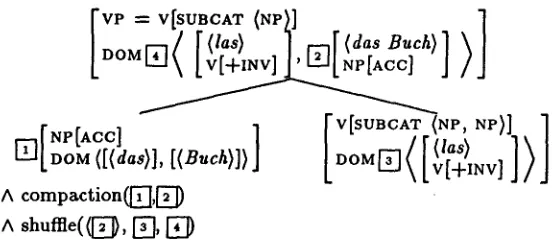
A compaction([~],[~])
^ shuffle(q , E], [D
Figure 2: Domain formation using compaction and shuffle
Given compaction and the earlier shnffle relation, the construction of the intermediate VP domain can be thought of as involving an instance of the Head- Complement Schema (Pollard and Sag, 1994), aug- mented with the relevant relational constraints on domain formation, as shown in Figure 2.
2 Extraposition via Order Domains
Order domains provide a natural framework for or- der variation and discontinuous constituency. One of the areas in which this approach has found a natural application is extraposition of various kinds of con- stituents. Reape (1994) proposes the binary-valued feature EXTRA to order an extraposed VP last in the domain of the clause, using the LP statement in (5):
(5) [--EXTRA] "~ [+EXTRA]
Similarly, Nerbonne (1994) uses this feature to account for instance for extrapositions of relative clauses from NPs such as (6); the composition struc- ture proposed by Nerbonne for (6)is given in Fig- ure 3.
(6)
einen Hund fiittern [der Hunger hat] a dog feed that hunger has 'feed a dog that is hungry'The structure in Figure 3 also illustrates the fea- ture
UNIONED,
which Reape and Nerbonne assume to play a role in domain formation process. Thus, a constituent marked[UNIONED -Jr-]
requires that the contents of its domain be shuffled into the domain of a higher constituent that it becomes part of (i.e. it is domain-unioned). For instance, in Figure 3, the[UNIONED +]
specification on the higher NP occa-sions the VP domain to comprise not only the verb, but also both domain objects of the NP. Conversely,
a [UNIONED --]
marking in Reape's and Nerbonne'ssystem effects the insertion of a single domain ob- ject, corresponding to the constituent thus specified. Therefore, in Figure 3, the internal structure of the relative clause domain becomes opaque once it be- comes part of the higher NP domain.
3 S h o r t c o m i n g s o f N e r b o n n e ' s a n a l y s i s
One problematic aspect of Nerbonne's proposal con- cerns the fact that on his account, the extraposabil- ity of relative clauses is directly linked to the Head- Adjunct Schema that inter alia licenses the combi- nation of nominals with relative clauses. However, whether a clause can be extraposed is independent of its adjunct/complement status within the NP. Thus, (7) illdstrates the extraposition of a comple- ment clause (Keller, 1994):
(7) Planck hat die Entdeckung gemacht Planck has the discovery made [dab Licht Teilchennatur hat]. that light particle.nature has 'Planck made the discovery that light has a particle nature.'
The same also holds for other kinds of extraposable constituents, such as VPs and PPs. On Nerbonne's analysis, the extraposability of complements has to be encoded separately in the schema that licenses head-complement structures. This misses the gen- eralization that extraposability of some element is tied directly to the final occurrence within the con- stituent it is dislocated from. s Therefore, extrapos- ability should be tied to the linear properties of the constituent in question, not to its grammatical func- tion.
A different kind of problem arises in the case of ex- tractions from prepositional phrases, as for instance in (S):
(8) an einen Hund denken [der Hunger hat] of a dog think that hunger has 'think of a dog that is hungry'
On the one hand, there has to be a domain object for an einen Hund in the clausal domain because this
[image:3.612.66.342.62.182.2]VP
oo.( <.r
],
],
)]
~_. I r (einen Hund) ] [ ( der Hunger hat)|
]
"REL-S
UNIONED -
[NP
] EXTRA"~-
DoM ([ (eine.)1, [(Hund)
])
ool,,, (
[<Jet)]
<Hunger)
.
],[<v',O,>])
Figure 3: Extraposition of relative clause in Nerbonne 1994
[VoM
element is subject to the same variations in linear order as PPs in general. On the other hand, the attachment site of the preposition will have to be higher than the relative clause because clearly, the relative clause modifies the nominal, but
not
the PP. As a potential solution one may propose to have the preposition directly be "integrated" (phonologi- cally and in terms ofSYNSEM
information) into the NP domain object corresponding toeinen Hund.
However, this would violate an implicit assumption made in order domain-based approaches to lineariza- tion to the effect that domain objects are inalterable. Hence, the only legitimate operations involve adding elements to an order domain or compacting that do- main to form a new domain object, but crucially, op- erations that nonmonotonically change existing do- main objects within a domain are prohibited.4 P a r t i a l c o m p a c t i o n
In this section, we present an alternative to Ner- bonne's analysis based on an extension of the pos- sibilities for domain formation. In particular, we propose that besides total compaction and domain union, there is a third possibility, which we will call
partial compaction.
In fact, as will become clear be- low, total compaction and partial compatcion are not distinct possibilities; rather, the former is a sub- case of the latter.Intuitively, partial compaction allows designated domain objects to be "liberated" into a higher do- main, while the remaining elements of the source domain are compacted into a single domain object. To see how this improves the analysis of extraposi- tion, consider the alternative analysis for the exam- ple in (6), given in Figure 4.
As shown in Figure 4, we assume that the or- der domain within NPs (or PPs) is essentially flat, and moreover, that domain objects for NP-internal prenominal constituents are prepended to the do-
main of the nominal projection so that the linear string is isomorphic to the yield of the usual right- branching analysis trees for NPs. Adjuncts and complements, on the other hand, follow the nomi- nal head by virtue of their
["t-EXTRA]
specification, which also renders them extraposable. If the NP combines with a verbal head, it may be partially compacted. In that case, the relative clause's do- main object (El) is inserted into the domain of the VP together with the domain object consisting of the sameSYNSEM
value as the original NP and that NP's phonology minus the phonology of the relative clause ([~]). By virtue of its[EXTRA "~-]
marking, the domain object of the relative clause is now ordered last in the higher VP domain, while the remnant NP is ordered along the same lines as NPs in general.One important aspect to note is that on this ap- proach, the inalterability condition on domain ob- jects is not violated. Thus, the domain object of the relative clause ( [ ~ in the NP domain is token- identical to the one in the VP domain. Moreover, the integrity of the remaining NP's domain object is not affected as--unlike in Nerbonne's analysis-- there is no corresponding domain object in the do- main of the NP before the latter is licensed as the complement of the verb
fattern.
[image:4.612.77.470.64.240.2]I
VP, IZ]/REL-~
L E X T R A -4-
[]
/r,e,ne.,]
] r' er n,erha"]
DET
[~oM ([(#,,n~)])]
^ p-compaction(l-i-l,[Z], lID)
^ shume(I[Zl), ( ~ , l ' q , ~
I REL-S E X T R A
+
v , . \ LR~.'. J' uP
[,:.')])]
Figure 4: Extraposition via partial compaction
(9) p-compaction ([~],[~],[~) -
-[ sign
"1
LDOMIZ]
J
[ dora-oh1 ]
^ [~: 1 ~ _ 5 ] 1
[PHON 7LT.J J
^
s h u m e ( m , [ ] , ~
A joineHoN (~J,[L])
Intuitively, the
p-compaction
relation holds of a sign S (~]), domain object O ([~, and a list of domain objects L (~]) only if O is t~-e compaction of S with L being a llst of domain objects "liberated" from the S's order domain. This relation is invoked for instance by the schema combining a head (H) with a complement (C): [image:5.612.75.487.64.361.2](10) [ i ~ ]
[I-I:]
[ D O M F ~ ][C:] [ ]
A p- compaction ([~],~],[~])
^ shume(([~,ff],[E,ff])
^ [B: zist ( [s~NSEM [EXTRA +]])
[
[ HEAD
verb^([]: <>
v [ :LS'N EM-Lsu. AT
<>]])
The third constraint associated with the Head- Complement Schema ensures that only those ele-
ments that are marked
as [EXTRA -t-])
within the smaller constituent can be passed into the higher do- main, while the last one prevents extraposition out of clauses (cf. Ross' Right Roof Constraint (Ross, 1967)).This approach is superior to Nerhonne's, as the extraposability of an item is correlated o n l y w i t h its linear properties (right-peripheral occurrence in a domain via [EXTRA +]), but not with its sta- tus as adjunct or complement. Our approach also makes the correct prediction that extraposition is only possible if the extraposed element is already final in the extraposition source. 6 In this sense, ex- traposition is subject to a monotonicity condition to the effect that the element in question has to occur in the same linear relationship in the smaller and the larger domains, viz. right-peripherally (modulo other extraposed constituents). This aspect clearly favors our approach over alternative proposals that treat extraposition in terms of a NONLOCAL depen- dency (Keller, 1994). In approaches of that kind, there is nothing, for example, to block extraposition of prenominal elements.
Our approach allows an obvious extension to the case of extraposition from PPs which are prob- lematic for Nerbonne's analysis. Prepositions are prepended to the domain of NPs in the same way
Iv.
DOM[5-']i [][ (Neienen
Hund der ftunger hai) ], [ (vf£Ltteru)
]
)]
]
[
(einen)
[ ] D o M T ,
A p-compaction(I-F],[], 0 )
^ s h u t n e ( ( [ ~ , 0 , [ ] , E l )
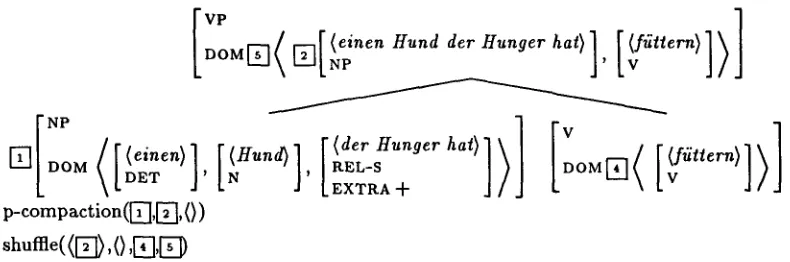
Figure 5: Total compaction as a special case of compaction
t h a t determiners are to N domains.
Along similar lines, note t h a t extrapositions from topicalized constituents, noted by Nerbonne as a challenge for his proposal, do not pose a problem for our account.
(11) Eine Dame ist an der Tiir a lady is at the door [die Sie sprechen will]. who you speak wants 'A lady is at the door who wants to talk to you.'
If we assume, following Kathol (In progress), t h a t topicalized constituents are part of the same clausal domain as the rest of the sentence, 7 then an ex- traposed domain object, inherited via partial com- paction from the topic, will automatically have to occur clause-finally, just as in the case of extraposi- tion from regular complements.
So far, we have only considered the case in which the extraposed constituent is inherited by the higher order domain. However, the definition of the p-
compaction
relation in (12) also holds in the case where the list of liberated domain objects is empty, which amounts to the total compaction of the sign in question. As a result, we can regard total com- paction as a special case of thep-compaction
relation in general. This means t h a t as an alternative lin- earization of (6), we can also have the extraposition- less analysis in Figure 5.Therefore, there is no longer a need for the
U N I O N E D feature for extraposition. This means that
we can have a stronger theory as constraints on ex- traposability will be result of general conditions on the syntactic licensing schema (e.g. the Right Roof Constraint in (10)). But this means that whether or not something can be extraposed has been rendered exempt from lexical variation in principle---unlike in Reape's system where extraposability is a m a t t e r of lexical selection.
rI.e. the initial placement of a preverbal constituent in a verb-second clause is a consequence of LP constraints within a
flat
clausal order domain.Moreover, while Reape employs this feature for the linearization of nonfinite complementation, it can be shown t h a t the Argument Composition approach of Hinrichs & Nakazawa (Hinrichs and Nakazawa, 1994), among m a n y others, is linguisti- cally superior (Kathol, In progress). As a result, we can dispense with the UNIONED feature altogether and instead derive linearization conditions from gen- eral principles of syntactic combination t h a t are not subject to lexical variation.
5 C o n c l u s i o n
We have argued for an approach to extraposition from smaller constituents t h a t pays specific atten- tion to the
linear
properties of the extraposition source, s To this end, we have proposed a more fine- grained typology of ways in which an order domain can be formed from smaller constituents. Crucially, we use relational constraints to define the interde- pendencies; hence our approach fits squarely into the paradigm in which g r a m m a r s are viewed as sets of relational dependencies t h a t has been advocated for instance in DSrre et al. (1992). Since the relational perspective also lies at the heart of computational formalisms such as CUF (DSrre and Eisele, 1991), the ideas presented here are expected to carry over into practical systems rather straightforwardly. We leave this task for future work.R e f e r e n c e s
Jochen DSrre and Andreas Eisele. 1991. A Compre- hensive Unification-Based G r a m m a r Formalism. DYANA Deliverable R3.1.B, E S P R I T Basic Ac- tion BR3175.
Jochen DSrre, Andreas Eisele, and Roland Seif- fert. 1992. G r a m m a r s as Relational Dependen- cies. AIMS Report 7, Institut fiir maschinelle Sprachverarbeitung, S t u t t g a r t .
[image:6.612.78.473.64.195.2]David Dowty. In press. Towards a Minimalist The- ory of Syntactic Structure. In Horck and Sijtsma, editors, Discontinuous Constituency. Mouton de Gruyter.
Erhard Hinrichs and Tsuneko Nakazawa. 1994. Linearizing finite AUX in German Verbal com- plexes. In John Nerbonne, Klaus Netter, and Carl Pollard, editors, German in Head-Driven Phrase Structure Grammar, pages 11-38. Stanford: CSLI Publications.
Andreas Kathol and Carl Pollard. 1995. On the Left Periphery of German Subordinate Clauses. In West Coast Conference on Formal Linguistics,
volume 14, Stanford University. CSLI Publica- tions/SLA.
Andreas Kathol. In progress. Linearization-Based German Syntax. Ph.D. thesis, Ohio State Univer- sity.
Frank Keller. 1994. Extraposition in HPSG. un- publ. ms., IBM Germany, Scientific Center Hei- delberg.
John Nerbonne. 1994. Partial verb phrases and spu- rious ambiguities. In John Nerbonne, Klaus Net- ter, and Carl Pollard, editors, German in Head- Driven Phrase Structure Grammar, pages 109- 150. Stanford: CSLI Publications.
Carl J. Pollard and Ivan A. Sag. 1994. Head-Driven Phrase Structure Grammar. CSLI Publications and University of Chicago Press.
Carl Pollard, Robert Levine, and Robert Kasper. 1993. Studies in Constituent Ordering: Toward a Theory of Linearization in Head-Driven Phrase Structure Grammar. Grant Proposal to the Na- tional Science Foundation, Ohio State University. Mike Reape. 1993. A Formal Theory of Word Or- der: A Case Study in West Germanic. Ph.D. the- sis, University of Edinburgh.
Mike Reape. 1994. Domain Union and Word Or- der Variation in German. In John Nerbonne, Klaus Netter, and Carl Pollard, editors, German in Head-Driven Phrase Structure Grammar, pages 151-198. Stanford: CSLI Publications.
John Ross. 1967. Constraints on Variables in Syn- tax. Ph.D. thesis, MIT.
Susan Stucky. 1987. Configurational Variation in English: A Study of Extraposition and Re- lated Matters. In Discontinuous Constituency,
volume 20 of Syntax and Semantics, pages 377-
404. Academic Press, New York.