Glyn Morrill
Department of Computer Science Universitat Polit`ecnica de Catalunya Barcelona
Oriol Valent´ın
Department of Computer Science Universitat Polit`ecnica de Catalunya Barcelona
Spurious ambiguity is the phenomenon whereby distinct derivations in grammar may assign the same structural reading, resulting in redundancy in the parse search space and inefficiency in parsing. Understanding the problem depends on identifying the essential mathematical structure of derivations. This is trivial in the case of context free grammar, where the parse structures are ordered trees; in the case of type logical categorial grammar, the parse structures are proof nets. However, with respect to multiplicatives, intrinsic proof nets have not yet been given for displacement calculus, and proof nets for additives, which have applications to polymorphism, are not easy to characterize. In this context we approach here multiplicative-additive spurious ambiguity by means of the proof-theoretic technique of focalization.
1. Introduction
In context free grammar (CFG), sequential rewriting derivations exhibit spurious ambi-guity: Distinct rewriting derivations may correspond to the same parse structure (tree) and the same structural reading.1 In this case, it is transparent to develop parsing algo-rithms avoiding spurious ambiguity by reference to parse trees. In categorial grammar (CG), the problem is more subtle. The Cut-free Lambek sequent proof search space is finite, but involves a combinatorial explosion of spuriously ambiguous sequential proofs. This spurious ambiguity in CG can be understood, analogously to CFG, as involving inessential rule reorderings, which we parallelize in underlying geometric parse structures that are (planar) proof nets.
The planarity of Lambek proof nets reflects that the formalism is continuous or concatenative. But the challenge of natural grammar is discontinuity or apparent dis-placement, whereby there is syntactic/semantic mismatch, or elements appearing out
1 This paper is a revised and expanded version of Morrill and Valent´ın (2015).
Submission received: 21 May 2017; revised version received: 7 February 2018; accepted for publication: 16 March 2018.
of place. Hence the subsumption of Lambek calculus by displacement calculus D, including intercalation as well as concatenation (Morrill, Valent´ın, and Fadda 2011).
Proof nets forD must be partially non-planar; steps towards intrinsic correctness criteria for displacement proof nets are made in Fadda (2010) and Moot (2014, 2016). Additive proof nets are considered in Hughes and van Glabbeck (2005) and Abrusci and Maieli (2016). However, even in the case of Lambek calculus, it is not clear that in practice parsing by reference to intrinsic criteria (Morril 2011; Moot and Retor´e 2012, Appendix B) is more efficient than parsing by reference to extrinsic criteria of uniform sequent calculus (Miller et al. 1991; Hendriks 1993). In its turn, on the other hand, uniform proof does not extend to product left rules and product unit left rules, nor to additives. The focalization of Andreoli (1992) is a methodology midway between proof nets and uniform proof. Here, we apply the focusing discipline to the parsing as deduction ofDwith additives.
In Chaudhuri, Miller, and Saurin (2008), multifocusing is defined for unit-free multiplicative-additive linear logic, providing canonical sequent proofs; an eventual goal would be to formulate multifocusing for multiplicative-additive categorial logic and for categorial logic generally. In this respect the present article represents an inter-mediate step (and includes units, which have linguistic use). Note that Simmons (2012) develops focusing for Lambek calculus with additives, but not for displacement logic, for which we show completeness of focusing here.
The article is structured as follows. In Sections 1.1 and 1.2 we describe spurious ambiguity in context-free grammar and Lambek calculus. In Section 2 we recall the displacement calculus with additives. In Section 3 we contextualize the problem of spurious ambiguity in computational linguistics. In Section 4 we discuss focalization. In Section 5 we present focalization for the displacement calculus with additives. In Section 6 we prove the completeness of focalization for displacement calculus with additives. In Section 7 we exemplify focalization and evaluate it compared with uniform proof. We conclude in Section 8. In Appendix A we prove the auxiliary technical result of Cut-elimination for weak focalization.
1.1 Spurious Ambiguity in CFG
Consider the following production rules: (1) S→QP VP
QP→Q CN VP→TV N
These generate the following sequential rewriting derivations: (2) S→QP VP→Q CN VP→Q CN TV N
S→QP VP→QP TV N→Q CN TV N
These sequential rewriting derivations correspond to the same parellelized parse structure:
(3)
S
QP VP
And they correspond to the same structural reading; sequential rewriting in CFG has, then,spurious ambiguity, and the underlying geometric parse structures are ordered trees.
1.2 Spurious Ambiguity in CG
Lambek calculusL(Lambek 1958) is a logic of strings with the operation+of concate-nation. Recall the definitions of types, configurations, and sequents ofLin terms of a set
Pof primitive types;2in Backus Naur form (BNF) notation whereFis the set of types,
Othe set of configurations, andSeq(L) the set of sequents: (4) Types F ::=P|F\F|F/F|F•F
Configurations O::=F|F,O
Sequents Seq(L) ::=O⇒F
Lambek calculus types have the following interpretation in semigroups or monoids: (5) [[A\C]]={s2| ∀s1∈[[A]],s1+s2∈[[C]]}
[[C/B]]={s1| ∀s2∈[[B]],s1+s2 ∈[[C]]}
[[A•B]]={s1+s2|s1∈[[A]] &s2 ∈[[B]]}
Where A,B,C,D are types and Γ,∆ are configurations, the logical rules of Lambek calculus are as follows:
(6) Γ⇒A ∆(C)⇒D\L
∆(Γ,A\C)⇒D
A,Γ⇒C \R
Γ⇒A\C
Γ⇒B ∆(C)⇒D
/L
∆(C/B,Γ)⇒D
Γ,B⇒C
/R
Γ⇒C/B
∆(A,B)⇒D •L
∆(A•B)⇒D
∆⇒A Γ⇒B
•R
∆,Γ⇒A•B
There is completeness when the types are interpreted in free semigroups or monoids Pentus (1993, 1998).
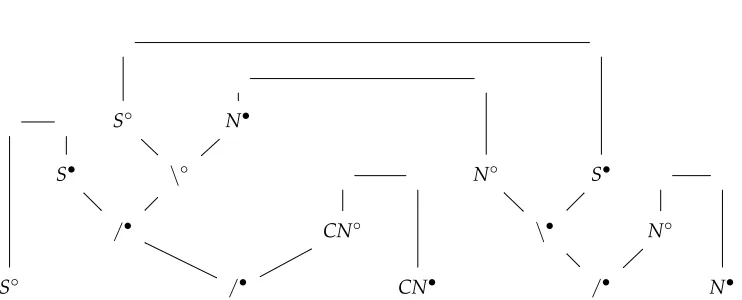
Even among Cut-free proofs there is spurious ambiguity; consider, for example, the sequential derivations of Figure 1. These have the same parallelized parse structure (proof net), given in Figure 2: The structures that represent Lambek proofs without spu-rious ambiguity are planar graphs that must satisfy certain global and local properties, and are called proof nets; for a survey see Lamarche and Retor´e (1996). Proof nets provide a geometric perspective on derivational equivalence. Alternatively, we may identify the same algebraic parse structure (Curry-Howard term):
(7) ((xQxCN)λx((xTVxN)x))
CN⇒CN N⇒N
N⇒N S⇒S \L N,N\S⇒S
/L N, (N\S)/N,N⇒S
\R
(N\S)/N,N⇒N\S S⇒S /L S/(N\S), (N\S)/N,N⇒S
/L (S/(N\S))/CN,CN, (N\S)/N,N⇒S
N⇒N
CN⇒CN
N⇒N S⇒S \L N,N\S⇒S
\R
N\S⇒N\S S⇒S /L S/(N\S),N\S⇒S
/L (S/(N\S))/CN,CN,N\S⇒S
[image:4.486.50.421.171.321.2]/L (S/(N\S))/CN,CN, (N\S)/N,N⇒S Figure 1
Spurious ambiguity in CG.
S◦ N•
S• \◦ N◦ S•
/• CN◦ \• N◦
S◦ /• CN• /• N•
Figure 2
Proof net: The parsing structure of categorial grammar (Morrill 2000).
But Lambek calculus is continuous (planarity). A major issue in grammar is disconti-nuity, namely, syntax/semantics mismatch (e.g., the fact that quantifier phrases occur in situ but take sentential scope; or “gapping” coordination), hence the displacement calculus. This provides a general accommodation of discontinuity in grammar, by contrast with, for example, Combinatory Categorial Grammar (Steedman 2000), which seeks minimal case by case augmentations of the formalism to deal with quantification, gapping, and so on.3
2. D with Additives, DA
The basic categorial grammar of Ajdukiewicz and Bar-Hillel is concatenative/ continuous/projective, and this feature is reflected in the fact that it is context-free equivalent in weak generative power (Bar-Hillel, Gaifman, and Shamir 1960). The same is true of the logical categorial grammar of Lambek (1958), which is still context free in generative power (Pentus 1992). The main challenge in natu-ral grammar comes from syntax/semantics mismatch or displacement; such non-concatenativity/discontinuity/non-projectivity is treated in mainstream linguistics by overt movement (e.g., the verb-raising of cross-serial dependencies) and covert move-ment (e.g., the quantifier-raising of quantification). The displacemove-ment calculus is a
α + β
=
α β
append+:Li,Lj→Li+j
α 1 γ
×k
β
=
α β γ
[image:5.486.55.365.61.219.2]plug×k:Li+1,Lj→Li+j Figure 3
Append and plug.
response to this challenge, which preserves all the good design features of Lambek calculus while extending the generative power and capturing “movement” phenomena such as cross-serial dependencies and quantifer-raising.4
In this section we present displacement calculus D, and a displacement logicDA comprisingD with additives. AlthoughD is indeed a conservative extension of the Lambek calculus allowing empty antecedents (L*), we think of it not just as anextension of Lambek calculus but as ageneralization, because it involves a whole reformulation to deal with discontinuity while conservingL*as a special case.
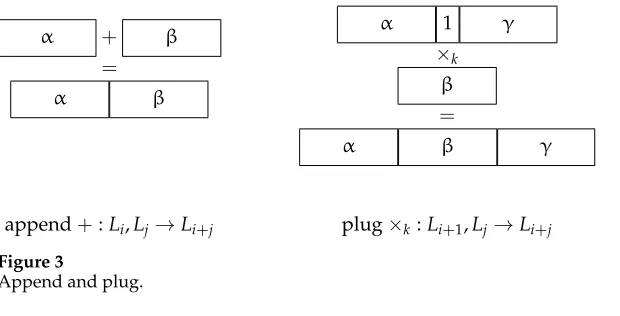
Displacement calculus is a logic of discontinuous strings—strings punctuated by a separator1 and subject to operations of append (+; concatenation) and plug (×k; interca-lation at thekth separator, counting from the left); see Figure 3. Recall the definition of types and their sorts, configurations and their sorts, and sequents, for the displacement calculus with additives (iandjrange over the naturals 0, 1,. . .):
(8) WherePiare primitive types of sorti, Types Fi::=Pi
Fj::=Fi\Fi+j
Fi::=Fi+j/Fj
Fi+j::=Fi•Fj
F0 ::=I
Fj::=Fi+1↓kFi+j1≤k≤i+1
Fi+1 ::=Fi+j↑kFj 1≤k≤i+1
Fi+j::=Fi+1kFj 1≤k≤i+1
F1 ::=J
Fi::=Fi&Fi
Fi::=Fi⊕Fi
Sorts(A)=theis.t.A∈Fi
For example,s((S↑1N)↑2N)=s((S↑1N)↑1N)=2 wheres(N)=s(S)=0
WhereΛis the metasyntactic empty string there is now the BNF definition of configurations:
Configurations O::= Λ|T,O
T ::=1|F0|Fi>0{O:. . .:O
| {z } iO0s
}
For example, there is the configuration (S↑1N)↑2N{N, 1 :S↑1N{N},S}, 1,N, 1 Sorts(O)=|O|1
For examples((S↑1N)↑2N{N, 1 :S↑1N{N},S}, 1,N, 1)=3 SequentsSeq(DA) ::=O⇒As.t.s(O)=s(A)
The figure−→A of a typeAis defined by:
(9) −→A =
A ifs(A)=0
A{1 :. . .: 1
| {z } s(A) 10s
}ifs(A)>0
Where Γ is a configuration of sort i and ∆1,. . .,∆i are configurations, the fold
Γ⊗ h∆1:. . .:∆ii is the result of replacing the successive 1’s in Γ by ∆1,. . .,∆i
respectively. For example ((S↑1N)↑2N{N, 1 :S↑1N{N},S}, 1,N, 1)⊗ h1 :N,N\S:Λi is (S↑1N)↑2N{N, 1 :S↑1N{N},S},N,N\S,N.
Where∆is a configuration of sorti>0 andΓis a configuration, thekth metalin-guistic wrap∆|kΓ, 1≤k≤i, is given by
(10) ∆|kΓ =df ∆⊗ h1 :. . .: 1
| {z } k−1 1’s
:Γ: 1 :. . .: 1 | {z } i−k1’s
i
that is,∆|kΓis the configuration resulting from replacing byΓthekth separator in∆. In intuitive terms, syntactical interpretation of displacement calculus is as follows (see Valent´ın [2016] for completeness results):
(11) [[A\C]]={s2| ∀s1 ∈[[A]],s1+s2∈[[C]]}
[[C/B]]={s1| ∀s2 ∈[[B]],s1+s2 ∈[[C]]}
[[A•B]]={s1+s2|s1∈[[A]] &s2 ∈[[B]]}
[[I]]={0}
[[A↓kC]]={s2| ∀s1 ∈[[A]],s1×ks2 ∈[[C]]}
[[C↑kB]]={s1| ∀s2 ∈[[B]],s1×ks2∈[[C]]}
[[AkB]]={s1×ks2|s1∈[[A]] &s2∈[[B]]}
[[J]]={1}
a potentially discontinuous distinguished occurrenceΓ with external context∆0 and internalcontexts∆1,. . .,∆n:
(12) Γ⇒A ∆h − →
Ci ⇒D \L
∆hΓ,−−→A\Ci ⇒D
−→ A,Γ⇒C
\R
Γ⇒A\C
Γ⇒B ∆h−→Ci ⇒D
/L
∆h−−→C/B,Γi ⇒D
Γ,−→B ⇒C
/R
Γ⇒C/B
∆h−→A,−→Bi ⇒D •L
∆h−−→A•Bi ⇒D
∆⇒A Γ⇒B
•R
∆,Γ⇒A•B
∆hΛi ⇒A IL
∆h−→I i ⇒A
IR
Λ⇒I
(13) Γ⇒A ∆h − →
Ci ⇒D ↓kL
∆hΓ|k−−−→A↓kCi ⇒D
− →
A|kΓ⇒C ↓kR
Γ⇒A↓kC
Γ⇒B ∆h−→Ci ⇒D ↑kL
∆h−−→C↑kB|kΓi ⇒D
Γ|k−→B ⇒C ↑kR
Γ⇒C↑kB
∆h−→A|k−→Bi ⇒D kL
∆h−−−→AkBi ⇒D
∆⇒A Γ⇒B
kR
∆|kΓ⇒AkB
∆h1i ⇒A JL
∆h−→J i ⇒A
JR 1⇒J
(14) Γh − →
Ai ⇒C &L1 Γh−−→A&Bi ⇒C
Γh−→Bi ⇒C &L2 Γh−−→A&Bi ⇒C
Γ⇒A Γ⇒B
&R
Γ⇒A&B
Γh−→Ai ⇒C Γh−→Bi ⇒C ⊕L
Γh−−→A⊕Bi ⇒C
Γ⇒A ⊕R1 Γ⇒A⊕B
Γ⇒B ⊕R2 Γ⇒A⊕B
as the:N/CN for the man:N and sings:N\S for John sings:S, and loves: (N\S)/N for John loves Mary:S. Hence, forthe man:
(15) CN⇒CN N⇒N/L N/CN,CN⇒N
And forJohn singsandJohn loves Mary:
(16) N⇒N S⇒S\L
N,N\S⇒S N⇒N
N⇒N S⇒S \L N,N\S⇒S
/L
N, (N\S)/N,N⇒S
The continuous product•is exemplified by a “small clause” assignment such as considers: (N\S)/(N•(CN/CN)) forJohn considers Mary socialist:S.
(17) N⇒N
CN⇒CN CN⇒CN
/L
CN/CN,CN⇒CN
/R
CN/CN⇒CN/CN •R N,CN/CN⇒N•(CN/CN)
N⇒N S⇒S \L N,N\S⇒S
/L
N, (N\S)/(N•(CN/CN)),N,CN/CN⇒S
Of course, this use of product is not essential: We could just as well have used ((N\S)/(CN/CN))/Nbecause in general we have bothA/(C•B)⇒(A/B)/C(currying) and (A/B)/C⇒A/(C•B) (uncurrying).
The discontinuous multiplicatives {↓, , ↑, J}, the displacement connectives, of Morrill and Valent´ın (2010) and Morrill, Valent´ın, and Fadda (2011) are defined in relation to intercalation. When the value of theksubscript is 1 it may be omitted (i.e., it defaults to one). Circumfixation, or extraction,↑, is exemplified by a discontinuous particle-verb assignmentcalls+1+up: (N\S)↑NforMary calls the man up:S:
(18)
CN⇒CN N⇒N
/L
N/CN,CN⇒N
N⇒N S⇒S \L N,N\S⇒S
↑L N, (N\S)↑N{N/CN,CN} ⇒S
Infixation, ↓, and extraction together are exemplified by a quantifier assignment everyone: (S↑N)↓Ssimulating Montague’s S14 rule of quantifying whereby a quantifier phrase can occur where a name can occur (but takes sentential scope):
(19)
. . .,N,. . . ⇒S
↑R
. . ., 1,. . . ⇒S↑N S⇒Sid
↓L
Circumfixation and discontinuous product, , are illustrated in an assignment to a relative pronounthat: (CN\CN)/((S↑N)I) allowing both peripheral and medial extraction,that John likes:CN\CNandthat John saw today:CN\CN:
(20)
N, (N\S)/N,N⇒S ↑R
N, (N\S)/N, 1⇒S↑N ⇒IIL R
N, (N\S)/N⇒(S↑N)I CN\CN⇒CN\CN
/L
(CN\CN)/((S↑N)I),N, (N\S)/N⇒CN\CN
(21)
N, (N\S)/N,N,S\S⇒S ↑R
N, (N\S)/N, 1,S\S⇒S↑N ⇒IIL R
N, (N\S)/N,S\S⇒(S↑N)I CN\CN⇒CN\CN
/L
(CN\CN)/((S↑N)I),N, (N\S)/N,S\S⇒CN\CN
The additive conjunction and disjunction{&,⊕}of Lambek (1961), Morrill (1990), and Kanazawa (1992) capture polymorphism. For example, the additive conjunction & can be used forrice:N&CNas inrice grows:Sandthe rice grows:S:
(22)
N⇒N &L1
N&CN⇒N S⇒S \L N&CN,N\S⇒S
N/CN,CN,N\S⇒S &L2
N/CN,N&CN,N\S⇒S
The additive disjunction ⊕ can be used for is: (N\S)/(N⊕(CN/CN)) as in Tully is Cicero:SandTully is humanist:S:
(23)
N⇒N
⊕R1
N⇒N⊕(CN/CN) N\S⇒N\S
/L
(N\S)/(N⊕(CN/CN)),N⇒N\S CN/CN⇒CN/CN
⊕R2
CN/CN⇒N⊕(CN/CN) N\S⇒N\S
/L
(N\S)/(N⊕(CN/CN)),CN/CN⇒N\S
3. The Problem of Spurious Ambiguity in Computational Linguistics
This section elaborates the bibliographic context of so-called spurious ambiguity, a problem frequently arising in varieties of parsing of different formalisms. The spurious ambiguity that has been discussed in the literature falls in two broad classes: that for categorial parsing and that for dependency parsing.
The literature on spurious ambiguity for categorial parsing is represented by the following.
considered: first, a notion of normalization for this implicative Lambek calculus, and second, a constructive calculus generating all and only the normal forms of the first. The latter consists of applying right rules as much as possible and then switching to left rules, which revert to the right phase in the minor premise and which conserve the value active type in the major premise. Hepple shows that the system is sound and complete and that it delivers a unique proof in each Cut-free semantic equivalence class. This amounts to uniform proof (Miller et al. 1991), but was
developed independently. Retrospectively, it can be seen as focusing for the implicative fragment of Lambek calculus. It is straightforwardly extendible to product right (Hendriks 1993), but not product left, which requires the deeper understanding of the focusing method.
r
Eisner (1996) provides a normal form framework for Combinatory Categorial Grammar (CCG) with generalized binary composition rules. CCG is a version of categorial grammar with a small number ofcombinatory schemata (or a version of CFG with an infinite number of non-terminals) in which the basic directional categorial cancellation rules are extended with phrase structure schemata corresponding to
combinators of combinatory logic. Eisner, following Hepple and Morrill (1989), defines a notion of normal form by a restriction on which rule mothers can serve as which daughters of subsequent rules in bottom–up parsing. Eisner notes that his marking of rules has a rough resemblance to the rule regulation of Hendriks (1993) (which is focusing). But whereas the former is Cut-based rule normalization, the latter is Cut-free metarule normalization. Eisner’s method applies to a wide range of harmonic and non-harmonic composition rules, but not to type-lifting rules. It has been suggested by G. Penn (personal communication) that it is not clear whether CCG is actually categorial grammar; at least, it is not logical categorial grammar; in any case, the focusing methodology we use here is still normalization, but represents a much more general discipline than that used by Eisner.
The literature on spurious ambiguity for dependency parsing is represented by the following.
r
Huang, Vogel, and Chen (2011) address the problem of word alignment between pairs of corresponding sentences in (statistical) machinetranslation. Because this task may be very complex (in fact the search space may grow exponentially), a technique calledsynchronous parsingis used to constrain the search space. However, this approach exhibits the problem of spurious ambiguity, which that paper elaborates in depth. We do not know at this moment whether this work can bring us useful techniques to deal with spurious ambiguity in the field of logic theorem-proving.
r
Goldberg and Nivre (2012) and Cohen, G ´omez-Rodr´ıguez, and Satta(2012) focus on the problem of spurious ambiguity of a general technique for dependency parsing calledtransition-based dependency parsing. The spurious ambiguity investigated in that paper arises in transition systems where different sequences of transitions yield the same dependency tree. The framework of dependency grammars is non-logical in its nature and the spurious ambiguity referred here is completely different from the one addressed in our article, and unfortunately not useful to our work.
r
Hayashi, Kondo, and Matsumoto (2013), which is situated in the field ofdependency parsing, proposes sophisticated parsing techniques that may have spurious ambiguity. A method is presented in order to deal with it based on normalization and canonicity of sequences of actions of appropriate transition systems.
All these approaches tackle by a kind of normalization the general phenomena of spurious ambiguity, whereby different but equivalent alternative applications of operations result in the same output. Focalization in particular is applicable to logical grammar, in which parsing is deduction. This turns out to be quite a deep methodology, revealing, for example, not only invertible (“reversible”) rules, which were known to the early proof-theorists, but also dual focusing (“irreversible”) rules, providing a general discipline for logical normalization, which we now elaborate.
4. Reducing Spurious Ambiguity: On Focalization
In previous sections we have shown the proof machinery ofDA. A further sequent rule is missing, the so-calledCutrule, which incorporates in the sequent calculus the notion of (contextualised)transitivity:
(24) Γ⇒A ∆h − →
Ai ⇒B Cut
∆hΓi ⇒B
Haupsatz. This very important theorem gives as a byproduct the subformula property and decidability in the case ofDA.5
4.1 Properties of Cut-Free Proof Search
“Reversible” rules are rules in which the conclusions are provable if and only if the premises are provable. The reversible rules of displacement calculus with additives are:
/R,\R,•L,IL,↑kR,↓kR,kL,JL, &R, and⊕L. By way of example, consider/R: (25) a. Γ⇒C/B b. Γ,B⇒C
We can safely reverse sequent (25a) into sequent (25b) because both provability and non-provability are preserved—that is,Γ⇒C/Bis provable iffΓ,B⇒Cis provable. We say that the type-occurrence ofC/Bin the succedent of (25a) isreversible.6This means that
in the face of alternative reversible rule options a choice can be made arbitrarily and the other possibilities forgotten (don’t care nondeterminism).
Dually, “irreversible” rules are rules in which it is not the case that the conclusions are provable if and only if the premises are provable. The irreversible rules of displace-ment calculus with additives are:/L,\L,•R,IR,↑kL,↓kL,kR,JR, &Land⊕R. By way of example, consider the/Lrule:
(26) Γ⇒B ∆(C)⇒D/L
∆(C/B,Γ)⇒D
We cannot assume safely that there exist configurations Γand ∆(C) that match the antecedent of the end-sequent, and that preserve provability: We do not have that
∆(C/B,Γ)⇒Dis provable iffΓ⇒Band∆(C)⇒Dare provable. In this case, we say that the distinguished type-occurrenceC/Bin the above sequent isirreversible.7In the face of alternative irreversible rule options, the choice matters and different possibilities must be tried (don’t know nondeterminism).
4.1.1 On Reversible Rules. Consider the following sequents where two distinguished type-occurrences have been underlined:
((N\S)/N)/N,N•N⇒N\S ((N\S)/N)/N,N•N⇒N\S There are the following two commutative derivation fragments:
N, ((N\S)/N)/N,N,N⇒S •L N, ((N\S)/N)/N,N•N⇒S
\R ((N\S)/N)/N,N•N⇒N\S
5 This is because in Cut-free backward-chaining proof search for a given goal sequent a finite number of rules can be applied backwards in only a finite number of ways to generate subgoals at each step, and these subgoals have lower complexity (fewer connectives) than the goal matched; hence the proof search space is finite.
N, ((N\S)/N)/N,N,N⇒S \R ((N\S)/N)/N,N,N⇒N\S
•L ((N\S)/N)/N,N•N⇒N\S
r
Applying the two rules in either order, both (proof) derivations have the same syntactic structure (and the same semantic lambda-term labeling, which we introduce later when we present focused calculus).r
The reversible rules•Land\R commutein the order of application in the proof search. These commutations contribute to spurious ambiguity.r
Reversible rules can be applied don’t care nondeterministically. This resultwas already known by proof-theorists in the 1930s (Gentzen, and others such as Kleene). These rules were calledinvertiblerules.
4.1.2 On Irreversible Rules.Consider the following:
CN⇒CN
/L N, (N\S)/N,N⇒S
\R
(N\S)/N,N⇒N\S S⇒S
/L S/(N\S), (N\S)/N,N⇒S
/L
(S/(N\S))/CN,CN, (N\S)/N,N⇒S
N⇒N
CN⇒CN S/(N\S),N\S⇒S
/L
(S/(N\S))/CN,CN,N\S⇒S
/L
(S/(N\S))/CN,CN, (N\S)/N,N⇒S
r
Dually, both (proof) derivations have the same syntactic structure, (i.e., proof net), as well as the same semantic term labeling codifying the structure of derivations.r
The irreversible rules for/(S/(N\S))/CNand/(N\S)/Ncommutein the order of application in the proof search. These commutations also contribute to spurious ambiguity.r
Contrary to the behavior of reversible types, the choice of the active type (the type decomposed) is critical when it is irreversible.4.2 Consequences
r
A combinatorial explosion in the finite Cut-free proof search space due to the aforementioned rule commutativity.r
The solution: proof nets. But proof nets for categorial logic in general are not fully understood, for example, in the case of units and additive connectives.r
This problem is exacerbated in displacement calculus because there are more connectives and hence more rules giving rise to spuriousambiguities.
4.3 Toward a (Considerable) Elimination of Spurious Ambiguity: Focalization
Reversible rules commute in their order of application and their key property is re-versability. Dually, irreversible rules also commute and their key property (completely unknown to the early proof-theorists8) is so-calledfocalization, which was defined by Andreoli in Andreoli (1992).
4.4 The Discipline of Focalization
Given a sequent, reversible rules are applied in a don’t care nondeterministic fashion until no longer possible. When there are no occurrences of reversible types, one chooses an irreversible type don’t know nondeterministically as active type-occurrence; we say that this type occurrence is in focus, or that it is focalized; and one applies proof search to its subtypes while these remain irreversible. When one finds a reversible type, reversible rules are applied in a don’t care nondeterministic fashion again until no longer possible, when another irreversible type is chosen, and so on.
4.4.1 A Non-focalized Proof: A “Gymkhana in the Proof-search”. Let us consider the following provable sequent with typesQ=S/(N\S), andTV=(N\S)/N.
(27) Q/CN,CN,TV,N⇒S
Sequent (27) has the algebraic Curry-Howard term: (28) ((xQ/CNxCN)λx((xTVxN)x))
Consider the proof fragment:
(29)
CN⇒CN
N⇒N .. .
/L
Q,N\S⇒S
/L
Q,TV,N⇒S
/L
Q/CN,CN,TV,N⇒S
This fragment of proof concludes into a correct proof derivation. But crucially, the discipline of focalization is not applied resulting—in the words of the father of linear logic—in a gymkhana! (In the sense of jumping back and forth.) The foci on irreversible types are not preserved and alternating irreversible types are chosen. Concretely, the underlines show how the active irreversible type in the right premise is not a subtype of the active irreversible type in the endsequent. The discipline of Andreoli’s focalization consists of maintaining the focus on the irreversible subtypes, hence reducing the search space and reducing spurious ambiguity. This rests on the focusing property: that if an irreversible rule instance leads to a proof, it leads to a proof in which the subtypes of the active type are the active types of the premises, if they are irreversible. This is the re-markable proof-theoretic discovery of Andreoli, which fortunately can be applied in the
present case as this article explains. The discipline of focalization reduces dramatically the combinatorial explosion of categorial proof-search.
4.4.2 A Focalized Proof Derivation.A fragment of focalized proof derivation for (27) is as follows:
(30)
CN⇒CN
.. .
\R
TV,N⇒N\S S⇒S
/L
Q,TV,N⇒S
/L
Q/CN,CN,TV,N⇒S
Note that the focus is correctly propagated to the irreversible subtype of the focused irreversible type in the endsequent.
4.5 A Last Ingredient in the Focalization Discipline
r
What happens with literal types? Can they be considered reversible or irreversible? What happens then in the focalized proof-search paradigm?r
The answers: Literals can be assigned what is called in the literature areversible or irreversiblebiasin any manner according to which they belong to the set of reversible or irreversible types. (As we state later we leave open the question of which biases may be favorable.)
Depending on the context, we will saycompoundreversible or irreversible types, or atomicreversible or irreversible types.
5. Focalization for DA
In focalization, situated (in the antecedent of a sequent, input: •; in the succedent of a sequent, output: ◦) compound types are classified as of reversible or irreversible polarityaccording to whether their associated rule is reversible or not; situated atoms obviously do not have associated rules, but we can extend the concept of polar-ity to them, overloading the termsreversible and irreversible, applying the previously mentioned concept of bias. We define in Example (31) a BNF grammar for arbitrary types (observe that atomic types are classified as either At•or At◦):
(31) P::= At◦|A•B|I|AkB|J|A⊕B Q::= At•|C/B|A\C|C↑kB|A↓kC|A&B
summarizes the notational convention on arbitrary (atomic or compound) polarized formulasPandQ:
(32)
input output
rev. P Q
irrev. Q P
Notice that in Example (32) arbitrary polarized types exhibit a kind of De Morgan duality: If reversible output typesQoccur in input position, then they are irreversible; whereas if reversible output typesPoccur in input position, then they are irreversible.
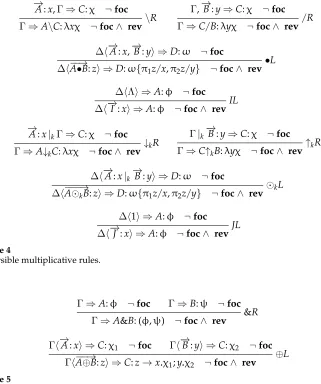
− →
A:x,Γ⇒C:χ ¬foc \R
Γ⇒A\C:λxχ ¬foc∧ rev
Γ,−→B:y⇒C:χ ¬foc
/R
Γ⇒C/B:λyχ ¬foc∧ rev
∆h−→A:x,→−B:yi ⇒D:ω ¬foc
•L
∆h−−→A•B:zi ⇒D:ω{π1z/x,π2z/y} ¬foc∧ rev
∆hΛi ⇒A:φ ¬foc IL
∆h−→I:xi ⇒A:φ ¬foc∧ rev −
→
A:x|kΓ⇒C:χ ¬foc ↓kR
Γ⇒A↓kC:λxχ ¬foc∧ rev
Γ|k−→B:y⇒C:χ ¬foc ↑kR
Γ⇒C↑kB:λyχ ¬foc∧ rev
∆h−→A:x|k−→B:yi ⇒D:ω ¬foc
kL
∆h−−−→AkB:zi ⇒D:ω{π1z/x,π2z/y} ¬foc∧ rev
∆h1i ⇒A:φ ¬foc JL
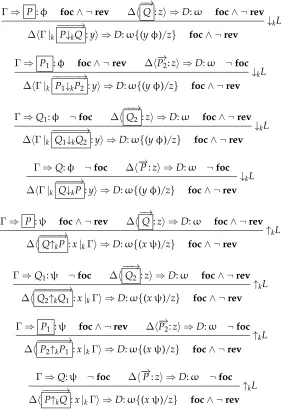
[image:16.486.72.393.265.649.2]∆h−→J :xi ⇒A:φ ¬foc∧ rev Figure 4
Reversible multiplicative rules.
Γ⇒A:φ ¬foc Γ⇒B:ψ ¬foc &R
Γ⇒A&B: (φ,ψ) ¬foc∧ rev
Γh−→A:xi ⇒C:χ1 ¬foc Γh−→B:yi ⇒C:χ2 ¬foc ⊕L
Γh−−→A⊕B:zi ⇒C:z→x.χ1;y.χ2 ¬foc∧ rev Figure 5
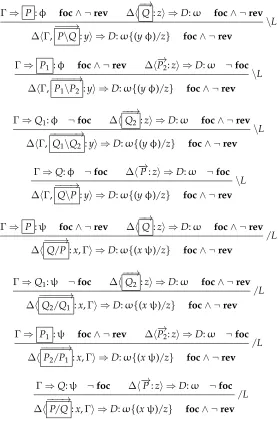
Γ⇒ P:φ foc∧ ¬rev ∆h−→Q:zi ⇒D:ω foc∧ ¬rev \L
∆hΓ, −−−→
P\Q:yi ⇒D:ω{(yφ)/z} foc∧ ¬rev
Γ⇒ P1 :φ foc∧ ¬rev ∆h
−→
P2:zi ⇒D:ω ¬foc
\L
∆hΓ, −−−−→
P1\P2 :yi ⇒D:ω{(yφ)/z} foc∧ ¬rev
Γ⇒Q1:φ ¬foc ∆h
−−→
Q2 :zi ⇒D:ω foc∧ ¬rev
\L
∆hΓ,
−−−−−→
Q1\Q2 :yi ⇒D:ω{(yφ)/z} foc∧ ¬rev
Γ⇒Q:φ ¬foc ∆h→−P:zi ⇒D:ω ¬foc \L
∆hΓ, −−−→
Q\P :yi ⇒D:ω{(yφ)/z} foc∧ ¬rev
Γ⇒ P:ψ foc∧ ¬rev ∆h−→Q:zi ⇒D:ω foc∧ ¬rev
/L
∆h −−−→
Q/P :x,Γi ⇒D:ω{(xψ)/z} foc∧ ¬rev
Γ⇒Q1:ψ ¬foc ∆h
−−→
Q2 :zi ⇒D:ω foc∧ ¬rev
/L
∆h
−−−−−→
Q2/Q1 :x,Γi ⇒D:ω{(xψ)/z} foc∧ ¬rev
Γ⇒ P1 :ψ foc∧ ¬rev ∆h
− →
P2:zi ⇒D:ω ¬foc
/L
∆h −−−−→
P2/P1 :x,Γi ⇒D:ω{(xψ)/z} foc∧ ¬rev
Γ⇒Q:ψ ¬foc ∆h→−P:zi ⇒D:ω ¬foc
/L
∆h −−−→
[image:17.486.104.382.61.482.2]P/Q:x,Γi ⇒D:ω{(xψ)/z} foc∧ ¬rev Figure 6
Left irreversible continuous multiplicative rules.
6. Completeness of Focalization for DA
Γ⇒ P:φ foc∧ ¬rev ∆h−→Q:zi ⇒D:ω foc∧ ¬rev ↓kL
∆hΓ|k−−−−→P↓kQ:yi ⇒D:ω{(yφ)/z} foc∧ ¬rev
Γ⇒ P1 :φ foc∧ ¬rev ∆h
−→
P2:zi ⇒D:ω ¬foc
↓kL
∆hΓ|k−−−−−→P1↓kP2 :yi ⇒D:ω{(yφ)/z} foc∧ ¬rev
Γ⇒Q1:φ ¬foc ∆h
−−→
Q2 :zi ⇒D:ω foc∧ ¬rev
↓kL
∆hΓ|k−−−−−−→Q1↓kQ2 :yi ⇒D:ω{(yφ)/z} foc∧ ¬rev Γ⇒Q:φ ¬foc ∆h→−P:zi ⇒D:ω ¬foc
↓kL
∆hΓ|k−−−−→Q↓kP :yi ⇒D:ω{(yφ)/z} foc∧ ¬rev
Γ⇒ P:ψ foc∧ ¬rev ∆h−→Q:zi ⇒D:ω foc∧ ¬rev ↑kL
∆h−−−−→Q↑kP:x|kΓi ⇒D:ω{(xψ)/z} foc∧ ¬rev
Γ⇒Q1:ψ ¬foc ∆h
−−→
Q2 :zi ⇒D:ω foc∧ ¬rev
↑kL
∆h−−−−−−→Q2↑kQ1 :x|kΓi ⇒D:ω{(xψ)/z} foc∧ ¬rev
Γ⇒ P1 :ψ foc∧ ¬rev ∆h
−→
P2:zi ⇒D:ω ¬foc
↑kL
∆h−−−−−→P2↑kP1 :x|kΓi ⇒D:ω{(xψ)/z} foc∧ ¬rev
Γ⇒Q:ψ ¬foc ∆h→−P:zi ⇒D:ω ¬foc ↑kL
∆h −−−−→
[image:18.486.98.379.62.472.2]P↑kQ:x|kΓi ⇒D:ω{(xψ)/z} foc∧ ¬rev Figure 7
Left irreversible discontinuous multiplicative rules.
type-occurrence. The meaning of such a box is to mark in the proof-search an irre-versible (possibly atomic) type-occurrence either in the antecedent or in the succedent of a sequent. We will say that such a sequent isfocalized.
Additionally, the setSeq(DAFoc) is constrained as follows: (33) Boxed sequents cannot contain compound reversible types
We will usejudgements focand revonDAFoc-sequents. WhereS∈Seq(DAFoc),
Γh−→Q:xi ⇒C:χ foc∧ ¬rev
&L1 Γh−−−−→Q&B:zi ⇒C:χ{π1z/x} foc∧ ¬rev
Γh−→P:xi ⇒C:χ ¬foc
&L1 Γh−−−→P&B:zi ⇒C:χ{π1z/x} foc∧ ¬rev
Γh−→Q:yi ⇒C:χ foc∧ ¬rev
&L2 Γh−−−−→A&Q:zi ⇒C:χ{π2z/y} foc∧ ¬rev
Γh−→P:yi ⇒C:χ ¬foc
[image:19.486.142.347.62.258.2] [image:19.486.117.376.303.507.2]&L2 Γh−−−−A&→P:zi ⇒C:χ{π2z/y} foc∧ ¬rev Figure 8
Left irreversible additive rules.
∆⇒ P1 :φ foc∧ ¬rev Γ⇒ P2 :ψ foc∧ ¬rev
•R
∆,Γ⇒ P1•P2 : (φ,ψ) foc∧ ¬rev
∆⇒ P:φ foc∧ ¬rev Γ⇒Q:ψ ¬foc •R
∆,Γ⇒ P•Q: (φ,ψ) foc∧ ¬rev
∆⇒N:φ ¬foc Γ⇒ P:ψ foc∧ ¬rev •R
∆,Γ⇒ N•P: (φ,ψ) foc∧ ¬rev
∆⇒N1:φ¬foc Γ⇒N2:ψ foc
•R
∆,Γ⇒ N1•N2 : (φ,ψ) foc∧ ¬rev
IR
Λ⇒ I: 0foc∧ ¬rev Figure 9
Right irreversible continuous multiplicative rules.
Sfoc∧ ¬rev. The judgmentS¬focmeans thatSis not focalized (and so may contain reversible type-occurrences).
∆⇒ P1 :φ foc∧ ¬rev Γ⇒ P2 :ψ foc∧ ¬rev
kR
∆|kΓ⇒ P1kP2 : (φ,ψ) foc∧ ¬rev ∆⇒ P :φ foc∧ ¬rev Γ⇒Q:ψ ¬foc
kR
∆|kΓ⇒ PkQ: (φ,ψ) foc∧ ¬rev
∆⇒Q:φ ¬foc Γ⇒ P :ψ foc∧ ¬rev kR
∆|kΓ⇒ QkP: (φ,ψ) foc∧ ¬rev
∆⇒Q1:φ ¬foc Γ⇒Q2:ψ ¬foc
kR
∆|kΓ⇒ Q1kQ2 : (φ,ψ) foc∧ ¬rev
[image:20.486.110.373.61.242.2]JR 1⇒ J : 0foc∧ ¬rev Figure 10
Right irreversible discontinuous multiplicative rules.
Γ⇒ P:φ foc∧ ¬rev ⊕R1 Γ⇒ P⊕B:ι1φ foc∧ ¬rev
Γ⇒Q:φ ¬foc
⊕R1 Γ⇒ Q⊕B:ι1φ foc∧ ¬rev
Γ⇒ P :ψ foc∧ ¬rev ⊕R2 Γ⇒ A⊕P:ι2ψ foc∧ ¬rev
Γ⇒Q:ψ ¬foc
[image:20.486.64.403.281.470.2]⊕R2 Γ⇒ A⊕Q:ι2ψ foc∧ ¬rev Figure 11
Right irreversible additive rules.
∆h−→Q i ⇒A foc
∆h−→Qi ⇒A
∆⇒ P foc
∆⇒P Figure 12
Foc rule forDAFoc.
application. Pseudo-code for a recursive algorithm of strongly focalized proof search is as follows:
bool. functionprove(Σ:unfocused sequent);
/* prove(Σ) returnstrue if the unfocused sequent Σ is provable; otherwise it returnsfalse. */
returnprove rev lst([Σ]).
bool. functionprove rev lst(Ls:list of unfocused sequents);
whileLs contains a sequentΣwith a reversible typedo
Ls := Ls withΣreplaced by the premises of the rule for the reversible type;
returnprove rev lst(Ls).
bool. functionprove irrev lst(Ls:list ofunfocused sequents);
/* prove irrev lst(Ls) returns trueif the list of unfocused sequents without reversible types Ls are provable; otherwise it returnsfalse.*/
varSuccess:bool;
ifLs = []then return true else whereLs = [Σ|T]do
begin
Success :=true;
foreach irreversible type inΣdo ifSuccessthen
begin
focus this irreversible type toΣ0; Success := prove irrev(Σ0);
end; end;
returnSuccessandprove irrev lst(T).
bool. functionprove irrev(Σ: focused sequent);
/* prove irrev(Σ) returnstrueif the focused sequentΣis provable; otherwise it returnsfalse.*/
varSuccess:bool;
varLs rev:list ofunfocused sequents; varLs irrev:list offocused sequents; Success := true;
foreach rule application to the focused type inΣdo ifSuccessthen
begin
Ls rev := its reversible premises; Ls irrev := its irreversible premises;
Success := prove rev lst(Ls rev)andprove irrev lst(Ls irrev); end;
returnSuccess.
procedure prove irrev applies focusing rules and recurses back on prove rev lst and prove irrev lst to determine provability for the given focusing.
In order to prove completeness of (strong) focalization we invoke also an interme-diate weakly focalized system. In all we shall be dealing with three systems: the dis-placement calculus with additivesDAwith sequents notated∆⇒A, theweakly focalized displacement calculus with additives DAfoc with sequents notated ∆=⇒wA, and the strongly focalized displacement calculus with additives DAFoc with sequents notated
∆=⇒A. Sequents of bothDAfocandDAFocmay contain at most one focalized formula. When aDAfocsequent is notated∆=⇒wA3focalized, it means that the sequent possibly contains a (unique) focalized formula. Otherwise,∆=⇒wAmeans that the sequent does not contain a focus. In DAfoc Constraint (33) is not imposed. Thus, whereas strong focalization imposes maximal alternating phases of reversible and irreversible rule application, weak focalization does not impose this maximality. In this section we prove the strong focalization property for the displacement calculus with additivesDA, that is, strong focalization is complete.
The focalization property for Linear Logic was defined by Andreoli (1992). In this article we follow the proof idea from Laurent (2004), which we adapt to the intuitionistic non-commutative caseDAwith twin multiplicative modes of combination, the contin-uous (concatenation), and the discontincontin-uous (intercalation) products. The proof relies heavily on the Cut-elimination property for weakly focalized DA, which is proved in Appendix A. In our presentation of focalization we have avoided the react rules of Andreoli (1992) and Chaudhuri (2006), and use instead our simpler box notation suitable for non-commutativity.
DAFoc is a subsystem of DAfoc. DAfoc has the focusing rules foc and Cut rules p-Cut1, p-Cut2, n-Cut1, and n-Cut29 shown in Equation (34), and the reversible and
irreversible rules displayed in the figures, which are read as allowing in irreversible rules the occurrence of reversible types, and in reversible rules as allowing arbitrary sequents possibly with a focalized type; when3focalizedappears in both premise and conclusion, it means that they are either both focused or both unfocused:
(34) ∆h −→
Qi=⇒wA foc
∆h−→Qi=⇒wA
∆=⇒wP foc
∆=⇒wP
Γ=⇒wP ∆h−→Pi=⇒wC 3focalized p-Cut1
∆hΓi=⇒wC 3focalized
Γ=⇒wQ 3focalized ∆h−→Qi=⇒wC p-Cut2
∆hΓi=⇒wC 3focalized
Γ=⇒wP 3focalized ∆h−→Pi=⇒wC n-Cut1 ∆hΓi=⇒wC 3focalized
Γ=⇒wQ ∆h−→Qi=⇒wC 3focalized n-Cut2 ∆hΓi=⇒wC 3focalized
With respect to bias assignment, consider the provable sequentn,n\s,s\q⇒q. The biases n∈At◦ and q, ands∈At• mean that we have the identity axioms n⇒ n ,
q ⇒q, and s ⇒s.
n⇒ n s,s\q⇒q∗ \L n, n\s,s\q⇒q
foc n,n\s,s\q⇒q
n⇒ n s ⇒s \L n, n\s ⇒s
foc
n,n\s⇒s q ⇒q \L n,n\s, s\q ⇒q
foc n,n\s,s\q⇒q
On the contrary, if we have the biasesn,s∈At◦andq∈At•we have the following blocked derivation:
∗
n,n\s⇒ s q⇒ q \L n,n\s, s\q ⇒q
foc n,n\s,s\q⇒q Whereas we have:
n⇒ n
s⇒ s
q ⇒q foc q⇒q
\L s, s\q ⇒q
foc s,s\q⇒q
\L n, n\s,s\q, ⇒q
foc n,n\s,s\q⇒q
6.1 Embedding of DA into DAfoc
The identity axiomIdwe consider forDAand for bothDAfocandDAFoc is restricted to atomic types; recalling that atomic types are classified into irreversible biasAt◦and reversible biasAt•:
In fact, the identity axiom holds of any type A. The generalized case is called the identity rule Id. It has the following formulation in the sequent calculi considered here:
(36)
− →
A ⇒A inDA
− →
P=⇒w P
−→
Q=⇒wQ inDAfoc −
→
P=⇒P −→Q=⇒Q inDAFoc
The identity ruleId, which applies not just to atomic types (likeId), but to all types is easy to prove in bothDAandDAfoc, but the same is not the case forDAFoc. This is the reason to consider what we have called weak focalization, which helps us to prove smoothly this crucial property for the proof of strong focalization.
Theorem 1 (Embedding ofDAintoDAfoc)
For any configuration∆and typeA, we have that if`∆⇒Athen`∆=⇒wA.
Proof. We proceed by induction on the length of the derivation of DAproofs. In the following lines, we apply the induction hypothesis (i.h.) for each premise ofDArules (with the exception of the identity rule and the right rules of units):
− Identity axiom, wherepandqdenote, respectively, positive and negative atoms:
− →p=⇒
w p foc −
→p=⇒ wp
−→ q=⇒wq
foc −
→q=⇒ wq
− Cut rule: just applyn-Cut. − Units
IR
Λ⇒I ;
IR
Λ=⇒wI foc
Λ=⇒wI
JR
1⇒J ;
JR 1=⇒w J
foc 1=⇒wJ
Left unit rules apply as in the case ofDA.
− Right discontinuous product: There are casesP1kP2,Q1kQ2,QkP, and PkQ. We show one representative example:
∆⇒P Γ⇒Q
kR
∆|kΓ⇒PkQ ;
Γ=⇒wQ
∆=⇒wP
Id −
→ P=⇒w P
Id −
→
Q =⇒wQ foc −
→ Q=⇒wQ
kR −
→
P |k−→Q⇒ PkQ foc −→
P|k−→Q=⇒wPkQ n-Cut1 ∆|k−→Q=⇒wPkQ
n-Cut2 ∆|kΓ=⇒wPkQ
− Left discontinuous↑krule (the left rule for↓kis entirely similar): As in the case for the right discontinuous productkrule, we only show one representative example:
Γ⇒P ∆h−→Qi ⇒A ↑kL
∆h−−−→Q↑kP|kΓi ⇒A ;
Γ=⇒wP
Id −
→ P=⇒w P
Id −→
Q=⇒wQ ↑kL −−−−→
Q↑kP |k−→P=⇒wQ foc −−−→
Q↑kP|k−→P=⇒wQ ∆h−→Qi=⇒wA n-Cut2 ∆h−−−→Q↑kP|k−→Pi=⇒wA
n-Cut1 ∆h−−−→Q↑kP|kΓi=⇒wA
− Right discontinuous↑krule (the right discontinuous rule for↓kis entirely similar):
∆|k−→A ⇒B ↑kR
∆⇒B↑kA ;
∆|k−→A=⇒wB ↑kR
∆=⇒wB↑kA
− Product and implicative continuous rules: These follow the same pattern as the discontinuous case. We interchange the metalinguistick-th
Concerning additives, conjunction right translates directly and we consider then conjunction left (disjunction is symmetric):
∆h−→Pi ⇒C &L1
∆h−−→P&Qi ⇒C ;
Id P=⇒w P
foc P=⇒wP
&L1 −−−−→
P&Q=⇒wP foc −−→
P&Q=⇒wP ∆h−→Pi=⇒wC n-Cut1 ∆h−−→P&Qi=⇒wC
where byIdand application of thefocrule, we have−−→P&Q=⇒wP. 6.2 Embedding of DAfocinto DAFoc
Theorem 2
LetSbe aDAFocsequent. The following holds:
IfDAfoc`S thenDAFoc`S
Proof.We proceed by induction on the size of DAfoc-provable S sequents, namely on |S|.10SinceDA
focis Cut-free (see Appendix A) we consider Cut-freeDAfocproofs ofS. − Case|S|=0. This corresponds to the axiom case, which is the same for
both calculiDAfocandDAFoc—- see Equation (35).
− Suppose|S|>0. Because|S|>0,Sdoes not correspond to an axiom. HenceSis derivable with at least one logical rule. Otherwise, the size ofS
would be equal to 0. The last rule?can be either a logical rule or afocrule (keep in mind we are considering Cut-freeDAfocproofs!). We have two cases:
a) If?is logical, becauseSis supposed to belong toSeq(DAFoc), it follows that its premises (possibly only one premise) belong also toSeq(DAFoc). The premises have size strictly less thanS. Therefore, we can safely apply i.h., whence we conclude.
10 For a given typeA, thesizeofA,|A|, is the number of connectives inA. By recursion on configurations we have:
|Λ|::=0
|−→A,∆|::=|A|+|∆|, fors(A)=0 |1,∆|::=|∆|
|A{∆1:· · ·:∆s(A)}|::=|A|+
s(A)
P
i=1
|∆i| Moreover, we have:
|∆h−−Q→i=⇒wA|=|∆h−→Qi=⇒wA|
b) Suppose?is thefocrule, that is:
S0
foc
S
Observe that |S0|=|S|, because the size | · |function counts connectives, and not boxes of focalized type-occurrences. Because|S0|>0, it follows that in the proof ofS0
there must be at least one logical rule.S0can have the following judgments:
S0 foc∧ ¬rev
S0 foc∧ rev
We consider the two cases:
− S0foc∧ ¬rev. BecauseSis focalized and there is no reversible type occurrence, the last rule ofS0must correspond either to a multiplicative or additive irreversible rule. The premises (possibly only one premise) have size strictly less thanS. We can then safely apply the induction hypothesis (i.h.), which gives usDAFocprovable premises to which we can apply the? rule. WhenceDAFoc`S0, and henceDAFoc`S.
− S0foc∧ rev.
The size of S0 equals that of the end-sequent S, and moreover the premise is foc∧ rev, which does not belong toSeq(DAFoc). Clearly, we cannot apply i.h.. What can we do?
Thanks to the flexibility ofDAfocwe can overcome this difficulty.S0contains at least one reversible formula. We see three cases that are illustrative of the situation:
(37) a) ∆h−−−→AkBi=⇒w P b) ∆h−→Qi=⇒wB↑kA c) ∆h−→Qi=⇒wA&B We consider these in turn:
a) We have byIdthat−−−→AkB=⇒w−−−−→AkB. We apply to this sequent the reversiblekleft rule, whence−→A|k→−B=⇒w−−−−→AkB. In case (37a), we have the following proof inDAfoc:
(38) − →
A|k−→B=⇒w−−−−→AkB ∆h−−−→AkBi=⇒wP
p-Cut1
∆h−→A|k−→Bi=⇒w P foc
∆h−→A|k−→Bi=⇒wP
To thisDAfocproof we apply Cut-elimination and we get the Cut-free DAfocend-sequent∆h
−→
A|k−→Bi=⇒wP. We have|∆h−→A|k−→Bi=⇒wP|<
|∆h−−−→AkBi=⇒wP|. We can apply then i.h. and we derive the provable DAFocsequent∆h
− →
b) In the same way, we have that −−−−→
B↑kA|k−→A=⇒wB. Thus, in case (37b), we have the following proof inDAfoc:
(39)
∆h−→Qi=⇒wB↑kA
−−−−→
B↑kA |k−→A=⇒wB p-Cut2
∆h−→Qi |k−→A=⇒wB foc
∆h−→Qi |k−→A=⇒wB
As before, we apply Cut-elimination to the above proof. We get the Cut-freeDAfocend-sequent∆h
−→
Qi|k−→A =⇒wB. It has size less than |∆h−→Qi=⇒wB↑kA|. We can apply i.h. and we obtain theDAFocprovable sequent∆h−→Qi|k−→A=⇒B, to which we apply the↑kright rule.
c) We have
(40) ∆h −→
Qi=⇒wA&B foc
∆h−→Qi=⇒wA&B
by applying thefocrule and the invertibility of &Rwe obtain the provable DAfocsequents∆h
− →
Qi=⇒wAand∆h−→Qi=⇒wB. These sequents have smaller size than∆h−→Qi=⇒wA&B. The aforementioned sequents have a Cut-free proof inDAfoc. We apply i.h. and we obtain∆h
− →
Qi=⇒Aand
∆h−→Qi=⇒B. We apply the & right rule inDAFoc, and we obtain
∆h−→Qi=⇒A&B.
LetProvΣ(C) be the class ofΣsequents provable in calculusC. Theorem 3
Strong focalization is complete.
Proof. Observe that in particular ProvSeq(DA)(DAFoc)=ProvSeq(DA)(DAfoc). Because, by Theorem 1 ProvSeq(DA)(DAfoc)=Prov(DA), we have that ProvSeq(DA)(DAFoc)=
Prov(DA).
7. Evaluation and Exemplification
CatLog version f1.2, CatLog1 (Morrill 2012), is a parser/theorem-prover using uni-form proof and count-invariance for multiplicatives. CatLog version k2, CatLog3 (Morrill 2017), is a parser/theorem-prover using focusing, as expounded here, and count-invariance for multiplicatives, additives, brackets, and exponentials (Kuznetsov, Morrill, and Valent´ın 2017). To evaluate the performance of uniform proof and fo-cusing, we created a system version clock3f1.2 made by substituting the theorem-proving engine of CatLog1 into the theorem-theorem-proving environment of CatLog3 so that count-invariance and other factors were kept constant while the uniform and focusing theorem-proving engines were compared.
str(dwp(’(7-7)’), [b([john]), walks], s(f)). str(dwp(’(7-16)’), [b([every, man]), talks], s(f)). str(dwp(’(7-19)’), [b([the, fish]), walks], s(f)).
str(dwp(’(7-32)’), [b([every, man]), b([b([walks, or, talks])])], s(f)).
str(dwp(’(7-34)’), [b([b([b([every, man]), walks, or, b([every, man]), talks])])], s(f)). str(dwp(’(7-39)’), [b([b([b([a, woman]), walks, and, b([she]), talks])])], s(f)). str(dwp(’(7-43, 45)’), [b([john]), believes, that, b([a, fish]), walks], s(f)).
str(dwp(’(7-48, 49, 52)’), [b([every, man]), believes, that, b([a, fish]), walks], s(f)). str(dwp(’(7-57)’), [b([every, fish, such, that, b([it]), walks]), talks], s(f)). str(dwp(’(7-60, 62)’), [b([john]), seeks, a, unicorn], s(f)).
str(dwp(’(7-73)’), [b([john]), is, bill], s(f)). str(dwp(’(7-76)’), [b([john]), is, a, man], s(f)). str(dwp(’(7-83)’), [necessarily, b([john]), walks], s(f)). str(dwp(’(7-86)’), [b([john]), walks, slowly], s(f)). str(dwp(’(7-91)’), [b([john]), tries, to, walk], s(f)). str(dwp(’(7-98)’), [b([john]), finds, a, unicorn], s(f)).
str(dwp(’(7-105)’), [b([every, man, such, that, b([he]), loves, a, woman]), loses, her], s(f)). str(dwp(’(7-110)’), [b([john]), walks, in, a, park], s(f)).
str(dwp(’(7-116, 118)’), [b([every, man]), doesnt, walk], s(f)).
Figure 13
Montague test minicorpus for evaluation.
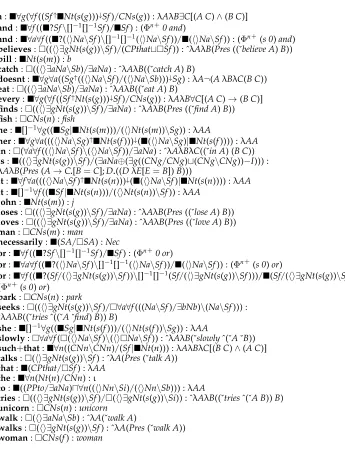
Montague lexicon was as in Figure 14. The tests were executed in XGP Prolog on a MacBook Air. The running times in seconds for exhaustive parsing were as follows:
(41) clock3f1.2 (uniform) 36 k2 (focusing) 17
The tests for the minicorpus show that the focusing parsing/proof-search runs in half the time of the uniform parsing/proof-search.
We could have also made comparison with proof net parsing/theorem proving (Moot 2016), but our proposal includes additives for which proof nets are still an open question, and not just the displacement calculus multiplicatives, and the point of focalization is that it is a general methodology extendible to, for example, exponentials and other modalities also, for which proof nets are also still under investigation. That is, our focalization approach isscaleablein a way that proof nets currently are not, and in this sense comparison with proof nets is not quite appropriate.
Here we illustrate propagation of focused types in derivations with output of CatLog3. Note that in the derivations produced by CatLog the application of focusing rules is hidden, and derivations can terminate at an unfocused identity axiom (which is derivable by focusing and applying a focused identity axiom). Atomic types are given a reversible bias uniformly. We give an example of quantificational ambiguity involving discontinuous types, and examples of polymorphism of the copula including coordination of unlike types involving additive types. The lexicon is as follows:
and: ((((Nt(s(A))\Sf)/(NB⊕(CNC/CNC)))\(Nt(s(A))\Sf))\(((Nt(s(A))\Sf)/(NB⊕(CNC/CNC)))\ (Nt(s(A))\Sf)))/(((Nt(s(A))\Sf)/(NB⊕(CNC/CNC)))\(Nt(s(A))\Sf)) :
λDλEλFλG[((E F)G)∧((D F)G)]
Cicero:Nt(s(m)) :c
everyone: (SA↑Nt(s(B)))↓SA:λC∀D[(person D)→(C D)]
humanist:CNA/CNA:λBλC[(B C)∧(humanist C)]
is: (Nt(s(A))\Sf)/(NB⊕(CNC/CNC)) :λDλE(D→F.[E=F];G.((GλH[H=E])E))
loves: (Nt(s(A))\Sf)/NB:love
someone: (SA↑Nt(s(B)))↓SA:λC∃D[(person D)∧(C D)]
The (classical) quantification example is: (foc(1))everyone+loves+someone:Sf For this lexical lookup yields:
(SA↑Nt(s(B)))↓SA:λC∀D[(person D)→(C D)],
(Nt(s(E))\Sf)/NF:love, (SG↑Nt(s(H)))↓SG:λI∃J[(person J)∧(I J)] ⇒ Sf
a:∀g(∀f((Sf↑Nt(s(g)))↓Sf)/CNs(g)) :λAλB∃C[(A C)∧(B C)] and:∀f((?Sf\[]−1[]−1Sf)/
Sf) : (Φn+ 0 and) and:∀a∀f((?(hiNa\Sf)\[]−1[]−1(hiNa\Sf))/
(hiNa\Sf)) : (Φn+
(s 0)and) believes:((hi∃gNt(s(g))\Sf)/(CPthattSf)) : ˆλAλB(Pres((ˇbelieve A)B)) bill:Nt(s(m)) :b
catch:((hi∃aNa\Sb)/∃aNa) : ˆλAλB((ˇcatch A)B)
doesnt:∀g∀a((Sg↑((hiNa\Sf)/(hiNa\Sb)))↓Sg) :λA¬(AλBλC(B C)) eat:((hi∃aNa\Sb)/∃aNa) : ˆλAλB((ˇeat A)B)
every:∀g(∀f((Sf↑Nt(s(g)))↓Sf)/CNs(g)) :λAλB∀C[(A C)→(B C)] finds:((hi∃gNt(s(g))\Sf)/∃aNa) : ˆλAλB(Pres((ˇfind A)B)) fish:CNs(n) :fish
he:[]−1∀g((Sg|Nt(s(m)))/(hiNt(s(m))\Sg)) :λAA
her:∀g∀a(((hiNa\Sg)↑Nt(s(f)))↓((hiNa\Sg)|Nt(s(f)))) :λAA in:(∀a∀f((hiNa\Sf)\(hiNa\Sf))/∃aNa) : ˆλAλBλC((ˇin A) (B C)) is:((hi∃gNt(s(g))\Sf)/(∃aNa⊕(∃g((CNg/CNg)t(CNg\CNg))−I))) : λAλB(Pres(A→C.[B=C];D.((DλE[E=B])B)))
it:∀f∀a(((hiNa\Sf)↑Nt(s(n)))↓((hiNa\Sf)|Nt(s(n)))) :λAA it:[]−1∀f((Sf|Nt(s(n)))/(hiNt(s(n))\Sf)) :λAA
john:Nt(s(m)) :j
loses:((hi∃gNt(s(g))\Sf)/∃aNa) : ˆλAλB(Pres((ˇlose A)B)) loves:((hi∃gNt(s(g))\Sf)/∃aNa) : ˆλAλB(Pres((ˇlove A)B)) man:CNs(m) :man
necessarily:(SA/SA) :Nec
or:∀f((?Sf\[]−1[]−1Sf)/
Sf) : (Φn+0 or) or:∀a∀f((?(hiNa\Sf)\[]−1[]−1(hiNa\Sf))/
(hiNa\Sf)) : (Φn+(s 0)or) or:∀f((?(Sf/(hi∃gNt(s(g))\Sf))\[]−1[]−1(Sf/(hi∃gNt(s(g))\Sf)))/
(Sf/(hi∃gNt(s(g))\Sf))) : (Φn+
(s 0)or) park:CNs(n) :park
seeks:((hi∃gNt(s(g))\Sf)/∀a∀f(((Na\Sf)/∃bNb)\(Na\Sf))) : ˆλAλB((ˇtriesˆ((ˇAˇfind)B))B)
she:[]−1∀g((Sg|Nt(s(f)))/(hiNt(s(f))\Sg)) :λAA
slowly:∀a∀f((hiNa\Sf)\(hiNa\Sf)) : ˆλAλB(ˇslowlyˆ(ˇAˇB)) such+that:∀n((CNn\CNn)/(Sf|Nt(n))) :λAλBλC[(B C)∧(A C)] talks:(hi∃gNt(s(g))\Sf) : ˆλA(Pres(ˇtalk A))
that:(CPthat/Sf) :λAA
the:∀n(Nt(n)/CNn) :ι
to:((PPto/∃aNa)u∀n((hiNn\Si)/(hiNn\Sb))) :λAA
tries:((hi∃gNt(s(g))\Sf)/(hi∃gNt(s(g))\Si)) : ˆλAλB((ˇtriesˆ(ˇA B))B) unicorn:CNs(n) :unicorn
walk:(hi∃aNa\Sb) : ˆλA(ˇwalk A)
[image:30.486.52.397.182.633.2]walks:(hi∃gNt(s(g))\Sf) : ˆλA(Pres(ˇwalk A)) woman:CNs(f) :woman
Figure 14
There is the wide-scope object derivation:
Nt(s(A)) ⇒ Nt(s(A))
Nt(s(A)) ⇒ Nt(s(A)) Sf ⇒ Sf
\L
Nt(s(A)), Nt(s(A))\Sf ⇒ Sf /L Nt(s(A)), (Nt(s(A))\Sf)/Nt(s(B)) ,Nt(s(B)) ⇒ Sf
↑R
1, (Nt(s(A))\Sf)/Nt(s(B)),Nt(s(B)) ⇒ Sf↑Nt(s(A)) Sf ⇒ Sf
↓L
(Sf↑Nt(s(A)))↓Sf , (Nt(s(A))\Sf)/Nt(s(B)),Nt(s(B)) ⇒ Sf
↑R
(Sf↑Nt(s(A)))↓Sf, (Nt(s(A))\Sf)/Nt(s(B)),1 ⇒ Sf↑Nt(s(B)) Sf ⇒ Sf
↓L
(Sf↑Nt(s(A)))↓Sf, (Nt(s(A))\Sf)/Nt(s(B)), (Sf↑Nt(s(B)))↓Sf ⇒ Sf
∃B[(person B)∧ ∀E[(person E)→((love B)E)]]
And the wide-scope subject derivation:
Nt(s(A)) ⇒ Nt(s(A))
Nt(s(A)) ⇒ Nt(s(A)) Sf ⇒ Sf
\L
Nt(s(A)), Nt(s(A))\Sf ⇒ Sf /L Nt(s(A)), (Nt(s(A))\Sf)/Nt(s(B)) ,Nt(s(B)) ⇒ Sf
↑R
Nt(s(A)), (Nt(s(A))\Sf)/Nt(s(B)),1 ⇒ Sf↑Nt(s(B)) Sf ⇒ Sf
↓L
Nt(s(A)), (Nt(s(A))\Sf)/Nt(s(B)), (Sf↑Nt(s(B)))↓Sf ⇒ Sf
↑R
1, (Nt(s(A))\Sf)/Nt(s(B)), (Sf↑Nt(s(B)))↓Sf ⇒ Sf↑Nt(s(A)) Sf ⇒ Sf
↓L
(Sf↑Nt(s(A)))↓Sf , (Nt(s(A))\Sf)/Nt(s(B)), (Sf↑Nt(s(B)))↓Sf ⇒ Sf
∀B[(person B)→ ∃E[(person E)∧((love E)B)]]
The weak polymorphism of the copula with respect to nominal and adjectival comple-ments is illustrated as follows.
(foc(2))Tully+is+Cicero:Sf
Nt(s(m)) :t, (Nt(s(A))\Sf)/(NB⊕(CNC/CNC)) :λDλE(D→F.[E=
F];G.((GλH[H=E])E)),Nt(s(m)) :c ⇒ Sf
Nt(s(m))
⇒
Nt(s(m))⊕
R Nt(s(m))⇒
Nt(s(m))⊕
(CNA/
CNA)Nt(s(m))
⇒
Nt(s(m)) Sf⇒
Sf\
L Nt(s(m)), Nt(s(m))\
Sf⇒
Sf[t=c]
(foc(3))Tully+is+humanist:Sf
Nt(s(m)) :t, (Nt(s(A))\Sf)/(NB⊕(CNC/CNC)) :λDλE(D→F.[E=
F];G.((GλH[H=E])E)),CNI/CNI:λJλK[(J K)∧(humanist K)] ⇒ Sf
CNA
⇒
CNA
CNA
⇒
CNA
/
L
CNA
/
CNA
,
CNA
⇒
CNA
/
R
CNA
/
CNA
⇒
CNA
/
CNA
⊕
R
CNA
/
CNA
⇒
NB
⊕
(CNA
/
CNA)
Nt(s(m))
⇒
Nt(s(m))
Sf
⇒
Sf
\
L
Nt(s(m)),
Nt(s(m))
\
Sf
⇒
Sf
/
L
Nt(s(m)), (Nt(s(m))
\
Sf
)
/
(NA
⊕
(CNB
/
CNB)) ,
CNB
/
CNB
⇒
Sf
(humanist t)
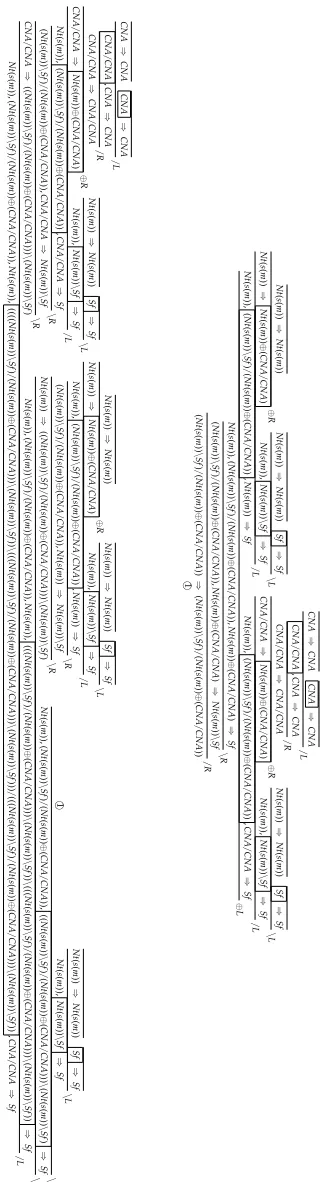
Finally, the presence of such polymorphism in the coordination of unlike types (Bayer 1996; Morrill 1990) is illustrated by the following; the derivation is fragmented in two parts in Figure 15.
(foc(4))Tully+is+Cicero+and+humanist:Sf
Nt(s(m)) :t, (Nt(s(A))\Sf)/(NB⊕(CNC/CNC)) :λDλE(D→F.[E=
F];G.((GλH[H=E])E)),Nt(s(m)) :c, ((((Nt(s(I))\Sf)/(NJ⊕(CNK/CNK)))\ (Nt(s(I))\Sf))\(((Nt(s(I))\Sf)/(NJ⊕(CNK/CNK)))\(Nt(s(I))\Sf)))/
(((Nt(s(I))\Sf)/(NJ⊕(CNK/CNK)))\(Nt(s(I))\Sf)) :λLλMλNλO[((M N)O)∧ ((L N)O)],CNP/CNP:λQλR[(Q R)∧(humanist R)] ⇒ Sf
[[t=c]∧(humanist t)] 8. Conclusion
We have claimed that just as the parse structures of context free grammar are ordered trees, the parse structures of categorial grammar are proof nets. Thus, just as we think of context free algorithms as finding ordered trees, bottom–up, top–down, and so forth, we can think of categorial algorithms as finding proof nets. The complication is that proof nets are much more sublime objects than ordered trees: They embody not only syntactic coherence but also semantic coherence. Focalization is a step on the way to eliminating spurious ambiguity by building such proof nets systematically. A further step on the way, eliminating all spurious ambiguity, would be multifocusing. This remains a topic for future study. Another topic for further study in focusing is the question of which assignments of bias are favorable for the processing of given lexica/corpora.
Alternatively, for context free grammar one can perform chart parsing, or tabular-ization, and at least for the basic case of Lambek calculus suitable notions of proof net also support tabularization (Morrill 1996; de Groote 1999; Pentus 2010; Kanovich et al. 2017). This also remains a topic for future study.
Appendix A. Cut Elimination in DAfoc
We prove this by induction on the complexity (d,h) of topmost instances ofCut, where d is the size11 of the cut formula andh is the length of the Cut-free derivation above the Cut rule. There are four cases to consider: Cut with axiom in the minor premise, Cut with axiom in the major premise, principal Cuts, and permutation conversions. In each case, the complexity of the Cut is reduced. In order to save space, we will not be exhaustively showing all the cases because many follow the same pattern. In particular, for any irreversible logical rule there are always four cases to consider corresponding to the polarity of the subformulas. In the following, we will show only one representative example. Concerning continuous and discontinuous formulas, we will show only the discontinuous cases (discontinuous